Overview: The Scalability Dilemma and the Evolution to Elastic Networks
The progression of Ethereum scaling has witnessed a fundamental paradigm transition. Early scalability efforts concentrated on monolithic execution layer optimizations, which were quickly superseded by modular Layer 2 rollups. By shifting transaction execution off-chain while anchoring cryptographic proofs and data availability to Ethereum Layer 1, rollups delivered substantial transaction throughput gains and fee reductions. However, as the number of independent rollups multiplied, a new systemic friction emerged: ecosystem fragmentation. Independent Layer 2 networks operate with isolated state spaces, fragmented liquidity pools, fragmented developer tooling, and insecure third-party cross-chain bridges that introduce substantial counterparty and smart contract exploit risks.
To overcome this fragmentation without sacrificing sovereignty or security, Matter Labs engineered the ZKsync Elastic Chain. Unveiled as the architectural evolution of ZKsync Era, the Elastic Chain is an interconnected cluster of zero-knowledge rollups, validiums, and enterprise chains known collectively as Hyperchains. Built upon an open-source, modular framework designated the ZK Stack, the Elastic Chain functions as a unified cryptographic network where independent blockchains interoperate seamlessly with sub-second cross-chain messaging, shared liquidity, and mathematically verified trust-minimized security anchored to Ethereum.
Unlike multi-chain ecosystems that depend on federated multi-signature bridges or centralized relays, the Elastic Chain enforces cross-chain validity through recursive zero-knowledge proofs. By standardizing cryptographic state transitions, transaction formats, and bridge settlement contracts across all participating networks, the Elastic Chain aims to replicate the frictionless user experience of the traditional internet while preserving the decentralized, censorship-resistant guarantees of Ethereum Layer 1.
The ZK Stack Framework: Modular Hyperchain Architecture
At the foundation of the Elastic Chain is the ZK Stack, a modular, open-source software development kit (SDK) engineered for deploying sovereign, customizable Hyperchains. The framework allows developers to tailor core blockchain parameters to specific use cases while maintaining native interoperability with every other chain in the network.
Customizable Execution and State Models
The ZK Stack provides modular interfaces across key layers of blockchain infrastructure:
- Execution Environment: Hyperchains execute bytecode inside an optimized virtual machine (zkEVM) that maintains native compatibility with Ethereum smart contracts written in Solidity and Vyper. Developers can configure execution parameters, such as block gas limits and transaction execution time slices, without modifying the underlying cryptographic primitives.
- Custom Gas and Settlement Tokens: While ZKsync Era utilizes native ETH for transaction fees, Hyperchains built with the ZK Stack can define sovereign gas tokens. A gaming or enterprise Hyperchain can designate its native utility token as the base gas currency, while the underlying settlement layer programmatically converts fees into ETH to pay for Layer 1 verification and data availability costs.
- Privacy and Permissioning Tiers: Enterprise and institutional builders can deploy permissioned Hyperchains with restricted validator sets or private transaction access rules. Because these chains generate standard zero-knowledge proofs, they can verify state integrity and settle transactions to the broader public network without revealing private business logic or account balances.
Unified Settlement Contract Architecture
Every Hyperchain deployed through the ZK Stack anchors its state transitions to a standardized shared bridge contract deployed on Ethereum Layer 1, known as the Diamond Proxy or Bridgehub. This unified smart contract registry acts as the source of truth for all Hyperchains, tracking valid state roots, verifying cryptographic proofs, and maintaining custody of cross-chain collateral. By routing all inter-chain settlements through a single, audited base layer interface, the ZK Stack eliminates the fragmented smart contract interfaces that historically plagued multi-rollup architectures.
The Boojum Prover: High-Throughput STARK-to-SNARK Recursive Cryptography
Zero-knowledge rollups depend on the performance and computational efficiency of their cryptographic proving engines. In early iterations of ZK-rollups, proof generation was bottlenecked by memory-intensive SNARK provers requiring high-end data center clusters with specialized hardware. Matter Labs overhauled this cryptographic pipeline with Boojum, a cutting-edge proving system engineered for extreme computational throughput, low memory overhead, and commodity hardware execution.
Goldilocks Field Arithmetic and Vectorized Execution
Boojum is built upon a high-performance STARK (Scalable Transparent Argument of Knowledge) foundation operating over the Goldilocks field. The Goldilocks field is a specialized prime field defined by the prime modulus p = 2^64 - 2^32 + 1:
- Native 64-Bit CPU and GPU Harmony: Because the prime modulus fits comfortably within standard 64-bit machine words, modern CPU and GPU registers can execute field additions, multiplications, and Montgomery reductions natively in single-digit clock cycles without multi-word precision overhead.
- Hardware Democratization: By minimizing RAM utilization and eliminating heavy elliptic curve operations during initial execution proving, Boojum can generate cryptographic proofs on consumer-grade graphics processing units (GPUs) with as little as 16 gigabytes of VRAM. This low hardware threshold decentralizes proof generation, enabling community operators to participate in network proving rather than centralizing operations in enterprise cloud providers.
- Fast Algebraic Hashing: Boojum integrates algebraic cryptographic hash functions, such as Poseidon2 and Rescue-Prime, which are mathematically structured to maximize performance inside arithmetic circuits while minimizing proof generation latencies.
Recursive STARK-to-SNARK Compression Pipeline
While STARK proofs provide fast generation speeds and quantum-resistant mathematical foundations, raw STARK proofs are computationally bulky, often spanning hundreds of kilobytes. Verifying a raw STARK proof directly on Ethereum Layer 1 would incur prohibitive gas costs.
Boojum resolves this through a multi-tiered recursive compression pipeline:
- Tier 1 (Block-Level STARKs): As transactions execute on a Hyperchain, Boojum generates lightweight STARK proofs for individual computational circuits, verifying opcode execution, memory accesses, and state trie modifications.
- Tier 2 (Recursive STARK Aggregation): Multiple block-level STARK proofs are aggregated recursively into an intermediate STARK proof. This intermediate proof proves the mathematical correctness of dozens of constituent proofs in a single cryptographic statement.
- Tier 3 (Final SNARK Wrapper): Before publishing to Ethereum Layer 1, the aggregated STARK proof is wrapped inside a succinct SNARK proof (such as a PLONK or Groth16 circuit over the BN254 elliptic curve). The resulting SNARK proof is remarkably compact (under one kilobyte) and can be verified on Ethereum Layer 1 for approximately 200,000 to 300,000 gas, regardless of the thousands of underlying transactions contained in the batch.
Interoperability Infrastructure: Inter-Hyperchain Communication via ZK Gateway and Shared Routers
The primary architectural differentiator of the Elastic Chain is its trust-minimized, native interoperability. Traditional cross-chain communication relies on centralized relays, multi-signature attestations, or optimistic fraud-proof windows that introduce multi-hour to multi-day transfer delays. The Elastic Chain resolves this through cryptographic settlement contracts and a dedicated coordination protocol known as the ZK Gateway.
The ZK Gateway Coordination Protocol
The ZK Gateway is a decentralized middleware layer that coordinates state synchronization and proof aggregation across all participating Hyperchains:
- Cross-Chain Message Routing: When a user or smart contract on Hyperchain A initiates a transaction destined for Hyperchain B, the outgoing message is committed to Hyperchain A's local state trie. The ZK Gateway routes the inclusion proof across the network, validating that the transaction was finalized in a verified state root.
- Unified Proof Batching: Rather than each individual Hyperchain submitting separate proofs to Ethereum Layer 1 and incurring individual verification fees, the ZK Gateway aggregates proofs from multiple Hyperchains into a single consolidated cryptographic proof. This shared batching amortizes Layer 1 gas costs across the entire network, lowering settlement expenses for smaller, specialized chains.
- Light-Client State Relay: Replicas and node operators run lightweight state monitoring routines that verify cryptographic headers forwarded by the ZK Gateway, guaranteeing real-time cross-chain awareness without requiring full-node replication of every connected chain.
Shared Liquidity and Asynchronous Atomic Composability
Because all Hyperchains share a common Bridgehub contract on Ethereum Layer 1, collateral deposited into the ecosystem is not fragmented across disparate smart contract silos:
- Unified Collateral Pool: When native assets (such as ETH or ERC-20 tokens) are bridged into the Elastic Chain, they are held in the common Layer 1 Bridgehub contract. Hyperchains mint wrapped representations with 1:1 mathematical backing verified by zero-knowledge state proofs.
- Trust-Minimized Asset Migration: Assets can move between Hyperchain A and Hyperchain B without unwinding back to Ethereum Layer 1. The source chain burns the asset, the ZK Gateway verifies the cryptographic burn event, and the destination chain mints the corresponding asset locally, completing cross-chain value transfers in seconds.
- Asynchronous Call Execution: Smart contracts across different Hyperchains can invoke cross-chain functions asynchronously. While atomic composability within a single execution block remains local to a specific chain, the Elastic Chain enables deterministic multi-chain workflows where dependent transactions execute reliably once cross-chain inclusion proofs verify.
Protocol-Level Native Account Abstraction (Native AA)
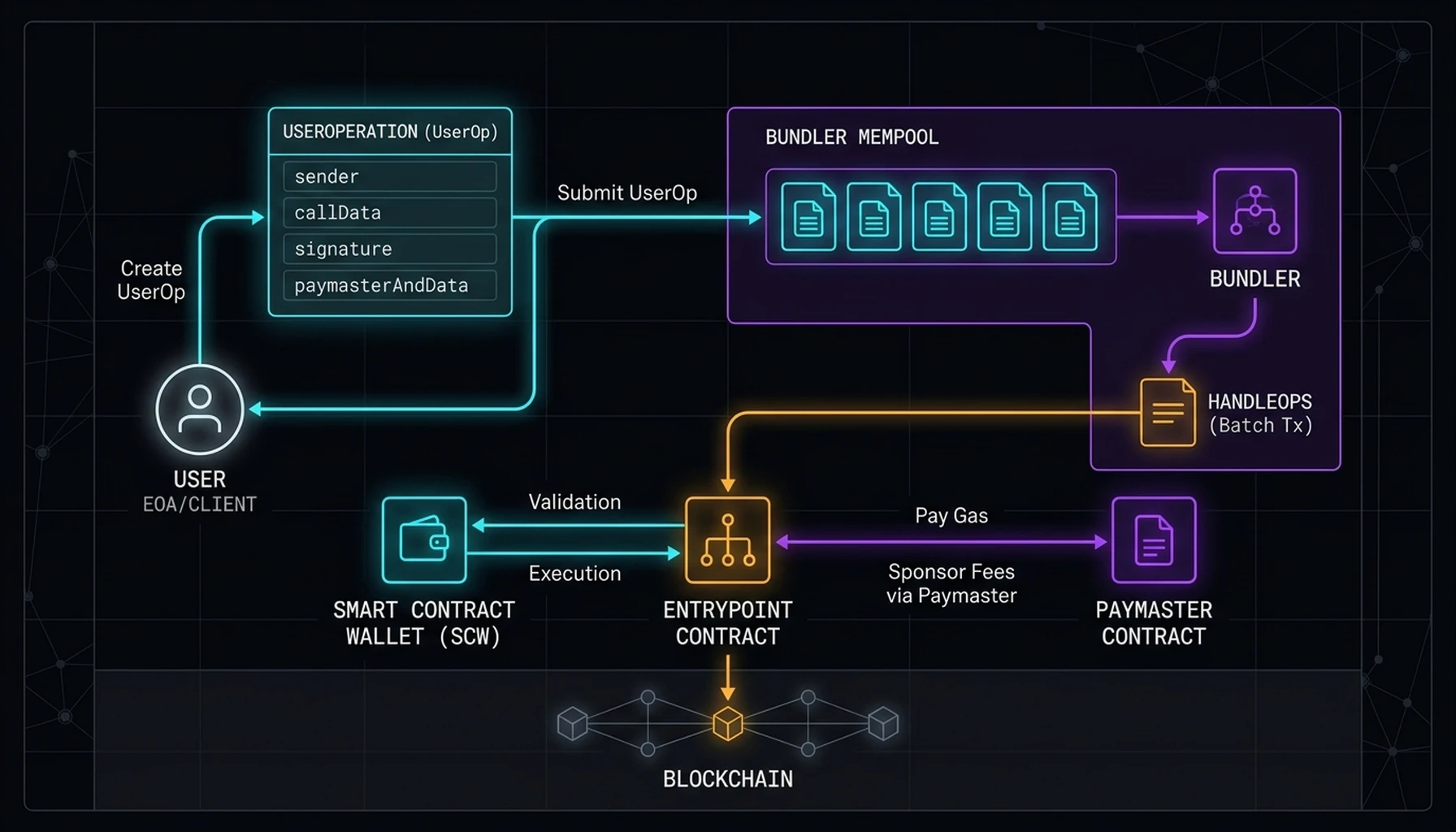
User experience in Web3 has historically been hindered by the limitations of Externally Owned Accounts (EOAs), requiring users to manage complex seed phrases, hold native ETH for gas, and sign confusing hex strings. While Ethereum introduced ERC-4337 to enable smart contract wallets, it operates as an application-layer overlay requiring off-chain user operation bundlers and auxiliary entry-point contracts.
ZKsync engineered Account Abstraction directly into the protocol kernel (Native AA), treating every account on the network as a programmable smart contract:
The Bootloader Kernel Execution Model
In standard EVM clients, the distinction between EOAs and smart contracts is enforced at the core protocol level. In the ZKsync architecture, transactions are processed through a special system contract known as the Bootloader:
- Uniform Transaction Interface: All accounts, whether initiated by private key pairs or complex smart contracts, implement a standardized account interface (IAccount). The Bootloader processes all transactions identically: invoking a validation step (validateTransaction) followed by an execution step (executeTransaction).
- Flexible Signature Schemes: Because signature verification is programmed inside the account logic rather than hardcoded to ECDSA secp256k1 curves, accounts can implement alternative cryptographic algorithms, including WebAuthn passkeys (using biometric hardware like Apple Face ID or Touch ID), RSA signatures, and quantum-resistant signature schemes.
- Atomic Multi-Operation Batching: Users can execute multi-step workflows (such as approving an ERC-20 token allowance and executing an automated market maker swap) within a single atomic transaction, eliminating redundant gas fees and reducing signing interactions.
Paymaster Architecture for Gas Sponsorship and Multi-Token Fees
Native Account Abstraction includes integrated Paymaster support (IPaymaster), enabling comprehensive flexibility in fee payment:
- ERC-20 Gas Payment: Users can pay transaction fees directly using stablecoins (such as USDC or USDT) or project utility tokens. The Paymaster contract programmatically intercepts the fee, verifies liquidity or exchange rates with decentralized oracles, and converts the asset into the required base settlement currency.
- Sponsored Gas and Gasless Onboarding: Applications can subsidize transaction costs entirely for new users, removing the barrier of acquiring cryptocurrency before interacting with a decentralized application.
- Session Keys and Automated Permissions: Users can grant time-limited, rule-constrained session keys to gaming bots or automated trading algorithms, allowing them to execute predefined transactions without prompting the user for approval on each interaction.
Data Availability Strategies: Rollup Mode, Validiums, and Alternative DA Layers
Scaling a multi-chain ecosystem requires balanced data availability strategies. While zero-knowledge proofs mathematically guarantee that state transitions are valid, nodes still require access to underlying state data to construct the current world state, reconstruct balances, and generate new transactions.
Rollup Mode and State Diff Optimization
In traditional rollup mode, the sequencer publishes transaction data directly to Ethereum Layer 1, utilizing EIP-4844 blob storage:
- State Diff Publishing: Unlike optimistic rollups and older ZK-rollups that publish full transaction calldata (including signatures and transaction parameters), ZKsync publishes only state diffs: the net changes to storage slots at the end of a block. If a decentralized exchange pool experiences 10,000 trades within a batch, the rollup does not post 10,000 trade payloads to Ethereum; it posts only the updated token balances of the pool and traders. This compresses data availability requirements by up to 80% compared to raw calldata publishing.
- Maximum Ethereum Anchoring: Rollup mode provides the highest tier of security. Even if the entire sequencer and Hyperchain infrastructure disappears, users can reconstruct the entire blockchain state directly from Ethereum blobs and execute emergency withdrawals.
Validium Mode and External DA Integrations
For applications where transaction costs must remain fractions of a cent (such as high-frequency trading, social networks, and gaming), publishing data to Ethereum blobs can still be cost-prohibitive. The ZK Stack supports Validium modes and modular Data Availability layers:
- Data Availability Committees (DAC): In a Validium configuration, state diffs are stored off-chain by an independent committee of trusted nodes, while only the state root and cryptographic validity proof are published to Ethereum.
- Modular DA Layers (Celestia and EigenDA): Hyperchains can integrate dedicated modular data availability protocols like Celestia or EigenDA, securing high-throughput blob throughput at significantly lower operational costs while preserving decentralized availability guarantees.
Fee Mechanics, Execution Gas, and State Growth Economics
The economic engine of the Elastic Chain balances off-chain computation with on-chain settlement expenses:
- Two-Dimensional Fee Formula: Transaction costs are decomposed into two fundamental components: computational execution gas (measuring CPU instructions, memory allocations, and arithmetic circuit constraints inside the zkEVM) and data availability gas (measuring the byte footprint of the resulting state diff published to Ethereum Layer 1).
- Dynamic L1 Gas Price Tracking: The sequencer continuously tracks the base fee and blob gas price of Ethereum Layer 1. If Ethereum gas spikes during network congestion, the fee formula dynamically scales the L1 data cost component to prevent sequencer operating deficits.
- State Growth Mitigation: Because state diffs are priced according to storage slot modifications, the economic model penalizes unnecessary storage bloat while rewarding storage cleanup (such as zeroing storage slots to reclaim gas refunds).
Critical Engineering Challenges, Decentralization Vectors, and Trade-offs
A rigorous architectural assessment must objectively evaluate the operational challenges, engineering complexities, and governance vulnerabilities present in the Elastic Chain design.
Sequencer Centralization and Liveness Risks
In its current deployment phase, ZKsync Era and initial Hyperchains rely predominantly on centralized sequencer infrastructure operated by Matter Labs or designated node partners. If the primary sequencer suffers hardware failure, network disconnection, or database corruption, transaction processing halts immediately. While user funds remain cryptographically protected on Ethereum Layer 1 through escape hatches, sequencer downtime disrupts real-time application availability. Decentralizing the sequencer set across a Byzantine Fault Tolerant consensus network remains a vital milestone on the ZKsync technical roadmap.
Cryptographic Circuit Complexity and Prover Bugs
The Boojum proving system and zkEVM circuits represent an immense mathematical and software engineering achievement, comprising tens of thousands of lines of cryptographic code. Circuit bugs, constraint under-specification, or subtle arithmetic flaws could theoretically allow an adversary to construct a valid zero-knowledge proof for an invalid state transition. To mitigate this risk, the protocol undergoes continuous multi-firm security audits, maintains an active security council, and utilizes formal verification tools to prove circuit completeness.
Proof Generation Latency vs User Finality
While the sequencer provides instantaneous soft confirmation to users within hundreds of milliseconds, the complete cryptographic proving and Layer 1 verification cycle takes significantly longer. Generating recursive STARK proofs, wrapping them in a final SNARK, and settling on Ethereum Layer 1 typically requires minutes to hours depending on batch accumulation thresholds. Cross-chain bridges and financial institutions requiring absolute finality must account for this latency delta when coordinating high-value settlement flows.
Cross-Chain Asynchrony and Composability Boundaries
While the Elastic Chain facilitates frictionless asset transfers and asynchronous message routing, it does not provide synchronous atomic execution across distinct Hyperchains within a single block. If a decentralized application relies on synchronous multi-contract interactions (such as atomic arbitrage between two independent lending pools located on different Hyperchains), the transactions cannot be executed atomically across chain boundaries without specialized multi-chain sequencing infrastructure. Application developers must therefore adapt their smart contract architectures to handle asynchronous callbacks and multi-step state transitions.
Conclusion
The ZKsync Elastic Chain represents a technically sophisticated and ambitious solution to Ethereum's scalability and fragmentation challenges. By leveraging the modular ZK Stack framework, high-throughput Boojum recursive proving, native account abstraction, and a shared cryptographic settlement layer via the ZK Gateway, the Elastic Chain creates an ecosystem of sovereign Hyperchains that operate with the speed of independent networks and the unified security of Ethereum. As the protocol continues to decentralize its sequencer infrastructure and expand multi-chain proof aggregation, the Elastic Chain establishes a foundational technical architecture for enterprise-grade, privacy-preserving, and horizontally scalable decentralized computing.