Overview
Account Abstraction has long been regarded as one of the most vital milestones for decentralized application usability. Historically, users on Ethereum interacted with the blockchain via Externally Owned Accounts (EOAs), which couple cryptographic key pairs directly with user accounts. ERC-4337 introduces account abstraction entirely at the application layer without requiring consensus-level protocol changes to the underlying Ethereum execution layer.
The Structural Limits of Externally Owned Accounts (EOAs)
Traditional Ethereum accounts suffer from structural rigidity that hampers mainstream user adoption:
- Single Point of Failure: The loss or exposure of a single private key permanently compromises all associated assets.
- Mandatory Native Gas Asset: Transactions must be funded with native ETH, creating friction for users holding ERC-20 tokens or stablecoins.
- Sequential Execution: Every on-chain action requires an independent transaction signature, preventing atomic batching of token approvals and contract calls.
- Limited Signature Schemes: EOAs are constrained exclusively to ECDSA signatures on the secp256k1 elliptic curve.
The ERC-4337 Modular Architecture
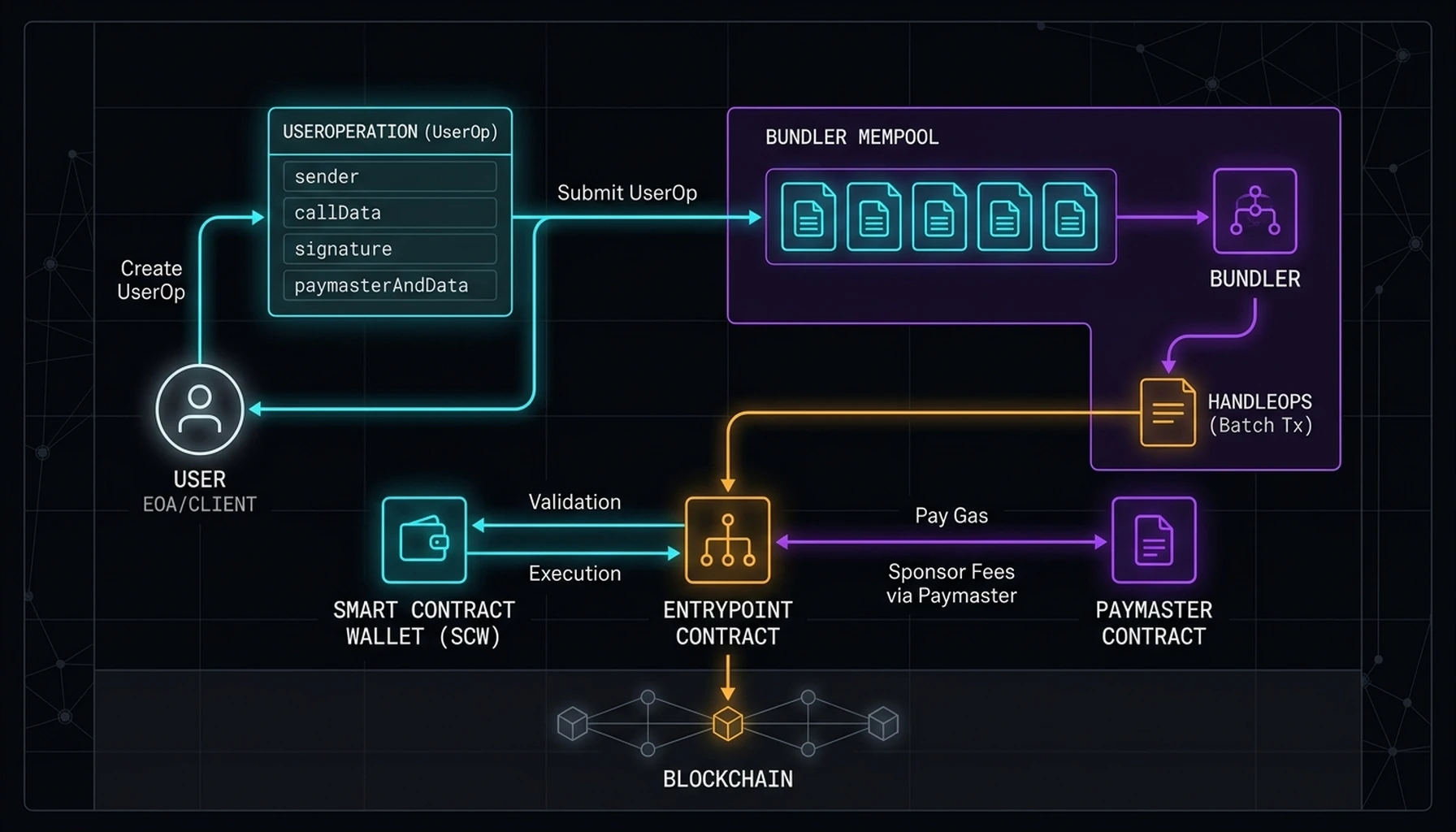
ERC-4337 circumvents consensus changes by constructing a decentralized pseudo-mempool operated by specialized actors called Bundlers. The architecture consists of four distinct architectural components:
- UserOperation (UserOp): A higher-level transaction structure containing intent data, sender contract address, gas limits, signature payload, and optional paymaster parameters.
- Bundler: A specialized node that monitors the UserOperation mempool, validates UserOps via simulation, and packages valid operations into a single standard Ethereum transaction.
- EntryPoint Contract: A singleton, audited smart contract that orchestrates the verification and execution loop for bundled UserOperations across all accounts.
- Smart Contract Wallet (SCW): The programmable account on-chain that exposes validateUserOp and executeUserOp interfaces to authorize and execute transactions.
Paymasters and Flexible Gas Mechanics
One of the most consequential capabilities enabled by ERC-4337 is the Paymaster entity. Paymasters are smart contracts that sponsor transaction gas fees or allow users to pay gas in arbitrary ERC-20 tokens:
- Sponsored Transactions: Decentralized applications can subsidize onboarding transactions for new users, removing gas friction entirely.
- ERC-20 Gas Payment: A paymaster can accept USDC, DAI, or custom tokens from the user's smart wallet, exchange the required value, and reimburse the EntryPoint contract in native ETH.
Architectural Trade-offs and Overhead
While ERC-4337 brings programmable security and flexible recovery logic, it introduces distinct engineering trade-offs:
- Gas Overhead: Validating signatures and executing transactions through a smart contract incurs higher gas consumption compared to a raw 21,000 gas EOA transfer.
- Simulation Constraints: Bundlers must simulate UserOperations under strict storage access rules to prevent denial-of-service vectors where a transaction invalidates previous mempool submissions.
- Mempool Fragmentation: The separation of standard mempools and UserOp mempools requires dedicated infrastructure and active bundler liquidity.
Conclusion
ERC-4337 represents a pragmatic, production-ready foundation for smart contract wallets on EVM chains. By shifting transaction verification into programmable smart contracts while preserving decentralized relaying, account abstraction bridges the usability gap without compromising decentralized network guarantees.