Overview
Solana is a high-performance Layer 1 blockchain engineered specifically for horizontal scalability, sub-second finality, and ultra-low transaction costs. Unlike modular blockchain architectures that offload execution to Layer 2 rollups, Solana optimizes every layer of its software stack to maximize execution performance directly on its base settlement layer.
The Core Innovation: Proof of History (PoH)
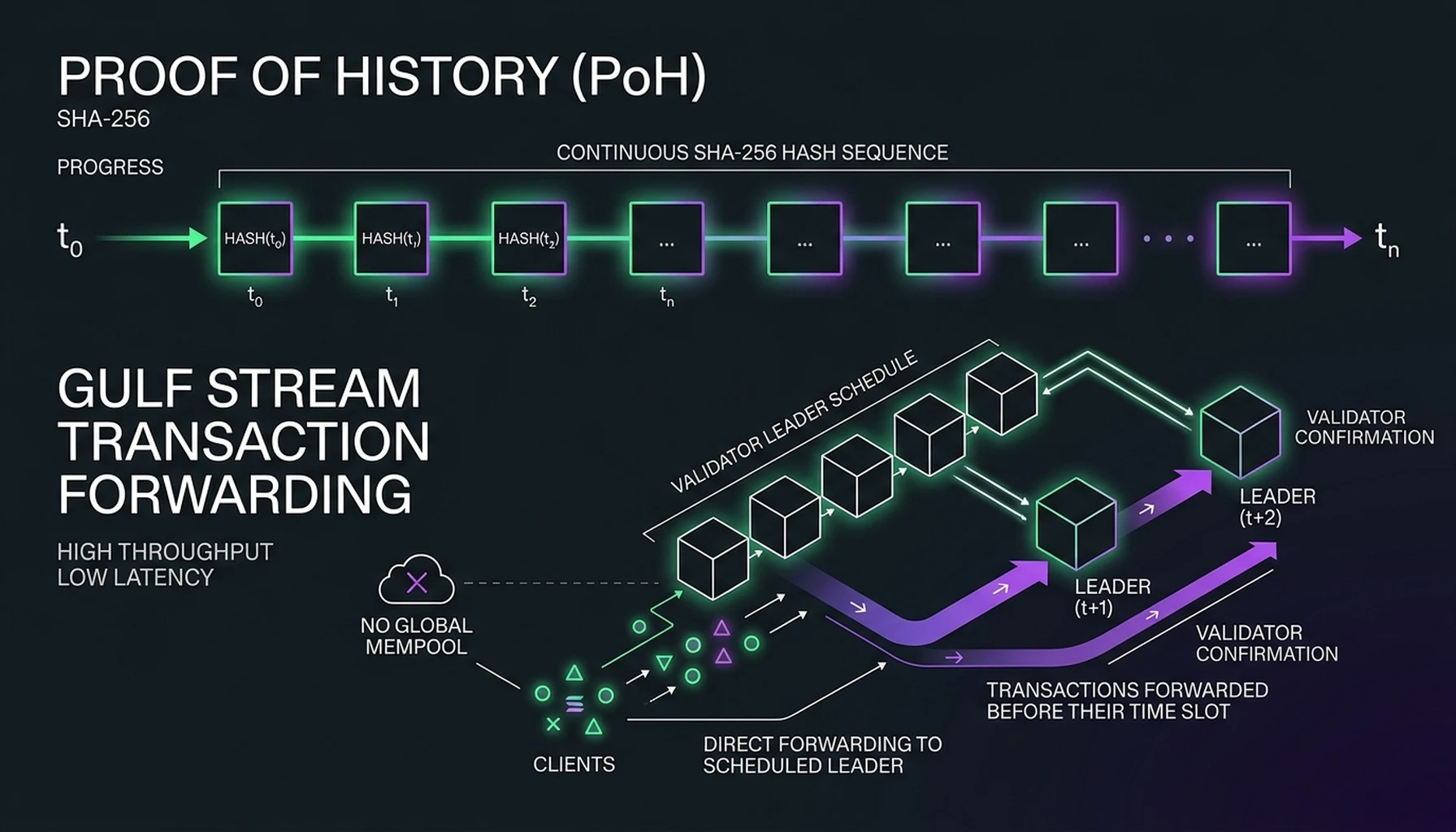
In distributed systems, establishing agreement on the passage of time without relying on a centralized clock is a fundamental challenge. Solana solves this with Proof of History (PoH):
- Sequential Hashing: PoH is a Verifiable Delay Function (VDF) implemented as a continuous SHA-256 hash chain where each hash output serves as the input to the next iteration.
- Cryptographic Timestamping: Events and transactions are hashed into the sequence, proving cryptographically that a piece of data existed before a subsequent hash was computed.
- Decoupled Consensus: Because validators receive a deterministic record of time within the data stream itself, they can verify state transitions without waiting for synchronous round-trip network acknowledgments.
Gulf Stream and Mempool-Less Architecture
Traditional blockchains rely on global mempools where pending transactions wait for block producers to select and sequence them. Solana eliminates the public mempool bottleneck using Gulf Stream:
- Deterministic Leader Schedule: The validator network generates a deterministic leader schedule across predefined epochs.
- Speculative Forwarding: Clients and RPC gateways push signed transactions directly to the upcoming leader validators ahead of their scheduled slot, reducing memory pressure and transaction latency.
- Rapid Pipeline Execution: Leaders stream transaction shreds to downstream validators as soon as they are processed, enabling continuous verification rather than batched block validation.
Sealevel Parallel Execution Engine
Solana utilizes Sealevel, a parallelized runtime built with Rust and the Berkeley Packet Filter (BPF) bytecode standard:
- Explicit State Declarations: Every Solana transaction explicitly lists which accounts it reads from and writes to prior to execution.
- Concurrent State Transitions: Non-overlapping transactions execute simultaneously across multi-core processors, scaling throughput with available hardware parallel processing power.
- Localized Fee Markets: State contention on a single smart contract (such as a popular NFT mint) does not congest unrelated decentralized applications operating on separate state partitions.
SOL Tokenomics and Network Incentives
The native asset, SOL, serves three core network functions: gas fee settlement, staking security, and on-chain governance:
- Staking and Validation: Token holders delegate SOL to validators participating in Tower BFT consensus, securing the network and receiving inflation rewards.
- Deflationary Fee Burn: A fixed 50 percent of every transaction fee is permanently burned, introducing deflationary counter-pressure that scales with network volume.
- Disinflationary Schedule: Network inflation started at approximately 8 percent annually and decreases by 15 percent each year until reaching a long-term terminal rate of 1.5 percent.
Technical Scrutiny and Trade-Offs
Achieving extreme throughput requires clear engineering compromises that remain focal points of technical scrutiny:
- Validator Hardware Demands: Operating a Solana validator requires enterprise-grade hardware (high clock-speed multi-core CPUs, minimum 128 GB RAM, and high-speed NVMe storage), raising barriers to individual home validation.
- Historical Network Halts: Early network iterations experienced halts during extreme transaction surges, necessitating upgrades like QUIC transport protocol integration, stake-weighted Quality of Service (QoS), and localized fee markets.
- State Growth and Rent Economics: High transactional frequency accelerates ledger growth, requiring active account rent models and distributed archival storage solutions.
Conclusion
Solana represents an uncompromising exploration of monolithic, hardware-accelerated blockchain design. By combining Proof of History with parallel runtime execution, it achieves throughput metrics that remain a benchmark for high-frequency decentralized finance and real-time consumer applications.