Overview: Scaling Ethereum via Validity Proofs
Ethereum's decentralized consensus imposes strict computational throughput constraints on its execution layer. Each full node in the network must redundantly re-execute every transaction to verify state transitions, establishing an inherent trade-off between decentralized node operation and transactional capacity. Zero-knowledge rollups resolve this structural bottleneck through validity proofs: computation is performed off-chain by specialized provers, while succinct cryptographic proofs verifying the mathematical correctness of state updates are verified on-chain by Ethereum smart contracts.
Starknet is a permissionless validity rollup (ZK-Rollup) operating as a Layer 2 network over Ethereum. Developed by StarkWare, Starknet distinguishes itself from other rollups through its exclusive reliance on STARKs (Scalable Transparent Arguments of Knowledge) and the Cairo Virtual Machine. By abandoning standard EVM byte-code execution in favor of an algebraic RISC architecture, Starknet enables verifiable computation with polylogarithmic verification complexity, native account abstraction, and quantum-resistant cryptographic assumptions.
Cryptographic Foundation: STARKs vs. SNARKs
Zero-knowledge proof systems in distributed networks broadly divide into SNARKs (Succinct Non-Interactive Arguments of Knowledge) and STARKs. While SNARKs dominate early privacy and scaling implementations due to compact proof sizes, STARKs introduce distinct architectural properties essential for high-throughput scaling.
Elimination of the Trusted Setup Ceremony
Traditional SNARK constructions (such as Groth16) require a trusted setup phase, colloquially termed a ceremony, to generate structured reference strings (toxic waste). If the cryptographic secrets generated during this ceremony are compromised or collusively retained, malicious actors could forge invalid proofs without detection. STARKs are entirely transparent: they utilize publicly verifiable randomness generated via the Fiat-Shamir heuristic, eliminating trusted setups and neutralizing systemic parameter compromise risks.
Post-Quantum Collision-Resistant Cryptography
SNARKs rely on elliptic curve pairings and discrete logarithm hardness assumptions, rendering them theoretically vulnerable to Shor's algorithm on sufficiently scaled quantum hardware. In contrast, STARKs rely exclusively on collision-resistant cryptographic hash functions (such as Poseidon, Rescue, and Blake) and information-theoretic arguments. This construction provides mathematical post-quantum security guarantees while maintaining high prover throughput.
Polylogarithmic Proof Verification
STARK proof generation time scales quasi-linearly with computational trace length (O(N log^2 N)), while verification time and proof verification gas consumption on Ethereum scale polylogarithmically (O(log^2 N)). Consequently, as Starknet aggregates larger batches of transactions into a single execution trace, the amortized verification cost per individual transaction approaches near-zero on Layer 1.
Cairo Virtual Machine: Algebraic Computation and Sierra
General-purpose execution environments like the EVM are structurally inefficient for cryptographic proof generation because EVM opcodes operate over 256-bit machine words that do not align with prime-field arithmetic. Starknet circumvents this limitation through Cairo, a Turing-complete virtual machine designed specifically for provable programs.
The Cairo Architecture for Inspecting Runtimes Over an AIR
The Cairo CPU is an algebraic RISC machine operating over a large prime field (traditionally 2^251 + 17 * 2^192 + 1). The architecture utilizes only three core machine registers:
- Program Counter (pc): Points to the memory address of the instruction currently being executed.
- Allocation Pointer (ap): Points to the next free, unallocated cell in contiguous memory.
- Frame Pointer (fp): Stores the execution frame base address for subroutine function calls and local variables.
Crucially, Cairo memory is non-deterministic and strictly read-only: once a memory cell is assigned a value during execution trace generation, its content is immutable. This single-assignment memory model maps cleanly to polynomial equations without requiring complex dynamic memory arbitration logic in the Algebraic Intermediate Representation (AIR).
Sierra: Guaranteeing Provability and Neutralizing DoS Attacks
In decentralized rollups, provers must be economically compensated for computational cycles expended when executing transactions. In early iterations, a reverted transaction caused an execution failure that could not produce a valid cryptographic proof. Consequently, malicious users could submit failing transactions that consumed sequencer compute time without paying gas fees, exposing the network to denial-of-service (DoS) attacks.
Starknet resolved this challenge by introducing Sierra (Safe Intermediate Execution-Ready Assembly), an intermediate representation positioned between high-level Cairo code and low-level Cairo assembly:
- Sierra verifies that every legal instruction stream is deterministically provable, even when runtime assertion errors occur.
- Failed operations return a boolean execution flag rather than an unprovable panic, enabling the sequencer to construct a valid STARK proof for reverted executions and deduct gas fees from the sender.
- Sierra acts as a compiler abstraction barrier, protecting users from compiler regressions while maintaining verifiable program execution.
The Prover Pipeline: From Stone to Stwo
Generating STARK proofs requires converting Cairo execution traces into low-degree polynomials and proving that these polynomials satisfy all boundary and transition constraints without revealing the underlying data.
SHARP (Shared Prover) and Stone Prover
Starknet transactions are aggregated and proven through StarkWare's Shared Prover (SHARP) architecture. Individual Starknet blocks and independent Cairo applications submit computational traces to SHARP, which compiles multiple execution paths into a unified execution trace. The Stone Prover (StarkWare's open-source C++ proving engine) executes polynomial interpolations, applies Low Degree Testing via the FRI protocol, and outputs a cryptographic proof submitted to Ethereum.
The FRI Protocol (Fast Reed-Solomon Interactive Oracle Proofs of Proximity)
The core mathematical engine of STARKs is the FRI protocol. FRI establishes that an committed polynomial vector is close to a genuine low-degree polynomial over an evaluation domain. By recursively folding evaluation domains in half across sequential rounds, FRI reduces the verification of thousands of algebraic constraints to a series of random Merkle authentication path checks, enabling rapid verification on Ethereum.
Stwo: Next-Generation Circle STARK Prover
To scale throughput and lower proving hardware costs, Starknet developed Stwo, a next-generation prover based on Circle STARKs over the Mersenne-31 prime field (M31 = 2^31 - 1):
- Traditional STARKs require 252-bit fields to prevent brute-force cryptographic attacks, demanding substantial RAM and arithmetic simulation overhead.
- Circle STARKs evaluate polynomials over the unit circle in a 31-bit field, aligning computation with standard 32-bit and 64-bit CPU vector registers (SIMD and AVX-512 extensions).
- Stwo delivers up to 100x acceleration in proof generation speeds compared to the first-generation Stone prover, dramatically reducing transaction latency and infrastructure overhead.
L1 Settlement and Ethereum Data Availability
The lifecycle of a Starknet state transition culminates in settlement on Ethereum Layer 1, providing immutable security and censorship resistance.
State Updates via State Diffs
Unlike optimistic rollups that publish all compressed transaction data and witness signatures to L1, Starknet publishes only state diffs. A state diff records the net balance and storage modifications resulting from a block batch rather than individual transaction signatures. If an account updates its balance five times within a block batch, only the final net state change is posted to Ethereum, significantly reducing data availability footprint.
EIP-4844 Blob Integration
Starknet utilizes Ethereum's EIP-4844 blob-carrying transactions to store state diffs. Blob storage provides short-term data availability (pruned by Ethereum nodes after approximately 18 days), lowering data posting expenses by over 90% compared to legacy calldata storage.
Native Account Abstraction Architecture
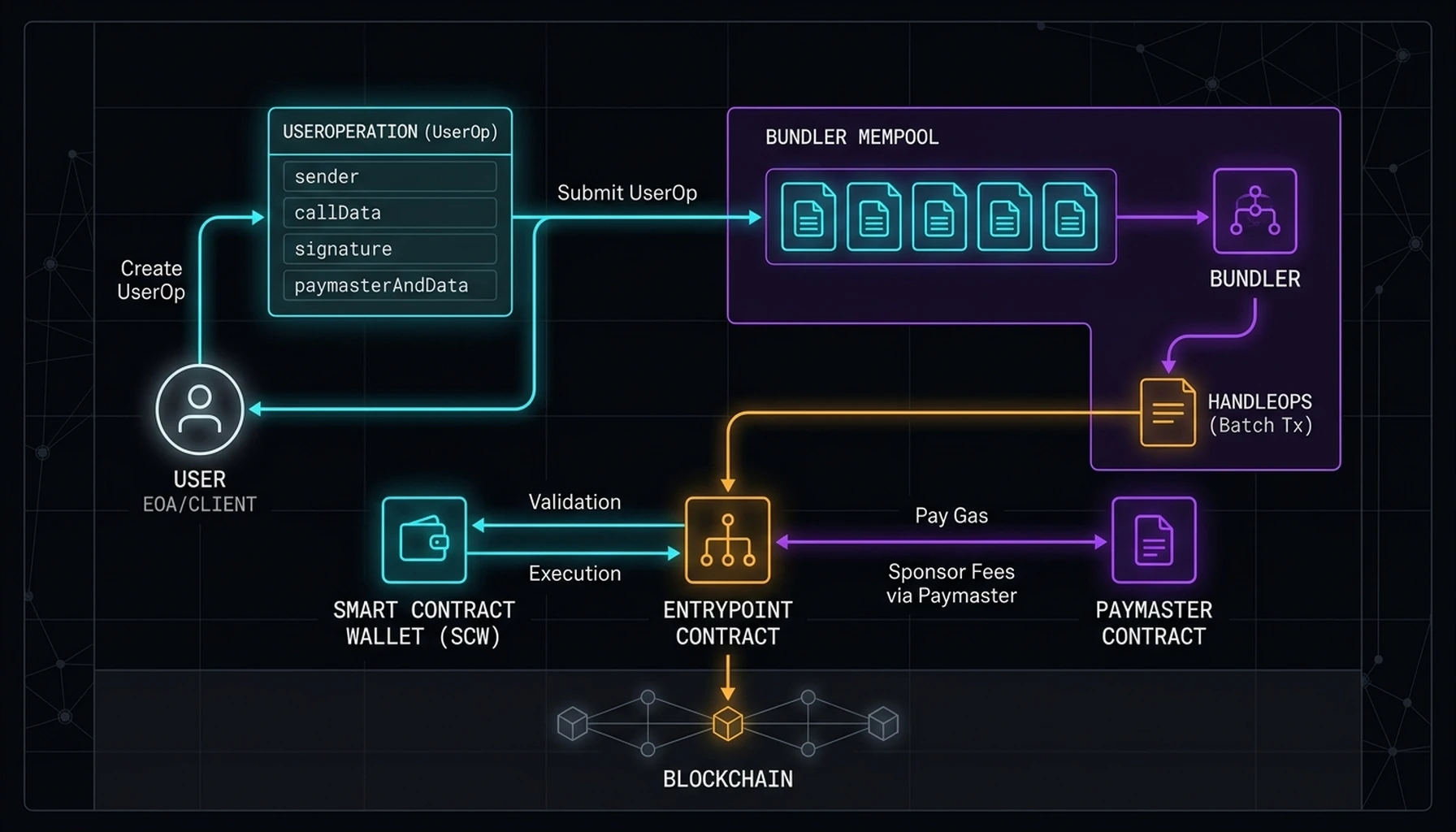
A primary architectural distinction between Starknet and standard EVM networks is the complete absence of Externally Owned Accounts (EOAs). On Ethereum, transactions must originate from a private-key-controlled EOA that pays gas in ETH using the ECDSA secp256k1 curve. On Starknet, every user account is deployed as an autonomous smart contract.
The Dual-Phase Execution Protocol
Starknet account contracts implement a standardized account interface defined by two primary entrypoints:
- __validate__: Verifies the caller's cryptographic authorization, nonce sequencing, and gas payment capability. If validation fails, the transaction is dropped before state changes execute.
- __execute__: Executes the substantive business logic, external contract calls, and asset transfers once validation succeeds.
Arbitrary Cryptographic Curve Support and WebAuthn
Because validation logic is executed within contract bytecode rather than hardcoded consensus rules, Starknet accounts can implement any cryptographic signature scheme:
- STARK Curve ECDSA: Highly efficient for native STARK proving pipelines.
- WebAuthn and Secp256r1: Allows users to create non-custodial wallets authenticated directly via biometric hardware (Apple TouchID, FaceID, and Android Passkeys) without installing browser extensions or managing paper seed phrases.
- Session Keys: Users can grant scoped, temporary signing permissions to gaming clients or automated trading bots, executing transactions within predefined spending limits without manual signature prompts.
Multicall Atomicity and Paymaster Sponsorship
Native account abstraction enables multicall transaction batching. A user can approve a token allowance and execute a decentralized swap within a single atomic transaction, eliminating redundant approval transactions. Additionally, Paymaster infrastructure enables third-party protocols to sponsor user transaction fees or accept gas payments in alternative assets (such as STRK or USDC).
STRK Tokenomics and Decentralized Sequencing
The STRK token is the native governance, staking, and operational asset of the Starknet ecosystem, designed to facilitate progressive decentralization.
Token Distribution and Utility
The initial supply of STRK is 10 billion tokens minted off-chain by StarkWare and allocated across foundational stakeholders:
- Starknet Foundation: Directs community grants, developer incentives, research allocations, and ecosystem bootstrap programs.
- Core Contributors and Investors: Subject to multi-year lockup and vesting schedules to align long-term development incentives.
- Transaction Gas Payment: STRK serves as a native gas token on Starknet alongside ETH, allowing users to settle transaction fees directly in STRK.
Decentralized Sequencing and Staking
Starknet's architectural roadmap decentralizes block production by introducing a Proof-of-Stake consensus mechanism among sequencers. Stakers lock STRK tokens to participate in sequencer rotation, where consensus leaders are selected proportionally to staked capital. Sequencers that propose invalid state transitions or violate liveness criteria are subjected to automated slashing penalties.
Critical Vulnerabilities, Systemic Risks, and Architectural Trade-Offs
Despite its advanced cryptographic design, Starknet exhibits distinct technical trade-offs, operational bottlenecks, and centralization risks that require continuous evaluation.
Sequencer Centralization and Liveness Dependencies
Currently, Starknet relies on centralized sequencer and prover clusters operated by StarkWare. While state updates are cryptographically constrained by L1 verification contracts (preventing the sequencer from stealing user funds), a centralized sequencer can theoretically censor user transactions or suffer operational outages that temporarily halt network liveness. The rollout of decentralized BFT consensus and permissionless proving remains essential to achieve full censorship resistance.
Proving Latency and Hardware Moats
Although STARK proof verification is exceptionally fast on Ethereum, generating STARK proofs for complex execution traces requires massive parallel computation across enterprise-grade GPU clusters. This asymmetry creates an infrastructure moat: individual users and small node operators cannot feasibly run high-throughput provers locally, resulting in reliance on centralized proving pools like SHARP.
EVM Incompatibility and Developer Tooling Fragmentation
Cairo's specialized algebraic architecture means Starknet is not natively EVM-compatible at the bytecode layer. Smart contracts written in Solidity must be rewritten in Cairo or executed through translation layers such as Kakarot zkEVM. This introduces developer friction, prevents drop-in deployment of established Ethereum protocols, and requires unique auditing standards tailored to Cairo's memory model.
Data Availability Modes and Validium Trust Assumptions
To reduce transaction costs below rollup thresholds, Starknet supports Validium and Volition architectures where data availability is maintained off-chain by a Data Availability Committee (DAC). While Validium drastically reduces fees by avoiding L1 blob posting, it introduces trust assumptions: if DAC members collude to withhold data, users may face challenges reconstructing state trees to exit their assets back to Ethereum.
Conclusion
Starknet represents a rigorous, uncompromising approach to blockchain scalability. By pairing transparent, quantum-resistant STARK proofs with the algebraic efficiency of the Cairo VM, Starknet establishes a mathematically sound foundation for high-throughput computing. Its native account abstraction transforms user experience by unlocking biometric authentication and atomic multicall batching. As the network transitions to the Stwo circle STARK prover and implements decentralized sequencer consensus, Starknet provides a compelling blueprint for the long-term scalability of decentralized ecosystems.