Overview: High-Throughput Scalability via Subsampling Consensus
The trilemma of blockchain scalability has historically forced distributed network architects to choose between high decentralization, rapid finality, and computational throughput. Classical Byzantine Fault Tolerant (BFT) protocols (such as PBFT) offer deterministic sub-second finality but suffer from quadratic message complexity (O(N^2)), limiting active validator sets to tens or hundreds of nodes. Conversely, Nakamoto consensus scales to thousands of participants but exhibits sluggish probabilistic settlement times and high energy consumption.
Avalanche was engineered by Ava Labs to transcend these structural boundaries through a novel family of consensus protocols known as Snow consensus. Operating on a heterogeneous, multi-chain network architecture anchored by the AVAX utility asset, Avalanche achieves sub-second transactional finality and high throughput without sacrificing validator set scalability. At the core of its economic design is a rigid 720 million supply cap, a dynamic staking reward schedule, and an absolute 100% transaction fee burn mechanism across its primary infrastructure.
The Snow Consensus Engine: Metastability and Directed Acyclic Graphs
Avalanche replaces traditional leader-based block proposal routines with a leaderless, metastable voting process inspired by epidemic algorithms and gossip networks.
Metastability via Repeated Random Subsampling
In Avalanche's consensus model, nodes do not broadcast votes to every other peer in the network. Instead, when a transaction is received, a validator initiates repeated random subsampling:
- Subsample Size (k): The node randomly selects a small, fixed constant of peer validators (typically k = 20 to 35) from the global validator registry and queries their transaction preferences.
- Quorum Threshold (alpha): If a supermajority of sampled peers (greater than or equal to an alpha threshold, such as 80%) support the transaction, the querying node updates its local preference toward that state.
- Decision Threshold (beta): The node repeats this random sampling loop across consecutive rounds. If the network preference remains concordant for a predefined consecutive round counter (beta), the transaction is cryptographically committed as irreversible and final.
This design creates a metastable system: even if validator opinions begin evenly divided, small stochastic perturbations rapidly tip the entire network toward unanimous agreement, achieving sub-second finality with communication complexity of only O(k * log N).
From Slush to Snowman
The Snow consensus family evolved through four progressive mathematical iterations:
- Slush: A basic memoryless probabilistic protocol demonstrating state convergence via repeated random subsampling.
- Snowflake: Introduced a confidence counter to track consecutive concordant rounds, stabilizing state decisions.
- Snowball: Added persistent state confidence counters to resist targeted Byzantine adversarial attacks.
- Avalanche: Combined Snowball with a Directed Acyclic Graph (DAG) data structure, allowing non-conflicting transactions to be gossiped and finalized concurrently without linear block serialization.
- Snowman: A linear, chained variant of Snow consensus optimized for Turing-complete smart contracts, serving as the consensus engine for linear execution environments such as the Contract Chain (C-Chain) and Platform Chain (P-Chain).
Primary Network Architecture: The Multi-Chain Division of Labor
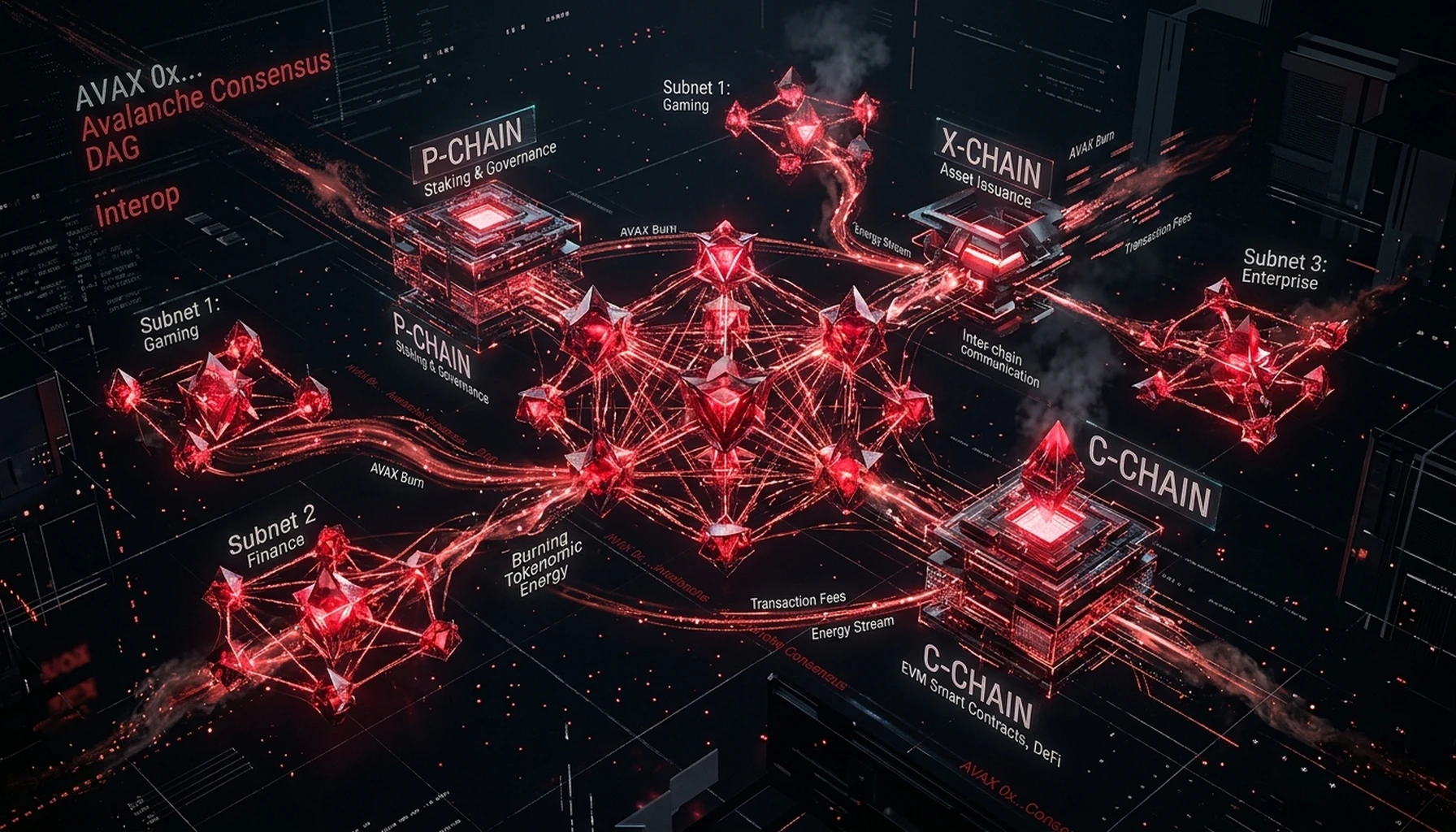
Rather than forcing all transactions, asset transfers, and smart contracts into a single monolithic blockchain, Avalanche partitions its operational responsibilities across three sovereign built-in chains collectively known as the Primary Network.
1. P-Chain (Platform Chain): Coordination and Staking
The Platform Chain functions as the administrative backbone of the Avalanche network. Operating on Snowman consensus, the P-Chain coordinates active validator registries, tracks staking and delegation allocations, manages validator hardware uptime, and oversees the creation and lifecycle of custom Subnets.
2. X-Chain (Exchange Chain): High-Performance UTXO Asset Engine
The Exchange Chain is an asset issuance and trading platform built on a Directed Acyclic Graph using Avalanche DAG consensus. Utilizing an Unspent Transaction Output (UTXO) accounting model similar to Bitcoin, the X-Chain processes peer-to-peer asset transfers with extraordinary throughput. Because independent UTXO transactions do not interact with shared smart contract state, the X-Chain finalizes transfers in parallel without transaction sequencing bottlenecks.
3. C-Chain (Contract Chain): EVM-Compatible Smart Contract Execution
The Contract Chain is Avalanche's smart contract execution layer, running the Coreth client (an optimized fork of Go-Ethereum executing over Snowman consensus). The C-Chain provides 100% bytecode and JSON-RPC compatibility with Ethereum, hosting Avalanche's vibrant decentralized finance ecosystem, automated market makers, lending markets, and NFT protocols.
Cross-Chain Primitives: Avalanche Warp Messaging (AWM) and Teleporter
Avalanche bridges communication between the P-Chain, X-Chain, C-Chain, and independent Subnets through Avalanche Warp Messaging (AWM). AWM utilizes Boneh-Lynn-Shacham (BLS) multi-signatures to enable direct, trustless message verification between any two chains in the ecosystem without relying on centralized multi-sig bridges or off-chain relayers. Teleporter builds on AWM to deliver seamless cross-chain EVM smart contract composability.
AVAX Tokenomics: Capped Supply, Staking Mechanics, and 100% Fee Burning
The economic model of the AVAX token combines monetary scarcity principles with an aggressive deflationary fee sink designed to capture the economic output of the network.
Rigid 720 Million Supply Cap and Genesis Distribution
The absolute maximum supply of AVAX is capped at 720,000,000 tokens:
- Genesis Allocation: Exactly 360,000,000 AVAX were minted at the launch of mainnet in September 2020 to seed public sale participants, foundation treasuries, community grants, and team allocations subject to multi-year vesting schedules.
- Staking Reserve Pool: The remaining 360,000,000 AVAX are locked in the protocol minting pool, emitted exclusively over decades as staking rewards to incentivize node security.
100% Transaction Fee Burning
In contrast to Ethereum's EIP-1559 (which burns base fees while routing priority tips to block builders) or Solana (which burns 50% of transaction fees), Avalanche executes an absolute 100% burn policy for all transaction fees across its Primary Network:
- Every gas fee paid on the C-Chain is burned permanently.
- Every transfer and asset creation fee paid on the X-Chain is burned permanently.
- Every validator registration, staking action, and Subnet creation fee on the P-Chain is burned permanently.
These burned tokens are destroyed from the circulating supply forever. When on-chain transaction velocity and network activity expand, the cumulative fee burn creates an organic deflationary force that directly counteracts validator staking emissions.
Dynamic Staking Issuance Curve
Staking emissions in Avalanche are determined by a dynamic formula that balances network security with monetary inflation. The rate of annual minting depends on the percentage of total circulating AVAX actively staked in the network, targeting an equilibrium staking ratio. If the staked ratio drops, reward rates rise to incentivize capital locking; if the staked ratio approaches saturation, reward rates gradually decay.
Staking Parameters and Non-Slashing Uptime Protocol
Avalanche enforces strict staking parameters to safeguard consensus stability:
- Validator Minimum Bond: A node operator must stake a minimum of 2,000 AVAX to join the validator registry.
- Delegation Minimum: Token holders who do not run hardware can delegate their capital with a minimum of 25 AVAX.
- Staking Duration: Staking periods are fixed between a minimum of 2 weeks and a maximum of 1 year. Staked capital remains illiquid and locked for the duration of the chosen staking window.
- Non-Slashing Uptime Rule: Avalanche does not slash staked principal for node offline events or protocol errors. Instead, to receive staking rewards, a validator must maintain verified online responsiveness for at least 80% of their staking duration. If a validator falls below this 80% uptime threshold, they forfeit all accrued rewards for the period, but their initial principal is returned intact.
Governance Mechanics and Bound Parameter Calibration
Avalanche implements an on-chain governance framework that enables token holders to calibrate system parameters dynamically without requiring contentious hard forks.
Bounded Dynamic Range Governance
To eliminate the risk of governance attacks where malicious capital alters critical protocol guarantees, governance voting in Avalanche is strictly confined to predefined, hardcoded ranges:
- Calibratable Parameters: The community can vote to adjust the minimum staking amount, minimum and maximum staking durations, the target staking reward rate, and the base transaction fee schedule.
- Immutable Invariants: The absolute maximum supply cap of 720,000,000 AVAX is structurally immutable and cannot be altered by any governance vote, preventing arbitrary inflation of the circulating asset pool.
Critical Trade-Offs, Subnet Economics, and Systemic Risks
An objective evaluation of Avalanche and the AVAX token reveals several technical trade-offs, operational hurdles, and structural risks.
Validator Capital Barriers and Node Centralization
The requirement to bond 2,000 AVAX to operate an independent validator creates a significant capital barrier to entry for individual solo stakers. At prevailing market prices, this capital threshold often represents tens of thousands of dollars, concentrating validating infrastructure among well-capitalized institutions, professional staking providers, and centralized exchange custodians.
Subnet Validation Burden and ACP-77 Architecture
Historically, Avalanche Subnets faced an economic scaling bottleneck: every node operating on a custom Subnet was required to simultaneously stake 2,000 AVAX and validate the entire Primary Network (P-Chain, X-Chain, and C-Chain). This dual requirement imposed heavy hardware and capital costs on emerging projects. Avalanche Community Proposals (such as ACP-77) address this friction by separating Subnet validation from Primary Network validation, allowing Subnet creators to configure flexible validator staking rules and pay dynamic P-Chain leasing fees in AVAX.
State Bloat and Archive Footprint on the C-Chain
The C-Chain's sub-second block tempo and high EVM throughput generate substantial state storage accumulation. Running a full archival node requires terabytes of high-performance NVMe storage, increasing operational expenses for independent RPC providers and raising long-term decentralization concerns for the execution layer.
Activity-Dependent Deflationary Equilibrium
The economic narrative of AVAX as a deflationary asset depends fundamentally on sustained, high-volume transaction activity. In periods of macroeconomic contraction or reduced DeFi throughput, the volume of burned transaction fees fails to exceed annual validator staking rewards, causing net circulating supply to expand. AVAX relies on steady ecosystem usage across C-Chain transactions and Subnet inter-chain messaging to maintain an equilibrium burn rate.
Conclusion
Avalanche stands as a mature, technically sophisticated Layer 1 architecture that successfully blends the rapid, scalable settlement of the Snow consensus family with an EVM-compatible multi-chain framework. The AVAX token unites protocol security, governance calibration, and value accrual through its 720 million hard cap, structured staking incentives, and total 100% transaction fee burn mechanism. While high validator capital barriers, C-Chain state accumulation, and reliance on continuous transaction volume remain active operational challenges, Avalanche's ongoing modular improvements through Subnet decoupling and native warp messaging position AVAX as an essential cornerstone of modern decentralized infrastructure.