Overview: Specializing Data Availability in Modular Blockchains
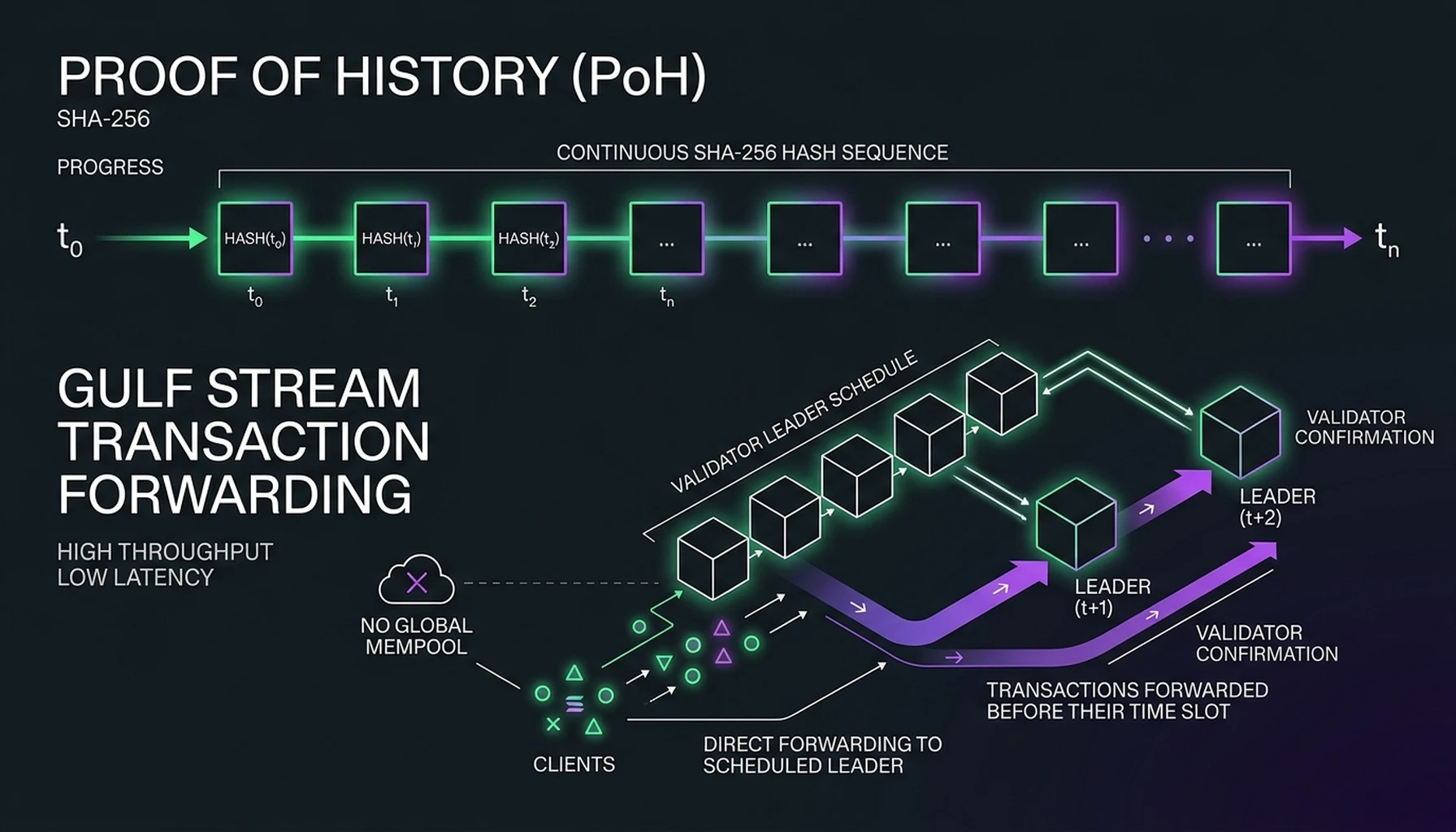
For more than a decade, public blockchains operated predominantly on monolithic architectures. Networks like Bitcoin, Ethereum Layer 1, and Solana bundle consensus, execution, data availability, and settlement into a single, tightly coupled layer. While monolithic designs simplify state validation, they create structural throughput bottlenecks: every full node must download, execute, and verify every transaction in every block.
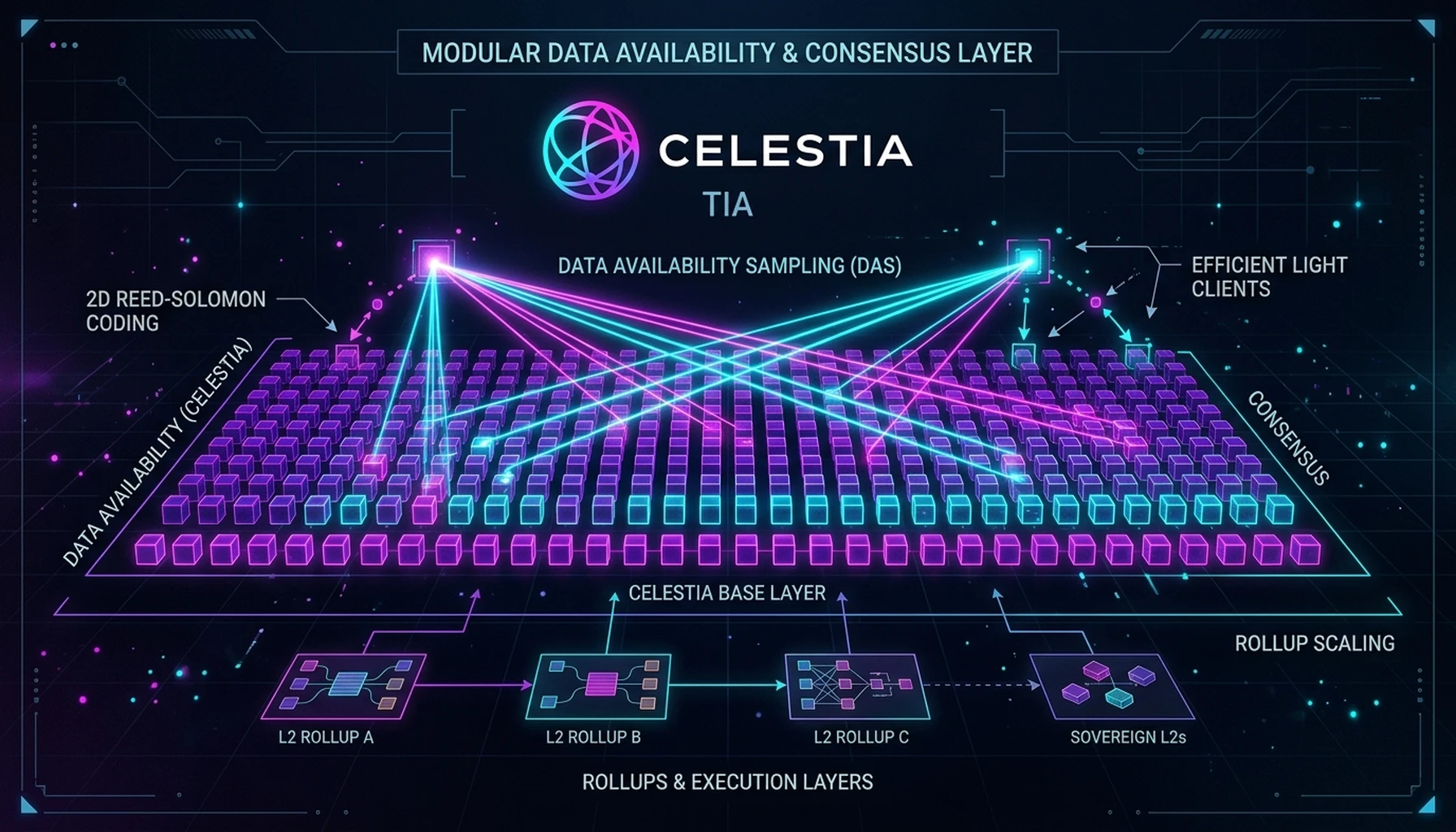
Celestia (token ticker: TIA) pioneers a modular paradigm by deliberately unbundling these responsibilities. Celestia is a dedicated Layer 1 network specifically optimized for two core functions: transaction ordering (consensus) and data availability (DA). By deliberately shedding execution and settlement, Celestia transforms data availability into a scalable, high-throughput commodity, providing the underlying data foundation for autonomous sovereign rollups and modular execution environments.
Consensus Architecture and Core Technical Mechanisms
Celestia is built using the Cosmos SDK and implements the CometBFT (formerly Tendermint Core) consensus algorithm. However, its underlying data handling differs fundamentally from standard Cosmos chains.
Two-Dimensional Reed-Solomon Erasure Coding
To guarantee that block data cannot be partially withheld by block producers, Celestia arranges block data into a square matrix of data chunks (k by k). This matrix is then extended into a 2k by 2k square matrix using two-dimensional Reed-Solomon erasure coding:
- Horizontal Extension: Each row of original data chunks is extended with parity chunks.
- Vertical Extension: Each column, including the parity chunks, is extended vertically with additional parity chunks.
- Reconstruction Guarantee: Because the data is encoded in two dimensions, any honest node that downloads only 25 percent of the total data chunks (sampled across rows and columns) can mathematically reconstruct the entire block matrix. This eliminates the risk of an attacker publishing just enough data to fool light clients while withholding critical state transitions.
Data Availability Sampling (DAS)
The breakthrough technical mechanism in Celestia is Data Availability Sampling (DAS). In traditional blockchains, nodes must download every block in full to confirm data availability, which creates a hard ceiling on block sizes. With Celestia, light clients can verify availability without downloading the block:
- Random Sampling: A light client randomly samples a small, fixed number of data shares from the 2D Reed-Solomon matrix over the peer-to-peer network.
- Merkle Inclusion Proofs: For every share received, the light client verifies an accompanying Merkle inclusion proof against the block header's Data Availability Root.
- Probabilistic Security: By sampling roughly 20 to 30 random shares, a light client achieves greater than 99.999 percent mathematical confidence that the complete block data is available to the network. As more light clients join the network and sample the matrix in parallel, Celestia can safely increase block sizes without compromising decentralization.
Namespaced Merkle Trees (NMTs)
Celestia organizes block data using Namespaced Merkle Trees (NMTs). Each transaction share is tagged with a specific namespace identifier corresponding to the rollup or application that submitted it. When a rollup node queries Celestia for its transaction history, it only downloads the data shares belonging to its specific namespace, accompanied by a cryptographic proof that no namespace data was omitted. Rollups do not waste bandwidth downloading data belonging to unrelated applications.
TIA Tokenomics, Utility, and Network Incentives
The native utility token of the network is TIA. TIA serves four distinct functional and economic purposes within the Celestia ecosystem:
Paying for Blobspace
Rollup sequencers and decentralized applications submit transaction batches to Celestia in the form of PayForBlobs transactions. These transactions store arbitrary data blobs on the base layer. Sequencers must pay gas fees denominated strictly in TIA. The fee structure relies on a dynamic fee market similar to EIP-1559, pricing transactions based on current byte demand relative to block size targets.
Proof-of-Stake Consensus and Validator Staking
Celestia is secured by a Proof-of-Stake consensus mechanism with a bonded validator set (typically 100 active validators). Holders delegate TIA to validators to secure CometBFT consensus. Validators and delegators earn staking rewards funded through programmatic protocol inflation and transaction fee capture, while risking stake slashing for double signing or liveness downtime.
Sovereign Gas and Rollup Bootstrapping
Developers deploying sovereign rollups on Celestia can choose to use TIA as the gas asset for their execution environment, eliminating the need to issue a speculative token immediately. Alternatively, rollups can use TIA as collateral or bridge liquidity within the broader modular ecosystem.
On-Chain Governance
TIA holders participate in decentralized governance through on-chain voting. Governance parameters include adjusting block size limits, managing the community treasury, altering gas fee multipliers, and voting on protocol upgrades.
Supply Dynamics and Inflation Schedule
Celestia launched with a total initial supply of 1 billion TIA tokens. The protocol implements an annual inflation schedule designed to balance validator incentives with supply dilution:
- Initial Year 1 Inflation: Started at 8.0 percent annually.
- Disinflation Decay: Network inflation decreases by 10 percent every year.
- Terminal Floor: The annual inflation rate gradually stabilizes at a long-term terminal floor of 1.5 percent.
- Fee Burn Dynamics: Similar to Ethereum's EIP-1559, the base fee component of every PayForBlobs transaction is burned, introducing a deflationary mechanism that offsets issuance as rollup transaction throughput scales.
Critical Trade-Offs, Token Unlock Overhang, and Market Risks
Despite its architectural innovations, Celestia faces substantial economic, competitive, and technical trade-offs:
The Low-Fee Value Accrual Paradox
Celestia's primary value proposition is making data availability radically cheap and abundant. However, this creates an economic paradox for token value accrual. If posting data blobs costs mere cents, Celestia requires colossal transaction volume across thousands of rollups for aggregate fee burns to outpace the annual staking inflation rate. Unlike monolithic base layers, Celestia does not capture high-value execution-layer maximal extractable value (MEV), which remains primarily with rollup sequencers.
Token Unlock Schedule and Supply Overhang
A significant portion of Celestia's initial 1 billion token supply was allocated to early investors, seed backers, and the core development team under multi-year vesting schedules. Substantial token unlocks introduce periodic supply overhangs that require substantial ongoing market absorption, creating price volatility for spot holders.
Intense Competition in the Data Availability Sector
Celestia operates in an intensely competitive landscape. Ethereum's EIP-4844 (Proto-Danksharding) introduced dedicated blob transactions, providing native data availability directly within Ethereum's existing security umbrella. Furthermore, alternative DA solutions such as EigenDA (which leverages restaked Ethereum capital) and Avail introduce alternative tradeoffs that compete directly for rollup sequencer integrations.
Light Client P2P Network Assumptions
While Data Availability Sampling is mathematically robust, it relies on an active peer-to-peer gossip network where light clients can freely request and share sampled chunks. If malicious validators control a significant portion of network relay nodes, they could selectively delay or eclipse light clients from discovering sampling failures, making decentralized p2p topology a critical security boundary.
Conclusion
Celestia represents a definitive milestone in the transition toward modular blockchain architecture. By leveraging 2D Reed-Solomon erasure coding and Data Availability Sampling, it transforms data availability into a resource that scales with user adoption. While long-term value accrual remains dependent on generating immense aggregate blob demand, TIA stands as the foundational asset underpinning the first production modular data layer in Web3.