Part 1 – Introducing the Problem
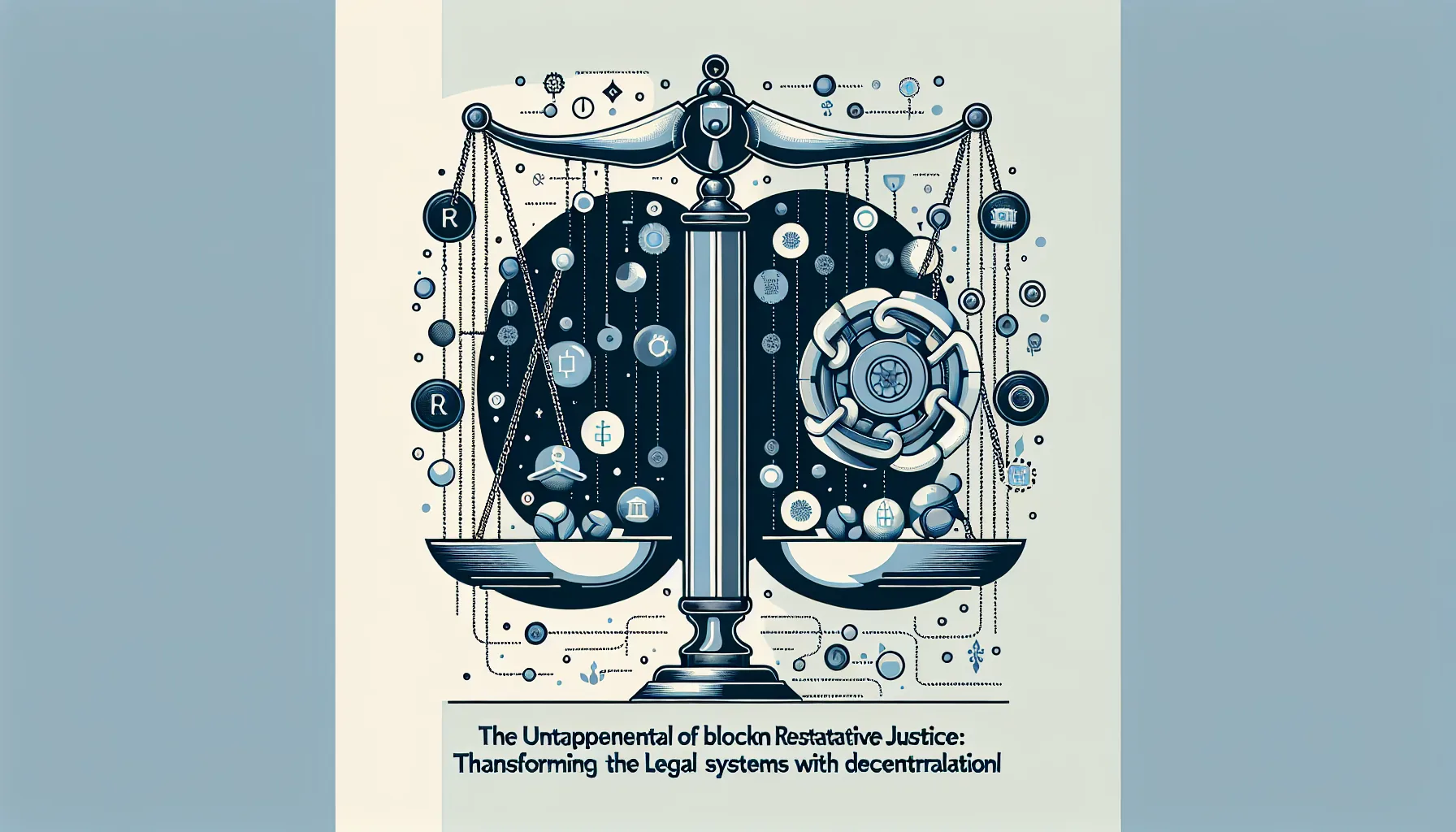
The Untapped Potential of Blockchain in Restorative Justice: Transforming Legal Systems with Decentralization
Part 1: The Structural Incompatibility Between Traditional Justice Systems and Decentralized Technologies
Despite the rapid evolution of decentralized infrastructure in areas like finance, identity, and governance, one highly underexplored vector remains dormant: the intersection of blockchain and restorative justice. While blockchain-based legal primitives have materialized—like smart contract arbitration and decentralized court systems—they generally mimic retributive justice systems. What remains fundamentally unaddressed is the potential for blockchains to encode restorative accountability, which shifts the paradigm from punishment to repair.
Restorative justice focuses on rehabilitating harm through dialogue, acknowledgment, and mutual agreement among affected parties. This process is inherently community-driven and relational—qualities that starkly contrast with the transactional rigidity of both centralized court systems and most current blockchain dispute models. The challenge is that decentralization has, so far, modeled governance around tokens, not people—reducing human relationships to voting scores, stake weight, or worse, governance theater.
Blockchains excel at transparent computation and traceability but falter in ambiguity, nuance, and emotional context. This hard incompatibility makes it difficult to encode processes like truth-telling, forgiveness, and mediation—essential features of restorative justice. Yet ironically, blockchains are also optimal tools for creating permanent histories and shared records, which could support collective memory, facilitate reconciliation, and prevent institutional erasure. The tension between what blockchain can do and what it cannot (yet) express keeps restorative justice on the periphery of decentralized transformation.
Historically, decentralized justice innovations like Kleros and Aragon Court gravitate toward adversarial models—token-curated juries and cryptoeconomic incentives—more suited to enforcing rules than healing communities. Efforts to humanize these structures remain isolated experiments. Coding empathy into a system built on Cartesian logic remains a design frontier, not a solved problem.
This structural impasse remains largely unexplored because there’s no clear incentive model yet. Unlike financial primitives that generate yield or tokens that power DAOs, restorative justice does not produce immediate, quantifiable value. But its absence—especially within online communities marred by reputational harm, rug pulls, or abuse—leaves a vacuum of legitimacy and accountability that erodes Web3’s long-term credibility.
Solving this friction will require insights not just from cryptography or game theory, but from trauma-informed design, sociology, and even Indigenous governance models. Some groundwork on localized community governance begins to hint at these possibilities. For deeper context, see The Hidden Power of Blockchain-Enabled Localized Governance: Transforming Community Dynamics in a Decentralized World.
Any viable on-chain restorative model will need to move beyond pseudonymous arbitration and token voting. The next section explores not just theoretical blueprints but possible protocol-level primitives that may bridge infrastructure and empathy.
Part 2 – Exploring Potential Solutions
On-Chain Restorative Justice Systems: Emerging Blockchain-Based Frameworks and Cryptographic Toolkits
Several blockchain-native solutions have surfaced to address the most persistent issue from Part 1 — the lack of transparency, fairness, and local agency in traditional restorative justice mechanisms. These proposed models range from zero-knowledge-enabled identity systems to decentralized autonomous courts. Each brings specific technical strengths but also introduces implementation hurdles and trade-offs.
One promising approach involves leveraging decentralized governance frameworks such as RDAO-style systems. These models enable community-driven resolution processes through on-chain voting and quadratic reputation scoring. For instance, participants can stake governance tokens to signal decisions related to mediation outcomes, victim compensation, or sanctions. However, this creates attack vectors, particularly through plutocratic voting dynamics. The scenario where high-token holders could sway restorative outcomes exposes ethical risks. A breakdown of similar models can be found in The Hidden Power of Blockchain-Enabled Localized Governance: Transforming Community Dynamics in a Decentralized World.
A second strategy gaining traction is integrating zero-knowledge proofs (ZKPs) within dispute resolution workflows. ZKPs enable confidential evidence verification — allowing a party to prove a claim (e.g., fact of harm, restitution paid) without revealing the underlying data. This appeals to cases involving minors, sensitive incidents, or power-imbalanced communities. Yet, practical integration remains minimal due to ZKP system complexity, circuit auditing costs, and the lack of user-friendly tooling in judicial UI layers. Protocols enabling generalized ZK proof composition, such as zk-SNARKs or zk-STARKs, still trade off performance for privacy.
Thirdly, smart contract-based escrow and conditional payouts — often used in DeFi — are now being adapted for restorative processes. For example, a smart contract may hold funds until all mediation participants digitally sign off on the fulfillment of agreed terms. While this mitigates trust issues, it assumes low-friction onboarding for non-technical users and often lacks mechanisms for dispute escalation or fiat connectivity. Without robust oracles for subjective outcomes, the reliability of these automations remains limited.
The underlying theme across all models is the necessity of verifiable reputation. On-chain reputation systems, particularly when decoupled from wallets and tied to decentralized identifiers (DIDs), are crucial for ensuring decisions are grounded in trustworthiness, not identity spoofing. For further insights see The Power of On-Chain Reputation Systems: Building Trust and Accountability in Decentralized Finance.
Some projects experiment by combining all the above: RDAO governance for vote-based conflict resolution, ZK-enabled privacy for documentation, and programmable escrows for accountability. These systems, while theoretically appealing, pose technical composability issues that have yet to be ironed out at scale.
As several of these technologies prepare to transition from whitepapers to testnets, the next section will evaluate real-world applications and pilot programs already underway.
Part 3 – Real-World Implementations
Case Studies in Blockchain-Powered Restorative Justice: From Theory to Deployment
Several blockchain-based experiments have attempted to infuse restorative justice principles into decentralized frameworks. One such notable initiative is Kleros—a decentralized dispute resolution protocol. Although not marketed as a restorative justice tool, Kleros showcases how decentralized arbitration can replace traditional litigation with peer-based consensus. Built on Ethereum, it utilizes game-theoretic incentives, randomly-selected jurors, and token staking (PNK) to enforce accountability. However, it struggles with narrative-oriented dispute types, a cornerstone of restorative justice. The lack of empathy mechanisms and inability to accommodate community-based dialogue limits its restorative functionality.
Another example is JUR, which has pivoted from traditional legal adjudication to DAO governance tooling but initially aimed to create blockchain-native courtrooms prioritizing consensus-based resolutions. Despite integrating reputation scoring and off-chain-on-chain decision mirroring, legal enforceability became a bottleneck. Without sovereign integration or recognition from judicial systems, settlements—even if agreed via smart contracts—held limited real-world leverage.
Smaller DAOs like Holochain's JusticeDAO prototype have explored community-led grievance redressal with emphasis on reparative action and dialogue rather than punishment. Technically operating outside the blockchain paradigm—Holochain is agent-centric, not ledger-centric—it poses architectural challenges regarding transparency and verifiability. The lack of truly immutable audit trails makes external trust difficult, undermining legitimacy for more critical restorative functions.
Efforts to incorporate on-chain reputation systems have also caught traction. Some DAOs experiment by tying dispute histories and community engagement to wallet-specific metadata, attempting to embed behavioral context into governance rights. Projects highlighted in The Power of On-Chain Reputation Systems show how these systems can weight voting power based on prior good faith, which aligns strongly with restorative principles. However, maintaining sybil resistance while preserving anonymity remains unresolved, as does portability across ecosystems.
Technical challenges persist. Smart contracts are deterministic but restorative justice requires nuance. Contextual interpretation is nearly impossible to encode in Solidity or Vyper, and current L2s like Optimism or Arbitrum don’t offer native tools for narrative-centric reconciliation. Projects exploring AI-assisted moderation—while promising—risk embedding algorithmic bias or removing agency from affected parties.
Illiquidity of incentive tokens used in jury or arbiter payments also dampens long-term sustainability. Many micro-economies built for dispute settlement inflate supply to maintain user involvement, compromising token utility. This issue mirrors flaws in other governance DAOs, as explored in The Hidden Power of Blockchain-Enabled Localized Governance.
Finally, most initiatives lack effective entry-and-exit rituals for impacted parties, crucial to the cyclical nature of healing in restorative justice. Current dApp designs prioritize finality. Restorative systems need elasticity.
Part 4 – Future Evolution & Long-Term Implications
The Future of Blockchain in Restorative Justice: Predictive Protocols, Cross-Chain Integration, and AI-Powered Smart Contracts
The next phase of blockchain’s role in restorative justice systems will hinge on composable modularity, privacy-centric infrastructure, and evolution in dispute resolution logic. One emergent vector is the convergence of zero-knowledge (ZK) proof systems with decentralized identity (DID) frameworks. As ZK circuits become cheaper to generate and verify, we’re likely to see privacy-preserving justice protocols gain adoption among decentralized public defenders and cross-jurisdictional mediators.
On-chain behavioral reputations—a concept already explored in some DeFi ecosystems—could fit naturally inside restorative contracts. Participants in mediated dispute sessions could earn immutable trust scores based on their voluntary engagements, restitution payments, or compliance with community resolutions. Smart-contract-based compliance scoring bolstered by ZK reputation proofs allows defendants to carry verified behavioral history across platforms without revealing sensitive context—key for minimizing retraumatization and bias.
Yet streamlining these systems won’t be trivial. Current restorative justice blockchain dApps are largely siloed in single-network environments. The next iteration will likely rest atop more interoperable frameworks, potentially leveraging generalized message-passing protocols from ecosystems like Cosmos or Polkadot. The friction of legal blockchain app composability today mirrors the early headaches of fragmented liquidity in pre-AMM DeFi—solvable, but requiring intense coordination.
Gas optimization and execution latency still remain bottlenecks. While Layer-2s offer a temporary reprieve, fully asynchronous restorative structures will need persistent state synchronization across chains. Functional composability across ZK-rollups and optimistic environments must evolve to accommodate time-sensitive arbitration logic—think escrow-linked restorative contracts that expire over multi-chain timelines. These limitations need smarter fee markets and possibly intent-centric protocols to manage conditional commitments.
Restorative systems could also benefit from the autonomous logic of AI-powered smart contracts. Natural language processing embedded into on-chain resolution submissions can streamline dispute documentation, classifying cases and mapping them to protocol-approved mediators. For an early glimpse at this intersection, see our analysis in The Rise of AI-Powered Smart Contracts: The Next Evolution in Blockchain Technology.
Scalability alone won’t drive adoption. Credibility indicators like tokenized juror staking, community slashing for bad actors, and recursive governance logic must evolve concurrently. This is where decentralized governance schemas such as those examined in The Hidden Power of Blockchain-Enabled Localized Governance: Transforming Community Dynamics in a Decentralized World become relevant—especially when transitioning from linear to multi-party arbitration environments.
As the interplay between restorative justice, pseudonymous accountability, and on-chain sovereignty deepens, the role of participatory governance models will move from auxiliary to foundational.
Part 5 – Governance & Decentralization Challenges
Governance and Decentralization Challenges in Blockchain-Based Restorative Justice
Implementing restorative justice using blockchain tech introduces glaring governance complexities. While decentralization promises resilience and transparency, its messy interplay with human coordination and on-chain power distribution often backfires. The primary dilemma revolves around institutional legitimacy vs on-chain consensus—how do we balance anarchic flexibility with structured legal order?
Centralized vs Decentralized Governance Models
Centralized governance—where decisions are made by a designated committee or foundation—is often deemed antithetical to the ethos of blockchain. However, in scenarios involving sensitive legal frameworks like restorative justice, having a competent, accountable decision-making body reduces coordination drag. Central models offer faster upgrades and regulatory compliance but open the door to censorship, data custodianship, and permanent trust dependencies.
On the other hand, decentralized governance offers ideological purity but at operational cost. Voting inefficiencies, low voter turnout, and fragmented DAO structures weaken the pace of legal interpretation and platform upgrades. Worse, DAO vote capture by whales can lead to the very plutocracy decentralized systems are supposed to reject.
Governance Attacks and Plutocracy Risks
Projects aiming for community-controlled conflict resolution must anticipate coercive governance attacks, such as malicious proposal injection or silent vote accumulation. Plutocratic patterns surface quickly: token-weighted voting mechanisms inherently favor large stakeholders, tilting protocol evolution toward those with economic rather than ethical investment. We’ve seen patterns of this in DeFi, such as in the critiques discussed in RDAO Under Fire: Key Criticisms Explained, where stakeholder dominance overrides community intent.
Regulatory Capture and Layer-One Dependencies
Protocols operating at Layer-2 or relying on external consensus mechanisms open up new attack vectors through upstream governance changes. For instance, if a base layer undergoes a contentious fork or adopts compliance mechanisms due to state mandates, any restorative application deployed on it risks becoming involuntarily non-neutral.
Regulatory capture is not just about governments. Powerful institutional actors or NGOs entering the chain governance process—from “stakeholder coalitions” to external arbitration bodies—can distort the system’s output into reinforcing status quos rather than disrupting them.
Localized Governance as a Possible Path
Localized, micro-DAO governance embedded in geographic or social communities could offer resilience while staying contextually relevant. This approach was explored in-depth in The Hidden Power of Blockchain-Enabled Localized Governance, where governance adapts to the norms and values of its environment without compromising broader technical decentralization.
Decoder layers must still be embedded within smart contract logic to validate inputs from these nodes of local judgment. The interoperability between global consensus and zone-specific resolution remains largely unsolved.
Part 6 will explore the scalability and engineering compromises required to make these governance concepts viable at state or population scale.
Part 6 – Scalability & Engineering Trade-Offs
Scalability vs Decentralization: The Bottlenecks in Blockchain-Based Restorative Justice
Implementing blockchain in restorative justice frameworks introduces fundamental engineering trade-offs, particularly along the decentralization-security-scalability trilemma. Maintaining distributed consensus while ensuring fast and secure transaction settlements across jurisdictions isn’t just a technical hurdle—it’s an inherent friction within layer-1 protocols and consensus models.
Public permissionless blockchains like Ethereum optimize for decentralization and security using Proof-of-Stake (PoS), but they sacrifice throughput and finality speeds. Even with recent upgrades like proto-danksharding, consistently updating offender-offended interactions in a restorative model—especially in real-time mediation or agreement tracking—runs into latency barriers. These limitations make high-volume case management systems nearly impossible without Layer-2s or alternate architectures.
Conversely, high-speed chains like Solana offer significantly improved throughput through Proof-of-History (PoH), but their path trades node diversity for performance. In scenarios where neutrality, trustlessness, and censorship-resistance are vital—such as in multi-jurisdiction legal applications—validator centralization becomes a risk vector. This is especially problematic when algorithmic dispute resolution or time-sensitive restorative contract execution is required.
Comparatively, modular blockchain architectures—or stackable consensus layers like those proposed in Cosmos and Polkadot—offer alternative scaling strategies by abstracting execution from consensus. These ecosystems could, in theory, isolate judicial data into sovereign appchains, but interoperability nightmares and XCM vulnerabilities still plague real-time data synchronization between legal bodies.
Then there are rollup-centric chains pushing optimistic or zero-knowledge proofs. While zk-rollups address scalability and data integrity brilliantly, their technical complexity and high cost of circuit generation and verification remain a bottleneck. Especially in regions with limited compute capacity, deploying these at-scale undermines the equitable access decentralization intends to promote.
True sharded blockchains offer another path forward. Zilliqa’s sharding design distributes state and computational load, enhancing throughput without compromising on decentralization. Still, sharding introduces cross-shard complexity—potentially undermining case state consistency, which is non-negotiable in justice systems.
These technological choices aren’t made in isolation. Governance overchain execution introduces friction. Projects like RDAO have exposed just how contentious and fragmented decentralized decision-making becomes at scale. Translating this into conflict resolution infrastructure only magnifies coordination failures.
The engineering stack needs to be highly configurable, privacy-preserving, and interoperable without collapsing under the weight of trade-offs. But as scalability solutions evolve, the discussion must shift toward whether these models can comply with legal norms, jurisdictional boundaries, and enforceable standards.
That leads directly into the core issue to be analyzed next: how regulatory and compliance frameworks will respond to these emerging decentralized justice systems.
Part 7 – Regulatory & Compliance Risks
Regulatory and Compliance Risks: Legal Minefields in Blockchain-Based Restorative Justice Systems
The implementation of blockchain in restorative justice frameworks introduces a set of complex regulatory and legal uncertainties, especially as such models challenge the jurisdictional boundaries entrenched in national and international law. These decentralized structures, which rely on smart contracts, on-chain identity verification, and community-driven decision-making, stand in direct tension with traditional legal norms that demand centralized oversight, jurisdictional clarity, and well-defined procedural safeguards.
One major regulatory concern is the legal enforceability of outcomes generated by decentralized restorative justice systems (DRJS), particularly when operated autonomously through smart contracts. While smart contracts are increasingly recognized in some jurisdictions, others lack any legal framework to interpret, dispute, or enforce outcomes derived from automated consensus mechanisms. This opens the door to legal ambiguity, especially in cross-border disputes, where the offender and victim reside in different legal jurisdictions, each with their own evidentiary requirements and privacy laws.
Further complicating adoption is the question of data compliance. Restorative justice processes require sensitive personal data—offense records, identity metadata, and psychological assessments—that may conflict with regional data protection laws like GDPR or similar frameworks. The immutability of blockchain data poses obvious conflicts with "right to be forgotten" provisions. Implementing on-chain restorative processes would require either robust zero-knowledge proof (ZKP) integrations or off-chain data repositories governed by decentralized identity layers—both of which are technically achievable, but present additional attack vectors and liability issues.
Historical crackdowns on privacy coins, mixer protocols, and DAO governance structures also present a precedent for governmental resistance. Regulators may view DRJS systems as quasi-judicial bodies operating without state sanction—raising serious concerns about sovereignty and legal oversight. Given the scrutiny decentralized governance has faced (as seen in episodes like those explored in RDAO Under Fire: Key Criticisms Explained), similar warnings should be expected for DRJS. They could be seen as parallel legal systems that bypass critical regulatory controls.
Adding to this complexity, governments may impose mandatory KYC/AML on participants, especially if token incentives or reputation-based staking mechanisms are embedded in the process. This could result in friction between the anonymity ethos of blockchain and regulatory compliance, potentially leading to balkanized implementations or outright bans in certain countries.
The need for multilateral agreements, global standards for decentralized governance, and regulatory sandboxes cannot be overstated—but progress remains sluggish. Until these gaps are resolved, DRJS initiatives will remain experimental, limited to legal gray zones or governed as private arbitration networks with minimal state recognition.
Part 8 will delve deeper into the economic and financial consequences of integrating decentralized justice mechanisms into mainstream markets.
Part 8 – Economic & Financial Implications
Economic and Financial Implications of Blockchain-Based Restorative Justice Systems
Restorative justice on blockchain introduces a paradigm shift not only in legal theory, but in value creation and disruption across decentralized markets. It blurs traditional silos, requiring new intersections between legal validation, dispute resolution, and programmable finance—forcing a reevaluation of what markets should exist and who captures the upside.
For institutional investors, the risks are asymmetric. The appeal of gaining early exposure to a fundamentally new infrastructure—one that could make arbitration-based legal services, compliance enforcement platforms, or even court document verification obsolete—carries alpha, but also uncertainty. If protocol-driven justice systems gain traction, expect a reallocation of capital toward tokens that collateralize and govern these ecosystems. This has already spurred interest in governance design patterns found in platforms like RDAO: Redefining Governance in Decentralized Finance, where enforcement mechanisms closely resemble the logic required in blockchain-based legal avenues.
Developers benefit from the proliferation of demand for modular legal frameworks integrated into smart contracts—essentially “justice-as-code.” However, this could also introduce heightened audit fatigue. Every flaw in protocol-level arbitration becomes a vector for financial manipulation. These contracts can't operate in a vacuum. They’ll demand decentralized identity layers, on-chain reputation metrics, and localized governance modules. Protocols not architected with these dependencies in mind may lag behind or become irrelevant.
For DeFi traders and speculators, the risks are more nuanced. If blockchain-based justice becomes the enforcement backend for DAO disputes, insurance claim payouts, or real-estate escrows, markets could see a bifurcation: assets tied to justice-enabled smart contracts may carry a premium for perceived “enforceability,” while others become risk-discounted. This dynamic could also attract regulatory interest, adding compliance risk to what has historically operated in a legal gray zone.
There’s also an emergent problem of liquidity fragmentation. If multiple justice protocols emerge—each with their own token incentives and governance tokens—it's not difficult to imagine large liquidity pools being siloed across legally incompatible stacks. This could hamper composability and diminish the efficiencies that made DeFi attractive in the first place.
Speculatively, we may see new asset classes deriving value solely from arbitration outcomes, reversing the model of staking toward yield and replacing it with staking toward legal finality. But the line between trustless execution and subjective justice remains thin—and investors may not be ready for a financial system calibrated around nuance.
This leads to a much deeper question: what happens to the human element when legal decisions are driven by code? A question we’ll explore next through the lens of social and philosophical implications.
Part 9 – Social & Philosophical Implications
Blockchain and Restorative Justice: Economic Turbulence or Transformation?
Restorative justice powered by blockchain infrastructure doesn't just challenge traditional legal paradigms—it threatens to disrupt entrenched financial frameworks. By introducing trustless audits, immutable community contracts, and decentralized ledger-based restitution systems, it lays the groundwork for capital flows driven by new definitions of civic accountability and asset-backed justice mechanisms.
For institutional investors, the opportunity lies in early-stage infrastructure tokens tied to legal tech protocols. Market makers and VCs eyeing long-term demographic shifts—particularly jurisdictions plagued by prison overpopulation and civil rights litigation—may see profit in the tokenization of restorative fund pools, legal outcome oracles, and decentralized mediation frameworks. This opens the door to staking mechanisms that yield returns based not on arbitrage or DeFi farming, but on real-world restitution transactions—a new paradigm of value extraction tied to tangible social impact.
Smart contract developers could find unprecedented demand for niche applications like micro-insurance for victims, tokenized restitution delivery, or privacy-focused court data chaining using zk-SNARKs. However, this economic promise is undermined by fragmented jurisdictional recognition. Without cohesive regulatory alignment, developers risk building infrastructure that cannot integrate into formal legal ecosystems, stalling adoption and threatening long-tail network effects.
Traders and speculators face even trickier dynamics. Restorative justice use cases typically lack the high-volatility narrative appeal that fuels meme-based or swing trading momentum. Instead, token values may evolve slowly, if at all, calibrated more by local governance participation than global speculative demand. Liquidity pools for these tokens may remain thin unless mechanisms similar to those powering community DAOs are embedded at protocol level. The problems faced by projects like RDAO illustrate the fragility of idealistic infrastructures against the grind of market expectations.
Economic risks are non-trivial. Capital flowing into restorative token ecosystems could be vulnerable to social engineering if not coupled with identity proving and slashing-based mechanisms. Without robust on-chain reputation infrastructures tied to case workers, community validators, and claimants, bad actors could exploit pseudonymity. While some systems attempt to address this through governance reputation staking—as explored in The Power of On-Chain Reputation Systems—the legal stakes are dramatically higher here.
As capital, coding talent, and community incentives converge on this socio-legal frontier, deeper consequences emerge—not only for wallets, but for ethical frameworks. Is restitution just when it’s tokenized? Would human empathy survive inside smart contract cages? In Part 9, we’ll explore the social and philosophical undercurrents of embedding justice into decentralized code.
Part 10 – Final Conclusions & Future Outlook
Final Reflections: Blockchain's Role in Restorative Justice at a Crossroads
Over the course of this series, we’ve unpacked the architectural, ethical, and operational implications of applying blockchain to restorative justice systems. Core takeaways include blockchain’s unique ability to introduce immutable accountability, decentralized conflict resolution mechanisms, and transparent reputation systems into judiciary procedures that have long suffered from opaque gatekeeping and systemic bias. But while the technology shows profound promise, it also raises significant complexity and jurisdictional challenges.
On-chain enforcement mechanisms, for example, can encode restorative logic — restitution agreements backed by smart contracts, restorative circles facilitated through DAOs, or decentralized evidence submission — but these tools demand interoperability between legal recognition and blockchain protocols. This gray area is yet unresolved.
In a best-case future, we may see a network of interoperable legal DAOs that reflect local jurisprudence but coordinate global restorative standards. Local communities, empowered by blockchain-based governance (see The Hidden Power of Blockchain-Enabled Localized Governance), could anchor justice-reinvention efforts based on cultural context, elevating marginalized voices while minimizing institutional inertia. Here, blockchain isn't about decentralization for its own sake, but decentralization in service of legitimacy and community-led healing.
Yet the worst-case scenario is equally vivid: fragmented protocols, rampant techno-solutionism, and an abundance of underperforming “restorative” smart contracts lacking cultural nuance or legal enforceability. In such a context, blockchain could be used to mimic punitive systems under a decentralized sheen, mistaking automation for empathy. Without credible off-chain integration, the tech risks building hard-coded abstractions of justice that are unresponsive to human experience.
Three unanswered questions linger:
1. Can blockchain-based reputation systems avoid replicating the bias of traditional credit scores or surveillance tools?
2. How do smart contracts account for dynamic, non-binary human resolution processes in restorative models?
3. Who arbitrates when the autonomy of decentralized participants collides with societal notions of justice?
Mainstream adoption depends on purposeful interoperability, jurisdictional clarity, and sustained community education — far beyond technical refinement. It's less about a “killer app” and more about governance literacy at scale.
As protocols like RDAO have shown us in the DeFi sector (RDAO Under Fire: Key Criticisms Explained), governing collective outcomes on-chain isn’t frictionless — especially when incentives are unaligned with values. Justice systems are orders of magnitude more complex than yield farming or liquidity voting.
So stands the ultimate paradox: does blockchain amplify our most humane instincts through trustless coordination, or does it quantify justice into rigid rule sets devoid of context?
Will restorative justice mark blockchain’s most transformative legacy — or remain another vaporware fantasy shelved between ICO failures and DeFi exploits?
Authors comments
This document was made by www.BestDapps.com