Part 1 – Introducing the Problem
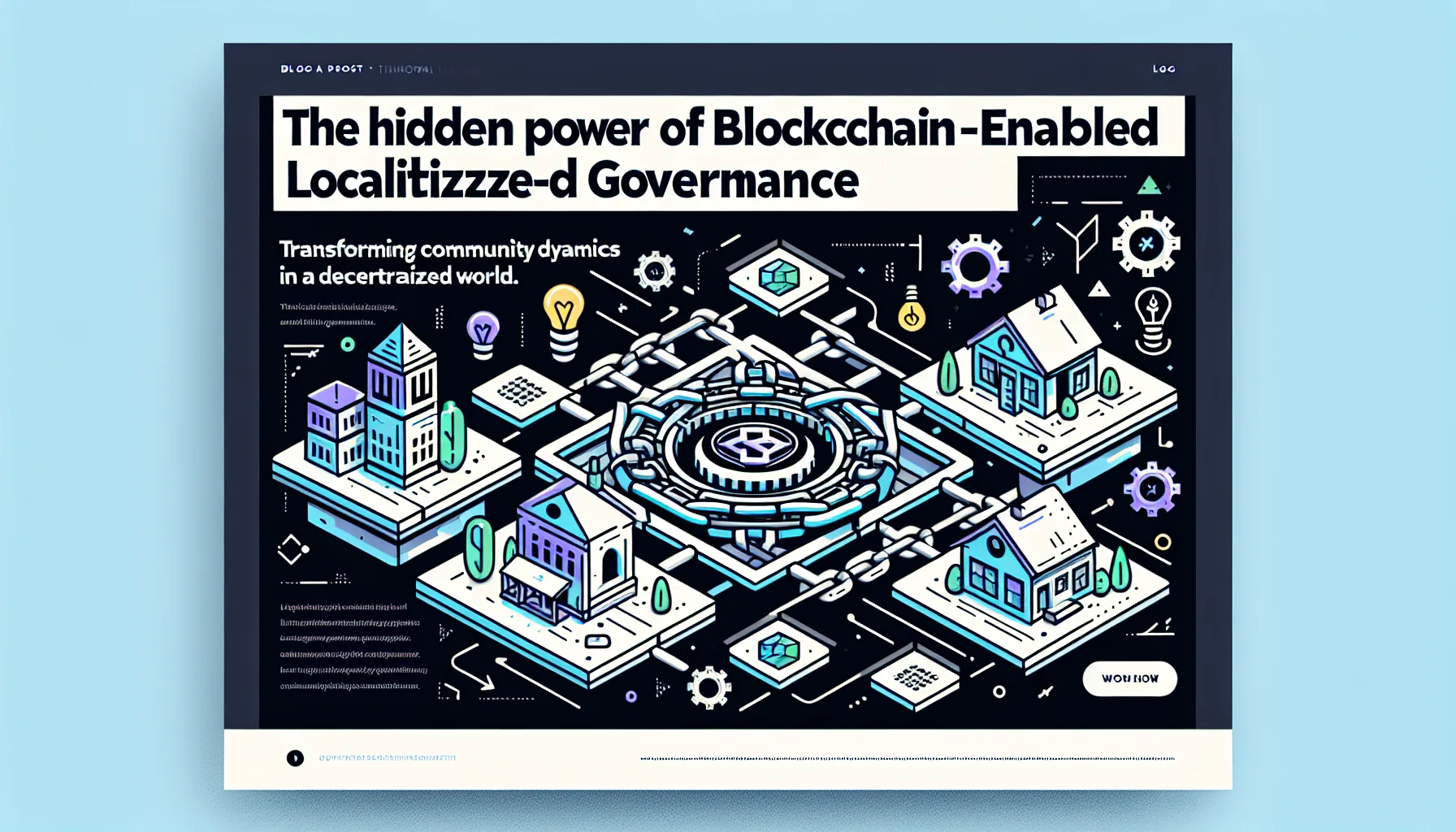
The Hidden Power of Blockchain-Enabled Localized Governance: Transforming Community Dynamics in a Decentralized World
Part 1 – Introducing the Problem: Why Localized Governance Is the Missing Layer in Web3
In the technical pursuit of decentralization, the blockchain ecosystem has obsessively centered governance on protocol-wide consensus. Chains like Ethereum, Cosmos, and Polkadot structure power around token-weighted votes, validator incentives, and DAOs. But in doing so, we've overlooked the crucial granularity of real-world governance: locality. Physical communities, digital subcultures, and regional economies are governed using a “one-size-fits-all” framework that fails to account for their distinct needs. This misalignment between global protocol design and local community governance is quietly becoming a critical scaling obstacle.
Why? Because the infrastructure powering DeFi, NFTs, and DAOs lacks the sociopolitical nuance that makes governance sustainable in smaller contexts. Most crypto-native governance systems incorrectly presume homogeneity among users, ignoring the heterogeneity in legal jurisdictions, language, access to capital, literacy levels, and cultural expectations. The result: participation remains low, community policies lack legitimacy, and voter apathy breeds governance capture.
Unlike financial scalability—often tackled through L2s or rollups—this problem is structural. Consider the frictions seen in protocols like Curve or Compound, where meaningful community engagement in governance remains disproportionately skewed toward a few whales or core developers. Even in newer experiments like Decentralized Governance in Frax Share Explained, meaningful grassroots participation is limited by the absence of location-aware governance tooling.
This isn't a UX failure—it’s a stack-level omission. Without mechanisms for communities to self-govern on a localized level (based on geography, interest, or identity), DAOs risk becoming bureaucratic shells. In real-world governance, voting isn't just about reaching consensus—it’s about forming communities of trust. Blockchain governance lacks that middle layer.
Also notable is the regulatory pressure brewing globally. Local ordinances and national regulations are increasingly placing pressure on DeFi platforms, pushing them toward compliance. Yet the tools to compartmentalize user governance based on region simply don’t exist within today’s systems. Localized governance may be not only efficient—it may be inevitable for protocol survival.
Technologically, the capability is there. Smart contracts can express jurisdiction-based rules. ZK-proofs can mask sensitive data while plugging into local identity systems. What’s missing is a coherent framework—and the political will to challenge the default centralization of DAO governance design.
In upcoming sections, we’ll examine how introducing localized governance modules could reshape everything—from funding allocation, to reputation mechanisms, to regulatory alignment.
Part 2 – Exploring Potential Solutions
Blockchain-Driven Local Governance Models: Cryptographic Design Patterns and Technical Trade-offs
To address the governance dysfunctions described in Part 1—centralized bottlenecks, low participation, and opaque decision-making—several cryptographic and protocol-level solutions are being proposed. Each leverages blockchain's inherent transparency and auditability but with varied approaches to scalability, inclusivity, and accountability.
Token-Based Quadratic Voting
One increasingly explored model is token-based quadratic voting (QV). In QV, the cost of casting multiple votes scales quadratically, preventing whales from dominating outcomes while still allowing influence proportional to conviction levels.
Projects like Gitcoin have shown experimental success with QV in funding allocation. But the major drawback in local governance use cases is that QV still hinges on token distribution as a proxy for civic participation. This can entrench plutocratic dynamics if initial token allocations lack fairness or long-term rebalance mechanisms.
On-Chain Reputation Systems
Reputation-linked voting mechanisms offer an alternative anchor to decision power. Systems assign influence based on a participant’s decentralized activity record—such as proposal contributions, participation in governance discussions, and peer ratings.
However, these are notoriously difficult to design without sybil resistance or overfitting to gaming behavior. The Power of On-Chain Reputation Systems: Building Trust and Accountability in Decentralized Finance illustrates how even reputation metrics can generate perverse incentives if not handled transparently. Additionally, privacy trade-offs in tying historical activity to user influence are non-trivial.
ZKP-Based Governance Participation
Zero-knowledge proofs (ZKPs) have opened doors to privacy-preserving governance. ZK-Rollups or zkSNARKs allow vote casting and auditing without revealing voter identity. This addresses transparency without doxxing, a key balance in sensitive or hostile local environments.
While mathematically verifiable, ZKP schemes are currently computationally expensive. This creates performance and UX frictions, especially on low-resource edge nodes typical in underrepresented communities.
Modular Sub-DAO Architectures
The emergence of scalable Sub-DAO frameworks—like those built using smart contract factories or governance modules on chains such as Fantom—enable localized decision-making units with interoperability across a central protocol. Unlike traditional DAOs, Sub-DAOs allow governance rules tailored to community-specific needs, such as quorum thresholds or consensus mechanisms.
Still, interoperability between sub-governance layers introduces hierarchy-like dynamics if not managed with strict protocol guarantees. Moreover, economic alignment between sub-DAOs and parent DAOs is still an unsolved balance-of-power puzzle. Readers interested in Fantom’s approach to DAO modularity may find A Deepdive into Fantom highly relevant.
Emerging Opportunities
Cross-chain identity frameworks, behavior-bound staking models, and multi-sig delegatory layers are also surfacing as viable tools—each with severe limitations in composability or cognitive overhead.
To assess how these model architectures manifest under real-world constraints, Part 3 will dissect actual implementations of community-governed systems and examine signals of success and failure across the ecosystem.
Part 3 – Real-World Implementations
Real-World Deployments of Blockchain-Enabled Local Governance: Successes, Struggles, and Lessons in Progress
Several blockchain networks and projects have already attempted to implement localized on-chain governance, each with differing levels of decentralization, usability, and community traction. One high-visibility example is Kusama, a permissionless governance “canary network” designed for experimentation before Polkadot mainnet launches features. Kusama's on-chain governance model allows stakeholders to submit and vote on proposals using KSM tokens, with a sophisticated referendum mechanism that balances technical council input and community voice. Despite the flexible governance architecture, Kusama has faced criticism for complexities that alienate less technical community members. The challenge isn’t the mechanism itself, but rather effective user onboarding for civic participation—a recurring obstacle for localized DAO-style communities.
In contrast, Decentraland has adopted a refined governance process powered by its MANA token and the Decentraland DAO. Here, landowners have a tangible stake in virtual space policy, managing everything from rules on content moderation to grants for community development. MANA’s utility in ecosystem governance, while empowering, has led to issues of plutocracy, with a few token whales disproportionately steering key decisions. For a deep dive into the governance mechanics of these dynamics, see Democratizing Decentraland Governance Through MANA.
Another illustrative case is HIVE Blockchain, whose fork from Steem was a direct response to concerns over centralized control. HIVE introduced a Delegated Proof of Stake (DPoS) system and aims for true community governance, but block producer centralization still remains a problem. Despite the system being billed as decentralized, several critiques have noted that a small handful of community actors can exert excessive influence—raising questions about whether DPoS is inherently susceptible to such structural drift.
On the technical front, a recurring challenge is voter participation and smart contract reliability. In projects like dYdX, where governance directly affects protocol parameters, participation rates among token holders often hover below meaningful thresholds. Proposed solutions like quadratic voting or reputation-weighted models introduce greater nuance, but also additional surface area for Sybil vulnerabilities. The reputation systems discussed in "The Power of On-Chain Reputation Systems" are increasingly being explored to enhance legitimacy in governance without sacrificing pseudonymity.
Meanwhile, protocol integration with identity solutions remains underdeveloped. No leading network has yet solved the issue of persistent pseudonymous identities for civic duty without over-centralizing control or compromising privacy—a dilemma that continues to prevent highly localized DAOs from scaling beyond tightly knit, enthusiastic developer communities.
Referral link: For those exploring the governance capabilities of newer token ecosystems, early adoption opportunities are often best accessed via native platforms like Binance: Sign up here.
Part 4 – Future Evolution & Long-Term Implications
Future-Proofing Local Blockchain Governance: Scalability, Modularity, and Cross-Chain Synergy
As blockchain-enabled localized governance systems mature, the importance of extensibility and interoperability will define their next phase of evolution. The early emphasis on permissionless participation and tamper-resistant decision logs is giving way to a more sophisticated set of priorities—most notably, scaling mechanisms that can accommodate granular governance at the neighborhood, city, and regional levels without compromising latency or increasing validator overhead.
A primary constraint in current local governance deployments is the throughput ceiling inherent in most Layer-1s. Modular architectures are emerging as a pragmatic response. Projects leveraging app-specific rollups or Layer-2s are enabling optimized execution environments where local proposals, votes, and enforcement mechanisms are isolated within jurisdiction-specific sidechains. These rollups can settle on high-throughput chains like Fantom, whose speed and low fees create a favorable foundation for hyperlocal DAOs—read more in https://bestdapps.com/blogs/news/a-deepdive-into-fantom.
However, scaling doesn’t stop at technical architecture—it must also consider data composability. Innovations in on-chain behavioral analytics and decentralized reputation systems are poised to make consensus more reflexive and context-aware. By incorporating verified historical governance behaviors, communities can weigh votes using identity-anchored credibility metrics rather than equal token weight alone. This brings complexity, but it also counters sybil attacks and plutocratic manipulation—two chronic issues in token-based voting.
Where innovations get increasingly promising—though untested at scale—is in integrating governance stacks with zero-knowledge verification. ZK-native attestations could enable privacy-preserving voting on contentious local policies, without leaking individual affiliations or stake sizes. Layer-2 chains with native ZK capabilities may soon serve as opt-in governance layers for communities prioritizing anonymity, especially in politically volatile regions.
Yet this roadmap is not without its fault lines. Cross-chain governance interoperability remains fragmented. Bridging platforms that attempt to synchronize state between multichain local DAOs face latency lags, inconsistent finality standards, and incompatible identity primitives. The vision of a mesh of sovereign neighborhood DAOs communicating trustlessly across Layer-1s is currently aspirational, not actualized.
Still, with emerging DAO frameworks decoupling proposal execution from decision-making logic and incorporating AI-enhanced quorum detection, the building blocks for more intelligent, scalable governance layers are under construction. Interfacing these with smart contract composability into DeFi, prediction markets, and even digital ID frameworks may redefine how communities collectively act on local and global resource allocation.
This sets the groundwork for a deeper exploration into decentralized governance, delegation models, and decision-making logic—core dynamics which will reshape what legitimacy and representation mean in a blockchain-native society.
Part 5 – Governance & Decentralization Challenges
Navigating Governance Models and Decentralization Challenges in Blockchain-Enabled Local Governance
Effective coordination at the community level through blockchain hinges on the robustness of governance architectures. Yet decentralization, while idealized in theory, introduces complexities that centralized systems often mitigate more directly. The trade-off is not simply ideological—it's intensely operational.
Centralized vs. Decentralized Governance Architectures
Centralized models offer agility and clearer accountability. Authorities make decisions quickly, and changes can be rolled out with minimal friction. However, these systems are a breeding ground for regulatory capture and special interest domination, especially if governance tokens are allocated through early insider distributions or VC-heavy seed rounds. The risk escalates when control is cloaked in a DAO façade that functions more as a multisig committee than a community-steered protocol.
Conversely, decentralized models aspire toward distributed decision-making but are vulnerable to plutocratic control. In on-chain voting systems like token-weighted governance, influence scales disproportionately with wealth. This creates a systemic flaw: local community members may be outvoted on matters affecting their jurisdiction by external whales unaffiliated with the community’s needs.
Consider token staking mechanics. Poorly designed staking incentives can lead to stake centralization, where reward-maximizing behavior overtakes civic-minded governance. This becomes particularly problematic when applied to geographically localized governance, where voter participation is essential yet can be disproportionately overshadowed by global actors with higher holdings.
Governance Attacks and Strategic Manipulation
Governance attacks—where malicious actors accumulate voting power to pass unfavorable proposals—aren't theoretical. The low cost of participation in some systems entices sybil resistance exploits and bribery-based governance farming. Snapshot voting, for example, can be gamed by flash loan-fueled short-term holders, diluting governance power for genuinely engaged stakeholders.
The Overlooked Layer of Accountability in Decentralized Finance outlines how trust in blockchain governance is often undermined by these unaddressed attack surfaces. Localized systems doubling down on real-world use cases risk reputational erosion when governance mechanisms become easy vectors for manipulation, especially if there's no off-chain recourse.
DAO Tooling Fragmentation and Regulatory Friction
As DAOs mature, inconsistency in tooling—from voting dashboards to proposal frameworks—has led to governance fatigue. Fragmented systems frustrate participation and increase the barrier to entry for non-technical but community-invested members.
Meanwhile, governments are increasingly scrutinizing DAO-based decision-making. Courts and regulators may deem decentralized collectives liable for decisions that impact public well-being. Without clear entity structures, well-intentioned governance initiatives may find themselves entangled in legal ambiguity or forced into centralized fallback mechanisms for compliance.
In Part 6, we’ll dissect the scalability bottlenecks and engineering trade-offs required to operationalize blockchain-local governance frameworks at population scale.
Part 6 – Scalability & Engineering Trade-Offs
Scalability, Security, and Speed: Trade-Offs in Localized Blockchain Governance
At the core of implementing blockchain-enabled localized governance at scale lies an unforgiving trilemma: decentralization, security, and scalability rarely coexist without friction. As governance shifts from centralized gatekeepers to permissionless systems, engineering teams must navigate this tension across protocol layers, validator distributions, and consensus mechanisms.
Fully decentralized networks like Ethereum or Cosmos often prioritize censorship resistance and trustless computation, but at the expense of throughput. While Ethereum’s transition to proof-of-stake and rollup-centric scaling strategies has improved block finality and gas efficiency, these solutions are often still bounded by data availability challenges for large-scale, granular governance structures distributed across municipalities or federated communities. Conversely, more centralized Layer 1s like Solana and Avalanche deliver higher throughput and lower latency but at the cost of validator centralization and increased reliance on full archival nodes. High performance may hinder the auditability required in public governance systems.
Implementing smart contract-based decision-making for hyper-local zones (districts, towns, neighborhoods) exponentially amplifies the load on block space—especially when layered with voting logic, off-chain data validations, and dispute resolution mechanisms. Even sharded architectures like Zilliqa or Near Protocol, while promising horizontal scalability, must solve cross-shard communication latency before they can meet the decentralized governance bandwidth of thousands of small autonomous networks operating in parallel.
On the consensus front, PoS chains implementing fast finality (e.g., BFT-like consensus in Cosmos SDK or Tendermint Core) emerge as top candidates for localized decision-making where deterministic outcomes are crucial. However, these come with downsides: validator cartels, higher slashing risk, and limited throughput per validator set. For instance, governance rollouts on networks like Fantom using Lachesis DAG protocols as discussed here offer superior aBFT consensus performance, but their scalability ceiling is tightly coupled to validator count and network topology assumptions.
Another overlooked cost is cryptoeconomic complexity. Bonding, staking, delegation mechanics, and governance token distributions often reinforce early voter dominance, reducing large-scale adoption. Adding multi-signature layers, zero-knowledge proofs for vote privacy, or Verifiable Delay Functions (VDFs) to enforce fairness only compounds the engineering overhead and gas costs.
App-layer solutions can leverage modular blockchains or application-specific rollups, but setup costs for each zone introduce fragmentation. Projects hoping to implement local governance on Ethereum L2 ecosystems must contend with rule synchronization, chain composability, and the underlying data availability model—particularly for optimistic rollups with week-long finality delays.
Scalability remains the bottleneck in transforming democratic engagement through blockchain. Future improvements will depend not only on novel architectures but also cross-chain governance coordination and ecosystem UX fragmentation.
Up next: a deep look into the regulatory and compliance friction points threatening to undermine decentralized local governance model viability.
Part 7 – Regulatory & Compliance Risks
Regulatory and Compliance Risks: Legal Hurdles Facing Blockchain-Enabled Localized Governance
While decentralized governance platforms promise autonomy and localized control, they clash fundamentally with traditional regulatory frameworks. Specifically, their automated, permissionless structures—and tokenized incentive layers—present significant jurisdictional friction. Unlike DeFi or NFT platforms, localized DAOs may directly intersect with municipal policies, land rights, and public funding mechanisms, escalating regulatory scrutiny far beyond existing crypto applications.
One core challenge is the ambiguity surrounding legal entity classification. Is a local governance DAO a cooperative? A nonprofit? A digital commons? In most jurisdictions, none of these boxes fit, leaving these systems stuck in regulatory limbo. Jurisdictions like the United States may apply securities law if tokens carry profit expectations under the Howey Test—especially when tied to tangible resources or public utilities. In the EU, GDPR presents its own compliance burdens, particularly when governance tools log personal data on-chain, potentially in immutable formats.
Adding complexity, there’s no global standard. A DAO operating street-level infrastructure in Kenya might be fully legal, while the same DAO in Singapore could face penalties under digital ledger restrictions. This lack of harmonization forces devs to geo-fence—or worse, withdraw entirely—delaying cross-border cooperation in smart governance. Precedents set during the crackdown on ICOs and unlicensed exchanges remain relevant. Regulatory bodies often favor containment over innovation, meaning even pilot-level projects could be stifled by opaque compliance risks.
And then there's the risk of forced centralization through regulatory compromise. Local governments may pressure projects to use identity-verifiable wallets or centralized KYC systems, dampening the censorship resistance that blockchain governance is supposed to enable. Even more concerning are the latent risks posed by real-world assets tied to on-chain decisions—such as community land ownership or water distribution—which raise state-level sovereignty issues.
For example, if a community DAO governs public transport funding through a native token, is that token a reward or taxation proxy? These lines blur quickly, and enforcement often begins not with guidance, but investigations or asset freezes.
Some communities have looked at hybrid approaches, integrating decentralized identity solutions—like those discussed in The Overlooked Promise of Decentralized Digital Identity Systems—to bridge privacy and compliance concerns. However, these integrations are not yet standardized or legally robust.
As localized governance infrastructures gain traction, developers and stakeholders will need to proactively mitigate regulatory ambiguity or face the same disruptive fate seen in early DeFi provocateurs. The economic, reputational, and enforcement consequences of ignoring these risks are not theoretical—they are operational reality.
Next, we’ll dissect how these systems create new economic flows, challenge traditional financial models, and reshape value distribution at the community level.
Part 8 – Economic & Financial Implications
The Economic and Financial Fallout of Blockchain-Enabled Localized Governance
Unlike protocol-level DAOs or layer-1 validator networks, blockchain-based localized governance mechanisms—structured around municipalities, districts, or cooperatives—introduce novel markets and redefine existing capital flows. Rather than a global DeFi scheme, this evolution transforms real-world governance units into tokenized economic zones, with implications that extend far beyond voting mechanics.
From Investment Zones to Tokenized Public Infrastructure
Localized governance DAOs create a fresh class of utility tokens, tethered not to abstract smart contract functions but to specific, measurable outcomes: local solar grid output, water credits, or school performance. These tokens can become tradable financial instruments that represent long-tail, semi-regulated micro-economies. Institutional investors may see opportunity in municipal-token arbitrage or governance Yields-as-a-Service (YaS), which package voter participation into composable DeFi derivatives.
But this illiquidity by design—coupled with jurisdiction-specific legal ambiguity—introduces emergent risk. Once governance tokens are backed by city-level revenue or contracts, failures in service delivery could result in cascading effects across derivative markets. Expect new “governance default” risk models akin to sovereign bonds, but more fragmented and politically volatile.
Developers and Builders: New Revenue Streams, New Frictions
For Web3 developers, the localized governance stack unlocks monetization at the API layer. Backend tools for civic data or vote aggregation can charge on-chain by usage or validation. This gives rise to on-chain SaaS—but in a highly heterogeneous market space. Unlike protocols like Audius or dYdX which scale horizontally, localized systems have vertical fragmentation embedded into their design.
Check out how Audius’ governance model enables creator control — a similar model may apply to district-level artists or civic technologists.
However, developer capture becomes a credible threat. In systems with weak civic participation, control can consolidate around technical teams maintaining the governance layers. These enclaves of influence, unaccountable to token holders, reflect Web2-style platform centralization under the guise of decentralization.
Traders and Speculators: Emergent Fragmentation, Arbitrage at the Edge
For traders, the proliferation of civic-focused tokens presents both arbitrage opportunity and execution friction. LPs may drift toward high-turnover city DAOs with predictable governance cycles, but token illiquidity, gated access, and variable compliance environments break composability. Cross-regional DAO arbitrage can never mimic the fluidity of Uniswap pools. Trading such tokens will resemble FX markets in pre-Euro Europe—uncoordinated, spiky, and politically driven.
In sum, blockchain-enabled localized governance represents a new dawn of tokenomics—highly context-specific, semi-composable, and riddled with non-financial variables. These features spell opportunity for early movers, but the underlying fragility will demand novel tools for economic modeling and political risk assessment.
Next, we’ll step beyond markets to examine how these governance substrates reshape trust, identity, and consent—rewiring the very philosophy of societal organization.
Part 9 – Social & Philosophical Implications
Blockchain-Enabled Localized Governance: Disrupting Economic Structures and Creating Asymmetrical Advantages
When localized governance structures migrate on-chain, the financial implications aren't incremental—they're paradigm-shifting. At the core, blockchain enables microeconomic systems to bypass traditional intermediaries, turning previously passive communities into financially autonomous ecosystems. Smart contracts governing localized DAOs (Decentralized Autonomous Organizations) can issue and manage community tokens tied to utility, governance, or reputation—all tradable on-chain, all liquid (or illiquid) depending on execution.
For institutional investors, this fragmentation into thousands of community-specific token economies opens both opportunities and headaches. On one hand, early exposure to high-performing, low-cap governance tokens offers alpha previously only accessible in grey-zone illiquid markets. On the other, vetting community DAOs rooted in culture rather than capital introduces reputational and due diligence risk. Fund managers now face the question: do you invest in a DAO stewarding municipal utilities or its community yield farm forked from LayerZero liquidity boots?
Developers are arguably the most empowered—and exposed—stakeholders in this new economic terrain. They can monetize open-source tooling or stake-based governance proposals across hundreds of jurisdictions. However, the incentive misalignment between short-term token appreciation and community-centric development may lead to unsustainable economic loops, especially in under-regulated zones. Poorly designed tokenomics could implode systems from within, creating negative flywheels—a scenario explored in Decoding Frax Share The Future of Tokenomics.
Traders, meanwhile, exploit temporal mispricings between governance events and token action. Arbitrage across community protocols—voting windows, slashing penalties, reputation boosts—becomes a new class of strategy. But this real-time activation of local political will creates economic signals that are only as strong as their sybil-resistance and off-chain enforcement mechanisms. A DAOs token might spike after a favorable bylaw gets passed, only to crash when real-world compliance jams up execution.
Unforeseen risks loom large. Liquidity pools backing local governance tokens may be thin, unstable, or manipulated through vote-buying. Token issuance schedules without proper vesting or emission controls could mirror microcosms of failed fiat monetary policy. Worse, overlapping jurisdictional claims could trigger regulatory arbitrage wars between on-chain and legacy governance systems.
As capital begins to flow toward citizen-run DAO primitives, the economic chessboard is redrawn—and not always fairly. Shadow systems of finance emerge from the code itself. Whether these new structures promote sustainability or mirror legacy inequities hidden behind cryptographic veneers remains an open question.
Next, we’ll explore how these decentralized architectures influence collective identity, autonomy, and societal cohesion—beyond capital.
Part 10 – Final Conclusions & Future Outlook
The Hidden Power of Blockchain-Enabled Localized Governance: Final Conclusions & Future Outlook
After examining the mechanics, risks, and transformative potential of blockchain-enabled localized governance, the trajectory ahead remains highly contingent on how the ecosystem handles structural, technical, and socio-political complexities. The promise of decentralized, local-first governance—emphasizing autonomy, real-world utility, and resilience—is both powerful and precarious.
One clear insight: without strong on-chain reputation mechanisms and identity verifiability, localized governance is vulnerable to sybil attacks, voter fatigue, and manipulation by dominant or well-capitalized entities. Coordination games, rather than rational choice outcomes, often dictate participation, thereby distorting representational accuracy. The Power of On-Chain Reputation Systems: Building Trust and Accountability in Decentralized Finance explores some of these vulnerabilities in more detail.
A best-case scenario envisions local DAOs (powered by scalable L1s or rollups) interlinked via interoperability layers, allowing fluid data, asset movement, and shared security models. This would create a network of sovereign micro-economies—governed transparently, incentivized sustainably, and coordinated through decentralized arbitration. However, this assumes breakthroughs in civic UX, governance tooling, incentive alignment, and most pressingly, identity sovereignty.
In the worst-case? We end up with fragmented, non-interoperable silos. Decision-making is dominated by whales or bots, exploiting voter apathy via low-friction governance attacks. Without economic finality or credible commitment mechanisms, communities would unravel socially before they scale structurally—becoming either irrelevant or absorbed by top-down metagovernance structures of corporate-led chains.
Even platforms with strong community engagement, such as Fantom, show signs of stress when governance—or analysis of it—is neglected or sidelined by larger consensus narratives.
Several pivotal questions remain: Can governance frameworks truly reflect dynamic, real-world populations without compromising on chain-native values? Will regulatory frameworks eventually force these systems to centralize KYC-like burdens, undercutting their utility for community-led resilience?
For this model to reach viability at scale, three preconditions must be met: a credible identity layer that's privacy-preserving; a modular plug-and-play governance stack optimized for non-crypto users; and granular local funding rails that operate independently of speculative tokenomics.
Until those components align—and align credibly—decentralized local governance remains more of a speculative thesis than an inevitability.
Will blockchain-enabled governance redefine the political and economic agency of local communities—or simply become another unscalable ideal, lost in the sea of abandoned crypto primitives?
Authors comments
This document was made by www.BestDapps.com