Overview: Genesis, Yonatan Sompolinsky, and the Nakamoto Consensus Bottleneck
Bitcoin established the foundation of decentralized digital scarcity through Proof-of-Work (PoW) and Nakamoto consensus. Under Bitcoin's original design, miners globally compete to solve computational hashing puzzles, with the winning miner broadcasting a newly mined block every ten minutes. This ten-minute block interval, combined with a 1 MB to 4 MB block weight limit, was deliberately engineered by Satoshi Nakamoto to safeguard network synchronization. Because blocks require dozens of seconds to propagate across a global peer-to-peer network of disparate internet nodes, high block creation rates would cause simultaneous block discoveries, resulting in chain splits, orphaned blocks, and dangerous centralization pressures.
In a traditional linear blockchain, when two miners discover valid blocks simultaneously at the same block height, only one block can be included in the canonical longest chain. The competing block is completely discarded as an \\\"orphan\\\". As block creation intervals are reduced to achieve higher transaction throughput (such as 10 seconds or 1 second), the network propagation delay relative to the block time spikes dramatically. At high block rates, the orphan rate can exceed 50%, severely compromising network security: an attacker with only 30% or 40% of global hashpower can outpace the fragmented honest miners, executing double-spend reorganizations and 51% attacks with minimal capital expenditure.
To overcome this fundamental scalability barrier without compromising Proof-of-Work security or adopting centralized validator cartels, Dr. Yonatan Sompolinsky: an Israeli computer scientist, post-doctoral researcher at Harvard University, and co-author of the seminal GHOST (Greedy Heaviest Observed Sub-Tree) protocol cited by Vitalik Buterin in the original Ethereum Whitepaper: spent nearly a decade researching alternative distributed ledger topologies. Alongside researchers at DAGlabs, Dr. Sompolinsky conceptualized a paradigm where orphan blocks are completely eliminated by moving from a single, sequential linear chain to a Directed Acyclic Graph (DAG).
In November 2021, this research culminated in the mainnet launch of Kaspa (KAS). Kaspa implements the GHOSTDAG consensus protocol, transforming Proof-of-Work from an orphaned linear chain into a collaborative, high-throughput BlockDAG. By allowing blocks to reference multiple parent blocks and integrating all parallel blocks into a mathematically sound, total topological order, Kaspa achieves sub-second block creation and settlement speeds while preserving pure Nakamoto Proof-of-Work decentralization.
Kaspa (KAS) Tokenomics: Pure Fair Launch, Deflationary Chromatic Phase, and Zero Pre-Mine
The monetary architecture and distribution model of Kaspa represent a strict adherence to the ethos of classical Proof-of-Work cryptocurrencies, distinguishing KAS from modern venture-backed tokens.
1. Genesis Distribution and Fair Launch Integrity
Kaspa launched on November 7, 2021, with zero pre-mine, zero initial coin offering (ICO), zero venture capital allocations, zero private token sales, and zero team allocations. Every single KAS token in existence was mined permissionlessly through open computational Proof-of-Work. Unlike Proof-of-Stake protocols where early foundation insiders lock up commanding majorities of validator voting stake, Kaspa's distribution was completely open to global CPU, GPU, and subsequent ASIC miners from block zero.
2. Absolute Supply Cap and Chromatic Halving Schedule
The monetary policy of Kaspa is strictly hard-coded into protocol consensus with an absolute mathematical supply ceiling:
Maximum Total Supply: Exactly 28,700,000,000 KAS (28.7 Billion)
While Bitcoin implements a discontinuous step-halving every four years (210,000 blocks): causing sharp revenue shocks that can destabilize mining economics: Kaspa pioneers a continuous geometric emission decay termed the Chromatic Halving Phase. Inspired by the 12-tone equal temperament musical scale, the emission rate decreases smoothly every month by a factor of exactly:
Monthly Decay Factor: (1/2)^(1/12) ≈ 0.94387431268
Because $( (1/2)^{1/12} )^{12} = 1/2$, the block reward halves exactly once every calendar year, but does so through 12 gentle monthly decrements. This geometric decay provides predictable, non-volatile economic transitions for commercial mining facilities, eliminating sudden cliff-edge revenue collapses.
3. Circulating Supply and Terminal Deflation
Because Kaspa halves its block reward annually rather than quadriennially, its emission curve is substantially steeper than Bitcoin's. Over 90% of the entire 28.7 billion KAS maximum supply was mined into circulation within the network's first five years of operation. As the block subsidy approaches negligible micro-fractions of a KAS token per block in the late 2020s and 2030s, the network smoothly transitions into a sustainable transaction fee economy, where miner revenue is sustained by high-volume global transaction throughput.
The GHOSTDAG Consensus Protocol: From Linear Chains to BlockDAG
The foundational mathematical breakthrough powering Kaspa is GHOSTDAG (Greedy Heaviest Observed Sub-Tree Directed Acyclic Graph), a generalized extension of Nakamoto consensus conceived by Yonatan Sompolinsky and Aviv Zohar.
1. The Structure of a BlockDAG
In a standard blockchain, each block points to a solitary predecessor (its parent block), forming a single linear string of cryptographic blocks. Any block discovered concurrently is rejected.
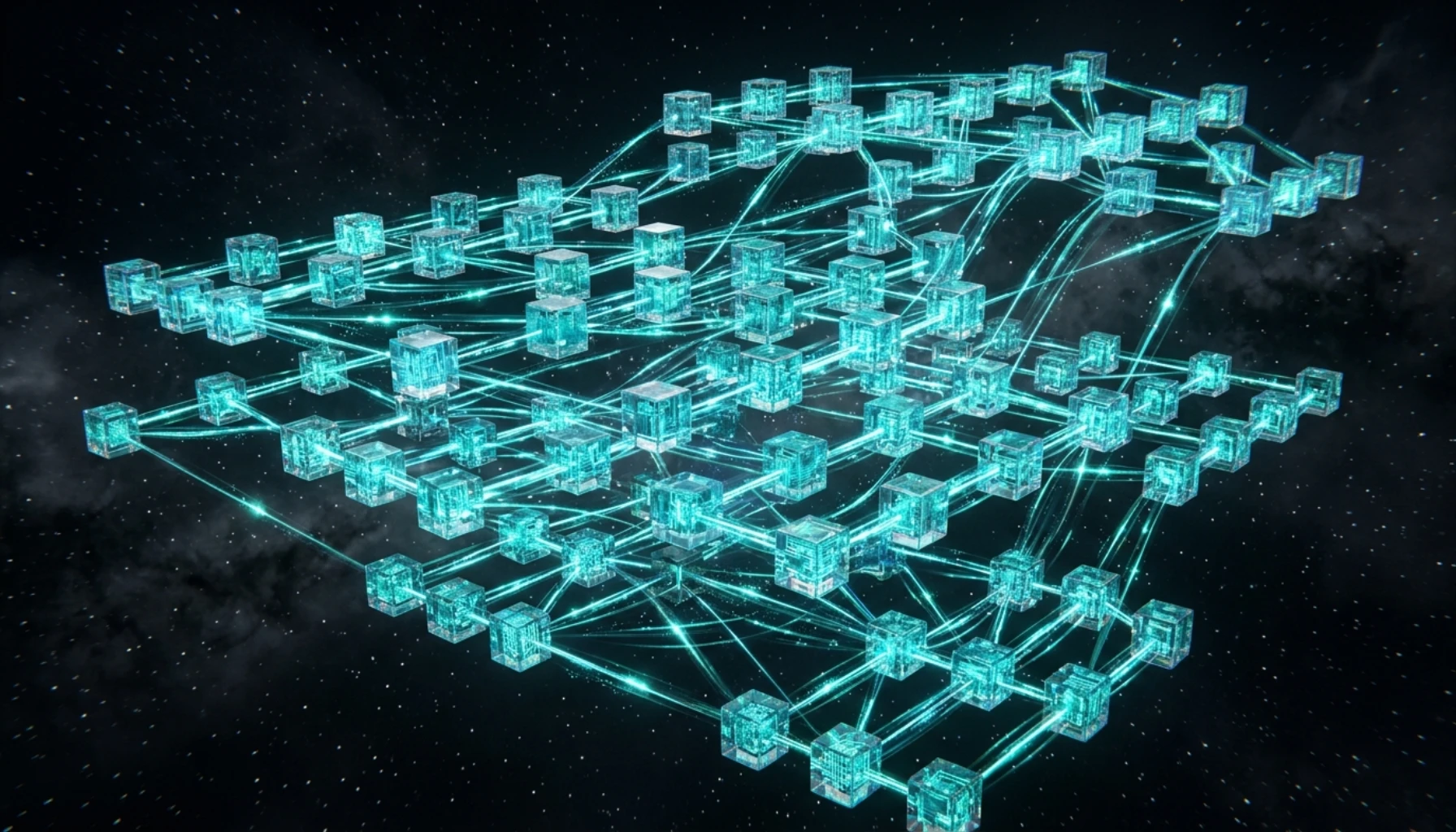
In the Kaspa BlockDAG, every block explicitly references multiple parent blocks:
- When a miner solves a proof-of-work puzzle, their node queries the local DAG state to identify the entire tips set (all valid blocks currently at the frontier of the DAG that have not yet been referenced by child blocks).
- The new block header contains an array of parent hashes pointing to all observed tips.
- Rather than orphaning competing blocks, the network weaves all concurrently mined blocks into an interconnected directed acyclic graph. Transaction fees and block rewards are shared among all honest block creators, completely eliminating the economic waste of orphan races.
2. The GHOSTDAG Selection Algorithm and the Kappa (k) Parameter
The central challenge of a BlockDAG is establishing a deterministic, universally agreed-upon linear ordering of all transactions without a centralized coordinator. Without total ordering, double-spend conflicts cannot be resolved. GHOSTDAG solves this through its greedy blue-set selection algorithm, parameterized by $\kappa$ (kappa).
The parameter $\kappa$ represents the maximum number of blocks that can be created concurrently within a single network propagation delay window by honest miners. In Kaspa, $\kappa$ is mathematically calibrated (typically $\kappa = 18$ or $\kappa = 32$) based on observed network latency bounds:
- Greedy Heaviest Sub-DAG Traversal: Starting from the genesis block, nodes iteratively traverse the DAG by selecting the child block that anchors the heaviest observed sub-DAG (the path with the greatest cumulative proof-of-work). This selected spine forms the Selected Parent Path.
- The Blue Set vs. Red Set Partition: For every block in the DAG, GHOSTDAG evaluates its local neighborhood. If a block's past DAG intersects with the Selected Parent Path within a $\kappa$-cluster (meaning it was broadcast within the honest network propagation window), it is designated as a Blue Block (honest block). If a block was withheld by an attacker, mined in secret, or delayed beyond the $\kappa$ boundary, it is categorized as a Red Block (potentially malicious or severely delayed).
- Total Topological Ordering: GHOSTDAG defines a deterministic algorithm that flattens the two-dimensional DAG into a single, unambiguous one-dimensional list of blocks. Transactions are executed strictly in this topological order: the first transaction to spend a UTXO succeeds, while any subsequent double-spending transaction in a competing block is automatically invalidated.
Because honest miners' blocks propagate rapidly across the gossip network, they naturally form a tightly knit cluster of mutually referencing blue blocks. An attacker attempting a private double-spend attack cannot reference honest tips without revealing their attack block; as soon as their secret branch is published, GHOSTDAG identifies that the attacker's blocks fall outside the honest $\kappa$-cluster, demoting them to red blocks and neutralizing the reorganization attempt.
High-Throughput PoW: From Go to Rust (Rusty Kaspa) and 10 BPS Execution
Scaling a Proof-of-Work ledger to process hundreds of blocks every minute requires overcoming severe software and hardware performance bottlenecks in network gossip, cryptographic hashing, and disk I/O.
1. The Rusty Kaspa Rewrite
Kaspa originally launched with an implementation written in Go (kaspad), capable of sustaining a stable mainnet throughput of 1 block per second (1 BPS): already 600 times faster than Bitcoin and 12 times faster than Ethereum Layer 1. However, the Go runtime: with its garbage collection pauses, heap allocation overhead, and single-lock database wrappers: could not scale to the double-digit block rates required for global retail adoption.
The core development team executed a complete, multi-year architectural rewrite of the node software in Rust (Rusty Kaspa). Completed and merged to mainnet in 2024, Rusty Kaspa delivered transformative performance enhancements:
- Zero-Cost Abstractions and Memory Safety: Rust's compile-time memory management eliminated garbage collection pauses entirely, ensuring deterministic sub-millisecond block processing latencies.
- Parallelized Block Validation Pipelines: Transaction signature verifications (Schnorr signatures over Secp256k1) and DAG topological sort algorithms were optimized with multi-threaded SIMD parallelization across all available CPU cores.
- RocksDB Optimization and Async I/O: Disk write paths and in-memory caches were redesigned to process thousands of block header writes and state updates asynchronously without stalling network gossip.
2. The 10 Blocks-Per-Second (10 BPS) Mainnet Transition
Following extensive stress-testing on public testnets (TN11) sustaining over 10 BPS with sub-second finality, Kaspa deployed its 10 BPS hard fork to mainnet. At 10 blocks per second:
- The network produces 600 blocks per minute and 864,000 blocks per day.
- Transactions achieve initial inclusion within 100 milliseconds of broadcast, delivering an instantaneous, credit-card-like user experience for retail payments.
- Cumulative Proof-of-Work accumulates at ten times the speed of legacy blockchains, making transaction reversals mathematically impossible within 10 to 15 seconds of confirmation.
3. Optical Proof-of-Work: The kHeavyHash Mining Algorithm
Kaspa secures consensus through a specialized hashing algorithm known as kHeavyHash:
- Traditional hashing algorithms (such as SHA-256 in Bitcoin or Scrypt in Litecoin) rely entirely on standard logical bit shifts, XOR operations, and modular addition.
- kHeavyHash incorporates dense 64x64 matrix multiplication sandwiched between two standard Keccak-256 hash rounds.
- This mathematical structure was specifically engineered to be compatible with optical matrix multiplication processors (photonic accelerators), drastically reducing energy consumption compared to conventional brute-force thermal hashing. While photonic miners remain emerging experimental hardware, commercial semiconductor manufacturers developed high-efficiency application-specific integrated circuits (ASICs: such as the IceRiver and Bitmain Antminer KS series) that secure the network with exahashes of dedicated hardware hashpower.
UTXO Architecture, Dynamic Pruning, and Smart Contract Roadmap
Managing the state growth of a blockchain generating nearly one million blocks per day requires innovative database engineering and ledger pruning.
1. Transaction Engine: Extended UTXO (xUTXO)
Kaspa utilizes the Unspent Transaction Output (UTXO) accounting model, the identical architectural primitive pioneered by Bitcoin. Unlike account-based blockchains (such as Ethereum or Solana) where accounts maintain mutable global balances that require complex state locks and serial execution queues, UTXO transactions consume immutable discrete outputs and produce new unspent coins.
The UTXO model provides critical architectural advantages for a high-frequency BlockDAG:
- High-Speed Parallel Validation: Because individual UTXOs are mathematically independent, nodes can validate thousands of concurrent transactions across distinct CPU threads without read/write state contention.
- Superior Privacy & Scalability: Users generate fresh addresses for every transaction, preventing public balance tracking and simplifying off-chain payment channel construction.
2. Bounded State Pruning Algorithm
A naive BlockDAG storing 10 blocks per second would generate tens of terabytes of ledger data annually, pricing home node operators out of the network and concentrating validation into centralized data centers. Kaspa solves this through its Proof-of-Work Pruning Point algorithm:
- The consensus rules enforce a continuous, mathematical pruning point set approximately 72 hours (or ~2.6 million blocks) in the past.
- Blocks older than the pruning horizon do not need to store transaction bodies, scripts, or spent witness signatures; nodes retain only compact block header hashes and the finalized UTXO set.
- Full validator nodes can operate indefinitely with an active disk storage footprint of approximately 50 GB to 100 GB, allowing regular consumer laptops and desktop computers to validate consensus rules locally.
3. The Smart Contract Roadmap: KEF, Layer 2s, and Native Programmability
Historically, Kaspa operated purely as a layer 1 monetary payment network. To unlock decentralized finance (DeFi), automated market makers, and tokenized assets, the Kaspa Ecosystem Foundation (KEF) and open-source contributors are actively pursuing a multi-layered smart contract architecture:
- KRC-20 Token Standard: An in-script token standard that enables the creation and transfer of fungible tokens directly on the Kaspa base layer, indexed off-chain via consensus-validated events.
- Zero-Knowledge and Optimistic Rollups on BlockDAG: Leveraging Kaspa's 10 BPS throughput and sub-second confirmation times as the ultimate fast-settlement and data availability layer for high-throughput smart contract execution rollups.
Governance, Mining Decentralization, and Real-World Utility
Governance on Kaspa is characterized by a complete absence of foundation token voting, backroom foundation grants, or multi-signature administrative keys.
1. Pure Nakamoto Governance
Like Bitcoin, Kaspa governance is strictly decentralized across three independent counterweights:
- Core Developers: Propose protocol improvements, write formal specifications (KIPs: Kaspa Improvement Proposals), and optimize open-source node client code.
- Miners: Signal readiness and vote on consensus hard forks by dedicating cryptographic hashpower to compatible client versions.
- Independent Node Operators: Enforce consensus rules locally. If developers or miners attempt to alter the 28.7 billion supply cap or introduce unauthorized rule changes, non-mining validator nodes simply reject the invalid blocks, preserving the economic constitution of the network.
2. Ecosystem Utility: Fast Digital Silver
While Bitcoin functions as \\\"Digital Gold\\\": an immutable, slow, high-value settlement layer: Kaspa is designed to function as high-velocity \\\"Digital Silver\\\":
- Peer-to-Peer Merchant Payments: With sub-second pre-confirmations and transaction fees averaging fractions of a cent, merchants can accept KAS point-of-sale payments without the 10-minute to 60-minute settlement delays of Bitcoin.
- Global Remittances and Micro-Transactions: Low-cost, borderless value transfer enables frictionless cross-border remittances and automated micro-tipping across decentralized social platforms.
Critical Cryptoeconomic Criticisms, Centralization Concerns, and Technical Risks
An objective, institutional analysis of Kaspa must examine its structural trade-offs, attack surfaces, and cryptoeconomic challenges.
1. ASIC Concentration and Mining Centralization
During its initial months, Kaspa was mined using consumer GPUs. However, the rapid emergence of ultra-efficient dedicated ASIC hardware (developed by manufacturers like IceRiver and Bitmain) triggered an astronomical explosion in network hashpower, rendering GPU mining completely obsolete.
This rapid ASIC industrialization has introduced mining pool concentration. A small handful of institutional mining pools (such as F2Pool, Antpool, and Hummerpool) frequently coordinate a majority of total network hashpower. While GHOSTDAG's $\kappa$-cluster math prevents pool operators from executing hidden reorganizations without detection, the physical concentration of ASIC hardware in specialized commercial hosting facilities represents a potential regulatory choke-point.
2. The Lack of Native Turing-Complete Smart Contracts
While networks like Ethereum, Solana, and Avalanche support full decentralized finance ecosystems with hundreds of billions of dollars in total value locked (TVL), Kaspa's Layer 1 execution environment is strictly non-Turing complete. It supports basic script opcodes for signature verification and timelocks, but cannot natively execute decentralized lending, automated market makers, or flash loans.
While Layer 2 rollup initiatives are under active development, Kaspa currently lacks the composable on-chain financial primitives that drive organic capital lockup and fee generation on competing Layer 1 ecosystems.
3. Network Bandwidth and Node Propagation Stress at Scale
Running a Proof-of-Work network at 10 blocks per second (and targeting 32 BPS in future upgrades) tests the limits of global consumer internet infrastructure:
- Nodes must maintain continuous high-bandwidth internet connections to propagate hundreds of block headers and transaction packets per second across thousands of peer-to-peer connections.
- Node operators in regions with high internet latency or strict ISP data caps may struggle to maintain synchronous DAG alignment, leading to temporary tip divergence or increased bandwidth costs.
4. Long-Term Security Budget Under Rapid Emission Decay
Kaspa's chromatic halving schedule is exceptionally aggressive: by halving its block subsidy every single year, the network will exhaust over 95% of its newly minted coin rewards in a fraction of the time required by Bitcoin.
This rapid subsidy decay means that within the next several years, miner profitability must be sustained primarily by transaction fee volume rather than block emissions. If Layer 2 adoption, KRC-20 tokens, and global merchant transaction volume fail to scale rapidly enough to replace the decaying block rewards, miners could be forced to shut down unprofitable ASIC hardware, resulting in a contraction of total network hashpower and diminishing the economic cost required to stage physical 51% attacks.
Conclusion
Kaspa (KAS) represents the most significant architectural evolution of Proof-of-Work since the creation of Bitcoin. By replacing the rigid linear chain with an interconnected BlockDAG governed by the mathematically proven GHOSTDAG consensus protocol, Kaspa resolves the longstanding trade-off between block rate and network orphan security.
Through its fair launch, hard-capped supply of 28.7 billion KAS, and innovative monthly chromatic halving decay, Kaspa maintains the sound monetary principles of classical digital scarcity. The complete Rust rewrite (Rusty Kaspa) and successful mainnet deployment of 10 blocks per second prove that high-throughput, sub-second transaction pre-confirmations are achievable without abandoning Proof-of-Work or centralizing validation into permissioned Proof-of-Stake consortiums.
While ASIC mining centralization, the absence of native Layer 1 smart contracts, and the impending economic transition to a pure transaction fee economy remain active challenges, Kaspa stands as the definitive technological benchmark for scalable Proof-of-Work, pioneering the frontier of high-frequency decentralized settlement in the broader digital asset economy.