Part 1 – Introducing the Problem
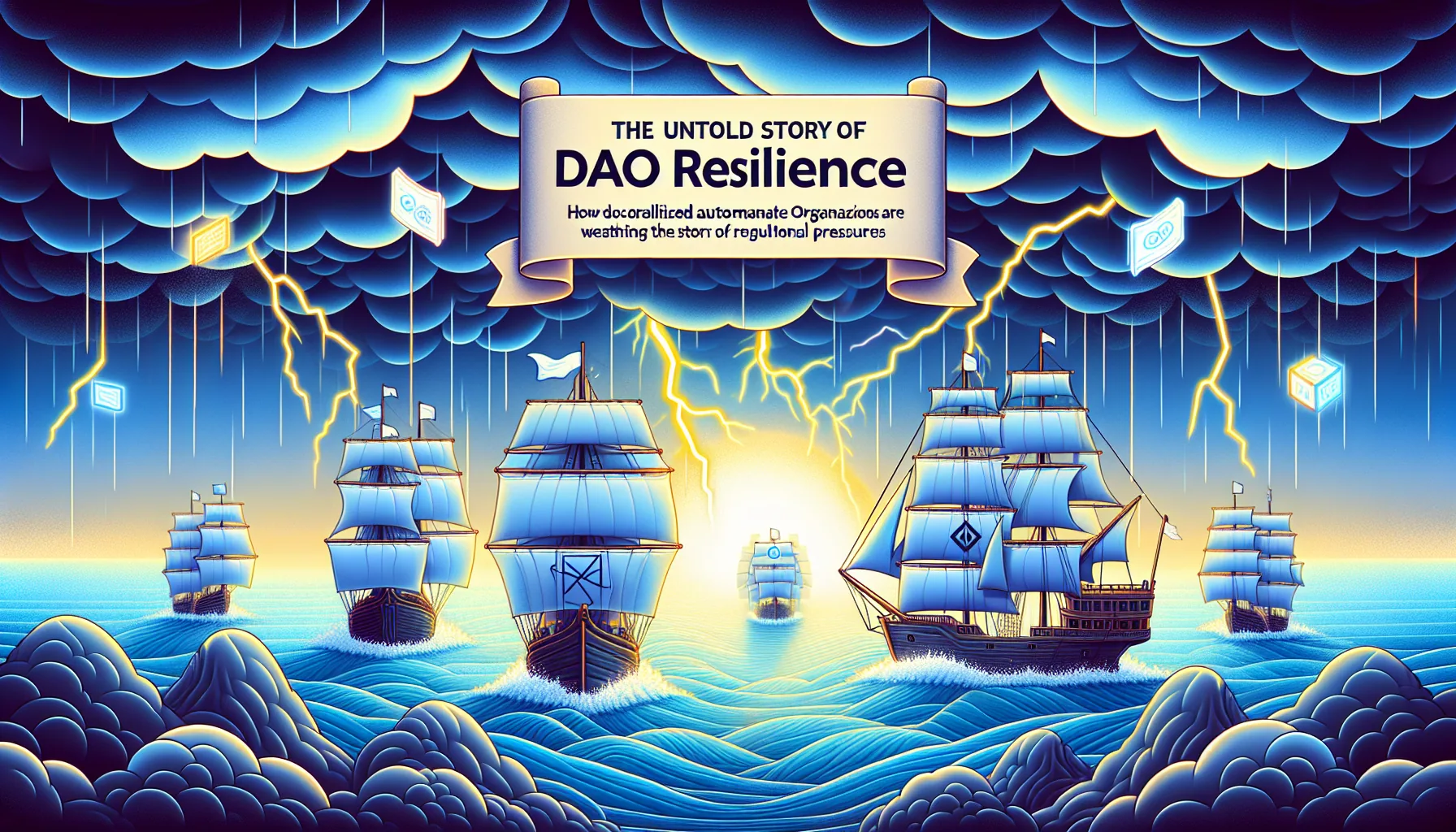
The Untold Story of DAO Resilience: How Decentralized Autonomous Organizations Are Weathering the Storm of Regulatory Pressures
Part 1: The Governance Obscurity No One's Talking About
While DAOs have eloquently positioned themselves as the ultimate evolution of organizational governance, a subtle yet existential threat looms in the background—an opaque interplay of regulatory uncertainty, legal liability, and jurisdictional dissonance. At its core, the issue is deceptively simple: DAOs lack legal personhood in most jurisdictions. But the implications are anything but.
This isn't a new problem, but one that has festered in the blind spots of even the most advanced DAO architects. With no universally accepted legal framework, DAOs operate in regulatory gray zones. In the absence of formal structures, the individuals who contribute to or benefit from DAO decisions risk being classified as general partners, opening them up to personal liability—without consent or recourse. In the case of adjudicated disputes, courts will not hesitate to treat DAOs as unincorporated associations. That classification brings with it burdensome responsibilities and crippling exposure under existing legal systems.
Ironically, DAOs were born from the urge to eliminate centralized points of failure, yet their resilience is being tested by the outside world's need for accountability. We've already seen regulators treat multisig signers or even key contributors as de facto controllers. The very idea of "code is law" collapses in front of a subpoena.
This issue is largely unexplored because of its complexity and the crypto ecosystem’s tendency to prioritize execution over compliance. Most crypto-native builders are incentivized to deliver product updates and hype-driven roadmaps, not to pre-emptively battle cross-border enforcement vectors. There’s also a cultural rebel bias: many DAOs reject structured intervention altogether, viewing any attempt at legal anchoring as a betrayal of decentralization’s ethos.
And yet, we’ve started to see cases where pseudo-anonymity does not shield DAO participants from enforcement. The consequences are real—asset seizures, website takedowns, reputational damage, and in some cases, litigation. Yet most DAOs remain unequipped, not even implementing fallback governance procedures should smart contract execution fail.
The implications ripple deeper than just governance. Interconnected DeFi protocols, multi-chain bridges, and yield-aggregators that lean on off-chain governance components via DAOs all inherit these vulnerabilities. The larger the composability, the greater the surface area for enforced accountability.
This story barely scratches the surface of the institutional fragilities DAOs face. It dovetails with The Overlooked Dynamics of Blockchain-Based Governance: What It Means for the Future of Decentralized Decision-Making, which reveals how superficial decentralization can be in practice.
What comes next is a gritty unraveling of the emerging frameworks, experimental legal wrappers, and shadow compliance strategies DAOs are quietly adopting to survive—without betraying their principles.
Part 2 – Exploring Potential Solutions
Emerging Tech in DAO Resilience: Exploring On-Chain Privacy, Modular Governance, and Jurisdictional Arbitrage
The search for DAO resilience under intensifying regulatory pressure has ushered in a wave of technical innovation. At the forefront are solutions blending smart contract flexibility with cryptographic tools and jurisdictional evolution. Several strategies stand out—each solving a surface-level governance issue while introducing new layers of complexity.
Modular Governance: Balancing Agility with Accountability
Projects like Moloch DAO and Zodiac have pioneered modular governance frameworks where governance logic is decoupled from core operations. These systems use plug-in governance modules, enabling DAOs to experiment with quorum rules, proposal flows, and even veto rights. While this approach enhances composability and rapid iteration, it doesn’t obviate the legal gray zones around controller liability—a core vulnerability highlighted in regulatory discourse.
Moreover, modular structures introduce economic risks if DAO members fail to audit or upgrade interdependent modules. In high-stakes ecosystems, this could lead to governance deadlocks or exploits. The system's strength—emergent complexity—is also a fragility when upgrades outpace member understanding.
ZK-Based Governance: Privacy Forward, Transparency Challenged
Zero-knowledge (ZK) cryptography is increasingly used in privacy-preserving voting and identity frameworks. Protocols like MACI (Minimal Anti-Collusion Infrastructure) allow vote anonymity while preserving tally integrity. This approach effectively counters voter coercion and Sybil attacks, but introduces new issues. For example, ZK rollups still rely on centralized sequencers in most implementations, creating a chokepoint that contradicts DAO decentralization ideals.
And while these systems promise legal deniability through anonymity, regulators may view them as obfuscation rather than protection. Compliance tooling embedded with proof-of-personhood mechanisms may be a middle-ground, though still vulnerable to off-chain identity leaks.
Jurisdictional Fragmentation: Legal Interoperability or Trap?
Some DAOs are experimenting with launching multiple sub-entities across crypto-friendly jurisdictions. Wyoming LLC wrappers, Marshall Island DAO legislation, and Liechtenstein’s TVTG are part of this trend, providing limited liability while preserving governance autonomy. Yet jurisdictional arbitrage is a whack-a-mole game. Multi-entity setups increase transaction costs, legal complexity, and challenge DAO composability.
Still, when structured strategically, this fragmentation allows DAOs to isolate regulatory risk by functional zone—core governance in one structure, asset holding in another, etc. But no jurisdiction yet supports full on-chain entity status with global recognition.
These disparate approaches suggest that resilience won’t come from a single solution, but from a layered cryptolegal stack. For more context on how these solutions integrate with evolving on-chain power structures, see the-overlooked-dynamics-of-blockchain-based-governance-what-it-means-for-the-future-of-decentralized-decision-making.
In Part 3, the focus shifts from theory to practice—analyzing DAOs attempting real-world implementation of these technologies and the outcomes they’re facing.
Part 3 – Real-World Implementations
Real-World DAO Implementations: Navigating Code, Community, and Compliance
The implementation of DAO resilience strategies rarely goes according to whitepaper diagrams or idealistic governance proposals. One stark example is Verasity, which upgraded its governance model to introduce a multi-layered verification mechanism aimed at mitigating the risks of Sybil attacks. The system initially gained support for its balance between community voting and economic staking mechanics. However, logistical friction quickly emerged — high gas fees on Ethereum conflicted with the DAO’s accessibility goals. Verasity attempted a partial migration to a Layer-2 solution, but voter drop-off post-migration revealed how interface fragmentation could unintentionally discourage participation. A detailed overview of Verasity’s evolving governance can be found here.
Meanwhile, ORDO embraced a more aggressive approach: fully automating quorum calculations via snapshot-based off-chain proposals synced with limited on-chain ratification. While this reduced overhead and sped up consensus cycles, it exposed a critical vulnerability—unverified but influential delegation. A community-initiated audit found that several “inactive vaults” continued to sway votes through stale power delegations. The team responded with auto-expiring delegation contracts, but skepticism persists about silent centralization in automated voting flows.
Blurt—positioning itself as a censorship-resistant content platform—introduced reputation-weighted voting as a form of delegated signal amplification. While it aligned with community ethos of creator equity, it created perverse incentives: whales were often incentivized to back popular but controversial content for maximum engagement rather than quality. Reputation graph manipulation became a real issue, prompting an overhaul involving extra staking penalties for repeated malicious engagement. Despite this, its token value failed to reflect increased participation, sparking debate over whether Blurt's governance changes addressed symptoms rather than root causes. For a closer look, refer to this deep dive on Blurt.
A more technically ambitious rollout came from a cross-chain DAO experiment running atop Cosmos IBC. The idea was simple: allow proposal origination on one chain, while execution could occur across others. In practice, latency, consensus incompatibilities, and cross-chain state delays led to multiple “shadow forks” where proposals appeared passed but failed to finalize across networks. The team behind the project had to hotfix quorum calculations mid-cycle—a jarring breach of immutability doctrine that fractured their validator community.
These implementations show a clear pattern: organizational decentralization is easier to theorize than to engineer. The symbolic decentralization of authority often collides with the need for functioning UX, sound economic game theory, and real-time coordination across protocols. As DAO-based governance pushes further into modular, multi-chain, and domain-specific setups, the long-term implications and viability require closer examination.
Part 4 – Future Evolution & Long-Term Implications
DAO Infrastructure Evolution: Scalability, Modularity, and Interoperability in the Next Phase
Decentralized Autonomous Organizations (DAOs) are approaching a pivotal inflection point, driven by tangible advances across modular execution stacks, Layer-2 scaling protocols, and zero-knowledge cryptographics. These emerging primitives point to a future where DAO frameworks abandon their monolithic architecture and instead adopt plug-and-play components—enhancing composability without compromising on decentralization.
One major vector of innovation is in off-chain computation and modular execution layers. By abstracting state transitions to execution layers like Optimism's Bedrock or Starkware's Cairo-based zkRollup environments, DAOs can gain EVM equivalence while significantly increasing throughput. This modularity isn’t without trade-offs; it introduces governance challenges when composable logic spans chains or rollups. Trust-minimized bridging protocols remain an unsolved bottleneck. As interoperability expands, the governance surfaces and attack vectors multiply.
Equally critical is the integration of intent-centric architectures. DAOs are beginning to experiment with autonomous agents capable of processing user-defined intents rather than explicit transaction execution. Such systems may rely on infrastructure similar to Flashbots' SUAVE or Account Abstraction pipelines under ERC-4337. While promising for UX and automation, they shift consensus and economic value from Layer-1 protocols towards execution relays—raising concerns over centralization creep hidden behind abstraction layers.
Interfacing with identity and reputation protocols is also climbing the DAO priority stack. Verifiable credentials (VCs) and decentralized identifiers (DIDs) are increasingly embedding into voting and access control frameworks. Projects looking to anchor identity logic into verifiable off-chain attestations now eye integrations with KILT Protocol and similar reputation-driven systems. However, quantifying influence without enabling plutocracy remains a delicate tension.
Cross-pollination between DAOs and tokenomic ecosystems is deepening as DAOs operate not just as governance wrappers but as value-creation engines. Protocols like Crypto.com's ecosystem, especially via https://bestdapps.com/blogs/news/the-overlooked-dynamics-of-blockchain-based-governance-what-it-means-for-the-future-of-decentralized-decision-making, showcase how on-chain treasury behavior, staking models, and incentive alignment directly condition long-term protocol success. Treasuries are evolving from passive asset holdings into yield-generating, real-time reallocation protocols using bonding curves, TWAMMs, and DAO-native liquidity layers.
Scalability isn't purely a throughput problem; it’s a governance equilibrium challenge. The move toward globally distributed subDAOs, permissionless working groups, and multi-chain deployment strategies push operational coordination beyond what today's tooling can natively support. DAO toolkits—like DAOhaus, Tally, or Snapshot—remain overly UI-centric rather than logic-centric, a constraint as roles evolve beyond simple yes/no voting.
As DAOs move from experimentation to critical infrastructure, these architectural changes will demand redefined governance models, a topic explored deeply in the continuation of this series focused on decentralization theory and composable decision-making engines.
Part 5 – Governance & Decentralization Challenges
Governance Under Pressure: Unpacking DAO Centralization Risks and Structural Attacks
The allure of Decentralized Autonomous Organizations (DAOs) lies in their promise of collective ownership and bottom-up governance. But beneath the autonomy veneer are unresolved governance tensions that threaten their long-term resilience. These challenges are not merely philosophical—they manifest in concrete technical, legal, and economic vectors vulnerable to exploitation.
One increasingly apparent pain point is the delegate model itself. Many DAOs rely on token-weighted voting systems, where governance tokens confer disproportionate influence. This opens up the possibility of plutocratic control—where a few token whales or VC-backed entities co-opt decision-making, undermining the DAO's decentralized ethos. This risk compounds over time as governance power consolidates, especially in tokenomic systems that reward incumbency.
Centralized governance designs often offer operational efficiency, but at the cost of resilience. A classic example is off-chain governance tied to multisig wallets or foundation boards. This model, though expedient for protocol upgrades or emergency management, becomes the bottleneck during regulatory pressure or internal factional disputes. On-chain transparent governance, by contrast, introduces its own challenges—voter apathy, low participation rates, and susceptibility to flash loan governance attacks through borrowed voting power.
Governance attacks are no longer theoretical. DAOs with minimal quorum thresholds and poorly designed proposal execution logic are actively targeted. Attackers propose malicious changes, wait for voter inactivity, and push them through with a few well-timed votes. In extreme cases, these exploits result in treasury siphoning or control of critical protocol functions. For DAOs with billions in total value locked, these are not edge cases but systemically significant risks.
Then there’s the specter of regulatory capture. As DAOs try to navigate institutional acceptance, many establish legally incorporated arms or interface with centralized DeFi frameworks. Ironically, the more compliant a DAO becomes, the more centralized it risks becoming. The interplay between seeking legitimacy and preserving decentralization has yet to find equilibrium.
Projects like Verasity have experimented with hybrid models, balancing staking-based governance with operational oversight. Their challenges, detailed in Understanding Governance in Verasity (VRA), underline the difficulty of maintaining decentralization without sacrificing efficiency or security.
Ultimately, governance architecture plays a defining role in the DAO's ability to endure scrutiny—be it regulatory, internal, or via outright sabotage. But even well-designed governance schemas face scalability issues, incentive misalignments, and UX frictions. These topics open the door to a broader discussion on scalability trade-offs, which we’ll explore next—how engineering decisions and infrastructure limitations shape the path to mass DAO adoption.
Part 6 – Scalability & Engineering Trade-Offs
Scaling DAOs: Architectural Trade-Offs Between Decentralization, Speed, and Security
The promise of Decentralized Autonomous Organizations (DAOs) wrestles constantly with structural limitations rooted in blockchain’s core: scalability. As DAOs mature beyond hobbyist governance into multi-billion-dollar collectives, the increasing complexity of on-chain coordination exposes a fundamental tension between decentralization, security, and throughput—the so-called “blockchain trilemma.”
Ethereum, the predominant DAO infrastructure layer, faces notorious throughput bottlenecks. Its current Proof-of-Stake (PoS) architecture processes approximately 15–30 transactions per second (TPS) on Layer-1, throttling high-voting activity periods and causing exorbitant gas fees. While Layer-2 rollups offer scalability relief with optimistic and zk-rollup tech, delegating governance logic to Layer-2 often fragments state continuity and may require cryptographic verification back on the base layer—reintroducing latency or additional trust assumptions. These limitations directly affect participation incentives in DAOs, leading to voter apathy and delays in decision finality.
In contrast, high-throughput Layer-1 chains like Solana or Avalanche employ consensus models that favor performance—but at considerable compromise in validator decentralization. Solana’s Proof-of-History, while delivering 1,000+ TPS, depends on high-spec nodes, reducing barrierless validator inclusion. This tilt toward performance raises concerns over DAO capture: fewer actors controlling the infrastructure layer increases risk of censorship or collusion across proposal execution.
Composability further complicates DAO architecture. DAOs often rely on interoperable protocols: multisigs for treasury management, oracles for quorum validation, strategy modules for yield allocation. Every module adds smart contract surface area, exposing DAOs to cross-protocol vulnerabilities. Exploits in DAO treasuries have demonstrated how engineering trade-offs—like prioritizing faster voting mechanisms or automated allocation—can undermine critical security guarantees.
Even governance layer trade-offs bite hard. Liquid democracy models with token-weighted voting (prevailing across protocols such as those using CRO governance tokens) offer technical scalability over 1:1 voting—but open vectors for plutocratic dominance. Voter anonymity, slashing conditions, and proposal thresholds must all be rigorously engineered to avoid systemic manipulation. For more on governance architecture in protocols like CRO, see The Overlooked Dynamics of Blockchain-Based Governance: What It Means for the Future of Decentralized Decision-Making.
Finally, DAOs relying on multichain participation face fragmentation concerns. Cross-chain voting requires bridging, which either imposes asset wrapping risks or entrusts consensus to centralized relayers. These choices are rarely neutral—they represent a calculus of either embracing convenience or fortifying censorship resistance.
The path to scalable DAO adoption hinges not just on throughput improvements, but on coherent structural design free of contradictory incentives. Regulatory and compliance architecture, often overlooked in favor of technical enhancements, will be dissected next.
Part 7 – Regulatory & Compliance Risks
DAO Regulation and Compliance: The Fragmented Legal Frontier
The legal uncertainties confronting decentralized autonomous organizations (DAOs) are not just theoretical—they’re existential. Unlike centralized entities, DAOs stake their operational legitimacy on code, not charters, making them difficult to classify under conventional legal frameworks. Jurisdictional ambiguity is among the most immediate threats: regulatory definitions of what constitutes a "legal person" vary substantially between countries, and DAOs often function across borders without a formal domicile.
In the U.S., for example, the absence of a unified federal stance on DAO classification has resulted in an ad hoc patchwork response. State-level frameworks like Wyoming's DAO LLC designation provide a degree of legal recognition, yet fall short of offering comprehensive compliance shields—particularly when federal agencies such as the SEC or CFTC investigate token issuance and voting frameworks for potential securities violations. Meanwhile, in regions like the EU, evolving MiCA (Markets in Crypto-Assets) regulations are stirring concerns around compliance burdens for protocols that weren't designed with traditional oversight in mind.
Historical cautionary tales like The DAO hack of 2016 continue to inform regulators' approach, reinforcing a cyclical narrative: innovation begets misuse, which begets scrutiny. DAOs, by their nature, blur the line between user and issuer, making it complicated to apply legacy principles like fiduciary duty and liability. This ambiguity raises strategic risks for protocol developers who choose to remain pseudonymous—especially when enforcement agencies seek accountability through Know-Your-Customer (KYC) and Anti-Money Laundering (AML) integrations.
Adding another layer of complexity, DAO treasuries open new doors for regulatory friction. Multisig wallets controlled through community governance are particularly vulnerable to conflicts over asset custodian roles and taxation structures. Questions remain unanswered: Who’s responsible for reporting taxable events? Where is the “tax home”? International regulators could interpret these differently, leading to inconsistent compliance obligations that strain DAO sustainability.
Interventionist scenarios also can’t be ruled out. Governments may demand clearer routes to halt smart contracts, impose licensing requirements for protocol facilitators, or mandate gatekeepers at DAO entry points via compliant RPC or front-end web access. These intrusions challenge the permissionless ethos upon which DAOs were founded.
Protocols rooted in hybrid DeFi-CeFi integrations, such as those discussed in A Deepdive into Crypto.com, are already navigating compliance compromises—something DAOs might increasingly confront as regulation intensifies. For developers or users migrating assets through such ecosystems, understanding jurisdictional exposure is no longer optional—it's survival.
As DAO resilience continues to be tested in legal arenas, the next focus shifts to analyzing the economic and financial repercussions tied to mainstream and institutional adoption of decentralized governance models.
Part 8 – Economic & Financial Implications
Economic Fallout or Financial Renaissance? DAO Disruption at the Market Core
Decentralized Autonomous Organizations (DAOs) are reshaping the economics of digital coordination and investment in ways that are beginning to fracture traditional structures. The disruption is deepest where capital, governance, and automation converge. With smart contracts controlling treasuries and community-driven voting mechanisms directing multi-million-dollar decisions, DAOs are no longer niche experiments—they are decentralized capital markets in their own right.
For institutional investors, DAOs pose both an opportunity and a challenge. On one hand, liquid governance tokens on decentralized exchanges offer a way to gain exposure to emerging sectors without direct equity, obviating the need for venture rounds or board seats. On the other, the lack of legal clarity and fragmented risk frameworks may disqualify them from participation under traditional compliance regimes. DAOs like those operating on L2 solutions have begun offering structured frameworks that mimic investor protections—but these are voluntary, unenforceable, and inconsistent.
Retail traders, meanwhile, have thrived in DAO ecosystems. The convergence of liquidity mining, token staking, and speculative governance markets has given rise to entirely new mechanics. However, this environment remains predatory for unsophisticated participants—made worse by vote-buying cartels, rug pulls masked as "governance exits," and liquidity exit traps. Flash loan attack vectors, combined with bidding manipulation in DAO treasuries, create risks that are unintelligible to most outside deeply technical circles.
Smart contract developers occupy a unique role in this ecosystem. Protocols live and die by their code, and yet very few developers operate with insurance, indemnity, or stable income mechanisms. While some DAOs now embed developer royalties or proposal-based grants, they also expose contributors to DAO governance forks and retroactive community backlash—especially when treasury funds evaporate after bad code executes.
On macroeconomic fronts, the growing presence of DAOs with hundreds of millions in managed assets raises concerns about capital coordination outside sovereign monetary control. Treasury allocations that rapidly shift from stablecoin to volatile assets by community votes may inadvertently fuel systemic instability, particularly when DAOs cluster around correlated assets. Cross-protocol dependencies may introduce cascading failures—similar to how UST’s collapse impacted DAOs reliant on Terra’s ecosystem.
A nuanced examination of governance architecture and organizational engineering—covered in a prior article, “The Overlooked Dynamics of Blockchain-Based Governance: What It Means for the Future of Decentralized Decision-Making”—is critical to understand how these risks are encoded.
As DAOs challenge conventional asset ownership, stakeholder influence, and collaborative capital allocation, the economic logic underpinning open finance is being rewritten—not just on-chain, but in the foundational ethos of digital markets.
The social and philosophical consequences of these shifts—particularly regarding autonomy, collective identity, and trust—will be explored next.
Part 9 – Social & Philosophical Implications
The DAO Effect on Markets: Disruption, Opportunity, and Economic Fragility
Decentralized Autonomous Organizations (DAOs) are reshaping economic frameworks by dismantling traditional hierarchies and introducing programmable governance at scale. At the market level, DAOs serve as autonomous capital allocators, turning otherwise illiquid community consensus into executable financial intent. This shift isn’t just theoretical—it's visible in the redistribution of value away from centralized infrastructures toward distributed governance protocols.
One of the most immediate disruptions is to venture capital itself. Protocol-native treasuries are increasingly funding early-stage projects through DAO votes, bypassing traditional seed funding mechanisms. This disintermediation threatens the gatekeeping relevance of institutional investors, although it simultaneously opens arbitrage opportunities for traders familiar with governance token dynamics. For example, acquisition strategies that focus on underpriced governance tokens ahead of anticipated proposal voting have emerged as a new form of activist investing—albeit in an environment with fewer regulatory guardrails.
Institutional players attempting to interact with DAOs face structural challenges. While token-based governance offers proportional influence, it also introduces sybil resistance issues and cartelization risks. Whales can dominate voting procedures, distorting supposedly community-led funds into instruments of capital capture. Smaller developers and community members may find themselves economically disincentivized to participate meaningfully, especially when vote-buying mechanisms skew outcomes.
On the upside, developers and technical contributors are seeing more equitable compensation formats via DAO treasuries. Instead of traditional employment models, contributors are rewarded through reputation-based proposals, Grants DAOs, or performance-triggered smart contracts. However, this model exposes contributors to price risk and volatile treasury policies, deterring long-term commitment and introducing atypical labor market stress. The shift in labor dynamics is further explored in this analysis.
DAOs also present fragmentation risks in liquidity coordination. As more capital pools shift from centralized exchanges to protocol-governed treasuries, liquidity may atomize unless bridged by interoperable governance. This weakens coordinated monetary policy across chains and contributes to capital inefficiency during black swan events.
Moreover, DAO governance forks—once rare—are becoming a strategic maneuver to resolve irreconcilable economic or political friction, further balkanizing value. Each fork or treasury split introduces economic risk tied directly to social consensus failures embedded in code.
As we edge further into environments defined by autonomous economic logic, the implications move beyond mechanics and into underlying collective philosophies. DAO structures not only shift capital—they challenge the foundational assumptions behind economic coordination itself.
Part 10 – Final Conclusions & Future Outlook
DAO Resilience in the Face of Regulatory Uncertainty: Final Insights and Scenarios
After dissecting the resilience of DAOs through governance, treasury management, legal arbitrage, and adaptive tooling, the endgame narrative, if there is one, feels increasingly bifurcated. DAOs today sit between two starkly different futures—one where decentralized governance becomes architecturally embedded in critical protocols and services, and another where regulatory capture forces them into centralized compliance frameworks or irrelevance.
In the optimistic scenario, DAOs evolve into programmable juristic entities recognized and protected across multiple legal jurisdictions. Treasury strategies mature, bolstered by better DAO-native risk management tools and automated incentive alignment protocols. Participation improves through modular governance UX stacks that encourage non-technical users to engage effectively. This future isn’t utopian but functional—akin to how Linux powers critical infrastructure without most users ever interacting with it directly.
But the darker trajectory remains plausible. Without cohesive cross-jurisdictional frameworks, DAOs may become fragmented—trapped between compliance burdens, the threat of domestic enforcement, and the challenge of decentralized consensus-building. Liability remains one of the largest unresolved risk vectors. The absence of limited liability protections and binding dispute resolution processes exposes DAO participants to significant personal risk—disincentivizing sophisticated contributors and capital.
Scalability remains another structural limitation. Many DAOs continue to operate more like Discord communities with multisigs than truly decentralized governance bodies. Without hardened governance protocols, voting fatigue and low quorum thresholds risk cartelization or governance attacks. True decentralization, in many cases, is more aspirational than actualized.
For DAOs to bridge into mainstream adoption, they must achieve three critical breakthroughs: jurisdictional clarity, composable security tooling, and incentive-aligned UX standards. The latter might involve integrations with reputation systems and on-chain proof-of-work that go beyond speculative token stakes. The relevance of insights from The Overlooked Dynamics of Blockchain-Based Governance cannot be overstated here.
Still, a lingering question refuses to fade: is the legal cage built around traditional corporate structures simply incompatible with permissionless logic? Even stablecoins like USDC and ecosystem tokens like CRO have faced intense scrutiny despite centralized oversight.
So much of DAO sustainability will hinge not just on surviving regulatory upheaval, but on meaningful evolution. Which raises the final provocation: Will DAOs become the operating system of decentralized society or merely an early experiment slowly extinguished under the weight of legal reality and human coordination limits?
Authors comments
This document was made by www.BestDapps.com