Part 1 – Introducing the Problem
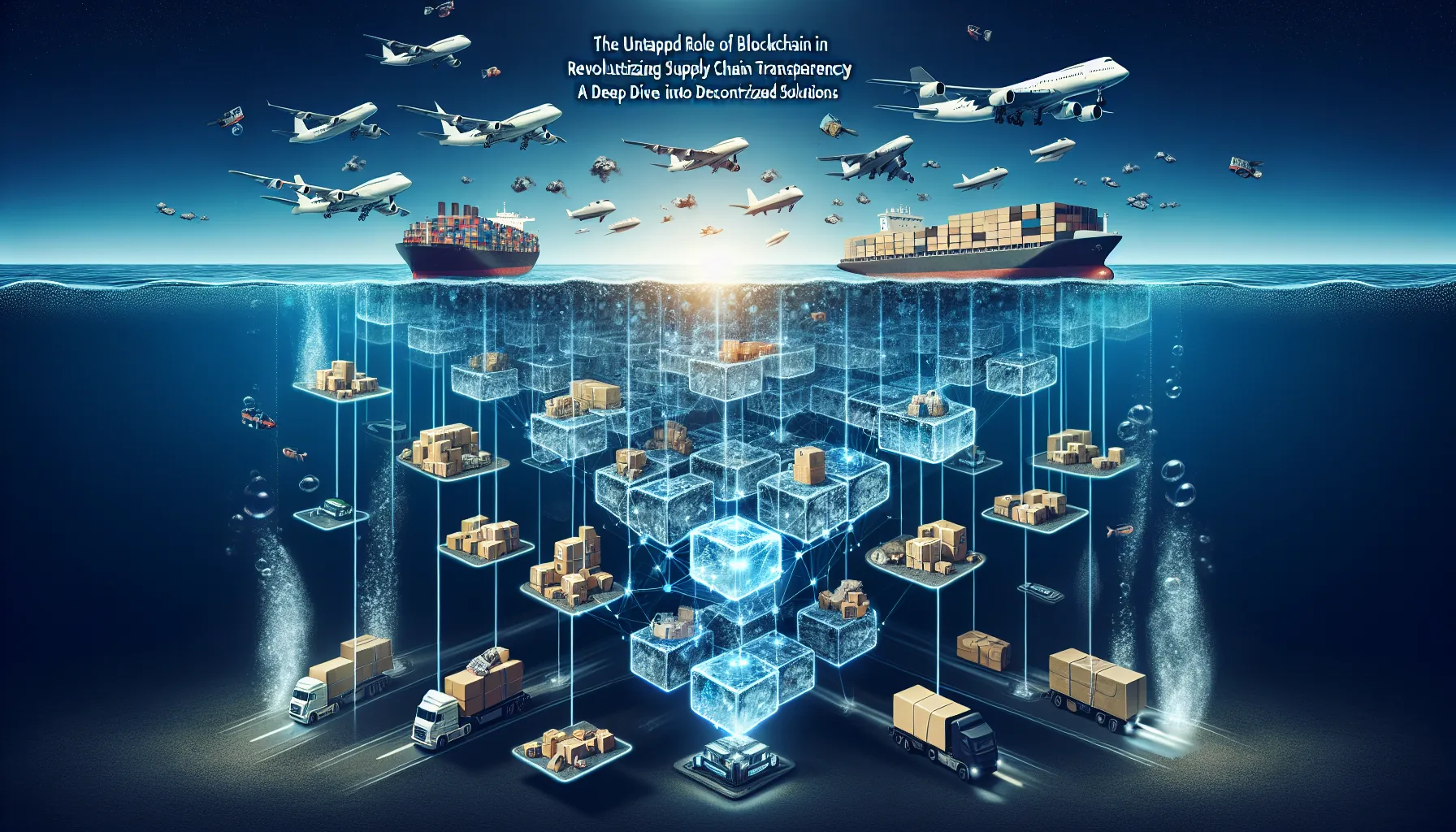
The Untapped Role of Blockchain in Revolutionizing Supply Chain Transparency: A Deep Dive into Decentralized Solutions – Part 1: Introducing the Problem
Supply chains are broken—not because they are slow or expensive, but because they are fundamentally opaque. Despite decades of digital transformation and enterprise resource planning systems, multi-tiered global supply chains still rely on fragmented data silos, black-box logistics, and unverifiable records across manufacturers, shippers, ports, warehouses, and retailers. Most concerningly, current tracking systems are often only as trustworthy as the centralized entities inputting the data—making fraud, corruption, and greenwashing not just possible, but routine.
While blockchain is often associated with crypto trading and DeFi, its implications for supply chain transparency remain largely unexplored. Tokenization, for instance, is predominantly discussed in the context of financial assets, smart contract-based derivatives, and synthetic instruments. Rarely is it applied to real-world economic input chains—the provenance proof for a shipment of lithium, the sustainability audit trail for fast fashion, or the certification chain for fair-trade cocoa.
Part of the problem is that enterprise blockchains have attempted to solve this from a permissioned angle: closed networks, managed by consortiums, limited by top-down governance, often controlled by the same opaque interests they're meant to disrupt. The result? Limited adoption, weak data integrity guarantees, and interoperability issues that prevent true global traceability.
Authenticity without decentralization is toothless. This makes transparent, trustless architecture—a defining attribute of public blockchain infrastructure—an unleveraged advantage in the supply chain sector. Yet, few crypto-native developers or protocols have moved into this arena. Why? Because it’s brutally complex. Anchoring physical world events to a trustless digital ledger involves solving oracle trust models, sensor input validation, privacy-preserving auditing, and cross-jurisdictional compliance barriers simultaneously.
Some projects on networks like the Oasis Protocol touch adjacent issues through encrypted data handling and confidential computation. Oasis' own aspirations for real-world data integrity through smart privacy infrastructure are relevant here—see https://bestdapps.com/blogs/news/the-overlooked-role-of-cross-chain-identity-solutions-bridging-user-sovereignty-across-decentralized-platforms—but have not yet been extended deeply into logistical applications.
The real obstacle isn't ambition—it’s the absence of composable decentralized solutions specifically designed to bridge ledger-based truth with real-world shipments. Blockchain rails already exist; what's left is to deal with the last-mile frictions, sensor validity, decentralized certification structures, and a scalable incentive system for decentralized validators to uphold supply chain data integrity.
The solutions aren’t speculative—they just remain largely unbuilt.
Part 2 – Exploring Potential Solutions
Blockchain-Based Mechanisms for Supply Chain Transparency: Emerging Solutions and Critical Challenges
In dissecting the failure points of traditional supply chains introduced previously—namely, data opacity, unverifiable sourcing claims, and centralized chokepoints—a range of blockchain-enabled solutions is beginning to surface. Yet, each comes with trade-offs in scalability, security, and real-world integration.
1. Permissioned Ledgers vs. Public Blockchains
Hyperledger Fabric and Quorum offer low-latency, permissioned environments attractive to enterprises. They prioritize throughput and data confidentiality, making them suitable for B2B ecosystems. However, the lack of open validation means trust is offloaded to consortium governance rather than cryptoeconomic consensus. Public networks like Ethereum and Avalanche push toward full transparency, but battles with throughput limitations and cost constraints hinder industrial-scale adoption.
2. Tokenizing Supply Chain Events
Token standards such as ERC-1155 allow multi-fungible item tracking while reducing on-chain storage redundancy. For example, token-bound credentials can represent pallets or shipments, dynamically updating status as they pass through checkpoints. This opens the door to automated compliance and recall protocols, but integrating such tokenization with legacy ERP systems remains brittle. Off-chain data inputs create oracles as a failure vector—unless hardened with decentralized verification layers.
3. Zero-Knowledge Proofs for Privacy-Preserving Audits
Projects utilizing zk-SNARKs or zk-STARKs (e.g., Mina Protocol's recursive SNARKs) are gaining traction in validating supply chain attestations without exposing sensitive data. A supplier can cryptographically prove compliance with labor standards without disclosing the entire certificate. However, ZK systems trade off computational cost for trust minimization. Without widespread SNARK-friendly hardware or layer-2 adoption, their use in high-volume logistics remains aspirational.
4. Decentralized Data Availability Protocols
Data availability remains the Achilles’ heel. Protocols like Celestia and EigenDA detach execution from storage, allowing modular verification of supply attestations without full chain bloat. While promising for off-chain-heavy systems, these frameworks are still maturing and face latency issues affecting real-time supply chain needs.
5. Cross-Chain Identity and Provenance Anchoring
Several projects are charting territory in cross-chain data identity. As outlined in The Overlooked Role of Cross-Chain Identity Solutions, bridging proof-of-origin across chains helps unify fragmented recordkeeping. Still, true provenance anchoring requires trust not in a single chain, but in cross-chain relay security—an area fraught with exploits and incomplete standards.
6. Incentive-Driven Transparency Markets
Finally, emerging paradigms blend DeFi with logistics. Stake-based verification systems utilize penalty slashing and reward mechanisms to enforce honest reporting. When paired with referral-based node growth (e.g., Binance sign-up incentives), these systems develop economic gravity. Still, aligning decentralized incentives with regulatory requirements and legal accountability remains largely unresolved.
Stay tuned as Part 3 breaks down the real-world use cases where these theoretical frameworks are already being tested under manufacturing, agriculture, and consumer goods supply chains.
Part 3 – Real-World Implementations
Blockchain-Powered Supply Chains: Case Studies and Technical Obstacles in Real-Time Deployments
Several blockchain initiatives have attempted to operationalize trustless transparency in supply chains, but execution has often revealed major technical and economic constraints—especially when bridging on-chain state with off-chain physical logistics.
One widely referenced case is IBM and Maersk's now-defunct TradeLens, a permissioned blockchain targeting global shipping logistics. Though it relied on Hyperledger Fabric, its closed-consortium model limited decentralized governance and suffered low on-chain participation. The protocol died due to a lack of network adoption from competing freight forwarders—a strategic misstep in open incentive design. The data silo mentality persisted even under a blockchain label.
Contrast this with more decentralized attempts like VeChain. Designed for supply chain provenance, VeChainThor enables real-time public attestations of product lifecycle data using smart contracts and IoT devices. In theory, it should allow every stakeholder—consumers, suppliers, regulators—to independently verify authenticity. In practice, the protocol faced major impedance when aligning consensus latency with fast-moving physical inventory. Furthermore, RFID tag tampering remains a core vector for supply chain forgery, highlighting one of blockchain’s oldest problems: garbage in, garbage out.
Provenance, a UK-based startup, also trialed an Ethereum-based transparency layer for food and fashion brands. While it provided immutable claims on ethical sourcing, the challenge wasn't throughput or gas optimization—it was user onboarding and real-world data integrity. Farmers and distributors were unwilling to digitize processes without tangible ROI, leaving gaps in the end-to-end supply narrative.
A technically promising solution has been multi-chain interoperability for credential management. For example, some projects have experimented with cross-chain identity credentials to validate vendor certifications across fragmented networks. This aligns with broader efforts seen in The Overlooked Role of Cross-Chain Identity Solutions: Bridging User Sovereignty Across Decentralized Platforms, highlighting how leveraging decentralized identity layers may resolve trust bottlenecks across heterogeneous systems.
On the incentivization side, tokenomics remains largely unsolved. While some deployments tried to offer token rewards for verified data inputs (e.g., node-stamped CO2 emissions), network inflation and oracle manipulation created exploitable attack surfaces. Permissionless participation, while ideologically pure, led to unverifiable claims being added to the ledger—demonstrating that token incentives, without robust data validation, backfire.
Despite the setbacks, these real-world trials offer invaluable insight into blockchain’s friction points in physical-world logistics—foreshadowing where iteration must occur for scalable adoption.
Part 4 – Future Evolution & Long-Term Implications
The Future of Blockchain-Based Supply Chain Transparency: Scaling, Privacy, and Interop Challenges Ahead
The long-term viability of blockchain as a transformative tool in supply chain transparency hinges on its ability to evolve beyond current architectural and infrastructural constraints. While early implementations have proven the concept, scaling these systems to match global logistics networks introduces persistent bottlenecks at both the protocol and consensus layer.
Zero-knowledge proofs (ZKPs) are a particularly potent area of research that holds promise to address privacy-preserving audits without sacrificing verifiability. Integrating ZK Rollups with supply chain blockchains could allow for granular product-level data exposure without compromising broader trade secrets. However, this introduces significant complexity in terms of computational footprint and verifier costs—especially on public blockchains such as Ethereum where gas fees spike under network congestion. Off-loading this logic to Layer-2 solutions like Optimism or ZKSync may shift performance limitations but introduces trust assumptions tied to bridge designs.
On-chain supply chain data must also operate across multiple ecosystems. Here, interoperability becomes critical. Projects like Celer Network are actively working on cross-chain messaging and state synchronization—with some traction in enabling asset transfers and communication across heterogenous chains. Their work in bridging infrastructure, detailed further in https://bestdapps.com/blogs/news/celer-network-pioneering-blockchain-scalability-solutions, acts as a relevant template, even though integrating them into supply chain workflows still faces performance and composability limits.
A further innovation vector comes from decentralized physical infrastructure networks (DePIN), where tracking devices, IoT sensors, and satellite-based timestamping interact with on-chain proofs of location and status. These integrations are nascent but could redefine provenance verification, providing cryptographic guarantees on physical events. Real-world data finality remains imperfect, though—data oracles and sensor manipulation remain attack vectors still without a fully decentralized resolution.
Tokenization of supply chain events (e.g. transformation of raw materials into SKUs represented by NFTs or SBTs) is gaining some theoretical backing among logistics players experimenting with digital twins. Still, the complexity of current token standards—lack of composability, high metadata fragmentation, and interop issues between NFT protocols—stands in the way of scalable adoption.
To compound this, regulatory ambiguity in different jurisdictions and lack of uniform standards across industries make harmonization especially elusive. While standards bodies explore blockchain-agnostic data schemas, their implementation is slow and fragmented.
Even well-intentioned deployments hit user experience walls. Without seamless UX layers and wallet abstraction, supplier onboarding—especially for small and medium enterprises—remains a friction point, even with subsidized infrastructure or B2B-centric L2s. Referral partnerships with platforms like Binance for fiat-crypto UX bridging could close part of that gap, although centralization risk resurfaces.
With many of the technical hurdles still unresolved, the focus ahead turns toward not just how these systems scale—but who governs them, and under what consensus. That’s where the mechanics of decentralization, protocol voting, and DAO-based dispute resolution begin to influence outcomes.
Part 5 – Governance & Decentralization Challenges
Governance and Decentralization in Blockchain-Powered Supply Chains: Navigating the Fault Lines
The allure of decentralized infrastructure for supply chains lies in its promise of transparency, immutability, and disintermediation. Yet the governance architectures underpinning these systems are riddled with tensions—especially when balancing decentralization with operational efficiency. These tensions aren’t just theoretical; they’re structural vulnerabilities, influencing real-world adoption in high-stakes industries like food traceability, pharmaceuticals, and defense logistics.
Decentralized Autonomous Organizations (DAOs), the preferred model for on-chain governance, are exposed to complex attack surfaces. Governance attacks, including vote-buying and delegation hijacking, can distort protocol upgrades, firmware disclosures, or critical API integrations. This becomes particularly dangerous in mission-critical supply chains where false data or delay in updates could result in product recalls or regulatory sanctions.
Conversely, centralized or semi-centralized governance offers speed and clarity, but sacrifices auditability and riddles the system with single points of control. In situations where a central node holds considerable sway—such as a logistics institution acting as a validating authority—the risk of regulatory capture becomes more than hypothetical. Once local or national regulators realize the chokepoints of these systems, the temptation for enforced standards or backdoor access escalates. These dynamics mirror concerns addressed in Empowering Voices: Governance in Celer Network, where concerns over token-weighted governance were laid bare.
Plutocratic governance models add another layer of complexity. On-chain voting often correlates voting power with token holdings—a feature, not a bug, in most proof-of-stake configurations. While defensible from a game-theoretic perspective, it structurally favors whales and early insiders who can stall or outright block governance proposals that dilute their control. This centralization of influence manifests strongly in supply chain contexts, where large incumbents may resist changes such as open APIs or whistleblowing triggers to protect legacy business models.
Moreover, fragmentation in off-chain governance mechanisms—like GitHub repos, Discord channels, and multisig treasuries—means that coordination failures are commonplace. Misalignment between on-chain votes and off-chain execution further erodes trust and creates brittleness in protocol maintenance. Without robust meta-governance frameworks, these projects remain susceptible to inertia or populist signaling without follow-through.
As we explore further in Part 6, resolving these asymmetries isn’t just a governance issue but also deeply tied to scalability and engineering trade-offs needed to push these systems into global industrial adoption.
Part 6 – Scalability & Engineering Trade-Offs
Blockchain Scalability in Supply Chains: Navigating the Decentralization Trilemma
Integrating blockchain into global supply chains reveals a complex matrix of scalability bottlenecks. At the core of the issue lies the decentralization trilemma—balancing decentralization, security, and speed without sacrificing one for the other. Public chains like Ethereum prioritize decentralization and security, but their throughput constraints are incompatible with the high transaction volumes and latency sensitivity seen in enterprise-grade logistics networks.
Permissioned blockchains like Hyperledger Fabric or private configurations of Cosmos SDK offer higher throughput due to reduced node participation and consensus overhead. However, they risk undermining the very decentralization that legitimizes transparent supply chains. For example, a delegated proof-of-stake (DPoS) network may deliver sub-second finality, but centralization of validators shifts the trust model from protocol to governance, reintroducing opacities blockchain aims to eliminate.
Consensus mechanisms are not a trivial consideration. Proof-of-Work (PoW) chains, while secure, are computationally intensive, unsuitable for IoT-driven supply events where thousands of interactions can occur per second across global endpoints. On the other hand, Proof-of-Stake (PoS)-based chains like those employed by the Oasis Network optimize energy usage and support parallel workloads. Notably, Oasis Network's unique architecture separates consensus from execution, facilitating scalability without completely forfeiting trustlessness. Still, this introduces architectural complexity and cross-layer security dependencies.
Layer-2 solutions provide another trade-off surface. While rollups (e.g., zk-rollups or optimistic rollups) can alleviate mainnet congestion, they introduce additional challenge periods, off-chain computation, and complexity in data availability. In a supply chain scenario where provenance and timestamping need to be tamperproof in real time, such delays or dependencies on sequencers could be operationally unacceptable.
Sidechain configurations, as seen in deployments like Celer Network, offer horizontal scaling benefits via state channel architectures and message routers. However, their trust model frequently requires users to assume additional security risks due to bridge validators and dependency on central relayers—a concern highlighted in Celer Network: Unpacking Key Criticisms and Concerns.
Integration with external systems—such as ERP software, GPS IoT sensors, and customs databases—also introduces scalability challenges beyond the blockchain itself. Orchestrating thousands of permissioned and permissionless interactions in hybrid mesh networks demands rigor in smart contract logic, event indexing, and off-chain computation layers.
No single chain currently resolves these trade-offs universally. Engineering decisions must prioritize based on specific supply chain requirements: Do stakeholders prioritize cryptographic finality in real time, or is settler-layer transparency enough for periodic auditing? These nuances will also intersect with compliance needs, which we’ll explore in Part 7, focusing on the regulatory and legal dimensions of deploying decentralized infrastructure in cross-border logistics systems.
Part 7 – Regulatory & Compliance Risks
Blockchain Supply Chains and Compliance Complexity: Regulatory Crosshairs and Legal Ambiguity
The decentralized architecture of blockchain introduces a fundamental misalignment with traditional regulatory frameworks—particularly when applied to global supply chain visibility. While the promise of trustless, immutable tracking appeals to logistics and manufacturing sectors, the compliance landscape is anything but static or universally accepted.
One of the most immediate issues is the problem of jurisdictional oversight. A supply chain dApp running on a decentralized protocol may touch data nodes governed by the EU’s GDPR, U.S. CCPA, or China’s Cybersecurity Law—each demanding specific forms of permission, auditability, and even data localization. Yet blockchain systems are inherently permissionless and geographically agnostic, making compliance with such regional mandates extraordinarily complex.
This creates a double exposure: networks are vulnerable to multi-jurisdictional enforcement and also must contend with inconsistent definitions of what qualifies as personal or trade-sensitive information. In the EU, for example, transparency features of public blockchains may conflict with “the right to be forgotten.” Conversely, U.S. SEC precedent interpreting certain blockchain tokens as securities casts a chilling shadow over platforms that use tokenized incentives to reward data input across decentralized supply networks.
Looking back, the aggressive clampdowns on privacy coins and unregistered token sales offer a warning. Government bodies have shown little hesitation in targeting node operators, developers, and even front-end architects for perceived regulatory breaches. In supply chain contexts, tokenizing shipping documents or creating incentive layers for supplier data raises the threat of similar regulatory attention—especially when such tokens are freely traded on international platforms like Binance (signup here).
Even non-tokenized implementations aren’t immune. Immutable ledgers used for recording inspections, certifications, or traceability proofs might inadvertently violate anti-fraud or reporting laws if they’re seen as supplanting licensed third-party entities. Efforts to automate compliance—via oracles or zero-knowledge proofs—remain underdeveloped, especially when dynamically interpreting legally binding regulatory change.
For blockchain-based supply chain platforms aiming to integrate cross-chain identity standards or on-chain reputation scoring, the line between lawful innovation and unauthorized data processing is dangerously thin. This is particularly relevant in light of frameworks examined in related systems such as the Oasis Network, which has explored privacy-first compute layers for sensitive data—a potentially compliant direction for supply logistics too (see more).
As developers tread this uncertain terrain, they must navigate overlapping audits, context-specific liability, and the possibility of de facto bans. The decentralized ethos that makes blockchain compelling also ensures its frictions with legacy law will remain unresolved for the foreseeable future.
In Part 8, we’ll dissect the economic disruptions posed by blockchain-based supply chain infrastructure—covering margin erasure, information asymmetry disintegration, and revenue model reconfiguration.
Part 8 – Economic & Financial Implications
Blockchain Disruption in Supply Chains: Economic Impacts, Opportunities, and Risks
The integration of blockchain into supply chain management introduces profound macro- and microeconomic ripple effects. By decentralizing record-keeping, transaction validation, and product traceability, blockchain could erode the market dominance of entrenched intermediaries—logistics conglomerates, third-party verifiers, and certification authorities—effectively compressing multi-billion-dollar industries into code-executed consensus layers.
This shift reshapes profit margins and creates asymmetric windfalls. Institutional investors anticipating these changes are already redirecting capital into permissionless chains and infrastructure projects tied to logistics use cases. We’re beginning to see early analogs in systems like Celer Network, where off-chain scaling solutions are designed for rapid transactional throughput—an essential feature for real-time inventory reconciliation across global supply nodes. Celer Network: Pioneering the Future of Blockchain offers a technical perspective for those studying the convergence point of scalability and supply logistics.
For developers, the demand curve is curving upward. Protocol-level engineering for composable tracking tools, zero-knowledge proofs for confidentiality in pricing and procurement, and NFT-based digital twins of physical assets now present lucrative opportunities. Smart contract engineers and oracle integrators building decentralized traceability layers may find themselves at the epicenter of new funding rounds and protocol treasuries.
However, this disruption also introduces underappreciated risks. Commodities traders relying on opaque supply chain practices may oppose blockchain’s immutable audit trails, as transparency could disintermediate brokers profiting from asymmetric information. Compliance frameworks also lag significantly behind the tech layer. The absence of enforceable international blockchain reporting standards amplifies the legal risks for corporate adopters—a challenge that could stall institutional onboarding.
Moreover, tokenization of supply chain assets could fragment liquidity across narrowly scoped ecosystems. While this offers granularity, it also runs the risk of capital silos, a vulnerability reminiscent of DeFi’s liquidity fragmentation issue. Swap fees and bridge risks between these asset-specific ledgers could replicate inefficiencies that decentralization was meant to resolve.
From a trader’s perspective, tokenizing physical goods feeds a new class of speculative instruments, but with unpredictable liquidity curves and demand dependencies. Unless synthetic markets evolve around them—with robust oracle integration and risk mitigation—it’s difficult to ensure long-term trading viability for tokenized commodities.
Blockchain’s synthesis with supply chain mechanics erects a new digital economy, but the winners and losers are far from set. As stakeholder incentives realign, the integration of decentralized identity and verifiable credentials may become crucial for access privileges among supply chain actors—an angle explored in detail in The Overlooked Role of Cross-Chain Identity Solutions.
In understanding this economic tilt, it becomes important to consider not only markets and capital—but also how trust, labor, and value itself are redefined under decentralization. This opens the door to critical questions around ethics, agency, and systemic equity—topics we'll unpack next through a socio-philosophical lens.
Part 9 – Social & Philosophical Implications
Economic Disruption and Financial Risks in Blockchain Supply Chain Transparency
The integration of blockchain transparency into supply chains does more than optimize logistics—it directly impacts market structures and capital allocations. By eliminating data silos and enabling tamper-evident provenance tracking, blockchain challenges traditional intermediaries like trade finance banks, customs brokers, and centralized logistics platforms. As their roles shrink, so does their economic moat. Liquidity previously tied up in inefficient reconciliation processes or misinformation hedging can be freed, redeployed, or vaporized entirely, creating both windfalls and wipeouts for incumbents.
Institutional investors are watching this pivot closely. The rise of permissioned blockchains like Hyperledger and public networks incorporating enterprise-grade features is creating new asset classes centered around tokenized bills of lading or smart contract-based inventory options. Tokenized supply chain finance is no longer theoretical; DeFi railroads are assembling infrastructure to support just-in-time liquidity through automated credit scoring or staking-based risk models. However, liquidity fragmentation across chains—especially in cross-border scenarios—still poses significant friction. Protocols exploring cross-chain identity as detailed in https://bestdapps.com/blogs/news/the-overlooked-role-of-cross-chain-identity-solutions-bridging-user-sovereignty-across-decentralized-platforms are gaining traction here.
For developers, this landscape fosters a bifurcation: those building supply chain-native dApps with fine-tuned UX, and those grappling with protocol interoperability, auditing complexities, and regulatory uncertainty. APIs integrating logistics or quality control sensors with blockchain records generate new streams of micropayment monetization. But developer reliance on multiple oracle networks—and jurisdiction-specific compliance modules—increases overhead and attack surfaces, which compounds the cost of innovation.
Traders and speculators also face a dual-edged opportunity. Tokens governing supply chain platforms (via DAOs or staking mechanisms) may offer exposure to real-world asset flows, but their market behavior often lacks correlation with underlying logistics data. This dissonance creates both arbitrage windows and risks of speculative bubbles in low-float tokens. Investors using platforms such as Binance to access early-stage tokens must be cautious, especially when utility is not directly integrated into supply chain anchors. Register on Binance if you plan to explore access to token offerings—but understand the systemic risks.
Misaligned incentives between transparency and privacy, particularly in competitive industries, could compel enterprises to fund or fork private blockchain variants, further fragmenting the ecosystem. Meanwhile, public adoption of transparent systems raises philosophical questions around digital labor, pseudonymity, and algorithmic trust—topics that open the door for a deeper social and ethical investigation.
Part 10 – Final Conclusions & Future Outlook
Blockchain and Supply Chain Transparency: A Future Hanging in Balance
Throughout this series, we’ve dissected the convergence of blockchain and supply chain systems—from provenance tracking, decentralized audit trails, and automated compliance, to the integration of smart contracts and zero-knowledge proofs for privacy-preserving verification. While the potential remains undeniably disruptive, the path to mainstream adoption is littered with both promise and pitfalls.
Fundamentally, blockchain offers a new infrastructure for transparency, making it theoretically impossible to falsify logistical data without detection. But in practice, we’ve seen ongoing fragmentation across protocols, data silos due to inconsistent formatting standards, and the persistent off-chain/on-chain gap—especially in industries like pharmaceuticals and electronics where sensor fidelity and real-time oracles are critical.
The best-case scenario involves true end-to-end traceability, enforced by tamper-resistant records and augmented with privacy layers like zk rollups or fully homomorphic encryption. If decentralized identifiers (DIDs) and verifiable credentials reach interoperability across chains, and regulatory frameworks evolve to embrace on-chain documentation, supply chains could become self-auditing, machine-verifiable entities. For more insight into how such interoperability can be enabled, see the-overlooked-role-of-cross-chain-identity-solutions-bridging-user-sovereignty-across-decentralized-platforms.
However, the worst-case scenario isn't a dramatic failure—but slow irrelevance. Blockchain solutions that aren't paired with effective real-world integrations may be seen as cost centers rather than operational enablers. Without credible enforcement mechanisms or buy-in from Tier 1 suppliers and regulators, blockchain may just become a glorified spreadsheet—immutable, yes, but unused.
Several hard questions remain unanswered: Who controls the data input layer? Can oracles ever be truly trustless in high-stakes environments? Will zero-knowledge proof systems scale without usability compromises? And perhaps most significantly, can decentralized governance models evolve fast enough to adapt supply chain protocols to frequent regulatory changes?
For mass adoption, three key developments are necessary: globally accepted data standards driven by consortium blockchains, improvements in off-chain data integrity, and seamless regulatory interfacing. The underlying infrastructure must not only be secure and scalable but composable enough to act as a shared utility layer across industries and borders.
In a space defined by volatility and innovation, blockchain as a trust fabric for supply chains stands at a crucial juncture. Will it define the very purpose of decentralization going forward—or quietly join the graveyard of unrealized blockchain promises?
And ultimately, in a sector where logistics rule and time is money, can blockchain finally deliver more value than complexity?
Authors comments
This document was made by www.BestDapps.com