Part 1 – Introducing the Problem
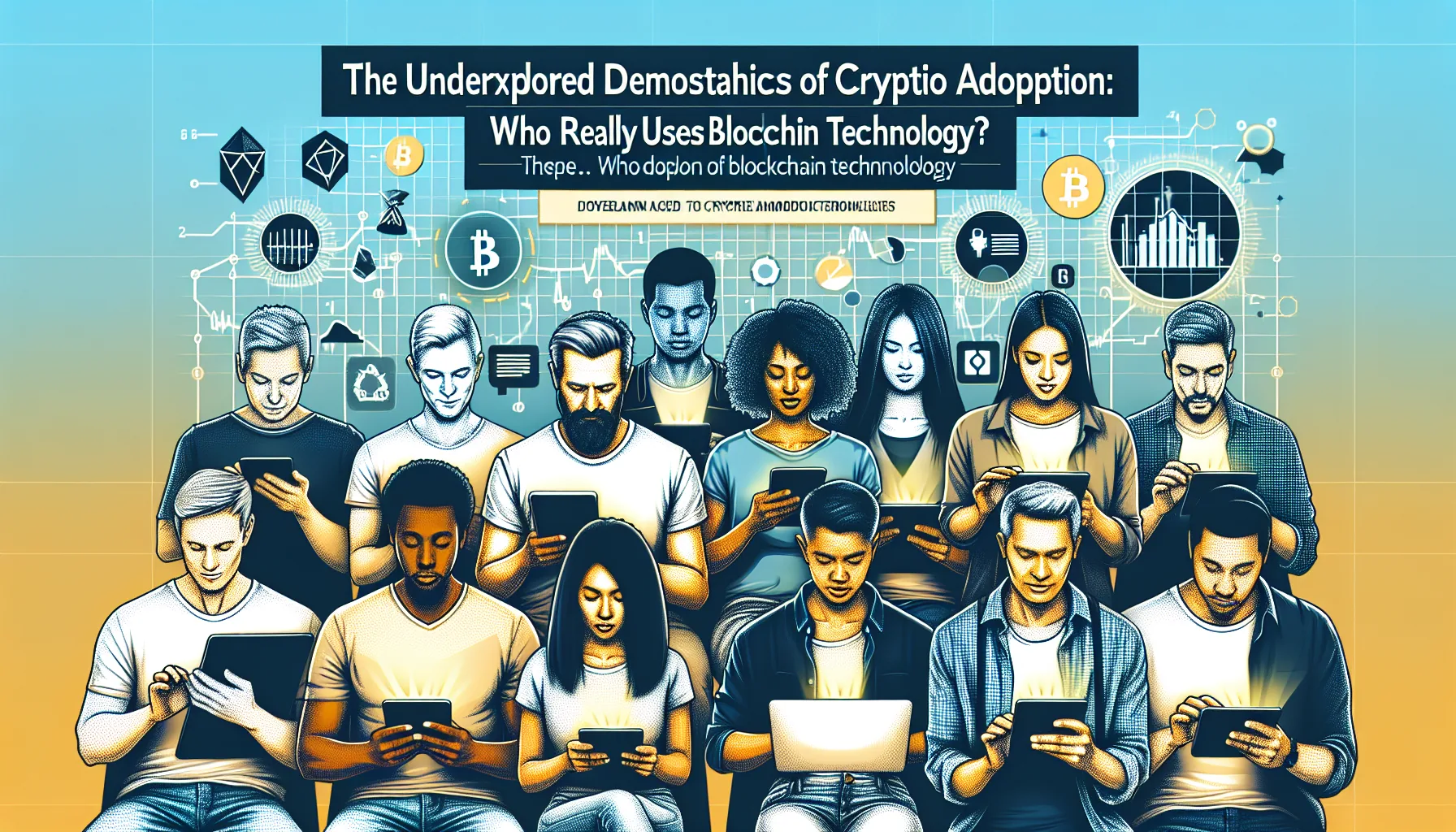
The Underexplored Demographics of Crypto Adoption: Who Really Uses Blockchain Technology?
The Myth of Crypto’s Universal Adoption
Despite the prevailing narrative that crypto adoption is a global phenomenon, underlying demographic trends remain largely unexamined. While institutional investors, speculation-driven retail traders, and DeFi enthusiasts dominate the conversation, there are entire segments of users whose presence in the space is either ignored or underestimated. This blind spot significantly impacts blockchain design, governance models, and market positioning.
The Unknown Participants Shaping the Ecosystem
Crypto projects often cater to tech-savvy developers, financial traders, and yield-farming aficionados, but what about the silent adopters—those using blockchain solutions without participating in speculative markets? Emerging trends suggest that certain unexpected demographics, from unbanked populations in developing countries to niche subcultures leveraging blockchain for unconventional use cases, may play a far greater role than commonly acknowledged.
Some of these underexplored users engage with layer-2 scaling solutions, social token ecosystems, or cross-chain interoperability tools to navigate financial barriers that traditional banking cannot address. Yet, because they do not fit the conventional mold of a “crypto user,” their impact remains invisible in most adoption metrics.
Why This Remains Overlooked
The tendency to evaluate crypto adoption through transaction volume, exchange activity, and TVL (Total Value Locked) frameworks leads to biases that exclude non-traditional users. Many of these metrics cater to profit-driven participants rather than those leveraging blockchain for practical, real-world applications.
In addition, most crypto adoption reports rely on surveys conducted within the industry, creating an echo chamber that reinforces existing assumptions. Without a broader, data-driven approach that includes overlooked demographics, crypto’s evolution risks becoming insular, overlooking critical design considerations necessary for more inclusive engagement.
The Potential Consequences
Ignoring these underexamined user groups can create structural inefficiencies in blockchain design, governance, and ecosystem development. Many projects optimize for high-frequency traders or liquidity providers while neglecting those who engage with blockchain as an infrastructure layer rather than an investment vehicle.
For instance, governance frameworks in DAOs often assume active participation from token holders, yet if portions of the user base remain silent, governance models may suffer from inaccurate voter representation. A related discussion on the unseen influence of blockchain governance models can be found here.
Bridging the gap between these silent adopters and mainstream blockchain narratives will require rethinking adoption metrics, revising governance structures, and reassessing user scalability beyond just financial speculation.
Part 2 – Exploring Potential Solutions
Emerging Technologies Addressing Crypto Adoption Barriers
1. Decentralized Identity (DID) Solutions
One of the most promising solutions to crypto’s adoption gaps is Decentralized Identity (DID). Many underserved demographics struggle with access to finance due to a lack of verifiable identity. DID protocols such as Verifiable Credentials (VCs) and Self-Sovereign Identity (SSI) enable individuals to prove aspects of their identity without relying on centralized authorities.
Strengths:
- Privacy-focused – Users control their own identity data.
- Global accessibility – DID systems can onboard users without traditional banking access.
- Mitigates fraud – Reduces the reliance on centralized databases prone to breaches.
Weaknesses:
- Adoption friction – Requires integration with existing identity frameworks, which are often resistant to change.
- Scalability concerns – Many DID solutions depend on Layer 1 blockchains, which could introduce bottlenecks.
For more on the relevance of DID in crypto security and trust mechanisms, explore The Underestimated Power of Decentralized Identity in Strengthening Ecosystem Security in Blockchain Applications.
2. Layer 2 Scalability Enhancements
Many underserved communities experience crypto in environments with high fees and sluggish transactions, deterring actual use. Layer 2 solutions address these challenges by enabling faster, cheaper interactions on blockchain networks.
Strengths:
- Cost efficiency – Drastically reduces gas fees, making transactions viable for low-income users.
- Speed enhancement – Immediate confirmations improve usability for real-world applications.
Weaknesses:
- Security trade-offs – Some implementations compromise decentralization for efficiency.
- Interoperability issues – Cross-chain functionalities between different Layer 2 solutions remain limited.
For deeper insight into Layer 2, read The Hidden Challenges of Layer 2 Solutions: Are They Really the Answer to Blockchain Scalability?.
3. Crypto UX and Human-Centered Design
Crypto adoption remains hindered by poor user experience (UX). Many excluded demographics interact with financial tools designed without usability in mind. Projects focusing on human-centered design aim to make wallets, DeFi platforms, and dApps more intuitive.
Strengths:
- Onboarding simplification – Reduces friction for non-technical users.
- Reduces user error – Intuitive interfaces can prevent costly mistakes in transactions.
Weaknesses:
- Implementation inconsistency – Not all projects prioritize UX, leading to fragmented experiences.
- Security risks – Simplified UX could result in abstracted security controls, making new users more vulnerable.
A discussion on user-friendly DeFi design strategies can be found in Understanding the Role of User-Centric Design in Enhancing DeFi Adoption.
4. Tokenized Social Infrastructure
Using blockchain-based financial incentives to engage underserved communities in social and digital economies could drive meaningful adoption. Tokenized social platforms incorporate rewards for participation, helping onboard entire demographics that may not initially prioritize crypto.
Strengths:
- Direct incentivization – Encourages active participation with real financial upside.
- Decentralized moderation – Reduces censorship risks in certain economies.
Weaknesses:
- Sustainability concerns – Many token economies struggle to maintain value beyond speculation.
- Regulatory challenges – Can be perceived as securities, leading to legal uncertainty.
For more on tokenized engagement, refer to The Hidden Value of Tokenized Social Media: A New Frontier in Digital Engagement.
Part 3 – Real-World Implementations
Real-World Implementations: Blockchain Networks and Startups in Action
Metis: A Layer 2 Scaling Solution with Trade-Offs
Metis has emerged as a notable Layer 2 solution, aiming to improve Ethereum’s scalability through optimistic rollups. The project emphasizes decentralized sequencers to reduce reliance on central entities, but this implementation has been far from seamless. One of the key challenges has been ensuring finality without excessive delays—Ethereum’s Layer 1 confirmation times combined with fraud-proof windows create an inevitable trade-off between speed and decentralization.
Additionally, Metis has attempted to differentiate itself with a focus on DACs (Decentralized Autonomous Companies) to encourage real-world adoption by enterprises. However, onboarding traditional businesses has proven to be an uphill battle due to regulatory uncertainties and the technical barrier of integrating blockchain-based operations. More details on Metis’s challenges and innovations can be explored here.
TRACX: Supply Chain on the Blockchain
Supply chain management has long been discussed as a prime use case for blockchain, and TRACX has attempted to bring this vision to life. By leveraging smart contracts and immutable ledgers, TRACX aims to provide end-to-end transparency in logistics. One of its biggest hurdles has been scaling with real-world demand. Data integrity remains a significant issue—while blockchain ensures transparent records, the transition from off-chain to on-chain data inputs still requires trust in the original source.
Additionally, many enterprises remain wary of fully decentralized solutions due to compliance requirements. TRACX has tackled this by offering both permissioned and permissionless models, but striking a balance between accessibility and decentralization continues to pose a challenge. TRACX is further examined in this deep dive.
BLKZ: Governance Experimentation with Uncertain Results
Decentralized governance often promises user empowerment, but BLKZ has experienced firsthand the difficulties of practical implementation. The project set out to create a truly community-driven governance model, yet fluctuations in voter participation and the technical complexity of on-chain voting mechanisms have weakened the intended vision. One recurring issue has been the concentration of governance power among large token holders, leading to concerns of plutocracy instead of genuine decentralized decision-making.
Additionally, BLKZ has experimented with tokenomics designed to incentivize long-term participation, but the effectiveness of these mechanisms remains uncertain. The project continues to iterate on governance structures, knowing that broader participation remains a bottleneck. More about BLKZ’s governance model can be found here.
These case studies illustrate the real-world challenges faced by blockchain projects. While the technology brings undeniable innovation, practical limitations and market realities continue to shape its trajectory.
Part 4 – Future Evolution & Long-Term Implications
The Future Evolution of Blockchain: Scaling, Innovation, and Interoperability
As blockchain technology evolves, its long-term viability depends on solving critical bottlenecks such as scalability, privacy, and interoperability. Emerging solutions like zero-knowledge proofs (ZKPs), modular blockchain architectures, and Layer 2 innovations are pushing the ecosystem toward greater efficiency. However, these advancements come with trade-offs in decentralization, governance complexity, and network security.
Next-Generation Scalability: Modular vs. Monolithic Chains
A fundamental shift is underway in how blockchains are designed. The debate between monolithic and modular blockchain architectures continues to shape the industry’s future. Monolithic chains like Solana optimize for speed and low latency but struggle with decentralization and security. In contrast, modular chains separate consensus, data availability, and execution layers, enabling greater flexibility.
Rollups, particularly optimistic rollups and ZK-rollups, are leading the scalability charge. While rollups drastically reduce on-chain computation costs, they introduce new concerns around centralization, validator incentives, and exit delays. Solutions such as Metis, which leverages optimistic rollup tech, highlight both the promise and challenges of Layer 2 scaling. For a deeper dive into this ecosystem, see https://bestdapps.com/blogs/news/unlocking-metis-ethereums-game-changing-layer-2-solution.
Cross-Chain Integration: The Rise of Interoperability
As blockchain ecosystems fragment, interoperability has become a critical priority. However, cross-chain protocols have exposed vulnerabilities, as demonstrated by numerous bridge hacks. New approaches, including trust-minimized interoperability protocols and shared security models, offer potential answers but remain in early stages.
The move toward generalized messaging layers like LayerZero and Axelar aims to unify liquidity and smart contract interactions across chains. The bigger question is whether blockchain ecosystems will converge around a few dominant hubs or continue diverging into increasingly specialized networks.
The Role of Zero-Knowledge Proofs in Privacy and Security
ZKPs are rapidly advancing, enabling scalable privacy solutions for public blockchains. While ZK proofs offer breakthrough solutions for private transactions, identity verification, and authentication, they also introduce computational overhead and usability concerns. Continued improvements in recursive ZK proofs and hardware acceleration will determine their adoption at scale.
However, applying ZK tech to governance and decision-making presents unresolved challenges. As Layer 2 solutions leverage ZKPs, their governance mechanisms will have to adapt to maintain transparency while safeguarding user data.
With these advancements, blockchain infrastructure will become more modular, private, and interconnected. The next major challenge is governance—how decision-making power is distributed in this evolving landscape.
Part 5 – Governance & Decentralization Challenges
Governance & Decentralization Challenges in Crypto Adoption
Decentralization vs. Centralization: The Paradox of Blockchain Governance
Blockchain technology was built on the promise of decentralization, yet its governance models create conflict between democratic ideals and practical implementation. On one side, fully decentralized systems aim for censorship resistance and community-driven decision-making. On the other, centralized governance structures ensure agility and compliance. But which approach fosters sustainable adoption?
Decentralized autonomous organizations (DAOs) and on-chain governance mechanisms put power into token holders’ hands. However, this often leads to oligarchic systems where wealth concentration dictates governance. In contrast, centralized leadership—especially in enterprise-driven chains—offers clear decision-making pathways but risks regulatory capture and censorship.
The Threat of Governance Attacks
Decentralized governance is not immune to manipulation. Take governance token voting: a single entity accumulating tokens can steer a project in self-serving directions, undermining decentralization. This plutocratic control can lead to hostile takeovers, particularly in projects with low voter turnout.
An emerging governance threat is "governance mining," where attackers accumulate voting power cheaply and then exploit it to push harmful proposals or drain treasury funds. Without robust security measures and effective voter participation, DAOs are susceptible to orchestrated governance attacks.
Regulatory Capture: The Inevitable Centralization?
As blockchain adoption grows, governments and regulatory bodies exert greater influence over governance structures. The collapse of pseudonymous governance can be seen in several jurisdictions pushing for KYC and compliance frameworks that target decentralized protocols.
A key concern is the forced gatekeeping of decentralized networks, where infrastructure becomes dependent on centralized service providers. Validators, RPC nodes, and front-end access points are often controlled by a few entities, making "decentralization" more theoretical than practical. These vulnerabilities dilute the very principles blockchain aims to protect.
Centralization Bottlenecks in Layer 2 Solutions
Many Layer 2 solutions claim decentralization but over-rely on centralized sequencers or administrative control. Optimistic rollups, for example, often feature a single "operator" who processes transactions before fraud proofs can be submitted. While these models promise a path to decentralization, current implementations introduce points of failure.
This centralization is not just a theoretical concern—governance failure at the L2 level could result in censorship, collusion, or, in extreme cases, state intervention. Some projects, like Metis, have approached decentralization with unique transaction validation frameworks, but whether they can maintain security without inviting inefficiencies remains a key issue. Read more about Metis governance models here.
The Governance Dilemma Moving Forward
Crypto governance remains an evolving battleground. Between economic concentration, governance takeovers, and regulatory threats, many projects struggle to balance efficiency with decentralization. However, governance constraints also play directly into another pressing challenge—scalability. The next part of this series will explore the trade-offs necessary to bring blockchain technology to mass adoption without compromising its foundational principles.
Part 6 – Scalability & Engineering Trade-Offs
Scalability & Engineering Trade-Offs in Blockchain Adoption
Scalability remains one of the most significant challenges in blockchain adoption. As the user base grows, networks must balance decentralization, security, and transaction throughput—often forced to sacrifice one to improve the other two.
The Scalability Trilemma: A Persistent Bottleneck
Vitalik Buterin’s “Scalability Trilemma” suggests that a blockchain cannot simultaneously optimize decentralization, security, and scalability. Bitcoin and Ethereum, for example, prioritize decentralization and security but struggle with transaction speed and cost. Layer 2 solutions, like rollups, aim to bypass this by offloading computations off-chain, but they introduce new complexities, such as reliance on centralized sequencers or delayed finality guarantees.
Architectural Divergence: Monolithic vs. Modular Blockchains
Monolithic blockchains like Solana attempt to handle consensus, execution, and data availability within a single architecture, achieving higher throughput but often at the cost of decentralization. In contrast, modular blockchains, including Ethereum with rollups, separate these functions to optimize efficiency—but this fragmentation increases interoperability challenges and requires robust coordination between layers.
Projects focusing on modular blockchains heavily rely on cross-chain communication protocols, which introduce new attack vectors. A breakdown in these systems can lead to issues such as state discrepancies across chains or economic security failures in multi-chain ecosystems.
Consensus Mechanisms: Speed vs. Security
PoW (Proof of Work) remains the most secure consensus mechanism but is inherently slow and resource-intensive. PoS (Proof of Stake) variants offer improved scalability but introduce trade-offs, such as validator centralization risks and potential long-range attacks.
Innovative consensus models like DAGs (Directed Acyclic Graphs) or hybrid PoS/PoW solutions attempt to overcome these issues with asynchronous processing, but they often sacrifice user experience due to increased complexity in finality validation. In Layer 2 environments like Optimistic Rollups, fraud proofs ensure security, but users face withdrawal delays—creating friction in liquidity movement between layers.
The Layer 2 Challenge: Scaling Without Fragmentation
Even among Layer 2 frameworks, not all solutions align. Optimistic Rollups rely on fraud proofs but introduce latency, while ZK-Rollups process transactions faster but require high computational resources. This balancing act mirrors the broader dilemma in blockchain scalability: whether the trade-offs are acceptable depends on the intended use case.
For example, Metis aims to solve Ethereum’s scalability issues through fast finality and decentralized sequencers, but it must ensure these features do not jeopardize security or increase barriers to entry for node operators.
Introduction to Regulatory & Compliance Risks
While scaling solutions attempt to improve blockchain efficiency, they introduce concerns about compliance and legal constraints. How do regulatory bodies view Layer 2 solutions or decentralized applications bridging multiple jurisdictions? In the next section, we will examine the regulatory and compliance challenges blockchain faces as it integrates with traditional finance and global markets.
Part 7 – Regulatory & Compliance Risks
Regulatory & Compliance Risks in Crypto Adoption: Navigating a Fragmented Legal Landscape
The widespread adoption of blockchain technology faces significant regulatory and compliance challenges. Governing bodies in various jurisdictions are either tightening restrictions or struggling to establish clear frameworks, creating uncertainty for projects and users alike. The key risks affecting crypto adoption can be categorized into jurisdictional conflicts, enforcement inconsistencies, and emerging regulatory precedents.
Jurisdictional Conflicts & Legal Fragmentation
Crypto regulations vary wildly between countries and regions. While some nations promote innovation through sandbox environments and progressive frameworks, others impose draconian restrictions that hinder development. This disparity leads to a patchwork regulatory landscape where businesses must navigate multiple compliance requirements simultaneously.
For example, decentralized finance (DeFi) protocols that operate without clear geographical boundaries often face scrutiny from regulatory agencies claiming extraterritorial jurisdiction. Platforms facilitating financial transactions must decide whether to comply with the strictest regulations globally or risk legal repercussions by operating in more permissive environments.
Enforcement Risks & Clashing Regulatory Approaches
One of the biggest uncertainties for crypto adopters is inconsistent enforcement. Even within the same country, agencies may have conflicting views on the classification of digital assets. Some classify cryptocurrencies as securities, while others regard them as commodities or even mere digital representations of value. This lack of uniformity creates compliance risks for developers, exchanges, and users.
Case law and regulatory action also evolve unpredictably based on political shifts. Changes in leadership at financial oversight agencies can lead to sudden reversals in policy, making it difficult for businesses to plan long-term strategies. Companies that attempt compliance in one jurisdiction may find themselves targeted by a different authority based on different interpretations of existing laws.
Historical Regulatory Precedents & Their Implications
Regulatory decisions from past legal battles provide insight into possible future challenges. Actions against major exchanges and crypto lending platforms have resulted in precedents that impact the wider crypto space. Crackdowns on permissive stablecoin issuance, privacy-enhancing technologies, and cross-chain transactions signal areas of vulnerability for projects operating on similar models.
Moreover, compliance frameworks like the Financial Action Task Force (FATF) Travel Rule continue to push for stricter KYC/AML oversight in decentralized environments. This is particularly impactful for DeFi protocols, which traditionally rely on pseudonymous interactions. Blockchain governance models that fail to incorporate regulatory considerations risk becoming unviable in heavily regulated regions. A deeper examination of such governance structures can be found in this article.
The Regulatory Future & Economic Consequences
As governments advance their oversight, blockchain projects must either adapt, decentralize further, or face legal roadblocks. This regulatory uncertainty directly influences adoption rates and economic outcomes. In the next section, we explore the economic and financial ramifications of crypto adoption, examining how regulatory landscapes impact innovation, investment flows, and institutional involvement in the space.
Part 8 – Economic & Financial Implications
Economic & Financial Implications of Crypto Adoption: Market Disruptions, Investment Shifts & Risks
Disrupting Traditional Markets
Blockchain technology is forcing a reevaluation of financial structures once considered untouchable. Banks are losing their monopoly on transaction settlement, remittances, and lending as decentralized financial (DeFi) platforms offer permissionless alternatives. Meanwhile, supply chain finance, real estate tokenization, and on-chain insurance are reducing reliance on intermediaries. Institutional investors, once dismissive, are increasingly allocating capital toward crypto assets—not just for speculation but as a hedge against inflation, liquidity crises, and even regulatory overreach.
The rise of Layer 2 solutions like METIS has further streamlined blockchain adoption, lowering fees and increasing scalability. However, this efficiency could also erode the profitability of traditional clearinghouses and credit networks. For an in-depth examination of METIS’s economic implications, refer to METIS: Revolutionizing Blockchain with Innovative Solutions.
Investment Opportunities & Shifting Asset Classes
The programmable nature of smart contracts has enabled the proliferation of new financial instruments. Staking, yield farming, and algorithmic stablecoins are redefining capital management, posing both lucrative opportunities and uncharted risks. Institutions are now integrating crypto assets into their treasury management strategies, mirroring the early adoption phase of ETFs and derivatives.
However, crypto’s yield-generating mechanisms introduce unpredictability. Collateralization ratios in DeFi lending protocols, liquidity incentives, and flash loan exploits can create compounding risks that aren't reflected in traditional risk models. Investors holding tokenized equities or commodities may also be exposed to counterparty risks inherent in oracle dependencies and smart contract vulnerabilities.
Financial Risks & System Fragility
As blockchain adoption grows, unforeseen systemic risks emerge. DeFi's reliance on liquidity pools makes it susceptible to cascading liquidations during market downturns, potentially triggering cycles of forced asset sales. Additionally, governance token concentrations can lead to opaque decision-making, undermining decentralization.
One major vulnerability lies in the reliance on Layer 1 blockchains to secure financial applications. If a base-layer protocol suffers a critical failure or governance dispute, it can destabilize entire DeFi ecosystems built on top of it. The article The Hidden Challenges of Layer 2 Solutions: Are They Really the Answer to Blockchain Scalability? highlights potential weaknesses in the infrastructure supporting DeFi's rapid expansion.
Further complicating matters is regulatory intervention. Governments face the dilemma of fostering innovation while mitigating systemic risks. The introduction of Central Bank Digital Currencies (CBDCs) threatens permissionless cryptocurrencies, while stringent compliance requirements could push privacy-focused users further into decentralized protocols.
As these financial transformations unfold, the broader implications extend beyond economics—reshaping societal structures, freedom of transaction, and philosophies of governance.
Part 9 – Social & Philosophical Implications
Economic & Financial Implications of Crypto Adoption: Disruptions, Opportunities, and Risks
Institutional Disruption and Market Reconfiguration
Blockchain is actively reshaping financial infrastructure, challenging traditional intermediaries like banks, asset managers, and payment processors. Institutional investors have moved from skepticism to active participation, integrating crypto assets into diversified portfolios. While major players benefit from early adoption, traditional finance risks obsolescence if it fails to adapt to blockchain’s efficiency in global transactions, smart contract automation, and decentralized lending.
Despite this, regulatory uncertainty remains a wildcard. Institutions heavily rely on compliance frameworks, and fluctuating regulatory stances worldwide create indirect barriers to entry. A poorly structured legal environment could limit blockchain's economic potential, restricting liquidity and institutional confidence in digital assets.
The Rise of Alternative Investment Models
Crypto has birthed entirely new financial models—yield farming, staking, and tokenized assets grant access to revenue streams inaccessible in traditional finance. Smart contract-driven protocols replace fund managers, eroding high-fee structures in traditional investments. However, this decentralization introduces volatility and security vulnerabilities, with liquidity crises threatening users who fail to manage risk.
Decentralized autonomous organizations (DAOs) further decentralize capital allocation, allowing anyone to participate in governance. Funding mechanisms and treasury management through DAOs challenge venture capital dominance, but they also lack formal risk controls, leading to potential mismanagement or exploits. As blockchain technology evolves, maintaining decentralized governance efficiency remains an industry-wide concern. For a deeper dive into how governance models influence crypto longevity, check out this analysis.
Winners and Losers in Crypto Adoption
Developers and early adopters are the primary beneficiaries of blockchain innovation. Infrastructure builders—from smart contract engineers to layer-2 scaling architects—monetize their solutions through transaction fees, governance tokens, or ecosystem grants. However, project's long-term viability depends on network security, adoption, and regulatory acceptance.
Traders navigate an entirely new landscape of algorithm-based trading, arbitrage across multiple blockchains, and perpetual futures unique to decentralized exchanges. While high-yield opportunities exist, market inefficiencies, front-running, and protocol vulnerabilities create serious risks.
Conversely, retail users lacking technical expertise face significant entry barriers. Interoperability issues, complex wallet management, and smart contract risks deter mainstream adoption, making blockchain’s financial benefits disproportionately accessible to a tech-savvy elite. Unless user-centric solutions improve accessibility, crypto risks remaining a niche financial instrument rather than a global economic disruptor.
With financial implications assessed, the discussion now shifts to blockchain’s broader impact on social structures, governance, and philosophical ideals—factors that could redefine digital ownership, privacy, and individual economic power.
Part 10 – Final Conclusions & Future Outlook
The Underexplored Demographics of Crypto Adoption: Who Really Uses Blockchain Technology?
Part 10 – Final Conclusions & Future Outlook
After dissecting the overlooked demographics behind crypto adoption, key patterns emerge. Certain blockchain applications have successfully bridged the gap into mainstream industries, while others remain trapped in speculative ecosystems or developer-centric niches. The disparity between adoption rates among different user groups signals an ongoing challenge—how can blockchain evolve beyond early adopters, institutional speculation, and decentralized finance enthusiasts to real-world utility with broad societal impact?
Best-Case vs. Worst-Case Scenarios
In an ideal trajectory, blockchain technology transcends its technical complexity to become an intuitive, frictionless infrastructure for digital interactions. Cross-chain interoperability advances, decentralized identity solutions reduce friction in financial inclusion, and blockchain-driven governance models strengthen institutional transparency. If integrated correctly, Web3 applications could redefine digital ownership and economic participation.
On the other end of the spectrum, stagnation awaits. A worst-case scenario envisions persistent scalability bottlenecks, increasing regulatory crackdowns, and liquidity crises that reinforce skepticism. Projects that fail to demonstrate real-world value risk vanishing alongside past blockchain experiments, leaving only a handful of dominant ecosystems backed by corporate or state interests. This would undercut the founding principles of decentralization.
What’s Holding Blockchain Back From Mass Adoption?
The promise of decentralization clashes with usability concerns. While blockchain offers trustless execution, users often prioritize convenience over principles. For mainstream adoption, blockchain applications must abstract away technical complexity—an area where traditional SaaS-driven platforms still hold an advantage. Integrations that prioritize seamless user experiences, as explored in Understanding the Role of User-Centric Design in Enhancing DeFi Adoption, will determine crypto’s ability to move from speculative hype to practical utility.
Additionally, a disjointed regulatory landscape remains a major obstacle. Regulatory clarity will determine whether decentralized innovation flourishes or becomes confined to fringe use cases. This complexity discourages broader business and consumer participation, forcing blockchain projects to either operate in regulatory gray areas or remain siloed within permissioned networks.
Will Blockchain Define the Future or Be Just Another Experiment?
The ultimate question remains—will blockchain transform global systems or fade into technological obscurity like countless innovations before? The answer hinges on whether it can overcome usability obstacles, regulatory friction, and market skepticism while delivering undeniable advantages over existing infrastructure. As the space evolves, are we witnessing the birth of a foundational technology, or will it become another speculative bubble that history barely remembers?
Authors comments
This document was made by www.BestDapps.com