Part 1 – Introducing the Problem
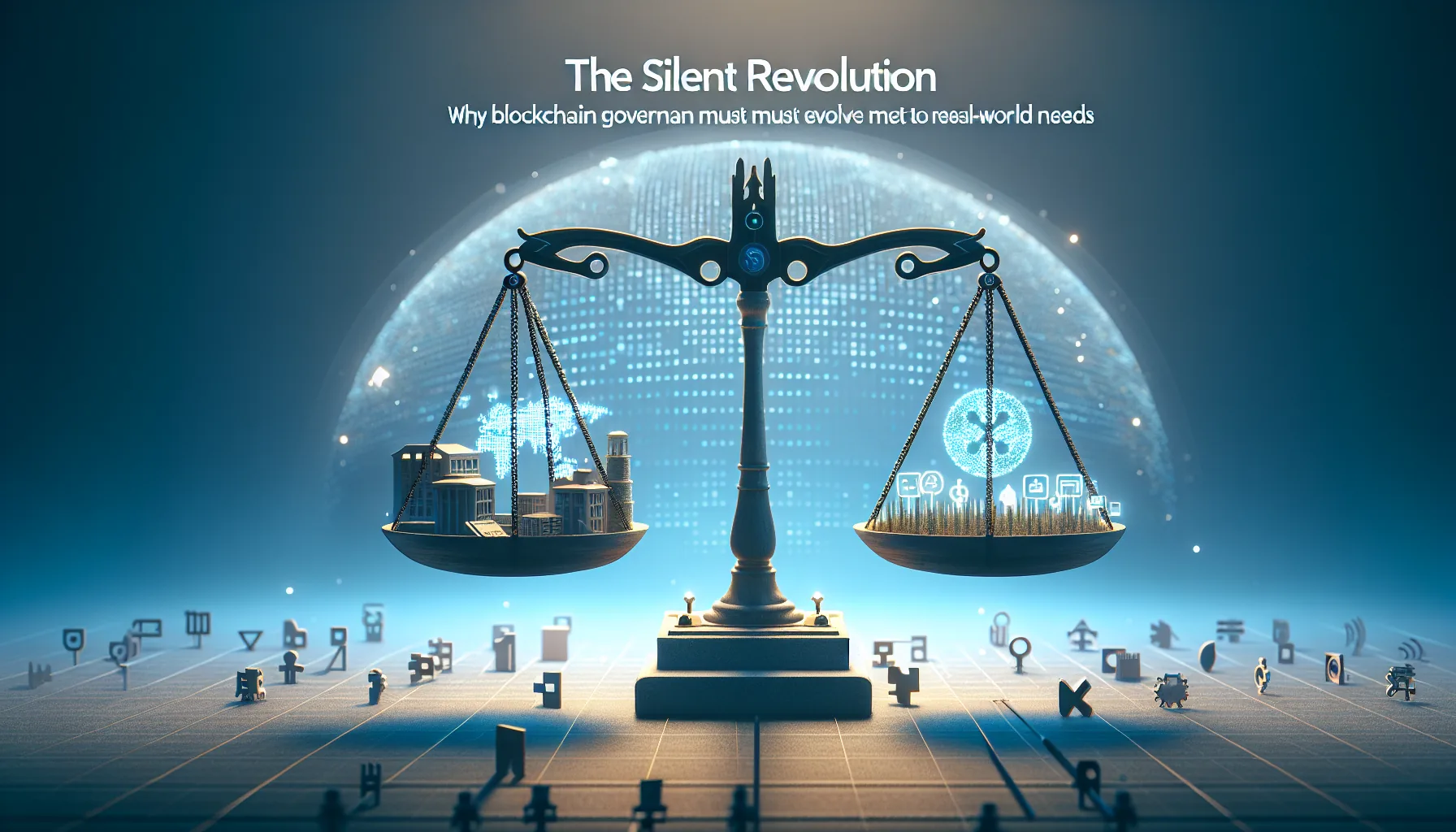
The Silent Revolution of User-Centric Protocols: Why Blockchain Governance Must Evolve to Meet Real-World Needs
Part 1 – Introducing the Problem: The Governance Gap at the Heart of Decentralized Protocols
Despite the explosive innovation in decentralized finance, DePIN, and NFTs, almost every major protocol today stands on a governance architecture that inherits the same flaw: the user is structurally peripheral to organizational control. Whether governed via token-weighted voting, multisig councils, or hybrid models, decision-making power often resides with capital rather than the actual stakeholders who rely on these systems daily.
This asymmetry didn’t happen by accident—it’s an artifact of early DeFi design. When Ethereum-based protocols like MakerDAO and Compound launched, the focus was on bootstrapping liquidity and minimizing coordination failure. Token-weighted governance allowed for easy scalability, but made little room for long-tail users or contributors without significant capital exposure. Fast-forward to today: protocols are worth billions, yet most active user segments have near-zero influence over protocol direction, fee structures, safety mechanisms, or UX design.
Critically, participation remains confined to an elite minority. Snapshot data across DAOs consistently reveals dismal engagement—often fewer than 1% of token holders vote. Governance remains opaque, slow, and for the average user, irrelevant. In practice, governance tokens act more like pseudo-equity for early insiders than instruments of collective will.
This disconnect is becoming increasingly untenable. As crypto infrastructure becomes embedded in global financial and social systems, the risks of top-down governance—protocol capture, cartel formation, off-chain collusion—grow exponentially. The user, the person running the client, staking the capital, providing liquidity, or trading art on-chain, remains disenfranchised.
One illustrative case lies in the NFT ecosystem, where projects like Blur have onboarded massive user bases, only for critical decisions—like trading incentives or platform fees—to be steered by token whales. In this context, Blur's governance model reveals both the promise and present pitfalls of token-weighted systems. Governance isn’t neutral—it encodes power dynamics, and in crypto, those dynamics are growing increasingly skewed.
This foundational misalignment between protocol usage and governance control isn’t just a philosophical issue—it introduces systemic fragility. The collapse of protocol integrity under bad governance isn’t hypothetical; it’s inevitable without structural redesign.
Whispers of possible solutions now echo across the ecosystem: reputation-based voting, identity-linked coordination, outcome-oriented delegation, and human-readable on-chain consent. But each introduces tradeoffs and implementation complexity. For now, the governance gap persists—a silent yet growing contradiction at the heart of Web3.
Even among the DeFi-native, few are confronting this head-on. That silence will not last.
Part 2 – Exploring Potential Solutions
The Future of Blockchain Governance: Emerging Solutions Beyond the Token Vote
Transitioning from token-weighted democracy to user-centric governance has revealed a provocative set of challenges—but several emergent technologies and theoretical frameworks are attempting to close the gap between on-chain rules and real-world consensus. A few approaches demand serious attention.
Quadratic Voting and Conviction Voting
Quadratic voting (QV) grants users influence based on the square root of tokens spent, mitigating plutocracy. Radical yet elegant in theory, QV has been explored in Gitcoin and DAOist experiments, but capital-intensive attacks remain plausible due to sybil vulnerabilities. Conviction voting, meanwhile, enables slow-building consensus weighted over time rather than instant snapshots. While this reduces governance volatility, it introduces latency—an issue for protocols where response agility is essential.
Account Abstraction and Identity Layers
Account abstraction opens powerful possibilities by decoupling user identity from wallet addresses. Protocols implementing smart contract wallets (e.g., ERC-4337) allow for modular voting rights—like delegating votes per domain expertise or limiting governance drag with multisig-powered voting weight decay. However, abstract accounts still require robust identity primitives to prevent sybil attacks. Solutions like SBTs (soulbound tokens) and on-chain reputation systems are experimental and have yet to scale trustlessly.
Formal Governance Models with Binding Logic
Projects like Tezos and Polkadot introduced self-amending ledgers—where governance proposals can enforce protocol upgrades directly. This eliminates reliance on off-chain coordination but risks enshrining short-term interests into immutable code. Without strong socialware, these systems are brittle. Lido and Curve operate on formalized on-chain governance, but voter inertia and low participation challenge legitimacy. Experiments like Decentralized Governance in Render Network Explained illustrate the tightrope walk between code authority and human consensus.
Multi-Sig Councils and Hybrid Structures
Some DAOs revert to semi-centralized multisig councils to filter or ratify community proposals. While pragmatically effective, this undermines censorship resistance and introduces off-chain accountability risks. Still, hybrid governance—like councils with rotating membership or veto power over automated proposals—may improve coordination during emergencies. Such designs are present in gaming ecosystems like Gala Games, though Decentralized Power: Governance in Gala Games reveals tensions between founders and token holders.
Cryptoeconomic Skepticism and Governance Minimization
A growing camp advocates for minimizing governance entirely. Protocols like Liquity remove discretionary governance, using immutable logic and deterministic parameters at launch. This "set it and forget it" design may constrain feature upgrades but maximizes predictability—making these systems appealing for DeFi maximalists. However, unchangeability can also freeze protocols in time, preventing upgrades to user needs, compliance, or market shifts.
In Part 3, we’ll dissect how these frameworks play out in live protocols—revealing whether idealism survives contact with reality, and where user-centric governance is actually gaining traction in deployed systems.
Part 3 – Real-World Implementations
Real-World Implementations: User-Centric Governance Collides with On-Chain Reality
As user-centric governance models push theoretical frontiers, real-world implementations highlight the messy complexity of decentralization in practice. Render Network, for instance, has positioned itself as a leader in decentralized compute, yet its governance rollout revealed underlying contradictions between token-based influence and stakeholder alignment. While the DAO allows token holders to vote on proposals, node operators—arguably the backbone of the network—often lack sufficient token weight to influence critical resource allocation decisions. This disconnect has led some contributors to question whether governance is optimizing for infrastructure reliability or merely token velocity. More analysis of this paradox is available in Render Network vs Rivals: A Comparative Analysis.
In contrast, Gala Games attempted to implement a more voice-weighted governance structure by introducing node licensing as a requirement for voting eligibility. Theoretically, this model incentivizes longer-term commitment over short-term speculation. However, the execution has been marred by centralized control over proposal framing, effectively narrowing the scope of governance from the outset. In community channels, multiple contributors raised concerns over lack of veto recourse, particularly during the controversial asset burn decision. These issues were dissected in Gala Games Under Fire: Key Criticisms Explained, which outlines how governance optics don't always translate to governance substance.
Then there’s Blur—a DAO-driven NFT marketplace aiming to decentralize curation and reward distribution. While nodes and users theoretically shape marketplace policy through BLUR governance tokens, in practice, early airdrop allocations tilted the power heavily toward whales. This misalignment created feedback loops: whales proposed reward structures that benefited vault activity over actual marketplace health. In their effort to pivot toward more sustainable tokenomics, Blur’s developers faced the hard limit of entrenched voting blocs. A technical patch was proposed via quadratic voting, but lacked credible sybil resistance to pass.
These examples underscore a persistent theme: the architecture of influence—tokenomics, contributor roles, and DAO procedures—is often at odds with the ideals of user-centricity. It’s clear governance is more than just smart contracts—it’s power encoded through protocol design.
Even as these systems iterate toward maturity, their stories frame the foundation for understanding how decentralized governance may evolve. From Render's node-token divide to Blur’s governance inertia, these case studies illustrate where protocol design meets political economy—and where idealism meets entropy.
Part 4 – Future Evolution & Long-Term Implications
Adaptive Protocol Infrastructure: The Future of Scalable, Interoperable User-Centric Governance
The trajectory of user-centric protocols will not be dictated solely by code-level refinement—it hinges on a broader architectural evolution that unites scalability, interoperability, and governance fluidity. The technical debt accumulated from rigid protocol governance and monolithic smart contract structures is increasingly at odds with dynamic user demands and modular composability.
A key area of innovation lies in intent-centric architectures, where user interactions are abstracted into intents rather than direct function calls. These systems create a frictionless UX layer, automating backend protocol coordination. Systems like these reduce the cognitive load on users and introduce programmable flexibility at a granular level. But encoding intents securely requires breakthroughs in zk-proof compression and on-chain signal validation. Without it, implementations will remain centralized oracles-in-disguise masquerading as permissionless tooling.
Modularity is also pushing forward through shared sequencing layers and application-specific rollups, allowing user-focused applications to operate in sovereign environments while settling on shared L1 consensus. The shift toward hyper-specialized rollups forces a reframing of governance: who controls the re-org rules below the dApp layer? The separation of state execution from consensus finality undermines common governance assumptions—such as majority-token-vote systems being inherently representative.
Real breakthroughs will require holistic integration between protocol logic and on-chain governance frameworks. Upgradable smart contracts, while flexible, introduce mutable trust boundaries—users are forced to rely on admin keys arbitrarily codified as 'ecosystem multisigs'. Without procedural clarity or recourse, user-centric claims become branding rather than design. Governance frameworks will need to transparently articulate upgrade paths, reversion mechanisms, and quorum thresholds—pulling from models like Decentralized Governance in Render Network Explained, where stakeholder segmentation is layered into vote weighting and proposal lifespan.
Finally, cross-protocol integration will accelerate through advancements in zero-knowledge messaging, universal wallets, and account abstraction. If multi-chain UX is to become viable, the underlying tech must invisibly support asset portability, reputation proofing, and transaction relaying. However, with these developments comes the pressing question: how will governance frameworks stabilize under such fluid conditions? Unlike current dApps governed in isolation, interoperable platforms will require federated decision-making systems capable of negotiating conflicts across multiple chains.
Such challenges are magnified when governance is dominated by whales or locked behind opaque mechanisms. Looking ahead, the tension between adaptive technical evolution and ossified governance layers will define whether user-centricity becomes a lived reality—or remains a philosophical aspiration. This will be the central theme as we explore the governance mechanics that must evolve in tandem.
Part 5 – Governance & Decentralization Challenges
Governance Pitfalls in Decentralized Protocols: The Structural Weaknesses Hindering Real-World Adoption
Decentralized protocols promise resilience, transparency, and user empowerment. But the reality is that governance in this paradigm is still conceptually and structurally fragile. As user-centric blockchain systems scale, the distinction between theory and practice becomes increasingly consequential—especially in navigating governance vulnerabilities that threaten both protocol integrity and user trust.
In a fully decentralized governance model, token-weighted voting often translates into plutocracy. While designed to represent stakeholder interests proportionally, in practice it creates decision-making monopolies through capital concentration. Protocols like DAOs that distribute power based on governance tokens frequently suffer from voter apathy, dominance by early whales, and manipulative flash-loan voting. Governance attacks—far from hypothetical—are recurring events in DeFi history. This architecture not only risks technical takeovers but also strategic stagnation, where powerful actors stifle innovation that jeopardizes their incumbent advantages.
On the opposite end, centralized governance—favored during early-stage protocol development—offers agile, coordinated upgrades but exposes projects to regulatory capture, censorship pressure, and opaque decision-making. Centralized entities, even if non-profits or foundations, eventually encounter questions of legitimacy. When custodial power becomes indistinguishable from traditional corporate governance, the entire narrative of decentralization erodes.
Hybrid models have emerged to strike a balance, yet they often postpone core governance issues rather than resolving them. For example, governance councils or multi-sig stewards are useful stopgaps but remain subject to human error, internal conflict, or external coercion. There's also the persistent challenge of forking stagnated or captured protocols—and the reality that most users will not migrate even when a fork represents ideologically “purer” values.
Blur’s DAO offers a revealing case study in balancing governance mechanics with ecosystem incentivization. Its token-weighted voting allows a participatory layer, but the entry barrier for influential governance remains disproportionately high—making it more brand-driven than community-scale efficient. An in-depth review of governance trade-offs in Blur can be found here.
Ultimately, the challenge is architectural: designing governance that neither drifts into technocratic elite control nor collapses under voter disinterest. Until these trade-offs are structurally addressed—whether through reputation staking, quadratic voting, or off-chain coordination frameworks—widespread, trustless participation will remain an ideal, not a reality.
Scalability exponentially amplifies these issues. Next, we’ll examine the engineering and coordination trade-offs that must be reconciled to scale user-centric protocols without collapsing under their own complexity.
Part 6 – Scalability & Engineering Trade-Offs
Scalability Trade-Offs in Blockchain Governance: Navigating the Trilemma
Implementing user-centric governance at blockchain scale is not a linear engineering challenge—it's an entanglement of hard trade-offs. At the heart of this is the blockchain trilemma: decentralization, security, and scalability. Optimizing for one often comes at the expense of the others.
Protocols prioritizing decentralization usually opt for consensus mechanisms like Proof-of-Work (PoW) or delegated Proof-of-Stake (dPoS), which introduce latency in decision-making and block finality. Ethereum’s move from PoW to Proof-of-Stake (PoS) with its beacon chain has improved energy efficiency and reduced finality time, but governance throughput remains limited. Critical voting mechanisms are still constrained by gas costs and chain congestion during peak periods. These are consequential issues when implementing user-centric systems that depend on frequent DAO participation.
Contrastingly, high-throughput blockchains like Solana or networks employing optimistic rollups offer better speed and lower costs but often at the cost of decentralization. In some cases, these architectures lean heavily on sequencers or validators with too much centralized influence. The result is governance optics that appear decentralized but are technologically centralized under the hood—problematic for any initiative rooted in democratic participation.
L2 solutions and sharded architectures attempt to strike a middle ground. Yet they introduce fragmentation risks and state reconciliation complexity. For example, when communities vote across L2s, determining quorum, preventing replay attacks, and maintaining identity continuity across shards all become non-trivial problems. Cross-chain governance interoperability remains an unsolved problem and is further complicated by bridge vulnerabilities.
In parallel, verifiable off-chain voting systems like Snapshot offer speed and efficiency but lack on-chain binding enforceability without governance relayers. That model depends on social consensus—effective in small communities but fragile during adversarial or high-stakes events.
Projects like Blur, which introduced rapid governance proposals through token-based voting, have demonstrated both engagement potential and scalability strain. But maintaining integrity and inclusivity in these fast-paced cycles remains a challenge, as highlighted in BLUR Governance: Shaping the Future of NFTs.
Ultimately, scaling user-centric governance involves more than increasing TPS. It requires systemic answers to validator incentives, cryptographic identity, dispute resolution, and persistent data availability across chains. Any engineering path forward must recognize that governance isn’t a bolt-on feature—it’s the protocol.
Next, we’ll examine how regulatory and compliance considerations intersect with these architectural choices, opening a new dimension of governance friction.
Part 7 – Regulatory & Compliance Risks
Jurisdictional Headaches and the Compliance Crossfire in Blockchain Governance
The decentralized nature of blockchain technologies presents a persistent challenge for regulators and protocol developers alike: jurisdictional ambiguity. Most blockchains operate across borders, yet remain subject to an overlapping web of inconsistent legal frameworks. A DAO governed by participants in 13 time zones can still find itself entangled in regulatory enforcement from a single jurisdiction—often the one where its developers, servers, or users reside.
We’ve already seen this play out in actions taken against mixer protocols and pseudonymous projects. The Tornado Cash case serves as a chilling precedent: code alone can be classified as sanctionable under certain regimes, even when decentralized governance structures are in place. This puts developers and protocol governors at personal legal risk, especially when their protocols offer privacy-preserving features or asset anonymization—functionality at odds with established AML/KYC expectations.
Governance tokens further complicate matters. Token holders active in shaping roadmaps or voting on proposals may inadvertently become liable under securities laws, particularly in jurisdictions with expansive interpretations of managerial influence and profit expectation. In short, the more participatory and user-centric governance becomes, the higher the exposure to legal friction.
Some jurisdictions have attempted to accommodate decentralized systems through sandbox frameworks or DAO-specific legislation (e.g., Wyoming and the Marshall Islands), but these efforts remain siloed and incompatible abroad. This fragmentation opens up exploitable legal arbitrage—an enticing but unstable foundation for long-term protocol sustainability.
The trend toward regulatory hardlining also threatens composability. Protocols that plug into each other via smart contracts inherit not just code dependencies, but compliance liabilities. A DeFi application relying on a DAO-governed stablecoin such as CRVUSD doesn’t just assume price risk—it absorbs regulatory collateral damage if upstream mechanisms get flagged.
In seeking mass adoption, user-centric protocols face a paradox. Making systems more intuitive and governed by their users often requires off-chain interfaces, regulation-facing contributors, and fiat onramps—all of which become jurisdictional chokepoints. Even centralized front-end providers may undergo pressure to geo-block or detour access based on regional compliance.
These compliance exposure points will only become more acute as chains begin interfacing with fiat payment rails and state actors. Expect cross-chain identity solutions and privacy features based on ZK-proofs to grow in popularity as a means of maintaining sovereignty while appeasing regulators—or at least avoiding their spotlight.
This legal and compliance fragility is more than a growing pain—it’s a structural failing that could bottleneck innovation if not meaningfully addressed. The economic and financial implications of these regulatory obstacles will be explored in Part 8.
Part 8 – Economic & Financial Implications
The Economic Impact of User-Centric Governance: Risks, Shifts, and Strategic Plays
DeFi has long been heralded as a challenge to TradFi, but the rise of truly user-centric governance protocols initiates a deeper financial recalibration. Unlike superficial token-voting systems heavily dominated by whales and VC allocations, emergent models centered around active user participation and reputation mechanisms could transform current economic dependencies, possibly disintermediating not just legacy institutions, but also today's dominant tokenomics models.
On one hand, institutional investors face a paradox. User-driven governance landscapes reduce their ability to manipulate outcomes via token weight, pushing them to adapt with new strategies—such as sybil-resistant staking or identity-linked governance enhancements. While this could temper speculative influence, it also undermines their core value proposition: capital leverage over protocol direction. As reputation-anchored voting gains traction, institutions either need to invest in protocol stewardship (e.g., ecosystem grants, forum-level credibility) or risk decentralized irrelevance.
Retail traders could be inadvertently squeezed, too. If participation-based influence is algorithmically modeled to reward long-term engagement or behavioral fidelity, short-term token holders may find themselves disenfranchised. A surge in governance utility tokens could increase speculation, but also trigger user fatigue where meaningful power is gated behind endless hoops of "engagement farming."
Developers, often the bedrock of protocol innovation, sit in a volatile position. On one end, user-weighted input could reduce governance capture by non-technical stakeholders who lack protocol context. On the other, it opens the door to populist decision-making that skews toward feature popularity over security or scalability. Especially for protocols handling intricate infrastructure—like Render Network—where engineering complexity isn’t easily crowd-sourced, there's risk of fatal feature creep or governance deadlock.
New financial opportunities inevitably emerge. Reputation-mining and participation-derived income mechanisms could capitalize on attention markets, turning governance into a yield stream. Governance-retrofitted tokens could trade at a premium—valued not just on utility but social capital ROI. This introduces second-order derivatives: governance rights leasing, reputation marketplaces, and slashing insurance instruments.
Yet, these speculative layers reintroduce risk: governance arbitrage, cartelization via off-chain coordination, and attack vectors where governance power is gamified or externally bought. Platforms like Blur, already experimenting with governance and rewards feedback loops, reveal both the power and precariousness of these dynamics.
Tokenomics built around active participation, rather than passive holding, will continue to reshape digital asset valuation—and the investment thesis behind them. But aligning protocol survivability with economic experimentation introduces volatility that no stakeholder can fully hedge against.
This sets the stage to explore the broader questions of identity, autonomy, and societal redesign—core to understanding why governance evolution is more than technical: it’s philosophical.
Part 9 – Social & Philosophical Implications
Economic and Financial Implications of User-Centric Protocols in Blockchain Governance
The rise of user-centric governance models—those that shift control from protocol founders and whales to everyday participants—has far-reaching economic consequences, both promising and perilous.
For institutional investors, this evolution introduces a paradox. On one hand, democratized governance can de-risk investments by reducing founder centralization and regulatory exposure. On the other, such decentralization destabilizes control levers. Funds accustomed to predictive tokenomics and board-level influence might balk at DAOs where governance decisions are driven by unpredictable, socially-influenced voting behavior. Liquidity providers that farm governance tokens for yield could find their positions diluted faster than expected due to evolving community-led emissions policies.
Developers face similar tension. Protocols that adopt truly user-centric governance mechanisms often mandate community approval for roadmap changes, treasury disbursements, or incentive mechanisms. While this democratizes protocol development, it slows iteration speed and introduces strategic friction. Teams pushing cutting-edge features may find themselves bottlenecked by token voter fatigue or voter base fragmentation—particularly when incentive alignment breaks down and voter apathy sets in.
Traders and speculators experience more fluid implications. The emergence of protocols governed through quadratic voting, conviction staking, or on-chain reputation systems creates complex new alpha opportunities, not always visible in traditional chart-based technical analysis. For example, frontrunning likely governance outcomes or exploiting disparities between token voting power and market sentiment becomes a viable strategy. Yet these same systems can create perverse feedback loops—a surge in token staking to influence governance might create artificial scarcity, drawing in unsuspecting speculators and triggering short-lived price pumps before utility value collapses.
Meanwhile, entirely new asset classes emerge. Governance rights themselves can be spun off, loaned, or even shorted on emerging decentralized governance rights markets. As secondary markets for governance influence take shape, we see early symptoms of financialization that mirror traditional derivatives—yet without the regulatory oversight, increasing systemic fragility.
Real economic dangers also loom. Coordinated attacks via DAO capture could reallocate treasuries or fork projects into competing factions. As user-centric governance protocols incentivize deeper user ownership, malicious actors may accumulate social capital via pseudonymous engagement, only to subvert protocol goals from within. The risk ceiling here is no longer technical—but political.
These dynamics echo issues seen in platforms such as CRVUSD, where governance token concentration and voter coordination (or lack thereof) have material impacts on ecosystem incentives.
The socio-philosophical ramifications—in particular, the shifting power dynamics between users, founders, and capital—come next in this series.
Part 10 – Final Conclusions & Future Outlook
The Silent Revolution of User-Centric Protocols: Why Blockchain Governance Must Evolve to Meet Real-World Needs
Part 10 – Final Conclusions & Future Outlook
After examining the fragmented evolution of user-centric protocols across DeFi, NFTs, and infrastructure layers, one truth stands out: the governance layer has become blockchain’s choke point. Protocols remain technically decentralized but socially stagnant, constrained by inflexible voting structures, governance fatigue, and plutocratic outcomes that often marginalize the very users these systems are supposed to empower.
A best-case scenario sees the emergence of modular, adaptive governance stacks that blend off-chain context with on-chain execution. These systems would integrate mechanisms like quadratic voting, reputation-based influence, and AI moderation to dynamically scale community input while mitigating sybil attacks and voter apathy. The path requires protocols to decouple voting from mere token weight and evolve toward meaningful participation frameworks embedded into UX from day one.
Worst case? Governance ossifies into meme-driven popularity contests or hostile takeover arenas dominated by whales and coordination-networks. Real governance discourse becomes performative. Innovation bottlenecks. Protocols drift toward centralized convenience, wrapped in pseudo-decentralization. User trust erodes, and the very notion of DAO viability may collapse under entropy.
The unanswered questions are sharp:
- Can protocols truly decentralize power while still remaining agile enough to adapt to rapid market shifts?
- Will governance evolve into a core user function or remain a niche mechanic for whales and insiders?
- How do we fund public goods, retrospectives, and sub-DAOs without returning to VC-driven hierarchies?
There are promising signals, such as Blur’s multi-layered DAO design, which integrates incentive alignment with timely decision-making. But even that is a partial puzzle—most proposals in such systems still face inertia, off-chain influence, or manipulation via vote-delegation concentration.
Mainstream adoption is not gated by tech anymore. It's blocked by usability, governance clarity, and perceived fairness. For users to commit more than speculation, governance itself must become less opaque and more embedded, much like how UX design morphed from an afterthought to a product differentiator. Without this shift, DeFi and decentralized infrastructure risk becoming tools for the few, rather than ecosystems owned and stewarded by their users.
So, we end with this:
Will user-centric governance define the next era of blockchain utility—or will it be remembered as the noble but misunderstood experiment that never scaled beyond the voting wallets of whales?
Authors comments
This document was made by www.BestDapps.com