Part 1 - Introducing the Problem
The Overlooked Synergies of Blockchain and Circular Economy: Paving the Way for Sustainable Business Models
The Bridging Challenge: Blockchain Lacks Circular Integration by Design
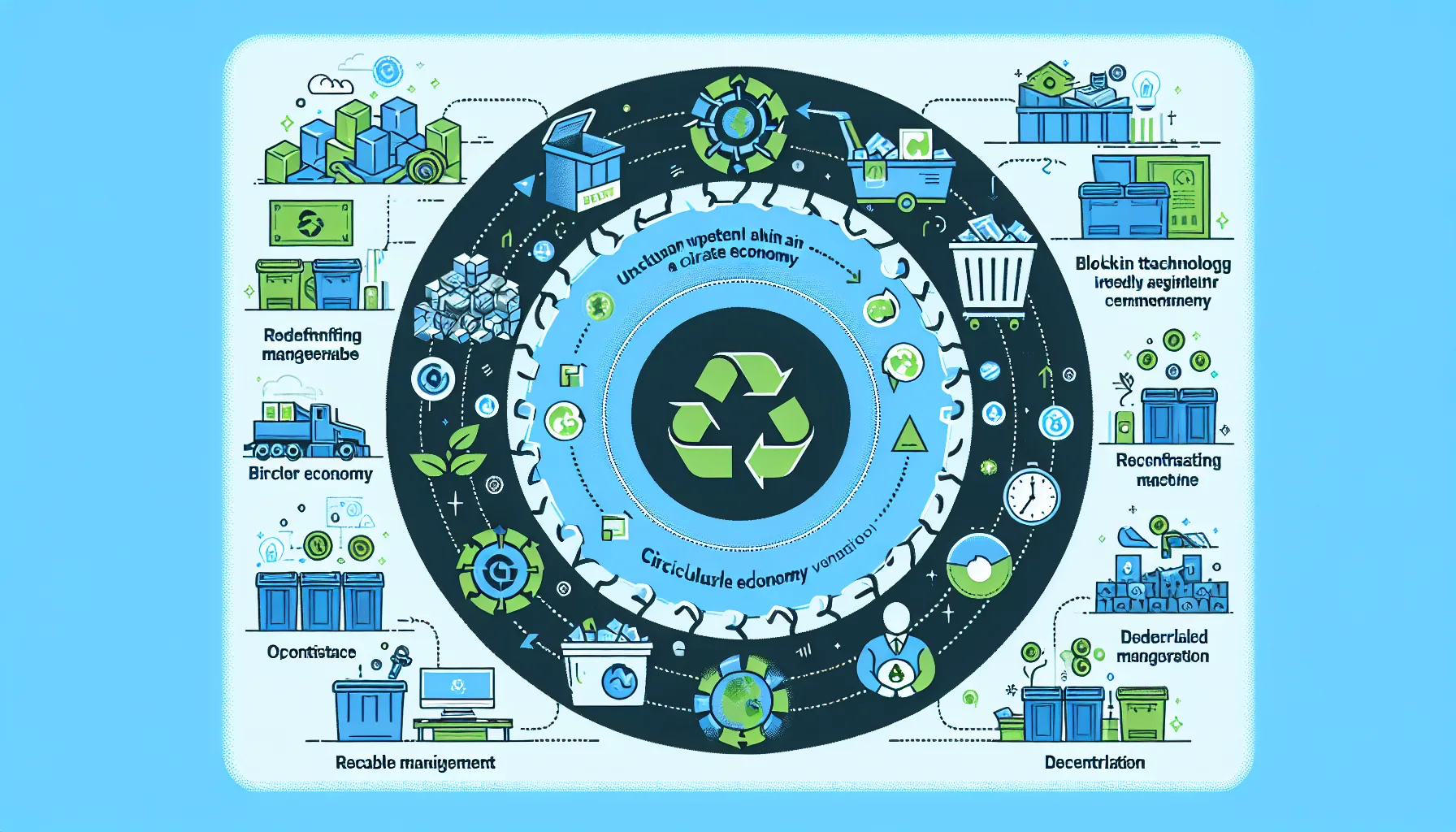
Despite cryptocurrency’s obsession with innovation, one of the most underexplored and structurally misaligned areas is its relationship with the circular economy. Crypto’s core architecture - fast-paced token incentives, infinite speculation, and mining-based destruction of energy budgets - exists in stark contrast to the principles of regenerative sustainability. And yet, blockchain also holds the unique traits required to enable circular systems: transparency, traceability, anti-fraud proofs, and decentralized accountability.
So why hasn’t this convergence happened?
Historically, blockchain development has optimized system-level throughput, financialization of assets, and composability - largely within the gates of DeFi. Meanwhile, circular economy models - repair, reuse, product-as-a-service, and reverse logistics - require grounding in real-world assets and verifiable consumption loops. The result is a divergence: protocols solving purely digital problems vs. sustainability models rooted in physical network externalities. This chasm has led to two siloed innovations that fail to recognize their potential interoperability.
Part of the issue stems from on-chain data structures being ill-suited for granular material tracking or lifecycle states unless coupled with increasingly complex oracles, IoT integrations, or zero-knowledge proofs - none of which have become default implementations. The economic cost of implementing such systems is difficult to justify without quantifiable financial incentives, which don’t yet exist because adoption hasn't occurred at meaningful scale. It’s a recursive stall-out.
Another barrier lies in tokenomics. The circular economy thrives on distributed value capture across multiple lifecycle agents - users, repairers, recyclers. But most crypto token models centralize value around few actors (e.g., LPs, early traders). Integrating loopy, feedback-driven economics into linear, extractive incentive designs remains an open-ended challenge that few protocols have attempted.
Tackling this design misalignment requires looking outside traditional DeFi protocol mechanics and rethinking crypto incentives from a circular lens - not just in how value is captured, but in how degradation, reuse, and regeneration are accounted for. One glimmer of a solution appeared in experiments like Pendle, where time-based yield tokenization introduces asynchronous value flows - a concept potentially critical for modeling real-world product lifecycles. See our breakdown in Unlocking DeFi: Pendle's Tokenized Yield Revolution.
If blockchain is to become more than just an ephemeral finance layer, it needs to address where value actually ends up - especially when value loops back into the system. Until these reciprocal patterns are encoded on-chain, sustainability will remain a narrative gloss, not a native protocol feature.
And yet, buried in failed ICOs and obscure DAO experiments lie the early schematics of circular design on-chain. The problem isn’t potential. It’s recognition.
Part 2 - Exploring Potential Solutions
Blockchain Technologies Enabling Circular Economy: Exploring Solutions with Real Technical Depth
A viable circular economy model demands airtight transparency and interoperable data across supply chains-features that blockchain is uniquely positioned to enable. Several innovations aim to bridge this gap, each with distinct trade-offs in scalability, data integrity, and economic incentives.
1. Zero-Knowledge Proofs for Supply Chain Privacy
ZKPs offer mathematically verifiable proofs without disclosing the underlying data-essential for supply chains balancing transparency and confidential business operations. Projects like ZK Finance are pushing this frontier, particularly in waste provenance and recycling certifications. However, ZK systems often suffer from high computational overhead and integration complexity. Their cryptographic sophistication can deter adoption among smaller Circular Economy actors lacking technical bandwidth. A related deep dive on ZK governance innovations can be explored in Unlocking the Secrets of ZK Finance.
2. On-Chain Asset Tokenization for Material Flow
Tokenization of physical assets enables persistent tracking of resources through NFTs and synthetic tokens. For example, tokenizing e-waste components or sustainable materials allows secondary markets to effectively price reusability. But token-to-asset binding presents a real-world oracle problem. Without trusted verification mechanisms, token validity becomes either centralized or exploit-prone. While DeFi platforms like Pendle offer nuanced yield-generating mechanics for tokenized assets, issues still linger-like decoupling of token price from the asset’s actual environmental impact. See the full discussion in this Pendle deep dive.
3. Decentralized Identity (DID) for Circular Accountability
Circular economy participation hinges on authentic reporting of reuse, waste reduction, and material flows. DIDs can anchor this by tying actions to verified reputational identities. Protocols leveraging W3C-compliant identity frameworks could disincentivize greenwashing via on-chain penalties or staking slashing. However, wide-scale DID adoption is hindered by fractured standards and lack of incentive alignment across jurisdictions. Regulatory tension also complicates integrating sovereign identity with programmable financial contracts.
4. Composable Protocol Infrastructure
Modular smart contract architecture enables niche circular economy verticals to build atop shared primitives-such as decentralized storage for lifecycle records or governance for repair marketplaces. This cross-project composability is a strength in theory but can create fragility through tightening inter-protocol dependencies. Time-lock flaws, upgradability exploits, and governance capture risks magnify as more layers integrate.
From a user staking perspective, platforms offering yield opportunities tied to environmental impact metrics may introduce misaligned incentives. Without robust oracle inputs, any emissions offset claims are probabilistically unverifiable.
Next, we shift from architecture to reality-examining how these ideas manifest in deployed systems across e-waste, remanufacturing, sustainable textile tracking, and beyond.
Part 3 - Real-World Implementations
Blockchain and Waste Traceability: Real-World Attempts to Close the Loop
One of the most compelling applications of blockchain in the circular economy involves waste traceability, where startups like Circularise have attempted to implement tokenized material passports leveraging private smart contracts and zero-knowledge proofs. Their ambition: create immutable digital twins of physical materials to track them across complex global supply chains. However, bottlenecks emerged around data standardization when onboarding supply chain actors, particularly from legacy manufacturing industries reluctant to expose proprietary process information-even under cryptographic obfuscation.
On the protocol level, VeChain developed several solutions using its ToolChain framework, anchoring RFID and IoT sensor data on-chain to establish provenance for products in the fashion and consumer electronics sectors. Despite its technical feasibility, full circularity was hindered by off-chain opacity at e-waste collection points. Many municipal partners lacked infrastructure to validate end-of-life data and relay it back to VeChain’s on-chain audit trail. This disconnect reflects an unglamorous but unsolved pain point: the interface between physical and digital verification.
Token incentives also faced real-world testing. Plastic Bank ran a pilot integrating blockchain-based token rewards for recycling in emerging markets. An early iteration utilized Stellar’s public blockchain but experienced UX friction due to slow confirmation times and difficult wallet onboarding for unbanked participants. A later version used a permissioned system to prioritize scalability over decentralization. This raised critiques from purists on whether circular economy solutions can remain credibly decentralized while accommodating real-world user constraints.
From a DAO-centric angle, projects like Regen Network have aligned ecological regeneration efforts-such as soil carbon sequestration-directly with atmospheric data and satellite validation mechanisms. Here, the challenge lies in correlating trusted geospatial metadata on-chain without making the network overly reliant on centralized oracle constellations. This issue closely mirrors debates in DeFi as seen in The Untapped Role of Fractionalization in NFT Ownership, where reliance on oracles exposes systems to vulnerabilities without solving root issues of verifiability.
That said, the most successful attempts so far have occurred in closed-loop ecosystems rather than open marketplaces-where stakeholder alignment can be enforced via governance rather than assumed. In attempting to decentralize the regenerative economy, these implementations reveal the hard trade-offs between auditability, composability, and real-world entropy. Ultimately, these deployments form the architectural testbed to assess what is technically viable and socially scalable for sustainability-integrated tokenomics.
Part 4 will dissect how these learnings inform the broader evolution and long-term trajectory of blockchain-circular economy convergence.
Part 4 - Future Evolution & Long-Term Implications
The Future of Blockchain-Circular Economy Integration: Scaling Beyond Conceptual Pilots
As blockchain matures, its role in enabling circular economy models will be increasingly shaped by multi-layered innovation stacks, modular protocol upgrades, and mesh-style governance models. Currently, the biggest bottleneck remains a lack of scalable infrastructure tailored for circular systems-especially where asset provenance, resource tracking, and lifecycle validation converge across disconnected supply nodes. However, emerging Layer-2 and Layer-3 scaling solutions are beginning to address these architectural challenges with composability and application-specific execution layers.
Zero-knowledge (ZK) rollups and validity proofs can dramatically streamline sustainability reporting and data privacy for reverse logistics, especially for consumer goods with embedded IoT sensors. For example, instead of overloading the mainnet with product return data for refurbished electronics, a ZK-enabled chain can anonymize and batch-verify circular compliance on-chain. This keeps storage efficient and cost-predictive-two features vital for enterprises managing distributed takeback programs.
Protocol-level breakthroughs are also likely to accelerate asset fractionalization in regenerative economics. Being able to tokenize and subdivide ownership of upcycled assets (e.g., remanufactured e-bike motors or refurbished solar cells) can unlock liquidity layers for components that would otherwise sit idle. This decentralized fractionalization model mirrors the approach of DeFi protocols like Pendle, where tokenized yield streams have become liquid primitives rather than static contracts.
But with innovation comes complexity. Interoperability has surfaced as a major constraint. Many traceability protocols lack common data standards, resulting in fragmented L1-L2 bridges or siloed subnets that cannot speak uniformly. Projects attempting to track textile reuse, for instance, often run into protocol inconsistencies when aggregating data from competing supply side providers. Cross-chain messaging protocols and universal NFT standards may provide partial solutions, yet their adoption is uneven and often rerouted through centralized oracles.
Another emerging fault line lies in incentive misalignment. Designing regenerative tokenomics for looping consumption models involves more than staking rewards or emissions burns. Tokens must account for temporal value shifts across product states-virgin, used, refurbished-while still being non-extractive. This will demand logic-rich, multi-condition smart contracts with on-chain market feedback integration, something still theoretical for most green-focused protocols today.
Integration with parametric insurance and dynamic data oracles could be a game changer, especially for measuring circular performance at scale in disaster-prone zones or climate-sensitive industries. These bridges between economic regeneration and programmable finance are nascent but technically feasible.
As development outpaces governance innovation, however, tensions are surfacing. Part 5 will examine how decentralized coordination, stakeholder alignment, and token-weighted voting shape the long-term governance of blockchain-powered circular economies.
Part 5 - Governance & Decentralization Challenges
Power Struggles in Code: Governance Risks in Decentralized Circular Economy Platforms
When merging blockchain with the circular economy, governance becomes more than protocol layer mechanics-it directly impacts material flow, ownership rights, and resource access. Governance models are central to aligning incentives between producers, consumers, and recyclers, but the complexity and risk associated with decentralized decision-making create distinct obstacles to sustainability and scalability.
At the heart of decentralized platforms lies an uneasy tension: distribute control to protect against capture, but don't over-distribute to the point of gridlock or apathy. Token-weighted voting, while common, introduces plutocratic risks. As circular economy platforms tokenize physical assets like recycled materials, waste credits, or carbon units, concentrated token ownership can weaponize influence. This not only endangers equitable participation but creates governance attack surfaces-where malicious actors accumulate governance tokens to swing critical proposals, such as altering fee structures or disabling consumer protections.
Governance attacks aren’t theoretical. Poor quorum thresholds or unchecked delegation rules routinely enable hostile takeovers, especially in protocols relying on automated smart contract upgrades. In a circular economy protocol where asset redemption and compliance are tightly coupled to governance logic, one incorrect proposal could lead to regulatory breaches, reputation damage, or insolvency events.
Centralized approaches often allow faster iteration, legal compliance, and coordinated stakeholder management. But that agility comes with entrenched risks-namely, regulatory capture and opaque decision-making. Projects aiming to serve community waste recyclers or local logistics firms will find trust eroded quickly if the legal entity behind the platform has unilateral control over incentive emissions or withdrawal limits. The illusion of decentralization might carry them through initial funding rounds, but long-term sustainability demands better transparency.
A hybrid-permissioned governance systems with clear, time-locked upgrade windows and mandatory off-chain audit layers-can offer compromise. Still, even that exposes operators to compliance fragmentation across jurisdictions, which becomes critical when recycling data triggers asset indexation or ESG scoring. Projects like Empowering Decisions: Governance in Pendle (PENDLE) demonstrate some forward-thinking models, showcasing modular governance contracts and staged proposal execution pipelines. Yet these remain nascent compared to the regulatory and systemic complexity of circular economy assets.
Delegation systems, reputation-weighted voting, and multi-tiered DAO structures are emerging, but scale introduces user disengagement. If only 5% of participants vote, then by definition, most power resides with a tiny elite-precisely what the model was built to counter. DAO-as-a-service platforms are automating these structures, but this risks turning decentralized governance into a subscription model controlled by few node operators and third-party frameworks.
We now turn to the next critical hurdle-the engineering realities of scaling such infrastructure without compromising decentralization and security. Part 6 explores the data bottlenecks, architectural design choices, and consensus mechanisms that must adapt for real-world mass adoption.
Part 6 - Scalability & Engineering Trade-Offs
Scalability Trade-Offs in Blockchain for Circular Economy Infrastructures
The tension between decentralization, security, and speed remains one of the most complex engineering challenges when deploying blockchain infrastructures fit for circular economy applications at scale. Public chains like Ethereum offer high decentralization and robust security but continually face throughput friction due to their consensus mechanisms, particularly with Proof of Work historically and the more recent Proof of Stake set-up-with finality times and network congestion still persistent under high loads.
Contrast that with Layer 2 networks or alternative L1s prioritizing performance-such as Optimistic Rollups (like Optimism), zero-knowledge proofs (zkSync), or high-speed chains like Solana. These offer accelerated transaction rates, sometimes exceeding 2,000 TPS, but often sacrifice decentralization by limiting validator sets or introducing centralized sequencers-an unacceptable compromise for circular supply chain projects demanding resilience and tamper-proof auditability across diverse geographies.
Combining different consensus models could help mitigate this. Modular chains (e.g., Celestia) offload data availability and execution layers, allowing projects to customize trade-offs. But integrating these modules introduces new attack surfaces and synchronization complexity-non-trivial risks when immutable smart contracts govern real-world material flows.
In smart circular applications-like tracking product life cycles or automating incentivized recycling-latency tolerance is low. Actions (e.g., token issuance for material return) must trigger near-instantaneously. Yet if these smart contracts live exclusively on L1, they suffer from network-induced bottlenecks, especially during peak usage. Engineers can lean on optimistic execution, but delays in finality or rollback risks from fraud proofs might produce economic ambiguity, reducing participant trust.
Not all blockchain infrastructures are suitable for cross-organizational data sharing in circular environments. For example, validators oracles forwarding environmental sensor data can become centralized choke points. As outlined in Pendle's evolution through data-informed yield strategies (https://bestdapps.com/blogs/news/pendle-navigating-data-for-defi-success), syncing disparate, real-world inputs into on-chain dynamics demands high operational precision-errors here could invalidate entire ESG-based reward structures.
Even if scalability challenges are resolved at a protocol level, infrastructure demands-such as node synchronization, sharded state awareness, or cross-chain message relays-pose new levels of DevOps complexity. Projects face the unenviable choice: optimize for user accessibility via multi-chain wallets and bridges, or harden trust layers for ecosystem integrity, which limits composability.
The result is clear: while blockchain may be the ideal coordination layer for circular economy models, its implementation is anything but plug-and-play. The trade-offs involved must be managed rigorously at every protocol layer, from consensus to UI latency-and few current architectures fully optimize for the hybrid needs of sustainability, supply chain traceability, and decentralized governance.
Part seven will explore how these architectural decisions intersect with compliance frameworks, particularly in the context of evolving international standards and regulatory exposure.
Part 7 - Regulatory & Compliance Risks
Navigating Regulatory & Compliance Risks of Blockchain-Powered Circular Economies
The integration of blockchain technology into circular economy models introduces complex legal and regulatory implications that transcend simple token governance or smart contract audits. While decentralization enables transparency and traceability-core tenets of closed-loop systems-it also invites a multitude of compliance pitfalls spanning jurisdictional gray zones, evolving policy frameworks, and fragmented enforcement regimes.
One prominent friction point is the mismatch in regulatory maturity between regions. For instance, the European Union approaches blockchain regulation from a sustainability and digital identity angle, emphasizing supply chain traceability and product lifecycle tracking via the Digital Product Passport. This contrasts with the more fragmented U.S. model, where utility tokens and environmental blockchain use cases may still fall under securities scrutiny depending on state-specific enforcement climates and shifting interpretations from agencies like the SEC or CFTC.
This regulatory divergence becomes more problematic when dealing with material certification, waste tokenization, or traceable carbon credits. If a blockchain circular economy platform issues asset-backed tokens signifying recycled materials or emissions offsets, those tokens could inadvertently fall under commodity or financial asset classifications. Depending on jurisdiction, the entity involved might be legally required to obtain brokerage licenses or register offerings, undermining the decentralized foundations of the model.
Historical enforcement patterns show that projects which originated with eco- or utility-minded goals have not been immune to crackdowns. Even protocols with strong technical merit have faced regulatory actions due to governance centralization or ambiguous investor utility structures. Cases like these set a precedent: intentions alone don’t exempt projects from compliance obligations.
Moreover, sustainability-focused blockchain applications may become targets of regulatory sandboxes or pilot schemes. While these environments promote experimentation, they may also constrain innovation by locking ecosystems into compliance-first frameworks that stifle permissionless participation. Startups navigating these waters must carefully balance regulatory optics with operational sovereignty-an especially delicate task in circular economy deployments, where on-chain material flows are tightly linked to off-chain regulatory regimes.
Cross-chain interoperability adds another layer of risk. Data exchanged between chains may originate in jurisdictions with incompatible privacy or consumer protection laws. These legal entanglements can substantially hinder multi-chain tracing systems used in waste reduction or product reuse verification.
Interestingly, the risks and rewards of governance models under regulatory scrutiny are not new to the crypto space. A cautionary lens on Empowering Decisions: Governance in Pendle reveals how decentralized control does not absolve protocol actors from legal responsibility.
Part 8 will unpack the economic and financial shifts triggered by blockchain's entry into material resource loops-an area where regulatory clarity, or lack thereof, significantly affects capital flows, token utility, and incentive structures.
Part 8 - Economic & Financial Implications
Economic and Financial Implications of Blockchain in the Circular Economy: Winners, Losers, and Market Disruptions
Blockchain’s integration into circular economic models is not merely a technical evolution-it redefines value capture and redistribution in ways that pose significant implications for financial architecture. The granular traceability and tokenized representation of material flows challenge traditional ownership, pricing models, and even the definition of financial assets.
For institutional investors, blockchain in circular economies offers a new class of investable products-asset-backed tokens derived from real-world materials, carbon credits, or tokenized waste streams. These, however, are difficult to price using legacy methods. Questions of custodianship and insurance multiply when the underlying assets are decentralized, fragmented, and fluctuating in physical value. Smart contracts introduce further disintermediation, turning previously service-based models (like recycling brokers or compliance auditors) into programmable logic. This strips revenue from incumbents while creating hyper-efficient, yet potentially brittle, new systems.
Developers stand to benefit most in the short term, as demand for bespoke circular-economy protocols-combining sensor data, IoT, and tokenomics-grows. But the technical barriers are steep. For instance, real-world data needs to be fed into smart contracts, revealing an underexplored dependency on oracles and IoT reliability. While attempts to decentralize these inputs exist, they are far from robust, and adversarial data may inject economic exploits at large scale. Related reading: The Untapped Intersection of Blockchain and IoT: Revolutionizing Smart Cities Through Decentralization.
Traders and liquidity providers must grapple with non-traditional DeFi primitives. Markets for tokenized plastic, reclaimed metal, or future recycling rights are profoundly illiquid and difficult to model. Pendle’s approach to tokenized yields in DeFi hints at what’s possible here-instrumentalizing time, commitment, and forward contracts in environmental asset flows. For a deep understanding, see Unlocking DeFi: Pendle's Tokenized Yield Revolution.
However, not all participants benefit. Centralized platforms, logistics intermediaries, and even some ESG-compliant fund structures may find their roles diminished as value migrates away from centralized data silos toward on-chain verification mechanisms. Moreover, not all tokens representing circular value will pass regulatory or financial audit thresholds-leading to compliance friction and difficult exits for investors.
This convergence of blockchain with a circular model doesn’t just redistribute capital-it redefines what qualifies as capital. That paradigm shift has deeper ramifications beyond finance-resonating into social organization, philosophy of ownership, and the ethical contours of digital economies. These broader implications will be examined next.
Part 9 - Social & Philosophical Implications
Economic & Financial Implications of Blockchain in the Circular Economy: Disruption, Opportunity, and Systemic Risk
The fusion of blockchain and circular economy design pushes beyond environmental optimization; it disrupts the fundamental mechanics of market structure and financial incentives across industries. Value is no longer driven solely by volume and consumption but by traceability, longevity, and distributed attribution. This model challenges incumbent actors-especially those hooked on linear supply chains-and introduces capital flow pathways that redefine how asset and data provenance are monetized.
Institutional investors used to concentrating risk in green bonds or ESG-aligned equities may find themselves unprepared for the radically transparent and composable asset systems enabled by smart contracts. On-chain circular economy protocols tokenize modular components of previously illiquid systems-such as e-waste parts, secondary raw materials, and reverse logistics. This fractionalization model echoes developments seen in protocols like Pendle’s innovative approach to tokenized yield, where yield-bearing assets are partitioned over time. These circular assets could behave similarly, offering value streams based on lifecycle completion instead of pure speculation.
Developers, particularly those working with IoT integrations, stand to capture market share by building out dual-layer infrastructure: physical product registries tied to decentralized runtime environments. However, this interoperability increases attack vectors, and system fragmentation could escalate if standardization fails-especially across jurisdictions. The economic implications here spill over into compliance costs and legal ambiguity, particularly in sectors locked into traditional product liability frameworks.
Meanwhile, crypto-native traders may gravitate toward the yield dynamics of regenerative asset pools, which reflect consumption-based incentives and localized micro-credit loops. Yet these also carry a risk profile unlike anything in conventional DeFi. Automatic redistribution of tokens based on degradation rates or circularity milestones could create liquidity cliffs reminiscent of uncollateralized algorithmic systems. Slippage and impermanent loss become harder to model when assets themselves age or disaggregate over time.
Liquidity providers could see temporary profit from market asymmetries as circular protocols bootstrap governance and adoption layers, but their long-term exposure increases if liquidation events aren't clearly codified around expiration or product fidelity.
Economic modeling built for infinite-growth paradigms may fail here. Instead of volatility driven by narrative or tech upgrades, tokens in this model may derive price fluctuations from repair rates, material composition disclosures, or decentralized audit burn events. This is not theoretical-tokenized ESG assets already exhibit data-driven lifecycle exposure.
Next, we’ll dive into the socio-philosophical tensions these shifts uncover-asking what it means when accountability, value, and trust are abstracted into code.
Part 10 - Final Conclusions & Future Outlook
The Final Verdict on Blockchain and Circular Economy: Innovation, Integration, or Illusion?
The convergence of blockchain and circular economy principles holds transformative potential-but only if we address critical structural, behavioral, and technical gaps. Across this series, we have outlined how blockchain can enforce provenance, optimize resource lifecycles, and incentivize recycling through token structures. Yet, most pilots remain either too localized or conceptually ambitious without clear mechanisms for value capture and real-world scalability.
In the best-case scenario, we move toward interoperable, EVM-compatible platforms where supply chain metadata, digital product passports, and verifiable waste streams are transparently recorded, tradable, and gamified via DeFi tools. Models like Pendle’s tokenization of future yield could inspire secondary sustainability markets where recycling rights, carbon credits, and regenerative actions are treated as on-chain assets-a concept explored in Pendle's ecosystem.
But worst-case? We see gated ecosystems dominated by extractive tokenomics under the guise of “green tech." If projects prioritize short-term liquidity mining over genuine behavioral change, the industry risks reproducing the same linear consumption models it aims to disrupt. Existing barriers include fragmented data standards, consumer disinterest in circularity, and perverse incentives where some actors benefit more from metadata obscurity than traceability.
There’s also an accountability vacuum. While DAOs can reinforce decentralized governance, token voting is susceptible to plutocracy. Who decides which sustainability actions are valuable enough to be rewarded? And how do we prevent gaming of impact metrics? These unresolved questions require more than just cryptographic tools-they demand rethinking governance primitives across sectors.
For mainstream adoption, three things must align: regulatory clarity around environmental tokens and NFTs-as-eco-certificates, user experience layers that abstract away blockchain friction, and native integrations with existing lifecycle infrastructure (IoT devices, recycling databases, logistics). If those fail to mature, the blockchain-circular economy linkage may stagnate as a niche academic curiosity or be absorbed by greenwashed corporate strategies.
The potential is substantial but dependent on systemic convergence. Will industries open their backends to tokenized transparency, or continue siloing sustainability into compliance checklists? The infrastructure is nearly in place; the culture and incentives are not. Even among crypto natives, circularity typically scores low on priority matrices dominated by APYs and meme virality.
In the end, we’re left with a fundamental question: will the fusion of blockchain and circular economy define the next era of sustainable digital infrastructure-or will it be remembered as yet another speculative narrative that died in the whitepaper stage?
Authors comments
This document was made by www.BestDapps.com