Part 1 – Introducing the Problem
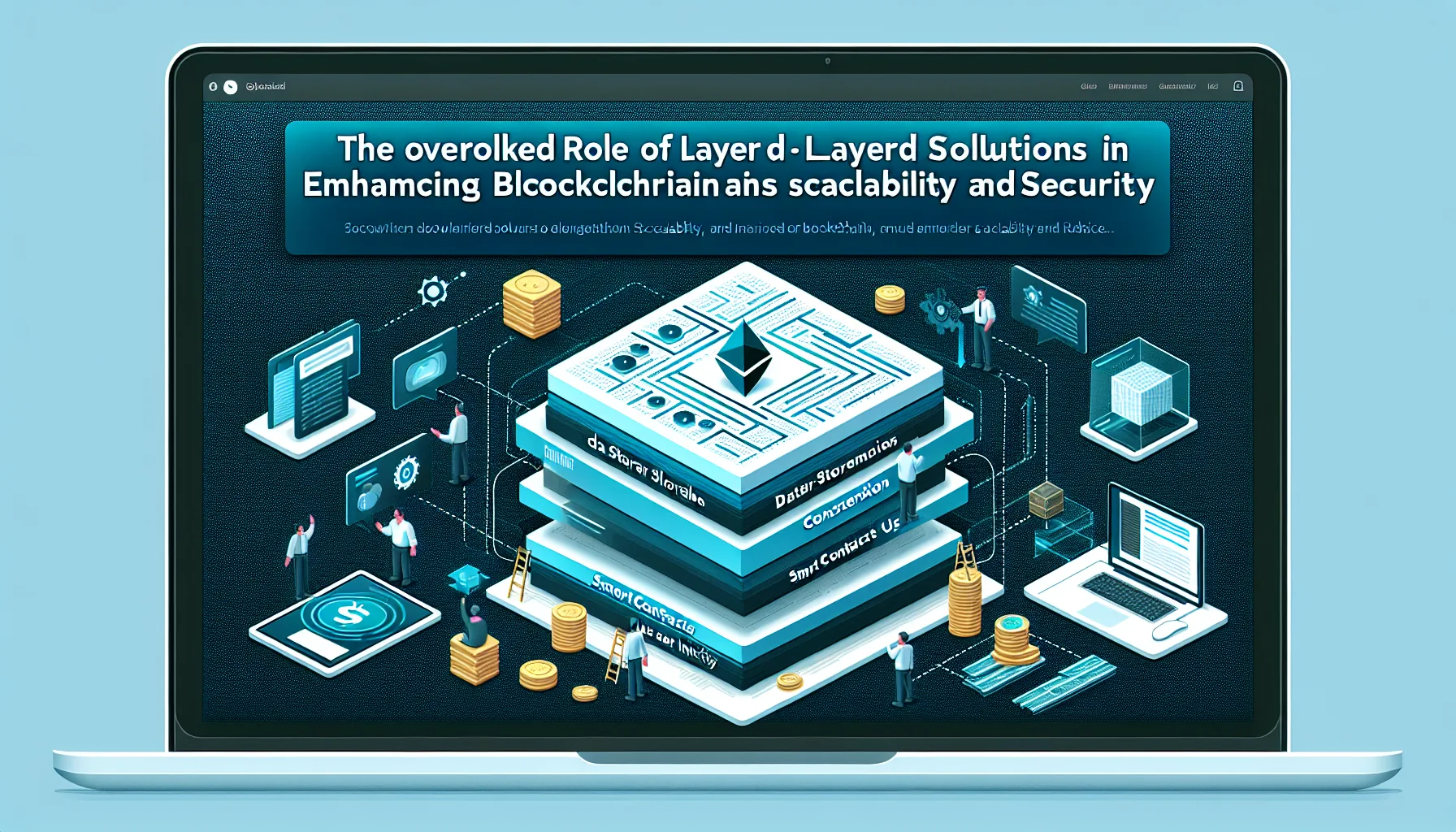
The Overlooked Role of Layered Solutions in Enhancing Blockchain Scalability and Security
The Scalability and Security Bottleneck in Blockchain
Blockchain's fundamental trade-offs between decentralization, scalability, and security—often encapsulated in the "blockchain trilemma"—continue to shape the industry's trajectory. Despite numerous protocol innovations, achieving a seamless balance remains elusive. While Layer 1 chains prioritize security and decentralization, they often falter in scalability. Conversely, high-throughput Layer 1 designs introduce centralization risks or require validators to maintain excessive computational power.
The challenge isn't new. Bitcoin's block size debate highlighted early tensions between security and scalability, while Ethereum's transition toward rollup-centric scaling underscores the growing reliance on layered solutions. However, discussions around Layer 2 adoption frequently lean toward transaction efficiency rather than exploring its security implications, leaving critical questions unanswered.
Why This Issue Remains Overlooked
While Layer 2 solutions such as optimistic rollups and ZK-rollups promise better scalability, their impact on security gets less attention. Cross-layer interactions introduce new complexities, from data availability risks in rollups to trust assumptions in bridges. Moreover, fragmentation in layered architectures has raised concerns over ecosystem cohesion, particularly as disparate Layer 2 networks develop in isolation.
Despite notable advances, security incidents highlight vulnerabilities at intermediary layers rather than the foundational blockchain. Bridge exploits, rollup sequencer censorship, and economic attacks targeting rollup exit mechanisms illustrate how layered scaling introduces novel threats.
Yet, much of the discourse remains focused on user adoption and throughput enhancements rather than a deep dive into how layered architectures reshape blockchain’s security paradigm. Existing security models center on Layer 1 resilience, often failing to account for adversarial scenarios that emerge when assets operate across multiple layers.
The Greater Implications for the Crypto Ecosystem
The evolving reliance on Layer 2 architectures without a uniform security standard could fragment the blockchain ecosystem further. Variability in fraud proofs, settlement delays, and validator incentives can reshape power dynamics, potentially centralizing control among a few dominant Layer 2 networks.
Additionally, reliance on cross-chain liquidity solutions to bridge assets between layers introduces points of failure outside the base chain’s consensus. If unaddressed, these security gaps could lead to systemic risks exceeding those faced by traditional Layer 1 vulnerabilities.
This overlooked intersection of scaling and security raises an essential question: how can Layer 2 solutions achieve both efficiency and robust security without compromising decentralization? While some projects attempt to address this, such as Komodo’s (KMD) focus on cross-chain security innovations (see more on Komodo), a comprehensive framework for evaluating layered security remains absent.
As blockchain adoption scales, misaligned security assumptions between layers could lead to unforeseen systemic failures. Exploring these risks and potential mitigation strategies requires more than just surface-level optimization—it demands a reevaluation of how blockchain layers interoperate securely.
Part 2 – Exploring Potential Solutions
Emerging Layered Solutions for Blockchain Scalability and Security
Optimistic and Zero-Knowledge Rollups: Scaling Without Sacrificing Security
Layer 2 solutions like Optimistic Rollups (ORs) and Zero-Knowledge Rollups (ZKRs) aim to solve Ethereum’s congestion problem. ORs, for example, bundle transactions and execute them off-chain, assuming transactions are valid unless challenged. Meanwhile, ZKRs use cryptographic proofs to validate transaction correctness before committing them on-chain.
Strengths:
- ORs enhance throughput by reducing on-chain computation and are relatively simple to implement.
- ZKRs offer stronger security and instant finality, making them resistant to fraud.
Drawbacks:
- ORs have a delay for withdrawals due to the challenge period, introducing liquidity inefficiencies.
- ZKRs, while secure, have high computational overhead, making them slower and more expensive to generate proofs.
To understand how cryptographic advancements shape blockchain efficiency, consider this article.
Danksharding and Data Availability Sampling: Optimizing On-Chain Storage
Ethereum’s roadmap includes danksharding, an evolution of sharding that introduces data availability sampling (DAS). Instead of splitting execution across shards, danksharding focuses on optimizing data storage for rollups. DAS allows nodes to verify data availability without downloading entire datasets.
Strengths:
- Enables rollups to function efficiently by ensuring block data availability.
- Reduces the burden on individual nodes, allowing for greater decentralization.
Challenges:
- Shuffling validator responsibilities can introduce coordination challenges.
- Requires continual protocol upgrades, adding complexity to implementation.
Validium: Off-Chain Scalability with On-Chain Security Trade-offs
Validiums store transaction data off-chain while using ZK proofs for verification. This reduces blockchain congestion without compromising transaction integrity.
Strengths:
- Significantly higher transaction throughput compared to rollups.
- Does not require high on-chain gas fees for data posting.
Weaknesses:
- Data availability is dependent on external committees, introducing trust assumptions.
- Not ideal for financial applications requiring full on-chain data transparency.
Hybrid Approaches: Structuring Layered Security Models
Some projects explore combining optimistic and validity-based rollups for better flexibility. For example, hybrid rollups use fraud proofs for normal transactions but ZK proofs for high-value transactions.
Benefits:
- Optimizes between cost and security depending on transaction type.
- Enhances adaptability for different blockchain use cases.
Concerns:
- Complexity grows, increasing the risk of smart contract vulnerabilities.
- New attack vectors emerge where adversaries exploit inconsistencies in security mechanisms.
Layered blockchain solutions continue evolving, with each innovation introducing unique trade-offs. The next section will shift focus to real-world implementations of these technologies and their impact on blockchain networks.
Part 3 – Real-World Implementations
Real-World Implementations of Layered Solutions for Blockchain Scalability and Security
Case Study: Ethereum’s Layer 2 Rollups – Optimism and Arbitrum
Ethereum's congestion and soaring gas fees prompted the rise of Layer 2 rollups, with Optimism and Arbitrum leading the charge. These solutions process transactions off-chain while maintaining security by periodically submitting proofs to Ethereum's Layer 1.
Optimism, employing Optimistic Rollups, relies on fraud proofs where transactions are assumed valid unless challenged. However, its one-week fraud proof challenge period has proven to be a bottleneck, limiting its ability to facilitate instant finality.
Arbitrum has a similar approach but improves on decentralization by minimizing validator reliance. Still, challenges remain—delays in decentralizing its sequencer and governance concerns over multisig controls have drawn criticisms from the Ethereum community.
Case Study: ZK-Rollups and the Challenges of Zero-Knowledge Proofs
Zero-Knowledge Rollups (ZK-Rollups) offer a different layer-based solution, bundling transactions and generating validity proofs verified on-chain. zkSync and StarkNet are key players in this space, promising reduced congestion without sacrificing Ethereum’s security.
Despite their potential, ZK-Rollups face technical challenges. Generating zero-knowledge proofs is computationally expensive, making integration difficult for decentralized applications. StarkNet’s Cairo-based smart contracts require developers to abandon Solidity, creating adoption friction. While zkSync attempts EVM compatibility, performance issues and sequencing delays continue to hinder an optimal user experience.
For a broader discussion on cryptographic protocols and interoperability, see The Overlooked Impact of Cryptographic Protocols on Interoperability Among Blockchain Networks.
Case Study: Komodo’s Layered Approach to Cross-Chain Security
Komodo (KMD) has implemented a unique layered security model, leveraging delayed proof-of-work (dPoW). This mechanism notarizes transactions onto the Bitcoin blockchain, providing security resilience against 51% attacks.
While effective in certain cases, this solution isn't without problems. The reliance on Bitcoin’s network introduces dependencies that contradict decentralized ideals. Additionally, Komodo’s adoption has been limited due to competitive Layer 2 solutions that offer better scalability without relying on an external blockchain.
More details on Komodo’s approach can be found in Komodo KMD: The Future of Blockchain Interoperability.
These implementations illustrate the real-world complexities of layered scaling solutions. Whether optimizing transaction finality, overcoming computational bottlenecks, or avoiding external dependencies, no single approach has fully solved blockchain’s trade-offs between scaling and security.
Part 4 – Future Evolution & Long-Term Implications
The Future Evolution of Layered Blockchain Solutions: Scaling Beyond Current Limitations
Anticipated Breakthroughs in Layer 2 and Beyond
As blockchain technology matures, one of the most pressing challenges remains scalability. Layered solutions, particularly Layer 2 networks such as rollups and state channels, are evolving towards more efficient architectures. The development of recursive zero-knowledge proofs (zk-SNARKs and zk-STARKs) is set to dramatically reduce the computational burden on Layer 1 chains by bundling even greater numbers of transactions before settlement.
Another key breakthrough is the emergence of decentralized sequencers in rollup ecosystems. Current rollups rely on centralized operators to manage transaction ordering, posing both censorship and resilience concerns. The shift towards decentralized sequencers using proof-of-stake validation or MEV-resistant designs could create Layer 2 solutions that maintain high efficiency without relying on single points of failure.
Cross-Chain Layer 2 Integration
Interoperability between Layer 2 solutions and differing blockchain ecosystems is another frontier that could redefine how decentralized applications function. Rollups operating across multiple chains currently struggle with fragmented liquidity and state synchronization. Advances in optimistic and zero-knowledge bridges could facilitate seamless asset movement between disparate ecosystems without compromising security.
Protocols such as stateful cross-rollup communication frameworks might soon allow applications to interact fluidly across Ethereum Layer 2 solutions without holding redundant liquidity in multiple environments. This could fundamentally alter how users perceive blockchain scaling—not as isolated siloed efficiencies but as a unified distributed execution environment.
Efforts in cross-chain Layer 2 dynamics tie into ongoing research around blockchain interoperability, which has also been explored in discussions on protocols enhancing secure and scalable decentralized interactions (see related insights here).
Security Trade-Offs and Long-Term Viability
While innovation in Layer 2 scaling continues, security remains a critical concern. Fraud-proof mechanisms in optimistic rollups rely on economic game theory, but recent discussions suggest that the time delay for fraud challenges could expose critical vulnerabilities in real-world attacks.
Additionally, reliance on centralized bridges for interoperability between Layer 2 solutions and Layer 1 blockchains has been a focal point for debate. Compromised bridges have led to some of the largest exploits in crypto history, questioning whether hybrid models—such as trust-minimized bridges leveraging cryptographic proofs—would be a safer alternative.
Beyond security, the long-term sustainability of Layer 2 ecosystems directly hinges on decentralization. Centralized rollup operators currently control fee structures and transaction ordering, leading to concerns of eventual gatekeeping. The roadmap ahead must balance economic incentives with genuine decentralization efforts to prevent scalability solutions from simply recreating centralized financial models under a new guise.
Part 5 – Governance & Decentralization Challenges
Governance & Decentralization Challenges in Layered Blockchain Solutions
Centralized vs. Decentralized Governance Models
The governance of blockchain networks, particularly those employing layered solutions, introduces a critical trade-off between centralization and decentralization. While centralized governance models ensure efficiency and fast decision-making, they also expose the ecosystem to single points of failure, regulatory control, or even outright governance takeovers.
In contrast, decentralized governance models aim to distribute decision-making among token holders, validators, or DAOs. However, these systems are not immune to manipulation. The rise of plutocratic control, where governance power accumulates in the hands of large stakeholders, undermines the democratic ethos of decentralized networks. Layered blockchain solutions must carefully design governance frameworks that balance efficiency with decentralized security, avoiding centralization vectors that could compromise the network's long-term viability.
Governance Attacks & Network Hostile Takeovers
As blockchain governance evolves, so do new forms of governance attacks. Hostile takeovers such as vote-buying, Sybil attacks, and governance-cartel formations have emerged as tangible risks. Large entities acquiring governance tokens can influence critical proposals that alter consensus models, impose restrictive policies, or inject attack vectors that compromise network security.
This risk is especially pronounced in layer 2 scaling solutions that rely on bridges to layer 1 networks. If a malicious entity gains control over a governance proposal on a rollup or state channel, they can manipulate transaction settlement mechanisms, potentially disrupting the entire ecosystem. The security models of these solutions require extensive economic defenses, such as higher participation thresholds or multi-layer verifications, to prevent governance from becoming a centralized attack surface.
Regulatory Capture: A Growing Concern
Beyond internal threats, external pressure from regulators introduces another governance challenge. Decentralized protocols are increasingly targeted by regulatory capture, where governments or institutional entities influence protocol changes through legal mandates, sanctions, or financial incentives.
For projects aiming to comply with jurisdictional regulations, validators and sequencers may be pressured to filter transactions, restrict certain wallet addresses, or implement KYC-based access layers—fundamentally shifting the decentralized nature of these solutions. This trend mirrors the larger battle between censorship resistance and mainstream adoption, forcing projects to navigate a knife-edge between autonomy and compliance.
Can Layered Solutions Sustain True Decentralization?
While layered blockchain solutions vastly improve system scalability, they also introduce governance complexities that demand novel solutions. Some networks explore optimistic governance models, where backward-compatible governance decisions are only executed if disputed. Others leverage cross-layer governance mechanisms, where control is distributed across different layers and checkpoints are enforced at the base layer.
However, even with these attempts, decentralization without economic inefficiencies remains an unresolved challenge. Projects like ZKF4, which is pioneering decentralized governance in the crypto space, serve as examples of governance experiments that may influence future blockchain governance frameworks.
In the next part, we will shift our focus to another pressing issue: scalability and engineering trade-offs. As blockchain solutions aim for mass adoption, technical architecture, finality speed, and transaction throughput are becoming battlegrounds where security and decentralization directly compete.
Part 6 – Scalability & Engineering Trade-Offs
Scalability & Engineering Trade-Offs in Layered Blockchain Solutions
Expanding blockchain networks at scale presents critical engineering challenges that require trade-offs between decentralization, security, and transaction speed. Layered solutions—such as rollups, sidechains, and state channels—aim to alleviate scalability issues, yet they introduce new complexities that must be carefully considered.
The Scalability Bottleneck
Layer 1 blockchains, particularly those relying on proof-of-work (PoW) or proof-of-stake (PoS), struggle with transaction throughput limitations due to block size, block time, and consensus constraints. Ethereum, for example, has worked around these issues with rollups and sharding, whereas Solana opts for high throughput at the cost of increased hardware demands.
Layer 2 solutions like zero-knowledge rollups (ZK-rollups) improve efficiency by batching multiple transactions off-chain before finalizing them on the main chain. However, these solutions often concentrate validation power among a smaller set of actors, which may weaken decentralization.
Balancing Speed with Security
Higher throughput typically means a trade-off in security. Sidechains and optimistic rollups, for example, offer faster finality but carry additional risks due to weaker security assumptions. In some cases, users must rely on fraud proofs or trusted validators, both of which pose potential vulnerabilities. The challenge is ensuring that these secondary layers remain resistant to malicious actors while still maintaining cost-effectiveness.
Challenges in Cross-Chain Communication
Interoperability between Layer 1 and Layer 2 solutions introduces an entirely new set of engineering challenges. Cross-chain bridges, while essential for moving assets between ecosystems, are frequent targets for attacks. The struggle is ensuring that assets remain secure across different blockchain environments without compromising speed. Projects like Komodo (KMD) have explored unique approaches to interoperability by focusing on security-first mechanisms. Read more on Komodo’s approach here.
The Risk of Centralization in Layered Solutions
A key argument against Layer 2 scaling solutions is the risk of centralization creeping back into blockchain ecosystems. Stronger reliance on centralized sequencers, validators, or off-chain trust mechanisms raises concerns about censorship resistance and long-term sustainability.
Meanwhile, projects experimenting with hybrid models—blending Layer 1 decentralization with Layer 2 speed—face significant governance issues. Disputes over upgrade control, fee structures, and validator incentives make it difficult to sustain completely decentralized operations.
Mitigating these trade-offs requires new cryptographic techniques, better economic incentives, and possibly fundamental shifts in blockchain architecture. The next section of this series will examine how regulatory and compliance risks further complicate the deployment of these scalability solutions.
Part 7 – Regulatory & Compliance Risks
Regulatory & Compliance Risks: Legal Barriers to Layered Blockchain Adoption
The integration of layered scaling solutions in blockchain ecosystems introduces a complex legal and regulatory landscape that varies significantly across jurisdictions. While these solutions aim to enhance scalability and security, they also pose compliance challenges that could hinder their adoption.
Jurisdictional Fragmentation: A Minefield for Layered Solutions
Regulatory authorities worldwide differ in their classification of cryptocurrencies, tokens, and blockchain networks. In some jurisdictions, Layer 2 solutions may be categorized as securities due to their staking or governance mechanisms, leading to additional compliance burdens. Other regions take a more lenient stance, offering regulatory sandbox environments for blockchain experimentation.
One of the most pressing issues arises when certain jurisdictions mandate strict Know Your Customer (KYC) and Anti-Money Laundering (AML) requirements. Decentralized Layer 2 rollups and sidechains often rely on pseudonymous transactions, complicating compliance efforts. This could expose operators and developers to legal scrutiny, particularly if they inadvertently facilitate illicit financial activity.
Governmental Interventions and Protocol Censorship Risks
Governments and regulatory bodies are increasing oversight on blockchain networks, with some enforcing mechanisms that could impact Layer 2 scalability solutions. Layered architectures often introduce new points of centralization, especially where sequencers or validators manage transaction ordering. This structure opens the door to potential regulatory pressure, forcing these entities to enforce restrictions or blacklist certain transactions.
Furthermore, attempts to make blockchain infrastructure compliant with financial regulations could lead to protocol-level censorship. If regulators require intermediaries in Layer 2 networks to block certain addresses suspected of money laundering or sanctions evasion, the decentralized ethos underpinning blockchain could be severely compromised. This has already been demonstrated in past governmental interventions targeting privacy-enhancing protocols and mixers.
Precedents from Historical Regulatory Actions
Several landmark cases and regulations provide insight into how authorities may approach Layer 2 development. Regulatory crackdowns on unregistered securities offerings have resulted in substantial fines for crypto projects, posing risks for Layer 2 tokens that use rollup mechanics involving rewards or staking. Additionally, multiple governments have imposed bans or restrictions on blockchain technologies, forcing Layer 1 and Layer 2 solutions to modify operations or exit certain markets.
Stablecoin regulations also offer a glimpse into how authorities might address Layer 2 ecosystems. As regulators push for stringent oversight on token issuance and reserves, any settlement layers reliant on stablecoins could face hurdles in maintaining liquidity and compliance with financial laws.
The evolving landscape of blockchain regulation underscores the need for Layer 2 solutions to adopt flexible governance models that can adapt to shifting compliance concerns. The tension between innovation and oversight remains a pivotal challenge for blockchain scalability.
In the next section, we'll examine the economic implications of layered solutions and their role in reshaping financial markets.
Part 8 – Economic & Financial Implications
The Economic and Financial Implications of Layered Blockchain Solutions
The integration of layered solutions in blockchain architectures is poised to reshape economic structures, creating new markets, disrupting existing ones, and introducing both opportunities and risks for investors. While scalability enhancements promise greater capital efficiency, shifting security models could generate unintended economic trade-offs.
Capital Inflows and Market Expansion
Layered solutions, particularly Layer 2 rollups and modular blockchain frameworks, lower transaction costs and facilitate higher throughput, which in turn attracts institutional capital. By decreasing entry barriers, these frameworks make decentralized applications (dApps) commercially viable at scale, leading to an influx of new financial instruments—derivatives, lending markets, and synthetic assets—previously impractical due to gas fee constraints.
Volatile Network Effects and Capital Redistribution
With improved scalability, liquidity aggregation becomes more efficient, potentially accelerating network effect dominance. However, this consolidation could also lead to a winner-takes-most scenario where smaller ecosystems struggle to retain users. Traders benefiting from high-frequency strategies could profit, whereas ecosystems dependent on network fees—such as certain Layer 1 chains—may see diminishing revenue streams, shifting the financial balance in unpredictable ways.
Security Considerations and Capital Protection
While economic efficiencies improve, layered scaling solutions introduce fragmented security assumptions. Rollups securing transactions via Ethereum inherit its security, yet the economic relationship between Layer 1 and Layer 2 remains complex. If trust assumptions falter—either due to smart contract vulnerabilities or centralized sequencers—capital at stake could be compromised. Institutional investors may hesitate to engage in assets dependent on a security model that diverges from fully decentralized execution.
The Institutional Shift and Regulatory Pressures
As traditional finance players explore on-chain adoption, layered solutions present a dual-edge dynamic: reduced transaction costs increase usability, but compliance challenges grow as transaction routing becomes opaque. Financial regulations, including Know Your Customer (KYC) and Anti-Money Laundering (AML) protocols, become harder to enforce within multi-layered execution environments, prompting potential regulatory backlash that could impede innovation.
Unforeseen Economic Risks
New economic attack vectors emerge alongside efficiency gains. MEV (Maximal Extractable Value) dynamics persist across layers, while fragmented liquidity may introduce novel arbitrage markets, some with unintended destabilizing effects. Additionally, exploitative incentive structures—such as liquidity mining programs driving short-term engagement but lacking sustainable usage—could erode capital efficiency over time.
The Broader Societal and Philosophical Considerations
Beyond financial expansion and risk distribution, layered blockchain solutions also carry ideological implications. Who ultimately benefits from increased scalability? How does decentralization persist in a multi-layer market structure? These are the pressing questions shaping the next phase of blockchain’s evolution.
Part 9 – Social & Philosophical Implications
Economic & Financial Implications of Layered Blockchain Solutions
Layered blockchain solutions are forcing a fundamental shift in how financial markets interact with distributed systems, impacting everything from institutional investment strategies to how value is transacted across ecosystems. While these innovations promise efficiency and scalability gains, they challenge economic models that have been built on traditional blockchain architectures.
Institutional Capital and Strategic Positioning
Institutional investors are recalibrating their approach due to the emergence of Layer 2 networks. These solutions reduce transaction fees and enhance throughput, making DeFi more accessible to larger pools of capital. However, concerns persist about long-term value accrual. If activity shifts away from a Layer 1 chain—where protocols like Ethereum derive security from transaction fees—toward rollups or state channels that settle infrequently, the economic incentives of miners and validators may weaken.
Moreover, Layer 2 protocols often introduce governance tokens for scaling solutions, adding new speculative layers to an already complex market. While some investors see this as an alpha-generating avenue through staking yields and governance participation, others worry about fundamental value dislocation if governance incentives cannot sustain long-term participation.
Disrupting Liquidity and Market Structures
Exchanges, both centralized (CEXs) and decentralized (DEXs), must navigate the liquidity fragmentation resulting from Layer 2 adoption. While rollups enhance transaction efficiency, they introduce additional withdrawal times and require bridges to move funds across chains. Traders who rely on speed may find themselves exposed to higher capital inefficiencies when moving between Layer 1 and Layer 2 environments.
Similarly, liquidity providers (LPs) face a dilemma: maintaining capital on Layer 1, where the liquidity depth is greatest, or deploying assets onto Layer 2 where transaction costs are lower but volumes are still developing. A misalignment between liquidity availability and user adoption could inadvertently introduce price inefficiencies, impacting arbitrageurs and automated market makers (AMMs) relying on tight spreads.
Unintended Financial Risks
As with any financial innovation, layered blockchain solutions introduce new risk vectors. Smart contract vulnerabilities within these scaling solutions could lead to significant capital losses, especially if attacker incentives outweigh the costs of exploitation. Case studies from DeFi highlight how liquidity fragmentation can open up attack surfaces via oracle manipulation or cross-chain arbitrage exploits.
Furthermore, the rise of Layer 2 networks forces traders and investors to reassess risk models for capital efficiency. The reduced transaction fees and execution speed benefits could come at the cost of added smart contract dependencies, increasing systemic complexity in DeFi lending protocols or synthetic asset markets.
Shaping the Next Generation of Crypto Economics
The economic implications of layered blockchain frameworks extend beyond immediate trading and liquidity concerns. Governance frameworks must evolve as transaction execution increasingly happens off-chain, shifting influence away from Layer 1 token holders toward new Layer 2 stakeholders.
Emerging protocols like POND2 explore how governance and economic incentives can be reinforced across chains—but long-term alignment between Layer 1 and its scaling layers remains an unresolved challenge.
This evolving financial architecture does not only impact market participants but also provokes deeper discussions on decentralization, governance centralization tendencies, and crypto’s broader philosophical foundations. These themes will be explored next.
Part 10 – Final Conclusions & Future Outlook
The Overlooked Role of Layered Solutions in Enhancing Blockchain Scalability and Security
Final Conclusions & Future Outlook
After deep-diving into the intricacies of layered blockchain solutions, one truth stands out—scalability and security remain intrinsically linked. While Layer 2 solutions offer unparalleled transaction speed and cost efficiency, they risk centralization concerns, fragmented liquidity, and novel attack vectors. Meanwhile, Layer 1 enhancements introduce fundamental architectural shifts but often struggle with adoption bottlenecks and backward compatibility issues.
Best-Case vs. Worst-Case Scenarios
In an optimal future, Layer 2 networks seamlessly interoperate across ecosystems, supported by robust fraud-proof and validity approaches. Achievements in zero-knowledge rollups and optimistic rollups could mitigate counterparty risks, while emerging data availability solutions may prevent off-chain dependency vulnerabilities. Security models will evolve to ensure state integrity without compromising decentralization.
In contrast, the worst-case scenario sees these advancements stall under technical debt, user resistance, and the regulatory scrutiny of off-chain execution. Fragmented rollup frameworks could create inaccessible liquidity pools, rendering the efficiency gains of universal scaling moot. Additionally, governance disputes around Layer 2 sequencing rights may lead to censorship and undue protocol centralization.
Unresolved Questions in Layered Blockchain Development
Despite promising progress, critical questions remain unanswered:
- Will decentralization incentives for Layer 2 sequencers align with network ethos, or will they resemble traditional financial institutions?
- Can zk-proofs achieve computational efficiency at scale without introducing latency overhead?
- How will security bridges mitigate the rising risk of cross-layer exploits?
These questions directly impact the longevity of layered scaling, particularly as centralized exchanges and custodians integrate Layer 2 solutions into mainstream trading platforms.
What Needs to Happen for Full Adoption?
For layered solutions to gain mainstream traction beyond speculative markets, blockchain infrastructure must meet enterprise-grade reliability standards. Consistency in liquidity provisioning will be crucial, requiring synchronization mechanisms as seen in emerging cross-chain protocols. Simultaneously, solving the usability gap—for developers and non-crypto-native users—will dictate whether these innovations remain niche or scale toward mass adoption.
Projects like Komodo (KMD) have already demonstrated the importance of interoperability in merging Layer 1 and Layer 2 efficiencies, yet the broader industry still struggles with standardized frameworks for implementation.
Ultimately, the question lingers: Will layered solutions define the future of blockchain infrastructure, or will they be relegated to experimental technologies that failed to achieve true decentralization and adoption?
Authors comments
This document was made by www.BestDapps.com