Part 1 – Introducing the Problem
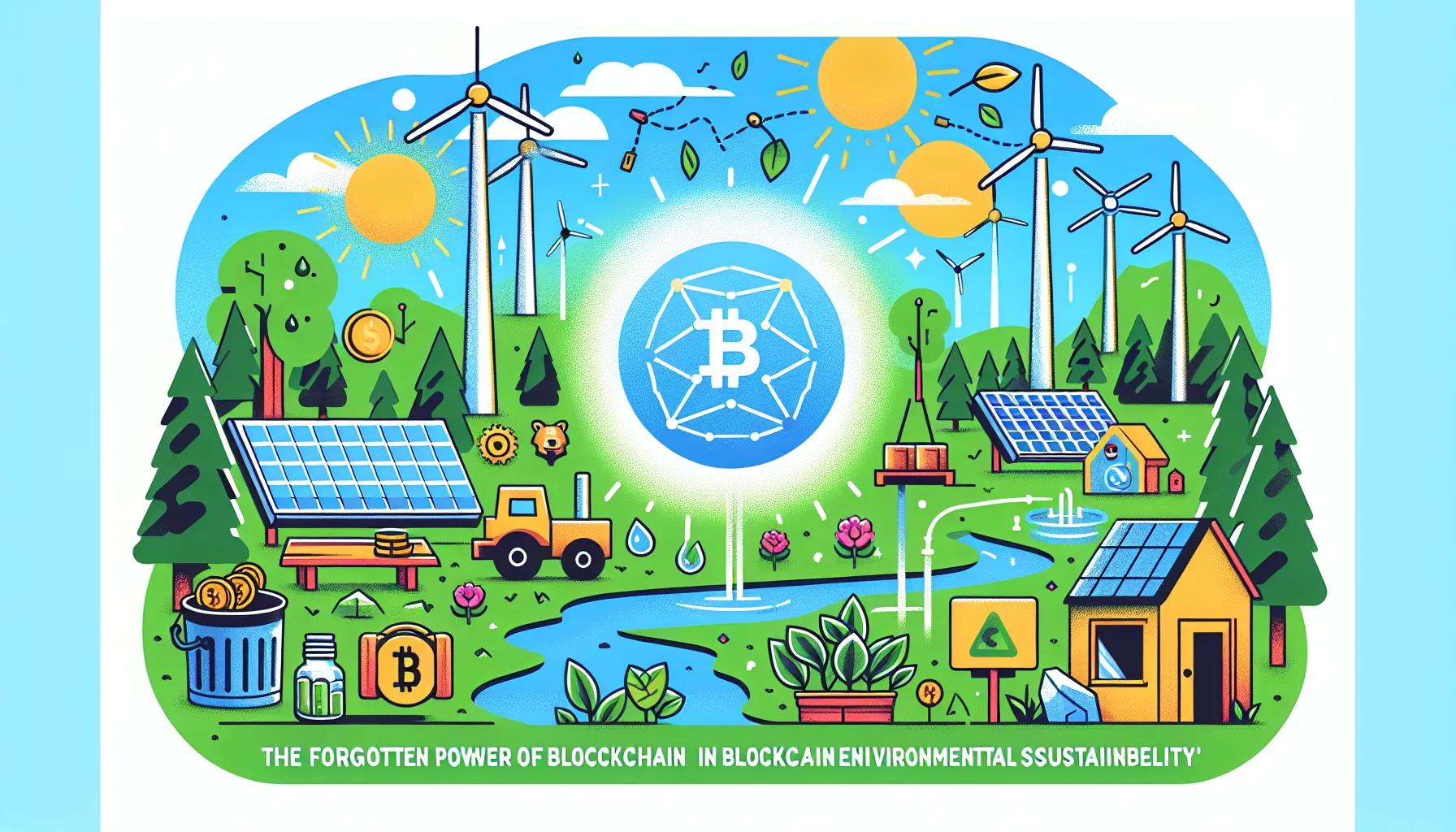
The Forgotten Power of Blockchain in Environmental Sustainability: How Decentralized Solutions are Driving Green Initiatives
Part 1 – Introducing the Problem
Environmental sustainability has emerged as a surprisingly under-addressed use case for blockchain technology, despite Web3's foundational promises of transparency, censorship resistance, and democratization. While crypto-native communities have extensively debated DeFi, DAOs, and tokenomics, the intersection of blockchain and environmental resilience remains largely relegated to niche applications like carbon credit tokenization or green NFTs. Most of these efforts, however, lack meaningful infrastructure-level implementation and are instead bolted on as marketing-layer optics.
What’s more concerning is that blockchains themselves—particularly Layer-1 chains—consume substantial energy, leading to public scrutiny that overshadows their potential as coordination engines for regenerative action. Projects that venture into green crypto spaces are either dismissed as virtue signaling or fail to scale due to fragmented incentive models, weak governance participation, or oracle dependency. This disconnect stifles innovation in one of the most pressing domains of our time: climate resilience.
Part of the issue stems from the architectural biases of early blockchains. Bitcoin, while revolutionary, was never designed to interface with off-chain ecological data or stakeholder feedback loops. Ethereum introduced smart contracts, yet most builders optimized for yield and gamification rather than sustainability. Even platforms like Waves, known for customizable dApp components and token creation ease, haven't fully leaned into environmental adaptation, despite possessing the infrastructure for it. Projects like those profiled in Unlocking WAVES: Diverse Use Cases in Crypto hint at untapped capabilities, but the ecosystem lacks cohesion around environmental governance.
Data silos serve as another major obstacle. Environmental metrics—sensor data, emissions levels, biodiversity indexes—remain trapped in private or government databases, making proof-of-impact systems difficult to authenticate on-chain without robust oracle mechanisms. Current oracle solutions are more focused on price feeds than complex environmental data—leaving a sizable interoperability gap.
There’s also a misalignment in incentive structures. DAOs and token economies have yet to successfully reward long-range impact behaviors, like conservation or emissions mitigation, because on-chain validation of such events is either too slow, too subjective, or too costly.
These compounded challenges create a vacuum where blockchain's promise of decentralizing trust and resource allocation is noticeably absent from environmental discourse. Hidden within this frontier is a dormant mechanism for ecological regeneration—encrypted, composable, and credibly neutral—but still architecturally underexplored. The deeper mechanics of how that might change—including through decentralized monitoring, programmable bribery mechanisms, or geospatial tokenization—open up new design frontiers for the environmentally conscious protocols of tomorrow.
The following section dives into early architectural patterns that have either constrained or enabled environmental use cases—starting with how consensus mechanisms encode ecological incentives, and whether Layer-1 innovation can reverse the trend.
Part 2 – Exploring Potential Solutions
Blockchain’s Environmental Puzzle: Theoretical Solutions Poised to Scale
The promise of blockchain for environmental sustainability isn’t in ESG tokens or greenwashing PR campaigns—it’s in robust, verifiable systems that encode sustainability values directly into decentralized infrastructure. But which technologies actually work?
1. Proof-of-Stake and Beyond: Consensus Reimagined
The shift from proof-of-work to proof-of-stake (PoS) was a fundamental upgrade for energy efficiency, but it’s only part of the conversation. Next-gen consensus models such as Avalanche’s DAG-based approach and Algorand’s Pure PoS drastically reduce resource wastage while maintaining permissionless security. However, their adoption often comes with trade-offs in validator decentralization. This isn’t just theoretical—centralization risks in PoS have material consequences, particularly in energy-grid tokenization efforts where consensus needs to remain auditable and diverse.
2. Verifiable Credentials and IoT-Linked Smart Contracts
Tracking carbon footprints cannot depend on self-reporting. Projects exploring Verifiable Credentials (VCs) tied to Internet of Things (IoT) devices aim to inject tangible environmental data directly into smart contracts. Theoretically, this grants on-chain carbon measurement a zero-trust architecture rooted in sensor data. The risk? Attack vectors on physical hardware or data spoofing—which remains an unresolved issue in many proposed Ethereum-based climate registries. As promising as these integrations sound, they require deep infrastructure trust that may exceed blockchain scope alone.
3. ZK Proofs for Green Confidentiality
Zero-knowledge proofs (ZKPs) are emerging as the stealth layer of verifiable environmental impact. Platforms experimenting with zk-SNARKs for carbon credit verification protect corporate or individual identity while still proving carbon compliance. But widespread implementation depends on efficient, decentralized ZK circuits—something most networks still struggle with. Scalability challenges persist, as does the lack of composable tooling for integrating ZKPs with existing DeFi protocols.
4. Tokenized Incentives for Sustainability
Protocols like Regen Network attempted to tokenize ecological updates as yield-bearing assets. While compelling, many systems remain siloed and illiquid, making it difficult to pair environmental yield with mainstream DeFi. WAVES, in some ecosystems, offers tools for creating customizable smart assets that theoretically support such token infrastructures. For more analysis, readers can explore Waves Blockchain Revolutionizing Smart Contracts and Tokens.
The design space for sustainability-driven blockchains is expanding, but none of these approaches are without constraints—technological, social, or financial. Fraud-resistant data, lifecycle transparency, and scalable incentive alignment are critical, and still up for refinement. The path to meaningful environmental accountability may be paved with novel cryptographic primitives—but practicality will require implementation discipline.
As decentralized climate efforts begin to exit the lab and emerge on mainnet, Part 3 will uncover which of these solutions are already shaping real-world change.
Part 3 – Real-World Implementations
Real-World Blockchain Implementations in Environmental Sustainability: Case Studies, Challenges, and Results
Several blockchain networks and eco-focused startups have transitioned from theoretical sustainability models to tangible applications—with mixed outcomes. Among them, Power Ledger, Toucan Protocol, and Regen Network represent varied approaches to environmental impact via decentralization.
Power Ledger built an energy trading marketplace using a dual-layer blockchain system—its native Power Ledger Token (POWR) lives on Ethereum, while its Sparkz token operates on a consortium chain. This hybrid architecture was designed to maximize interoperability while keeping transaction fees manageable in localized energy grids. However, the project has faced scalability limitations. Handling microtransactions for energy peer-to-peer trades pushed transaction throughput to its limits, especially in densely populated urban pilot zones. Additionally, regulatory hurdles in energy deregulation markets created delays and forced protocol redesigns.
Toucan Protocol gained rapid adoption for tokenizing carbon credits. Its Base Carbon Tonnes (BCT) product offered on-chain liquidity for voluntary carbon markets, initially bootstrapped via integrations with KlimaDAO. But this liquidity-first model also backfired: critics noted that credits of questionable integrity entered the blockchain through large-scale backward-looking bridging, undermining trust and transparency. These events triggered a governance overhaul and algorithmic filters to prevent poor-quality credits—a move that fragmented its community but brought the protocol marginally closer to industry standards.
Meanwhile, Regen Network chose to tackle ecological data on-chain by linking land stewardship and carbon sequestration records directly to its Cosmos-based chain. Its validator set includes cooperative farmers and ecologists, creating a more grounded governance model. However, Regen’s high dependency on physical data inputs—such as satellite imaging and third-party soil compositional studies—has exposed it to delays and data manipulation risks. The proof of ecological service remains in its infancy, with limited verifiability for off-chain regenerative outcomes.
A parallel yet underexplored trajectory runs through Layer-1 blockchains that emphasize energy efficiency by design. Notably, the WAVES platform provides smart contract functionality without exorbitant resource usage, making it suitable for simple environmental tokens and registries that need cost-effective execution. This is particularly relevant considering some of the smart contract architectures explored in efforts to track carbon emissions and water usage via NFTs. For more on how WAVES compares to other ecosystems in sustainable utility, see A Deepdive into Waves.
Despite the growing momentum, sustainability-centered projects face harsh trade-offs between decentralization, data integrity, and regulatory compliance. Initiatives tethered to physical-world assets often require significant off-chain validation layers, undermining decentralization. Others fall into the trap of greenwashing via tokenization without meaningful environmental impact—highlighting the urgency to develop purpose-built consensus models or bridges grounded in verifiable ecological metrics.
As these systems continue to iterate, Part 4 will explore how blockchain’s long-term alignment with environmental goals depends on technological evolution, regulatory frameworks, and the effectiveness of these ongoing experiments.
Part 4 – Future Evolution & Long-Term Implications
Next-Gen Blockchain for Sustainability: Where Scalability Meets Environmental Impact
Scalability remains one of the persistent roadblocks for blockchain applications aiming to drive environmental sustainability. With many public chains throttled by energy-demanding consensus protocols or constrained through TPS limitations, future breakthroughs lie in rethinking how decentralized infrastructures can deliver impact at scale without trade-offs in efficiency or trustlessness.
Rollup-centric roadmaps and modular execution environments are emerging as promising contenders to handle the load. Optimistic and zk-rollups, particularly when used in tandem with proof-of-stake Layer-1s, enable environmental projects to process data-heavy transactions—like carbon offsets tracking or decentralized energy exchanges—at lower operational costs. This shift is critical for large-scale sensor integrations in sustainability-focused oracles and smart contract logic. Future advancements in zk-SNARKs may even facilitate privacy-preserving green finance models, shielding user data while maintaining verifiability.
Cross-chain interoperability introduces another frontier. Sustainability solutions are often fragmented across ecosystems—one chain anchors climate impact NFTs, another hosts DAOs for green funding, while yet another tracks regenerative agriculture efforts. Seamless data and token flow between these networks will be vital. The evolution of trust-minimized bridges and shared security layers could be instrumental here. Projects like the Waves protocol have made early moves in this space through simplified token creation and smart contract deployment. Expanding on the ideas covered in Waves Blockchain: Revolutionizing Smart Contracts and Tokens, layering sustainability-specific tooling into developer kits could fast-track innovation.
An interesting parallel is the trajectory of off-chain compute integrations. As blockchains increasingly rely on external computation via decentralized servers or oracles, environmental apps too may favor off-chain analysis models. For instance, calculating real-time emissions reductions or verifying tree-planting through satellite imaging often demands processing power not feasible on-chain. Whether through systems like decentralized cloud infrastructure or confidential compute nodes, expect tight coupling with edge AI systems and climate analytics moving forward.
However, infrastructure evolution alone won’t fix carbon-intensive mining chains retroactively. There’s still tension: proof-of-work chains hosting green ELTs (environmental-linked tokens) risk undermining the very ethos they aim to support. A serious pivot in validator incentives—or migration to energy-efficient consensus—must occur if environmental messaging is to gain credibility.
Innovative staking models also hold potential. Liquid staking combined with regenerative finance (ReFi) could incentivize node participation and green infrastructure growth in tandem. Protocols offering sustainability-focused reward mechanisms might emerge as foundational, especially in validator marketplaces integrating environmental metrics.
All of this sets the stage for deeper questions around coordination: Who decides validity in decentralized climate data? Where does governance fit? Part 5 will explore those growing governance dilemmas.
Part 5 – Governance & Decentralization Challenges
Governance and Decentralization Challenges in Blockchain-Based Sustainability Projects
Environmental blockchain applications face a unique conundrum: while decentralization promises autonomy, transparency, and censorship-resistance, it also brings operational ambiguity, governance vulnerabilities, and attack surfaces that traditional structures are better suited to deter.
In sustainability-focused blockchains—e.g., tokenized carbon offset markets or decentralized renewable energy credit exchanges—governance must reconcile varying incentives among public participants, private stakeholders, and regulators. The challenge intensifies when token-weighted systems evolve into de facto plutocracies. Token-rich stakeholders can dominate protocol decisions, skewing priorities toward financial gains rather than environmental impact. This mirrors problems seen in protocols like MakerDAO and Curve, where governance "voting power" is disproportionately centralized among whales.
The risk of governance attacks—such as bribery-based vote manipulation, or Sybil attacks via wrapped tokens—is compounded in green protocols operating in morally sensitive spaces. Malicious actors could manipulate emission tracking registries for greenwashing, where sustainability metrics are fabricated or misrepresented. Without robust governance mechanisms that promote verifiability and community enforcement, the environmental use case weakens its own ethical credibility.
Moreover, the push for decentralization often clashes with regulatory compliance. Initiatives aimed at globally approved sustainability goals may inadvertently recreate centralized chokepoints by inviting governmental oversight. This leads to the risk of regulatory capture, particularly when project administrators—or large token holders entangled with regulators—serve as the gatekeepers of index inclusion or registry updates. These hybrid structures often mask centralized influence under the pretense of multi-sig governance or DAO speculation.
Projects like Waves illustrate how protocol-level governance can evolve over time to purportedly remain community-driven while simultaneously enabling developer-led steering. While this helps insulate against random forks or consensus stagnation, it also muddies the waters around control and can replicate centralized dynamics under another name.
Furthermore, due to governance fragmentation, many sustainability-focused DAOs struggle to make high-agency decisions. Proposals often stall in voting limbo due to voter apathy or off-chain collusion. Even relying on staking as a voting mechanism exacerbates the "rich-get-richer" loop, limiting inclusivity—a paradox for any public-good mission.
Until decentralized projects adopt more resilient governance modules, many intersecting risks—attack vectors, capture potential, and skewed incentives—make implementation in high-stakes environmental sectors more complex than anticipated. These governance challenges are a precursor to another highly contested problem: the scalability and engineering trade-offs that must be addressed to transition from theory to infrastructure-level deployment.
Part 6 – Scalability & Engineering Trade-Offs
Scalability Limitations and Engineering Trade-Offs in Environmental Blockchain Protocols
The promise of integrating blockchain into environmental sustainability hinges not just on ideological alignment, but practical technical scalability. Yet scaling decentralized solutions across national and global environmental infrastructure is riddled with complex trade-offs among decentralization, security, and speed.
At the heart of this challenge lies the choice of consensus mechanism. Proof-of-Work remains highly secure and decentralized—but becomes untenable when applied to eco-centric applications due to its energy consumption profile and scalability bottlenecks. Ethereum’s recent transition to Proof-of-Stake has helped mitigate such concerns, though not without substantial centralization risks stemming from capital-driven validator influence.
In applications like carbon credit tracking or waste traceability, speed and cost matters. Blockchain systems favoring scalability, such as Solana or Avalanche, achieve high throughput by compromising on validator diversity and finality guarantees. These speed-optimized chains are often criticized for sacrificing credible neutrality—particularly dangerous in systems requiring transparent climate accountability.
Layer-2 solutions like rollups offer a compelling middle ground, offloading processing from base layers while preserving Ethereum’s security assumptions. Yet integration complexity and the need for multi-bridge infrastructure introduce significant engineering overhead. Greening the world with blockchain requires more than just scaling transactions—it demands scaling trust, composability, and interoperability.
This is where wave-architected chains claim an edge. The Waves Blockchain, for instance, leverages a hybrid consensus mechanism built on Leased Proof-of-Stake (LPoS), balancing low energy consumption with rapid transaction finality. But trade-offs persist: reduced decentralization and historical criticisms regarding governance and transparency still haunt long-term viability for mission-critical climate applications.
Moreover, node operation and state bloat introduce formidable engineering bottlenecks. As smart contracts scale, storage requirements increase non-linearly. Environmental monitoring dApps—tied to frequent sensor feeds or IoT data—compound this issue. Stateless architectures like zk-rollups could reduce overhead but bring their own developer learning curves and tooling immaturity.
In the end, no L1 or L2 stack today offers a silver bullet. Builders aiming to leverage blockchain for environmental solutions must prioritize modularity: separating computation, consensus, and data availability layers while acknowledging the nuances of each trade-off. Validator distribution, economic accessibility, on-chain finality assurance—all must be continuously balanced.
Part 7 will examine how the adoption of blockchain for environmental causes interacts with regulatory and compliance pressures, particularly as decentralized infrastructures intersect with traditional environmental oversight mechanisms.
Part 7 – Regulatory & Compliance Risks
Legal and Compliance Hurdles: The Achilles’ Heel of Blockchain Sustainability Projects
Despite the promise of decentralized environmental solutions, regulatory uncertainty remains one of the primary friction points obstructing blockchain’s entry into large-scale ecological initiatives. Projects aiming to tokenize carbon credits, track emissions on-chain, or enable decentralized ownership of renewable infrastructure face a tangled web of jurisdictional mismatches and legacy compliance expectations.
One critical hurdle lies in how jurisdictions define “securities,” “commodities,” or “carbon assets.” A DAO issuing tokenized carbon offsets may be compliant in one country and deemed an unregistered security in another. Just as the SEC's interpretation of various DeFi protocols has caused fragmentation in U.S. markets, similar enforcement patterns could extend to sustainability-focused blockchains. This drastically increases the legal due diligence cost for projects trying to operate globally, forcing many into regulatory arbitrage or gray zones—neither of which are conducive to large-scale environmental impact.
In regions with stronger environmental policy enforcement, additional compliance layers exist. For instance, if a blockchain network offers mechanisms to buy or trade carbon credits—synthetic or real—it may trigger monitoring requirements from local environmental protection agencies. However, no international consensus exists yet on how these decentralized instruments should be audited or recognized. This creates significant friction when attempting to bridge local ecosystems to global markets via open blockchain protocols.
The decentralized nature of DAOs also conflicts with legacy “know-your-customer” (KYC) and anti-money laundering (AML) protocols, especially when those DAOs are funding green infrastructure in developing regions. For example, how is AML enforced on a permissionless exchange where tokenized green bonds are traded? Or how are emissions-related data streams, stored immutably on-chain, reconciled with GDPR-style privacy compliance?
Historical precedence doesn’t offer much clarity. Regulatory crackdowns on early exchanges like EtherDelta or evolving litigation around DeFi protocols show that innovation often leads regulation rather than the reverse. Until frameworks are reformed to accommodate DAOs or carbon assets on-chain, most environmental blockchain use cases will be legally precarious.
Notably, networks like Waves have explored decentralized governance and token standardization with varying degrees of regulatory pressure—an example worth analyzing further in understanding jurisdictional fragilities. Explore Waves: Revolutionizing Smart Contracts and Tokens.
As this technology tiptoes into an ill-defined legal territory, the risk is not just stifled innovation but severe enforcement actions that disincentivize experimentation. This backdrop sets the stage for an even more nuanced dimension—next, we delve into the economic and financial ripple effects of blockchain-powered sustainability entering the global market.
Part 8 – Economic & Financial Implications
Economic and Financial Implications of Blockchain in Environmental Sustainability
The integration of blockchain technology into environmental sustainability initiatives introduces a range of economic dynamics that could reshape capital markets, investment behavior, and even entire revenue models. One of the most direct implications is the potential transformation of carbon markets through tokenization. Projects that tokenize carbon offsets or environmental impact certifications allow them to be traded across decentralized platforms, opening access to liquidity pools previously unavailable to small-scale environmental ventures. Yet, this democratization of access could destabilize traditional carbon markets, where price formation is tightly controlled by centralized bodies and regulators.
For institutional investors, blockchain introduces both opportunity and risk. On one hand, green assets backed by smart contracts offer programmable compliance and real-time auditability—a compelling value proposition for ESG-focused portfolios. On the other, the still-nascent regulatory frameworks governing tokenized environmental assets expose funds to significant compliance uncertainties.
Developers stand to benefit most directly from the rise of sustainability-oriented dApps. Protocols purpose-built for environmental validation, carbon credit issuance, or regenerative finance (ReFi) mechanisms offer new monetization vectors. However, building in this niche demands unique oracles, on-chain data integrations, and adherence to evolving standards that deviate from DeFi norms. This adds technical debt and increases infrastructure fragility compared to conventional DeFi projects.
For traders, the volatility profile of environmental tokens complicates traditional yield strategies. Staking mechanisms linked to verifiable ecological impact are appealing, but their returns often depend on non-financial metrics—like tons of CO₂ sequestered—which are difficult to model in automated trading algorithms. Moreover, price discovery in these markets may skew more toward perceptions of social value than pure liquidity or utility.
Further complicating this picture are interoperability flaws that limit the ability of these environmental token ecosystems to interact with broader DeFi. Projects like Waves Blockchain: Revolutionizing Smart Contracts and Tokens attempt to address this by offering flexible token standards and more sustainable consensus mechanisms, but adoption barriers remain high due to fragmented tooling and low developer mindshare.
Lastly, economic concentration and potential greenwashing cannot be ignored. Several sustainability-focused tokens are deployed with vague impact verification, yet succeed at securing significant liquidity based on socially-driven hype. Without robust, decentralized governance mechanisms, these projects may replicate the same power asymmetries they aim to disrupt.
These evolving economic risks and incentives set the stage for a deeper examination of how decentralized environmental systems affect not just markets—but society, governance norms, and human values on a fundamental level.
Part 9 – Social & Philosophical Implications
Blockchain Sustainability Projects: The Financial Wildcard in Green Economies
The economic implications of blockchain-based environmental technologies are anything but neutral. As decentralized systems begin to intersect with carbon markets, renewable energy credits, and real-world asset tokenization, capital flows in unexpected directions—unsettling incumbents while forging asymmetric opportunities for early adopters and hedge-minded investors.
Institutional capital is increasingly peeking into "regenerative finance" or ReFi ecosystems—platforms that tokenize ecological assets, such as carbon credits, on-chain. Projects using smart contracts for ecological staking or "proof-of-benefit" mechanisms are opening new forms of yield—signaling a potential redefinition of what constitutes a “sustainable asset class.” But while these mechanisms reduce greenwashing and add traceability, they also add complexity. Illiquid tokens tied to reforestation or ocean clean-up initiatives may not easily align with traditional fund mandates or risk appetites. That limits access while simultaneously catalyzing demand for more tailored ESG-focused decentralized investment vehicles.
For developers, the financial expression of sustainability introduces dual incentives. Write code, mint tokens, and stake impact. But this also draws venture-backed pressure to prioritize speculative instruments over actual utility. Some ecosystems have seen developers inflate the financial layer (metatokens, governance staking, synthetic credits) without clear impact tooling underneath—diluting public trust in the process.
Traders, meanwhile, eye arbitrage between offset markets and on-chain derivatives. Carbon credit futures, green bond tokenizations, or even geopolitically sensitive water rights tokenized into DeFi protocols may one day originate flash loan strategies or basis trade opportunities. However, the asymmetry of information—particularly around ecological metrics—means manual verification and oracle accuracy are critical chokepoints that could lead to systemic mispricing or cascading liquidations. Liquidity risks aren’t theoretical; they are already surfacing in pseudo-environmental DAOs with poorly-designed bonding curves or thin DEX liquidity.
Among these complexities, platforms like WAVES illustrate varying degrees of infrastructure readiness. With their ability to launch eco-focused tokens on an accessible Layer-1 chain, WAVES offers a technical pathway for green projects—though critics point out centralized elements and governance opacity in WAVES Crypto: Unpacking the Criticisms.
Ironically, while the underlying technology promises decentralization, existing economic implications hint at a re-centralization of climate finance—only this time through protocol-controlled treasuries, whale-dominated DAOs, and governance fatigue. Whether this will reinforce or disrupt existing financial asymmetries depends on the evolution of economic design—not just cryptographic ones.
Part 9 will extend this financial layer into the realm of values, exploring the deeper social and philosophical tensions intrinsic to blockchain’s role in sustainability. Will decentralization truly give communities environmental agency, or will it just tokenize yet another ideology?
Part 10 – Final Conclusions & Future Outlook
Blockchain and Sustainability: Decentralization’s Double-Edged Sword
Across this series, one principle has become clear: blockchain is not inherently sustainable—but it can be leveraged to drive sustainability if designed with intention. From transparent carbon credit tracking to decentralized energy grids, we've explored a wide array of applications. Yet the potential remains just that—potential—unless key systemic obstacles are addressed.
In the best-case scenario, blockchain-based sustainability platforms reach composability across protocols, powered by permissionless access to environmental data and automated by smart contracts. Real-time emissions verification using on-chain IoT oracles could eliminate greenwashing and enforce net-zero commitments. DAOs might govern community-owned renewable assets, enabling hyper-local sustainable economies that operate beyond traditional corporate silos.
However, the worst-case scenario is equally plausible: sustainability narratives become marketing veneers for high-emission L1s, carbon offsets are tokenized but unverifiable, and initiatives die under regulatory uncertainty. In this outcome, blockchain becomes a performative tool—creating more opacity than clarity—and ultimately contributes to environmental degradation by incentivizing unsustainable mining or tokenomic arbitrage.
Core questions remain unanswered. Can decentralized governance frameworks efficiently respond to real-world climate crises with high urgency? Will carbon credit tokenization survive legal scrutiny, especially without unified frameworks for MRV (monitoring, reporting, and verification)? Crucially, can high-throughput networks deliver low energy cost-per-transaction without compromising censorship resistance?
One notable example is the WAVES blockchain, which has experimented with applications intersecting blockchain and sustainability through its smart contract capabilities. For those seeking to dive deeper into its architecture and environmental implications, Waves Blockchain: Revolutionizing Smart Contracts and Tokens offers a technical breakdown of its scripting model and greener consensus approach.
For mainstream adoption to occur in the sustainable blockchain space, interoperability must mature. ESG protocols should integrate with DeFi primitives without sacrificing verifiability. Projects must decouple incentives from speculative token behaviors and anchor them in measurable climate outcomes. And perhaps most important: user-accessible interfaces that abstract complexity are non-negotiable for mass engagement.
Ultimately, the trajectory rests on whether the blockchain community prioritizes long-term societal value over short-term gains. Will this convergence of decentralization and sustainability redefine what blockchain is for?
Or, in a cycle all too familiar to this space, will environmental blockchain solutions become just another forgotten experiment in techno-optimism?
Start trading or building with more purpose.
Authors comments
This document was made by www.BestDapps.com