Overview: The Sequencing Dilemma and the Evolution to Based Rollups
Ethereum Layer 2 scaling architectures have achieved monumental transaction throughput gains, yet the vast majority of production optimistic and zero-knowledge rollups remain anchored to a glaring architectural compromise: centralized sequencers. In conventional rollup designs, a single sequencer node (or a permissioned consortium administered by a core foundation) possesses the exclusive privilege to order, batch, and compress user transactions before submitting them to Ethereum Layer 1. While centralized sequencers cannot steal user funds due to cryptographic state validation or fraud-proof invariants, they introduce catastrophic failure vectors, including single points of failure, network outages, arbitrary transaction censorship, and unchecked maximum extractable value (MEV) exploitation.
Taiko was architected from inception to eliminate sequencer centralization entirely by implementing a Type 1, bytecode-equivalent Based Contestable Rollup (BCR). Conceived around research by Justin Drake and the Ethereum Foundation, a "based" rollup delegates transaction sequencing directly to Ethereum Layer 1 validators and block proposers. By abandoning independent sequencer infrastructure, Taiko natively inherits Ethereum's exact decentralization, censorship resistance, and liveness guarantees, ensuring that the rollup can never halt as long as Ethereum Layer 1 continues producing valid blocks.
To overcome the economic and latency barriers of pure zero-knowledge proving while preserving mathematical integrity, Taiko introduces a contestable, multi-tier proof system. Combining low-latency hardware enclaves (Intel SGX) with verifiable zero-knowledge virtual machines (RISC Zero and SP1), Taiko's BCR architecture establishes an optimistic-validity hybrid pipeline that minimizes proof verification gas while maintaining cryptographic soundness.
Based Sequencing Mechanics: Delegating Block Order to Ethereum L1 Proposers
In a based rollup, sequencing is not an internal network function. Instead, it is an external market process driven entirely by Ethereum Layer 1 block builders, searchers, and proposers within the standard Proposer-Builder Separation (PBS) pipeline.
The Block Proposal Pipeline
The sequencing process operates through direct interaction with the TaikoL1 smart contract on Ethereum mainnet:
- Permissionless Proposal: Any actor on Ethereum can act as a Taiko proposer. Proposers assemble batches of L2 transactions from the public L2 mempool, encode them into binary payloads or EIP-4844 data blobs, and invoke the
proposeBlockfunction on theTaikoL1contract. - Deterministic State Derivation: Once an L1 transaction containing an L2 batch is confirmed in an Ethereum block, the transaction order of the Layer 2 block is permanently fixed. Proposers cannot reorder, insert, or censor transactions retroactively, as execution rules are deterministic and verifiable by any full node.
- Liveness and Censorship Inheritance: If an individual proposer attempts to censor a user's transaction, any other user or searcher can assemble an L1 block proposal transaction containing the censored transaction. Because Ethereum proposers are economically incentivized to maximize fee capture, censorship requires censoring the underlying Ethereum Layer 1 transaction, which is economically prohibitive.
MEV Re-Alignment and L1 Value Accrual
Centralized rollups isolate MEV, extracting profits into closed foundations or private market makers. Based sequencing re-aligns economic incentives with Ethereum Layer 1. MEV generated by Taiko transactions (such as cross-domain arbitrage between Uniswap on L1 and ambient DEXs on Taiko) flows directly to Ethereum searchers and block builders. Ethereum proposers capture this value via MEV-Boost bids, directly reinforcing the economic security and validator yields of the base layer.
The Based Contestable Rollup (BCR) Multi-Tier Proving Architecture
Generating pure zero-knowledge validity proofs for an entire Ethereum-equivalent block within seconds requires immense, expensive GPU compute clusters. If a network mandates immediate ZK proofs for every single block, prover costs surge and settlement delays mount. Conversely, relying strictly on optimistic fraud proofs imposes cumbersome multi-day withdrawal challenge periods. Taiko resolves this dilemma through the Based Contestable Rollup (BCR) design.
Optimistic Execution with Contestable Escalation
The BCR model adopts a game-theoretic contestation structure. Instead of forcing every block through expensive ZK proving pipelines immediately, the protocol allows provers to submit fast, lightweight proofs backed by significant economic collateral. If a proof is undisputed throughout a defined cooldown window, it is accepted as valid. If any participant detects an invalid state assertion, they can challenge the submission, forcing the state transition to escalate to higher-tier cryptographic verification.
Multi-Tier Prover Hierarchy
Taiko structures proof verification across three distinct cryptographic tiers:
- Tier 1: Hardware TEE Proofs (Intel SGX): Low-cost, real-time proof generation. Intel Software Guard Extensions (SGX) enclaves run Taiko's execution client within an isolated hardware perimeter, generating a cryptographic attestation confirming that the block executed in strict accordance with the state transition function. SGX proofs cost fractions of a cent to produce and verify.
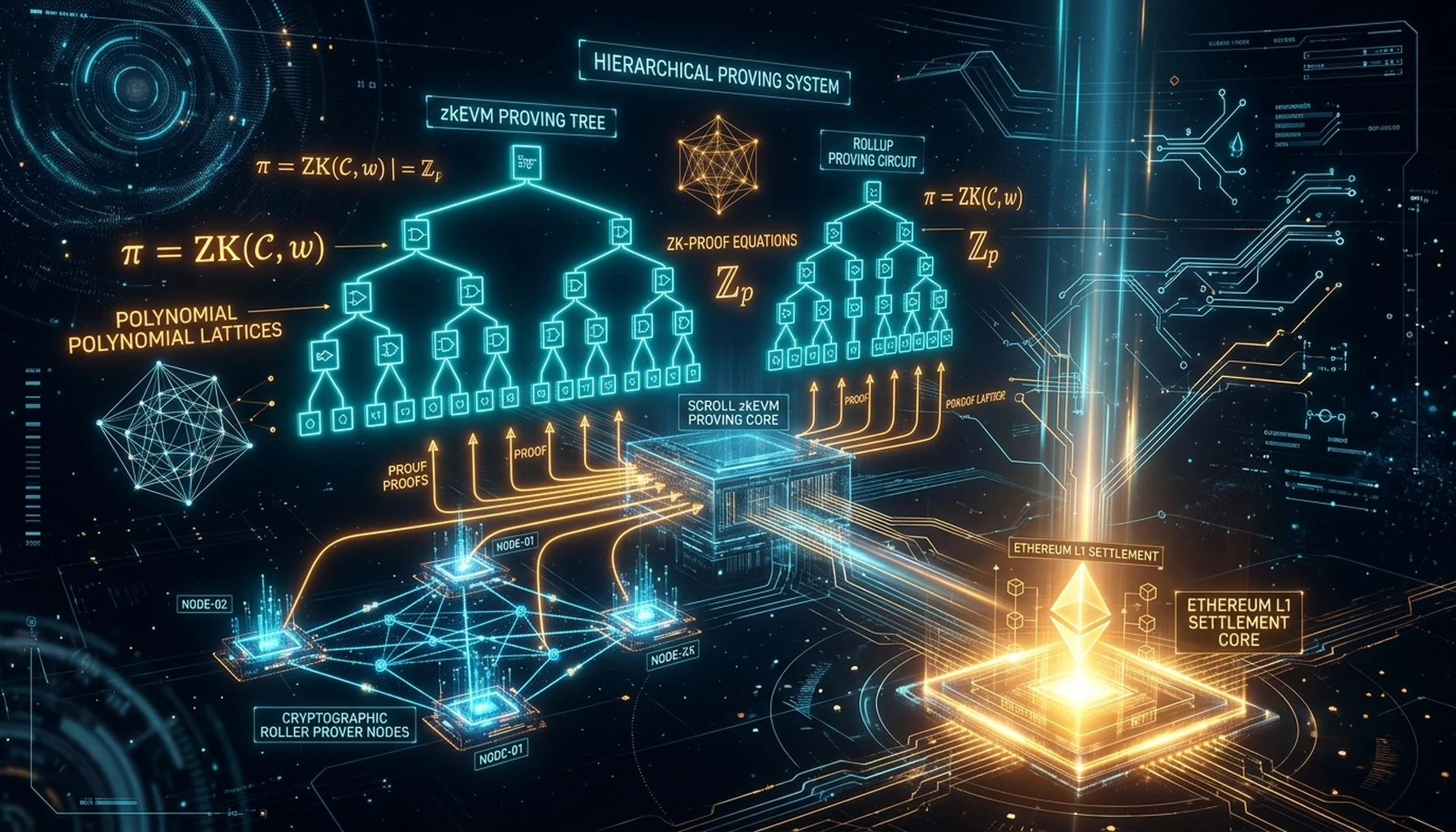
- Tier 2: Zero-Knowledge SNARK Proofs: High-integrity cryptographic proofs generated using general-purpose zkVMs (including RISC Zero and Succinct SP1). These circuits arithmetize the execution trace, producing succinct zero-knowledge proofs that mathematically guarantee state correctness without trusting physical silicon microcode.
- Tier 3: Guardian / High-Threshold Multi-Prover Quorum: A failsafe escalation layer designed to arbitrate high-value contests or emergency circuit breaks if both SGX enclaves and ZK proving systems encounter zero-day implementation vulnerabilities.
The Contestation Cycle: Economic Bonds and Game-Theoretic Settlement
The security of the BCR architecture relies on rigorous economic incentives governing provers and challengers.
Prover Bonds and Validity Windows
When an L1 block proposal is recorded, provers compete to submit a validity proof by calling proveBlock on the TaikoL1 contract. To submit a proof, the prover must lock a substantial bond denominated in Taiko tokens (TKO). This bond guarantees that the prover has skin in the game.
Once a Tier 1 (SGX) proof is posted, a contestation window (cooldown period) opens. During this window, the block state remains in an unfinalized, provisionally accepted status.
Contestation Mechanics and Escalation
If a challenger observes that an SGX proof asserts an incorrect post-state root (for example, resulting from an SGX hardware exploit or compromised enclave signing key), the challenger initiates a contestation by:
- Locking a contestation bond equal to or exceeding the original prover's bond.
- Submitting the dispute transaction to the
TaikoL1contract, which suspends the block's transition to finality. - Triggering an automatic escalation to Tier 2 (ZK-SNARK) verification.
An independent ZK prover must then generate a full zero-knowledge proof of the disputed block. If the ZK proof proves that the original SGX proof was fraudulent, the original prover's bond is slashed. A major portion of the slashed bond is paid out to the challenger as a bounty, while the remainder is burned. Conversely, if the original SGX proof is confirmed mathematically valid by the ZK proof, the challenger's contestation bond is slashed and awarded to the original prover.
The Four-Stage Settlement Lifecycle: Propose, Prove, Contest, and Finalize
The complete end-to-end transaction journey in Taiko progresses through four deterministic phases:
Stage 1: Batch Proposal and Blob Publication
User transactions submitted to the L2 mempool are collected by based proposers. The proposer packages the raw transaction data into an EIP-4844 blob and sends a transaction to TaikoL1.proposeBlock. The Ethereum consensus layer registers the blob commitment, and the TaikoL1 contract assigns a unique block ID, records the proposal timestamp, and establishes the deterministic L2 execution order.
Stage 2: Execution and Tier 1 Proof Submission
Taiko full nodes and prover nodes download the blob from Ethereum Layer 1, decode the transactions, and execute them against the local state database using Taiko's Type 1 EVM client. An SGX prover runs the execution inside a secure enclave, signs the state root output, and submits the proof along with the required TKO bond via TaikoL1.proveBlock.
Stage 3: The Contestation Window
The block enters the contestation cooldown period. Watchtower nodes, rival provers, and verifiers monitor the submitted state root against their independent local executions. If all state roots match, no challenge is submitted. If a mismatch is detected, the contestation cycle activates, escalating the verification to ZK-SNARK proving circuits.
Stage 4: L1 State Root Finalization
Once the cooldown period elapses without dispute (or following successful resolution of a contestation through ZK verification), the block is marked as finalized in the TaikoL1 contract storage. The L2 state root is officially committed, enabling trustless withdrawals back to Ethereum mainnet via standard Merkle Patricia Trie proofs.
Synchronous Composability and Based Preconfirmations
A primary critique of early based rollup models was latency: because sequencing relies on Ethereum L1, transaction inclusion was bound to Ethereum's 12-second block intervals, leading to slower user feedback compared to centralized sequencers delivering 200-millisecond soft confirmations. Taiko addresses this limitation through Based Preconfirmations.
Slashing-Backed Fast Confirmations
Based preconfirmations enable Ethereum L1 proposers (or specialized lookahead delegates) to issue cryptographically signed commitments guaranteeing that a specific L2 transaction will be included in their upcoming L1 proposal block. These commitments are backed by restaked economic collateral (such as EigenLayer or Symbiotic restaking pools). If an L1 proposer issues a preconfirmation for an L2 transaction and subsequently fails to include it in the designated block, the proposer's restaked collateral is slashed on-chain.
This mechanism grants Taiko sub-second soft-finality for user wallets and decentralized applications, while maintaining the non-custodial, decentralized integrity of Ethereum-based sequencing.
Atomic Cross-L2 Synchronous Execution
Because multiple based rollups share Ethereum Layer 1 as their universal sequencer, they unlock synchronous cross-rollup composability. An Ethereum block builder can assemble a single bundle containing transactions spanning Ethereum L1, Taiko, and other based rollups simultaneously. This enables flash loans and atomic arbitrage across separate execution environments within a single L1 block, eliminating the fragmentation that plagues isolated optimistic and validium rollups.
TKO Tokenomics: Prover Collateral, Slashing Conditions, and Governance
The Taiko token (TKO) serves as the primary coordination asset securing the decentralized proving and contestation marketplace.
The Economic Role of TKO
Unlike rollups that use tokens solely for speculative voting, TKO possesses direct protocol utility:
- Prover Collateral Bonds: Provers must acquire and lock TKO to participate in block proving. This requirement prevents denial-of-service spam, ensuring that provers incur capital costs for every submitted proof.
- Contestation Bonds: Challengers must deposit TKO to initiate a dispute. This mechanism prevents malicious actors from griefing honest provers with spurious challenges.
- Protocol Governance: TKO tokenholders vote on protocol upgrades, verification threshold parameters, cooldown duration windows, and the progressive decentralization of the Guardian Council.
Token Distribution and Supply Dynamics
The genesis supply of TKO was fixed at 1,000,000,000 tokens, distributed across community initiatives, core contributors, investors, and the Taiko DAO Treasury. Token burning occurs dynamically when provers or challengers are slashed during failed disputes, creating a deflationary sink tied directly to protocol security enforcement.
Critical Bottlenecks, Attack Vectors, and Architectural Trade-Offs
An objective engineering assessment reveals important operational trade-offs and structural vulnerabilities inherent in the Based Contestable Rollup framework.
L1 Gas Price Sensitivity and Blob Contention
Because every block proposal requires an Ethereum Layer 1 transaction, Taiko's operational overhead is tied directly to Ethereum mainnet base fees and EIP-4844 blob gas pricing. During episodes of extreme Ethereum congestion, the cost to submit proposeBlock transactions escalates. Proposers are forced to delay batch submission to accumulate larger transaction counts, leading to temporary spikes in L1 finality latency.
Intel SGX Enclave Vulnerabilities
The reliance on Intel SGX for Tier 1 proofs introduces hardware trust assumptions. The computer security research community has historically uncovered microarchitectural side-channel exploits in speculative execution architectures (such as Spectre, Meltdown, Foreshadow, and Downfall) that allow extraction of enclave attestation private keys. If an attacker extracts an SGX signing key, they could forge Tier 1 proofs. While Taiko's contestation cycle ensures that such forgeries can be challenged and overturned by Tier 2 ZK-SNARK provers, a zero-day exploit could cause mass contestation events, temporarily overloading L1 gas capacity.
Prover Capital Lockup and Economic Inefficiencies
Requiring provers to lock TKO collateral for the duration of the contestation cooldown window creates capital inefficiency. Provers must maintain substantial liquidity reserves to sustain continuous high-throughput proving operations. If TKO token volatility is high, provers face hedging costs, which are ultimately passed on to end users in the form of higher transaction fees.
Guardian Council Centralization During Bootstrap Phases
To guard against undiscovered bugs in the early deployment stages of both SGX firmware and zero-knowledge circuits, Taiko maintains a Guardian Council multi-signature key capable of intervening in disputed blocks. While standard across developing Layer 2 ecosystems, this administrative override represents a temporary centralization vector that must be phased out through progressive governance decentralization.
Conclusion
Taiko's Based Contestable Rollup architecture represents a major step forward in resolving the Layer 2 sequencer trilemma. By delegating block sequencing directly to Ethereum Layer 1 proposers, Taiko eliminates single points of failure and aligns economic value accrual with base layer decentralization. Through its multi-tier proving framework, combining efficient SGX hardware enclaves with fallback ZK-SNARK circuits, Taiko balances transaction cost efficiency against uncompromising mathematical verification. As based preconfirmations and synchronous cross-rollup composability mature, Taiko establishes a compelling blueprint for how Ethereum can scale without sacrificing its foundational cypherpunk principles of permissionless access and censorship resistance.