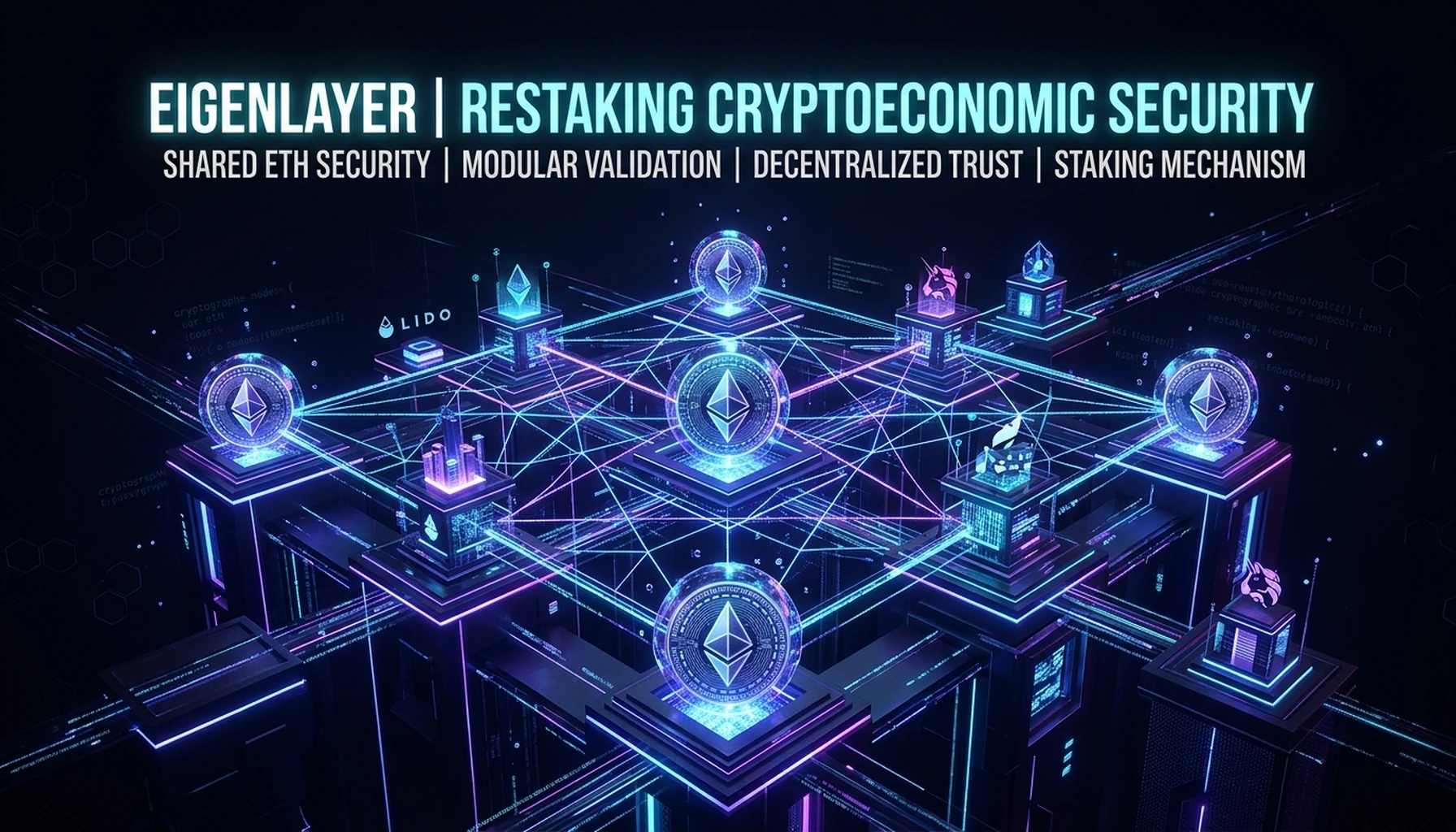
Overview: The Shared Security Paradigm and the Mechanics of Restaking
The rise of decentralized proof-of-stake (PoS) blockchains and modular rollup infrastructure introduced an acute economic bootstrapping bottleneck. Every new application-specific execution layer, decentralized oracle network, shared sequencer, data availability committee, and cross-chain bridge must recruit an independent set of node operators and amass millions of dollars in capital to defend against 51% economic reorganizations and Byzantine faults. For emerging protocols, achieving economic security comparable to established base layers requires excessive token inflation, complex liquidity subsidies, and substantial validator coordination overhead.
Restaking emerged as a transformative cryptoeconomic primitive to overcome this fragmentation. By allowing capital already committed to proof-of-stake base layers (or existing decentralized assets) to simultaneously guarantee the cryptoeconomic security of secondary distributed systems-commonly designated as Actively Validated Services (AVSs) or simply Networks-restaking creates an open marketplace for pooled security. Capital providers earn incremental yield across multiple services, while decentralized protocols instantly borrow billions of dollars in established economic finality without launching speculative native staking economies from zero.
However, early restaking architectures adopted opinionated, centralized, and highly upgradeable frameworks. Monolithic restaking designs often rely on complex smart contract proxy topologies, enforce rigid asset whitelists dominated by specific liquid staking tokens (LSTs), and retain extensive administrative multisig controls over protocol parameters, slashing execution, and yield distribution. Symbiotic was architected from first principles to invert this philosophy, introducing a modular, permissionless, and immutable shared security protocol designed as thin, un-opinionated middleware for Ethereum.
Core Architectural Divergence: Opinionated vs. Immutable Middleware
Symbiotic differentiates itself from first-generation restaking platforms through an uncompromising commitment to decentralization and immutability. Where competing protocols act as managed platforms that dictate token qualification, slashing logic, and operator sets, Symbiotic functions as a neutral coordination layer akin to Uniswap v1 or Uniswap v2 core contracts.
1. Immutability Without Administrative Proxies
The foundational core contracts of Symbiotic are deployed as immutable, non-upgradeable smart contracts. There are no admin keys, no centralized upgradeability proxies, and no governance multi-signatures capable of pausing core deposits, altering accounting balances, or modifying state transitions. Once deployed, the core rules governing collateral handling, vault accounting, and network-operator matchmaking execute deterministically in perpetuity.
2. Absolute Asset and Collateral Agnosticism
While traditional restaking protocols restrict collateral almost entirely to native ETH and selected liquid staking derivatives (such as stETH, rETH, or cbETH), Symbiotic treats collateral as a completely open primitive. Any standard ERC-20 token can serve as restaked collateral within Symbiotic. This includes:
- Liquid Staking Tokens (LSTs): Lido stETH/wstETH, Coinbase cbETH, Rocket Pool rETH, Mantle mETH.
- Synthetic Dollars and Stablecoins: Ethena USDe/sUSDe, Maker/Sky DAI/USDS, Tether USDt, Circle USDC.
- Wrapped Assets and LP Tokens: Wrapped Bitcoin (WBTC), tokenized commodities, and Automated Market Maker liquidity pool tokens (e.g., Uniswap v3 full-range LP tokens or Curve LP shares).
- Native Protocol Governance Tokens: Application-specific network tokens utilized in dual-staking or multi-asset security matrices.
3. Separation of Concerns and Modular Sovereignty
Symbiotic does not mandate how networks must punish bad actors, nor does it decide which node operators are legitimate. Instead, it decouples the security marketplace into five orthogonal primitives, granting networks, vault curators, and stakers complete sovereignty over their risk parameters.
The Five Foundational Primitives of Symbiotic
The Symbiotic architecture is organized around five strictly decoupled mathematical and structural building blocks: Collateral, Vaults, Operators, Networks, and Resolvers.
1. Collateral
Collateral in Symbiotic represents the underlying economic value committed to secure external systems. Collateral is defined as any ERC-20 contract that conforms to standard transfer and balance interfaces. To accommodate rebasing tokens without introducing non-deterministic balance fluctuations into vault accounting, Symbiotic standardizes non-rebasing wrappers (such as wrapping stETH into wstETH) or tracks collateral via balance-snapshotting mechanisms that preserve invariant share-to-asset ratios.
2. Vaults
Vaults are the primary user-facing layer and capital aggregation engine. A Vault accepts deposits of a specific Collateral token, mints proportional share tokens to depositors, and delegates the pooled economic weight to specific Operators and Networks. Vaults handle all accounting, epoch transitions, stake bonding periods, withdrawal unbonding queues, and the distribution of slashing penalties across user deposits.
3. Operators
Operators are independent computational entities (node operators, institutional staking providers, or specialized validation firms) that register their cryptographic identity with Symbiotic. Operators run off-chain validation software, consensus clients, or coprocessors required by connected Networks. An Operator can accept collateral delegations from multiple independent Vaults and allocate its operational capacity across multiple Networks.
4. Networks
A Network is any off-chain or on-chain decentralized system that requires cryptoeconomic security. Examples include Layer 2 rollup sequencers, decentralized bridge relayers, oracle networks, fast-finality gadgets, and AI coprocessors. A Network registers with Symbiotic, defines its slashing conditions, selects the Operators authorized to validate on its behalf, and establishes the specific Vaults from which it accepts economic collateral.
5. Resolvers
Resolvers are dedicated dispute resolution contracts or arbitration entities that evaluate and adjudicate slashing requests initiated by Networks. Symbiotic recognizes that fully automated, unconstrained programmatic slashing introduces catastrophic systemic risks. Resolvers act as circuit breakers, decentralized courts, or veto mechanisms that guarantee an Operator and its delegators are not penalized erroneously due to network software bugs, consensus partitions, or malicious network governance proposals.
Deep Dive: Vault Architecture and Delegation Mechanics
Vaults in Symbiotic govern how capital moves between passive asset holders and active validating infrastructure. The design of Symbiotic vaults provides unprecedented flexibility, supporting both simple single-operator vaults and complex pooled multi-network strategies.
Multi-Operator vs. Single-Operator Vaults
Vaults are constructed according to modular deployment templates:
- Single-Operator Vaults: A dedicated vault where 100% of deposited collateral is delegated exclusively to a single Operator chosen at deployment. This provides complete risk isolation: depositors know exactly which operator controls their infrastructure, eliminating cross-operator contagion.
- Multi-Operator Curated Vaults: Advanced vaults (such as those engineered by Mellow Finance for the Lido Alliance) where a professional risk curator or DAO dynamically allocates deposited collateral across a curated consortium of high-reputation node operators and diverse Networks. The curator manages operator weights, collateral caps, and network risk diversification.
Epoch-Based Accounting and Slashing Windows
To prevent malicious actors from front-running slashing events or exploiting asynchronous block delays, Symbiotic enforces deterministic epoch-based accounting across all vault operations:
- Discrete Time Epochs: Protocol state progresses through fixed, deterministic time intervals (epochs). Deposits, delegations, and network limit updates become economically active only at the boundary of the subsequent epoch.
- Unbonding and Withdrawal Queues: When a user initiates a withdrawal, their shares enter an unbonding queue spanning a predetermined number of epochs (the unbonding delay). During this delay, the capital remains fully committed and exposed to potential slashing penalties for any faults committed by operators during the epochs in which the capital was active.
- Snapshot Immutability: At every epoch boundary, the vault takes an immutable snapshot of total active collateral, delegated amounts, and per-operator balances. If a network detects a Byzantine fault, slashing proofs are evaluated strictly against the historical epoch snapshot corresponding to the exact timestamp of the fault, preventing attackers from escaping slashing via rapid flash withdrawals.
Network and Operator Matchmaking: Limit Allocation
A core innovation in Symbiotic is how it handles multi-network risk. In naive restaking architectures, if a single dollar of collateral is restaked across ten independent networks, a simultaneous failure across all ten networks could theoretically attempt to slash the same dollar ten times over, creating unbacked debt and cascading insolvency.
Symbiotic resolves this through explicit limit allocation frameworks:
- Network Max Limit (Cap): A Network specifies the maximum amount of economic security it is willing to accept from a specific Operator or Vault. Adding collateral beyond this threshold yields zero additional consensus voting power on the Network, disincentivizing excessive centralization.
- Operator Delegation Limits: A Vault specifies the absolute maximum slashable percentage or total unit amount that a delegated Operator may pledge to each Network. This allows vault curators to implement strict risk budgets-ensuring, for example, that an Operator cannot pledge more than 20% of a vault's assets to high-risk experimental networks.
- Non-Overlapping vs. Shared Stake Modes: Symbiotic permits vaults to operate in segmented allocation mode (where collateral is strictly partitioned such that each dollar secures exactly one network) or in shared-security restaking mode (where collateral secures multiple networks under explicit, mutually agreed-upon slashing priority rules).
Slashing Architecture and Dispute Resolvers
Slashing-the irreversible confiscation or burning of staked collateral in response to cryptographic or protocol misbehavior-is the ultimate enforcement mechanism of cryptoeconomic security. However, indiscriminate programmatic slashing represents the single greatest barrier to institutional restaking adoption. In complex distributed systems, software bugs, client desynchronization, benign network partitions, or unexpected hard forks can generate spurious slashing proofs, destroying hundreds of millions of dollars of honest delegator capital without any malicious intent.
The Resolver Primitive
Symbiotic addresses this systemic vulnerability through the formalization of the Resolver primitive. A Resolver is a sovereign dispute adjudication contract that sits directly between a Network's slashing trigger and the Vault's asset-burning execution.
When a Network detects a Byzantine violation (such as a double-signing event, invalid state transition, or data withholding violation), it does not immediately burn vault funds. Instead, it submits an on-chain slashing request to the designated Resolver.
Types of Slashing Resolvers
Because Symbiotic is un-opinionated, Networks and Vaults can agree upon various resolver architectures tailored to their operational security profile:
- Optimistic Escalation Resolvers: The slashing request enters a mandatory dispute window (e.g., 72 hours). If no challenge is mounted, the slashing executes automatically. If an Operator or Vault curator disputes the penalty, the slashing request is escalated to an arbitration panel or decentralized court (such as UMA Oracle, Kleros, or a multisig council of cryptographers).
- Veto Resolvers: The slashing request is scheduled to execute after a timelock, during which an independent security committee (e.g., the Lido DAO Dual Governance committee or an elected security council) possesses unilateral power to veto the slashing request if it is proven to be the result of a benign software defect.
- Fully Programmatic Instant Resolvers: For high-assurance networks with mathematically verified state proofs (such as Zero-Knowledge light client bridges), the resolver can be configured as a zero-delay contract that verifies the cryptographic validity of the proof on-chain and executes the slash instantaneously without human intervention.
The Slashing Execution Pipeline
- Fault Detection: The Network detects an on-chain or off-chain consensus violation committed by Operator O at Epoch E.
- Proof Submission: The Network calls
requestSlash(operator, epoch, amount, evidence)on the Vault, which routes the request to the associated Resolver. - Dispute Timelock: The requested collateral amount is immediately quarantined within the Vault. Quarantined shares are frozen and cannot be withdrawn or re-delegated, preventing capital flight during adjudication.
- Resolver Adjudication: The Resolver verifies the evidence. If the slash is confirmed (or the dispute window elapses without a veto), the Resolver signals
executeSlash(). - Burn or Escrow: The quarantined collateral is liquidated according to the vault's design-either permanently burned by sending it to a zero-address, transferred to an insurance fund, or deposited into a network compensation escrow to reimburse affected protocol users.
Ecosystem Integration: The Lido Alliance and Mellow Modular Vaults
Symbiotic's design was deeply influenced by the core requirements of Ethereum's largest staking participant, Lido DAO. With over 28% of all staked ETH locked in Lido's liquid staking pool, Lido faced strategic competitive pressure from restaking platforms that sought to displace stETH with native restaked ETH tokens.
Rather than launching an in-house monolithic restaking platform, Lido partnered with Cyber•Fund and Paradigm to champion Symbiotic as an open, neutral foundation for the Lido Alliance:
- Mellow Finance Modular Vaults: Mellow Finance engineered an ecosystem of permissionless, curated restaking vaults built directly on top of Symbiotic core primitives. These vaults accept stETH and wstETH, allowing depositors to earn compounding staking yield alongside restaking incentives.
- Curation Specialization: By utilizing Mellow's curated vault architecture, independent risk modeling firms (such as Steakhouse Financial, Re7 Labs, and MEV Capital) act as vault curators. Each curator defines its own risk appetite, selects vetted operators, and allocates collateral only to Networks with verified economic models.
- stETH Liquidity Preservation: By utilizing Symbiotic, Lido transforms stETH from a passive yield-bearing asset into the dominant base collateral for decentralized shared security without ceding governance control to centralized proxy multisigs.
Critical Engineering Trade-offs, Systemic Vulnerabilities, and Centralization Risks
A rigorous architectural assessment must analyze the systemic vulnerabilities, economic game-theory risks, and operational trade-offs inherent in Symbiotic's modular model.
1. Cascading Leverage and Multi-Asset Cross-Contagion
By permitting any ERC-20 token to serve as restaked collateral, Symbiotic dramatically expands the design space, but simultaneously introduces complex financial contagion risks. If a volatile synthetic dollar, an illiquid LP token, or a speculative governance token is accepted as collateral by multiple Networks, a sharp de-pegging event or liquidity drain in the underlying asset could trigger sudden under-collateralization across all connected services. Unlike ETH-denominated restaking, where the underlying collateral has deep, universal liquidity, exotic ERC-20 collateral can suffer from severe price dislocation during cascading market sell-offs.
2. Resolver Governance Capture and Bribery Surfaces
While Resolvers prevent disastrous accidental slashing, they introduce a subjective human layer into an otherwise programmatic cryptographic system. If a Resolver relies on a multisig council or a token-weighted arbitration DAO, well-capitalized adversarial actors could execute economic bribery attacks. If the economic gain from exploiting a Network (e.g., draining a bridge worth 500 million dollars) exceeds the cost of bribing or corrupting the Resolver committee to veto the resulting slashing request, the cryptoeconomic security of the Network collapses entirely.
3. Operator Key Centralization and Cartelization
Although anyone can register as an Operator on Symbiotic, institutional economies of scale create natural centralization vectors. High-performance networks require robust enterprise infrastructure, low-latency networking, and high-memory hardware. Consequently, a small cartel of professional node operators (such as Figment, Chorus One, P2P Validator, and Kiln) could accumulate a supermajority of delegated collateral across hundreds of disparate vaults. If a systemic infrastructure provider suffers a simultaneous outage or software compromise, dozens of ostensibly independent Networks could fail simultaneously, causing widespread correlated slashing and network halts.
4. Sovereign Network Fragmentation and Liquidity Siphon
Because Symbiotic gives every Network the freedom to design custom slashing, operator selection, and reward rules, the ecosystem risks acute fragmentation. Networks must actively market and incentivize individual vault curators to attract collateral. This dynamic favors established networks with deep treasury reserves, while innovative, early-stage protocols may struggle to compete for collateral against subsidized incentive programs.
Conclusion
Symbiotic represents a vital evolutionary step in the architecture of decentralized shared security. By ruthlessly adhering to principles of immutability, permissionless deployment, and structural modularity, Symbiotic avoids the single-point-of-failure vulnerabilities, rigid token hierarchies, and administrative proxy governance that characterized first-generation restaking platforms.
Through its elegant decoupling of Collateral, Vaults, Operators, Networks, and Resolvers, Symbiotic provides a robust, neutral foundation upon which developers can construct sovereign, multi-asset security markets. While the introduction of subjective dispute resolvers and multi-asset collateral requires rigorous economic modeling and vigilant curator oversight, Symbiotic establishes the definitive benchmark for un-opinionated, censorship-resistant cryptoeconomic infrastructure across the decentralized Web3 ecosystem.