Part 1 – Introducing the Problem
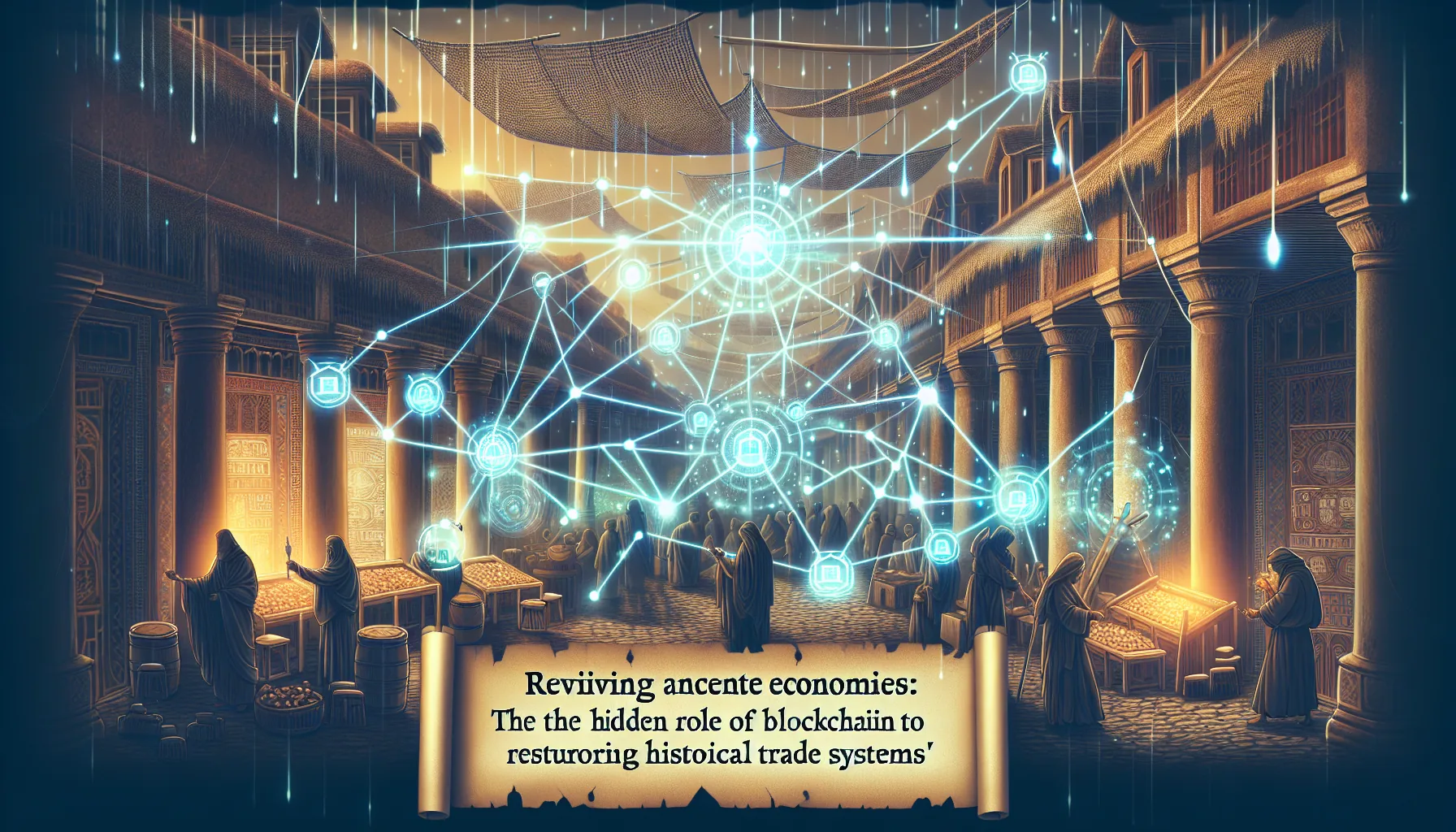
Reviving Ancient Economies: The Hidden Role of Blockchain in Restoring Historical Trade Systems
The Lost Efficiency of Ancient Trade Networks
Throughout history, trade has been the foundation of economic prosperity. Complex barter networks, credit systems, and trust-based exchanges allowed civilizations from Mesopotamia to the Silk Road to flourish. However, these systems were not without flaws—cumbersome intermediaries, slow record-keeping, and limited trust verification led to inefficiencies that eventually required central authority structures to maintain order.
Fast forward to the present, where globalization and digitalization have streamlined trade, though at the cost of increased centralization. Middlemen take a significant cut, regulatory hurdles stifle smaller market participants, and geopolitical tensions limit access to fair trade. Many of these same vulnerabilities plagued ancient trade economies, suggesting an underlying structural issue that has persisted across centuries.
The Problem: Bottlenecked Trust and Value Exchange
Decentralization—whether it be through ancient merchants depending on reputation-based trading or modern blockchain networks—aims to remove reliance on intermediaries. Yet, trust remains a bottleneck. Historically, trade routes relied on mutual trust reinforced by complex systems of physical ledgers, seals, and informal agreements. As modern markets transitioned to centralized financial institutions, blockchain stepped forward as a potential alternative—an immutable ledger designed to remove the need for intermediaries and restore trustless trade.
However, blockchain itself is still far from solving this problem. Despite its promises, critical gaps remain:
- Lack of adaptive reputation mechanisms – Unlike historical trade routes where trust was built over generations, most blockchain networks lack universal, portable reputation mechanisms that mimic human credibility systems.
- Limited real-world interoperability – Ancient economies maintained fluid cross-border trade with shared units of measurement and valuation methods. Current blockchain ecosystems are largely fragmented, struggling with seamless cross-chain interoperability.
- Governance dilemmas – Merchant guilds and early financial institutions offered decentralized governance in a practical way, something that smart contracts and DAOs are yet to fully replicate without contentious forks or rigid governance conflicts.
How Blockchain Could Reconnect the Past and Future
Understanding the mechanics of ancient trade systems could be key to overcoming these hurdles. Historical economic models offer a blueprint for building decentralized trust, evaluating reputation without central gatekeepers, and enabling frictionless global barter systems. Blockchain has the potential to reintroduce these efficiencies, not just through tokenized assets but by reinventing the very concept of trade.
This is where programmable money plays a crucial role. Smart contracts could automate conditional trade agreements, much like historical contracts between merchants and sovereign states. To explore this, examining the Overlooked Significance of Programmable Money in Driving Financial Inclusion Through Blockchain provides insight into how these mechanisms can be mimicked in a modern decentralized economy.
These historical parallels and blockchain’s ongoing struggles set the stage for a deeper exploration into resurrecting ancient trade principles. The answers may not solely lie in code but in the foundations of civilization’s earliest economic experiments.
Part 2 – Exploring Potential Solutions
Exploring Potential Solutions: Blockchain Innovations in Restoring Historical Trade Systems
1. Tokenized Barter Economies: Reviving Ancient Trade
Many pre-modern civilizations operated on barter-based trade networks. Blockchain enables tokenized barter systems where smart contracts facilitate multi-party exchanges without a central intermediary. Projects experimenting with programmable money could fuel this revival, allowing traders to exchange tokenized goods seamlessly. However, liquidity remains a critical issue—without a widely accepted valuation system, these networks risk becoming isolated, reducing their practical use.
A related challenge is the need for decentralized identity verification. Fraud-resistant reputation scores are integral to restoring trust in such trade models. The Underexplored Role of Decentralized Identity in Enhancing Trust and Accountability within DeFi Ecosystems explores how blockchain identity infrastructure might mitigate these concerns.
2. Smart Contracts for Ancient Silk Road-Like Trade Routes
Trade networks like the Silk Road relied on complex agreements enforced by intermediaries. Smart contracts automate these agreements, offering trustless escrow and dispute resolution. By eliminating intermediaries, transaction costs drop, and efficiency increases. However, contract rigidity remains a problem—codifying every possible dispute scenario into smart contracts remains a legal and technical hurdle.
Beyond technical limitations, jurisdictional enforceability poses a risk. Modern legal systems still struggle with recognizing smart contracts as legally binding. If disputes escalate beyond on-chain resolution mechanisms, traders may be left without proper recourse.
3. Cross-Chain Logistics Networks for Decentralized Supply Chains
Restoring historical trade systems requires integrating disparate supply chains. Cross-chain interoperability plays a role in linking fragmented economies within a broader decentralized network. For example, blockchain-based supply chain transparency solutions enable peer-to-peer trade verification. However, high gas fees and lack of seamless integration between different blockchains hinder mass adoption.
Additionally, cross-chain bridges remain a security concern. While interoperability increases economic connectivity, it also expands the attack surface for exploits. Without robust on-chain governance and security practices, these systems could face systemic risks.
4. zk-SNARKs and Trade Secrecy in Decentralized Markets
Historical trade systems thrived on secrecy—merchants guarded routes, pricing systems, and supplier relationships. Privacy-preserving blockchain technologies like zk-SNARKs enable confidential transactions while maintaining verifiability. This ensures participants in reconstructed ancient trade systems can protect sensitive business data.
Yet, implementing zk-SNARKs at scale introduces computational inefficiencies. High transaction costs and network latency still limit widespread use in day-to-day trading applications. Additionally, regulatory scrutiny around anonymous transactions could stifle adoption in jurisdictions concerned with anti-money laundering compliance.
By dissecting these potential blockchain-powered solutions, it’s evident that while technological progress is promising, several limitations persist. The next section will examine real-world implementations of these concepts, analyzing how these theoretical ideas hold up in practice.
Part 3 – Real-World Implementations
Real-World Implementations: Blockchain's Role in Restoring Historical Trade Systems
Several blockchain projects have taken ambitious steps toward integrating decentralized technology into historical trade models. These implementations vary significantly in approach, but each highlights the complexities of merging blockchain with legacy economic principles.
Case Study: Tokenized Barter Systems via Layer 2 Solutions
One compelling attempt has been the adoption of Layer 2 rollups to facilitate near-instant settlement of digitized barter exchanges. A project leveraging optimistic rollups attempted to create a permissionless trade network resembling the Silk Road’s decentralized nature. However, liquidity fragmentation became a key issue, as participants struggled to find matching counterparties efficiently. Additionally, the inherent reliance on fraud proofs resulted in slow dispute resolutions, leading to occasional bottlenecks in the system.
Smart Contracts for Historic Commodity-Backed Assets
Another initiative sought to tokenize real-world assets that historically served as mediums of exchange, such as salt and precious metals. A team developed ERC-721-based tokens representing ownership shares of vaulted goods, allowing historical trade practices to function on a blockchain infrastructure. While the project succeeded in providing immutable on-chain provenance, the primary obstacle it faced was regulatory friction. Jurisdictions imposed stringent compliance measures on tokenized commodities, stalling mass adoption.
Cross-Chain Trade Routes and Settlement Challenges
To replicate the ancient global trade networks that spanned multiple monetary systems, an interoperable solution was pursued. An implementation utilizing cross-chain bridges attempted to facilitate seamless conversion of digital tokens pegged to historical store-of-value assets. In practice, bridging delays and security vulnerabilities became major pain points. Several exploits exposed weaknesses in the system, causing liquidity drains and necessitating frequent contract upgrades.
The Role of Programmable Money in Trade Restoration
Projects incorporating programmable money for self-executing trade agreements witnessed mixed results. Decentralized identity verification was deployed to prevent sybil attacks within trustless barter networks. Nevertheless, the reliance on on-chain signatures introduced scalability concerns, creating potential friction for high-volume transactions. Some of the frameworks explored mirrored approaches discussed in The Overlooked Significance of Programmable Money in Driving Financial Inclusion Through Blockchain, though execution challenges remain.
Each of these implementations sheds light on both the promise and difficulties of integrating blockchain with historical trade systems. The next segment will focus on the long-term implications and potential evolution of these technologies.
Part 4 – Future Evolution & Long-Term Implications
The Future of Blockchain in Restoring Historical Trade Systems: Evolution & Long-Term Implications
As blockchain technology advances, its role in reviving ancient trade systems will undergo significant transformations. Scalability, interoperability, and programmability will shape its trajectory, making historical economic models more viable in the modern age. However, challenges in adoption, technical feasibility, and governance remain key constraints.
Scalability and Throughput Challenges in Trade Networks
For historical trade systems to function efficiently on blockchain, networks must handle high transaction volumes without compromising speed or cost-effectiveness. Traditional Layer 1 blockchains still struggle with throughput, making Layer 2 solutions and sidechains essential for optimizing trade interactions. This is especially critical in supply chain applications, where real-time validation and consensus mechanisms are required to mirror historical barter economies. While platforms like rollups and zero-knowledge proofs reinforce verifiability, their integration into legacy blockchain frameworks remains an ongoing challenge.
Interoperability: Bridging Trade Systems Across Networks
The success of ancient trade revitalization depends heavily on interoperability between disparate blockchain ecosystems. Different geographic regions historically operated with varied trade systems—blockchain must reflect this diversity by enabling seamless cross-chain transactions. Protocols focusing on decentralized identity mechanisms, such as those discussed in The Underestimated Power of Decentralized Identity in Strengthening Ecosystem Security in Blockchain Applications ( https://bestdapps.com/blogs/news/the-underestimated-power-of-decentralized-identity-in-strengthening-ecosystem-security-in-blockchain-applications ), play a vital role in enabling authentication across multiple networks without compromising security.
Programmable Trade Agreements and Automated Compliance
Smart contracts already streamline transactions, but their future evolution will introduce greater flexibility for historical trade models. Programmable incentives, multi-layered escrow systems, and decentralized arbitration could enhance trade agreements, mimicking governance frameworks once employed in early economic structures. However, smart contract vulnerabilities remain a lingering concern. Exploits, improper coding, and governance loopholes can create risks in automated trade, reinforcing the need for improved formal verification processes.
The Role of AI and On-Chain Data in Enhancing Trade Predictions
AI-driven analytics integrated with blockchain could recreate historical trade patterns by analyzing vast on-chain datasets. Predictive models based on market cycles during ancient economic eras may allow for automated trade strategies optimized for efficiency. However, the reliance on algorithmic decision-making also raises critical concerns regarding bias in AI training datasets, reinforcing the necessity of open-source and verifiable data models in blockchain applications.
As blockchain progresses, ongoing refinements in governance models will determine its long-term success. The following section will examine the complexities of decentralization, governance frameworks, and decision-making mechanisms crucial to maintaining the integrity of these trade networks.
Part 5 – Governance & Decentralization Challenges
Governance & Decentralization Challenges in Blockchain-Based Trade Systems
The implementation of blockchain in restoring historical trade systems introduces a fundamental dilemma: governance. Governance models shape decision-making processes, security, and long-term viability. While decentralization is a foundational principle of blockchain, it comes with harsh realities—governance attacks, regulatory capture, and plutocratic influence threaten its integrity.
Centralized vs. Decentralized Governance Structures
A centralized governance model ensures efficiency and compliance but often sacrifices immutability and censorship resistance. In nation-backed digital economies, government or corporate entities can override trade agreements or reverse transactions. While this may seem appealing for dispute resolution, it undermines the core advantage of blockchain-based trade systems: trustless autonomy.
Decentralized Autonomous Organizations (DAOs) and on-chain governance systems attempt to mitigate these risks by distributing voting power among participants. However, these models face their own vulnerabilities. Token-based voting systems can be manipulated if wealthier players accumulate governance tokens, leading to plutocratic control rather than equitable decision-making.
The Risks of Governance Attacks
A significant vulnerability in decentralized governance is the risk of governance attacks. Malicious actors can accumulate voting power via token purchases or temporary borrowing through flash loans. Once they control a majority stake, they can steer protocol policies toward their own interests—often at the community's expense. Such attacks can lead to changes in trade regulations, asset reclassification, or even outright breaches in contractual agreements.
Protocols relying on quadratic voting or reputation-weighted methods mitigate these risks but introduce complexity. Reputation-based models demand long-term participation, but they can be arbitrarily reset or manipulated, while quadratic voting, if not properly designed, can incentivize collusion among smaller stakeholders.
Regulatory Capture and Compliance Dilemmas
Blockchain-based trade systems still need to navigate real-world legal frameworks. Regulatory bodies may enforce compliance measures that pressure projects to include centralized decision-making layers. This form of regulatory capture forces projects to align with traditional financial oversight, effectively diluting the system’s decentralization.
Permissioned blockchains, often favored by institutional players, integrate pre-approved validators who can override the consensus mechanism. While this ensures compliance, it contradicts the decentralized ethos, making such systems vulnerable to state intervention and external censorship.
The Threat of Plutocratic Control
Many blockchain projects witness wealth concentration among a small percentage of holders. In trade networks, this could mean a few entities dictate policies at the expense of smaller participants. Whales controlling governance tokens in decentralized markets could create trade barriers, impose unfavorable contract terms, or even manipulate dispute resolution mechanisms.
Some newer projects address this by introducing weighted governance models based on active participation rather than capital alone. However, these mechanisms remain experimental, and without proper safeguards, the risk of plutocracy remains.
A practical example of such governance complexities can be seen in projects integrating tokenized financial instruments to drive inclusion, as discussed in The Overlooked Significance of Programmable Money in Driving Financial Inclusion Through Blockchain. While programmable finance expands accessibility, it still hinges on governance structures that may centralize control over the underlying smart contracts.
Transitioning Into Scalability Challenges
Even with governance issues addressed, one major hurdle remains: scalability. Ensuring a decentralized yet efficient trade system requires balancing security, execution speed, and network congestion. The next section will dive into the engineering trade-offs necessary to bring blockchain-powered historical trade systems to mass adoption.
Part 6 – Scalability & Engineering Trade-Offs
Scalability & Engineering Trade-Offs: Balancing Decentralization, Security, and Speed in Blockchain-Powered Trade Systems
Implementing blockchain as a foundation for restoring historical trade networks introduces fundamental challenges in scalability, performance, and architectural trade-offs. The inherent limitations of blockchain—throughput constraints, high computational overhead, and inefficient consensus mechanisms—necessitate careful selection of infrastructure to prevent bottlenecks in global commerce applications.
The Scalability Dilemma: Layer 1 vs. Layer 2 Approaches
Most Layer 1 blockchains (Ethereum, Bitcoin, etc.) struggle with transaction throughput since every node must validate and store all transactions. This results in severe congestion, making these networks unsuitable for handling large-scale historical trade reconstruction where rapid settlements are crucial. Layer 2 scaling solutions, such as rollups or state channels, partially alleviate this by offloading computation and reducing gas fees. Yet, they introduce new failure points—such as reliance on bridge mechanisms—creating attack surfaces that undermine decentralization and security.
Layer 2 approaches like optimistic rollups heavily depend on fraud-proof mechanisms, which introduce latency since transactions are finalized after a challenge period. Conversely, zk-rollups offer faster finality but impose high computational costs, limiting adoption for smaller participants in historical trade ecosystems. These constraints call into question whether current scaling solutions are advanced enough for seamless cross-border trade restoration or if these markets would be forced into blockchain-based silos devoid of meaningful interoperability.
Engineering Trade-Offs: Consensus Mechanisms & Network Efficiency
No blockchain architecture achieves scalability, security, and decentralization simultaneously—known as the "Blockchain Trilemma." Proof-of-Work (PoW) ensures high security but cannot scale without significant inefficiencies. Proof-of-Stake (PoS) improves throughput but concentrates power among token holders, potentially reintroducing centralization issues reminiscent of historical banking institutions.
Alternative models, such as Directed Acyclic Graphs (DAGs) or sharding (as seen in Ethereum 2.0), promise better transaction parallelization. However, they come with added complexity, requiring specialized network incentives to maintain decentralization. Furthermore, these models often fail under adversarial conditions, leading to centralization risks that undermine the original intent of reviving decentralized historical trade economies.
A similar struggle is evident in governance mechanisms, a factor heavily influencing blockchain longevity and security. The unseen impact of governance models on blockchain projects can directly determine a network’s ability to evolve while maintaining decentralization. This was explored in-depth in The Unseen Impact of Blockchain Governance Models on Crypto Project Longevity.
A Precarious Balance
Scalability remains a bottleneck in merging blockchain with historical trade systems. While innovative solutions push the boundaries, every improvement introduces trade-offs that impact decentralization, efficiency, or security. With regulatory and compliance pressures looming, the challenge extends beyond engineering—requiring a broader discussion on legal frameworks, jurisdictional concerns, and policy-driven constraints, which will be explored next.
Part 7 – Regulatory & Compliance Risks
Regulatory & Compliance Risks: Challenges to Rebuilding Ancient Trade Systems with Blockchain
The integration of blockchain into the revival of historical trade systems is not merely a technical challenge—it is a legal and regulatory minefield. Despite blockchain’s promise of decentralization and borderless commerce, governments and regulatory bodies worldwide remain either hesitant or outright hostile toward certain blockchain applications. These uncertainties pose direct risks to the viability of these revived trade networks.
The Jurisdictional Nightmare
One of the most significant hurdles facing blockchain-based trade restoration is the divergence in global regulatory approaches. Some jurisdictions promote blockchain innovation with crypto-friendly legislation, while others mandate restrictive compliance frameworks. Countries with strict anti-money laundering (AML) and combating the financing of terrorism (CFT) laws are particularly sensitive to the pseudo-anonymity of crypto transactions.
For example, trade networks revived through blockchain might be legal in one nation but non-compliant in another, leading to potential asset seizures, blocked settlements, or legal action. If an ancient Silk Road-style decentralized marketplace is developed, how does it ensure legal compatibility across multiple jurisdictions? Without uniform standards, companies and developers must constantly monitor regulatory shifts across different regions, data privacy laws, and tax implications—an expensive and legally complex challenge.
Government Interventions: Centralization vs. Decentralization
Governments are unlikely to sit back and let decentralized trade networks operate without intervention, especially if they sidestep traditional banking and taxation structures. Historically, regulators have responded to innovations like stablecoins, decentralized finance (DeFi), and privacy coins with increasing scrutiny. Blockchain-based trade settlements—especially those facilitating cross-border transactions independent of centralized financial institutions—could soon face similar measures, including blacklisting wallets, imposing transaction limits, or enforcing smart contract restrictions.
There’s also a concern about geopolitical maneuvering. A fully decentralized barter or tokenized trading system may inadvertently become caught in sanctions regimes. If a network enables trade between entities that sanctioned governments view as unlawful participants, this could lead to increased pressure on blockchain developers or exchanges facilitating these transactions. Governments could force intermediaries—such as node operators, wallet providers, or developers—to comply with their legal mandates or block them entirely.
The Precedent of Historic Crypto Regulations
Past regulatory frameworks for cryptocurrencies provide strong indicators of potential restrictions on blockchain-based trade revitalization. The treatment of Initial Coin Offerings (ICOs) by financial regulators, bans on private cryptocurrencies, and crackdowns on DeFi protocols highlight how old-world regulatory practices inevitably apply to blockchain networks.
These precedents indicate that blockchain-based trade restorations will likely face similar scrutiny, requiring network participants to implement compliance mechanisms such as KYC (Know Your Customer) and AML protocols. However, these restrictions contradict the permissionless and decentralized ethos of blockchain, creating a fundamental paradox: Should blockchain-based trade routes adopt centralized oversight for legal compliance, or should they remain permissionless at the expense of regulatory battles?
Given the role of programmable money in global transactions, decentralized trade systems will likely require advanced governance frameworks capable of balancing compliance with decentralization. Read more about how programmable money shapes financial inclusion in blockchain.
Part 8 will expand upon the economic and financial consequences of blockchain-driven historical trade revival, analyzing its impact on market liquidity, trade balance, and currency dynamics.
Part 8 – Economic & Financial Implications
Economic & Financial Implications of Blockchain in Reviving Ancient Trade Systems
Disruption of Existing Markets
Integrating blockchain into historical trade models could drastically shift how markets function. Traditional financial intermediaries, such as banks and centralized payment processors, could see their role diminished as decentralized ledgers allow direct value transfers with provable legitimacy. This would especially impact markets reliant on intermediaries for trust and verification, such as cross-border remittances, commodity trading, and even niche barter economies that previously lacked digital representation.
Additionally, legacy financial institutions might struggle to adapt to programmable money embedded in smart contracts—deals executed autonomously without third-party oversight. This raises questions about their long-term viability in transactions requiring escrow services, currency exchange, and cross-jurisdictional settlements. The emergence of smart contract-triggered asset transfers could also challenge market makers and liquidity providers who rely on price inefficiencies to generate profits.
New Investment Opportunities
At the same time, blockchain-based trade networks open investment avenues unavailable in traditional systems. Tokenized historical assets—such as ancient commodities, artisanal goods, or trade route-specific assets—can now be fractionalized, enabling broader market participation. Investors could gain exposure to trade routes once limited to specific nations or merchant classes.
Projects integrating programmable finance will likely emerge as decentralized autonomous organizations (DAOs), allowing token holders to shape governance structures for these revived economies. The unchecked potential for decentralized trade hubs could drive demand for blockchain infrastructure, boosting ecosystem tokens that facilitate these transactions. However, this would also invite speculative capital, challenging the equilibrium between historical accuracy and modern financialization.
Unforeseen Economic Risks
The biggest risk in bridging historical trade paradigms with blockchain is volatility in asset valuation. Unlike traditional centralized economies where inflation control and financial oversight exist, decentralized trade ecosystems may suffer from extreme fluctuations in asset prices, particularly during geo-political events or regulatory shifts. The absence of structured monetary policies could also lead to market failures when assets tied to past economic structures oscillate unpredictably under modern financial mechanisms.
Moreover, the potential for illicit financial flows must not be overlooked. Anonymous trading via decentralized exchanges could allow for the movement of high-value goods with little regulatory oversight, making these systems a haven for tax evasion or illicit goods trading. This could also expose investors to unregulated markets vulnerable to smart contract exploits, orchestrated rug pulls, or governance takeovers by whales.
Stakeholder Dynamics
Different market participants will experience varied outcomes depending on blockchain adoption patterns.
- Institutional Investors: Many funds already have exposure to DeFi, but investing in ancient trade-focused blockchain networks carries an added layer of unpredictability. Unlike established yield-bearing assets, traditional risk models may be ineffective in evaluating these systems.
- Developers: Code audits and governance structuring will be essential to ensure longevity. Developers creating these ecosystems may see lucrative opportunities, though regulatory scrutiny will pose a challenge.
- Traders & Arbitrageurs: Those utilizing on-chain liquidity mechanics will benefit if trade routes can be effectively modeled on transparent marketplaces. However, asset liquidity fragmentation between different blockchains could diminish profit potential without robust cross-chain solutions.
For decentralized identity mechanisms, ensuring authenticated participation in historical trade networks will be a key challenge. This topic has already proven critical in contemporary blockchain environments, as discussed in The Underappreciated Role of Decentralized Identity in Enhancing Trust and Accountability within DeFi Ecosystems.
This financial transformation also raises broader questions about societal philosophy and the role of trust in digital economies.
Part 9 – Social & Philosophical Implications
Economic & Financial Implications of Blockchain in Restoring Historical Trade Systems
Blockchain's intersection with historical trade systems presents profound economic and financial disruptions. By enabling decentralized marketplaces, tokenized trade routes, and programmable cross-border transactions, this innovation challenges traditional financial intermediaries while introducing new vectors for risk and speculation.
Market Disruption and the Institutional Response
Decentralized trade networks could reduce reliance on nation-state-backed financial structures, diminishing the control of central banks over cross-border commerce. Smart contracts and programmable money remove the need for third-party verification in transactions, cutting out intermediaries such as banks and trade finance institutions. This threatens the business models of legacy financial firms, potentially pushing them toward blockchain integration or obsolescence.
Institutional investors are already scouting for opportunities in tokenized trading systems, eager to capitalize on increased liquidity and seamless transaction finality. However, they risk exposure to regulatory uncertainty and fragmented jurisdictional oversight, which could trigger legal disputes or unforeseen financial liabilities.
Tokenized Assets and Speculative Investment
By digitizing historical commodities—such as spices, textiles, or metals—on blockchain, a new wave of speculation emerges. Just as tokenized carbon credits have introduced alternative trading ecosystems (read more here), tokenized trade assets could become speculative instruments, vulnerable to market manipulation. High-frequency trading algorithms designed for digital asset markets might further exacerbate volatility, creating artificial demand spikes detached from the real-world value of the traded goods.
Additionally, the programmability of assets in decentralized markets introduces challenges in liquidity management. While fractionalized ownership of trade assets can democratize access to investment opportunities, it also raises concerns over hyper-fragmentation and pricing inconsistencies. Traders accustomed to traditional commodities markets will have to recalibrate their valuation models to accommodate the new financial instruments enabled by blockchain.
Uncharted Risks for Developers and Traders
Developers building decentralized trade infrastructure face heightened legal exposure. Governments may classify these networks as shadow financial systems, enforcing stringent compliance measures or outright bans. Furthermore, coding vulnerabilities in trade settlement smart contracts could introduce attack vectors for cybercriminals, resulting in significant financial losses.
Traders operating within decentralized supply chains might encounter unpredictable liquidity fluctuations, as historical trade goods—when digitized—may not behave like conventional crypto assets. A lack of standardized pricing mechanisms places early adopters in precarious positions, balancing innovation with financial risk.
Beyond the financial sphere, blockchain's ability to restore historical trade systems raises deeper social and philosophical questions about digital sovereignty, trade autonomy, and decentralized governance—topics explored in Part 9 of this series.
Part 10 – Final Conclusions & Future Outlook
The Future of Blockchain in Historical Trade Systems: Breakthrough or Dead End?
The journey through how blockchain can revive ancient economies has uncovered remarkable possibilities—but also significant concerns. The integration of decentralized ledgers with historical trade practices promises a future where legacy supply chains are reimagined, but the road ahead is far from smooth.
The Promise: A Secure and Unstoppable Trade Network
In a best-case scenario, blockchain networks could evolve into the ultimate trust layer for global trade. Smart contracts could automate traditional barter systems, while decentralized identity solutions ensure transparent and tamper-proof records. Digital representations of real-world assets—land titles, livestock, raw materials—could bring ancient trade dynamics into a seamless on-chain ecosystem. If successful, such a system could serve not only historical economies but also modern markets dealing with fragmented supply chains and inefficient middlemen.
The Challenges: Regulatory Hurdles and Adoption Barriers
However, achieving this vision requires overcoming severe regulatory resistance. Many governments are reluctant to embrace widely decentralized trade mechanisms, particularly those that bypass established financial institutions. Additionally, adoption within smaller economies or regions adhering to historical practices may be hindered by inadequate digital infrastructure, technical illiteracy, or outright skepticism about blockchain's long-term reliability.
Another major challenge lies in ensuring interoperability between legacy economic structures and evolving decentralized networks. Without seamless cross-chain solutions and governance models optimized for collective decision-making, blockchain-powered trade systems may never reach mainstream adoption. This issue is particularly relevant when considering the overlooked impact of blockchain governance models on crypto project longevity (read more).
Worst-Case Scenario: A Forgotten Experiment?
The worst possible future is one where blockchain integration ends up as nothing more than an ambitious experiment lost in history. If these systems are unable to gain institutional backing or practical usability in real-world trade, they risk fading into obscurity. Much like numerous failed crypto projects that once promised financial transformation, an inability to scale, poor governance, or a lack of effective regulation could make blockchain-based historical economies a cautionary tale instead of a success.
The Final Question: A Defining Innovation or a Temporary Disruption?
With everything considered, blockchain has both the technical foundation and philosophical alignment to restore trust in historical trading systems. But will it truly redefine the future of ancient economies, or will it remain a theoretical innovation—ultimately abandoned as another unrealized promise in the crypto space?
Authors comments
This document was made by www.BestDapps.com