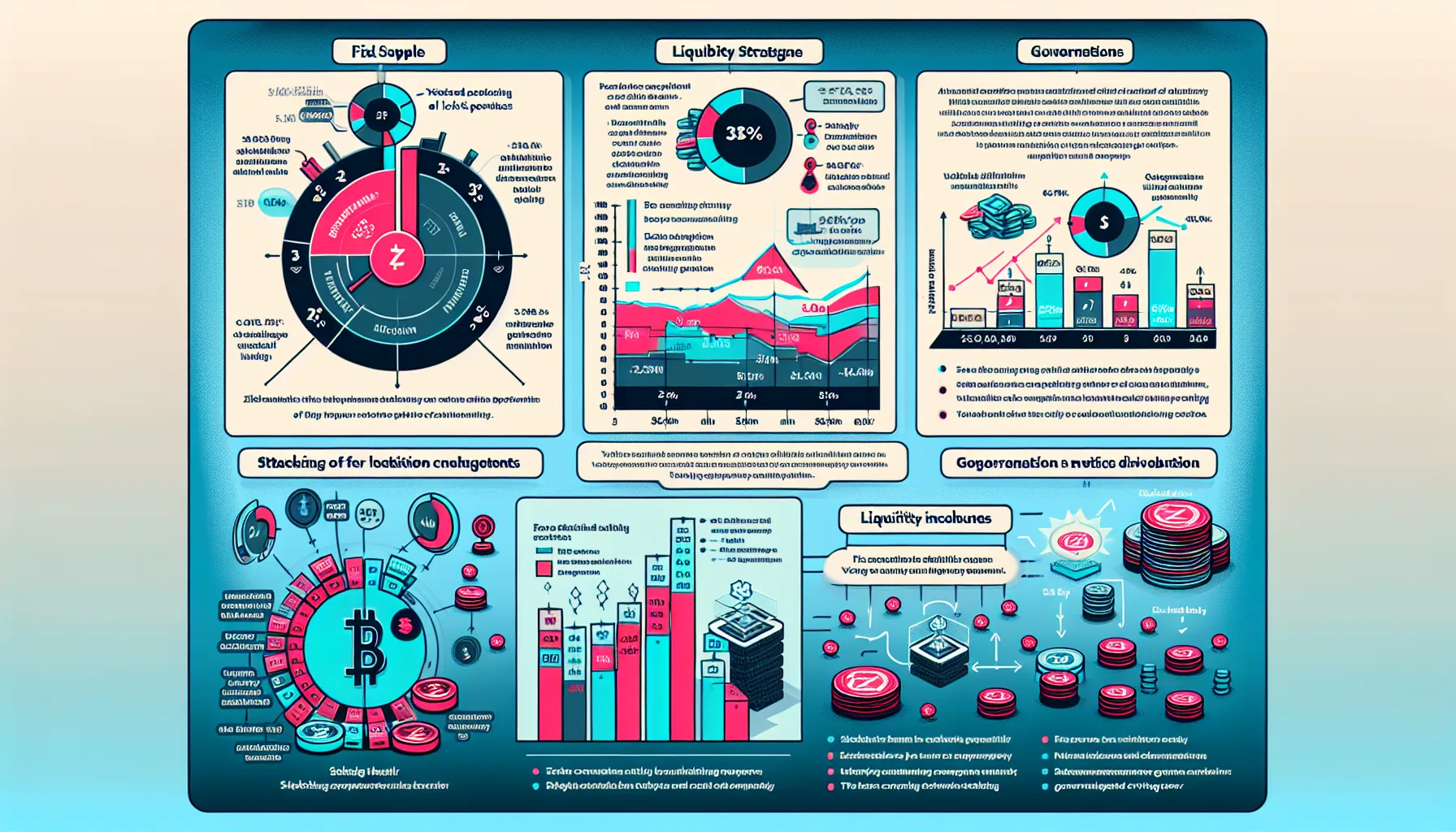
History of ZKF3
The History of ZKF3: Origins, Development, and Challenges
The Genesis of ZKF3
ZKF3 was conceived as a response to inefficiencies in zero-knowledge proof verification within decentralized finance and smart contract ecosystems. Its initial development was spearheaded by a group of cryptographers and blockchain engineers who recognized the need for a scalable, privacy-focused Layer 2 solution. The project first gained traction within niche cryptographic communities before drawing attention from a broader developer base.
Development Milestones and Technical Evolution
Early iterations of ZKF3 faced numerous technical challenges, particularly in optimizing proof generation times and reducing gas costs. The protocol underwent multiple testnet phases, during which developers refined its proof aggregation mechanisms and improved compatibility with Ethereum Virtual Machine (EVM)-based chains. These iterations helped address initial inefficiencies that had hindered adoption.
ZKF3’s eventual mainnet launch marked a turning point, as it introduced novel zero-knowledge rollups designed to enhance transaction throughput while maintaining Ethereum’s security guarantees. However, the launch was not without issues—network congestion and unexpected computational overhead forced rapid protocol updates in the weeks following deployment.
Governance and Community Involvement
ZKF3’s governance evolved in response to early setbacks. Initially controlled by a core development team, it later transitioned to a more decentralized model, incorporating token-based voting on protocol upgrades. While this shift was intended to increase resilience, it also introduced governance disputes, particularly surrounding smart contract upgradeability and validator incentives. Certain controversial proposals, including adjustments to staking mechanisms, sparked community divisions.
Despite governance challenges, ZKF3 maintained a dedicated developer community that contributed to ongoing protocol optimizations. The ecosystem saw integrations with multiple DeFi platforms, although adoption remained uneven due to complexities in implementing ZKF3’s cryptographic structures.
Security Incidents and Challenges
Like many emerging cryptographic protocols, ZKF3 encountered security concerns. A notable early vulnerability exposed a flaw in its proof aggregation logic, leading to an exploit that allowed attackers to bypass certain validation checks. The issue was swiftly patched, but it raised concerns about the protocol’s long-term robustness. Subsequent audits helped mitigate further risks, but skepticism persisted among some security analysts.
Another key challenge involved liquidity fragmentation. Because ZKF3 operated as a Layer 2 solution with its own execution environment, bridging assets between chains remained a point of friction. This led to delayed integrations with wider DeFi ecosystems, limiting its initial usability outside of niche applications.
Adoption Hurdles and Network Limitations
While ZKF3’s technology showed promise, its adoption was slowed by competition from other zero-knowledge-based Layer 2 solutions. Developers aiming to build on ZKF3 often faced a steep learning curve due to its unique architecture, which deterred projects from migrating fully. Additionally, transaction throughput—while an improvement over Layer 1—did not always meet expectations under high network demand, leading to periods of congestion.
Scalability enhancements and continued optimizations have attempted to address these issues, but broader ecosystem alignment remains a challenge. The protocol’s development trajectory suggests an ongoing struggle between innovation and usability, with technical enhancements requiring careful balancing against real-world adoption needs.
How ZKF3 Works
How ZKF3 Works: Mechanisms, Architecture, and Key Functions
ZKF3 operates as a privacy-centric Layer 2 protocol utilizing zero-knowledge proofs to enable scalable and secure transactions. At its core, it leverages zk-Rollups to batch multiple off-chain transactions into a single proof, which is then submitted on-chain, significantly reducing gas fees and congestion. Participants interact with the network through a combination of smart contracts and relayer nodes that facilitate transaction validation without exposing sensitive user data.
zk-Rollup Functionality and Transaction Processing
ZKF3's rollup mechanism aggregates hundreds of transactions into a single cryptographic proof, known as a zk-SNARK or zk-STARK, which is then verified on the mainnet. This approach drastically cuts down computational requirements while maintaining Ethereum-level security. Each transaction is validated off-chain, ensuring that only the final proof needs to be stored on-chain. However, users remain dependent on the rollup operator’s honesty for availability, and while validity proofs prevent fraud, data withholding attacks remain a potential concern.
Smart Contract Architecture and Execution Layers
The ZKF3 protocol functions through two main smart contract components: a verifier contract and a data availability contract. The verifier contract checks the zk-proofs’ integrity, ensuring that batched transactions conform to consensus rules. Meanwhile, the data availability contract ensures that off-chain state data remains accessible, preventing rollup providers from locking out users. While these mechanisms enhance scalability, reliance on off-chain data posting can create centralization risks if operators decide to censor or delay updates.
Privacy Mechanisms and Anonymity Features
Beyond efficiency, ZKF3 integrates zk-SNARKs to obfuscate transaction sender, receiver, and amount details. Unlike public ledger-based solutions, this setup ensures that even network validators cannot directly map transfers. That said, while privacy benefits users seeking financial confidentiality, regulators continue to scrutinize zero-knowledge-based protocols, and compliance challenges could arise if jurisdictions demand greater transparency.
Security and Decentralization Trade-offs
ZKF3 sacrifices some decentralization to achieve higher efficiency. The reliance on a trusted sequencer and a proving network means users must place trust in a small set of validators. While fraud-proof mechanisms deter malicious activity, censorship resistance is not absolute—if the proving system were compromised or manipulated, user transactions could face delays. Additionally, the exit procedure remains subject to rollup finality, meaning users may face withdrawal lags if they wish to interact with Layer 1 directly.
Finality and Withdrawal Considerations
Due to its zk-Rollup structure, ZKF3 enables near-instant transaction confirmations on Layer 2, but withdrawals to the base layer require proof generation and verification, introducing potential delays. Additionally, dependency on off-chain relayers means the system’s uptime impacts users’ ability to exit, a scenario that could pose liquidity risks for high-frequency traders or large transfers.
Use Cases
Use Cases of ZKF3: Privacy, Scaling, and Cross-Chain Interoperability
Private Transactions and On-Chain Confidentiality
One of the primary use cases of ZKF3 is facilitating private transactions on public blockchains. By leveraging zero-knowledge proofs (ZKPs), ZKF3 enables users to verify transactions without exposing sensitive details such as sender, receiver, or transaction amount. This is particularly beneficial for individuals and institutions that require confidentiality in financial operations while maintaining compliance with regulatory frameworks. However, the reliance on zero-knowledge technology can introduce challenges related to computational efficiency and proof generation times, which may impact network performance.
Layer 2 Scaling Through ZK-Rollups
ZKF3 is also used as a scaling solution on Layer 2 networks, leveraging ZK-rollups to batch multiple transactions into a single proof before submitting it to the Layer 1 chain. This significantly reduces gas fees and enhances transaction throughput. Businesses and DeFi platforms that process high volumes of transactions can benefit from this scaling mechanism. However, challenges such as prover centralization, data availability risks, and reliance on recursive ZKPs can present hurdles to widespread adoption.
Interoperability and Cross-Chain Transactions
ZKF3 facilitates cross-chain interactions by ensuring verifiable, trust-minimized transfers between blockchain networks. This makes it a potential solution for decentralized exchanges (DEXs) and liquidity bridges that require tamper-proof verification without dependence on centralized intermediaries. However, cross-chain implementation comes with potential security risks, such as vulnerabilities in bridge mechanisms which have historically been targets of exploits.
Decentralized Identity and Authentication
Another emerging use case of ZKF3 is in decentralized identity verification. By using zero-knowledge technology, users can prove credentials (such as age or membership proof) without exposing personal data. This is particularly useful for KYC/AML compliance in regulated DeFi platforms. The challenge here lies in ensuring broad adoption and compatibility with existing identity standards while maintaining censorship resistance.
Smart Contract Privacy for Institutional Use
ZKF3 extends privacy to smart contracts, allowing businesses to execute transactions and strategies without revealing proprietary data. This use case is beneficial for enterprises adopting blockchain for supply chain management, private auctions, and financial contracts. However, the integration of ZKPs into smart contracts can sometimes lead to higher gas costs due to computational complexity, limiting feasibility in cost-sensitive applications.
The continued development of ZKF3’s infrastructure and tooling remains crucial for these use cases to reach full potential, particularly in mitigating the technical and economic challenges that come with ZK-based systems.
ZKF3 Tokenomics
ZKF3 Tokenomics: Supply Dynamics, Utility, and Distribution
Fixed Supply and Emission Strategy
ZKF3 operates on a fixed token supply model, eliminating long-term inflation risks. The total supply was minted at genesis, with no provisions for future token creation. This scarcity-based approach aligns with deflationary economic principles but can also lead to liquidity constraints if large portions of the supply remain locked or concentrated in early investors' wallets.
Allocation Breakdown and Vesting Constraints
The initial token distribution favored early backers, with a significant allocation to private investors, the core development team, and ecosystem incentives. Vesting schedules vary, with team allocations generally featuring multi-year cliffs and gradual unlocks, whereas staking and reward pools see more aggressive emission curves. This staggered release structure mitigates immediate sell pressure but does not eliminate long-term concerns about concentrated token ownership.
Staking and Utility Incentives
ZKF3 incorporates staking mechanisms designed to secure its network while providing yield-bearing opportunities for holders. Staking rewards are structured to incentivize early participation, but yield dilution is expected as more tokens enter circulation. The staking model also introduces an opportunity cost dilemma—those who commit tokens are exposed to lock-up periods, limiting liquidity flexibility. Governance incentives are embedded in staking participation, though engagement levels fluctuate based on token distribution concentration.
Fee Capture and Network Activity
A portion of ZKF3’s transactional activity is channeled into network fees, some of which are either burned or redistributed. Fee dynamics are largely dependent on network adoption, meaning fluctuations in usage directly impact token demand. If network activity remains stagnant, the fee capture model loses effectiveness, making sustainability a concern. Additionally, reliance on transaction-based revenue introduces unpredictability in token velocity assumptions.
Liquidity and Market Depth Challenges
While major exchanges provide access to ZKF3, liquidity depth remains an issue due to large holder concentrations. This concentration heightens the risk of price manipulation, particularly in lower-volume trading periods. Decentralized liquidity pools provide an alternative trading venue but are susceptible to impermanent loss and slippage concerns.
Governance and Control Distribution
ZKF3 utilizes a governance model where token holders can propose and vote on protocol changes. However, governance participation is skewed toward large stakeholders, potentially undermining decentralization. The concentration of voting power raises concerns about governance capture, especially if major holders act in alignment to push preferential changes.
ZKF3 Governance
ZKF3 Governance: On-Chain Structure, Voting Mechanisms, and Challenges
Decentralized Governance Framework
ZKF3 employs an on-chain governance model that allows token holders to propose and vote on protocol upgrades, parameter adjustments, and treasury allocations. Governance actions are executed through smart contracts, ensuring transparency and immutability. The system is designed to minimize centralization risks, but token distribution remains a critical factor in determining the true decentralization of decision-making power.
Governance Token Utility
The governance mechanism revolves around ZKF3 tokens, which serve as the primary means of voting. Token holders can stake their assets to participate in governance decisions, with voting power typically proportional to staked amounts. However, this model, while common in decentralized systems, raises concerns about governance capture, where large stakeholders—whales or early investors—control proposals and steer protocol evolution to their advantage.
Proposal and Voting Process
Governance proposals must typically pass through multiple stages, beginning with community discussion. After sufficient discourse, proposals can be formally submitted by token holders, often requiring a minimum token threshold to prevent spam. Voting periods are time-bound, and quorum thresholds ensure that only well-supported decisions are enacted. The governance contracts automatically execute changes if a proposal passes, removing reliance on centralized entities.
Delegation and Participation Challenges
To increase participation, ZKF3 governance supports delegation, allowing smaller token holders to assign their voting power to representatives without actively voting themselves. However, low voter engagement remains a persistent issue. Many token holders, whether retail users or institutional participants, refrain from voting, leading to governance decisions being influenced by a small active minority.
Smart Contract Risks and Governance Attacks
ZKF3 governance operates through smart contracts, which—while immutable—are still susceptible to vulnerabilities. Exploits targeting governance contracts have occurred in other protocols, allowing attackers to manipulate governance proposals or drain treasuries. Additionally, governance attack vectors like "flash loan voting" remain a theoretical concern, where temporary token borrowing could enable malicious actors to sway a vote before repaying their borrowed assets.
Governance Centralization and Token Distribution
Despite the intent of decentralization, governance power in ZKF3 is closely linked to token distribution. If a concentration of tokens exists among early investors, foundations, or centralized entities, governance decisions may not fully represent the wider community. Ensuring fair token distribution is an ongoing challenge, as governance structures are only as decentralized as the token holder composition allows.
Technical future of ZKF3
ZKF3 Technical Developments and Roadmap
Enhanced Zero-Knowledge Proof Implementation
ZKF3 continues to refine its zero-knowledge proof (ZKP) framework, prioritizing efficiency and scalability. The latest iteration aims to reduce verification times and lower computational costs for both validators and users. However, challenges around prover efficiency persist, with optimizations still in progress to minimize resource-intensive calculations while maintaining security guarantees.
Layer-2 Rollup Integration
Ongoing work on Layer-2 rollups seeks to enhance ZKF3's transaction throughput. The project is currently optimizing its rollup architecture to reduce latency and improve compatibility with existing smart contracts. A key technical hurdle remains the seamless bridging of state changes between Layer-1 and Layer-2 without introducing excessive trust assumptions.
Decentralized Sequencer Development
Plans for decentralizing the rollup sequencer are underway, reducing reliance on a single coordination entity. The proposed sequencer network will incorporate cryptographic commitments to prevent transaction reordering attacks. However, achieving efficient consensus among decentralized sequencers without impacting transaction finality remains a critical technical challenge.
Multi-Chain Interoperability Expansion
ZKF3’s roadmap includes further integration with multiple blockchain ecosystems. Developers are working on standardized proof aggregation mechanisms to enhance cross-chain operability. The complexity of maintaining secure, scalable interoperability solutions without exposing the protocol to reorg risks is an ongoing technical challenge that remains unsolved.
MEV Mitigation Strategies
Efforts to address Miner Extractable Value (MEV) risks include implementing cryptographic transaction ordering mechanisms. One proposed strategy involves aggregating transactions within shielded mempools before executing them in batches. While this could mitigate frontrunning attacks, ensuring network-wide adoption without negatively impacting UX or validator incentives is still an open question.
Future Technical Upgrades
Upcoming protocol upgrades are expected to focus on further reducing proof generation times and optimizing resource utilization for nodes. Research is also being conducted into novel proving systems that could replace or augment the existing architecture. However, trade-offs between proof succinctness, verification overhead, and decentralization remain under active discussion.
Challenges with Smart Contract Compatibility
Compatibility with existing smart contract frameworks remains a work in progress. Developers are working on compiler toolchains that make it easier to deploy contracts directly on ZKF3's architecture. Ensuring full EVM equivalence without compromising the protocol’s core cryptographic guarantees presents substantial development difficulties.
Long-Term Implications of Governance Changes
ZKF3 has ongoing governance discussions around protocol upgrades and technical decision-making. A major concern remains how governance modifications could influence the rollout of future upgrades and whether decision-making bottlenecks will emerge as the network grows.
Comparing ZKF3 to it’s rivals
ZKF3 vs. ETH: A Deep Dive into Scalability and Execution Differences
Consensus Mechanisms and Execution Layers
ZKF3 and Ethereum (ETH) both prioritize decentralization, but their technological approaches diverge significantly. Ethereum currently operates on a Proof-of-Stake (PoS) consensus mechanism, whereas ZKF3 deploys a zero-knowledge-based system to achieve finality. The core distinction lies in execution layers—Ethereum relies on rollups and sharding proposals to scale, while ZKF3 uses a native zk-powered architecture to minimize on-chain burden.
Ethereum’s execution framework is deeply reliant on optimistic and zk-rollups to alleviate congestion, but these solutions still require settlement on Layer 1, leading to gas fee spikes during high activity. ZKF3, by contrast, integrates zero-knowledge proofs directly into its base layer, reducing dependency on external scaling protocols. However, this also introduces added complexity, especially for developers transitioning from Ethereum’s established EVM ecosystem.
Transaction Costs and Throughput
Gas fees on Ethereum continue to fluctuate based on demand, sometimes pricing out smaller transactions during peak congestion. Layer 2 solutions help mitigate this but add an extra layer of interoperability challenges. ZKF3, in contrast, benefits from its zk-native approach, processing multiple transactions off-chain before posting succinct proofs on-chain. While this drastically cuts costs and enhances throughput, it also limits direct compatibility with Ethereum-native applications without dedicated bridges or wrapped assets.
Another challenge for ZKF3 is the trade-off in computational complexity. Zero-knowledge proof generation, although efficient once processed, requires significant computation before verification. This results in a higher burden on provers, making node participation more demanding compared to Ethereum’s execution model. While Ethereum validators need substantial staked capital, ZKF3 nodes require powerful hardware to handle cryptographic proof generation at scale.
Smart Contract Flexibility
Ethereum boasts the most battle-tested smart contract framework, with Solidity and the Ethereum Virtual Machine (EVM) dominating decentralized application (dApp) development. ZKF3 attempts to optimize execution speed with a modified zk-compatible environment, but this comes with limitations. Many Ethereum smart contracts require reworking to efficiently function in a zero-knowledge framework, creating friction for projects looking to migrate seamlessly.
Another critical factor is debugging and transparency. Ethereum’s execution layers provide extensive tooling and visibility, allowing developers to audit state changes effectively. ZKF3, relying on cryptographic proofs, inherently reduces direct transparency for every participant, which may concern security researchers accustomed to Ethereum’s extensive chain history.
ZKF3 vs. SOL: Performance, Scaling, and Trade-offs
Execution Speed and Throughput
Solana (SOL) is known for its high throughput and low-latency blockchain design, utilizing Proof of History (PoH) alongside Proof of Stake (PoS). This results in sub-second block finality and a theoretical transaction per second (TPS) capacity far exceeding most other Layer 1 chains. In comparison, ZKF3 leverages zk-rollups to achieve scalability, offloading computation from the main chain while maintaining Ethereum compatibility. While ZKF3's zero-knowledge proofs enable efficient transaction batching, they introduce additional verification delays that, at times, reduce real-time execution speed in contrast to Solana’s aggressive block production.
Consensus Mechanism and Network Stability
Solana’s unique consensus model enables high-speed validation, but its reliance on supernodes and turbine-based block propagation has led to network instability concerns, including multiple high-profile outages. ZKF3, by contrast, inherits Ethereum-level security while utilizing zk-proofs to scale. While this ensures a higher degree of network dependability, it also presents limitations regarding pure L1 independence compared to Solana, which maintains its own validator set and network consensus.
Smart Contract Efficiency and Developer Experience
Solana’s smart contracts operate through Rust or C-based programming with Sealevel parallel transaction execution. While this enables optimized multi-threaded processing, Solana's account model demands explicit transaction structuring, leading to additional development complexity. ZKF3, prioritizing Ethereum compatibility, supports Solidity, making it more accessible to existing Ethereum-based developers. However, developers integrating with ZKF3 must account for proof-generation constraints, which can impact real-time dApp responsiveness compared to Solana’s near-instant block confirmations.
Transaction Costs and Fee Volatility
Solana’s low-cost transaction fees remain one of its standout advantages, with fees consistently lower due to its high throughput and optimized blockspace usage. However, congestion-related fee spikes have occurred during periods of network stress. ZKF3 benefits from zk-rollup transaction compression, minimizing costs per bundled transaction. However, the reliance on Ethereum mainnet for data availability introduces situations where fees become unpredictable, especially during high-demand periods.
Network Reliability and Downtime Risks
Solana’s history of full-network downtime poses questions regarding long-term reliability, mainly due to its monolithic architecture requiring high-performance validators. ZKF3, built on rollup technology, avoids single-layer failure risks but depends on Ethereum’s data availability layer. While this minimizes chances of complete network halts, any Ethereum-level congestion can slow down ZKF3-related transactions, impacting real-time usability.
ZKF3 vs. MATIC: Key Differences in Scaling and Architecture
Layer 2 Approach and Technical Design
ZKF3 and MATIC both aim to enhance blockchain scalability, but their foundational approaches diverge significantly. MATIC operates as a sidechain and Layer 2 scaling solution that primarily utilizes Plasma chains and an optimistic proof-of-stake (PoS) mechanism. In contrast, ZKF3 leverages zero-knowledge rollups (ZK-rollups), compressing multiple transactions into a single proof to achieve greater efficiency and on-chain verification integrity.
The fundamental difference lies in the trust model. MATIC’s sidechain setup relies on a separate validator set, which introduces an element of trust and potential centralization concerns. ZKF3, by utilizing zk-proofs, ensures that transaction validity is mathematically guaranteed without requiring additional validators outside the main chain.
Security and Decentralization Trade-Offs
MATIC’s Plasma implementation and PoS consensus provide reasonable security for most applications, but its architecture requires periodic checkpoints to Ethereum for validation. If a critical validator set were compromised, this could expose vulnerabilities, particularly in scenarios requiring mass fund withdrawals during network congestion or downtime.
ZKF3, with its reliance on zk-proofs, provides stronger cryptographic security since transactions are verified at the base layer without intermediaries. However, one potential drawback is the computational complexity of generating proofs, which can introduce latency issues depending on network conditions and available computational power.
Transaction Costs and Throughput Scaling
MATIC achieves lower transaction costs through its delegated PoS mechanism and off-chain scaling. However, due to the need for periodic root chain interactions, costs can fluctuate based on Ethereum base layer congestion.
ZKF3 offers significantly reduced gas fees through its aggregation of transactions before submitting them to the main chain. By compressing multiple transactions into zk-proofs, it reduces overall data footprint on-chain, minimizing costs associated with scalability bottlenecks. However, heavy reliance on zk-proof computations means that the cost advantage is dependent on efficient proof aggregation and well-optimized circuit design.
Ecosystem and Developer Adoption
MATIC has built a strong ecosystem around its EVM-compatible environment, benefiting from easy smart contract migration and extensive developer tooling support. ZKF3, while also EVM-compatible, uses a stricter execution model due to its reliance on zk-proofs, which can introduce challenges for developers unfamiliar with zero-knowledge cryptography.
While ZKF3 provides stronger security guarantees than MATIC, its adoption hinges on developer readiness to integrate with its rollup-based architecture. This presents a trade-off between widespread usability and cryptographic efficiency.
Primary criticisms of ZKF3
Primary Criticism of ZKF3: Scalability, Decentralization, and Adoption Concerns
Scalability Bottlenecks in High-Traffic Environments
One of the primary concerns with ZKF3 revolves around its ability to handle high transaction volumes under network stress. While its zero-knowledge-based framework enhances privacy, the underlying computational requirements can lead to increased latency when transaction throughput spikes. The complexity of zero-knowledge proofs demands significant processing power, making it difficult for ZKF3 to scale efficiently without centralized optimizations—potentially undermining the very decentralization it aims to preserve.
Centralization Risks in Validator Selection
Critics argue that ZKF3’s node and validator selection process leans towards centralization. While it incorporates decentralized governance mechanisms, the actual network participation is often constrained to entities with high computational resources. The proof-generation process necessitates specialized hardware, effectively limiting validator accessibility and raising concerns over network control by a concentrated group of participants. This centralization risk contradicts the ethos of decentralized finance and blockchain immutability.
Liquidity Fragmentation Across Layer-2 Ecosystems
ZKF3 operates in a competitive sector of Layer-2 scaling and privacy solutions. However, its adoption has led to ecosystem fragmentation, as its liquidity does not seamlessly integrate with other leading rollup solutions. Unlike more widely adopted interoperability frameworks, ZKF3 creates silos that require additional bridging mechanisms. This introduces friction in liquidity movement, higher transaction fees, and potential vulnerabilities in cross-chain operations, making it less appealing for high-frequency traders and DeFi applications.
Barriers to Developer Adoption
Despite its advanced cryptographic model, developer onboarding remains a challenge. The steep learning curve associated with ZKF3’s unique smart contract implementation poses difficulties for teams looking to integrate with the network. Existing Ethereum Virtual Machine (EVM) compatibility solutions are not fully optimized, forcing developers to refactor significant portions of their code. This limits the influx of new projects and slows overall adoption compared to more developer-friendly Layer-2 alternatives.
Regulatory Uncertainty Around Privacy Features
The zero-knowledge framework at the core of ZKF3 enhances privacy but also raises compliance concerns in certain jurisdictions. Regulatory bodies continue to scrutinize privacy-focused blockchains, and ZKF3’s ability to facilitate opaque transactions may attract unwanted regulatory attention. This introduces unpredictability in its long-term legal standing, affecting centralized exchanges' willingness to list ZKF3-based assets and limiting institutional adoption.
Founders
ZKF3 Founding Team: Key Figures & Background
The founding team behind ZKF3 consists of a mix of blockchain cryptographers, zero-knowledge proof (ZKP) researchers, and experienced DeFi architects. While their technical expertise is evident from their academic backgrounds and prior contributions to the crypto ecosystem, their relative anonymity has raised questions about transparency and long-term accountability.
Lead Architect: Deep Cryptographic Background
The lead developer, known pseudonymously as Xeno, has been a key figure in the construction of ZKF3’s cryptographic framework. Prior to ZKF3, Xeno was actively involved in multiple privacy-focused blockchain projects, specializing in zk-SNARK implementations and recursive proof systems. While their cryptographic design is widely regarded as innovative, their preference for remaining pseudonymous has sparked debates on governance accountability and long-term project stewardship.
Smart Contract & Protocol Engineers
The core team includes several engineers with backgrounds in Solidity, Rust, and Cairo, positioning ZKF3 at the intersection of EVM compatibility and zk-rollup scalability. Some of these developers previously worked on scaling solutions for major layer-1 and layer-2 chains, which explains ZKF3’s aggressive approach toward rollup optimization. Critics, however, have pointed out that the rapid deployment of smart contracts has led to occasional security concerns, with multiple audits revealing edge-case vulnerabilities that required urgent patches post-launch.
Ecosystem & Tokenomics Strategists
ZKF3’s economic model was largely constructed by a group of tokenomics analysts with backgrounds in DeFi modeling and incentive engineering. Some of these figures were involved in early-stage governance structures of other DeFi protocols, though their prior projects have faced issues related to emissions mismanagement and governance capture. Observers have noted that ZKF3’s staking and reward mechanisms bear striking similarities to models that previously struggled with sustainability, raising concerns about potential liquidity dilution over time.
Governance & Transparency Challenges
One of the most debated aspects of ZKF3's founding team structure is the lack of openly verifiable identities among key leadership figures. While this approach aligns with the broader ethos of privacy-first blockchain development, it complicates governance proposals and investor accountability. The absence of public team wallets and clear vesting schedules has also led to speculation regarding internal token allocations and their potential impact on supply dynamics.
ZKF3’s development is undeniably led by experts in cryptography and DeFi engineering, but the balance between privacy, transparency, and security remains a contentious issue within the community.
Authors comments
This document was made by www.BestDapps.com
Sources
- https://zkf3.io/whitepaper.pdf
- https://zkf3.io/yellowpaper.pdf
- https://zkf3.io/
- https://docs.zkf3.io/
- https://github.com/zkf3/zkf3-core
- https://github.com/zkf3/zkf3-contracts
- https://etherscan.io/token/0x...
- https://zkf3.io/audit.pdf
- https://forum.zkf3.io/
- https://zkf3.io/roadmap
- https://zkf3.foundation/
- https://twitter.com/zkf3
- https://discord.com/invite/zkf3
- https://medium.com/zkf3
- https://dune.com/zkf3/analytics
- https://defillama.com/protocol/zkf3
- https://coinmarketcap.com/currencies/zkf3/
- https://coingecko.com/en/coins/zkf3
- https://zkf3.io/technical-docs.pdf
- https://zkf3.io/tokenomics


