History of ZETA
The History of Zeta: Key Developments and Milestones
Zeta’s origins trace back to its goal of advancing decentralized finance (DeFi) with a focus on on-chain derivatives. The project was initiated to solve critical limitations in decentralized options and futures trading, particularly around latency, liquidity efficiency, and execution reliability. From its early development, the focus was on building an infrastructure capable of handling high-throughput, low-latency transactions directly on-chain, setting it apart from traditional DeFi derivatives platforms.
Early Development and Strategic Decisions
The initial development of Zeta prioritized creating a fully on-chain order book model, diverging from the prevalent automated market maker (AMM) mechanisms in DeFi. This approach aimed to bring the speed and efficiency of centralized exchanges (CEXs) to decentralized trading while maintaining non-custodial security. However, building an order book model on-chain posed significant challenges, especially around scalability and front-running risks.
A crucial early decision was integrating with Solana, leveraging its high-speed and low-cost architecture to mitigate the transaction bottlenecks associated with Ethereum-based DeFi protocols. While this allowed for fast and cost-efficient transactions, it also tied Zeta’s performance and reliability to Solana’s network stability. During periods of high network congestion or outages on Solana, Zeta’s operations were impacted, leading to criticism from traders reliant on consistent uptime.
Key Launch Events and Ecosystem Growth
The protocol initially launched with a focus on options and futures markets. Despite skepticism about whether DeFi users would migrate from platforms like dYdX and GMX, Zeta attracted significant attention due to its ability to execute trades with minimal slippage and near-instant settlement. Adoption grew as traders sought alternatives to AMM-based derivatives platforms that often suffered from inefficient pricing and impermanent loss.
As the platform gained traction, Zeta expanded the accessibility of its trading products, introducing features like cross-margin capabilities and advanced liquidation mechanisms. While these additions increased the protocol’s usability, they also introduced complexity, requiring greater education for users unfamiliar with order book dynamics in a DeFi setting.
Security and Challenges
Zeta, like many DeFi protocols, faced security challenges. Although there were no major exploits in its early history, concerns remained around smart contract vulnerabilities and potential liquidity fragmentation. The reliance on Solana’s network also meant that any congestion issues on the underlying blockchain could disrupt trading activities. Additionally, the lack of deep liquidity comparable to CEXs was an initial hurdle, limiting large-scale institutional participation.
Despite these challenges, Zeta’s development has continually evolved, with optimizations to improve capital efficiency and mitigate on-chain execution risks. However, the platform remains in a competitive landscape where liquidity, execution reliability, and network stability dictate long-term viability.
How ZETA Works
How Zeta Works: The Mechanics Behind the Protocol
Zeta is designed as a high-performance Layer-1 blockchain that integrates advanced smart contract functionality with off-chain scalability solutions. At its core, the protocol leverages a hybrid consensus model combining Proof-of-Stake (PoS) with additional mechanisms to optimize security and efficiency. Validators stake ZETA tokens to participate in network consensus, and block finality is achieved through a Byzantine Fault Tolerant (BFT) mechanism that prioritizes low-latency transactions.
Cross-Chain Interoperability
Zeta’s key differentiator is its interoperability layer, which enables native asset transfers across multiple blockchains without relying on wrapped tokens. This is achieved via a decentralized custody system that utilizes threshold signature schemes (TSS). A distributed set of nodes collectively manages locked assets, ensuring that cross-chain transactions remain secure and trust-minimized.
The protocol supports seamless interaction with external chains through a specialized relayer network. This network listens for events on different blockchains and facilitates asset transfers in a non-custodial manner. However, the reliance on external nodes introduces some centralization risk, as validator reputation and node distribution significantly impact security.
Smart Contract Execution & Gas Efficiency
Zeta’s smart contracts are optimized for low-cost execution, with a fee model designed to keep costs predictable. The protocol implements an adaptive gas pricing mechanism influenced by network congestion and demand dynamics. This ensures that transactions settle quickly while preventing excessive costs during periods of high activity.
Despite these optimizations, gas costs can still be volatile depending on network state. Additionally, cross-chain execution adds complexity, as it requires external confirmations that can introduce delays, especially when interacting with slower blockchains.
Security Model & Potential Risks
Zeta employs a multi-layered security model, incorporating self-healing mechanisms that mitigate chain splits and double-spending attacks. The use of threshold signatures reduces the risk of private key exposure in cross-chain interactions. However, this approach depends on the integrity of the distributed custodian network, which, if compromised, could threaten locked assets.
Another potential issue is smart contract security. While the protocol follows best practices in contract design, vulnerabilities in cross-chain implementations have historically been exploited in other ecosystems. Any flaw in relayer logic or signature aggregation could result in fund losses, requiring ongoing audits and rapid response mechanisms to mitigate risk.
Finality & Network Latency
Transaction finality on Zeta is designed to be near-instant, thanks to the BFT consensus model. However, latency can vary depending on network congestion and cross-chain communication times. Since interoperability mechanisms depend on multiple confirmations, achieving finality across chains may take longer compared to native transactions on a single blockchain.
Additionally, while the network is optimized for high throughput, performance bottlenecks could emerge if validator participation declines or if the cross-chain custody system encounters issues.
Use Cases
Zeta (ZETA) Use Cases
Decentralized Derivatives Trading
Zeta enables decentralized derivatives trading on-chain, offering low-latency, fully automated settlement. Users can trade options and futures without intermediaries, reducing counterparty risk. Unlike traditional DeFi options, Zeta’s infrastructure is designed for speed, minimizing slippage and capital inefficiencies. However, liquidity depth remains a challenge compared to centralized alternatives, potentially impacting large-order execution.
On-Chain Risk Management
With Zeta’s risk engine, traders can access real-time margining and liquidation mechanisms on Solana, allowing for efficient position management. The deterministic on-chain computation ensures transparency, but reliance on Solana means network congestion or outages could affect settlement and execution reliability.
Hedging and Yield Strategies
Traders and institutions can use Zeta for structured strategies such as covered calls, protective puts, and perpetual swaps. These tools provide alternative ways to earn yield beyond staking or lending. However, the complexity of managing Greeks and implied volatility can make it difficult for inexperienced users to execute effective hedging strategies.
Market-Making and Liquidity Provision
Liquidity providers can supply assets to Zeta’s liquidity pools, earning yield from trading fees and spreads. However, impermanent loss and exposure to directional market moves remain concerns. Additionally, since derivatives liquidity is more fragmented than spot markets, capital efficiency for market makers can be less optimal.
Composable DeFi Integrations
Zeta can integrate with other DeFi protocols, enabling cross-platform strategies such as using options for leveraged yield farming or futures for delta-neutral strategies. While this interoperability enhances capital efficiency, smart contract risks increase when leveraging multiple platforms. Any failure in composability could cascade risks across protocols.
Institutional and Algorithmic Trading
Due to its programmatic execution capabilities, Zeta is suitable for algorithmic traders who require low-latency execution on-chain. Institutions looking for non-custodial derivatives exposure can also leverage Zeta. However, institutional participation depends on factors such as liquidity depth, regulatory clarity, and long-term protocol stability.
Barriers to Adoption
Despite its advanced functionality, Zeta faces hurdles in widespread adoption. Traditional CeFi platforms still dominate derivative volumes due to familiarity, UI efficiency, and deep liquidity. Additionally, while Solana’s low fees and high throughput benefit Zeta, network reliability concerns remain a critical factor for sustained growth in usage.
ZETA Tokenomics
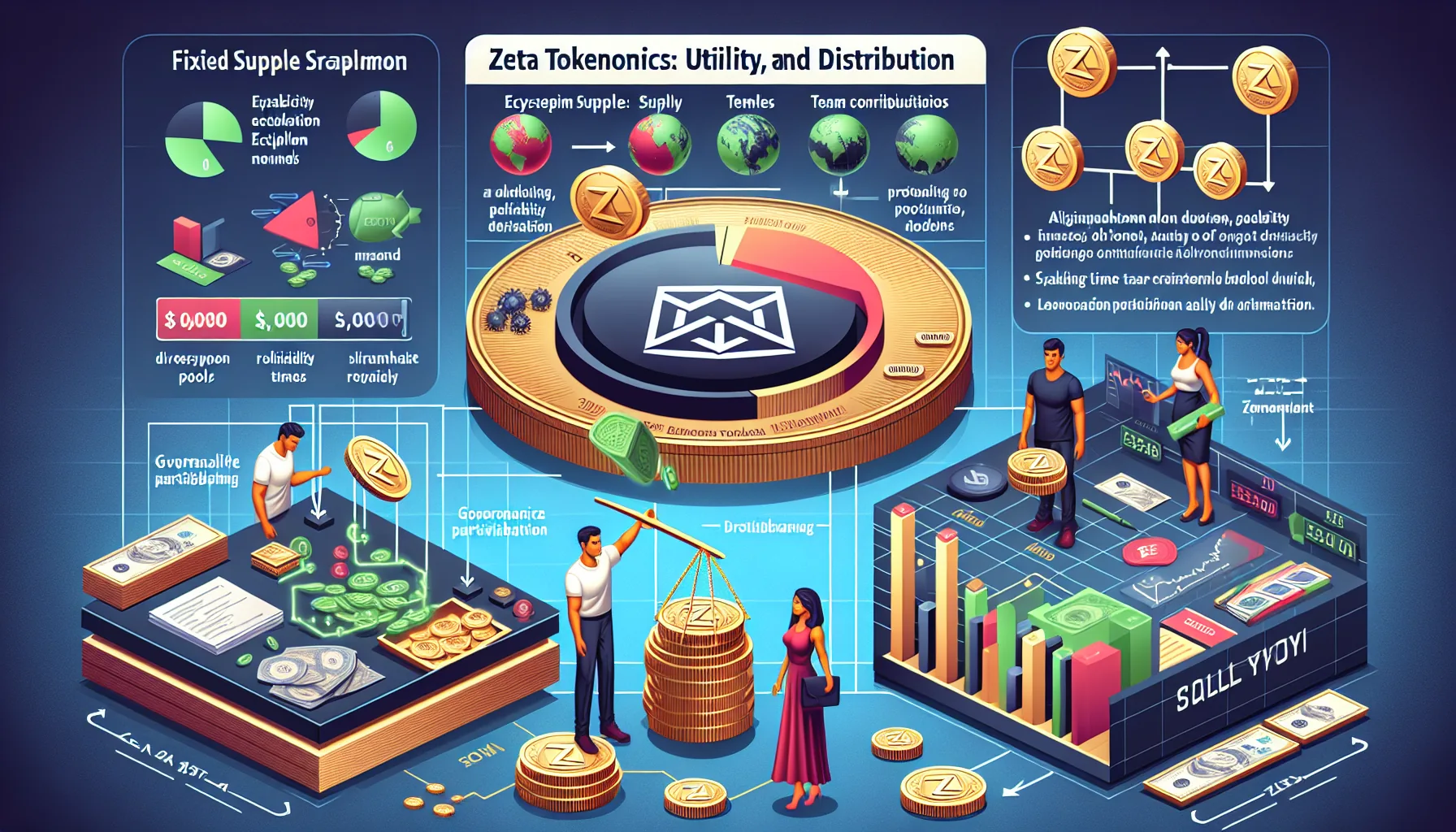
ZETA Tokenomics: Supply, Utility, and Distribution
Fixed Supply and Emission Model
ZETA operates with a fixed supply tokenomics model, ensuring scarcity over time. The total supply was minted at genesis, with no ongoing emissions, making it deflationary by design once tokens are burned or lost. Unlike infinite supply models that rely on continuous inflationary rewards, ZETA’s fixed allocation forces all incentives and ecosystem growth to function under a capped distribution. This structure benefits long-term holders but presents challenges for future incentive programs if the initial distribution is not efficiently allocated.
Allocation Breakdown and Vesting Schedules
The token allocation is divided between ecosystem incentives, team and early contributors, protocol development, and liquidity provisioning. A significant portion was reserved for early backers, often subject to vesting schedules that reduce immediate sell pressure but concentrate holdings among insiders in the early stages. If these allocations are overly concentrated, they can create centralization risks or liquidity crunches when large unlocks occur.
Vesting schedules are structured to align long-term incentives, often with a cliff period followed by linear emission over several years. While this mechanism prevents immediate dumping, it does not eliminate concerns around supply overhang, where large tranches of tokens enter circulation at predefined intervals, potentially leading to volatility.
Utility: Staking, Governance, and Gas Fees
The ZETA token serves multiple roles within its ecosystem. It can be used for staking, securing network operations, or providing liquidity. However, the yield mechanisms vary, and sustainability depends on network adoption rather than continuous token emissions. Unlike purely inflation-based staking models, ZETA’s incentive design must rely on organic network growth to maintain long-term staking rewards.
Governance participation is another function, allowing token holders to vote on protocol upgrades and key decisions. The influence of governance is tied to token distribution, meaning large stakeholders have disproportionate control unless participation is widespread.
ZETA may also be required for network transaction fees, anchoring its demand to on-chain activity. However, if alternative fee structures exist—such as stablecoin-based gas fees—this could reduce the necessity of holding ZETA for transactional purposes.
Liquidity and Market Dynamics
Liquidity provisioning plays a crucial role in maintaining market efficiency. If liquidity is concentrated in a few pools or controlled by a small number of entities, slippage and volatility can become significant concerns. Additionally, the availability of cross-chain liquidity solutions affects ZETA’s usability beyond its native ecosystem.
The absence of ongoing issuance means liquidity incentives must be carefully structured. If liquidity dries up due to low incentives, trading spreads may widen, reducing accessibility for new participants. On the other hand, aggressive liquidity mining programs risk short-term yield farming without long-term retention of participants.
ZETA Governance
Zeta Governance: Decentralization, Voting, and Control Mechanisms
Governance Model and Structure
Zeta operates under a governance framework designed to balance decentralization with effective protocol upgrades. Governance decisions are primarily made through token-holder voting, where participants influence key parameters, network upgrades, and treasury allocations. This system ensures community involvement but also introduces challenges, such as voter apathy and governance centralization risks.
Token-Based Voting Mechanism
Governance within Zeta is executed via a token-weighted voting system. Holders of ZETA tokens can propose changes or vote on existing proposals, typically covering network upgrades, fee structures, and strategic protocol decisions. While this model incentives participation, it also raises concerns about governance centralization in cases where large token holders exert disproportionate influence. Additionally, the complexity of governance proposals may discourage smaller holders from participating.
On-Chain vs. Off-Chain Governance
Zeta incorporates both on-chain and off-chain governance mechanisms. On-chain voting ensures transparency and immutability but can be slow and expensive due to blockchain transaction costs. Off-chain discussions, often facilitated through governance forums and social channels, help shape proposals before they reach formal voting stages. However, off-chain dialogues are susceptible to influence from select groups, raising concerns about decision-making equity.
Smart Contracts and Governance Execution
Governance decisions in Zeta are enforced through smart contracts, which autonomously execute approved changes. While this eliminates reliance on intermediaries, it also introduces risks. Improperly coded governance contracts can lead to unintended consequences, and upgrades to governance structures themselves may require manual intervention, potentially undermining decentralization principles.
Governance Proposals and Quorum Requirements
For changes to be implemented, governance proposals must usually meet quorum requirements. These thresholds help prevent low-engagement decisions but may also stall necessary updates if participation is low. The difficulty in achieving quorum is a common issue in decentralized governance, leading to governance fatigue and slow iteration cycles.
Potential Governance Risks and Challenges
While the Zeta governance model ensures stakeholder participation, several risks remain:
- Centralization by Large Holders: Whales or institutional investors could dominate decision-making.
- Low Voter Turnout: Participation rates in governance votes can be minimal, leading to governance inefficiency.
- Smart Contract Bugs: Vulnerabilities in governance contracts could be exploited, endangering the protocol.
- Coordination Friction: Decentralized governance requires broad consensus, which can delay critical upgrades.
These challenges highlight the ongoing trade-offs between decentralization, efficiency, and security in Zeta’s governance structure.
Technical future of ZETA
Zeta's Technical Developments and Roadmap
Optimizing ZetaChain’s Cross-Chain Infrastructure
ZetaChain continues to refine its omnichain smart contract capabilities, allowing developers to build natively interoperable dApps across multiple blockchains. A primary focus is enhancing the protocol’s handling of cross-chain message passing to minimize latency and reduce failure rates in high-volume transactions. Challenges remain in optimizing gas efficiency when interacting with non-EVM chains, with ongoing efforts to streamline execution paths for better cost-effectiveness.
Enhancements in On-Chain Smart Contract Execution
Recent upgrades to ZetaChain’s smart contract execution aim to improve cross-chain composability. A key priority is refining the security model for omnichain contracts, particularly in automating trustless verifications without increasing overhead. The team is investigating novel cryptographic primitives to reduce reliance on external relayers, minimizing attack vectors while preserving transaction finality.
Decentralization and Validator Network Expansion
ZetaChain’s validator set continues to grow, contributing to network resilience. However, maintaining uniform participation levels remains a challenge, with certain validators processing disproportionate segments of cross-chain transactions. Efforts are underway to implement load-balancing mechanisms that enhance decentralization without sacrificing transaction speed. Additionally, discussions around integrating more diverse node operator criteria are ongoing to mitigate potential centralization risks.
Improvements in Cross-Chain Liquidity Efficiency
A core aspect of ZetaChain’s utility is facilitating native cross-chain asset transfers without wrapped tokens. Ongoing advancements focus on reducing liquidity fragmentation, mitigating slippage, and improving automated market-making mechanisms for multi-chain swaps. The protocol’s reliance on liquidity providers remains an area of concern, as maintaining adequate liquidity across multiple chains introduces systemic inefficiencies in arbitrage mechanisms. Solutions such as dynamic liquidity rebalancing and incentive enhancements for market makers are currently under development.
Future Technical Roadmap
The roadmap prioritizes deeper integrations with non-EVM-compatible chains, expanding ZetaChain’s reach. Research continues into optimizing state synchronization mechanisms to support ecosystems like Solana and Cosmos-based chains without requiring extensive architectural modifications. Additionally, exploration into MEV (Maximum Extractable Value) resistance strategies is a growing focus, with potential implementations designed to mitigate sandwich attacks in cross-chain transactions.
Scaling solutions, including potential layer-2 integrations or modular execution layers, are also under evaluation to enhance throughput. However, balancing scalability with decentralization remains a critical concern, as introducing additional intermediary layers could reintroduce some of the very trust assumptions that ZetaChain aims to eliminate.
Security audits and bug bounty programs play a significant role in refining the network’s infrastructure, with continued testing focused on minimizing vulnerabilities in cross-chain data passing. Efforts to automate certain security mechanisms are being explored to reduce human-dependent oversight on critical functionality.
Comparing ZETA to it’s rivals
Zeta (ZETA) vs. Solana (SOL): A Comparison of Performance and Capabilities
Execution Speed and Throughput
Both Zeta and Solana prioritize high-performance execution, leveraging advanced consensus mechanisms to achieve low-latency transactions. Solana’s Proof-of-History (PoH) combined with Proof-of-Stake (PoS) allows for extremely fast transaction finality. Zeta, however, achieves high throughput via its Layer 1 infrastructure optimized for low-latency decentralized finance (DeFi) operations. While Solana has widely demonstrated real-world TPS (transactions per second) capacity in the thousands, network congestion and downtime have occasionally compromised its reliability. Zeta offers robust execution speeds but is still evolving in terms of demonstrating consistent, high-load performance under sustained network pressure.
Network Downtime and Reliability
Solana has faced multiple high-profile outages due to validator failures, congestion issues, and spam attacks. These incidents have raised concerns over network stability, especially for projects reliant on uninterrupted execution. In contrast, Zeta prioritizes reliability, though it remains to be tested under extreme loads seen in the most active blockchain environments. Zeta’s edge comes from its fault-tolerant design, aiming to mitigate single points of failure, though its real-world uptime track record is still being established.
Smart Contract Flexibility and Developer Ecosystem
Solana uses Rust-based smart contracts implemented through the Sealevel parallel processing engine, allowing for highly efficient execution. This has fostered a strong developer ecosystem but also introduced a steep learning curve compared to Solidity-based alternatives. Zeta takes a different approach, offering developers an environment that emphasizes cross-chain interoperability and modularity, which could appeal to teams building applications that require multi-chain compatibility. However, Solana benefits from a much larger and more mature developer base, making it easier to find resources, documentation, and support for project deployment.
Liquidity and DeFi Market Penetration
Solana's DeFi ecosystem is well-established, with deep liquidity pools and active participation from institutional and retail users. Major DeFi applications, including lending protocols, DEXs, and liquid staking solutions, have contributed to its dominance. Zeta, while positioning itself as a competitive Layer 1 within decentralized finance, still has room to grow in terms of liquidity depth and volume compared to Solana’s more entrenched platforms.
Consensus Mechanism and Validator Decentralization
Solana’s validator set has been criticized for its high hardware requirements, leading to centralization concerns as only well-resourced participants can reliably validate transactions. Zeta’s validator infrastructure is designed to address some of these centralization risks, but its validator count and overall system-wide decentralization are still developing. Whether Zeta can sustain a distributed validator ecosystem while maintaining performance remains an open question.
Zeta vs. Sui: A Deep Dive into Performance and Capability
Execution Speed and Finality
Zeta and Sui both emphasize high-performance transactions, but their approaches differ significantly. Sui leverages its Move-based object-centric model to enable near-instantaneous transactions without global consensus when handling independent transactions. This approach is highly efficient for parallelized operations but can introduce complexity for developers unfamiliar with Move’s resource-based programming.
By contrast, Zeta integrates with broader decentralized finance (DeFi) ecosystems while prioritizing low-latency execution. While Sui excels in localized execution, its infrastructure currently faces challenges in scaling to broader Layer 1 (L1) interoperability without significant overhead.
Smart Contract Flexibility
Zeta maintains EVM compatibility, making it more accessible for developers transitioning from Ethereum-based chains. This opens up a wider range of tooling and cross-chain composability. Sui, on the other hand, utilizes Move, which provides enhanced security through stricter asset ownership rules but presents a steeper learning curve. While Move contracts can prevent common smart contract vulnerabilities like re-entrancy more effectively than Solidity, the ecosystem lacks the extensive libraries and developer adoption that EVM-compatible chains offer.
Liquidity and Ecosystem Depth
Sui’s DeFi presence has seen dedicated ecosystem growth, but compared to Zeta’s design for cross-chain integration, its liquidity is more isolated. Sui's model fosters strong on-chain interactions but faces friction when bridging assets across external chains. Zeta, by emphasizing interoperability, facilitates deeper integration with multi-chain DeFi protocols, reducing liquidity fragmentation.
Validator Infrastructure and Decentralization
Sui deploys a delegated proof-of-stake (dPoS) model emphasizing validator optimization. While this design enables efficient throughput, its validator set remains relatively centralized compared to networks prioritizing broader participation. Zeta’s validator network is structured for optimized execution while maintaining decentralization, balancing operational efficiency with security.
Sui’s validator incentives are built around its storage fund mechanism, redistributing fees to maintain long-term sustainability. However, questions persist around whether this model effectively stabilizes long-term validator participation, given the dynamic nature of staking rewards.
Developer and User Experience
Move’s security benefits position Sui as a strong candidate for asset-centric applications, but the difficulty of onboarding developers unfamiliar with Move remains a hurdle. Zeta, leveraging existing EVM and DeFi infrastructure, benefits from streamlined adoption. Additionally, Sui’s wallet infrastructure and UX tooling are still developing, whereas Zeta’s integrations with widely used DeFi platforms provide a more seamless experience.
Zeta vs. Aptos: Performance, Features, and Trade-offs
Consensus and Speed
Aptos utilizes the AptosBFT consensus mechanism, an evolution of DiemBFT. This system is optimized for high throughput and low latency, leveraging parallel execution through Block-STM. While this promises impressive transaction speeds, real-world performance can vary depending on network conditions and validator efficiency.
Zeta, in contrast, integrates with Ethereum and broader ecosystems while focusing heavily on cross-chain interoperability. Unlike Aptos, which remains primarily confined to its ecosystem, Zeta is designed for seamless execution across chains, providing different liquidity and execution dynamics.
Smart Contract Capabilities
Aptos leverages the Move programming language, originally developed for Meta’s Diem project. Move is designed for security and resource efficiency, making it a strong choice for developers prioritizing formal verification and protection against common vulnerabilities. However, its adoption remains limited outside the Aptos ecosystem, which can slow developer onboarding.
Zeta, on the other hand, maintains EVM compatibility, making it more accessible to developers already familiar with Solidity. This allows for easier porting of existing dApps and greater integration with DeFi ecosystems that dominate on Ethereum and its Layer-2 solutions. While this provides flexibility, it also means exposure to the well-documented security challenges of EVM-based contracts.
Ecosystem and Liquidity
Aptos has received substantial backing from venture capital, contributing to rapid ecosystem expansion. Despite this, liquidity fragmentation is an ongoing issue, as adoption has not yet matched some larger ecosystems. The reliance on Move also means tooling and infrastructure support, while growing, is still maturing compared to more established smart contract platforms.
Zeta focuses on interoperability, which gives it access to deeper liquidity pools spread across multiple chains. This approach reduces the risk of liquidity silos but introduces additional dependencies on external networks, which can lead to higher complexity and potential security risks.
Security Considerations
Aptos’ consensus mechanism is designed for high resilience, but as a newer Layer-1 blockchain, its full security track record remains in development. With a smaller validator set compared to more decentralized networks, concerns around validator centralization persist.
Zeta’s security model is deeply tied to its cross-chain operations, meaning its robustness is dependent on external bridges and validators. While it mitigates some risks with a unique design, exposure to vulnerabilities in interconnected networks remains a challenge.
Primary criticisms of ZETA
Primary Criticism of ZETA
Centralization Concerns in Validator Set
One of the most frequently cited criticisms of ZETA is its validator network structure. While the protocol aims for decentralization, critics argue that the validator set remains relatively small and concentrated. A limited number of entities controlling block production and finalization raises concerns about censorship resistance and network security. Without a sufficiently decentralized validator set, there is a risk of collusion, potential governance manipulation, and an over-reliance on a few key stakeholders to maintain network integrity.
Security Risks in Cross-Chain Functionality
ZETA’s core value proposition revolves around interoperability, enabling seamless cross-chain transactions. However, its reliance on cross-chain bridges introduces substantial security risks. Historically, cross-chain solutions have been a prime target for exploits due to vulnerabilities in smart contracts, multi-signature wallets, and custodial bridges. Any flaw in the protocol’s bridging mechanism could lead to exploits, potentially resulting in substantial asset losses. Given the track record of cross-chain attacks in the crypto space, skepticism remains about whether ZETA’s security model is robust enough to mitigate such systemic risks.
Tokenomics and Incentive Misalignment
Another recurring critique centers on ZETA’s tokenomics. Questions have been raised about the long-term sustainability of its economic model, particularly regarding validator incentives, emission schedules, and transaction fee distribution. If token emissions outpace network adoption, inflationary pressures could reduce token value while making security incentives less compelling for validators. Furthermore, concerns exist around whether staking rewards and incentive structures truly align with decentralization goals or whether they disproportionately favor early adopters and large stakeholders.
Liquidity Fragmentation and User Friction
Despite its interoperability focus, liquidity fragmentation remains an issue. ZETA facilitates cross-chain functionality, but its ecosystem is only as strong as the liquidity provided across chains. If liquidity is insufficient or unevenly distributed, users may face higher slippage and limited access to deep markets. Additionally, the process of transferring assets across chains still introduces friction, whether due to wrapping mechanisms, network fees, or time delays. Such complexities could hinder mainstream adoption and make ZETA less attractive compared to alternative bridging solutions within the DeFi ecosystem.
Governance Transparency and Decision Making
Critics also point to governance concerns within the ZETA ecosystem. A lack of transparency around decision-making processes, upgrade proposals, and validator influence can create an opaque environment where key stakeholders wield disproportionate power. If governance remains largely in the hands of a concentrated group, long-term decentralization goals could be compromised, making the network less resistant to central control or external influence.
Founders
Zeta Crypto Founding Team: Background and Key Contributors
The founding team behind Zeta is composed of individuals with deep expertise in blockchain development, financial engineering, and distributed systems. The project's inception came from a vision to enhance decentralized finance infrastructure with a focus on scalability, speed, and security. While the team has maintained a fairly strong technical presence, transparency regarding individual contributors and leadership roles has, at times, been limited.
Core Developers and Technical Leadership
A key component of Zeta's development has been its strong emphasis on engineering talent, particularly in areas of cryptographic security and blockchain consensus mechanisms. Several of the project's early contributors have backgrounds in high-frequency trading, smart contract security, and Layer-1 blockchain optimizations. Their prior experience includes work at well-established blockchain firms, traditional financial institutions, and tech companies specializing in distributed computing.
However, while the protocol's technical advancements have been well-received, the team's partial anonymity—or at least a general lack of easily accessible public information—has raised concerns among some in the crypto community. This lack of transparency has at times impacted broader institutional trust, particularly among investors who prioritize project leadership visibility.
Strategic and Financial Contributors
Beyond the core engineering team, Zeta's early development was supported by contributors with financial backgrounds, including figures with experience in structured DeFi products, liquidity provisioning, and algorithmic market-making. These contributors played a role in shaping the economic mechanisms and incentive structures within the Zeta ecosystem. Additionally, early-stage funding and advisement came from individuals and firms with deep involvement in decentralized trading infrastructure and cross-chain communication protocols.
Despite this strategic backing, some concerns have been raised about whether the team possesses the necessary experience in large-scale financial regulation. As Zeta has expanded, questions about compliance preparedness and legal structuring in various global jurisdictions remain open.
Community Engagement and Openness
The Zeta founding team has maintained an active development presence, frequently contributing updates and engaging with the broader crypto development community. However, some critics argue that the team's interaction with retail users and non-technical stakeholders has been limited compared to other leading projects. The absence of high-profile leadership figures actively promoting the project has, at times, led to uncertainty about long-term ecosystem direction.
While Zeta's founding team has demonstrated strong technical capabilities, future challenges may arise from balancing decentralization, regulatory concerns, and broader adoption outside purely technical circles.
Authors comments
This document was made by www.BestDapps.com
Sources
- https://www.zetachain.com/
- https://docs.zetachain.com/
- https://github.com/zeta-chain
- https://zetachain.com/whitepaper.pdf
- https://zetachain.com/yellowpaper.pdf
- https://medium.com/zetachain
- https://twitter.com/zetachain
- https://discord.gg/zetachain
- https://explorer.zetachain.com/
- https://forum.zetachain.com/
- https://coinmarketcap.com/currencies/zetachain/
- https://www.coingecko.com/en/coins/zetachain
- https://defillama.com/protocol/zetachain
- https://messari.io/asset/zetachain
- https://decrypt.co/tag/zetachain
- https://www.theblock.co/linked/zetachain
- https://dappradar.com/zetachain
- https://www.binance.com/en/price/zetachain
- https://support.zetachain.com/
- https://blog.zetachain.com/


