History of YFI
The History of Yearn Finance (YFI)
Yearn Finance (YFI) was launched in mid-2020 by developer Andre Cronje as an effort to automate and optimize yield farming strategies within the decentralized finance (DeFi) ecosystem. Initially conceived as iEarn, the protocol underwent a rebranding to Yearn Finance, introducing a governance token, YFI, which quickly gained traction due to its unique distribution model and Cronje’s approach to decentralized development.
The Fair Launch Experiment
One of the defining moments in YFI’s history was its token distribution model. Unlike many projects that allocate large portions of supply to early investors or team members, YFI was distributed via a "fair launch," meaning no pre-mine, presale, or allocations to the team. The only way to acquire YFI at launch was to provide liquidity to the protocol. This distribution strategy set a precedent within DeFi, solidifying Yearn Finance’s reputation as a truly decentralized protocol governed by its community.
Rapid Growth and Expanding the Ecosystem
Within weeks, YFI saw massive adoption as users sought to participate in governance and the growing yield farming opportunities facilitated by the protocol’s automated vault strategies. Given its decentralized nature, the community played an increasingly active role in expanding the protocol, adding new features, and developing partnerships with other DeFi projects. This rapid iteration led to integrations with platforms such as Curve Finance and Aave, securing Yearn’s place within DeFi’s core infrastructure.
However, the fast-paced growth also led to internal challenges. Governance proposals became increasingly complex, leading to debates about the best decision-making processes. Additionally, as Yearn expanded its range of products, there were concerns about product fragmentation and whether the protocol was moving too far beyond its original scope.
Andre Cronje’s Departure and Its Impact
A pivotal moment in YFI’s history came when Andre Cronje announced his exit from active development, raising concerns about the project’s future. Cronje had been the face of Yearn’s innovation, and his departure led to questions about decentralization, developer incentives, and long-term sustainability. However, the protocol remained operational, with governance and community developers continuing to maintain and expand Yearn’s offerings.
Security Incidents and Governance Challenges
Like many DeFi protocols, Yearn Finance has faced challenges related to smart contract vulnerabilities. While no catastrophic exploits have permanently damaged the protocol, security concerns have remained a key discussion point among developers and governance participants. Additionally, disagreements within the community on treasury management, rewards distribution, and development priorities have occasionally led to governance deadlocks, highlighting the difficulties of fully decentralized decision-making in a rapidly changing DeFi landscape.
How YFI Works
How YFI Works: Governance, Yield Optimization, and Token Mechanics
Yearn Finance (YFI) operates as a decentralized ecosystem focused on yield optimization through automated strategies. The core functionality of YFI revolves around its governance model, the role of vaults, and how the YFI token itself is utilized within the protocol.
Governance and the Role of YFI
YFI is the governance token for Yearn Finance, granting token holders voting power over protocol upgrades, strategy changes, and treasury management. Unlike many governance tokens that allocate a portion to early investors or teams, YFI was initially distributed through liquidity mining with no pre-mine or investor allocation.
Key governance decisions are executed through off-chain proposals (via Snapshot) and on-chain executions powered by multisig signers. This decentralization comes with both strengths and weaknesses—while community-driven governance prevents centralized control, participation rates can sometimes be low, and decision-making can be slow-moving. Additionally, the concentration of YFI in the hands of a few whales has led to concerns over governance centralization despite the intent of decentralization.
Yearn Vaults and Yield Farming Strategies
The primary function of the Yearn Finance ecosystem is its vaults, which automate yield farming strategies to optimize returns for users. Vaults pool user funds and deploy them across DeFi protocols such as Aave, Compound, and Curve to maximize yield while minimizing gas fees and manual intervention.
Strategies within these vaults are created and updated by strategists within the Yearn community. When a strategy underperforms or a better yield opportunity arises, governance can vote to modify or replace it. However, reliance on governance for changes means that vault efficiency can be affected by slow proposal approval times. Additionally, some strategies can be complex, and black-box execution may make it difficult for users to fully understand the risks involved.
YFI Token Supply and Economic Model
Unlike inflationary governance tokens, YFI has a fixed maximum supply, leading to long-term scarcity. Early discussions considered introducing YFI minting to fund development, causing governance debates about dilution versus sustainability.
YFI can be staked to earn rewards, historically funded by protocol fees. However, fluctuations in protocol revenue have made reward consistency unpredictable. The fee model is dependent on Yearn’s vault profitability, meaning when DeFi yields decrease, YFI rewards may also decline.
Security is another consideration—smart contract exploits remain a risk, and while Yearn has undergone multiple audits and improvements, no protocol is fully immune to vulnerabilities.
Use Cases
Yearn Finance (YFI) Use Cases: Yield Optimization and Governance
Automated Yield Farming Strategies
YFI serves as the governance token for Yearn Finance, a decentralized protocol that optimizes yield farming across DeFi platforms. Holders gain exposure to automated yield strategies through Yearn’s vaults, which autonomously allocate user deposits to the highest-yielding opportunities. These vaults reduce the complexity of yield farming by handling gas fees, compounding rewards, and reallocating funds when yields shift. However, reliance on smart contracts introduces risk, including potential vulnerabilities and external protocol failures affecting yield performance.
Governance and Protocol Upgrades
YFI enables decentralized governance, allowing token holders to propose and vote on protocol changes. Governance decisions dictate fee structures, new product launches, and treasury fund allocations. While governance participation provides a decentralized decision-making process, it also comes with challenges such as low voter turnout and potential centralization risks if governance power concentrates among a few large holders. Additionally, governance proposals may be slow-moving, creating hurdles for swift protocol adjustments.
Fee Distribution and Revenue Sharing
A portion of Yearn Finance’s revenue, generated from performance and withdrawal fees on vaults, is distributed to YFI holders who stake their tokens in governance contracts. This incentive structure benefits long-term participants, but income can fluctuate based on market conditions, vault activity, and protocol usage. Fee streams are also subject to governance changes, meaning distribution models can shift over time.
Cross-Protocol Integration
YFI's role extends beyond Yearn’s ecosystem through integrations with other DeFi protocols. Yearn’s strategies interact with platforms such as Aave, Compound, and Curve, leveraging these protocols to maximize returns. However, dependency on external platforms introduces risks, including smart contract exploits, liquidity crises, or governance decisions from integrated protocols that may negatively impact Yearn’s strategies.
Collateralization in DeFi Lending
YFI can be used as collateral in DeFi lending markets, allowing holders to borrow stablecoins or other assets while retaining exposure. This creates liquidity opportunities for users but also carries liquidation risks, especially during high market volatility. The relatively low supply of YFI can result in less liquidity compared to larger crypto assets, potentially increasing slippage and limiting borrowing capacity.
Potential Limitations and Risks
Despite its utility, YFI faces limitations including smart contract risks, governance centralization concerns, and fluctuating yield opportunities. Its reliance on external DeFi protocols exposes it to systemic risks within the broader ecosystem. Additionally, token scarcity and governance participation challenges may impact its long-term sustainability as an effective coordination mechanism.
YFI Tokenomics
YFI Tokenomics: Scarcity, Supply Mechanics, and Emission Model
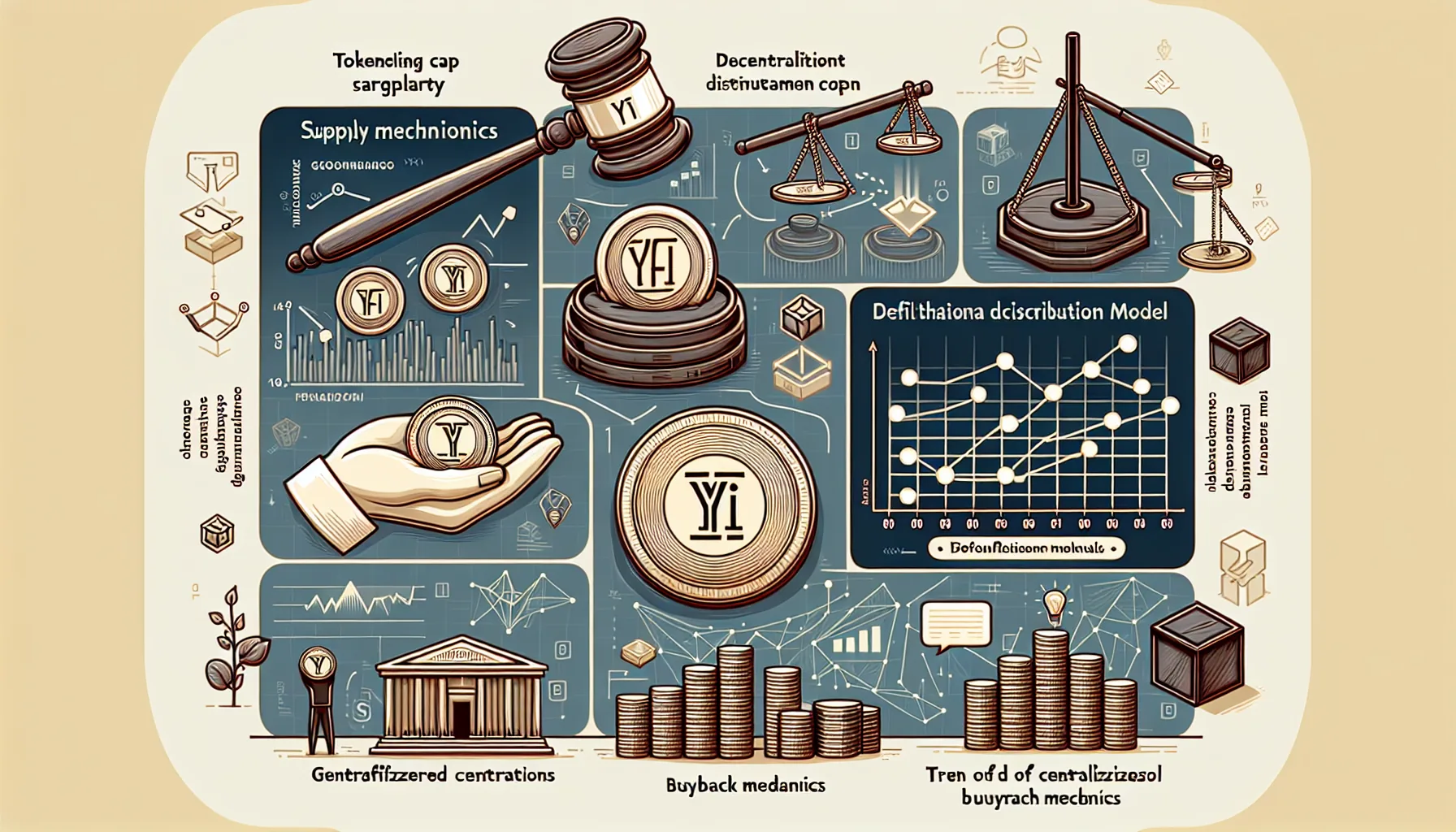
Yearn Finance’s YFI token has a distinct tokenomic structure, characterized by an immutable supply cap and a decentralized distribution model. Unlike many other DeFi protocols that reserve a percentage of tokens for insiders or development teams, the initial YFI distribution was fully decentralized, fostering a strong community-driven governance model. However, this unique approach also has implications for sustainability, incentive mechanisms, and governance efficiency.
Fixed Supply and Absence of Inflation
YFI has a hard-capped total supply, with no built-in inflation or continuous emissions. This strict scarcity model contrasts with many DeFi projects that implement ongoing emissions to incentivize liquidity providers. The lack of a continuous token distribution makes it deflationary by nature, as lost or burned tokens directly reduce circulating supply over time. While this scarcity is often viewed as a positive for price appreciation, it also presents challenges, particularly in ensuring long-term incentive alignment for protocol contributors without ongoing token rewards.
Governance Power and Token Distribution
YFI primarily functions as a governance token, granting voting rights on Yearn Finance protocol upgrades and treasury management. The initial distribution of YFI through liquidity mining ensured a widely decentralized holder base, avoiding concentration in early insiders or VCs. However, this distribution method has not prevented long-term centralization trends, as governance control tends to accumulate in the largest stakeholders, particularly since participation in governance voting requires active engagement from token holders.
Treasury and Buyback Mechanics
To counterbalance the lack of new token issuance, Yearn Finance has implemented mechanisms such as protocol revenue buybacks. A portion of fees generated by the protocol is allocated toward purchasing YFI from the open market, providing ongoing demand. While this design is intended to sustain value accrual, its effectiveness hinges on protocol profitability and transaction volumes. If revenues decline, the buyback mechanism loses impact, potentially affecting long-term sustainability.
Liquidity and Staking Incentives
Without ongoing emissions, YFI relies on protocol-generated yield opportunities to incentivize token holders. Yield optimization strategies within Yearn’s ecosystem act as indirect earning mechanisms for YFI holders, but they do not offer direct staking rewards in the way that inflationary staking models do. This creates a dynamic where YFI’s utility as a governance token is separated from its earning potential, leading to debates around whether additional economic incentives should be introduced to strengthen token retention.
Challenges in Token Utility Evolution
The absence of ongoing emissions makes YFI a unique case in DeFi tokenomics, but it also presents challenges in maintaining active governance participation and incentivizing long-term development. While the buyback model addresses some of these concerns, it is ultimately dependent on the protocol’s revenue generation. If Yearn Finance evolves without introducing new utility mechanisms for YFI, its governance participation could face continued concentration among fewer active holders, creating potential centralization issues.
YFI Governance
YFI Governance: Structure, Voting Power, and Challenges
Decentralized Governance via Snapshot Voting
YFI token holders govern Yearn Finance through a Snapshot-based off-chain voting system. Proposals (YIPs) dictate protocol changes, treasury decisions, and development priorities. While this system allows broad community participation without gas fees, it lacks on-chain execution, meaning successful votes require trusted developers or multi-sig signers for implementation.
Voting Power and Token-Based Influence
Governance influence is proportional to held or delegated YFI tokens. This creates a system where large holders (whales) exert outsized control over decision-making. Low voter turnout can exacerbate this issue, concentrating influence in a small subset of participants.
Treasury and Fund Allocation Governance
Yearn’s treasury, controlled via governance, funds development, security audits, and ecosystem maintenance. While this model fosters decentralized decision-making, managing treasury allocations efficiently requires well-aligned incentives among voters, contributors, and developers. Delayed or contested votes can slow down critical decisions.
Delegation and Active Participation Issues
YFI governance allows delegation, enabling passive holders to assign voting power to more engaged participants. However, maintaining an informed voter base remains a challenge. Many token holders do not actively participate, creating governance fatigue and decision bottlenecks. Large delegations can also reinforce centralization among a few active stewards.
Governance Attack Risks
A concentration of YFI in a few hands poses governance attack risks, including hostile takeovers or treasury misallocations. Although community oversight mitigates blatant attacks, contentious proposals have historically highlighted the risks of governance being controlled by financially motivated actors rather than long-term ecosystem contributors.
Proposal Implementation and Coordination Challenges
Even with passed proposals, execution depends on multi-sig signers or core contributors aligning with governance outcomes. This reliance on manual implementation can cause friction and delays, particularly if there are disagreements over interpretation or feasibility. Some proposals have faced difficulties when lacking clear execution pathways.
Iterative Governance Evolution
Over time, YFI governance has undergone refinements to improve participation and decision-making processes. Discussions on on-chain voting, tokenomics adjustments, and incentive structures continue to shape how governance evolves. However, balancing decentralization, efficiency, and security remains an ongoing challenge.
Technical future of YFI
Yearn Finance (YFI) Technical Roadmap and Future Developments
Smart Contract Enhancements and Security Audits
Yearn Finance continues to refine the security and efficiency of its smart contracts. Ongoing audits aim to mitigate risks related to composability within the DeFi ecosystem. Given Yearn's frequent integrations with protocols like Curve, Convex, and Aave, reducing external dependency vulnerabilities remains a primary focus. Smart contract optimizations are expected to enhance gas efficiency, particularly for vault strategies that currently struggle with high transaction costs during rebalancing. Security concerns remain around centralized control mechanisms, particularly multi-sig governance, with ongoing discussions about further decentralization of upgrade authority.
Vault Strategy Enhancements
Vaults remain central to Yearn’s functionality, with new strategies under development to maximize yield while mitigating capital inefficiency. One key challenge is the sustainability of certain yield sources, particularly within liquidity staking and incentive-driven farming, which can lose profitability as emissions decrease. Future updates are likely to focus on dynamic strategy allocation, where vaults automatically rebalance capital based on shifting yield opportunities rather than relying on static strategies a priori. Enhanced composability with Layer 2 and cross-chain vault strategies is also under exploration, though interoperability constraints remain a significant challenge.
Layer 2 Scaling and Cross-Chain Integrations
Gas fees on Ethereum remain a barrier for smaller depositors, making Layer 2 integrations a necessity. There has been active research into deploying Yearn vaults on scaling solutions such as Arbitrum and zkSync, though maintaining composability with existing Ethereum-based integrations presents technical hurdles. Another key area of exploration is cross-chain yield aggregation, allowing Yearn vaults to source returns from alternative ecosystems like Avalanche or Solana. Bridging mechanisms introduce additional smart contract risk, which has historically been a limiting factor in Yearn’s multi-chain expansion decisions.
Governance and Protocol Decentralization
While Yearn’s governance structure has evolved, concerns persist around the concentration of decision-making within a core group of contributors. Further decentralization efforts include incentivizing a wider range of token holders to participate in governance through mechanisms like veYFI—though implementation details remain uncertain. Governance automation via smart contract-based execution has been discussed but is not yet widely adopted due to concerns around rigid execution logic and changing protocol needs.
Automation and AI-Driven Yield Optimization
Discussions around using AI and algorithmic strategies to optimize yield farming remain in early stages. The complexity of DeFi market conditions makes full automation challenging, but improvements in machine-learning-driven strategy execution are being explored. Challenges include scalability, real-time risk assessment, and adapting to rapidly changing liquidity conditions.
Comparing YFI to it’s rivals
YFI vs. CVX: A Deep Dive into Their Competitive Landscape
Yearn Finance (YFI) and Convex Finance (CVX) both operate within DeFi but target different segments of the yield optimization market. While YFI originated as an automated yield aggregator leveraging various protocols, CVX has positioned itself as a meta-governance powerhouse, specifically dominating the Curve Finance ecosystem through its CVX token mechanics.
Governance and Influence
One of the most striking differences between YFI and CVX is their approach to governance. YFI is structured as a decentralized yield aggregator, where governance participants mainly influence how the protocol evolves and how treasury funds are deployed. The governance system has seen challenges due to fluctuating community engagement and shifting priorities among token holders.
CVX, on the other hand, has built a governance monopoly around Curve Finance’s CRV emissions. Its token gives holders the ability to direct CRV emissions by aggregating liquidity providers' interests. This has made CVX highly influential within Curve’s ecosystem, effectively turning it into a powerbroker for DeFi liquidity provisioning. YFI lacks such direct control over ecosystem incentives, making its governance engagement less concentrated in a single area but also less impactful in terms of dictating liquidity flows.
Yield Optimization Strategies
YFI offers automated vaults that optimize yields across multiple DeFi protocols, whereas CVX focuses primarily on boosting rewards for Curve LPs. CVX users stake CRV and CVX to maximize their returns, leveraging incentives within the Curve ecosystem without needing to interact directly with Curve’s more complex locking mechanics. This targeted strategy has given CVX a dominant position in Curve staking, whereas YFI’s broader approach means it does not enjoy the same level of specialization within any single DeFi protocol.
However, YFI’s diversified strategy provides flexibility when market conditions change. Rather than being tied to a single protocol’s mechanics, YFI vaults can adapt yield strategies based on where opportunities arise. This inherently makes YFI less dependent on a single platform’s health, whereas CVX’s sustainability is tightly linked to the continued dominance of Curve liquidity pools.
Risks and Challenges
YFI’s core challenge has been maintaining sustainable revenue without excessive reliance on inflationary incentives. CVX faces a similar problem but is more vulnerable to shifts in Curve’s dominance. If Curve governance incentives were to lose effectiveness or if innovative competitors disrupted Curve’s current advantage, CVX’s utility could diminish significantly.
Security is another challenge. YFI has encountered issues related to strategy exploits, though upgrades have improved its resilience. CVX, while relatively secure, concentrates significant governance power, making it an attractive target for governance attacks if a malicious entity were to accumulate sufficient voting influence.
YFI vs. AAVE: Comparing Yield Strategies and Governance Models
Yield Optimization: Active Management vs. Passive Lending
Yearn Finance (YFI) and Aave (AAVE) take fundamentally different approaches to yield generation. YFI acts as an aggregator, actively reallocating capital into different yield-generating strategies across DeFi protocols. This active management requires constant strategy updates and governance participation to optimize returns. In contrast, Aave operates as a decentralized liquidity protocol where users supply assets to earn passive yield via algorithmically adjusted interest rates.
A key distinction is yield volatility. Aave's interest rates fluctuate based on supply and demand within lending pools, meaning rates can compress during periods of excess liquidity. YFI’s vault strategies, however, are more flexible, as they can pivot between different DeFi opportunities, albeit with additional smart contract risk.
Governance Control and Fee Structures
Both YFI and AAVE feature decentralized governance, but they serve different functions. YFI holders vote on strategy deployments, performance fees, and vault parameters, directly influencing the protocol's revenue model. Meanwhile, AAVE governance focuses on risk parameters for loan markets, collateral onboarding, and protocol upgrades.
Aave captures value primarily through reserve factor fees, a portion of interest earned from borrowers. YFI, in contrast, extracts fees from vault profits through a combination of management and performance fees. This means YFI’s revenue is tied to the effectiveness of its strategies, whereas Aave’s earnings fluctuate with lending activity.
Capital Efficiency and Liquidity Utilization
Aave’s model is highly capital-efficient for lenders, as assets remain liquid and withdrawable at any time—subject to market utilization. YFI’s vaults, on the other hand, often require depositors to accept longer capital lockups in exchange for optimized yield strategies. This difference makes Aave preferable for users who need liquidity flexibility, while YFI appeals to those prioritizing yield maximization over accessibility.
Leverage also plays a key role. Aave enables borrowing against supplied assets, allowing users to amplify exposure or execute recursive lending strategies. YFI does not offer this directly but benefits indirectly by utilizing platforms like Aave within its vault strategies. This creates a dynamic where Aave acts as foundational DeFi infrastructure, while YFI builds on top of such platforms to enhance yield.
Risk Exposure: Smart Contracts vs. Liquidations
Smart contract risk is inherent in both protocols. YFI’s model introduces additional complexity due to frequent strategy updates and reliance on external protocols, increasing potential attack vectors. Aave’s primary risk lies in liquidation mechanisms, where volatile market conditions can trigger cascading liquidations if collateral values drop sharply.
While both protocols optimize yield-generation, the core trade-offs lie in active versus passive yield strategies, governance control, and liquidity flexibility.
YFI vs FXS: A Comparative Analysis
When analyzing Yearn Finance (YFI) in relation to Frax Share (FXS), key distinctions emerge in their design, governance, and utility within DeFi. While both tokens play critical roles in yield optimization and liquidity management, their fundamental structures and economic models differ significantly.
Governance and Token Dynamics
YFI operates under a purely decentralized governance model, where token holders dictate protocol changes through on-chain voting. In contrast, FXS governs the Frax ecosystem, which utilizes a hybrid stability mechanism combining algorithmic and collateralized elements. FXS holders influence decisions around collateral ratios, interest rates, and protocol incentives, but governance has been criticized for its concentration, with a small number of wallets often holding substantial voting power.
Compounding this, FXS emissions are tightly interwoven with Frax's liquidity incentives, creating a continual dilution effect if emission-based rewards outpace demand. YFI also had supply-side expansions via buybacks and staking incentives, but it has historically emphasized capped supply mechanics more than emission-based distribution.
Yield Strategies and Protocol Utility
YFI’s primary advantage lies in its vault strategies, which automate complex yield farming across multiple DeFi protocols. Frax, however, has developed yield strategies more centered on liquidity provisioning via Frax-based stablecoins. FXS plays a role in directing these incentives, particularly in mechanisms like FraxBP and FraxLend, where it serves as the governance and reward distribution token.
A critical distinction is the dependency on external protocols. FXS has strong integrations with Curve and Convex for the Frax stablecoin's liquidity incentives, making it highly reliant on Curve's governance structure. This can lead to fragility if external platforms shift incentives or reduce Frax's influence over key liquidity pools. YFI vaults, while also exposed to external risks, maintain more flexibility by reallocating strategies as DeFi landscapes evolve.
Stability vs. Volatility
FXS experiences price and governance volatility due to its direct ties to the algorithmic Frax stablecoin, which has endured moments of depegging. These instances have pressured FXS as a value accrual mechanism, forcing adjustments in incentives and collateral backing. YFI, while subject to broad market cycles, does not face the same systemic risks tied to a native stablecoin’s performance.
Ultimately, the differences in governance structure, liquidity dependencies, and stability mechanisms define how YFI and FXS operate within DeFi, highlighting the varying risk profiles and strategic roles each token serves.
Primary criticisms of YFI
Primary Criticism of YFI: Centralization Concerns and Governance Challenges
Governance and Developer Control
One of the most persistent criticisms of YFI revolves around governance centralization. While Yearn Finance initially positioned itself as a fully decentralized platform, in practice, governance remains heavily influenced by a relatively small group of core developers and contributors. Changes to the protocol often depend on the involvement of these key individuals, raising questions about the true extent of community-driven decision-making. Critics argue that this reliance on a small set of contributors leads to decision-making bottlenecks and contradicts the premise of decentralized governance.
Tokenomics and Incentive Structure
YFI’s hard-capped supply is often touted as a benefit, but it also presents structural issues. Unlike other DeFi protocols that continuously reward liquidity providers or contributors, Yearn Finance lacks an ongoing emission model. This has resulted in debates over how to incentivize long-term protocol development and maintenance. The absence of new YFI issuance means that funding for development often relies on existing reserves or external revenue streams rather than direct in-protocol incentives. Detractors argue that this model creates long-term sustainability concerns, particularly when compared to other DeFi projects with more flexible tokenomics.
Declining Governance Participation
Despite being one of the most community-driven DeFi projects on paper, YFI governance participation has seen significant declines. The high cost of voting, combined with governance fatigue, has led to lower engagement in protocol decisions. Large token holders, often referred to as whales, exert outsized influence, making it difficult for smaller participants to have meaningful impact. This concentration of decision-making power undermines the decentralized ideals that initially attracted users to the project.
Smart Contract Risks and Dependency on External Strategies
Yearn Finance relies on yield farming strategies that interact with multiple DeFi protocols, exposing it to smart contract risks beyond its own platform. Any vulnerabilities in third-party protocols that Yearn integrates with can directly impact user funds. Additionally, shifting market conditions can render once-profitable strategies ineffective, leading to reduced yields or potential losses. Critics highlight that Yearn’s reliance on constantly evolving DeFi primitives increases systemic risk and dependency on external projects.
Lack of Clear Long-Term Roadmap
While Yearn Finance has a history of rapid innovation, it often lacks a clearly communicated long-term roadmap. Unlike other DeFi projects that provide structured development plans, Yearn's approach is more fluid, relying heavily on community proposals. While this flexibility can be beneficial, it also leaves uncertainty about the protocol's direction. Some critics argue that this lack of structured guidance makes it difficult for investors and users to evaluate its long-term viability.
Founders
Yearn.Finance (YFI) Founding Team: Origins and Controversies
Yearn.Finance (YFI) was created by Andre Cronje, a developer known for his cypherpunk ethos and emphasis on automation in decentralized finance (DeFi). Unlike traditional crypto projects that launch with extensive VC backing and structured teams, Yearn.Finance emerged from Cronje’s solo efforts to simplify yield farming.
Andre Cronje: The Architect of YFI
Cronje coded and deployed Yearn.Finance as an automated DeFi yield aggregator. His approach was unconventional—he did not conduct an ICO, retain tokens for himself, or set up a centralized foundation. Instead, he distributed YFI entirely to the community through liquidity mining, an act that positioned the protocol as truly decentralized from the start. This hands-off approach established him as a unique figure in DeFi, though it also led to governance challenges.
Cronje’s relationship with the Yearn community has been turbulent. Despite early involvement in development, he has taken multiple extended breaks from the project, sometimes deleting social media and distancing himself from the community. This has raised concerns among users about Yearn’s long-term stability and leadership continuity. His unpredictable communication style and sharp criticisms of crypto culture have also caused friction.
Decentralized Development: Strength or Weakness?
While the Yearn.Finance community took over governance after Cronje’s initial launch, reliance on core contributors became a necessity. Over time, developers assembled to maintain and expand the protocol, but without a formal leadership hierarchy. This decentralized approach has led to periods of slower development and fragmented decision-making, as governance proposals often take time to gain consensus.
The absence of a centralized founding team has also created a perception that Yearn lacks structured accountability. Unlike protocols with clear executive teams or foundations, Yearn’s roadmap has often been influenced by community discussions rather than a single vision. While this aligns with DeFi ideals, it has at times led to coordination inefficiencies and slower responses to industry trends.
With Cronje stepping in and out of DeFi development, the question of Yearn’s long-term technical leadership remains open-ended. While contributors continue to build and improve the protocol, the absence of a clearly defined leadership team has been a double-edged sword—ensuring decentralization but also raising concerns about sustainability and innovation.
Authors comments
This document was made by www.BestDapps.com
Sources
https://yearn.finance/
https://github.com/yearn/yearn-security
https://gov.yearn.finance/
https://yearn.finance/static/media/Yearn%20Finance%20Security%20Audit.pdf
https://etherscan.io/token/0x0bc529c00C6401aEF6D220BE8C6Ea1667F6Ad93e
https://curve.fi/
https://medium.com/iearn
https://yearn.substack.com/
https://dune.com/yearn/yearn-finance
https://defillama.com/protocol/yearn-finance
https://github.com/yearn/yearn-protocol
https://www.coingecko.com/en/coins/yearn-finance
https://coinmarketcap.com/currencies/yearn-finance/
https://rekt.news/yearn-finance-hack/
https://twitter.com/iearnfinance
https://messari.io/asset/yearn-finance
https://nansen.ai/
https://yieldfarming.info/yearn/
https://yearn.watch/
https://delegate.cash/