History of XTZ
The History of XTZ: The Origins and Evolution of Tezos
Tezos (XTZ) emerged from a desire to address key governance and scalability challenges in blockchain technology. The project was conceptualized in 2014 by Arthur and Kathleen Breitman and was formally introduced to the public through the release of the Tezos whitepaper under the pseudonym “L.M. Goodman.” At its core, the idea behind Tezos was to create a self-amending blockchain that could evolve over time without the need for disruptive hard forks, a problem that had plagued earlier blockchains like Bitcoin and Ethereum.
The journey of XTZ began in earnest in July 2017 when the Tezos Foundation conducted an Initial Coin Offering (ICO). The ICO raised 65,681 BTC and 361,122 ETH, making it one of the largest cryptocurrency fundraisers at the time, valued at over $230 million at the ICO's conclusion. This significant funding underscored confidence in Tezos’ ability to address governance deadlocks and upgradeability issues. The ICO also caught attention for its unique structure—it used a donation model, promising contributors access to future XTZ tokens instead of selling them outright.
While the fundraising success was notable, Tezos’ early history was fraught with controversy and setbacks. A high-profile legal battle ensued between the Breitmans and Johann Gevers, the president of the Tezos Foundation at the time. The dispute centered on control of foundation funds and governance, delaying the mainnet launch and leading to a crisis of confidence among early supporters. The internal conflict ultimately saw Gevers stepping down in 2018, paving the way for the project to move forward.
The Tezos mainnet officially launched in September 2018, but its introduction was over a year behind schedule due to governance turmoil. The extended delays highlighted one of the core challenges of decentralized governance: balancing transparency and efficiency in decision-making.
Throughout its history, XTZ has faced criticism for its slow pace of adoption and limited traction in comparison to larger blockchain ecosystems. Concerns were also raised over its complex on-chain governance process, an innovative yet unproven feature at the time of its launch. Despite challenges, the Tezos network has drawn attention for its formal verification approach, which aims to improve smart contract security using languages like Michelson.
Tezos’ history serves as a microcosm of the broader crypto landscape—ambitious in vision, troubled by early controversies, yet continually iterating to remain competitive in a fast-evolving ecosystem.
How XTZ Works
How Tezos (XTZ) Works: A Deep Dive into Its On-Chain Governance and Consensus Mechanism
Tezos (XTZ) operates using a unique on-chain governance system paired with a Liquid Proof-of-Stake (LPoS) consensus mechanism. Designed to support smart contracts and decentralized applications (dApps), its architecture prioritizes upgradeability and decentralization, distinguishing itself from traditional blockchains that rely on off-chain governance or centralized upgrades. However, the system is not without its complexities and trade-offs.
On-Chain Governance: The Core of Tezos’ Functionality
At the heart of Tezos is its on-chain governance, where protocol upgrades are proposed, voted on, and implemented without requiring hard forks. This self-amending ledger is intended to mitigate contentious splits inherent to some blockchain ecosystems. Developers or stakeholders submit proposal amendments, attaching an invoice for compensation in XTZ tokens if the changes are implemented—an unusual but integral incentive mechanism.
These proposals progress through multiple phases: an initial nomination period, followed by a testing phase on a sandboxed testnet, and, finally, a vote for full adoption. Stakeholders participate through governance voting, where their influence is weighted based on staked XTZ. While this streamlines consensus, critics note potential risks of governance centralization, as individuals or entities with disproportionately large stake holdings may exert outsized influence.
Liquid Proof-of-Stake Explained
Tezos operates on a Liquid Proof-of-Stake (LPoS) consensus algorithm, a variant of Proof-of-Stake that introduces flexibility through delegation. Token holders can delegate their XTZ to "bakers" (validators) without transferring ownership of their funds. Bakers validate transactions, produce blocks, and secure the network. Delegators earn a share of block rewards minus the baker's commission fee.
LPoS reduces energy consumption compared to Proof-of-Work (PoW) systems while enabling smaller holders to participate indirectly in the consensus process. However, the delegation process poses security and trust considerations. Malicious bakers or improperly disclosed fees may exploit less-savvy delegators. Moreover, the system's economic model assumes that a significant portion of the token supply remains staked—a metric that could face challenges under scenarios of declining user engagement or competing yield opportunities.
Smart Contract Design and Michelson
Tezos uses its custom domain-specific language, Michelson, for smart contract development. While Michelson was chosen for its emphasis on formal verification, ensuring mathematically provable correctness, its esoteric nature presents a steep learning curve for developers. This barrier may hinder adoption compared to blockchain platforms with more mainstream developer tooling.
Tezos’ approach to modular and upgradeable design offers significant long-term adaptability but introduces operational and technical complexity that should not be overlooked by stakeholders or developers navigating its ecosystem.
Use Cases
Practical Use Cases of XTZ (Tezos) in the Digital Economy
1. Tokenized Assets and Smart Contracts
One of the most prominent use cases of Tezos (XTZ) lies in its ability to facilitate tokenized assets and handle advanced smart contracts. Its architecture enables developers to create decentralized applications (dApps) and tokenized representations of real-world assets, such as real estate, artwork, or intellectual property, in compliance with industry standards. Unlike some competitors, Tezos prioritizes formal verification, allowing for mathematically validated smart contracts that reduce the likelihood of bugs or security flaws. However, this focus on formal verification sometimes increases development complexity, which can limit its appeal for developers seeking quicker deployment options.
2. Governance-Focused Applications
XTZ also stands out as a leading protocol for governance-centric applications, thanks to its self-amending mechanism. Organizations and communities can use Tezos for decentralized governance structures to enhance organizational transparency and decision-making. However, critics argue that the voting participation rates within Tezos’ on-chain governance remain low relative to active holder numbers—potentially limiting the effectiveness of this system. For governance-heavy applications, this disconnect between potential and actual user participation should be closely monitored.
3. Staking and DeFi Integration
Tezos has carved out a niche in staking use cases, with XTZ holders able to delegate or bake (stake) tokens to secure the network and earn rewards. This delegation model enables passive participation without requiring technical knowledge. Additionally, Tezos has established itself as a viable ecosystem for decentralized finance (DeFi) applications, including lending, liquidity pools, and decentralized exchanges. However, Tezos’ DeFi activity levels remain lower compared to more dominant ecosystems like Ethereum, which indicates challenges in achieving greater liquidity and network effects.
4. NFT and Digital Art Applications
XTZ is a preferred blockchain for non-fungible tokens (NFTs) due to its lower transaction costs compared to alternative chains. Platforms utilizing Tezos have attracted creators who prize environmentally conscious operations, as Tezos’ proof-of-stake mechanism uses significantly less energy than proof-of-work systems. Despite this, there are notable concerns regarding scalability when NFT minting activity surges rapidly, as it can temporarily degrade performance.
5. Enterprise and Institutional Use Cases
Tezos offers a framework for enterprise and institutional blockchain applications, such as supply chain management, identity verification, and financial instruments. Its modular design makes it adaptable for business-specific needs. Yet, adoption in institutional sectors has faced challenges, including competition from platforms with more robust enterprise networks and a perceived lack of widespread developer support outside niche industries.
XTZ Tokenomics
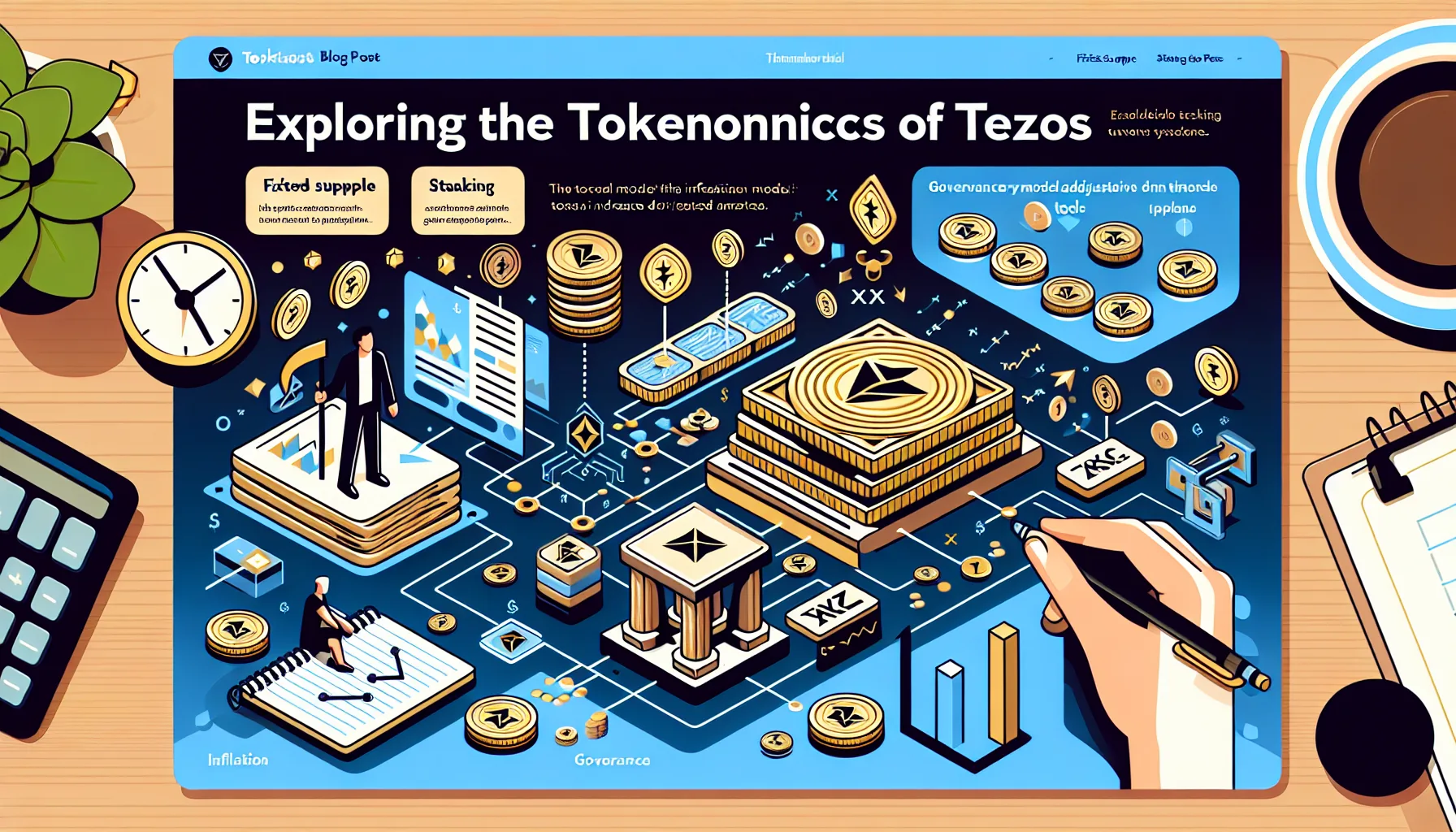
Exploring the Tokenomics of Tezos (XTZ)
Tezos (XTZ), the native token of the Tezos blockchain, operates on a unique economic model designed to balance long-term sustainability, network security, and decentralization. Understanding the specifics of its tokenomics requires examining its supply, staking mechanics, inflation model, and governance-driven adjustments.
Fixed Supply Principles, But Not Hard-Capped
Unlike Bitcoin’s hard-capped supply model, Tezos employs an inflationary approach where the total supply of XTZ increases over time. This inflation incentivizes network participants like bakers (validators) and delegators who play a crucial role in maintaining the network’s security and consensus. While the lack of a maximum supply cap can ensure continuous rewards for contributors, it poses potential concerns around dilution for passive holders. This dynamic aligns more closely with a "utility asset" philosophy rather than a "store of value" narrative, which may deter certain investors accustomed to deflationary models.
Staking-Based Consensus and Reward Mechanisms
Tezos uses a Liquid Proof-of-Stake (LPoS) mechanism, where staking governs consensus. Holders of XTZ can delegate their tokens to validators—or "bakers"—without transferring custody, making it a non-custodial process. This mitigates the risk of asset mismanagement by third parties. However, participation has some technical barriers; bakers are required to put up large amounts of XTZ as collateral (often referred to as a "roll"), locking out smaller players who may lack sufficient resources. This can lead to centralization risks, as a few large bakers—often institutional entities—control a significant portion of the network.
Inflationary Model and Network Security
The annual inflation rate of Tezos is not fixed and is directly influenced by the volume of staking activity on the network. Higher staking participation correlates with higher inflation since more tokens are issued as staking rewards. While this incentivizes active staking, it dilutes non-staked holdings. This inflationary design aims to sustainably fund network security, but critics argue that it pressures participants to stake their XTZ or face erosion in their relative share of the network’s value.
Governance-Driven Adjustments to Economic Parameters
XTZ’s tokenomics are deeply intertwined with Tezos’ on-chain governance model. This self-amendment process allows stakeholders to propose and vote on changes to economic parameters, including reward structure, baking requirements, and inflation rates. While this flexibility fosters adaptability, it can also introduce unpredictability for long-term holders, as changes in tokenomics could alter reward mechanisms or inflationary dynamics without external consensus mechanisms.
Tezos’ economic design strikes a deliberate balance between rewarding active participation and sustaining decentralized governance, but its inflationary policies and centralization concerns in staking remain topics of ongoing debate within the crypto community.
XTZ Governance
Governance in Tezos (XTZ): A Deep Dive into On-Chain Mechanisms
Tezos (XTZ) is often recognized for its self-amending on-chain governance system, a distinct feature that prioritizes protocol adaptability and decentralization. This innovative governance framework enables stakeholders to propose and vote on protocol upgrades without the need for contentious forks, a mechanism designed to sustain the long-term evolution of the network. However, while Tezos’ governance model brings remarkable advantages, it is not devoid of complexities and challenges.
Stakeholder-Driven Proposal Systems
The Tezos governance process is initiated through proposal submissions. Any stakeholder with sufficient XTZ can submit a proposal for changes to the protocol, which might include upgrades to the consensus mechanism, modifications to transaction fees, or other protocol-level improvements. With the design strongly emphasizing decentralization, community participation is critical to approval and implementation. However, this broad participation can also make reaching consensus slow, as aligning diverse stakeholder interests becomes increasingly complex over time.
Adaptive Quorum Biasing
One distinguishing feature of Tezos governance is its use of adaptive quorum biasing. Instead of a static participation threshold, Tezos modifies quorum requirements based on historical voter participation metrics. While this incentivizes engagement and ensures proposals are less likely to stagnate due to apathetic voting, it also introduces a vulnerability: highly organized minority groups could exert disproportionate influence if broader community participation declines. This issue has raised questions about how to ensure fair representation in the decision-making process.
Governance as Code Upgrades
Unlike traditional blockchains, Tezos streamlines code deployment directly through its governance process. When a proposal is approved, it is bundled into automatic upgrades, eliminating the risk of contentious hard forks. While technically elegant, this aspect has led to debates over whether fast-paced upgrades might outpace thorough code review and security auditing. Any governance mechanism that integrates code changes directly into a blockchain inevitably carries risks of introducing vulnerabilities into the protocol.
Centralization Risks in Delegated Governance
Tezos employs a Liquid Proof-of-Stake (LPoS) consensus, allowing token holders to either vote directly on proposals or delegate their voting rights to “bakers.” While this system encourages participation from stakeholders who might not otherwise engage, it can also exacerbate centralization risks. A significant proportion of token holders delegating to a small group of dominant bakers undermines the decentralized nature of governance. Addressing how to sustain diverse representation within this system remains a persistent challenge for the network.
Balancing Innovation and Governance Stability
Tezos' self-amending design ensures constant evolution, but the fine line between innovation and governance stability is hard to balance. Over time, stakeholders have expressed concerns about governance fatigue, where constant voting rounds could discourage long-term participation or lead to rushed decision-making. Additionally, proposals with unclear or overly complex implications may overwhelm voters, reducing the overall efficacy of the governance process.
Technical future of XTZ
Current and Future Technical Developments and Technical Roadmap of XTZ
On-Chain Governance and Protocol Enhancements
Tezos (XTZ) operates using a self-amending blockchain model, which enables continual protocol upgrades without requiring hard forks. This eliminates network splits while fostering protocol growth through on-chain governance. Recent on-chain activity has focused on refining the voting system to ensure more robust community participation and consensus.
However, while the design is innovative, it has faced issues with voter apathy, particularly from smaller XTZ holders. The concentration of voting power among whales and large validators has created concerns about decentralization and inclusivity. Addressing this imbalance remains a key focus for future governance improvements.
Layer-2 Scaling and Rollups
As part of its technical roadmap, Tezos developers are integrating Layer-2 scaling solutions, primarily optimistic rollups and zk-rollups. These efforts aim to address scalability and lower transaction costs for decentralized applications running on the network. Rollups are expected to play a significant role in reducing block size pressure and increasing throughput, a necessary step to maintain competitiveness against other Layer-1 blockchains.
Challenges persist, particularly in implementing zk-rollups, which require considerable computational complexity and careful attention to security. Despite progress, these technologies remain under active development, and their rollout timelines could stretch due to their technical intricacies.
Smart Contract Language Advancements
Tezos employs Michelson, a low-level stack-based language, and higher-level languages like SmartPy and LIGO for smart contract development. While praised for its formal verification capabilities, the learning curve associated with these languages presents barriers for mainstream adoption by developers.
Current technical efforts include enhancing development tooling, improving debugging processes, and simplifying onboarding for programming languages like SmartPy. However, existing gaps in developer documentation and ecosystem tools are being addressed slower than some community members would like.
Focus on Privacy Features
Tezos has expressed interest in integrating zero-knowledge proofs (ZKPs) to enable private transactions and privacy-centric dApps. The addition of privacy layers could broaden the platform’s use cases, but skepticism exists surrounding regulatory scrutiny that privacy features might attract. This has led to measured progress in adopting privacy solutions.
Future Roadmap Goals
The Tezos roadmap includes long-term aims of improving throughput scalability and upgrading consensus mechanisms, with a focus on faster block finality. However, technical critics have pointed out that frequent updates can burden third-party developers who struggle to keep pace with these changes. This dynamic creates friction for the ecosystem and poses a challenge to network-wide adoption.
Comparing XTZ to it’s rivals
Comparing XTZ to ADA: A Technical and Functional Perspective
The Tezos (XTZ) ecosystem occupies a unique position in the blockchain space, but its functionality and design inevitably draw comparisons to Cardano (ADA), given their focus on scalability, governance, and sustainability. While both are Layer 1 protocols with an emphasis on smart contracts and decentralized applications, their respective architectures illuminate key differences in design philosophy, execution, and user adoption challenges.
Governance Models: On-Chain Efficiency vs. Academic Rigor
XTZ is often highlighted for its self-amending governance system, an on-chain mechanism that enables network changes without requiring hard forks. This approach allows proposals to be implemented seamlessly after approval, fostering a dynamic environment for continuous improvement. ADA, on the other hand, employs a more structured governance model centered around its treasury system and the use of Catalyst, a funding mechanism for community projects. Critics of Tezos argue that its governance system, while efficient, can sometimes result in rapid updates without fully assessing long-term implications, which could introduce technical debt. In contrast, Cardano’s methodical, peer-reviewed system prioritizes rigorous analysis before upgrades but might sacrifice agility for caution.
Smart Contract Languages: Michelson vs. Plutus
Tezos’ reliance on its native smart contract language, Michelson, is a double-edged sword. While Michelson is designed for formal verification—ensuring a higher degree of security and reliability in smart contract execution—it presents a steep learning curve for developers unfamiliar with its functional programming paradigm. By comparison, Cardano’s Plutus leverages Haskell, a popular functional programming language, which arguably provides a more accessible entry point for developers with experience in similar ecosystems. This difference in developer accessibility may contribute to Cardano’s larger builder community relative to Tezos.
Consensus Mechanisms and Scalability
Both XTZ and ADA rely on Proof-of-Stake (PoS) algorithms to achieve consensus, but their implementations vary in meaningful ways. Tezos uses Liquid Proof-of-Stake (LPoS), which is lauded for its flexibility, allowing token holders to delegate their staking rights without relinquishing custody. ADA’s Ouroboros protocol, conversely, emphasizes academic rigor and energy efficiency but has faced criticism over staking centralization risks, with many ADA delegators opting for larger pools. Tezos also faces questions about validator distribution, but its lower barrier to entry for bakers (validators) can foster a more decentralized landscape if managed effectively.
Challenges in Adoption and Ecosystem Growth
Tezos has historically struggled with ecosystem adoption and a slower rate of decentralized application (dApp) development, despite its technical strengths. Cardano, while also criticized for delayed implementations, has gained a more prominent mainstream profile, partially helped by its strong community engagement and marketing. As a result, while Tezos may see its governance and efficiency as competitive advantages, it continues to face headwinds in capturing developer mindshare at the same scale as ADA.
Comparing XTZ to DOT: A Delve Into Key Differences
When analyzing Tezos (XTZ) alongside Polkadot (DOT), the contrast is grounded in their underlying protocols, consensus mechanisms, and approaches to scalability and governance. While both aim to solve blockchain bottlenecks, their methodologies highlight stark differences that cater to distinct user bases and developer communities.
Governance and Upgradability
One of the most striking comparisons lies in governance. XTZ leverages its on-chain governance system to enable seamless, self-amending upgrades. This approach minimizes hard forks, streamlining protocol evolution. DOT, however, adopts a more complex governance system. Polkadot utilizes a council and referenda model, requiring token holders to vote on proposed changes. The latter can sometimes introduce delays due to the need for wide network consensus before implementing updates. While Tezos prioritizes efficiency and simplicity, Polkadot’s model offers a higher level of decentralization at the expense of speed.
Scalability Models: Delving into Architecture
Polkadot’s defining feature is its relay chain and parachain architecture, which facilitates interoperability and parallel processing. This design allows connected blockchains to specialize and share security, a significant step toward scalability in the multichain future. In contrast, Tezos does not inherently support interconnected parallel chains, relying instead on layer-2 scaling solutions. For workloads requiring vast throughput or tailored blockchain designs, Polkadot holds a functional edge over XTZ’s more traditional blockchain architecture. However, the complexity of managing parachains has occasionally led to delayed rollouts of robust solutions.
Staking and Rewards
Both XTZ and DOT rely on Proof-of-Stake (PoS), but the reward dynamics and accessibility differ. Tezos utilizes its “Liquid Proof-of-Stake (LPoS),” allowing token holders to delegate their tokens while still retaining custody. This flexibility enhances accessibility for smaller stakeholders. Polkadot, by comparison, operates a more exclusive model where only a limited number of validator slots and minimum staking thresholds can limit participation for smaller investors. While Tezos positions itself as a more democratized network in this regard, Polkadot’s design is structured toward network stability and security assurances.
Smart Contracts and Developer Ecosystem
XTZ uses its Michelson programming language, prioritizing formal verification to maintain security. However, this language has faced criticism for its steep learning curve, potentially limiting developer adoption. DOT’s platform allows developers to work with frameworks like Substrate, which supports adaptability and a wider range of programming options. This flexibility has given Polkadot a notable edge in attracting diverse developer communities.
Network Complexity
A potential disadvantage for Polkadot is its architectural complexity. Parachain projects require auction mechanisms, which can lead to resource allocation challenges for smaller developers. Tezos, with its single main blockchain, may offer a simpler on-ramp for those looking to quickly deploy decentralized applications without navigating the nuances of parachain requirements. However, this simplicity comes at the cost of reduced scalability in comparison.
In the head-to-head comparison between XTZ and DOT, their architectural trade-offs and approaches to community engagement leave them firmly positioned as distinct options for users and developers alike. While one emphasizes streamlined governance and accessibility, the other opts for high modularity and scalability at the cost of complexity.
Comparing XTZ and SOL: A Technical and Ecosystem Analysis
When evaluating XTZ against Solana (SOL), the two projects offer distinct approaches to blockchain technology, particularly in areas like consensus mechanisms, scalability, and ecosystem growth strategies. While both are designed to support smart contracts and decentralized applications (dApps), their differences highlight diverse priorities and tradeoffs often debated within the crypto community.
Consensus Mechanisms and Decentralization
Solana operates on a unique combination of Proof of Stake (PoS) and its proprietary Proof of History (PoH) mechanism, designed to provide high throughput and low-latency transactions. This gives it a clear advantage in raw transactional speed, often boasting thousands of transactions per second. However, critics argue that the complexity of Solana’s architecture comes at the expense of decentralization. Its validator requirements are hardware-intensive and expensive, raising concerns that a relatively small set of validators is dominating the network. This creates potential centralization risks that could conflict with the ideals of distributed ledger systems.
In contrast, XTZ employs a more inclusive Liquid Proof of Stake (LPoS) model, designed to balance efficiency, security, and decentralization. The lower hardware requirements for baking (Tezos’ term for validating) make it more accessible for a broad range of participants, encouraging a larger and more distributed validator network. That said, this tradeoff in throughput does mean Tezos cannot compete with Solana’s transaction speeds, which may be a drawback for dApps with high-frequency transaction requirements.
Network Stability and Downtime
One area where Solana has faced ongoing scrutiny is network stability. Solana’s high-throughput design has led to several high-profile outages and performance bottlenecks, often attributed to both bugs and attacks exploiting its architecture. These events have sparked debate about whether its speed-centric model sacrifices resilience under strain.
Tezos, by contrast, has maintained a strong reputation for network uptime, often attributed to its more conservative and time-tested architectural choices. While this prioritizes reliability, it might reinforce its slower pace of innovation when measured against some of Solana’s cutting-edge features.
Smart Contract Development and Governance
For developers, Solana offers a performance-optimized environment built primarily around Rust, a language praised for its efficiency but regarded as complex for those new to blockchain development. This could limit accessibility for developers unfamiliar with the language or the network’s novel architecture.
Tezos offers Michelson, a stack-based language that prioritizes formal verification, making it ideal for applications requiring high security, such as financial derivatives or identity solutions. However, Tezos has sometimes been criticized for its steeper learning curve and a relatively smaller pool of developer tools compared to Solana, which fosters rapid prototyping.
Ecosystem Growth and Adoption Challenges
The Solana ecosystem has shown explosive growth in terms of partnerships, DeFi protocols, and NFT platforms, largely driven by its ability to handle large-scale applications with minimal transaction costs. However, this rapid adoption has also exposed the fragility of its infrastructure and raised concerns about sustainability under stress.
Tezos’ ecosystem growth has been more measured and deliberate, with an emphasis on governance-driven upgrades and high-profile art-focused NFT platforms. While this steady growth approach aligns with its emphasis on reliability, it has struggled to gain the same level of mainstream developer attention and adoption as Solana.
In summary, the XTZ versus SOL comparison illuminates a tradeoff between scalability and decentralization, with each making distinct choices about how to solve blockchain’s trilemma. These choices impact their performance, development appeal, and community adoption, creating competing visions for the future of Web3 infrastructure.
Primary criticisms of XTZ
Primary Criticism of XTZ: Exploring the Challenges Facing Tezos
Governance Centralization Concerns
One of the most significant criticisms aimed at Tezos (XTZ) surrounds its on-chain governance model, which, while innovative, has consistently raised concerns about centralization. The blockchain employs a delegated proof-of-stake (DPoS) consensus mechanism, allowing token holders to "bake" or delegate their voting power to validators. However, the distribution of staking power is often concentrated among a small number of bakers, leading to fears that decision-making power remains in the hands of a few. This dynamic inherently risks undermining the decentralized ethos that the blockchain space strives to uphold. Critics argue that those with greater token holdings or influential positions could disproportionately sway network upgrades and proposals, making the system effectively semi-centralized.
Complex Governance Process
Although the Tezos protocol prides itself on its self-amending feature, skeptics point out that the multi-phase governance process can be overly intricate and time-consuming. The process consists of proposal, exploration, testing, promotion, and adoption phases, each requiring strict community participation and approval thresholds. While designed to encourage robust vetting of protocol upgrades, this complexity often impedes the ability to execute changes swiftly, especially when critical updates are necessary. As a result, Tezos is sometimes criticized for lagging behind competitors that employ faster, simpler mechanisms for improving their ecosystems.
Limited Defi and Ecosystem Development
While Tezos has positioned itself as a blockchain platform aiming for advanced smart contract functionality and sustainability, its ecosystem growth has been comparatively slower than other blockchains. The criticisms often highlight that Tezos lacks the breadth and depth of decentralized finance (DeFi) applications seen in Ethereum or the robust developer activity found in newer layer-1 protocols. This slower adoption of Tezos-hosted dApps can make it less attractive to developers and users, leading detractors to label it as stagnating or underperforming in terms of ecosystem competitiveness.
Resource-Intensive Baking
Despite being a layer-1 protocol that leverages DPoS, Tezos still faces criticism regarding the resource-intensive nature of baking, which mirrors some of the same criticisms aimed at traditional proof-of-work systems. Participating as a baker requires significant upfront staking (an amount that can deter smaller holders), specialized hardware, and technical know-how. Critics point out that these barriers to entry may contribute to the centralization of validator nodes, reducing network inclusivity and resilience.
Past Legal and Organizational Challenges
Tezos has not been exempt from controversy in its organizational history. Issues including high-profile lawsuits and disputes between its early founding teams have often been cited by critics as reasons for skepticism about its governance structure, operational transparency, and long-term viability. Although these legal disputes may not directly impact the protocol's technical functioning, they have undeniably influenced its public perception, contributing to hesitancy among potential investors and collaborators.
Upgradability Bottlenecks
While self-amendment is a core feature of Tezos, critics argue that its practical implementation involves inherent inefficiencies. For example, the pace at which new features or enhancements can be added to the network is inversely tied to how frequently the governance cycle operates. This rigid structure may inadvertently slow innovation, leading detractors to claim that Tezos risks being outpaced in a rapidly evolving industry demanding adaptability and responsiveness.
Founders
The Founding Team Behind Tezos (XTZ)
The brainchild of Arthur and Kathleen Breitman, Tezos (XTZ) was envisioned as a blockchain platform offering self-amending capabilities through an on-chain governance model. The couple founded Dynamic Ledger Solutions (DLS) in 2014 to oversee the development of Tezos. While their partnership gave the project a strong foundation, it also sparked controversy, creating a mixed legacy that continues to shape perceptions of the Tezos ecosystem.
Arthur Breitman, who had prior experience at Morgan Stanley and Google X, is widely regarded as a highly technical mind in the blockchain space. Under the pseudonym "L.M. Goodman," Arthur published the Tezos whitepaper in 2014, outlining the protocol’s unique approach to governance, self-upgradability, and decentralized decision-making. His concept of avoiding hard forks by enabling protocol upgrades without splitting the chain was considered innovative. However, some critics have pointed out that Arthur’s technical focus occasionally comes at the expense of community-building and adoption priorities.
Kathleen Breitman brought significant project management and strategy experience to the table, leveraging her background at R3 and Bridgewater Associates. As co-founder of Tezos, Kathleen played an important role in shaping the ecosystem and navigating early challenges related to public relations and funding. However, her direct and assertive communication style has sometimes been divisive within crypto circles, especially during the project's more turbulent moments.
Despite its compelling vision and leadership credentials, issues surrounding the Tezos Foundation during its early days marred the credibility of the founding team. Tensions arose between the Breitmans and the Tezos Foundation's initial president, Johann Gevers, in 2017. This public dispute over control of the $232 million initial coin offering (ICO) funds delayed the network's launch and raised governance concerns about Tezos as a whole. Many viewed the fallout as a failure in transparency and coordination, leaving a lingering skepticism toward the team’s ability to navigate complex organizational challenges.
Although the Breitmans emphasized decentralization from the outset, their prominent influence over the project has led some critics to question whether the governance mechanism is truly community-led or overly reliant on the founding vision. The couple has since distanced themselves from the network’s daily operations, transitioning power to the broader Tezos community and development contributors. However, the imprint of their leadership—both its strengths and weaknesses—remains deeply woven into the fabric of the Tezos story.
Authors comments
This document was made by www.BestDapps.com
Sources
- https://tezos.com/
- https://tezos.foundation/whitepaper
- https://tezos.gitlab.io/protocols.html
- https://medium.com/tezos
- https://github.com/tezos/tezos
- https://metrics.tezos.foundation/
- https://baking-bad.org/
- https://tzkt.io/
- https://tezos.stackexchange.com/
- https://opentezos.com/
- https://forum.tezosagora.org/
- https://medium.com/@tezoscommons
- https://tzstats.com/
- https://www.tezos-nodes.com/
- https://assets.tqtezos.com/docs/whitepaper_revision1.pdf
- https://tezos.protokol.com/
- https://tezos.gitlab.io/shell/
- https://www.nomadic-labs.com/
- https://doc.tzalpha.net/
- https://tezos.com/get-started/developers/


