History of XNO
The History of Nano (XNO)
Nano, now represented by the ticker symbol XNO, emerged in 2015 under the original name RaiBlocks (XRB). Its creator, Colin LeMahieu, sought to address the inefficiencies inherent in Bitcoin and other first-generation cryptocurrencies, primarily focused on scalability, low transaction fees, and environmental sustainability. From its inception, the goal was to create a lightweight payment network capable of delivering instant transactions while minimizing energy consumption—an ambition that set Nano apart from Bitcoin's energy-intensive proof-of-work model.
One of Nano's most distinguishing design features is its block-lattice architecture. Unlike conventional blockchain systems, Nano’s protocol allows each user to maintain their own blockchain—referred to as an “account-chain.” This innovation came to life in late 2015, when the project was launched via a faucet distribution model. During this period, XRB tokens could be acquired by solving captchas, which was done not only to encourage decentralized token distribution but also to create broader engagement. While this method was lauded as a novel alternative to ICOs, it also drew criticism for logistical flaws, such as the high susceptibility to automation abuse by bot-driven accounts.
The rebranding from RaiBlocks to Nano occurred in January 2018 following community feedback. The new name was chosen to better reflect the project’s lightweight, efficient narrative. During this period, Nano garnered significant attention for its emphasis on speed and scalability, with transaction confirmation times typically measured in fractions of a second. However, the network’s early days were not without issues. Critics pointed to challenges related to spam attacks exploiting the feeless model, where users could flood the network without direct cost. Though periodic upgrades like the implementation of PoW transactional requirements helped mitigate such vulnerabilities, these events highlighted the trade-offs associated with removing economic friction.
Nano’s development trajectory also faced friction outside of technical parameters, particularly when the platform became embroiled in legal and governance disputes. One such controversy involved the now-defunct BitGrail exchange, where the theft of 17 million XRB tokens sparked intense debates about the role of developers in exchange security. Although the Nano Foundation (formed in late 2017) worked to protect the integrity of the project during these crises, it reinforced a persistent criticism of relatively centralized governance within the ecosystem.
Through its evolution, Nano has remained a polarizing asset. Its focus on decentralization and speed is respected by many in the crypto community, but its history of controversies and architectural challenges has tempered wider adoption, leaving it to occupy a niche yet vocal space in the broader cryptocurrency landscape.
How XNO Works
How XNO Works: Understanding the Nano Protocol
At its core, XNO (Nano) operates on a fundamentally distinct approach to blockchain architecture, leveraging a block-lattice structure instead of the traditional single-chain system. This unique design decentralizes transaction management by assigning each account its own blockchain, referred to as an "account-chain." Here’s a breakdown of its inner workings:
Block-Lattice Framework
Unlike conventional blockchains that bundle multiple transactions into blocks, the block-lattice structure enables every transaction in XNO to occupy its own block. Furthermore, these blocks are signed by the account holder and occur asynchronously. This reduces overhead since there’s no need for mining or intensive computational effort to confirm large transaction batches.
Each account-chain records only the transactions relevant to that particular address. When a user sends or receives XNO, two distinct blocks are created:
1. Send Block: Deducts XNO from the sender’s account balance.
2. Receive Block: Credits the equivalent amount to the recipient's account.
This division separates transaction confirmation from immediate execution, aiding in scalability and efficiency.
Consensus via Open Representative Voting (ORV)
XNO employs Open Representative Voting (ORV), a delegated Proof-of-Stake (dPoS) consensus mechanism. In this system:
- XNO holders can select representatives, assigning their voting weight without transferring ownership of their funds.
- These representatives validate and confirm network transactions.
This method enhances network security while avoiding the high energy consumption typical of Proof-of-Work (PoW) models. However, ORV does bring potential concerns around centralization risk, as representatives with significant voting power may exert disproportionate influence on transaction validation.
Fee-Less Transactions
A key aspect of XNO is its claim of zero transaction fees. Rather than requiring users to pay fees for transaction validation, the protocol relies on computational efficiency and its lightweight architecture. While this is advantageous for microtransactions and general usage, it comes with scalability challenges related to spam prevention. Without transaction fees as a deterrent, the network faces potential vulnerabilities in handling high volumes of trivial or malicious activity.
Instant Finality and Lean Resource Usage
Transactions on the XNO network settle within seconds thanks to the asynchronous nature of the block-lattice. Additionally, the absence of mining minimizes energy usage. While this aligns well with the vision of a sustainable blockchain, the system’s reliance on representative nodes may reduce its overall redundancy, potentially impacting decentralized governance.
In summary, Nano’s unique implementation marks a divergence from standard blockchain systems, but its trade-offs, particularly concerning decentralization and potential vector points for misuse, should be carefully weighed.
Use Cases
XNO Use Cases: Powering Micropayments and Beyond
XNO, the native cryptocurrency of the Nano protocol, is specifically designed to address challenges within payments and financial transactions. Its unique approach, leveraging a block-lattice architecture, comes with distinct advantages and limitations when applied to real-world use cases.
Micropayments and Instant Transactions
XNO excels in micropayments due to its zero-fee structure, allowing users to send even the smallest amounts without being burdened by transaction costs. This makes it particularly suited for industries like content monetization, tipping, gaming, and pay-per-use services. For example, XNO can facilitate fractional payments for digital services, such as paying per article read on a platform or tipping creators directly without intermediaries. Unlike most traditional payment systems, which are impractical for such uses due to high processing fees, XNO provides a viable alternative for microtransactions at scale.
The instant nature of XNO transactions further enhances its usability in scenarios requiring real-time payment settlement. Whether it's peer-to-peer payments or even point-of-sale transactions in physical stores, XNO’s near-instant finality empowers seamless payments without the delays typically experienced with traditional financial systems or even many blockchain networks.
Remittances and Cross-Border Payments
XNO's fee-less model and high-speed transaction capability position it as an efficient alternative for cross-border transactions. By eliminating intermediaries that often charge expensive fees for remittances, XNO allows individuals to transfer value across borders in a frictionless manner. However, it is important to note that adoption remains a bottleneck. Lack of liquidity and limited integration with banking systems in many regions could pose practical challenges when converting XNO to fiat currencies for end users.
Machine-to-Machine (M2M) Payments
Another potential use case for XNO is its application in enabling economic interactions between Internet of Things (IoT) devices. The absence of fees makes it theoretically possible for devices to conduct microtransactions autonomously, such as smart meters paying for electricity based on real-time consumption. Nevertheless, this futuristic use case is heavily dependent on infrastructure and market adoption, both of which remain underdeveloped for XNO-powered M2M payments.
Limitations in Scalability and Access
While theoretically capable of infinite scalability due to its unique architecture, XNO is not entirely free of practical barriers. The network relies on representatives to confirm transactions, which could concentrate power in scenarios where the distribution of representative nodes is limited. Furthermore, its overall use-case viability is tied to wallet integration, merchant adoption, and accessibility for non-technical users. Without significant improvements in these areas, even its fee-less structure cannot guarantee widespread adoption.
In conclusion, XNO demonstrates clear strengths in fee-less and instant payments but is impeded by ongoing challenges, including limited integration and network centralization risks. Its niche applications remain promising, though widespread adoption will depend on broader ecosystem development.
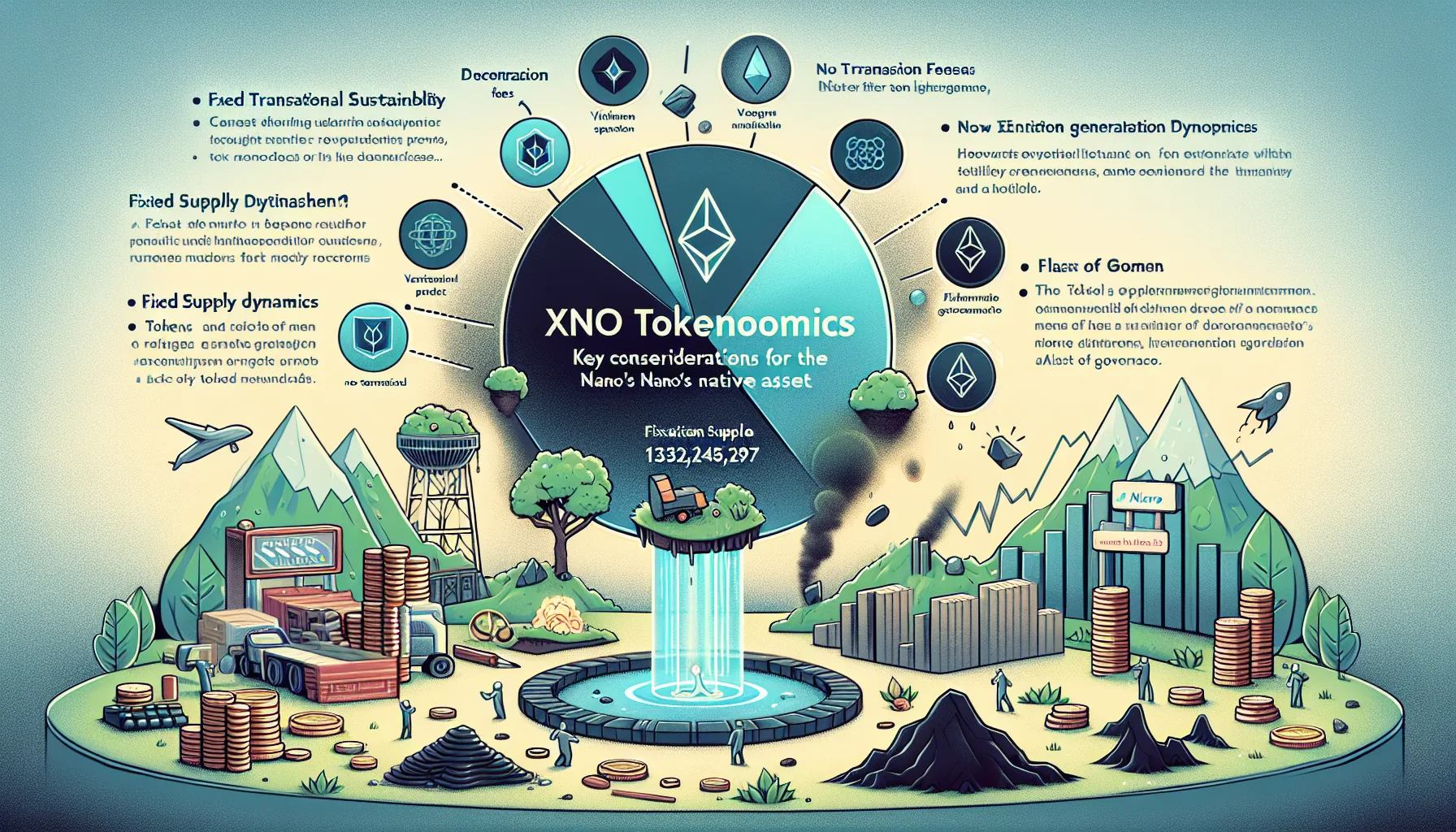
XNO Tokenomics
XNO Tokenomics: Key Considerations for Nano's Native Asset
XNO, the native crypto asset of the Nano protocol, is built to support a distinct set of tokenomics, prioritizing decentralization, low environmental impact, and fee-less transactions. Unlike many cryptocurrencies with inflationary or deflationary mechanics, XNO has a fixed supply, introducing unique dynamics to its economic model that are critical for prospective users and developers to consider.
Fixed Supply Dynamics
XNO operates with a fixed maximum supply of 133,248,297 tokens, a design choice rooted in disinflationary principles. This finite supply ensures that XNO holders are not subject to ongoing inflation risks but introduces certain limitations. The absence of block rewards or staking incentives means validators rely entirely on intrinsic network motivations and altruism to maintain the network. While this aligns with Nano’s fee-less ethos, it creates economic pressures for network participants to balance their operational costs versus the lack of direct financial incentive.
No Gas Fees or Revenue Redistribution
One of XNO’s pivotal tokenomic features is its lack of fees. Since there are no gas fees or transaction fees, the asset does not generate any revenue streams for validators. While this strengthens Nano’s use case for fast, microtransaction-heavy scenarios, it poses challenges for long-term network sustainability. Validators may struggle to justify their participation without alternative compensation mechanisms. Unlike ecosystems that redistribute transaction fees among token holders, XNO relies purely on the immutability of its fixed supply for value retention, sidestepping inflationary pressures but limiting any optional yield-generation mechanisms.
Governance Absence and Its Tokenomic Impact
Unlike many protocols, XNO does not incorporate token-based governance. This absence fosters decentralization but also prevents token holders from directly influencing the network’s development priorities or modification of its protocol rules. While this design choice avoids governance takeover fears and token manipulation schemes, the lack of stakeholder incentivization could discourage active engagement from larger institutional or retail users seeking influence over the ecosystem’s direction.
Burn Mechanisms: A Non-Factor
Unlike some blockchain ecosystems that implement burn mechanisms to create deflationary dynamics, XNO’s tokenomics strategy excludes token burns entirely. This ensures the supply remains stable but limits opportunities to directly enhance scarcity over time. Some participants may view this as a missed opportunity for creating additional long-term value through strategic supply reductions.
Challenges exist in the XNO tokenomics model, particularly regarding validator incentives and the absence of revenue generation streams. However, its focus on sustainability and simplicity prioritizes utility over speculative or inflationary mechanics.
XNO Governance
Governance in XNO: Decentralized Oversight and Challenges
XNO (Nano) operates without centralized governance, relying instead on a decentralized network of node operators and stakeholders to maintain protocol integrity. This model reflects Nano's broader ethos of minimalism and efficiency but introduces unique governance complexities that crypto-savvy stakeholders will recognize as both innovative and potentially fragile.
No Formal Governance Structure
Unlike many blockchain projects that have formalized governance systems through on-chain voting or governance tokens, XNO intentionally forgoes these mechanisms. Governance decisions emerge informally through community discussion, developer proposals, and consensus among node operators. While this approach reduces centralization risks and avoids conflicts tied to token-based voting power, it can also lead to ambiguity in decision-making processes. This lack of structure requires high levels of community alignment and can, in some cases, slow the resolution of contentious issues.
Developer Influence and Code Upgrades
Despite its decentralized framework, the Nano Foundation and core developers hold significant sway in XNO governance, particularly around protocol upgrades and key decisions. Though the community ultimately decides whether to adopt a new version of the protocol by running updated nodes, critics argue that developer influence creates a quasi-centralized bottleneck. To date, the Nano Foundation has been instrumental in technical development, but this reliance raises concerns about resilience in the event of shifting developer priorities or team attrition.
Voter Weight and Representative Nodes
XNO uses a Delegated Proof-of-Stake (DPoS) consensus mechanism, with voting power determined by the amount of XNO delegated to representative nodes. This system ensures lightweight, efficient transactions but has governance implications. Large token holders can wield disproportionate influence by consolidating votes with representatives they control or align with, creating centralization risks. While steps have been taken to encourage delegation to independent and well-distributed representatives, this issue remains a critical area of discussion within the XNO ecosystem.
Absence of Financial Incentives
Another governance consideration stems from XNO's fee-less design. Since there are no transaction fees, node operators do not receive financial rewards for validating transactions. This raises the possibility of decreased participation over time, especially if the network fails to sustain voluntary node operation on a large scale. The absence of economic incentives requires a culture of altruism or external motivations, both of which can complicate the long-term governance landscape.
Community Conflicts and Scalability
Governance in the XNO ecosystem is highly reliant on open dialogue within the community. While this inclusive approach fosters transparency, it also leaves room for disputes to escalate without formal mediation frameworks. Additionally, as adoption scales, maintaining effective communication and consensus across a larger, more global user base will likely become more challenging, potentially testing the limits of XNO's governance model.
Technical future of XNO
Technical Developments and Roadmap for XNO: Advancing Nano's Infrastructure
The XNO ecosystem, powering the Nano cryptocurrency, is undergoing a series of ongoing technical developments aimed at enhancing its usability, scalability, and decentralization. As a high-performance, fee-less cryptocurrency, Nano's development focuses on refining its unique block-lattice architecture and tackling challenges associated with adoption and network robustness.
Progress in Optimizing Block-Lattice Performance
The block-lattice structure, a cornerstone of XNO’s technology, allows each account to operate its own blockchain. Recent updates in the development of the protocol concentrate on improving the efficiency of the ledger, specifically the bandwidth and resource demand for nodes. Key optimizations, like pruned nodes and faster bootstrapping mechanisms, have been introduced to address the growing size of the ledger without compromising security or decentralization. These pruning solutions aim to reduce the long-term resource requirements for participants managing nodes, an issue that remains critical as networks scale.
Efforts to Enhance Decentralization
Nano’s network is heavily dependent on the distribution of its principal representatives (PRs). Although considerable progress has been made to improve their geographic and institutional decentralization, a recurring issue has been the influence concentrated in a handful of key representatives. Developers are exploring incentive systems and node voting weight redistribution strategies to reduce centralization risks without introducing token inflation or staking mechanisms, which are absent in Nano’s fee-less model.
Integration of Layered Solutions
While XNO has traditionally focused on being a lightweight, fast transfer layer, new developments are exploring compatibility with external systems. These include integrations with hardware wallets, easier interoperability with smart-contract-enabled blockchain ecosystems, and building tools for compliant and seamless fiat on/off-ramping. However, limited developer resources and the minimalistic architecture of Nano pose constraints that still require addressing for broader adoption across payment solutions.
Future Technical Roadmap
Looking ahead, the XNO roadmap places emphasis on long-term decentralization, further modularizing the software stack, and reinforcing its underlying consensus protocol, Open Representative Voting (ORV). Enhancing the security of ORV is a high priority, especially as hypothetical attack vectors such as minority voter attacks or sybil attack scenarios are assessed. Another key consideration is the development of flexible incentivization mechanisms for nodes in the absence of traditional mining rewards, an area developers continue to experiment with cautiously.
Ongoing Challenges in Ecosystem Growth and Scalability
XNO development faces challenges in achieving ecosystem-wide adoption due to its non-programmable nature, which limits its direct applications to transaction-only use cases. Despite this financial network simplicity, strategic technical improvements are being prioritized to balance usability with minimalism. Continued progress in stakeholder participation and refinement of its novel technology will be critical in ensuring its sustainability as an efficient digital currency.
Comparing XNO to it’s rivals
Comparing XNO to XRP: A Deep Dive into Key Differences
When analyzing XNO (Nano) against XRP (Ripple), it's clear that while both focus on improving transaction efficiency in the digital asset space, they are fundamentally different in their design philosophies and use cases. For crypto-savvy users, understanding these nuances is essential when evaluating each asset’s utility within their respective ecosystems.
Consensus Mechanism
A major differentiator between XNO and XRP lies in their consensus mechanisms. XNO relies on a unique block-lattice structure backed by Open Representative Voting (ORV). This system decentralizes voting power across representative nodes, allowing for fee-less transactions and near-instant finality. By contrast, XRP utilizes the Ripple Protocol Consensus Algorithm (RPCA), which depends on a network of selected validators under Ripple Labs’ guidance. While RPCA delivers fast transaction speeds, it has drawn criticism for concerns over centralization due to Ripple Lab's influence over the validator ecosystem.
Transaction Costs
One of the most prominent distinctions is transaction fees. XNO offers truly fee-less transactions. This is made possible by its block-lattice architecture, where computational costs are minimized and shouldered by the participants themselves. On the other hand, XRP introduces a minimal transaction fee in the form of a burning mechanism, where a fraction of XRP is permanently destroyed with every transaction. Although XRP's fees are negligible compared to traditional payment systems, the ongoing fee structure could introduce scalability questions as network demand increases.
Target Use Cases
XNO positions itself as a lightweight, fee-less solution for instantaneous peer-to-peer payments. Its focus is razor-sharp: facilitating fast transactions without relying on intermediaries. XRP, however, was designed with a broader goal in mind: bridging fiat currencies and enabling cross-border payments for banks and financial institutions. This distinction means XRP leans on institutional adoption as a driving force, while XNO appeals more to individual users seeking an alternative to mainstream payment mechanisms.
Decentralization and Criticisms
Decentralization is another contentious topic. XNO emphasizes a distributed and community-driven system, where representatives are selected by token holders, creating a governance model aimed at mitigating control by any one entity. In contrast, XRP's perceived centralization, stemming from the significant XRP holdings controlled by Ripple Labs, continues to be a controversial topic within the crypto community. Critics argue that this undermines XRP's trustless nature, a value deeply ingrained in blockchain ideals.
Scalability and Network Design
XNO’s block-lattice excels in scalability, as each user maintains their own blockchain, reducing contention within the network. This design allows the network to scale naturally with user growth. XRP's ledger, on the other hand, operates as a more traditional blockchain, where all transactions compete for inclusion in a single chain. While XRP has demonstrated the ability to handle high throughput, potential bottlenecks and dependency on validators could pose limitations under extreme network stress.
Comparing XNO to ALGO: Key Differences in Crypto Utility and Network Design
When comparing XNO (Nano) to ALGO (Algorand), the focus narrows on their intended applications, consensus mechanisms, and scalability strategies. While both projects aim to improve blockchain technology, they approach these ambitions with differing perspectives, resulting in distinct strengths and weaknesses.
Consensus Mechanism: PoW-Free but Divergent Paths
XNO adopts the Open Representative Voting (ORV) consensus mechanism—which builds on Directed Acyclic Graph (DAG) technology—to achieve feeless, swift transactions. Unlike ALGO’s Pure Proof-of-Stake (PPoS), which randomly selects validators proportional to their staked ALGO balances for securing the network, ORV emphasizes decentralization by allowing account holders to select representatives. ALGO’s staking protocol does provide a degree of fairness and inclusivity, catering to users with varying levels of token holdings. However, critics argue that PPoS sacrifices decentralization in favor of performance, potentially concentrating influence among large token holders. This tradeoff contrasts with XNO’s focus on decentralization, albeit at the cost of more complex implementation for representative selection.
Scalability: Different Interpretations of Performance
XNO’s DAG structure facilitates horizontal scalability and seamless transaction throughput due to its block-lattice design, allowing each user account to operate as its own blockchain. This architecture is inherently lightweight but does face challenges in terms of maintaining consensus at scale, particularly under high network activity that could stress bandwidth requirements.
ALGO, on the other hand, tackles scalability with its emphasis on rapid block finality and low-latency transaction validation, thanks to PPoS. Its layered approach to smart contracts and sharding compatibility supports broader adaptability for enterprise-grade solutions. That said, ALGO’s scalability can come at the expense of infrastructure complexity and potentially higher hardware requirements for validator nodes, creating barriers to entry for new participants.
Transaction Costs: Feeless vs. Low-Fee
A hallmark of XNO is its feeless transaction structure, an aspect it achieves by outsourcing costs like energy and computational resources to the participants. In contrast, ALGO operates with minimal fees, but these fees, though small in magnitude, accumulate with high usage scenarios. For small-scale payments, XNO’s feeless operation may offer a more frictionless user experience; however, the absence of fees also removes financial disincentives for spam transactions, which could introduce challenges for network integrity.
Development Ecosystem: Limited vs. Expansive
ALGO has positioned itself as a blockchain for programmable finance and decentralized applications, offering robust support for smart contracts via its Algorand Virtual Machine (AVM). This encourages a growing developer community and a wide range of use cases, but it also introduces a higher level of technical debt. For XNO, its minimalistic focus on payments lacks comparable programmability, resulting in a narrower range of applications. This approach can alienate developers seeking more versatile platforms, even as it refines XNO’s specialization as a digital cash solution.
These distinct choices in design and use case strategy carve clear differences between XNO and ALGO, each appealing to different user archetypes and adoption scenarios.
Comparing XNO and XLM: Key Differences in Technology and Use Cases
When analyzing the unique characteristics of XNO (Nano) and XLM (Stellar), both projects stand out in the crowded blockchain payments ecosystem, but their design philosophies and technical architectures set them apart. While both aim to facilitate fast, cost-effective transactions, their methods for achieving this differ significantly, influencing their respective use cases and adoption.
Consensus Mechanism and Network Architecture
XLM operates using the Stellar Consensus Protocol (SCP), a federated Byzantine agreement (FBA) model designed for scalability and decentralization while prioritizing trusted validator nodes. In contrast, XNO uses Open Representative Voting (ORV), which relies on delegated voting through validators chosen by Nano holders. While SCP hinges on predefined trust relationships, ORV enables dynamic community-based selection of representatives. This subtle distinction impacts how each network handles decentralization and resilience. Critics argue that XLM’s federated structure creates potential trust bottlenecks, as its utility depends on the performance and choices of trusted validator nodes. Meanwhile, XNO adheres to a more fully distributed ethos, but the delegation model raises concerns about future power consolidation among representatives with significant voting weight.
Transaction Speed, Fees, and Performance Considerations
Both assets prioritize transaction speed, but their approaches differ. XNO's block-lattice architecture fundamentally removes bottlenecks common in traditional blockchains by allowing asynchronous transactions. This enables nearly instantaneous settlement at zero fees—ideal for micropayments. XLM, while also fast, charges a nominal transaction fee (currently 0.00001 XLM) and employs a traditional single-chain architecture. XLM's fee structure, though minimal, serves a dual purpose: preventing spam attacks and financially sustaining the network—a trade-off that XNO bypasses at the potential cost of increased spam vulnerability.
Smart Contract and Asset Ecosystem Limitations
One notable limitation of XNO compared to XLM is its lack of smart contract functionality. XLM supports limited smart contracts and asset issuance, allowing for the creation of tokens and integration with decentralized finance (DeFi) systems. This positions XLM as more versatile for enterprise use cases such as cross-border asset transfers and tokenized securities issuance. XNO, on the other hand, maintains a narrower focus on peer-to-peer payments, eschewing complex programmability for simplicity and efficiency. While this focus minimizes computational demands and boosts transactional throughput, it inherently limits XNO’s adaptability in broader blockchain ecosystems.
Adoption Barriers and Implementation Challenges
XLM benefits from strong institutional partnerships, including with entities like money transfer services, which enhance its visibility in cross-border remittance markets. XNO, with its grassroots adoption model, struggles to achieve similar traction. Additionally, XNO’s lack of liquidity on exchanges and lower institutional interest creates challenges for broader ecosystem development, especially compared to XLM, which regularly positions itself as a viable solution for fintech applications. Conversely, XNO’s fee-free design stands as a significant advantage in developing markets where transaction affordability is critical, even as it faces criticism for requiring users to manage representative nodes actively.
Primary criticisms of XNO
Primary Criticism of XNO: Nano's Struggles with Scalability, Adoption, and Governance
One of the most prominent criticisms surrounding XNO (Nano) lies in its practical scalability, despite its theoretically efficient design. While Nano leverages its block-lattice architecture to enable feeless and near-instant transactions, the network's capacity is bottlenecked by its reliance on consensus through Open Representative Voting (ORV). Critics argue that as user adoption scales, the system’s dependency on representatives risks becoming centralized, especially since larger representatives naturally attract more delegated voting power. This raises concerns about whether Nano can maintain decentralization in a high-demand environment or if it inadvertently sacrifices one of the core tenets of blockchain systems.
Another frequent critique stems from Nano’s niche use case. By positioning itself primarily as a digital currency explicitly for payments, its utility is perceived as limited compared to multifaceted blockchain ecosystems that offer features such as DeFi, smart contracts, and NFT capabilities. Many argue that this narrow focus creates a scalability paradox: widespread payment adoption is required for meaningful demand, yet limited adoption results in fewer nodes and representatives, further centralizing the network. Further, some question whether a single-purpose protocol like Nano can sustain significant usage in an increasingly competitive crypto ecosystem dominated by multi-utility platforms.
The lack of a robust monetization model for node operators further exacerbates scalability concerns. Because Nano's fee structure is non-existent by design, there are no direct incentives for maintaining nodes beyond ideological support for the network. Critics regularly point to this as a weakness, with the argument that long-term sustainability could be impacted as potential operators may find the cost of running nodes outweighs the benefits, particularly if adoption scales and network resource demands increase.
Governance-related critiques also surface regularly. While Nano’s ORV system allows token holders to delegate voting power to representatives, detractors argue this is prone to voter apathy. A significant segment of token holders may neglect to actively participate or carefully vet representatives, which can lead to disproportionate influence being wielded by a small subset of representatives. Additionally, Nano does not have a formal governance treasury or mechanism for community-led funding, leaving longer-term development reliant on donations and goodwill, which some perceive as both financially unsustainable and a potential single point of failure for protocol upgrades.
Lastly, Nano's absence of built-in programmability often draws criticism for limiting its ability to adapt to a changing blockchain landscape. While simplicity may appeal to purists, others argue that the lack of extensibility weakens XNO's long-term competitiveness as crypto ecosystems pivot toward fostering decentralized applications and tokenized economies.
Founders
The Founding Team Behind XNO: Origins and Controversies
Nano (XNO), initially launched as RaiBlocks in 2015, emerged from the vision of its founder, Colin LeMahieu. A computer science professional with a software development background, LeMahieu set out to create a cryptocurrency that could effectively address the inefficiencies associated with blockchain scalability and energy consumption. His focus on an innovative block-lattice data structure has been key to Nano’s design, offering feeless transactions and near-instant processing times.
LeMahieu’s expertise in technology and programming has been evident; however, his role as the face of Nano has not been without challenges. While he maintained a low profile compared to the often flamboyant figures leading other crypto projects, some critics argue that the lack of aggressive marketing and visible engagement from the founder has hindered Nano's broader adoption. This reserved leadership approach has created a double-edged sword—Nano attracts a dedicated, grassroots community but struggles to compete against heavily marketed projects.
Another point of contention surrounding the founding history is Nano’s initial distribution model. Instead of relying on traditional Initial Coin Offerings (ICOs) or pre-mining, Nano used a faucet distribution system where users solved simple CAPTCHA challenges to earn tokens for free. While democratic in theory, this method opened the door for abuse through the creation of fake accounts. Questions have been raised about whether the team adequately anticipated and mitigated these vulnerabilities during its early days.
Over the years, the leadership structure has evolved beyond LeMahieu. The Nano Foundation was established to oversee the network’s development and direction. Still, some community members have expressed concerns about transparency in decision-making. For instance, announcements about key protocol updates or the Foundation’s financial reserves have occasionally led to debates within the community about the centralization of authority.
Finally, staffing within the Nano Foundation continues to be an area of concern. While the team remains lean, which aligns with Nano’s minimalist ethos, critics have noted that the limited staffing may slow innovation and the ability to respond to potential threats in the highly competitive crypto environment. The absence of a recognizable leadership roster beyond LeMahieu raises questions about the project's ability to endure through external challenges or operational scalability.
The founding team behind XNO exemplifies a mix of technical innovation, minimalism, and controversy. This dynamic plays a crucial role in shaping how the project is perceived by its community and the broader crypto ecosystem.
Authors comments
This document was made by www.BestDapps.com
Sources
- https://www.nano.org/en/whitepaper
- https://docs.nano.org/integration-guides/key-management/
- https://github.com/nanocurrency/nano-node
- https://nanolooker.com/
- https://medium.com/nanocurrency
- https://reddit.com/r/nano_currency/
- https://docs.nano.org/integration-guides/accounts/
- https://docs.nano.org/glossary/
- https://nanocharts.info/
- https://docs.nano.org/protocol-design/design-overview/
- https://docs.nano.org/protocol-design/cryptography/
- https://github.com/nanocurrency/raiblocks
- https://twitter.com/nano
- https://discord.com/invite/nano
- https://hub.docker.com/r/nanocurrency/nano
- https://wiki.nano.org/
- https://docs.nano.org/protocol-design/representatives/
- https://nault.cc/
- https://mynano.ninja/


