History of XCN
The History of XCN: Chain Token’s Evolution and Key Milestones
XCN, the native token of the Chain protocol, has undergone significant transformations since its inception. Originally designed to support the Chain ecosystem, XCN played a central role in governance, payments, and decentralized application (dApp) development. However, its trajectory has been marked by rebranding efforts, tokenomics adjustments, and shifts in market perception.
Origins and Initial Launch
XCN’s roots trace back to Chain, a blockchain infrastructure project focused on enabling financial institutions to issue and manage digital assets. The token initially gained traction as part of the broader infrastructure supporting Chain’s various products and services. In its early days, XCN was positioned for utility within Chain’s ecosystem rather than speculative trading.
Rebranding and Tokenomics Adjustments
One of the most significant changes in XCN’s history came with a rebranding and adjustments to its tokenomics. The restructuring aimed to enhance liquidity, expand adoption, and improve the token’s utility. However, these changes also sparked discussions around decentralization, governance control, and the overall direction of the project.
XCN’s token supply and distribution model underwent revisions, leading to increased scrutiny from the broader crypto community. As the project evolved, concerns arose regarding allocation strategies, including potential centralization of holdings in developer-controlled wallets. These discussions highlighted the balancing act between incentivizing growth and maintaining a decentralized asset distribution.
Governance Challenges and Adoption Hurdles
Governance mechanisms tied to XCN have been a focal point in the project’s history. While the token was intended to facilitate decentralized decision-making, real-world implementation has faced challenges. Issues such as participation rates in governance proposals, transparency in voting processes, and centralization concerns have been recurring topics of debate.
Additionally, XCN’s adoption has seen fluctuations, influenced by broader market conditions and the strategic direction of its development team. While Chain has maintained efforts to integrate XCN within its ecosystem, questions remain regarding its long-term role in a competitive blockchain landscape.
Regulatory and Security Considerations
As with many crypto assets, regulatory scrutiny has played a role in shaping XCN’s history. The evolving regulatory environment has influenced how the token is marketed and used within the Chain ecosystem. Security concerns, including potential vulnerabilities in smart contracts and network infrastructure, have also been areas of focus for developers and the community.
Despite strategic adjustments over time, XCN’s history reflects both the potential and challenges of developing a blockchain-native asset within an evolving regulatory and technological environment.
How XCN Works
How XCN Works: Mechanisms, Utility, and Network Functionality
XCN operates as the native token of the Chain protocol, facilitating governance, transaction fees, and network security. It leverages a permissioned blockchain framework that prioritizes scalability and institutional-grade deployment. Unlike fully decentralized public blockchains, Chain’s architecture relies on a federated model, which enables high throughput but also raises concerns about centralization and validator control.
Token Utility and Governance
XCN is used primarily for governance, allowing token holders to vote on protocol upgrades, parameter changes, and economic adjustments. However, governance participation is generally weighted in favor of large holders, leading to potential centralization in decision-making. The token also plays a role in transaction fee payments, though the network structure means that fees may be lower than in traditional smart contract ecosystems.
Consensus and Network Model
Instead of relying on proof-of-work (PoW) or a fully decentralized proof-of-stake (PoS) model, the Chain protocol utilizes a permissioned setup where network validators are pre-selected. This design allows for faster transaction finality and reduced network congestion but limits permissionless participation, making it less censorship-resistant than fully decentralized blockchains.
Smart Contract Execution and Layered Architecture
Chain offers an infrastructure for custom financial applications, but its approach to smart contract execution differs from more open environments like Ethereum. The blockchain integrates enterprise-focused solutions with off-chain processing capabilities, reducing on-chain computation costs. While this enhances performance, it raises concerns about transparency since not all operations are verifiable through public ledgers.
Token Economics and Supply Structure
XCN’s token supply has undergone modifications, including emission structure changes controlled via governance. Supply adjustments have raised questions around inflation and token distribution fairness, particularly as allocations favor early contributors and ecosystem developers. Additionally, vesting schedules and unlock mechanisms have been implemented, affecting circulating supply dynamics.
Potential Risks and Limitations
The reliance on a permissioned network means a lower risk of network congestion but limits decentralization. Governance mechanisms remain vulnerable to whale dominance, reducing democratic participation. Additionally, while the network's focus on institutional-grade solutions benefits scalability, it reduces accessibility for independent developers seeking fully open environments. The overall security of the network depends on the credibility of its validators rather than an open, decentralized mining or staking process, which creates trust-related challenges.
Use Cases
XCN Use Cases: Utility, Governance, and Enterprise Adoption
Utility in the Chain Protocol Ecosystem
XCN functions as the native token of the Chain Protocol, primarily facilitating on-chain operations such as transaction fees and smart contract execution. Within the Chain ecosystem, XCN can be staked to access governance rights and protocol-level benefits. Additionally, enterprises utilizing Chain’s infrastructure may integrate XCN for settlements, reducing operational costs by leveraging blockchain efficiencies. However, adoption as a transactional currency remains limited outside of the protocol’s immediate ecosystem, which may constrain its broader usability.
Governance and Network Participation
XCN holders play a role in governance decisions, often influencing protocol upgrades, resource allocations, and ecosystem developments. This governance mechanism aligns with decentralized decision-making practices, though real-world participation levels can vary. A major challenge is the centralization of voting power if a small number of entities control significant token holdings, potentially reducing the effectiveness of decentralized governance. Users engaging in governance must weigh the influence of whales on proposal outcomes and the overall decentralization of the decision-making structure.
Enterprise Blockchain Integrations
XCN is positioned as a utility asset for enterprise-level blockchain applications, providing businesses with tools to tokenize assets, manage digital contracts, and facilitate blockchain-based transactions. Chain’s focus on enterprise adoption differentiates it from purely retail-driven crypto assets. However, large-scale adoption of blockchain in corporate environments remains slow, and enterprise interest in blockchain-based settlements fluctuates with regulatory and technological developments.
Collateralization and DeFi Applications
The integration of XCN into decentralized finance (DeFi) applications allows for collateralization in lending protocols, liquidity provisioning, and staking opportunities. While this expands its utility beyond the Chain ecosystem, DeFi adoption depends on liquidity depth and security assurances. Low liquidity or high volatility could limit its effectiveness compared to more established collateral assets. Additionally, smart contract vulnerabilities in third-party DeFi protocols present risks for users engaging in financial applications with XCN.
Payment and Settlement Mechanisms
XCN’s potential as a settlement token in blockchain-based payment systems aligns with Chain’s infrastructure objectives. Some platforms integrate XCN for payment flows, loyalty rewards, or API-access functions. However, usability in broader commerce remains minimal, as adoption beyond native integrations has yet to scale. The competition from stablecoins and other crypto payment solutions also presents challenges for XCN in gaining widespread adoption as a settlement mechanism.
XCN Tokenomics
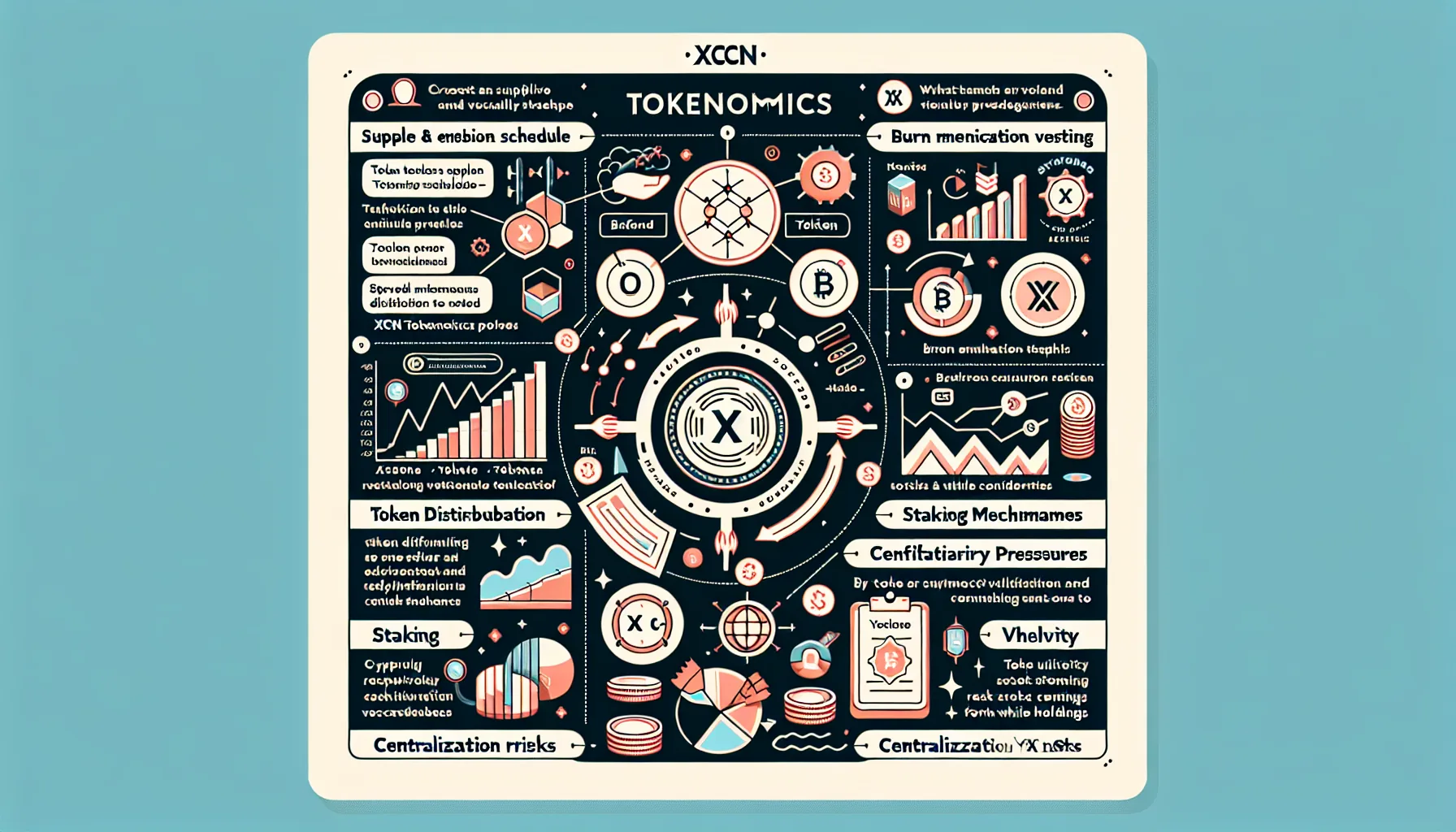
XCN Tokenomics: Supply, Distribution, and Incentive Mechanisms
Total Supply and Emission Schedule
XCN operates with a predefined total supply, with allocations structured across network incentives, ecosystem development, and team distributions. While initial token allocations are standard for protocol development, a key area of attention is the rate and method of token emissions. A supply schedule that allows for staking rewards and ecosystem growth can contribute to network participation, but inflationary pressures must be closely analyzed, particularly if emissions outpace organic demand.
Distribution and Vesting Considerations
A substantial portion of XCN's total allocation is designated for team, foundation, and strategic partners, with vesting mechanisms in place to gradually release tokens over time. This structured release can mitigate immediate sell pressure but raises the question of long-term centralization risks. A high percentage of supply controlled by early stakeholders may lead to concerns about governance centralization and market liquidity imbalance.
Burn Mechanisms and Deflationary Pressures
XCN incorporates burning mechanisms to counterbalance emissions to some degree. This can theoretically reduce circulating supply over time, supporting value retention. However, the effectiveness of burn structures depends on transactional volume and network adoption. If ecosystem activity remains low, deflationary pressures may not be significant enough to counter inflation from ongoing emissions.
Utility and Token Velocity
XCN is primarily utilized for governance, transaction fees, and protocol incentives. The extent to which these utilities drive on-chain activity directly impacts token velocity. High velocity without adequate demand can lead to downward price pressure, while low velocity may indicate limited ecosystem engagement. A successful token economy requires a balance between incentivizing usage and preventing excessive dilution from ongoing rewards.
Staking and Yield Considerations
Staking mechanisms allow participants to lock XCN in exchange for rewards, securing the network and aligning incentives. However, the sustainability of staking yields is dependent on token issuance models and network fees. If staking APYs are primarily funded through inflation rather than protocol revenue, sustainability concerns arise, potentially leading to long-term value erosion.
Centralization Risks and Whale Holdings
A review of on-chain data shows that a notable concentration of XCN is held by large wallets, which can signal a risk of price manipulation or coordinated governance actions. While such holdings can indicate confidence from institutional players, they also bring concerns about fairness in decision-making processes and sudden liquidity events if large holders decide to exit the market.
XCN Governance
Governance Structure of XCN
XCN operates within a governance framework designed to facilitate decentralized decision-making, but its structure presents both advantages and potential challenges. Governance is primarily executed through token-based voting, where XCN holders are granted influence over protocol upgrades and key network parameters. This model aligns with decentralized principles but inherently raises concerns related to token concentration and decision-making dynamics.
Token-Based Voting and Its Implications
Governance proposals within the XCN ecosystem are typically subject to a voting process where token holders cast votes proportional to their holdings. While this system ensures that stakeholders with economic exposure have influence over network changes, it also introduces the risk of centralization. Wealthier entities or early token recipients may wield disproportionate control over protocol governance, potentially shaping decisions in ways that prioritize their interests over broader community goals.
Governance Participation and Voter Engagement
A recurring challenge in XCN’s governance is the level of voter engagement. Lower voter participation rates are common in token-based governance models, leading to decisions that may not reflect the consensus of the wider community. When governance participation is low, a small subset of active voters can exert outsized influence, further exacerbating centralization risks. Strategies such as delegation mechanisms, where token holders entrust voting power to representatives, can mitigate these issues but come with their own risks of governance capture.
Proposal Process and Decision-Making Transparency
For governance to function effectively, transparency in the proposal process is critical. XCN governance proposals typically outline required changes, implementation details, and expected outcomes. However, challenges arise when proposals are vague, overly technical, or lack community discussion before voting. If proposals are pushed through without sufficient scrutiny, governance risks becoming a symbolic process rather than a genuine decentralized mechanism.
Smart Contract Governance and Potential Risks
XCN governance relies on smart contracts to facilitate voting and proposal execution. While this adds automation and reduces reliance on intermediaries, it also introduces security risks. Vulnerabilities in governance-related smart contracts could be exploited, leading to unintended protocol changes or governance manipulation. Ensuring rigorous security audits and fail-safe mechanisms is essential to mitigate such risks.
Governance Evolution and Changing Dynamics
Over time, governance structures may shift to address emerging challenges. Adjustments to voting weight calculations, quorum requirements, or delegation models could be considered to refine the governance system. However, the pace of governance evolution depends on the willingness of token holders to actively participate in shaping structural changes.
Technical future of XCN
XCN Technical Roadmap and Future Developments
Evolution of Chain Protocol Infrastructure
XCN operates within the Chain ecosystem, which focuses on blockchain-based financial infrastructure. The ongoing development of Chain’s protocol includes enhancements aimed at increasing transaction throughput, reducing latency, and improving interoperability. The roadmap includes further optimizations of smart contract execution to minimize resource consumption and gas fees. However, challenges around decentralization and network security remain topics of discussion within the developer community.
Smart Contract Functionality and Enterprise Adoption
A key focus of upcoming technical developments is expanding the capabilities of Chain’s smart contracts. While the protocol currently supports enterprise-level financial applications, compatibility with broader DeFi ecosystems via cross-chain integrations is still a work in progress. Enhancements to Chain smart contracts seek to improve customizability and security, but adoption within traditional institutions remains a hurdle due to regulatory uncertainties and enterprise-specific requirements.
Governance Model and Future Adjustments
XCN relies on a governance structure that enables community participation in protocol decisions. Future updates are expected to refine governance parameters, potentially introducing new mechanisms for stake-weighted voting and delegation. However, governance centralization concerns have been raised due to the concentration of XCN token allocation. Any shifts in governance design will need to address transparency and fairness to maintain stakeholder trust.
Scalability Upgrades and Layer-2 Solutions
Scalability remains a core priority, with potential layer-2 solutions being explored to complement the base chain. The integration of sidechains or rollups could mitigate congestion and enhance transaction efficiency. However, implementing effective solutions without compromising security or network reliability is still an ongoing challenge, requiring extensive testing and ecosystem support before deployment.
Developer Tooling and Ecosystem Expansion
Efforts to refine developer tooling include expanding Chain’s SDKs and APIs to facilitate easier application development. Documentation and open-source contributions continue to be areas that need improvements to accelerate ecosystem growth. While developer adoption is increasing, broader integration with external blockchain platforms and existing DeFi protocols is necessary to enhance overall utility.
Security Audits and Network Stability
Security remains a critical aspect, with periodic audits conducted to identify vulnerabilities. Despite these efforts, no blockchain system is immune to potential exploits, and XCN’s network must continually adapt to emerging threats. Future protocol updates will likely emphasize additional security layers, but response mechanisms to potential attacks must remain agile to prevent disruptions.
Comparing XCN to it’s rivals
XCN vs. XRP: A Technical and Utility Comparison
When evaluating XCN against XRP, the key differentiators arise in their network architecture, consensus mechanisms, and core use cases. While both assets aim to enhance the efficiency of financial transactions, they take contrasting approaches in achieving scalability, decentralization, and institutional adoption.
Consensus Mechanism: Federated vs. Staking-Based Governance
XRP operates on the XRP Ledger (XRPL), which utilizes a Federated Consensus Model. This model relies on a set of trusted validators that reach agreement on transaction ordering without requiring energy-intensive mining. This approach allows for high transaction throughput with minimal latency but introduces concerns regarding decentralization, as the validator set is relatively small compared to fully permissionless blockchains.
XCN, in contrast, is built within the Chain protocol, which incorporates staking-based governance. This mechanism relies on economic incentives to drive network security and consensus. While this model increases decentralization compared to a federated system, it may introduce complexities in governance participation and potential centralization risks based on token distribution.
Institutional vs. Multi-Chain Focus
XRP's primary adoption stems from institutional players within the cross-border payments space. Its ledger is optimized for financial institutions and remittance providers, aiming to serve as a bridge asset for high-speed, low-cost settlements. However, challenges such as regulatory scrutiny and reliance on specific partnerships have influenced its market position.
XCN differentiates itself by focusing on broader blockchain deployment use cases beyond financial institutions. Chain’s infrastructure is positioned for smart contracts, enterprise blockchain solutions, and protocol-level integrations. However, the asset's long-term role in the evolving enterprise blockchain landscape remains uncertain, especially given competition from other smart contract-enabled networks.
Transaction Fees and Speed
Both XCN and XRP benefit from low transaction costs, but their fee dynamics differ significantly. XRP transactions incur minimal fees, with costs structured to prevent spam rather than facilitate value accrual to token holders. The XRP Ledger is optimized for rapid finality, often settling in mere seconds.
XCN also features low fees, but its economic model ties transaction validation more closely to its staking framework. While this can provide additional incentives to network participants, it may also introduce variability in transaction costs depending on network activity and governance changes.
Smart Contract Capabilities
A notable distinction arises in smart contract functionality. XRPL has historically lacked native smart contract support, though ongoing developments aim to introduce these capabilities. XCN, by contrast, leverages a smart contract-enabled infrastructure from inception, allowing for a broader range of potential applications. However, its competitive positioning among established smart contract platforms remains an ongoing challenge.
XCN vs ALGO: A Comparison of Network Efficiency and Use Cases
When comparing XCN to ALGO, a key area of focus is network efficiency. Both Chain (XCN) and Algorand (ALGO) emphasize scalability and low-cost transactions, but they approach this challenge differently. Algorand employs a Pure Proof-of-Stake (PPoS) consensus, designed to offer fast finality and prevent forking. In contrast, Chain operates on a permissioned network model, prioritizing controlled access and customizability over a fully decentralized approach. This difference impacts their respective appeal—while ALGO aims for broad decentralization, XCN targets enterprise-grade blockchain solutions with governance flexibility.
Transaction Costs and Throughput
ALGO benefits from its unique consensus mechanism, which enables high throughput and low fees, making it suitable for large-scale applications like payments and smart contracts. However, XCN’s architecture allows customized blockchain implementations, where enterprises can optimize costs based on specific needs. The downside is that XCN’s model depends on institutional adoption rather than grassroots developer engagement, which could limit its widespread use in permissionless environments. Still, enterprises seeking predictable performance may find XCN’s model preferable over ALGO’s more open-ended approach.
Smart Contract Capabilities
In terms of smart contract functionality, ALGO utilizes TEAL (Transaction Execution Approval Language), which is deliberately restrictive to enhance security and efficiency. This approach minimizes execution risks but may limit the complexity of dApps compared to more flexible alternatives. XCN, by contrast, focuses on financial applications and allows tailored solutions but does not position itself as a general-purpose smart contract platform. Developers looking for permissionless, high-complexity smart contract deployments may find ALGO’s ecosystem more accommodating.
Adoption Challenges and Ecosystem Development
Despite ALGO’s goal of enabling a scalable and decentralized financial ecosystem, adoption challenges persist. Developer activity within the Algorand ecosystem has fluctuated, and integration with major DeFi platforms has been inconsistent. XCN, on the other hand, has positioned itself for business-focused integrations, but this limits exposure to retail-driven crypto innovation. Furthermore, ALGO’s larger emphasis on public blockchain interactions contrasts with XCN’s enterprise-focused deployments, framing their rivalry as one of open versus permissioned blockchain strategies.
Both networks bring unique strengths to the crypto landscape, yet each faces hurdles in securing sustained adoption and distinguishing itself amid a crowded sector.
XCN vs QNT: A Technical and Functional Comparison
Different Approaches to Enterprise Blockchain Integration
XCN and QNT both focus on enterprise-grade blockchain solutions, but their approaches differ significantly. XCN leverages the Chain protocol to provide scalable, permissioned blockchain infrastructure, whereas QNT operates as an interoperability-focused project, using its Overledger technology to enable seamless communication between multiple blockchains.
QNT's core functionality revolves around interoperability, allowing businesses to connect disparate blockchain networks without deploying additional infrastructure. XCN, on the other hand, offers more of a closed-loop system where enterprises integrate its blockchain solutions directly. This makes XCN a strong choice for permissioned environments but limits its flexibility when compared to QNT's multi-chain support.
Smart Contract and Programming Capabilities
While both assets target enterprise adoption, their smart contract capabilities diverge. QNT does not operate its own native smart contract ecosystem—instead, it acts as a layer facilitating smart contract execution across different chains. This makes it highly versatile, but it also means that developers looking for native contract execution must rely on external blockchains.
XCN, in contrast, provides more direct control by allowing enterprises to deploy blockchain applications within its ecosystem. However, the lack of universal interoperability means that projects building within XCN's framework may face challenges when integrating with external chains.
Token Utility and Network Economics
QNT is required to access the Overledger platform, with enterprises and developers needing to hold QNT to utilize its services. This demand structure introduces a direct utility mechanism tied to network usage.
XCN functions differently, being used for payments, governance, and network operations within its ecosystem. It also incorporates fee reduction incentives for enterprise adoption. However, due to its focus on permissioned blockchain environments, the demand dynamic differs from QNT, where token locking and access fees play a crucial role.
Adoption Challenges and Trade-offs
QNT benefits from a broad use case, as interoperability remains a major concern for enterprises navigating multi-chain frameworks. However, onboarding requires adherence to its proprietary Overledger system, which has both technical and financial barriers.
XCN’s adoption challenges are different, centering around its closed ecosystem approach. While it offers strong enterprise tooling, its permissioned nature can limit broader integration, especially in environments where multi-chain compatibility is a requirement.
Primary criticisms of XCN
Primary Criticism of XCN
Centralization Concerns
One of the most persistent criticisms of XCN is its perceived centralization. Despite being positioned as a decentralized asset, a substantial portion of the token supply has historically been concentrated in the hands of a few wallets, raising concerns about control and governance. Large token allocations to insiders or team-related addresses can create an environment where a small number of entities hold disproportionate influence over tokenomics, governance decisions, and market dynamics.
Tokenomics and Supply Inflation
XCN’s tokenomics have been a point of contention due to frequent adjustments in supply mechanics. Instances of rapid emissions, staking yield changes, or unannounced shifts in vesting schedules have led to criticism from market participants who expect a predictable supply structure. Unforeseen inflation events, particularly in a competitive landscape, can create downward price pressure and erode investor confidence. A lack of transparency in how incentives are structured has further fueled skepticism.
Governance Transparency Issues
Another major point of criticism surrounding XCN is a perceived lack of clarity in governance processes. While governance mechanisms exist, there have been questions about how decisions are made, whether community feedback is genuinely incorporated, and if governance proposals are executed in a decentralized manner. When core protocol changes are introduced without extensive discussion or with opaque decision-making, concerns about governance manipulation arise.
Reputation and Trust Issues
XCN has at times been scrutinized due to past project pivots, branding changes, or strategic shifts that were not always clearly communicated. In crypto markets, trust is built on consistent execution and reliable communication. When projects alter their technical roadmap, funding strategies, or partnerships without ample notice, skepticism emerges. Such events can lead to speculation about the project's long-term vision and the incentives of those driving it forward.
Exchange Liquidity and Market Stability
While XCN is frequently traded, liquidity depth and stability across multiple exchanges have been questioned. If a project's trading volume is concentrated on a limited number of platforms or dominated by a handful of market participants, it raises concerns about order book depth and susceptibility to manipulation. Volatility concerns may also be linked to liquidity fragmentation, making it difficult for traders to execute large positions without significant slippage.
Smart Contract and Security Risks
Blockchain security is a critical issue, and XCN has been subject to scrutiny regarding smart contract robustness. Any vulnerabilities or past security incidents can have lasting reputational effects. Even if a protocol has not experienced a major exploit, lack of public audits, insufficient bug bounty incentives, or reliance on closed-source components can generate distrust among security-conscious users.
Founders
Founding Team Behind XCN
XCN, the native token of Chain, was developed by a team with extensive experience in blockchain infrastructure. Chain was originally founded by Adam Ludwin in 2014 as a private blockchain solutions provider, but its trajectory shifted significantly after being acquired by Stellar's Lightyear in 2018. Following this acquisition, Chain's brand was repurposed and later relaunched under new leadership.
The relaunch of Chain saw Deepak Thapliyal step in as the CEO. Thapliyal, known for his background in blockchain development and investment, became a prominent face of the project. His approach to Chain’s direction has been focused on providing enterprise-level blockchain solutions, but Chain’s transition from private blockchain solutions to a more token-driven model with XCN brought major shifts in its strategic focus.
Despite Thapliyal’s leadership, the project’s core team structure has remained somewhat opaque to the broader crypto community. Unlike other blockchain ventures that emphasize decentralization, Chain has maintained a relatively centralized corporate presence. This lack of transparency has occasionally raised concerns about governance and decision-making within the ecosystem.
Additionally, there have been public controversies surrounding Thapliyal that have impacted Chain’s image. His involvement in high-profile NFT acquisitions and blockchain investments has put a spotlight on the company, sometimes overshadowing its core technology. While this has helped Chain maintain visibility in the broader crypto market, it has also drawn criticism regarding the alignment of leadership priorities.
Another notable aspect of Chain's team is its engagement strategy. Unlike many other blockchain projects that emphasize community-driven development and DAO governance models, Chain has remained more traditional in its corporate structure. This has led to questions about how much influence token holders actually have over the protocol’s direction, especially in comparison to other crypto projects that aim for more decentralized governance mechanisms.
Moreover, Chain has pursued an aggressive acquisition strategy under its current leadership, further highlighting the emphasis on corporate positioning rather than purely grassroots adoption. Despite this, details about the broader engineering and development team responsible for maintaining and upgrading the XCN ecosystem are not readily available, adding an additional layer of uncertainty regarding long-term technical oversight.
While XCN operates as a central part of the Chain ecosystem, its founding and leadership structure reflects a more corporate-driven approach rather than a fully decentralized model. This distinction is key for understanding how decisions related to XCN’s utility, supply, and governance are made, especially given the limited visibility into the project’s broader development team.
Authors comments
This document was made by www.BestDapps.com
Sources
- https://chain.com
- https://chain.com/whitepaper.pdf
- https://chain.com/developers
- https://github.com/chain
- https://docs.chain.com
- https://medium.com/chain-protocol
- https://etherscan.io/token/0xa2cd3d43c775978a96bdbf12d733d5a1ed94fb18
- https://coinmarketcap.com/currencies/chain
- https://www.coingecko.com/en/coins/chain
- https://defillama.com/protocol/chain
- https://twitter.com/Chain
- https://blog.chain.com
- https://community.chain.com
- https://chain.com/security
- https://chain.com/roadmap
- https://explorer.chain.com
- https://etherscan.io/address/0xa2cd3d43c775978a96bdbf12d733d5a1ed94fb18#code
- https://messari.io/asset/chain
- https://decrypt.co/resources/chain-protocol