History of XCH
A Deep Dive into XCH's History: From Concept to Implementation
The history of XCH, the native cryptocurrency of Chia Network, is steeped in innovative intent and methods that aim to differentiate it from the crowd of blockchain projects. Chia Network was founded with the vision of creating an energy-efficient and decentralized cryptocurrency that tackles the growing concerns over the carbon footprint of proof-of-work blockchains like Bitcoin. However, its path from ideation to deployment has not been without complexity and scrutiny.
Chia Network introduced a novel consensus mechanism called Proof of Space and Time (PoST), the concept of which was first proposed in the project's early whitepapers. Proof of Space relies on storage capacity as its primary resource, unlike the energy-intensive computational power associated with Proof of Work. Proof of Time complements this system by ensuring that the blockchain maintains consistent block intervals. This dual mechanism was meticulously designed to promote fairness and democratized participation, but it also faced criticism for potentially repurposing e-waste by incentivizing excessive hard drive usage. During its early development, skeptics raised concerns about the long-term environmental sustainability of increased demand for large-scale storage hardware.
XCH officially launched in mainnet form in 2021, after extensive testing of its infrastructure. Instead of conducting an initial coin offering (ICO) or pre-mining event commonly seen with other blockchains, Chia Network opted for a premine referred to as the "Strategic Reserve." This premine consisted of a significant portion of XCH intended for funding the organization's future development efforts and building trust with institutions. However, this approach sparked debates within the crypto community, with some arguing it deviated from the decentralization ethos of cryptocurrencies.
XCH farming—Chia Network's equivalent of mining—quickly gained traction within the storage-focused niche. Farmers allocate unused hard drive space to earn rewards for maintaining and securing the network. This farming activity significantly influenced the global hard drive market, briefly driving up prices and creating storage shortages. Despite the initial excitement, concerns grew around the wear-and-tear it imposed on consumer-grade solid-state drives (SSDs), discouraging entry-level participants who lacked enterprise-grade hardware.
Today, XCH’s journey remains a critical case study for blending environmental goals with blockchain development. Early decisions, such as its Strategic Reserve and the impact of farming on hardware markets, offer insight into the broader challenges faced by projects trying to balance innovative mechanisms with real-world implementation risks.
How XCH Works
How XCH Works: Understanding Chia’s Unique Proof of Space and Time Mechanism
Chia Network’s native cryptocurrency, XCH, operates on a decentralized blockchain distinguished by its innovative “Proof of Space and Time” (PoST) consensus mechanism, which contrasts sharply with resource-intensive Proof of Work (PoW) and the capital-heavy Proof of Stake (PoS) protocols. PoST aims to address the sustainability and decentralization challenges seen in more traditional crypto architectures, but it carries its own complexities and considerations.
Proof of Space: Decentralized Data Storage Commitments
The core concept of Proof of Space relies on participants, known as "farmers," dedicating unused hard drive space to the network. This space is "plotted" with cryptographic data structures that function as potential proofs. Plotting requires computational power initially to generate these data sets, but after completion, it shifts to being largely storage-based. Farmers compete to solve challenges issued on the Chia blockchain, with a winning proof selected probabilistically based on the size of the available space they provide.
Unlike PoW, where computational mining power correlates directly to energy consumption, PoST’s resource demand shifts to storage hardware. However, plotting is far from energy-neutral—it requires considerable computational resources to create plots, which can be an issue for smaller participants attempting to enter the ecosystem. For those without SSD or efficient storage solutions, plotting can be time-consuming, and wear-and-tear on hardware poses an additional economic downside.
Proof of Time: Verifiable Delays Adding Security
Proof of Space alone could potentially be vulnerable—attackers might fill and discard space rapidly to dominate challenges. To mitigate this, Chia introduces Proof of Time, which mandates that each blockchain transaction is verified through a sequential verifiable delay function (VDF). The VDF introduces a fixed time delay that cannot be parallelized, ensuring proper sequencing of blocks and disincentivizing fraudulent activities. This unique mechanism aims to preserve integrity across the network without drastic centralization.
The reliance on VDFs, however, necessitates high-precision hardware, leading to the centralization of certain aspects of validation. Only a limited number of entities currently produce competitive VDF hardware, creating potential bottlenecks in what is touted as an otherwise decentralized protocol.
Storage Efficiency and Trade-Offs
While XCH farming is often marketed as leveraging underutilized storage, the demand for high-capacity SSDs to optimize plotting creates an arms race among participants. Additionally, the long-term environmental impact of discarding worn-out SSDs has drawn critique, suggesting that the system’s "eco-friendly" branding may be limited to certain aspects of operation. Furthermore, with larger enterprises farming at scale, there’s an ongoing discussion on how sustainable decentralization truly is in practice.
Ultimately, the mechanics of Proof of Space and Time result in an innovative yet complex ecosystem that balances decentralization, hardware accessibility, and network security in a novel way but not without ongoing challenges in scalability and accessibility.
Use Cases
Use Cases of XCH: Exploring Real-World Applications of the Chia Blockchain
The Chia blockchain, powered by its native token XCH, presents unique use cases that differentiate it from many other crypto assets. Built on a proof-of-space-and-time consensus mechanism, Chia emphasizes sustainability and efficiency. However, its practical applications reveal both strengths and limitations within the blockchain ecosystem. Below, we delve into several specific use cases.
1. Decentralized Asset Management
Chia’s robust smart contract platform, called Chialisp, enables the deployment of decentralized solutions for asset management. Institutions and individuals can leverage Chialisp to create programmable tokens, manage digital assets, or implement trustless financial operations. Unlike Ethereum-based applications that may incur high gas fees, Chia transactions are optimized for reduced costs. However, current adoption remains low relative to its competitors, and developer tooling, although functional, is not as mature as more established smart contract platforms.
2. Green Enterprise Solutions
One of Chia’s key selling points is its eco-friendliness. Enterprises are exploring Chia for use cases such as carbon credit tracking, supply chain transparency, and compliance-based recordkeeping. The blockchain’s low energy consumption makes it attractive as corporations face increasing scrutiny over sustainability practices. Nevertheless, Chia's reliance on physical storage for its proof-of-space-and-time mechanism has raised concerns about potential e-waste and long-term scalability challenges as storage demands grow.
3. Decentralized Exchanges and Cross-Chain Solutions
Chia’s implementation of decentralized exchanges (DEXs) using atomic swaps has garnered interest, especially among users seeking alternatives to Ethereum’s liquidity-dependent DeFi protocols. XCH enables trustless trades without reliance on centralized infrastructure. Additionally, the project's focus on interoperability via bridges to other blockchains opens doors for cross-chain liquidity and asset transfer. Yet, adoption hurdles remain due to limited integration with major DeFi ecosystems and a relatively small user base.
4. Tokenized Real-World Assets
The Chia blockchain is increasingly seen as a viable platform for tokenizing real-world assets, such as real estate, art, or even securities. The transparency and efficiency of Chialisp-based smart contracts make it suitable for creating fungible and non-fungible tokens (NFTs). However, regulatory skepticism and the lack of widespread NFT infrastructure compared to ecosystems like Ethereum or Solana present obstacles to scaling this use case effectively.
5. Retail Payment Solutions
With XCH’s fast transaction times and reduced fees, the token could potentially serve as a medium for retail payments. Certain businesses have experimented with utilizing Chia for peer-to-peer transactions and merchant payments. Nonetheless, the lack of widespread merchant adoption and minimal integration with existing payment gateways limit XCH’s practicality as a mainstream payment solution.
6. Non-Custodial Lending and Borrowing
Chialisp enables robust mechanisms for non-custodial lending and borrowing platforms, eliminating intermediaries while maintaining strong security. These decentralized finance (DeFi) implementations are particularly promising for users looking to lend XCH or other synthetic assets within the ecosystem. However, fragmentation of liquidity and relatively immature lending platforms compared to Ethereum or Binance Smart Chain hinder broader participation.
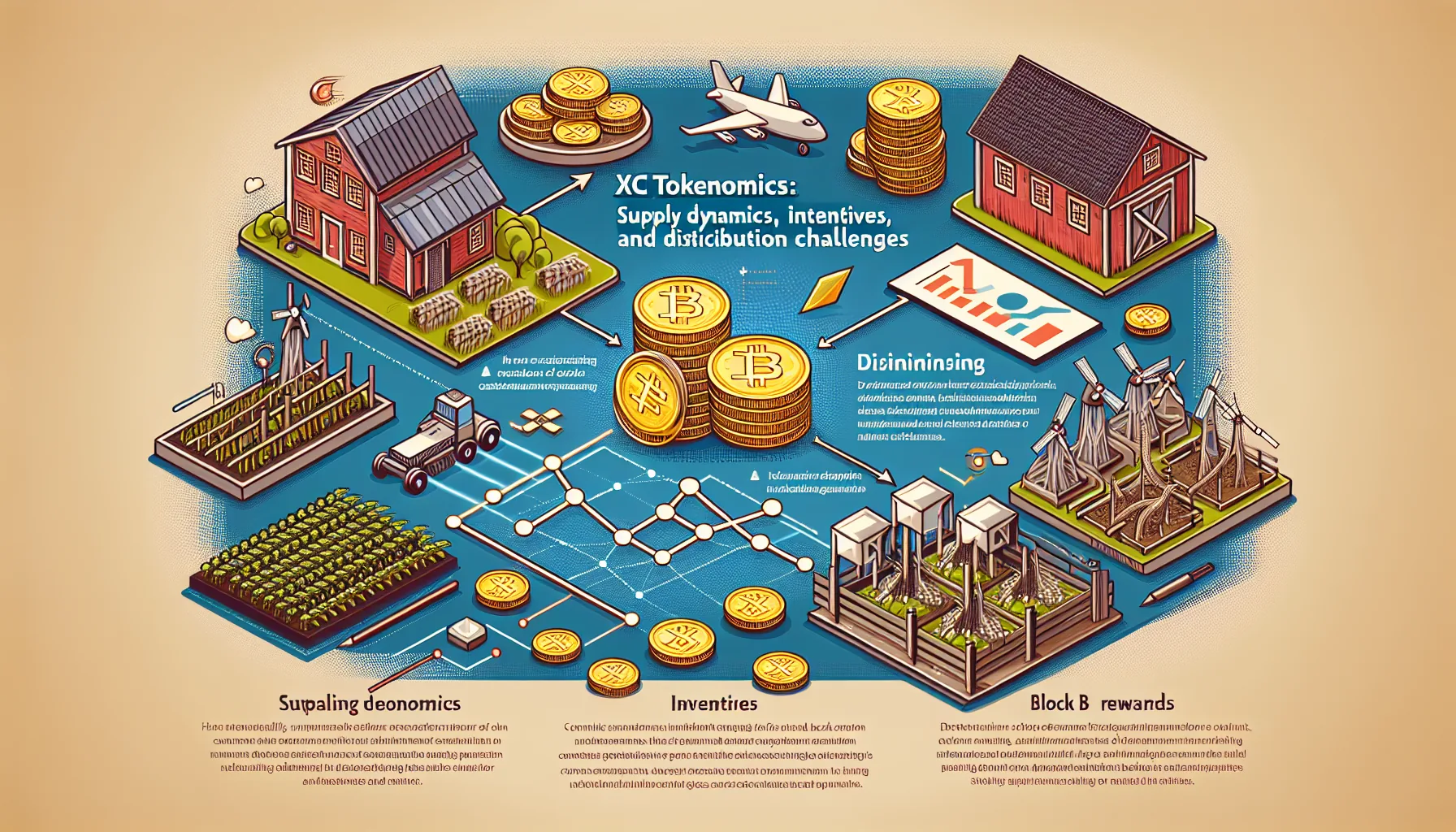
XCH Tokenomics
Exploring XCH Tokenomics: Supply Dynamics, Incentives, and Distribution Challenges
XCH, the native currency of the Chia blockchain, presents a nuanced tokenomic structure designed to balance sustainability, decentralization, and fairness. At the heart of its model lies an innovative farming-based consensus mechanism, which directly influences token distribution, supply growth, and network economics.
Controlled Supply and Strategic Release
Unlike cryptocurrencies with fixed total supplies, XCH's tokenomics utilize a predefined release schedule to control inflation. Block rewards are disbursed daily, with an initial phase of higher emissions tapering off over time. This predictable reduction in block rewards reinforces long-term scarcity. However, this approach raises concerns about sustainability for network participants, as diminishing rewards could impact the incentive structure for farmers as the network matures.
Chia's commitment to fairness also extends to its pre-farm, a significant allocation (21 million XCH) designated for institutional and development purposes. While some see this as a prudent step to ensure project longevity, critics argue that the large pre-farm could centralize power in the hands of developers, creating a trust dependency rarely seen in more decentralized crypto ecosystems.
Farming Incentives and Economic Sustainability
XCH employs proof-of-space-and-time (PoST), leveraging unused storage to validate transactions and secure the network. This design drastically reduces energy consumption compared to proof-of-work (PoW) models, but it introduces unique tokenomic challenges. Farming rewards and hardware costs create a delicate balance for participants; profitability is contingent on network size, storage costs, and reward rates. As the difficulty of farming scales with the network's growth, smaller participants may face challenges in remaining competitive, limiting decentralization.
Demand-Side Considerations
The utility-driven demand for XCH is primarily tied to transaction fees, decentralized application (dApp) use, and potentially strategic holdings. However, as a relatively young asset, concerns exist about whether demand can scale proportionally to supply expansion. A lack of diverse use cases beyond farming-related activities could exacerbate selling pressure as block rewards are distributed.
Addressing Long-Term Challenges
XCH’s tokenomics face scrutiny for their inherent reliance on pre-farm allocations and the gradual adjustments in farming rewards. A particular concern is the pace of transaction fee adoption. Without robust network activity, the transition from block rewards to fee reliance may pressure the ecosystem. Token holders and farmers might face declining economic incentives unless the network achieves adoption at scale.
XCH Governance
Governance Mechanisms of XCH: Decentralization and Challenges
The governance of XCH, the native cryptocurrency of the Chia blockchain, exhibits a hybrid model that balances community-driven decision-making with centralized oversight by its core development team. While the blockchain itself operates on a decentralized infrastructure, governance introduces a nuanced dynamic that combines on-chain mechanics with off-chain contributions.
Off-Chain Governance and Core Authority
A notable aspect of XCH governance is the influence wielded by Chia Network Inc., the entity responsible for the blockchain's development. This centralized core team plays a significant role in driving protocol updates, proposing improvement initiatives, and ensuring compliance with regulatory standards—an area they emphasize heavily. For some community members, this centralized oversight has raised concerns about potential single points of failure. These critics argue that the reliance on a corporate entity introduces risks around censorship, strategic prioritization, and transparency.
On-Chain Proposals: Limited Scope
Unlike governance models seen in blockchain ecosystems like Ethereum, which leverage decentralized autonomous organizations (DAOs) or token-weighted voting, XCH's governance mechanisms lean heavily on the development team rather than the token holders themselves. Many decisions regarding the protocol are finalized internally, with periodic feedback sourced from the community. While this structure has prevented governance capture by whales (large holders of tokens), it has also faced criticism for limiting the active participation of XCH token holders in shaping the direction of the ecosystem.
At present, there is no direct, token-based voting system that reflects a fully decentralized governance ethos. This absence places XCH in the category of blockchains where governance is primarily guided by its founding team rather than decentralized consensus. For proponents of full decentralization, this represents a misalignment of values.
Industry Compliance and Mitigating Governance Risks
One of XCH governance's standout attributes is its forward-looking approach to regulatory compliance. Chia Network Inc. has actively positioned itself as an eco-friendly and regulation-aware project. While this strategy ensures the project's long-term viability in tightly regulated jurisdictions, it introduces constraints on protocol innovation. Additionally, aligning with regulatory bodies can lead to decisions that conflict with the ideologies of more anarcho-crypto participants, alienating some user bases.
The governance of XCH unveils the complexities of balancing decentralization, centralized coordination, and regulatory alignment. As the ecosystem matures, this governance blend will likely remain a topic of significant debate among the blockchain’s community participants.
Technical future of XCH
Current and Future Technical Developments in XCH (Chia Network)
The Chia Network, underpinning the XCH crypto asset, is distinguished by its unique consensus mechanism called Proof of Space and Time (PoST). This innovative system leverages unused storage space as a resource, contrasting sharply with energy-intensive Proof of Work (PoW) models. Yet, while PoST has underpinned Chia's rise in recognition, it is not without its technical hurdles and development needs.
Advancements in Scalability and Smart Transaction Frameworks
A key ongoing area of technical development is improving Chia’s scalability. The current network relies on Chialisp, its bespoke on-chain programming language tailored to process smart transactions efficiently. While Chialisp offers high flexibility and a secure framework for decentralized applications (dApps), adoption and tooling have been slower compared to more widely adopted languages like Solidity or Rust. Chia developers are focused on building better integrations, developer resources, and libraries to improve the onboarding process for technical contributors.
Moreover, horizontal scaling solutions such as sharding or layered protocols have been discussed as critical milestones but remain unrealized. Without these, network load could present a bottleneck should adoption surge, as farming efficiency and block propagation times might encounter latency issues.
Improvements to Resource Efficiency
While PoST is inherently less energy-intensive compared to PoW systems, concerns persist over resource efficiency. Farmers (network participants) require significant storage capacity sustained long-term, leading to potential issues regarding e-waste and centralization. On the technical roadmap, enhancements in plot compression and optimization are a priority, with plans to allow smaller players to participate without needing enterprise-grade storage solutions. Future developments may explore innovative storage technologies or decentralized storage market models to tackle these resource concerns.
Integration of Cross-Chain Interoperability
Cross-chain interoperability has become a key focal point for XCH’s development to remain competitive in a multi-chain ecosystem. Current technical roadmaps detail efforts toward bridges or standards enabling communication and asset transfers with other blockchains. However, challenges lie in maintaining security during cross-chain transactions, requiring significant protocol-layer innovation to address interoperability vulnerabilities.
Upgrades to Decentralization and Governance
Decentralization remains a technical goal, although critiques regarding the entry cost of farming (due to storage requirements) persist. Future governance upgrades are expected to integrate decentralized voting mechanisms into the protocol, although the specifics are yet to be solidified. Ensuring accessibility while rolling out these changes will require significant refinement in consensus algorithms.
Comparing XCH to it’s rivals
Comparing XCH to FIL: A Deep Dive into Decentralized Storage Economics
When contrasting Chia Network's XCH asset with Filecoin’s FIL, the differences in their technological approach, economic design, and community ethos become apparent, reflecting their unique approaches to decentralized storage. Both platforms aim to disrupt traditional data storage ecosystems but diverge significantly in how they achieve this.
Consensus Mechanism: Energy Efficiency vs. Hardware Optimization
XCH relies on Chia’s Proof of Space and Time (PoST), an eco-conscious consensus method designed to minimize energy consumption compared to Proof of Work (PoW) systems. PoST leverages unused storage space to ensure network security, incentivizing participants to allocate available resources for farming. FIL, by contrast, employs Proof of Replication (PoRep) and Proof of Spacetime (PoSt—not to be confused with Chia’s PoST) to secure its blockchain. Filecoin miners must actively store and cryptographically prove they are hosting unique copies of data, requiring more hardware customization and greater operational complexity.
While Chia's minimalist farming appeals to a broader audience due to its lower barrier to entry, critics argue that PoST’s reliance on underutilized or secondhand drives could lead to concerns regarding hardware e-waste over time. Filecoin’s storage-mining approach, by contrast, has faced challenges related to storage power centralization, as participants often require significant upfront investments in specialized hardware.
Economic Model: Storage Utility vs. Layered Utility
One of the clearest distinctions lies in utility. XCH serves as the native token for the Chia blockchain, with its primary use case tied to transaction fees and incentivizing secure network participation. By contrast, FIL is deeply intertwined with its storage market. Users pay FIL as collateral or for storage and retrieval services, offering a more direct link between the asset and Filecoin's decentralized storage capabilities.
This design divergence could mean that XCH lacks the immediate storage-specific monetization layer FIL employs. However, Chia's broader focus on creating a versatile on-chain environment (such as leveraging its Clawback features, smart transaction programming, and forthcoming DeFi offerings) may appeal to users seeking applications that extend beyond just data storage marketplaces.
Community Dynamics and Ecosystem Development
FIL has historically attracted enterprise-grade collaborators from its inception via Protocol Labs, frequently positioning itself as a solution tailored to large-scale users. XCH, in contrast, has positioned itself as an open-access platform, leaning more on community-driven farming. This opens the door for grassroots participation but could limit enterprise adoption until clearer large-scale use cases emerge.
In comparing these dynamics, Chia and Filecoin embody fundamentally different philosophies of decentralized storage, each prioritizing different trade-offs between accessibility, economic utility, and participation incentives.
Comparing XCH and STORJ: A Deep Dive into Decentralized Storage Models
When analyzing Chia's (XCH) unique approach to decentralized storage via its "Proof of Space and Time" (PoST) consensus versus Storj's (STORJ) decentralized storage network, significant differences in both architecture and utility emerge. While both projects aim to solve storage inefficiencies in Web3 infrastructure, their methods and use cases cater to vastly different audiences and use cases.
Architecture and Tech Stack
STORJ offers a storage-focused infrastructure leveraging a distributed node network that provides secure, private, and scalable cloud storage. Unlike Chia’s broader focus on creating a green blockchain with its PoST mechanism, STORJ zeroes in on the enterprise-grade decentralized cloud market. The backbone of the STORJ ecosystem is the Tardigrade cloud service, which extends compatibility with major developer tools like Amazon S3 APIs to simplify adoption by legacy systems. Meanwhile, XCH’s storage efforts tie directly to its broader blockchain capabilities, requiring users to participate in farming that serves both consensus and potentially storage needs.
The challenge for XCH lies in its dual-purpose model. By tying storage to its consensus mechanism, Chia faces criticism that it doesn’t offer the same plug-and-play scalability for decentralized cloud storage as STORJ. Enterprises seeking pure cloud alternatives may find STORJ’s modular focus more appealing, particularly with its ability to provide pay-as-you-go services without requiring blockchain farming know-how.
Economic Incentives
Economic incentives structured around XCH farming reward users for providing unused hard drive space to secure the blockchain. While this approach encourages broader participation, its implementation may not directly translate into enterprise-ready storage capacity. In contrast, STORJ's tokenomics are tightly aligned with storage capacity and utilization. STORJ token rewards incentivize node operators to actively contribute stable and reliable uptime while maintaining redundancy across the network.
This divergence in reward alignment presents a challenge for XCH in competing with STORJ in enterprise landscapes. STORJ's rewards are tied directly to usable storage provided, whereas XCH balances both farming rewards and blockchain stability, which may dilute its storage-only focus.
Decentralization and Accessibility
STORJ promotes itself as more accessible, requiring minimal hardware investment to spin up a storage node. Its lightweight operating requirements contrast with XCH’s demand for significant disk space and energy to optimize farming efficiently. Smaller players may find STORJ’s barriers to entry far lower, particularly since running STORJ nodes doesn’t inherently impact hardware lifespan the way Chia farming does.
Additionally, STORJ operates using erasure coding, ensuring both data resiliency and redundancy across its global nodes. XCH’s PoST design, in contrast, addresses blockchain security primarily, with storage extensibility being more of a secondary benefit rather than a core focus. This divergence can pose challenges for Chia to present itself as a direct alternative in the same storage use-case ecosystem as STORJ.
Comparing Chia (XCH) to Arweave (AR): Strengths and Limitations
In the realm of decentralized storage solutions, Chia (XCH) and Arweave (AR) take divergent approaches to achieving their goals, each with distinct methodologies and trade-offs. While both aim to address data preservation and accessibility in innovative ways, their underlying mechanisms, ecosystems, and scaling potentials highlight key differences.
Technology and Consensus Mechanism Comparison
Arweave utilizes its unique proof-of-access (PoA) consensus mechanism, which is an extension of proof-of-work (PoW). This system ensures long-term data permanence by economically incentivizing miners to duplicate and verify data as part of the blockchain. One notable strength is its focus on storing information through a permaweb—a tamper-resistant network where data is intended to exist indefinitely. By contrast, Chia employs its energy-efficient proof-of-space-and-time (PoST) consensus, leveraging unused storage capacity to secure the network. While fewer energy inputs make Chia more environmentally appealing compared to AR’s PoW-derived mechanism, it may have limitations in terms of guaranteed data commitment. Chia prioritizes being a general-purpose smart contract platform over narrowly focusing on storage permanence.
Data Permanency vs. Flexibility
Arweave's strongest value proposition revolves around storing data with the promise of permanence. This feature targets users who prioritize immutable archiving, such as publishers, researchers, and decentralized application (dApp) developers aiming to preserve sensitive or long-term content. However, this hyperfocus on permanency can lead to increased storage costs for users attempting to upload large datasets. Chia, on the other hand, does not implicitly enforce data permanence and positions itself as a broader blockchain ecosystem with adaptable use cases beyond storage. This flexibility, while advantageous in certain situations, could be perceived as less specialized when directly juxtaposed to Arweave’s niche offering for long-standing, decentralized data archival.
Decentralization and Network Structure
Another area worth scrutiny is the relative decentralization and network participation models of the two assets. Arweave miners must store copies of the uploaded data to participate, creating a network that ties rewards directly to user data permanence. This setup, while effective for redundancy, results in more centralized storage clusters, as individual users are less likely to host full datasets. Chia, through its decentralized farming model, benefits from geographically distributed participants but doesn’t inherently bind storage to specific on-chain data use, potentially limiting verifiable decentralized storage guarantees.
Scaling Bottlenecks
While Arweave's static focus on permanent data storage suits its specific use case, its design might face challenges as the network scales. The hardware demands for storing ever-increasing amounts of immutable data could disincentivize smaller miners, potentially impacting decentralization. Chia, while less constrained by this issue, faces its own challenges of scaling as a general-purpose platform with growing transaction volumes, requiring careful infrastructure scaling to maintain efficiency.
Final Thoughts on the Comparison
In comparing Chia (XCH) to Arweave (AR), the fundamental question revolves around specialization versus generalization. Arweave excels in ensuring data persistence but faces cost and scalability challenges, while Chia's flexibility makes it versatile but less tailored for immutable data-specific needs. Each design has trade-offs that may influence how users and developers choose to interact with these respective ecosystems.
Primary criticisms of XCH
Primary Criticism of XCH: Unpacking the Drawbacks of Chia Network's Native Token
XCH, the native cryptocurrency of the Chia Network, has generated considerable attention in the blockchain space. However, alongside its technical innovations, the project has faced sustained criticism from various corners of the crypto community. Below, we explore the primary concerns raised about XCH.
Environmental Impact Debate: Proof of Space and Time Criticism
While Chia markets itself as an eco-friendly alternative to Proof of Work (PoW) blockchains, critics argue that its Proof of Space and Time (PoST) consensus model has simply shifted the environmental burden to another area. Rather than high energy consumption, Chia's model relies on storage infrastructure, leading to excessive demand for hard drives and solid-state drives (SSDs). This demand has resulted in an uptick in electronic waste, as low-end SSDs often degrade rapidly under the constant write-heavy processes required for farming. This issue has led some to question whether Chia’s sustainability claims hold up when analyzed more holistically.
Centralization Concerns: Unequal Distribution of Resources
Chia Network's pre-farm, often referred to as "Strategic Reserve," remains a point of contention for many blockchain purists. This large, centrally held reserve of XCH has sparked debates about the project's commitment to true decentralization. Critics argue that the existence of such a reserve runs counter to the ethos of distributed blockchain systems and risks establishing a power imbalance where the founding organization wields disproportionate control over the network's trajectory.
Storage Hoarding and Market Distortion
Another frequently cited concern involves the unintended consequences of Chia's demand for storage space. The need for large volumes of hardware has, at times, led to storage shortages in regional markets and inflated prices for SSDs and HDDs, which disproportionately affects industries beyond blockchain enthusiasts. This phenomenon has prompted concerns over the broader real-world implications of Chia’s growth, particularly for non-crypto sectors reliant on affordable storage hardware.
Lack of Community Governance
The governance structure of the Chia Network has also drawn criticism. Decision-making authority remains concentrated in the project's core developers and leadership team, with limited mechanisms for community members to influence the network's direction. This has led to skepticism about the project’s claims of being a truly open and innovation-driven ecosystem. Many decentralized finance enthusiasts view this as a step backward compared to protocols that foster robust community participation in governance.
Usability Challenges and Adoption Critiques
A final key criticism lies in XCH’s usability and adoption hurdles. Despite being labeled as a “green” cryptocurrency, its position within the broader blockchain ecosystem remains niche. Issues such as limited wallet support, relatively low transaction throughput compared to mainstream alternatives, and a lack of widespread developer adoption raise legitimate questions about the practical utility of XCH in everyday blockchain applications.
Founders
The Founding Team Behind XCH: Visionaries and Controversies
Chia Network, the entity behind the cryptocurrency XCH, was founded by Bram Cohen, a name that carries significant recognition in the tech and crypto community due to his role as the creator of the BitTorrent protocol. Cohen’s reputation for developing efficient decentralized technologies laid a strong initial foundation for Chia, as he leveraged his expertise in peer-to-peer (P2P) file-sharing systems to create a blockchain-based cryptocurrency.
The Chia project gained early traction not just due to Cohen's technical pedigree but also because of its focus on being an eco-friendlier alternative to proof-of-work blockchains like Bitcoin. By introducing the "Proof of Space and Time" consensus model, Chia aimed to minimize energy consumption. However, while unique and potentially impactful, this innovation has also drawn criticism, particularly directed at the unintended consequences related to hardware usage—specifically, wear and tear on SSDs and hard drives. These issues have raised concerns about the long-term viability of the vision pioneered by Cohen and his team.
Cohen’s leadership has been complemented by a core team of financial, legal, and engineering professionals, contributing to Chia's formal corporate structure—something notably distinct from many other crypto projects. This includes Gene Hoffman, who is responsible for navigating Chia’s path through the murky regulatory landscape, thanks to his background in legal compliance and scaling businesses. This focus on traditional corporate governance has earned the company both praise for its professionalism as well as criticism from die-hard decentralization advocates. Some believe the centralized decision-making framework undermines the ethos of cryptocurrencies, which typically lean toward decentralized autonomy.
Another contentious element surrounding the founding team stems from its strategy of pre-farming a substantial amount of XCH, a decision intended to fund operations and attract institutional investors. While this approach is not uncommon, it has raised questions about transparency and the extent to which it aligns with the decentralized principles espoused by the broader blockchain community. Critics frequently ask whether the founding team’s dual focus on eco-friendly innovation and financial solvency may conflict, ultimately benefiting centralized entities over grassroots participants.
In summary, XCH’s founding team boasts technical excellence and a structured business approach, but their decisions around pre-farming, governance, and hardware reliance have sparked heated debates in the crypto space. These dynamics are central to understanding both the prospects and controversies surrounding the asset's evolution.
Authors comments
This document was made by www.BestDapps.com
Sources
- https://www.chia.net/greenpaper/
- https://www.chia.net/whitepaper/
- https://www.chia.net/yellowpaper/
- https://www.github.com/Chia-Network/chia-blockchain
- https://explorer.chia.net/
- https://www.chiaforum.com/
- https://blog.chia.net/category/development-updates/
- https://github.com/Chia-Network/chia-dev-docs
- https://docs.chia.net/
- https://keybase.io/team/chia_network.public
- https://www.coingecko.com/en/coins/chia
- https://coinmarketcap.com/currencies/chia/
- https://www.chianetwork.eu/
- https://chia.net/faq/
- https://www.reddit.com/r/chia/
- https://intel.mockingbird.chia.net/
- https://chia.net/consulting/
- https://www.chiavision.com/
- https://chiadashboard.com/
- https://www.chiatrading.com/


