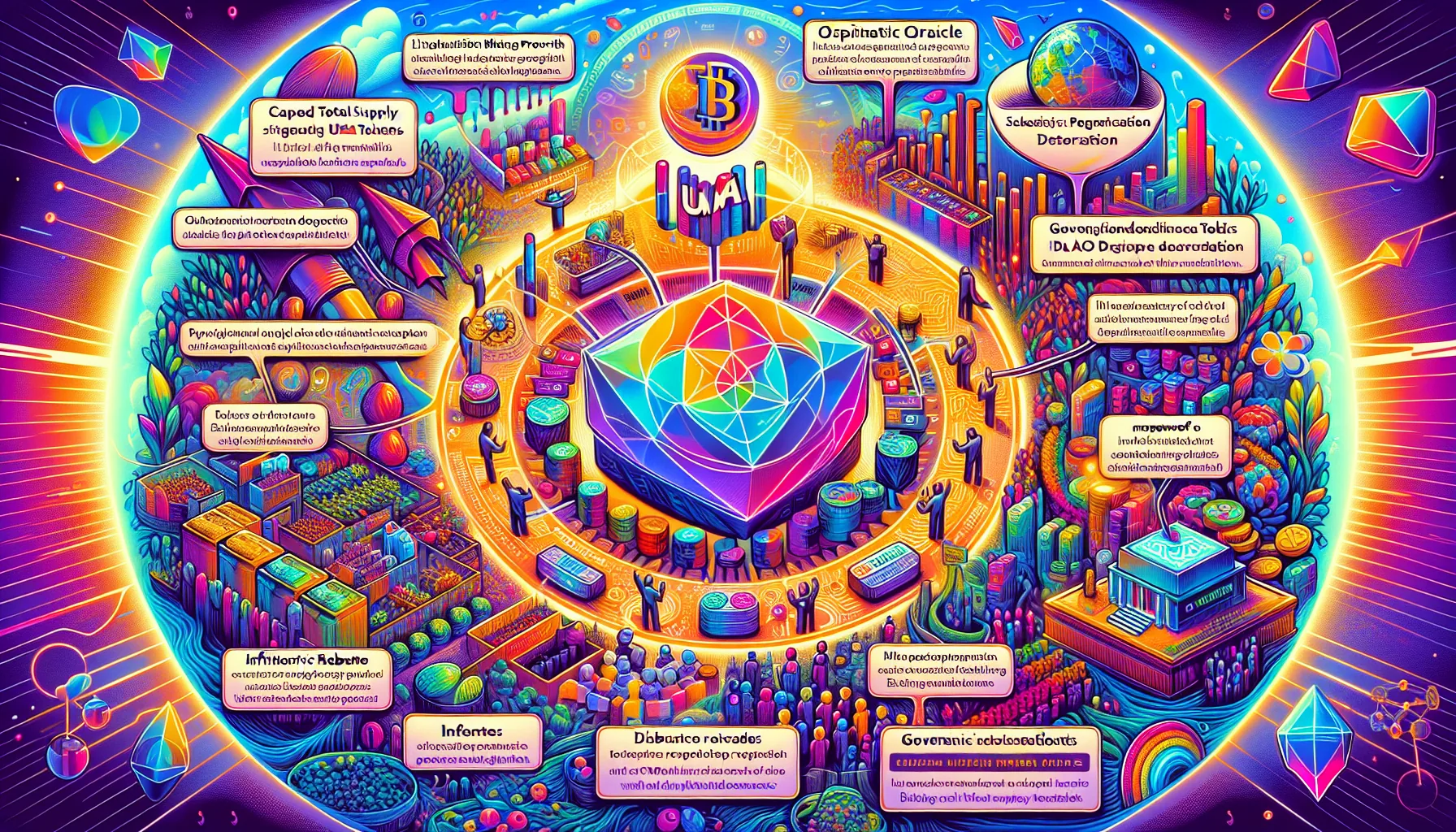
History of UMA
UMA Crypto Asset: Unpacking Its History
Universal Market Access (UMA) was launched in 2018 by Hart Lambur and Allison Lu. The project emerged from a deep recognition of inefficiencies within traditional financial markets and the need to democratize synthetic financial product creation. Built on the Ethereum platform, UMA provides the infrastructure for creating decentralized, trustless financial contracts, enabling any user to design and execute synthetic assets. Its open-source protocol was shaped by an ethos of reducing friction in global markets while fostering financial inclusivity.
One of the most significant moments in UMA's early history was the release of its whitepaper, which outlined the framework for creating priceless financial contracts. These contracts eliminated the need for frequent on-chain price updates, aiming to reduce reliance on on-chain oracles—a mechanism prone to manipulation. However, early critics flagged potential edge cases where the proposed oracle design might fail during high market stress or abnormal network conditions. This prompted the UMA team to invest heavily in refining their unique Optimistic Oracle, establishing it as a cornerstone of the protocol's architecture.
UMA's initial distribution strategy provided both opportunity and controversy. A portion of its token supply was allocated through a retroactive airdrop—distributed to active users of decentralized finance (DeFi) ecosystems. While this move was praised as egalitarian, questions about long-term token viability arose, given potential speculation by recipients uninterested in participation beyond quick trades. This dynamic occasionally raised concerns about governance centralization, as the more committed holders struggled to balance influence against short-term speculators.
One historical pain point for UMA involved the challenges in gaining traction for its synthetic asset ecosystem. While the protocol’s flexibility attracted strong technical users, its complex structure presented barriers to entry for less experienced DeFi participants. Compounding this was a lack of intuitive front-end tools, which led to slower adoption compared to competitors offering more streamlined user experiences. Critics argued that the team’s technical-first approach limited immediate network effects, even as proponents defended its long-term scalability.
Security has played a crucial role in UMA’s history. The team successfully avoided major breaches early on, reinforcing confidence in their development practices. However, like many DeFi projects, UMA faced scrutiny for risks inherent in smart contract composability. Exploits in surrounding DeFi platforms occasionally created ripple effects on UMA-based assets, revealing the interconnected vulnerabilities of the broader ecosystem.
UMA’s foundational history reflects the complex balance between innovation, usability, and security in the evolving crypto landscape. It remains both a case study in pushing technical boundaries and a reminder of the challenges in achieving widespread adoption in decentralized finance.
How UMA Works
How UMA Works: The Decentralized Framework for Synthetic Assets
UMA, or Universal Market Access, is a protocol designed to enable the creation, maintenance, and execution of decentralized synthetic assets on the Ethereum blockchain. At its core, UMA leverages self-enforcing smart contracts and a decentralized oracle system to facilitate trustless interaction without reliance on centralized intermediaries. This system allows users to gain exposure to assets and financial products that would typically be inaccessible.
Synthetic Asset Creation
UMA’s framework is built around the concept of synthetic assets—financial instruments that derive their value from underlying assets or metrics. Synthetic assets created with UMA are non-custodial and permissionless. To generate these assets, users must lock up collateral in smart contracts. The amount of collateral required is determined by the contract’s predefined parameters, including volatility and expected risk of the synthetic product. The system emphasizes over-collateralization to mitigate counterparty risk in the absence of centralized control.
The creation of synthetic assets is enabled using UMA’s Financial Contract Template. This flexible template simplifies the process of designing contract terms without needing to write new smart contract code. Developers can establish protocols for a wide range of use cases, such as tokenized stocks, commodities, or real-world indices.
The Optimistic Oracle
UMA’s decentralized oracle mechanism, known as the Optimistic Oracle, is a key component ensuring the reliability of off-chain data within the protocol. Unlike traditional oracles that repeatedly publish data to the blockchain, UMA’s oracle operates on a dispute-based model. It posts data only when queried, reducing costs and minimizing attack surfaces.
Here’s how it works: When external data is required, anyone can propose a data point, which becomes accepted unless directly challenged by another network participant. If disputed, UMA token holders collectively validate the accurate data through a dispute resolution process. While efficient and cost-effective, this optimistic approach depends on active participation from the UMA community and token holders. Low participation rates or limited decentralization of disputers could lead to vulnerabilities within the oracle system.
Key Considerations and Risks
The protocol’s heavy reliance on over-collateralization is both a strength and a limitation. While over-collateralization reduces default risk, it can lead to inefficiencies in capital use, particularly in volatile markets. Additionally, as with any DeFi protocol, UMA is exposed to potential smart contract vulnerabilities. Although audited, the risk of exploits remains inherent in decentralized systems. Furthermore, the Optimistic Oracle model, while innovative, demands continuous community involvement for dispute resolution—any decline in participation or token holder engagement could hinder the protocol’s integrity over time.
Finally, UMA’s design prioritizes flexibility, but its broad outcomes depend heavily on individual project implementations. Poorly calibrated contracts or inadequate collateral models can adversely impact the ecosystem as a whole.
Use Cases
Use Cases of UMA: Expanding Synthetic Asset Potential in DeFi
Universal Market Access (UMA) plays a pivotal role within the decentralized finance (DeFi) ecosystem by enabling the creation of synthetic assets—tokenized derivatives that track the value of real-world assets. Its flexible platform offers developers infrastructure to create a range of decentralized financial products, but it comes with its own set of limitations and complexities. Below, we delve into UMA's primary use cases, exploring both its potential strengths and challenges.
1. Synthetic Asset Creation for Broad Market Exposure
UMA allows the tokenization of virtually any asset—real-world or crypto-native—using its versatile and permissionless framework. This capability introduces synthetic stocks, commodities, or even indices into the DeFi space without requiring direct custody of the underlying asset. For instance, users could gain exposure to commodities like gold or indices like the S&P 500 without exiting the blockchain ecosystem. However, achieving accurate price tracking relies on UMA's novel Optimistic Oracle, which, while innovative, depends heavily on the assumption of honest arbitration and minimal disputes.
2. Permissionless Financial Products
Builders leverage UMA to introduce custom decentralized financial contracts, such as insurance policies, structured products, and prediction markets. These contracts can be uniquely designed, enabling niche or market-specific instruments. The open accessibility of UMA’s tools empowers diverse use cases for under-collateralized or non-traditional assets. However, this limitless customization also brings complexity in contract design. Poorly audited or improperly structured contracts could lead to inefficiencies, exploitation risks, or failure to maintain peg stability.
3. Risk Mitigation and Hedging Mechanisms
UMA is particularly suited for producing synthetic assets that are useful for hedging against portfolio risk. For example, creating a synthetic asset inversely pegged to BTC could help traders hedge against Bitcoin’s volatility. Yet, users of these instruments are exposed to risks inherent in the UMA ecosystem itself, such as dependency on accurate oracle resolutions and proper incentivization of dispute resolution participants.
4. Cross-Border and Regulatory Arbitrage
UMA's decentralized and permissionless nature enables global participation in synthetic asset markets, potentially bypassing traditional barriers or restrictions set by jurisdictions. This could appeal to users in regions with currency instability or limited access to financial products. That said, jurisdictions with strict regulatory oversight may view UMA-powered synthetic assets as legal gray areas, introducing the possibility of enforcement challenges for users and developers.
5. Decentralized Governance and Collaborative Experimentation
UMA’s governance token (UMA) allows for decentralized decision-making, particularly regarding protocol updates and oracle dispute management. Developers and users alike can participate in shaping the ecosystem. However, governance mechanisms in any project can be vulnerable to centralization risks, low voter turnout, or governance capture by significant stakeholders.
Overall, UMA provides a robust sandbox for innovation in DeFi. While its flexibility and composability open up diverse use cases, the reliance on its Optimistic Oracle and the inherent complexity of synthetic asset management require a deep understanding and continuous management to ensure stability and interoperability.
UMA Tokenomics
UMA Tokenomics: A Deep Dive into the Decentralized Protocol's Financial Structure
The Universal Market Access (UMA) protocol is underpinned by its native token, $UMA, which plays a vital role in maintaining its decentralized financial ecosystem. Designed to provide economic guarantees for the protocol's functions, $UMA operates on a foundation of well-considered tokenomics that balances supply dynamics, incentives, governance, and collateral utility. However, like any crypto asset, UMA’s tokenomics is not without its complexities and challenges.
$UMA Supply and Inflationary Mechanisms
The $UMA token has a capped total supply, an important characteristic that ensures scarcity. While the majority of tokens were distributed during its token launch, an allocation for future incentivization remains a key feature of UMA’s tokenomics. These incentives are linked to protocol growth initiatives, including liquidity mining programs and DAO participation rewards.
An interesting factor in $UMA’s supply framework is the inflationary rebate mechanism, which rewards users who participate in UMA's Optimistic Oracle dispute resolution system. While this mechanism is designed to align incentives, it presents a potential dilution risk for long-term holders due to periodic token emissions. The tradeoff for governance participants is clear: active involvement earns rewards but passive holding could see the real value of possessions erode.
Utility of $UMA in the Protocol
$UMA is central to UMA’s operations, most notably its Optimistic Oracle—a critical decentralized infrastructure. Token holders are incentivized to stake their $UMA as collateral for dispute resolution. In performing this function, stakers provide the economic guarantees necessary to uphold data integrity and prevent manipulation.
However, one unique challenge is balancing staking liquidity with governance obligations. Staked $UMA is locked into Oracle-related duties, which reduces the immediately available supply but also restricts its use for other revenue-generating purposes, thereby impacting the token’s broader utility profile.
Governance Power and Economic Implications
UMA token holders are empowered to vote on system upgrades, policy decisions, and parameter adjustments via UMA’s DAO structure. This governance utility is a cornerstone of UMA’s decentralized model, providing token holders with ownership in shaping the protocol’s future. However, vested interests, low voter turnout, and governance entry barriers could stall critical decisions, undermining the system’s adaptability.
Token concentration is another consideration. If governance power becomes overly centralized among large token holders, it risks skewing decision-making away from smaller contributors, which could erode the ethos of decentralization and community participation foundational to UMA’s design.
Incentive Design and Potential Vulnerabilities
UMA’s tokenomics incorporates incentive mechanisms to drive adoption and network security, but the effectiveness of these designs is tied to sustained protocol growth. Liquidity mining programs, while often effective in bootstrapping initial activity, carry the risk of unsustainable rewards draining token reserves. Additionally, disproportionate reliance on incentives could leave the ecosystem vulnerable to mercenary capital—users who depart as soon as rewards are exhausted.
UMA Governance
Governance Mechanisms of UMA: Decentralized Decision-Making in Action
The governance model of UMA (Universal Market Access) is designed to align incentives within its ecosystem while maintaining decentralization. UMA's governance revolves around its native token, UMA, empowering holders with the ability to vote on critical decisions. However, beneath its innovative architecture lies both opportunities and challenges for sustained development.
Token Holder Governance and UMA's Voting System
At the core of UMA's governance structure is the decentralized voting system, known as the Data Verification Mechanism (DVM). The DVM is a dispute resolution oracle, enabling token holders to vote on the validity of financial data claims and protocol upgrades. UMA token holders stake their tokens to signal their vote, with personal risk tied to the accuracy of their participation; honest voting ensures long-term rewards through inflationary issuance of UMA tokens.
While the DVM decentralizes decision-making and allows the community to resolve disputes without centralized mediators, its reliance on active and informed voter participation presents complications. Low voter turnout can lead to governance decisions being disproportionately influenced by a small subset of stakeholders, raising concerns about potential centralization of influence within the supposed decentralized protocol.
Security and Network Risks in Governance
UMA's governance relies on economic game theory to maintain system integrity. The protocol assumes that token holders are incentivized to act in the system's best interest due to their financial stake. This assumption, while theoretically sound, can be tested under real-world scenarios where voter apathy or malicious actors could undermine governance.
Additionally, UMA’s reliance on inflationary rewards to encourage participation creates a dilemma. While inflation compensates active participants, it dilutes passive holders and risks penalizing long-term investors. This could discourage the adoption of UMA tokens as a long-term value store, limiting the growth of its governance base.
Admin Key Risks and Onboarding Challenges
UMA governance utilizes smart contract-based mechanisms for implementing upgrades decided by the DVM. However, like many crypto protocols, UMA employs multisig-controlled admin keys to execute governance decisions. While this adds a layer of practical security in case of urgent interventions, it also poses risks associated with centralized control—potentially undermining the trustless ethos that UMA aims to promote.
Furthermore, governance systems like UMA's rely on a highly engaged community for success. Onboarding new participants into understanding complex mechanisms like the DVM requires robust educational efforts. Without sufficient awareness of the intricacies involved, new voters may unintentionally skew decisions or abstain altogether, weakening the democratic balance of decision-making.
Technical future of UMA
UMA Protocol: Advancing Technical Innovations and Roadmap Insights
The Universal Market Access (UMA) protocol has consistently aimed to reduce barriers in the decentralized finance (DeFi) ecosystem through its unique framework for synthetic assets. Recent and upcoming technical developments indicate a strong focus on enhancing the protocol’s flexibility, usability, and governance infrastructure, while certain challenges persist.
Current Technical Developments
A significant technical advancement for UMA has been the expansion of its Optimistic Oracle. This mechanism, which allows for dispute resolution and secure data verification, is being refined to support a broader range of use cases beyond just synthetic asset creation. The Optimistic Oracle now integrates with more Layer 2 solutions and alternative blockchains, addressing cost and scalability concerns that previously restricted adoption. However, its reliance on active participants for dispute resolution remains a challenge, particularly in scenarios with low engagement, which could impact integrity in niche or low-activity markets.
Another critical area of focus has been improving the developer experience. UMA has developed streamlined SDKs, enabling DeFi builders to deploy custom derivatives with fewer technical constraints. This approach accelerates innovation within the ecosystem but raises questions about security vulnerabilities as less-experienced developers adopt these tools. Comprehensive testing frameworks are still evolving, which leaves room for exploit risks.
Future Technical Roadmap
Looking forward, the UMA protocol is prioritizing modularity through interoperability with other DeFi ecosystems. This involves creating composable data feeds and oracles designed to integrate seamlessly with protocols such as Aave or Uniswap. While this is expected to strengthen synergies within the DeFi space, the increased interdependence amplifies systemic risks if one protocol experiences vulnerabilities or downtime.
UMA’s team is also targeting the automated evolution of governance. They aim to experiment with decentralized autonomous organization (DAO) upgrades that automate certain governance decisions via smart contracts—something that could reduce human intervention but raises concerns over smart contract immutability and adaptability in response to unpredictable challenges.
Another notable future improvement is UMA’s focus on introducing cross-chain compatibility. Enabling seamless synthetic asset transfers between multiple blockchains aims to attract broader adoption. However, achieving this level of interoperability typically comes with trade-offs related to complexity and security, factors that the UMA community and contributors will need to navigate carefully.
Conclusion
UMA’s technical developments emphasize scalability, utility expansion, and ecosystem integration. While the protocol shows substantial growth potential, issues such as developer security risks, dispute resolution bottlenecks, and the challenges of cross-chain synchronization remain areas of concern.
Comparing UMA to it’s rivals
UMA vs. Synthetix (SNX): Key Differences in Decentralized Finance Applications
When comparing UMA and Synthetix (SNX), two significant players in decentralized finance (DeFi), several critical differences emerge regarding their underlying architecture, use cases, and operational models. While both projects aim to enable synthetic assets in DeFi, their approaches diverge substantially.
1. Collateral Requirements and Liquidity Constraints
UMA’s Universal Market Access protocol focuses heavily on creating permissionless financial contracts and emphasizes minimizing overcollateralization through its innovative "Data Verification Mechanism" (DVM). This enables contracts without relying on centralized oracles, achieving a more trust-minimized model.
In contrast, Synthetix uses a decentralized oracle system to support the issuance of synthetic assets called Synths. However, SNX staking for collateral requires consistently high overcollateralization, often above 400%, to maintain network stability. This creates significant liquidity inefficiencies, tying up substantial capital that could otherwise be deployed. While such high collateralization ensures the reliability of Synths under volatile market conditions, it can discourage smaller participants and establish barriers to entry. UMA’s flexibility offers an alternative for projects seeking lower capital requirements.
2. Oracle Dependency Models
One of UMA’s main differentiators is its agnostic and dispute-focused oracle design. The DVM functions only in rare scenarios, such as disputes, reducing the reliance on constant price feeds. This limits opportunities for oracle manipulation, reinforcing UMA’s commitment to censorship resistance.
On the other hand, Synthetix oracles are continuously critical for determining Synth prices. Although these oracles are decentralized, constant reliance increases the system’s attack surface. Oracle downtime or inaccuracies could have broader cascading effects on Synthetix’s ecosystem. This fundamental reliance poses a higher systemic risk compared to UMA’s design philosophy.
3. Token Economics and Governance
UMA’s token focuses on functionality within the DVM dispute resolution process and governance proposals. The token utility is tightly connected to maintaining a trust-minimized system rather than active staking. This ensures that tokenholders influence platform evolution without introducing additional systemic pressures via staking mechanisms.
In contrast, SNX plays a dual role: as collateral for Synth issuance and a governance token. While this creates stronger direct incentives for SNX holders, the necessity of staking introduces complexities like inflationary tokenomics and risks tied to fluctuating token prices. For UMA, its simpler staking-agnostic model avoids some of these associated vulnerabilities.
4. Asset Diversity and Accessibility
UMA encourages innovation by allowing users to create custom derivatives for virtually any measurable data point, ranging from price indices to climate metrics. This "blank slate" approach offers unparalleled versatility but requires sophisticated users who can design and deploy such assets effectively.
Synthetix, meanwhile, pre-packages a defined list of assets, such as Synths tracking fiat currencies, commodities, and crypto indices. While this approach provides plug-and-play accessibility to mainstream users, it limits the scope of customization and flexibility for niche markets, which could constrain broader applications over time.
Challenges in Comparison
While UMA excels in flexibility and capital efficiency, it faces challenges in adoption due to the technical complexity of its tooling, which might alienate less-experienced users. Synthetix, with its centralized touchpoints and oracle dependency, sacrifices some decentralization ideals for usability and protocol security. Both models reveal limitations but serve distinct user bases in the evolving DeFi ecosystem.
UMA vs. PERP: A Detailed Comparison of Key Features
When analyzing UMA (Universal Market Access) against Perpetual Protocol (PERP), both stand out as decentralized finance (DeFi) platforms tackling derivatives in unique ways. However, their divergence in design philosophy, utility, and ecosystem dynamics highlights critical distinctions between the two protocols.
Decentralized Derivatives Model: Synthetic Assets vs. Perpetual Swaps
UMA’s core proposition revolves around synthetic assets, powered by its Optimistic Oracle. This allows users to create custom financial contracts that track any metric or asset. By contrast, PERP focuses on perpetual swaps, offering decentralized perpetual futures trading. Where UMA decentralizes collateral-backed synthetic asset issuance, PERP’s model revolves around an automated market maker (vAMM) design to enable leveraged futures trading.
The key difference here lies in user flexibility. UMA's contracts can tokenize any real-world metric or data source — from equities markets to weather indexes. PERP, on the other hand, keeps its scope narrowed to crypto-based perpetual swaps. This specialization gives PERP a clear use case, while UMA’s broad approach can sometimes result in less focused adoption for mainstream users.
Risk and Liquidity Management
A critical challenge for PERP lies in liquidity provisioning. Although its vAMM architecture mitigates some inefficiencies in traditional AMM systems, it still faces challenges like slippage and reliance on external incentives to sustain liquidity pools. In contrast, UMA’s synthetic assets require no AMM. Instead, UMA relies on dispute resolution via the Optimistic Oracle, reducing dependencies on liquidity providers (LPs). This model can scale more effectively across niche markets, though it also imposes more active responsibilities on users to ensure valid outcomes.
Tokenomics and Incentives
Both UMA and PERP deploy native tokens for governance and ecosystem incentives, but they differ substantially in use within their ecosystems. UMA governance revolves around voters resolving disputes and maintaining oracle accuracy, ensuring decentralized truth for synthetic assets. PERP’s token, however, serves multiple utilities, including staking rewards, liquidity mining, and governance. While this multi-pronged token utility can attract speculators, it also dilutes PERP's focus on core governance functions. UMA’s narrower token application may appeal to those prioritizing a minimalist, dispute-driven system.
Limitations in Scaling
PERP's high throughput requirements for perpetual futures markets necessitate advanced Layer-2 integrations, which introduce added complexity for users transitioning from Layer-1 chains. UMA, while Layer-2 compatible, faces limitations in scaling its Optimistic Oracle for instant resolutions, making real-time trading applications challenging. Thus, while PERP’s specialized infrastructure appeals to active traders, UMA broadly supports open-ended DeFi experimentation at the cost of usability.
In evaluating UMA alongside PERP, these contrasts illustrate their respective trade-offs between feature scope, scalability, and user specialization.
Comparing UMA to DPS: Decentralization vs. Permissioned Dynamics
When evaluating UMA alongside DPS, the differences between their underlying philosophies and approaches to decentralized finance (DeFi) become evident. UMA (Universal Market Access) places a heavy emphasis on its Optimistic Oracle for dispute resolution and trustless contract execution, which captures its focus on decentralization and permissionless interaction. DPS, by contrast, represents a more tailored, specific-use approach within the DeFi ecosystem, built around enhancing permissioned access and structuring unique derivatives markets.
Core Architecture and Focus Differences
UMA's infrastructure is centered around incentivized economic guarantees and the flexibility of synthetic asset creation, allowing developers to construct any financial product or derivative without requiring counterparties. By fully embracing decentralization, UMA minimizes reliance on centralized systems. However, its reliance on crypto-economic safety mechanisms introduces potential vulnerabilities, notably the risk of disputes in the absence of a sufficiently active verifier community monitoring the contracts.
DPS, on the other hand, operates through a more niche lens, offering innovations in dynamically adjusted derivatives within somewhat permissioned frameworks. This makes it more suitable for specialized use cases, such as bespoke contracts targeted at institutional actors requiring predictable risk parameters. The trade-off, however, lies in the slightly reduced accessibility for a wider range of retail users, as DPS often prioritizes fine-tuned control and pre-set constructs over a universal-access ethos.
Adoption Barriers: Flexibility vs. Complexity
While UMA’s broad flexibility attracts developers interested in creating custom financial instruments, its "design anything" model can overwhelm newcomers to the ecosystem. Writing and managing custom contracts via UMA demands a solid understanding of economic modeling and risk assessment, particularly for systems that rely heavily on proper incentives to prevent exploitation. In contrast, DPS offers simplicity and ease for those engaging through its structured frameworks, but this predefined nature limits broader applications.
Governance and Ecosystem Engagement
The community-driven governance of UMA, facilitated by decentralized voting mechanisms, ensures that key protocol changes are governed by token holders. DPS, in comparison, appears to make trade-offs between decentralized governance and efficiency, as its more curated ecosystem often involves centralized decision-making to push specific technological or market-driven goals. This distinction influences their respective developer and user bases—UMA tends to attract participants passionate about grassroots governance, while DPS may better align with entities prioritizing stability and pre-calibrated systems over full autonomy.
Ultimately, UMA’s permissionless ethos contrasts sharply with the structured, sometimes restrictive stance that DPS takes in its operations. This divergence creates clear differentiation in addressing the needs of their respective end users, though both systems come with their own unique limitations.
Primary criticisms of UMA
Primary Criticism of UMA: Evaluating the Challenges of the Protocol
Understanding the criticisms surrounding UMA (Universal Market Access) is crucial for analyzing its role in the decentralized finance (DeFi) ecosystem. While the protocol's design offers significant utility for building synthetic assets and decentralized oracles, several concerns and challenges have been raised by the crypto community.
Overreliance on the DVM Model
One of the primary points of contention lies in UMA’s reliance on its proprietary Dispute Resolution and Verification Model (DVM). UMA’s DVM functions as a dispute resolution mechanism, requiring token holders to participate in decentralized voting to validate whether economic conditions have been met. Critics argue that this approach centralizes decision-making power in the hands of UMA token holders, creating a possible oligopoly where whales may dominate governance. Beyond governance issues, detractors contend that relying on human-mediated voting in an otherwise algorithm-driven ecosystem introduces inefficiency and a potential attack vector for manipulation or collusion.
Limited Real-World Asset Adoption
While UMA operates with a flexible architecture to tokenize financial derivatives and synthetic assets, the lack of widespread adoption for real-world use cases presents a dilemma. Many synthetic assets created through UMA are often tied to niche or speculative markets rather than real, tangible applications. Critics suggest this limits the protocol's appeal and scalability when compared to competitors that have been more aggressive in bridging real-world asset adoption within the DeFi space.
Lack of Liquidity Depth
UMA-based synthetic assets often struggle with liquidity on decentralized exchanges (DEXs). Because most synthetic assets rely on UMA's unique economic guarantees, smaller liquidity pools and a lack of integration with major DeFi primitives have been flagged as weaknesses. Users often encounter challenges with slippage and inefficiency when trading UMA-linked derivatives, further hampering organic growth.
Complexity in Building and Maintaining Projects
While UMA offers a powerful infrastructure for developers to create synthetic products, the perceived complexity of its ecosystem has been a barrier for smaller or less experienced projects. The steep learning curve and granular knowledge required to navigate UMA’s systems can discourage developers, negatively impacting protocol adoption rates. Similarly, maintaining existing synthetic contracts on UMA can be resource-intensive given the requirement for periodic updates to ensure integrity and compliance with the DVM.
Risk of Economic Attacks
The incentive mechanism and dispute resolution process, though innovative, raise concerns about potential economic attacks. Because UMA primarily relies on economic guarantees rather than explicit collateralization, critics question whether this system is robust enough to withstand sophisticated exploits. A malicious actor with sufficient financial resources could theoretically manipulate oracle outcomes or disrupt synthetic contract settlements by leveraging UMA's dispute mechanisms at scale.
Considering these challenges, UMA's potential remains tied to resolving its technical and adoption barriers without sacrificing its foundational principles of decentralization and permissionless access.
Founders
UMA Founding Team: Visionaries Behind Decentralized Financial Contracts
UMA (Universal Market Access) was conceived by financial and technology industry veterans who sought to democratize access to financial derivatives through blockchain technology. The founding team’s background bridges traditional finance and decentralized systems, lending credibility to UMA’s mission while also illuminating some potential concerns for the project’s trajectory.
The co-founders of UMA are Hart Lambur and Allison Lu. Lambur, with a background in computer science from Columbia University, previously worked as a government bond trader at Goldman Sachs. His insights into traditional financial systems have informed the architecture of UMA, enabling the creation of decentralized financial instruments that mimic the functionality of derivatives in a trustless manner. Lambur’s vision for UMA centers on breaking down barriers to access, specifically addressing the ways in which centralized systems historically exclude participants due to legal, financial, or geographical constraints.
Allison Lu, on the other hand, has extensive expertise in financial structuring and derivatives, also having worked at Goldman Sachs before co-founding UMA. Lu’s understanding of risk management and sophisticated financial instruments provided the foundational knowledge needed to design UMA’s innovative Optimistic Oracle mechanism and synthetic token protocols. However, it’s worth noting that her low profile in the crypto space relative to Lambur has led some to question her ongoing involvement in the project, sparking debates within the community about transparency and developer participation.
The founding team’s strong ties to Wall Street offer much-needed technical expertise, but some critics have argued that these connections might raise questions about UMA's ethos in staying rooted to decentralization. In particular, skeptics have debated whether leveraging concepts and structures borrowed heavily from traditional finance might inadvertently reinforce centralization patterns, even as UMA tries to promote universal accessibility.
Another notable observation is the team’s comparative lack of high-profile technical members or cryptographic experts at the time of founding. While they have since assembled a competent development team, questions were initially raised about whether the necessary focus on security and smart contract reliability might have been deprioritized in favor of speed-to-market.
In summary, the UMA founding team’s blend of traditional finance and blockchain innovation has positioned the project as a pioneer in decentralized derivatives. However, their Wall Street origins and perceived gaps in early technical leadership remain topics of ongoing discussion among crypto enthusiasts and builders.
Authors comments
This document was made by www.BestDapps.com
Sources
- https://umaproject.org/
- https://github.com/UMAprotocol/protocol
- https://medium.com/uma-project
- https://docs.umaproject.org/
- https://etherscan.io/token/0x04Fa0d235C4abf4BcF4787aF4CF447DE572eF828
- https://blog.umaproject.org/
- https://whitepaper.io/document/108/uma-whitepaper
- https://messari.io/asset/uma
- https://defillama.com/protocol/uma
- https://cryptobriefing.com/tag/uma/
- https://gwei.cz/uma/
- https://coinmarketcap.com/currencies/uma/
- https://cointelegraph.com/tags/uma
- https://decrypt.co/resources/what-is-uma
- https://www.coingecko.com/en/coins/uma
- https://research.binance.com/en/projects/uma
- https://tokenterminal.com/terminal/projects/uma
- https://app.boardroom.io/uma
- https://protos.com/tag/uma/
- https://www.theblock.co/product/uma


