History of UBT
The History of Unibright (UBT): From Niche Origins to Enterprise Blockchain
Unibright (UBT) was created with the goal of simplifying blockchain adoption for enterprises, a vision spearheaded by German-based founders Stefan Schmidt and Marty Wiedemeyer under the parent company SPO Consulting GmbH. Even prior to UBT's official launch in 2018, the team had more than two decades of experience in integrating enterprise software systems, such as SAP, which served as a critical foundation for their blockchain ambitions. This historic grounding in enterprise applications has shaped UBT’s trajectory, but it has also exposed challenges inherent in bridging traditional corporate IT systems with blockchain technology.
Unibright's initial coin offering (ICO), launched in early 2018, was conducted during the ICO boom that flooded the market with new crypto assets. UBT managed to stand out by presenting a highly specific use case focused on tokenizing business processes and providing a no-code framework for blockchain implementations via the Unibright Framework. However, launching during a highly speculative market period proved to be a double-edged sword. While the project attracted significant attention and funding, it also faced skepticism as ICOs became synonymous with overpromised deliverables and rampant market volatility. This historical context influenced the perception of UBT in its early years, creating hurdles that the team had to actively overcome.
One of the most pivotal moments in UBT's history came with its decision to embrace Ethereum's ecosystem fully. While the project had initially positioned itself as blockchain-agnostic, its subsequent reliance on Ethereum standards such as ERC-20 for the UBT token signaled a pragmatic shift to align with one of the industry's largest and most widely adopted ecosystems. However, this pivot wasn’t without its drawbacks; Ethereum’s scalability issues and high GAS fees have periodically hampered the functionality of Ethereum-based projects, including those utilizing UBT.
Another key development was UBT's involvement with the Baseline Protocol, an open-source initiative co-developed with EY (Ernst & Young) and ConsenSys. This collaboration marked an attempt to establish a framework for businesses to synchronize private IT systems by using the Ethereum mainnet. While this showcased UBT’s growing credibility in enterprise blockchain integrations, it also put the project on a path where success is tightly coupled to widespread enterprise adoption—a hurdle that has proven to be historically slow-moving.
Additionally, UBT’s focus on token economics has presented mixed results. While business adoption of UBT as a utility token in workflows such as tokenization and DeFi appears promising, concerns around liquidity and long-term token utility are recurring discussion points in the community.
How UBT Works
How UBT Works: Examining the Core Mechanics of This Ethereum-Based Utility Token
Unibright (UBT) operates as an Ethereum-based utility token designed to support the functionality of the Unibright framework, a set of enterprise-focused tools and solutions aimed at simplifying the integration of blockchain technology into existing business processes. At its core, UBT plays a central role in ensuring seamless interaction between enterprises and blockchain systems, primarily through the provisioning of services, staking mechanisms, and ecosystem participation. Here’s a breakdown of how it works:
Token Utility and Business Process Integration
UBT is central to accessing the Unibright ecosystem. Enterprises use the token to leverage services like smart contract generation, template design, and blockchain deployment. A key component of the solution is the drag-and-drop interface, allowing businesses to model workflows visually using preconfigured templates, which are then translated into deployable, blockchain-compatible smart contracts. The UBT token is required to initiate and manage these processes, serving as a fuel for business process integration.
Baseline Protocol and Workflow Anchoring
A significant aspect of UBT’s utility ties into the Baseline Protocol, an open-source initiative for blockchain-based state synchronization. UBT underpins this by providing the staking mechanism that ensures data integrity and privacy while anchoring workflows to a blockchain system. This enables companies to achieve cryptographically secure, inter-organizational business processes without exposing sensitive information.
Staking for Ecosystem Participation
Staking is a critical element in the UBT ecosystem. Service providers stake UBT to gain access to the Unibright ecosystem or to secure their role in providing technical implementations. By staking UBT, participants signal their commitment to the ecosystem’s integrity, securing rights to act as validators or project implementers. However, the reliance on staking could raise centralization concerns, as entities with significant holdings could potentially dominate service provisioning.
Tokenized Subscription Model
Unibright implements a tokenized subscription model where enterprises purchase and lock UBT to use platform services. This creates demand for the token, aligning its utility with ecosystem growth. Still, the model relies heavily on enterprises steadily adopting blockchain technology—a barrier in industries resistant to change. Additionally, regulatory ambiguities surrounding token classifications could pose long-term challenges.
Potential Bottlenecks and Criticisms
While the framework is aimed at simplifying blockchain adoption, its reliance on Ethereum subjects UBT to the well-known scalability and transaction cost issues of the Ethereum network. High gas fees and potential network congestion could impact enterprise-level adoption. Furthermore, the need for businesses to acquire and manage tokens may discourage users unfamiliar with crypto assets, creating an onboarding hurdle.
By focusing on the intersection of token utility and enterprise blockchain adoption, UBT seeks to solve real-world problems. However, its success largely hinges on overcoming technical and adoption-related obstacles.
Use Cases
Unibright (UBT) Crypto Asset Use Cases
Unibright (UBT) is a blockchain-focused project catering primarily to enterprise clients. At its core, UBT serves as the utility token for accessing services within the Unibright framework. Integrating blockchain technology into traditional business processes can be both cost-intensive and technically challenging, but UBT aims to streamline and simplify this adoption. The token finds its use across various specialized cases, but it is not without limitations. Below, we’ll dive deeply into its current use cases.
1. Enterprise Blockchain Integration Through the Unibright Framework
The Unibright Framework offers a no-code environment for enterprises to create and deploy blockchain-based applications. UBT is necessary for users to access this framework, functioning as a payment token for smart contract generation, workflow design, and system integration. However, the reliance on UBT for these functionalities introduces friction: enterprises unfamiliar with tokenomics may face barriers when adopting this token-centric model. Additionally, the no-code promise may oversimplify blockchain development, leaving gaps for businesses with highly specific needs.
2. Baseline Protocol Enablement
One of Unibright's most unique contributions to the crypto ecosystem is its involvement with the Baseline Protocol. The protocol leverages Ethereum's public blockchain to synchronize enterprise systems while keeping data private. UBT is used for identity verification, system integration, and establishing baseline proofs. While this is a groundbreaking use case, it is highly specialized and appeals to a narrow audience of enterprise users already working with ERP systems like SAP.
3. Tokenization and Asset Lifecycle Management
Unibright also enables tokenization of assets, allowing enterprises to digitize real-world assets and manage them through their lifecycle. UBT facilitates these services, making it a key component in the asset management process. However, tokenized assets continue to face regulatory uncertainties, and adoption of such services may remain slow in jurisdictions with unclear legal frameworks.
4. Consulting and Implementation Services
UBT serves as payment for consulting services provided by Unibright’s team. These services include blockchain architectural design, feasibility studies, and deployment strategies. While a necessary component for complete integration, these consulting services are resource-heavy and depend on UBT demand, potentially tying the token's utility to enterprise adoption rates.
5. Staking for Network Participation
UBT can also be staked to facilitate ecosystem participation, particularly in scenarios where an organization provides liquidity or validation services. However, the staking mechanism introduces a level of complexity that may deter enterprises unfamiliar with DeFi practices.
Potential Challenges
While the versatility of UBT is clear, these use cases heavily depend on enterprise adoption, which remains a slow-moving process in blockchain. Moreover, requiring enterprises to purchase and manage UBT points to usability issues in bridging traditional businesses with crypto-backed solutions. End-users may also struggle to recognize the token's necessity if alternative blockchain ecosystems offer similar services without requiring direct token integration. These hurdles highlight a potential bottleneck in achieving broader adoption at scale within its target market.
UBT Tokenomics
UBT Tokenomics: A Comprehensive Breakdown for Advanced Users
Token Supply Dynamics of UBT
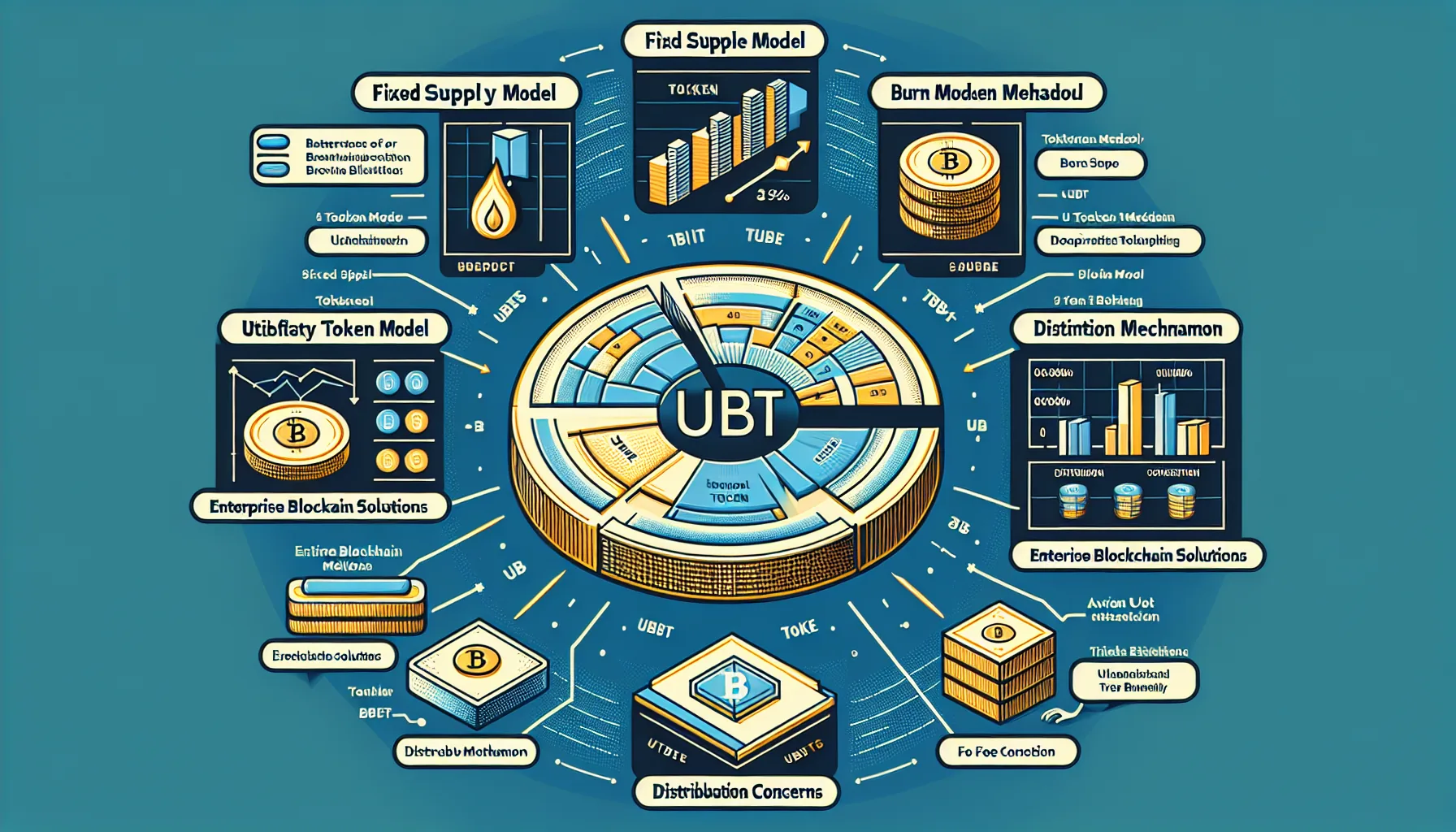
The Unibright Token (UBT) operates on a capped, fixed supply model with no additional tokens minted post-launch. This cap enforces scarcity but also presents challenges if adoption accelerates significantly, as token liquidity could be constrained. The token supply was pre-mined in its entirety upon launch, with initial allocations distributed to contributors, team members, and ecosystem development. This structure mitigates inflationary risks but creates dependency on effective circulation to prevent hoarding.
Utility-Driven Token Model
UBT’s tokenomics are intrinsically tied to its utility within the coordinated ecosystem. Unlike governance tokens or speculative assets, UBT primarily functions as a service token. Its role revolves around enabling access to tools, frameworks, and integrations within the blockchain enterprise solutions ecosystem, including Baseledger. However, the token model lacks a direct staking mechanism by itself; instead, token staking functionalities are integrated into broader network operations to address operational demand. Critics have pointed out that this indirect staking approach may dilute token valuation in utility-based scenarios where demand is inconsistent.
Burn Mechanism and Economic Impact
UBT employs a burn model to reduce supply over time. A portion of tokens can be removed from circulation based on usage fees and enterprise transactions within its ecosystem. While this deflationary mechanism theoretically increases token scarcity, it also introduces the potential risk of excessive burns eroding liquidity if enterprise activity scales quickly. Additionally, some in the crypto community have raised concerns about potential inefficiencies in aligning burn rates with adoption pace, warning that imbalances could undermine the token's long-term utility economics.
Token Distribution Concerns
A longstanding critique of UBT pertains to its distribution model. Early allocation mechanisms have concentrated token holdings among a limited group of owners, raising decentralization concerns. This centralization could amplify price volatility and undermine adoption potential in permissionless environments. While project builders defend this as a necessary structure for enterprise operations, it has left some participants skeptical about whether the distribution fosters truly equitable stakeholder engagement.
Fee Structures and Market Integration
Another critical component of UBT's tokenomics is its fee structure, which integrates the token directly into enterprise service models. Participants are required to transact in UBT for service fees tied to smart contract creation, integration frameworks, and Baseledger usage. While this creates a consistent use case for the token, it also exposes users to token price risks in volatile markets, potentially creating friction for enterprise adoption during fluctuations.
UBT Governance
UBT Governance: Decentralization, Decision-Making, and Challenges
The governance structure of the UBT crypto asset, central to the Unibright ecosystem, raises critical discussions around decentralization, stakeholder participation, and protocol upgrades. Like many utility tokens, UBT's governance mechanisms intersect with its use cases, but the framework it operates under is not without its challenges.
Governance Model and Stakeholder Roles
UBT governance, while not purely on-chain, is heavily influenced by the team behind Unibright and its broader community of users and enterprise partners. Decision-making often revolves around the progression of the token's utility within the Baseledger ecosystem, protocol optimizations, and partnerships with other blockchain-focused initiatives. While the concentrated involvement of the Unibright team ensures strategic alignment, it also places a substantial portion of the decision-making power in the hands of a central entity – a fact that has sparked debate about the degree to which UBT governance is decentralized.
Stakeholders, including enterprises leveraging Baseledger and individual UBT holders, have indirect influence on governance through their adoption and use of the ecosystem. However, the lack of a robust mechanism for token holders to propose or vote on changes can limit community engagement. This may discourage crypto-native users who prioritize decentralization and participatory models, potentially narrowing the token’s appeal in certain sectors of the blockchain space.
Off-Chain Governance Considerations
UBT’s governance skews toward off-chain decision-making, where discussions among core developers, enterprise partners, and the Unibright team play a crucial role. While this approach allows for streamlined coordination with enterprise participants, particularly those with compliance or performance requirements, it inadvertently creates opacity for individual token holders who may lack insight into these processes. Transparency mechanisms, such as regular updates or detailed governance roadmaps, could endear the team to more grassroots crypto users, but their absence has been a lingering criticism.
Challenges in Scaling Governance
A significant challenge in UBT governance is scalability. As Baseledger adoption grows, so will the diversity of stakeholders with competing priorities – enterprises, developers, and token holders alike. The current governance structure may struggle to accommodate such increasing complexity, particularly in balancing enterprise needs with crypto-native expectations for decentralization. Without adaptive changes or a clearer framework for participatory governance, misalignment across these diverse groups could hinder long-term cohesion.
In summary, UBT governance is a mixed model intertwined with the Unibright team’s strategic direction and enterprise participation. While effective for controlled decision-making, the lack of robust decentralized tools and community participation poses potential risks as the ecosystem matures.
Technical future of UBT
UBT Technical Developments and Roadmap: Current and Future Innovations
Unibright Framework Enhancements
One of the most notable technical components of UBT lies in its role within the Unibright Framework, a platform designed to simplify blockchain integration for enterprises. Recent developments focus on enhancing the framework’s smart contract lifecycle management tools. The workflow designer, which allows enterprises to create blockchain-based workflows without requiring deep technical knowledge, is undergoing improvements to support increased interoperability across various blockchains. These include Ethereum Layer 2 solutions and emerging enterprise-specific chains, such as Baseline-compatible networks.
However, questions remain regarding scalability. While the framework lowers the technical barrier for businesses, its performance when managing large volumes of concurrent smart contract executions has yet to be thoroughly stress-tested. For mission-critical operations, this could pose adoption challenges.
Baseledger Integration
The Baseledger blockchain, positioned as a complementary backbone to the Unibright ecosystem, continues to receive technical refinements. Powered by UBT staking and used for cost-efficient off-chain data anchoring, Baseledger aims to deliver enterprise-grade compliance. Future updates are expected to improve its privacy-preserving mechanisms, particularly through zero-knowledge proofs.
Baseledger's reliance on enterprise engagement, however, is a key challenge. Adoption may be limited by the slow pace of blockchain integration into larger companies. Technically, ensuring throughput and maintaining decentralization may also create friction unless its node structure scales appropriately.
Tokenized Workflow Monitoring
UBT’s critical role as a payment vehicle for monitoring tokenized workflows is another focal area for ongoing technical development. Upgrades to monitoring tools aim to provide real-time analytics and predictive operational metrics. This aligns with enterprise demand for deeper insights into blockchain workflows. Despite these advancements, questions persist about the degree of trust businesses place in decentralized monitoring solutions compared with conventional software-as-a-service platforms.
Future Roadmap
Unibright’s roadmap reveals planned technical upgrades that aim to improve both ecosystem efficiency and development flexibility. Key items include the introduction of more modular, reusable templates for smart contracts and advanced features to support NFT-based supply chain tracking. Developers are also working on compatibility bridges for other blockchains, signaling an intent to expand beyond the initial Ethereum-centric focus.
The roadmap’s ambition, while promising, could be hindered by the small team size supporting UBT’s ecosystem. As implementation timelines grow tighter, the need for resource scaling becomes increasingly critical to meet enterprise-level expectations. Without adequate staffing and community developer engagement, the ecosystem’s robustness may face long-term risks.
Comparing UBT to it’s rivals
UBT vs. QNT: A Focused Comparison
When comparing Unibright (UBT) to Quant Network (QNT), it becomes evident that while both projects target enterprise blockchain solutions, their approaches and core functionalities diverge significantly. These differences underscore not only their respective strengths but also potential limitations.
Architectural Approach
UBT operates as a connector for businesses aiming to adopt blockchain technology without the high cost, time, and complexity traditionally associated with it. Its low-code/no-code development platforms and integration frameworks allow enterprises to onboard and utilize blockchain technologies seamlessly, regardless of the underlying blockchain network. In contrast, QNT is built around its Overledger operating system. Overledger is highly focused on facilitating interoperability between varying DLTs (Distributed Ledger Technologies), aimed at enabling multi-chain applications (mApps). While UBT offers a toolkit for integrating blockchain into existing enterprise workflows, QNT’s strength lies in efficiently linking disparate blockchain networks together.
For enterprises focusing purely on interoperability challenges, QNT’s Overledger might appear as the more specialized solution. However, the broader applicability of UBT for blockchain adoption beyond multi-chain integration widens its potential use case.
Token Utility and Ecosystem Development
In terms of token utility, UBT is explicitly tied to its ecosystem processes. It plays an integral role in the workflows of the Unibright framework, such as tokenization, DeFi services, and enterprise adoption. Without UBT, much of the functionality within the system is inaccessible. QNT features a similar utility-driven token model, as developers and enterprises pay licensing fees in QNT to access its Overledger system. The differences, however, lie in market segmentation. UBT is often seen addressing specific niches like blockchain-based business process optimization, whereas QNT’s focus is broader, particularly with governments and large-scale finance systems aiming to unify fragmented networks.
Development and Adoption Challenges
One of UBT's potential drawbacks in comparison to QNT is limited visibility and branding, particularly in the enterprise DLT solutions space. QNT has effectively positioned itself as a major player in promoting cross-chain functionality, which has led to partnerships with prominent global entities. UBT, despite its compelling framework, has faced headwinds in achieving similar levels of brand recognition and adoption outside of technical circles. This presents a challenge for UBT as enterprises often weigh the perceived reliability of a solution before committing resources.
Secondly, the absence of a dedicated focus on cross-chain interoperability—although possible through partner-based integrations—can place UBT at a comparative disadvantage in markets where hybrid or multi-chain solutions are core requirements. While its modular architecture theoretically allows for interoperability, it lacks QNT’s direct emphasis on solving this pain point.
Both projects clearly address overlapping enterprise needs, yet the divergent technical emphases carve out unique strengths and weaknesses for UBT when juxtaposed specifically against QNT.
UBT vs HBAR: A Detailed Comparison
When evaluating Unibright (UBT) against Hedera Hashgraph (HBAR), certain key distinctions emerge in their technology, use cases, and ecosystem. While both are innovative players within the crypto space, they represent two very different approaches to blockchain and distributed ledger technology (DLT).
Technology and Architecture
One of the most striking distinctions is the underlying architecture. HBAR operates on the Hedera Hashgraph, a proprietary DLT that is not technically a blockchain but a hashgraph. This alternative structure allows Hedera to achieve impressive throughput and low latency, thanks to its asynchronous Byzantine Fault Tolerance (aBFT). On the other hand, UBT is built on Ethereum, using the core capabilities of Ethereum smart contracts combined with its own enterprise-ready tools like the Unibright Framework.
This fundamental difference introduces trade-offs. Hedera’s hashgraph structure is designed for speed and efficiency but operates under a patented governance model, which limits decentralized control. UBT, as an Ethereum-based solution, benefits from Ethereum’s decentralized nature and its established developer ecosystem but is bound by Ethereum’s scaling and gas fee challenges.
Enterprise Adoption
HBAR’s value proposition lies heavily in its enterprise-grade capabilities, including supply chain management, payments, and identity, all operating under the governance of its council, which includes prominent global companies. UBT also aims at enterprises, but its approach is dramatically different. The Unibright Framework focuses on simplifying blockchain integrations through templates, workflows, and an abstraction layer to reduce technical complexity for businesses.
A potential downside for UBT compared to HBAR is its reliance on Ethereum, which can introduce cost unpredictability during network congestion. HBAR, by comparison, offers consistent and extremely low transaction fees, which are a compelling advantage for businesses looking to avoid variable costs. That said, enterprises hesitant to adopt a semi-centralized solution like Hedera may favor UBT’s more decentralized approach, despite its limitations in performance during high network usage.
Ecosystem and Developer Support
Hedera has aggressively pursued partnerships and funding to build out its ecosystem, backed by its governing council. However, the closed-source nature of its technology could deter open-source developers. UBT, building on Ethereum, integrates into an ecosystem with one of the largest pools of developers in the blockchain industry.
There’s a stark philosophical divide here: Hedera prizes controlled innovation under centralized oversight, while UBT leverages the open and trustless qualities of Ethereum at the cost of scalability and fees. This divergence reflects fundamentally different ideals, catering to distinct subsets of enterprise clients.
Comparing UBT to LINK: Smart Contract Integration and Enterprise Adoption
When analyzing Unibright (UBT) in the context of Chainlink (LINK), an astute focus emerges on the nuances of smart contract middleware and their approaches to enterprise adoption. Both projects address the critical need for connecting blockchain frameworks to real-world systems, yet their execution methodologies and market positioning diverge significantly.
Decentralized Oracles vs. Enterprise Frameworks
Chainlink’s primary focus is its decentralized oracle network, which functions as a crucial intermediary to bring off-chain data to on-chain smart contracts. This critical service resolves the "oracle problem" by allowing smart contracts to interact reliably with external data sources. In contrast, UBT operates more as an enterprise-savvy framework solution, aiming to simplify blockchain adoption through tools like workflow modeling, tokenized solutions, and integration adapters. While LINK excels in its ability to serve decentralized ecosystems like DeFi and gaming platforms that require real-time, trustless data feeds, UBT’s focus is broader, targeting traditional enterprises with the aim of improving operational inefficiencies.
Adoption Barriers
One disparity lies in adoption hurdles. LINK has seen significant momentum in DeFi, where decentralized applications inherently require oracle services. For UBT, achieving traction among enterprises reliant on legacy systems has historically proven slower. Many enterprise-grade organizations remain hesitant to adopt blockchain due to operational upheavals, scalability concerns, or regulatory uncertainties. This puts UBT’s enterprise-focused approach at risk of stagnation compared to LINK’s wider adoption in decentralized environments, where adoption cycles tend to be quicker.
Token Utility and Ecosystem Development
A notable comparison exists in token utility. LINK’s token is required to pay node operators for oracle services, solidifying its role within an already burgeoning ecosystem. On the other hand, UBT serves multiple purposes: it acts as a means of payment for services like tokenization and workflow management, while also underpinning staking mechanisms in its Baseledger network. While UBT’s versatility points to a well-thought-out design, it arguably lacks the organic demand LINK drives from the DeFi space, which can give LINK a perception of more robust token economics.
Enterprise Partnerships and Brand Visibility
One challenge UBT faces is visibility. Chainlink has aggressively partnered with a broad array of projects across industries, from insurance to traditional finance, achieving a level of brand recognition that UBT has yet to match. UBT’s strategy has primarily centered around its enterprise framework stack, but that does not inherently generate the same media attention or hype cycle as LINK’s consistent stream of integration announcements.
In summary, while both UBT and LINK address blockchain connectivity in distinct ways, their market receptions, target audiences, and integration methodologies contribute to a clear differentiation in utility, use cases, and adoption trajectories.
Primary criticisms of UBT
Primary Criticisms of UBT: Key Challenges Facing Unibright
Limited Decentralization in its Ecosystem
One major criticism often directed at UBT revolves around the level of decentralization in its ecosystem. While blockchain purists value trustless systems, Unibright's model heavily relies on partnerships and centralized frameworks for enterprise adoption. This reliance raises questions about the integrity of the "decentralized" label it promotes. Although such an approach may suit large enterprises, it diverges significantly from the ethos of decentralization that underpins blockchain technology. Critics argue that this creates a middle ground where the benefits of both decentralization and centralization are partially realized but fall short of maximizing either.
Dependency on External Adoption
Another prominent issue with UBT is its dependency on external adoption. The token’s utility is deeply anchored to the success of enterprise integrations through its Unibright Framework, baseline protocol use cases, and affiliated products like Freequity. This high reliance on corporate adoption makes UBT disproportionately vulnerable to external factors such as slow enterprise blockchain adoption, organizational bureaucracy, and reluctance from traditional industries to transition into blockchain technologies. Consequently, skeptics view UBT as less of an independent ecosystem and more of a tool contingent on business-world variables outside the core crypto sphere.
Smart Contract Barriers for Small Projects
Unibright markets itself as an accessible solution for creating blockchain-based smart contracts without coding expertise. However, critics highlight that despite the promise of simplification, the platform's tools are primarily tailored to corporate-scale use cases. Smaller businesses or individual developers may find the initial onboarding complexity intimidating, even though lower-code options exist. Furthermore, the integration of UBT within enterprise processes often requires technical expertise beyond what many small-scale adopters possess, which ironically restricts it to primarily large organizations—counterintuitive for a project that emphasizes accessibility.
Token Usage Restrictions
The utility of UBT within its network has been critiqued for being overly gated to specific functions, such as smart contract creation, workflow tokenization, and transaction validation. Critics argue that these use cases, while significant, are relatively narrow compared to broader blockchain ecosystems offering more expansive token flexibility. Moreover, the token lacks diversified DeFi functionality—an aspect that has become near-essential for users looking for liquidity or passive income opportunities. This constraint potentially limits the token's appeal outside of its enterprise-specific niche.
Lack of Transparent Adoption Metrics
While Unibright puts significant emphasis on partnerships and tools offered, it provides limited transparency regarding measurable adoption success. Detailed data on active usage metrics, number of implemented workflows, or enterprise projects fully onboarded remain sparse. This lack of transparency fuels skepticism about the actual scale of engagement and adoption within the ecosystem, leaving room for doubt about the robustness of UBT's real-world impact.
Founders
Unibright (UBT) Founding Team: A Deep Dive
Unibright (UBT) was brought to life by a highly experienced team, largely composed of professionals with deep roots in business integration, blockchain solutions, and enterprise-grade software development. The project was founded by Marten Jung and Stefan Schmidt, who have over two decades of experience in the IT and consulting industries through their association with SPO Consulting GmbH, the firm that initially incubated Unibright.
Marten Jung: CEO and Blockchain Visionary
Marten Jung, the CEO of Unibright, plays a central role in defining the strategic direction of the platform. With a strong background in software architectures and process integration, Marten positioned Unibright to address the technical barriers enterprises face in adopting blockchain technology. However, criticism has surfaced in certain circles that he remains relatively low-profile compared to leaders in other blockchain projects, raising questions about Unibright’s ability to build external awareness and partnerships in a competitive crypto landscape.
Stefan Schmidt: CTO and Technical Strategist
Stefan Schmidt, Unibright’s CTO, complements Marten’s strategic vision with his technical leadership. Stefan has been a key driver behind Unibright’s no-code approach to blockchain adoption, which seeks to simplify creating blockchain-based solutions for enterprises. His work on the Unibright Framework demonstrates his expertise in integrating complex systems. However, skeptics have noted that the lack of a readily published roadmap in the early years of the project sometimes created ambiguity around his long-term technical strategy.
The Founders’ Connection to SPO Consulting GmbH
The founders’ affiliation with SPO Consulting marks one of the project’s most unique aspects. Leveraging SPO’s decades-long history in enterprise IT solutions, the Unibright team had a significant head-start in understanding real-world pain points enterprises face. Yet, it also raises concerns about whether Unibright might be too reliant on an outsourcing-first ethos, potentially limiting its ability to scale as a global blockchain solution provider.
Team Transparency and Communication Style
While the technical foundation of the Unibright team is undisputed, some crypto-savvy followers have pointed out that their communication style leans heavily toward targeting enterprise clients, often leaving retail token holders with less clarity around the token’s broader ecosystem role. This dichotomy in messaging has led to debates about whether UBT’s community-focused engagement needs improvement in comparison to other projects with more vocal founders.
Authors comments
This document was made by www.BestDapps.com
Sources
- https://unibright.io/wp-content/uploads/2018/04/Unibright_Whitepaper_2018.pdf
- https://unibright.io/
- https://github.com/unibrightio
- https://etherscan.io/token/0x5409ed021d9299bf6814279a6a1411a7e866a631
- https://medium.com/unibrightio
- https://cryptoslate.com/coins/unibright/
- https://coinmarketcap.com/currencies/unibright/
- https://www.coingecko.com/en/coins/unibright
- https://unibright.medium.com/unibright-and-the-baseline-protocol-c1bb811b2174
- https://twitter.com/unibrightio
- https://forum.unibright.io/
- https://www.baseline-protocol.org/
- https://www.linkedin.com/company/unibrightio/
- https://unibright.solutions/
- https://www.youtube.com/channel/UC4RgzdN6L1aWacA9ed1McWQ
- https://defillama.com/protocol/unibright
- https://icodrops.com/unibright/
- https://www.dash.org/forum/threads/unibright-u-form-smart-buyer-solutions-in-integrations.52269/
- https://www.cryptocompare.com/coins/ubt/overview
- https://www.block123.com/en/nav/469517570862.htm


