History of TRU
The History of TRU: Key Developments and Challenges
TRU, the native token of the TrueFi protocol, has undergone notable shifts since its inception. Originally launched as part of TrustToken’s expansion into decentralized finance (DeFi), TRU was designed to support an on-chain credit system that provided uncollateralized lending. This marked a move away from TrustToken’s earlier focus on tokenized real-world assets like TrueUSD (TUSD).
Early Development and Token Utility
At its launch, TRU played a central role in governance and staking within the TrueFi ecosystem. Lenders could stake TRU to participate in credit scoring, determining which borrowers received loans. This mechanism aimed to create a decentralized yet efficient model for capital deployment without requiring traditional collateral. However, the reliance on voter-based credit assessment introduced risks related to human decision-making and potential governance shortcomings.
The TrueFi protocol initially gained traction by offering institutional borrowers access to capital with competitive rates, attracting participants looking for yield in the DeFi space. Adoption among borrowers steadily grew, leading to periodic updates aimed at refining its financial infrastructure.
Market Cycles and Shifting Token Dynamics
Like many DeFi projects, TRU's trajectory has closely followed broader market cycles. Periods of high liquidity and bullish sentiment contributed to significant expansion, while downturns exposed structural risks. The protocol experienced challenges related to defaulted loans, particularly during broader crypto market corrections that pressured repayment abilities. These instances tested the resilience of the uncollateralized lending model and raised concerns about risk management.
Additionally, governance participation fluctuated as the token’s utility and perceived value evolved. Staking incentives were adjusted over time, impacting participation levels and affecting the overall security of the protocol’s decision-making mechanisms.
Structural Changes and Governance Evolution
As TrueFi matured, governance dynamics shifted with ecosystem developments. Control of the protocol gradually transitioned toward a more decentralized model, with proposals influencing lending policies, borrower vetting, and treasury management. However, like many DeFi governance systems, voter apathy and centralization concerns arose, sometimes leading to slower responses to critical issues.
TrueFi also explored expansions beyond its initial scope, including credit solutions tailored for institutional participants and partnerships aimed at scaling lending activity. Despite these efforts, maintaining sustainable growth within DeFi’s competitive landscape remained an ongoing challenge, particularly as regulatory scrutiny over uncollateralized lending increased.
TRU’s history reflects the complexities of merging traditional financial principles with decentralized infrastructure. While it enabled novel lending mechanisms, it also faced hurdles related to governance efficiency, borrower defaults, and evolving token utility. These factors collectively shaped the asset’s trajectory within the broader DeFi ecosystem.
How TRU Works
How TRU Works: Staking, Governance, and Utility
TRU as a Utility and Governance Token
TrueFi’s native token, TRU, plays a central role within the protocol, primarily facilitating governance and staking mechanisms. Governance is executed through TRU holders, who can vote on protocol upgrades, risk management policies, and borrower approvals. Since lending decisions in TrueFi rely on a combination of on-chain data and community assessment, TRU holders exert significant influence over how capital is allocated.
Staking TRU for Credit Risk Assessment
One of TRU’s core functions is staking to assess creditworthiness. Stakers delegate TRU to TrueFi’s staking pool, which serves as an economic backstop for uncollateralized lending. If a borrower defaults, the staked TRU is used to cover some of the losses, making staking inherently risky. The mechanism incentivizes participants to carefully evaluate borrowers to minimize delinquency rates. In return for the risk, stakers earn yields generated from lending activity, with rewards distributed in TRU and other applicable tokens.
TRU Incentives and Emissions
The protocol distributes TRU rewards to liquidity providers, stakers, and participants in governance. While these incentives helped bootstrap initial adoption, ongoing emissions contribute to inflationary pressure, potentially diluting token holders over time if usage growth does not absorb new supply. Governance plays a role in mitigating this by adjusting reward distribution and staking conditions.
Risks and Limitations
Several risks come into play when interacting with TRU. The staking model, while designed to provide a security layer, can result in significant losses for participants if defaults increase. The protocol’s reliance on decentralized governance means that decision-making efficiency can be inconsistent, particularly if voter engagement is low. Additionally, TRU’s value and utility are tightly connected to the growth and success of TrueFi’s credit markets. If borrowing demand declines or repayment rates drop, staking incentives and token utility may weaken.
Interaction With Other DeFi Protocols
TRU’s integration with broader DeFi infrastructure includes potential liquidity provisioning on decentralized exchanges, lending protocols, and staking incentives across multiple platforms. However, the depth of liquidity and accessibility can fluctuate based on broader market conditions and user engagement with TrueFi’s lending ecosystem.
Use Cases
TRU Token Use Cases
Governance in the TrueFi Ecosystem
TRU serves as the governance token for the TrueFi protocol, allowing holders to participate in decision-making processes. Users who stake TRU can vote on proposals, including changes to protocol parameters, onboarding new borrowers, and adjustments to the risk assessment model. Decentralized governance plays a crucial role in the protocol’s evolution, but voter apathy and the concentration of voting power among large stakeholders can impact the decision-making process.
Staking for Credit Assessment
TrueFi relies on a decentralized credit model where TRU stakers act as assessors for unsecured lending pools. By staking TRU, participants signal confidence in borrowers and influence which loans get approved. Stakers who make correct risk assessments can earn rewards, while those who back underperforming loans risk losing a portion of their stake. This creates a financial incentive for accurate credit evaluation but also exposes stakers to potential losses if defaults occur. The effectiveness of this model depends on collective diligence, making it vulnerable to manipulation or poor assessment if participation is low or if bad actors influence voting.
TRU in Borrower Incentives
Some borrowers in the TrueFi ecosystem receive TRU incentives for early participation, responsible repayment, or contributing to protocol growth. These incentives help bootstrap usage but may also introduce short-term sell pressure from recipients who liquidate rewards instead of holding or reinvesting in the ecosystem. Over time, the reliance on token incentives could diminish, but the role of TRU in borrower engagement will largely depend on protocol adoption and market conditions.
Liquidity Incentives and Yield Generation
TRU is used to incentivize liquidity providers who support the protocol’s lending pools. By supplying capital, liquidity providers can earn rewards in TRU alongside interest payments from borrowers. While these incentives help maintain liquidity, reliance on token emissions can lead to inflationary pressure and periodic rebalancing of reward models. As emissions decrease, the sustained participation of liquidity providers must rely more on organic borrower demand rather than token-based yield generation.
TRU Trading and Speculative Demand
Beyond its core utility in governance, staking, and liquidity provisioning, TRU is actively traded across exchanges, attracting speculative interest. Its price volatility can impact governance participation and staking behavior, as fluctuations affect the perceived risk and reward calculations for token holders. While trading activity increases exposure to the asset, speculation-driven demand is distinct from long-term utility-driven adoption, which remains dependent on the broader adoption of TrueFi’s decentralized lending model.
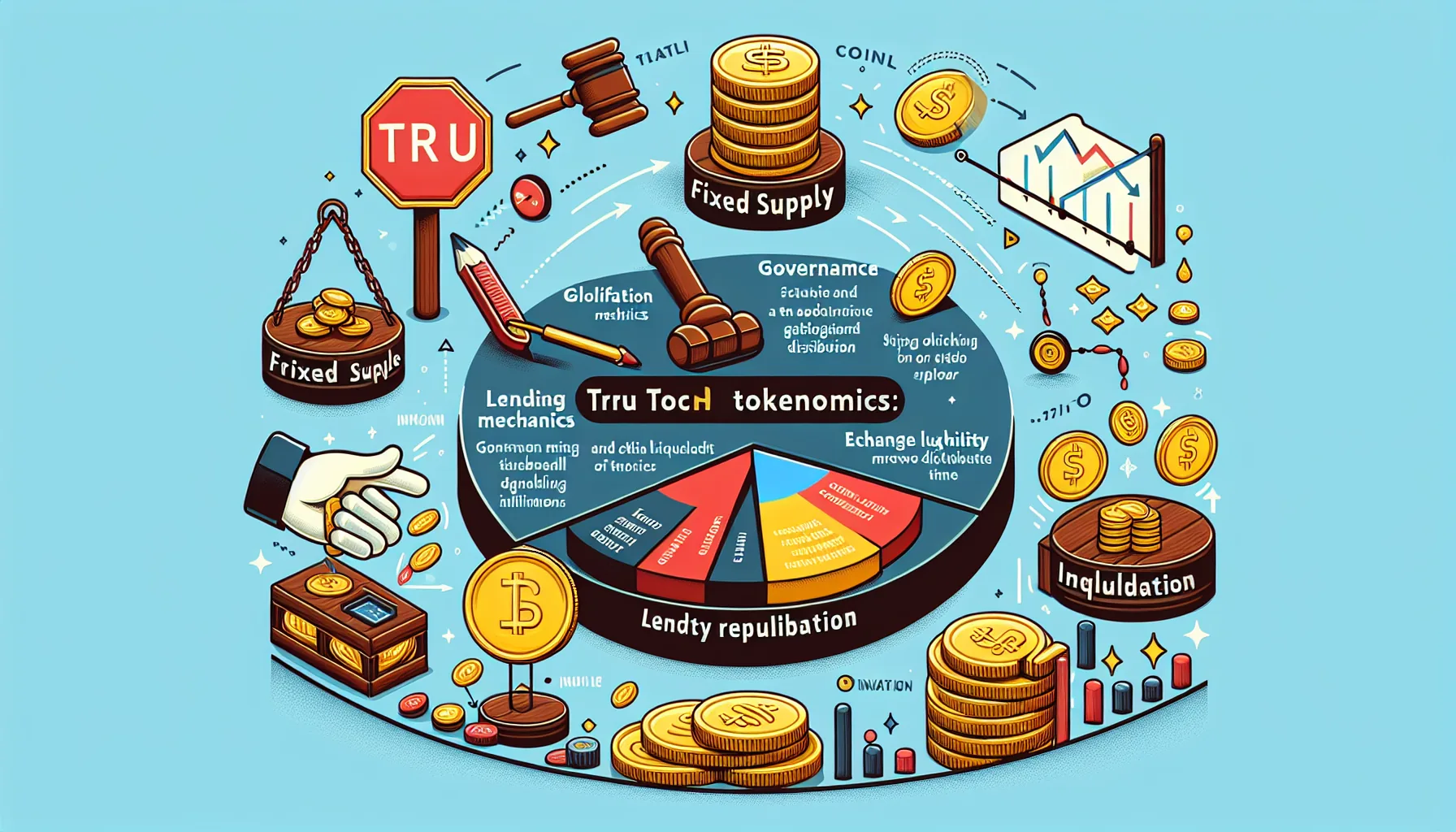
TRU Tokenomics
TRU Tokenomics: Supply, Utility, and Distribution
Fixed Supply and Token Distribution
The TrueFi (TRU) tokenomics model is built on a fixed supply framework, with a hard cap that ensures no additional tokens will be minted beyond the original issuance. A significant portion of the supply was allocated to early investors, team members, and treasury reserves, which has led to concerns about potential centralization risks. While vesting schedules were implemented to mitigate immediate selling pressure, the unlock dynamics remain a key factor influencing market sentiment around TRU.
Governance and Staking Incentives
TRU serves as the primary governance token of the TrueFi ecosystem, granting holders voting power over protocol upgrades, risk management decisions, and treasury allocations. Stakers play a crucial role in underwriting uncollateralized lending by providing a financial backstop against borrower defaults. However, staking rewards have fluctuated over time, sometimes creating misaligned incentives that could impact the long-term sustainability of participation.
Lending and Borrowing Mechanics
TRU is integrated into the TrueFi lending protocol, where it is used to reward liquidity providers and incentivize stablecoin deposits into lending pools. The token can be used to stake against borrower creditworthiness, theoretically improving protocol security. However, the reliance on TRU incentives to attract liquidity raises concerns about what happens when emissions taper off. If organic demand does not replace inflationary rewards, lender participation could decline.
Inflation and Reward Structures
While the token supply is fixed, TRU’s emissions follow a pre-set schedule that gradually decreases over time. Early participants benefited from higher staking and liquidity mining rewards, but as distributions slow, true utility adoption will be necessary to sustain demand. Any mismanagement of reward structures could lead to sell pressure when incentives run dry, a common challenge among DeFi protocols relying heavily on native token emissions.
Exchange Liquidity and Token Velocity
TRU is actively traded on both centralized and decentralized exchanges, contributing to its liquidity profile. However, trading volume has historically been dependent on broader DeFi trends and speculation around protocol growth. Token velocity—how frequently TRU changes hands—fluctuates based on reward cycles, governance participation, and lending demand, making its utility beyond speculation a key area of focus for long-term adoption.
TRU Governance
TRU Governance: Voting Power, Mechanisms, and Challenges
Governance Model and Voting Power
The governance structure of TRU is centered on token-based voting, where TRU holders can participate in decision-making processes. Governance typically involves proposals related to protocol upgrades, allocation of treasury funds, and other key operations. Token holders stake or lock their TRU to gain voting power, ensuring that those with a higher stake in the ecosystem have a greater influence over governance outcomes.
A significant aspect of TRU’s governance is how voting power is distributed. Unlike quadratic voting models that attempt to reduce the influence of large holders, TRU governance often follows a proportional weighting system, meaning higher token ownership correlates with increased decision-making authority. This structure can concentrate power among large holders or entities, which has both benefits in terms of efficiency and risks related to centralization.
Proposal Process and Execution
Governance proposals typically follow a structured process, starting with community discussions, formal proposal submission, voting, and eventual implementation. The proposal mechanisms may include time-locked execution or multi-signature approval to ensure proper vetting before changes take effect.
A critical factor within the governance system is voter engagement. Participation rates in decentralized governance often fluctuate, and lower turnout can result in governance decisions being influenced by a relatively small number of participants. This raises concerns about potential governance capture by well-coordinated groups or insiders who hold significant voting power.
Smart Contract Governance and Risks
TRU governance decisions are often executed on-chain via smart contracts, reducing the need for centralized intermediaries. This automation ensures transparency but also introduces risks. Poorly designed governance smart contracts can be exploited by attackers or used to push through controversial changes without broader community consensus.
Additionally, governance mechanisms relying on staking or locked tokens introduce liquidity trade-offs. Staking for governance may limit participants' ability to move their assets freely, leading to reduced engagement from traders who prefer flexibility. This shift could affect the quality of governance decisions if only long-term holders participate while active market participants disengage.
Concentration and Governance Centralization Risks
The governance model’s effectiveness ultimately depends on how evenly distributed TRU is among participants. If governance power overly concentrates in a few wallets, the risk of unilateral decision-making increases. This centralization can affect trust in the protocol, especially if major governance actions serve a narrow group’s interests rather than the broader ecosystem.
Governance centralization is an ongoing challenge for many crypto protocols, and TRU is no exception. Strategies like delegation of voting power, incentives for participation, or governance reforms could influence how governance evolves over time. However, structural imbalances remain a concern for stakeholders assessing the long-term decentralization of the protocol.
Technical future of TRU
TRU's Technical Roadmap and Future Developments
Smart Contract Enhancements and Security Audits
The TRU ecosystem continues to refine its smart contract infrastructure to improve efficiency and reduce vulnerabilities. Recent updates have focused on gas optimizations and improved modularity, allowing for easier upgrades without disrupting the network. However, security remains an ongoing concern, particularly given the broader history of exploits within DeFi. Continuous third-party audits aim to mitigate potential attack vectors, but any changes to core functionality still require rigorous testing before deployment.
Scalability and Layer-2 Integration
As on-chain activity grows, transaction costs and confirmation times have fluctuated. To address this, development efforts include evaluating Layer-2 solutions such as rollups and sidechains. While multi-chain compatibility remains a long-term goal, current Layer-2 integrations are limited to experimental phases, with no finalized implementation strategy. The challenge remains in balancing decentralization with the practicality of reduced fees and faster transaction execution.
Governance Improvements and On-Chain Voting
The governance model behind TRU is evolving to enhance participation and reduce potential centralization risks. Proposals to streamline voting mechanics aim to make decision-making more accessible to smaller stakeholders without compromising security. However, governance token concentration among large holders continues to be a point of discussion within the community, raising concerns about governance capture and potential resistance to protocol changes that favor decentralized decision-making.
Liquidity Optimization and Incentive Structures
Adjustments to staking mechanisms and liquidity mining incentives are in progress to enhance capital efficiency. Algorithmic tweaks to reward distribution models are being tested to discourage mercenary liquidity while maintaining competitiveness. One ongoing challenge remains sustaining long-term user engagement without excessive token inflation, which has historically eroded value in similar ecosystems.
Cross-Chain Expansion and Interoperability
Efforts to integrate TRU with cross-chain protocols are an essential focus area. Bridges to other ecosystems are under development, but security vulnerabilities in cross-chain interactions remain a key risk factor. The implementation approach prioritizes trust-minimized solutions, though trade-offs in transaction finality and cost efficiency continue to be explored.
AI and Data-Driven Enhancements
Emerging developments within the TRU ecosystem include AI-assisted analytics for capital allocation and risk management. While these enhancements aim to improve protocol efficiency, they also introduce concerns about dependency on external data sources and potential biases in algorithmic decision-making. The extent of AI integration remains uncertain, as its effectiveness depends on real-world testing and adoption metrics.
Comparing TRU to it’s rivals
TRU vs. LQTY: Decentralization and Utility Differences
When comparing TrueFi (TRU) and Liquity (LQTY), the most fundamental differences stem from their approaches to decentralization, utility, and token mechanics. While both projects operate within the DeFi lending space, their underlying models and implementations set them apart.
Collateralization Models: Unsecured vs. Overcollateralized
A defining distinction is in collateralization. TrueFi enables uncollateralized lending, making it unique among DeFi lending platforms that typically require over-collateralization. Borrowers on TrueFi are assessed based on on-chain and off-chain creditworthiness, allowing for capital-efficient loans without locking up excessive assets.
Conversely, Liquity’s model is entirely dependent on overcollateralized Ethereum-backed loans. Users deposit ETH to mint LUSD, a stablecoin pegged to USD, with a required minimum collateral ratio of 110%. This structure reduces counterparty risk compared to TrueFi’s uncollateralized lending but comes with liquidation risks during price volatility.
Token Utility and Governance: TRU vs. LQTY
The TRU token acts as the backbone for staking and governance on TrueFi. Stakers help underwrite loans and secure the lending protocol by assessing borrower creditworthiness. In return, they receive a share of lending yields. The protocol’s ability to maintain healthy credit markets depends on stakers making informed risk decisions.
On the other hand, LQTY is primarily used for fee capture and incentivizing stability. Liquity’s core mechanism includes LQTY rewards for early adopters, and fee redistribution favors long-term holders. Unlike TRU’s staking-based risk underwriting, LQTY does not actively participate in assessing credit risk but instead helps sustain platform liquidity.
Decentralization and Liquidity Mechanisms
Both protocols emphasize decentralization but take different approaches. Liquity is governance-minimized, meaning once deployed, no central entity controls adjustments to fees or collateral rules. This allows it to function autonomously but limits adaptability. TrueFi, in contrast, leans on governance participation using TRU, giving token holders a voice in the platform’s evolution.
Liquidity mechanisms also diverge. TrueFi relies on structured lending pools with specific underwriting rules, whereas Liquity utilizes a Stability Pool, where LUSD holders deposit funds to absorb liquidations. This creates fundamentally different risk exposures for participants in the two systems.
Risk Trade-Offs in Lending Structures
TrueFi’s reliance on uncollateralized lending introduces default risk, requiring stringent borrower assessments. Liquity’s overcollateralized structure prevents defaults but can lead to forced liquidations, especially during rapid ETH price declines. Each model presents trade-offs between capital efficiency and risk exposure, shaping how lenders and borrowers interact with the respective platforms.
TRU vs. TUSD: Key Differences in Utility and Collateralization
Collateralization Models: TRU's Risk vs. TUSD's Stability
One of the fundamental distinctions between TRU and TUSD lies in their collateralization models. TUSD operates as a fiat-backed stablecoin, with its value pegged to the U.S. dollar through reserves held in regulated financial institutions. This structure theoretically provides a strong safety net, making TUSD attractive for users who prioritize stability and regulatory oversight. However, reliance on centralized custodians introduces counterparty risk and potential points of failure, which have been concerns among decentralization advocates.
In contrast, TRU plays a role in a decentralized credit scoring and lending ecosystem, with utility far beyond mere value preservation. TRU is used to stake on borrower reputations, making it more speculative in nature. This introduces inherent risk, as the token’s function depends on the performance of borrowers in the ecosystem. Unlike TUSD, which retains a fixed peg, TRU's value can fluctuate significantly based on demand for decentralized lending and staking dynamics.
Regulatory & Centralization Trade-offs
TUSD's centralized nature means its compliance with regulatory frameworks is relatively straightforward. It is issued by entities that work directly with financial regulators, and its backing can be audited—though the transparency of these audits has sometimes been questioned. This centralization allows for potential blacklisting of addresses, limiting the utility of TUSD in censorship-resistant environments.
TRU, on the other hand, operates within a more decentralized framework, where token utility is dictated by its role in underwriting loans and assessing borrower creditworthiness. While this decentralization gives TRU a unique function in crypto lending, it also exposes it to potential regulatory scrutiny, especially as decentralized finance (DeFi) platforms come under increasing legal pressure. Additionally, the reliance on community governance for risk assessment means that TRU’s effectiveness is dependent on active participation, which fluctuates over time.
Liquidity & Market Adoption
TUSD benefits from wide exchange support and established liquidity, making it preferable for users who need quick conversions into fiat or other crypto assets. It is commonly used for trading pairs, stablecoin yield farming, and settlement due to its solid integrations across centralized and decentralized platforms.
TRU, however, is not designed to serve as a stable medium of exchange. Instead, its liquidity is largely influenced by demand within its decentralized lending environment. While it has a growing presence in DeFi, its trading volumes and market access are more niche compared to a widely recognized stablecoin like TUSD. This can lead to thinner liquidity, slippage in trades, and dependency on specific ecosystem growth rather than broad adoption across crypto markets.
TRU vs. FXS: A Comparative Analysis
Token Utility and Governance Differences
TRU and FXS both serve governance functions, but their influence and mechanics vary significantly. TRU is primarily used within the TrueFi ecosystem to facilitate decentralized credit assessment and governance decisions. Holders of TRU help determine borrower creditworthiness and contribute to risk assessments within TrueFi’s lending pools.
FXS, on the other hand, plays a central role in the Frax ecosystem, governing the Frax stablecoin protocol. Unlike TRU, which primarily governs a credit-focused DeFi platform, FXS influences multiple aspects of Frax’s algorithmic stablecoin issuance, collateralization ratios, and yield strategies. While both tokens exhibit governance utility, FXS has a broader scope, affecting liquidity strategies and fractional algorithmic stability mechanisms beyond lending.
Stability Mechanisms and Collateralization Models
One of the core divergences between TRU and FXS lies in their relationship to stable value assets. TRU is indirectly connected to TrueFi’s lending markets, where uncollateralized lending introduces credit risk assessments and capital efficiency tradeoffs. This contrasts with FXS, which is tied to a partially algorithmic, partially collateralized model for maintaining the Frax stablecoin’s peg.
FXS operates under the assumption that algorithmic mechanisms and incentives can regulate the price stability of the Frax token without requiring full collateralization. This approach, while capital efficient, has faced periods of instability, especially when confidence in algorithmic designs weakens. TRU, by focusing on decentralized credit scoring, shifts reliance toward credit markets rather than algorithmic stabilization. This distinction defines their risk dynamics—TRU’s risks stem from borrower defaults, while FXS navigates risks associated with algorithmic peg maintenance and liquidity balancing.
Liquidity and Market Dynamics Challenges
FXS benefits from integration with various DeFi strategies, allowing its value to be intertwined with Frax ownership and gauge mechanics across liquidity mining incentives. By contrast, TRU’s liquidity is more directly tied to TrueFi borrowing and lending activity. When lending demand fluctuates, TRU’s market positioning is more volatile due to credit cycles and borrower trust.
FXS holders interact with Frax’s ecosystem through veFXS staking mechanics, revenue-sharing incentives, and liquidity reward programs, fostering long-term holding behaviors. TRU, while also promoting governance engagement, faces a challenge in sustaining deep liquidity if lending activity declines. This fundamental difference in utility design leads to distinct demand pressures for both assets.
Primary criticisms of TRU
Primary Criticism of TRU
Centralization Concerns in TrueFi Governance
One of the most persistent criticisms of TRU revolves around the governance structure of the TrueFi protocol. While TRU holders can participate in governance, decision-making power remains concentrated among a limited number of stakeholders. This raises concerns about centralization, particularly in cases where major protocol changes depend heavily on a small group of token holders or affiliated entities. Critics argue that this undermines the decentralized ethos of DeFi, making the protocol more vulnerable to governance manipulation or unilateral decision-making.
Liquidity and Utility Challenges
Despite its role as the governance and staking token for TrueFi, TRU has faced scrutiny regarding its actual utility within the ecosystem. While staking and governance incentives exist, many users perceive limited real-world utility beyond speculative trading. This can lead to inconsistent demand, making the token highly dependent on market cycles rather than fundamental usage. Additionally, liquidity concerns arise during periods of low trading activity, which impacts both governance participation and the overall stability of the token within the ecosystem.
Reliance on Off-Chain Credit Mechanisms
TrueFi operates in the uncollateralized lending space, meaning capital efficiency is improved by removing the need for traditional collateral. However, critics argue that this approach introduces risk factors not commonly seen in fully on-chain lending protocols. Loan approvals often rely on off-chain creditworthiness assessments, which contradict the fully trustless nature of DeFi. The reliance on off-chain data sources and human-driven decision-making opens the door for potential misjudgments, opaque processes, or even lender defaults that can impact both borrowers and TRU stakeholders.
Competitive Pressure from Alternative Lending Protocols
The decentralized lending sector is highly competitive, with multiple protocols offering trustless or semi-trustless solutions for capital efficiency. TRU faces criticism for its ability to sustain long-term relevance in an ecosystem where alternative lending platforms may offer similar or superior loan structures. Protocols that incorporate decentralized identity verification, better risk assessment models, or fully on-chain transparency can overshadow the hybrid approach that TRU is associated with. This leads to ongoing skepticism about whether TrueFi can maintain an edge in an evolving DeFi landscape.
Regulatory Uncertainty and Institutional Risk
Given its focus on uncollateralized lending, TrueFi operates in a segment of DeFi that is highly susceptible to regulatory scrutiny. Critics point out that the protocol's reliance on loan agreements and partnerships with institutional borrowers makes it more exposed to potential legal frameworks that could restrict or reshape its operations. Any regulatory action affecting lending practices could impact the value proposition of TRU, adding an additional layer of unpredictability for token holders and ecosystem participants.
Founders
Founding Team Behind TRU: Key Players and Backgrounds
The TRU token is intrinsically tied to the origins and leadership of TrueFi, a decentralized lending protocol developed by TrustToken. The founding team played a pivotal role in establishing TRU’s tokenomics, governance, and early adoption within the decentralized finance (DeFi) ecosystem.
Rafael Cosman – Co-Founder and Former CEO
Rafael Cosman is one of the most recognized figures associated with TrueFi and TRU. Before his involvement in crypto, Cosman had a background in artificial intelligence and machine learning, having worked at Google. His expertise in data-driven financial systems significantly influenced TRU’s inception.
As one of the co-founders of TrustToken, Cosman positioned the platform as a bridge between traditional finance and decentralized lending. However, leadership transitions within TrueFi and the broader TrustToken ecosystem have led to evolving perspectives on the token's role. Cosman has since shifted his focus to new ventures, raising questions about the long-term vision and continuity of early TRU initiatives.
Co-Founding Team and Early Developers
Other key figures in TRU’s development include co-founders and early contributors with experience across fintech, cryptography, and blockchain infrastructure. While TrustToken initially gained recognition for its TrueUSD (TUSD) stablecoin, TRU was introduced later as a governance and staking mechanism for TrueFi’s uncollateralized lending protocol.
The founding team’s approach to risk management was a notable aspect of TRU’s early days. By leveraging on-chain credit scoring and decentralized governance, they aimed to differentiate TrueFi from overcollateralized lending protocols like Aave and Compound. However, this reliance on uncollateralized debt has also raised concerns about borrower defaults, risk exposure, and governance efficiency.
Challenges and Changes in Leadership
Over time, shifts in leadership and restructuring within the TrueFi ecosystem have led to strategic realignments. TrustToken's early success was largely attributed to the founding team’s efforts, but as decentralized finance evolved, adjustments were made to both the protocol and the token model.
A decentralized autonomous organization (DAO) structure was implemented to transfer decision-making power to TRU holders. While this aligns with the principles of decentralization, it has introduced challenges regarding governance participation, long-term sustainability, and protocol security. Some critics argue that the departure of original founders created uncertainty about consistency in TRU’s development roadmap.
The founding team’s expertise played a crucial role in TRU’s launch, but the ongoing evolution of TrueFi continues under new leadership and community governance, shaping the token’s trajectory beyond its initial vision.
Authors comments
This document was made by www.BestDapps.com
Sources
- https://truefi.io/
- https://docs.truefi.io/
- https://github.com/trusttoken
- https://whitepaper.io/document/582/truefi-whitepaper
- https://etherscan.io/token/0xA991356d261fbaF194463aF6DF8f0464F8f1c742
- https://coinmarketcap.com/currencies/truefi/
- https://www.coingecko.com/en/coins/truefi
- https://defillama.com/protocol/truefi
- https://dappradar.com/rankings/protocol/truefi
- https://twitter.com/TrueFiDAO
- https://medium.com/truefi
- https://discord.com/invite/truefi
- https://gov.truefi.io/
- https://snapshot.org/#/truefigov.eth
- https://messari.io/asset/truefi
- https://defipulse.com/truefi
- https://www.binance.com/en/trade/TRU_USDT
- https://support.kraken.com/hc/en-us/articles/360058703831-What-is-TrueFi-TRU-
- https://research.binance.com/en/projects/truefi


