History of TRB
TRB: A Deep Dive Into Its History
Tellor (TRB) was launched in 2019 as a decentralized oracle solution aiming to address the fundamental need for secure and reliable off-chain data, particularly within Ethereum's smart contract ecosystem. The project's inception was spearheaded by a team of blockchain experts, led by CEO Brenda Loya, who sought to tackle the centralization vulnerabilities that plagued existing oracle services. Unlike its competitors, Tellor proposed a decentralized, permissionless method where data reporters securely bring off-chain data into on-chain environments using trustless mechanisms.
The initial architecture of Tellor’s oracle system revolved around a competitive mining process. Data reporters mined TRB by submitting accurate data to the system, earning rewards in return. The protocol employed a dispute mechanism where any submitted data deemed erroneous could be challenged and voted on by TRB token holders, creating accountability. While this model was innovative, early adopters highlighted certain inefficiencies, including latency in dispute resolutions and scalability issues as the demand for diverse datasets grew.
One notable moment in TRB’s development history was the implementation of its staking system. Reporters were required to stake TRB tokens as collateral before submitting data. This move significantly reduced the submission of fraudulent data, as malicious actors stood to lose their stake if disputes were raised and ruled against them. On the flip side, questions were raised about the centralization tendencies this system might unintentionally introduce, given that larger holders with ample resources could dominate reporting activity.
As Tellor expanded its infrastructure, the introduction of the TellorX upgrade marked another pivotal chapter in TRB's evolution. The upgrade revamped core elements of the protocol, replacing the Proof-of-Work (PoW) model with a more efficient Proof-of-Stake (PoS)-based consensus mechanism, which reduced energy consumption while theoretically improving data submission scalability. While TellorX resolved many of the protocol’s earlier inefficiencies, it wasn’t without criticism. Detractors argued that the transition left room for potential centralization risks since well-funded entities could gain disproportionate influence by acquiring substantial TRB holdings.
Throughout its history, Tellor has grappled with challenges such as competition from larger oracle networks like Chainlink, which dominated early market share. Critics also pointed out that Tellor’s focus on Ethereum, while logical at the time, initially limited its adaptability to other blockchain ecosystems, necessitating later expansions. Despite these hurdles, the team’s commitment to decentralization has remained a driving force in shaping the project’s trajectory.
How TRB Works
How TRB Works: A Deep Dive into Tellor's Decentralized Oracle Mechanism
The TRB token powers the Tellor Oracle Network, a system designed to bridge decentralized smart contracts with off-chain data feeds. At its core, Tellor operates on a decentralized architecture where data reporters compete to provide data on-chain in exchange for TRB rewards. This incentive-driven mechanism ensures a steady supply of reliable data for smart contracts, but the system's design comes with complexities and unique challenges.
Central to Tellor's functionality is its mining-based dispute resolution protocol. Unlike traditional oracles, where a single centralized entity supplies data, Tellor relies on a network of independent reporters who compete to solve mathematical Proof-of-Work (PoW) challenges. These miners submit specific data points, such as price feeds, requested by smart contracts. The data is stored on-chain, enabling transparency and immutability.
A defining feature of Tellor’s system is its focus on security through economic incentives and penalties. To participate as a data reporter, users must stake TRB tokens as a security deposit. Bad actors risk losing their staked tokens if their submitted data is disputed and deemed invalid. Disputes can be initiated by any user in the network, and these are resolved via a decentralized voting process involving all TRB holders. While this mechanism enhances network security, it also introduces latency, as disputes require time to resolve.
Another limitation of Tellor's design is scalability. The protocol processes data points one block at a time, leading to delays in high-frequency data applications. For use cases such as decentralized finance (DeFi) protocols requiring rapid updates, this bottleneck may pose challenges. Additionally, the PoW mechanism, while robust for preventing Sybil attacks, inherits energy inefficiencies similar to those seen in early blockchain projects, raising concerns about long-term ecological impact.
Tellor’s fee model further impacts its usability. Data requesters must pay TRB tokens for submissions, creating a cost barrier for smaller applications. For systems requiring a high volume of data requests, these fees may accumulate, reducing economic viability and making it less competitive compared to alternative oracle solutions.
Despite these concerns, Tellor's fully decentralized architecture and focus on dispute resolution set it apart in the crowded oracle space. By ensuring data integrity through a distributed network and open governance, it targets users who prioritize decentralization over speed and cost-efficiency. However, understanding its trade-offs—slower processing times, energy concerns, and cost barriers—is critical for potential adopters considering TRB as their oracle solution.
Use Cases
TRB Use Cases: Exploring Tellor's Practical Applications
The Tellor (TRB) protocol is primarily designed to provide decentralized, trustless, and secure oracle solutions. This positions TRB within a critical niche in the blockchain ecosystem. As smart contract adoption continues to grow, the demand for reliable off-chain data feeds has surged, and Tellor addresses this need with its unique approach. Below we explore the primary use cases of TRB, as well as notable considerations.
Decentralized Data Validation for Smart Contracts
TRB serves as the native token of the Tellor oracle network, where its primary use case revolves around securing the reporting and validation of off-chain data. Smart contracts, inherently limited to on-chain information, rely on external oracles like Tellor to access real-world data such as price feeds, weather metrics, or economic indicators. Users incentivize data reporters (miners) to submit accurate information by offering TRB rewards. This incentive system ensures data quality while maintaining decentralization. However, scalability challenges arise with high transaction volumes, as miners must contend with potential bottlenecks in Ethereum gas fees.
Price Feeds for DeFi Protocols
In the decentralized finance (DeFi) space, Tellor is utilized to supply price feeds for various crypto assets, particularly for smaller cap tokens or exotic trading pairs. While competing oracles like Chainlink dominate larger markets, Tellor’s permissionless model makes it a viable choice for niche datasets or emerging DeFi protocols. That said, the system's reliance on dispute mechanisms for data integrity is both a strength and a weakness: while disputes reduce vulnerability to malicious reporting, they add latency to the resolution process, which can be problematic for real-time applications.
Increased Utility in Prediction Markets and Insurance Protocols
Blockchain applications such as prediction markets and parametric insurance rely on precise, tamper-resistant data inputs. Tellor offers a censorship-resistant oracle solution for reporting events like election outcomes or natural disasters. While this opens opportunities, these applications may expose limitations in Tellor's update frequency. In scenarios where rapid data updates are critical, Tellor’s block time-dependent submission process may create delays compared to more centralized options.
Governance and Dispute Resolution
Beyond its role in data provisioning, TRB also powers Tellor’s dispute resolution protocol. When incorrect data is suspected, TRB token holders can challenge the data’s validity by staking tokens to initiate a dispute. This governance model ensures decentralization in decision-making, but it introduces risks, including potential exploitation through economically motivated attacks (e.g., governance manipulation or collusion among large stakeholders).
Limitations in Cross-Chain Use
While Tellor's design is focused on Ethereum, growing demand for cross-chain data compatibility may pose an obstacle. The network's architecture is less nimble than some emerging multichain oracles, limiting its adoption in ecosystems like Cosmos or Solana. Although potential workarounds such as bridges exist, they come with significant risks, including centralization vectors and security vulnerabilities.
TRB Tokenomics
Tokenomics of TRB: Supply Dynamics, Utility, and Distribution Insights
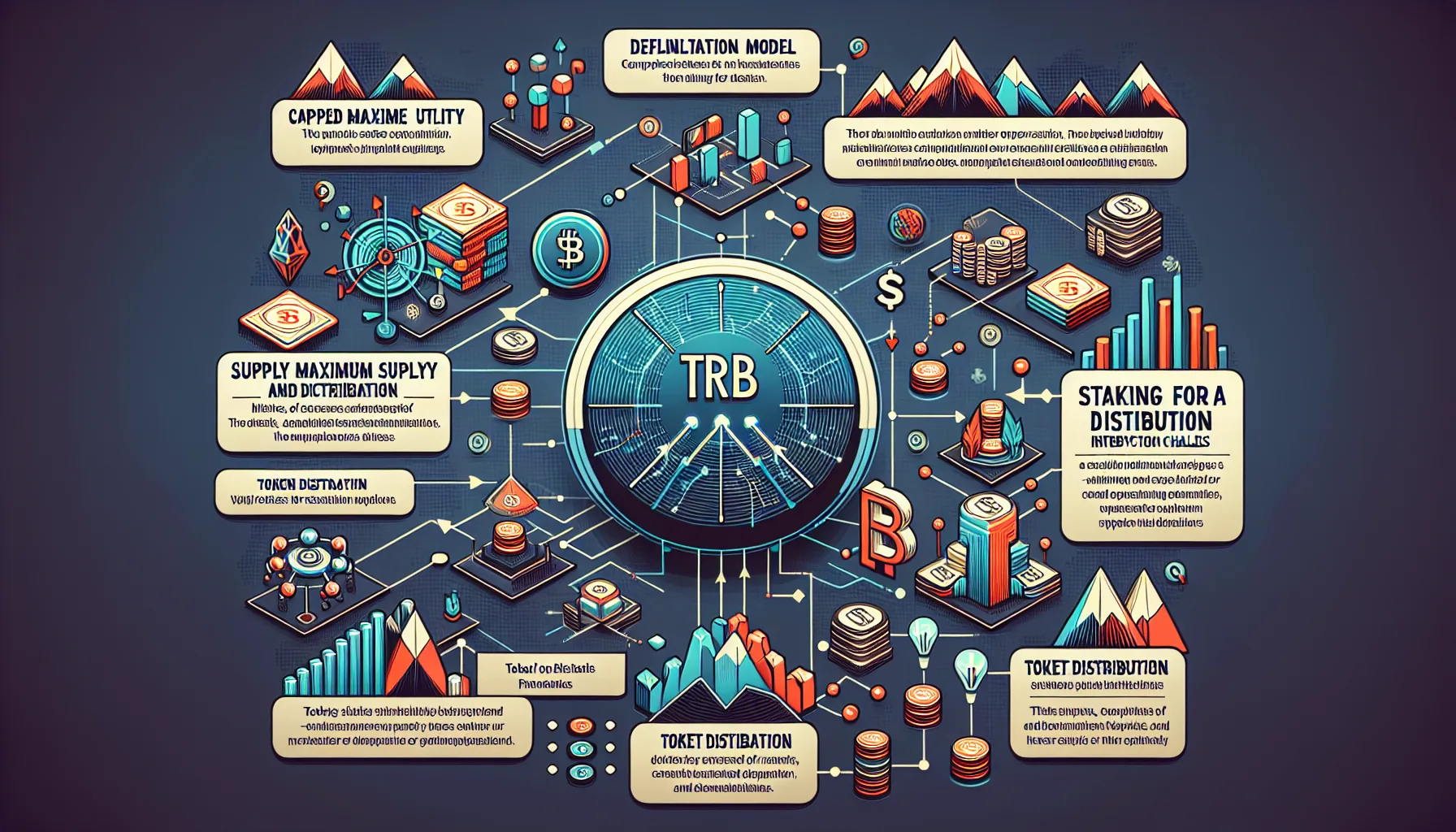
The tokenomics of TRB, the native asset of the Tellor network, are critical to understanding its role within the ecosystem. With a capped maximum supply of 2,400,000 tokens, TRB employs a deflationary model that adds scarcity as a potential factor in its valuation. However, the token supply mechanism and distribution structure elicit both advantages and challenges for the network’s operation and token holders.
Mining and Inflation Control
TRB’s generation mechanism is tied to its proof-of-work model. Miners who secure the network and validate oracle data submissions receive rewards. These rewards consist of a per-block payout combined with user-paid tips incentivizing accurate and timely data submissions. Notably, this system creates an ongoing emission of new tokens, albeit gradually declining over time as inflation slows. While this structure supports network security, it can dilute existing token holdings, particularly for non-participating holders if demand doesn’t scale proportionately.
Staking for Participation
Oracle reporters must stake TRB to participate in Tellor’s data reporting system. This staking introduces a direct utility for TRB, linking the token to the reliability and security of the network. The economic staking model, however, raises questions about accessibility for smaller participants. If the token’s value becomes prohibitively high, it may lead to centralization risks, where only well-capitalized entities can afford the financial barrier to entry. Conversely, if the token price declines, the value at stake may insufficiently disincentivize malicious actors.
Token Distribution and Challenges
The initial distribution employed a fair-launch mechanism without pre-mining or initial coin offerings (ICO), which limits early centralization risks often associated with pre-sale allocations. However, TRB’s distribution has since evolved, and a significant supply is now held on exchanges and within liquidity pools. Concerns arise regarding potential centralization if large amounts of TRB are consolidated in a small number of wallets, whether by exchanges, institutions, or entities controlling large mining or staking operations. Such centralization can reduce decentralization and increase the likelihood of governance manipulation.
Fee-Based Ecosystem Integration
Another factor influencing TRB's tokenomics is its role in a fee-based system. As data consumers pay for oracle services in TRB, the token is functionally integrated into the network’s utility. Still, this reliance on demand-driven utility exposes the token to cyclic market usage patterns, which can impact its value stability and, by extension, its broader network incentive alignment.
TRB’s tokenomics reflect a carefully engineered balance between utility, decentralization, and supply control, but ongoing developments and ecosystem dynamics will continuously test that balance. Proper governance and a keen awareness of potential centralization risks remain key to maintaining its foundational principles.
TRB Governance
TRB Governance: Mechanisms and Challenges in Decentralized Decision-Making
The governance structure of Tellor (TRB) represents a foundational component of its decentralized oracle network. Designed to foster community-driven decision-making, TRB governance revolves around both protocol upgrades and dispute resolution. However, while its mechanisms are robust in theory, certain challenges remain that could impact the efficacy of its decentralized approach.
On-Chain Voting and Community Participation
Governance in TRB is executed via an on-chain voting mechanism. Stakers of TRB tokens have direct voting rights, allowing them to influence the network’s evolution by proposing and approving changes. This democratic participation model ensures decisions are decentralized and aligned with the token holders’ consensus. Proposals typically require a quorum threshold and a majority of affirmative votes to be implemented, which protects against rushed or haphazard developments.
A notable challenge in this framework is the potential for voter apathy, a common issue in decentralized governance. Low participation rates could lead to governance decisions being controlled by a disproportionately small group of large holders, creating concerns about centralization of power—a dynamic that may conflict with Tellor's core ethos of decentralization.
Dispute Resolution in TRB’s Oracle System
A unique aspect of Tellor’s governance lies in its dispute resolution process. If a data point submitted by a reporter is flagged as inaccurate or malicious, community members can open disputes by staking TRB tokens. The resolution of a dispute is then decided by a vote among stakers, incentivizing accurate participation since the losing party forfeits their stake.
While the dispute mechanism discourages malicious reporting, it is not immune to weaknesses. For instance, it relies heavily on rational behavior from TRB stakers. Should governance participants collude to favor one side of a dispute, or if the economic incentives to vote correctly are inadequate, the system could become vulnerable to exploitation. Additionally, disputes require timely attention from the community, meaning unresolved disputes could result from low voter engagement, further illustrating the issue of participation.
Plutocracy Risks in TRB Governance
As in most token-based governance models, there is an inherent risk of plutocratic influence within TRB governance. Large TRB token holders can disproportionately shape the network’s direction, which might undermine smaller stakeholders’ voices. This dynamic raises questions about how equitable the governance process truly is and whether additional measures, such as quadratic voting, could mitigate these risks.
The tension between decentralized ideals and the practical limitations of token-weighted governance is a persistent challenge in TRB’s governance model, and one that continues to shape discussions within its community.
Technical future of TRB
TRB: Current and Future Technical Developments and Technical Roadmap
Upgrade to Tellor v2 Protocol
One of the pivotal technical advancements in the TRB ecosystem has been the rollout of the Tellor v2 protocol, which improved the network’s data-requesting and oracle mechanisms. By incorporating an optimized dispute resolution process, the upgrade reduced latency in handling data disputes, resulting in faster data provisioning for on-chain use. The v2 version also prioritized gas efficiency for reporters, addressing scalability issues and lowering operational costs for users. However, some developers argue that more granular customization of dispute parameters could further enhance versatility in diverse use cases, something that remains unaddressed.
Ethereum Layer-2 Integrations
Recent developments have expanded TRB's presence to Ethereum Layer-2 scaling solutions, including optimistic and zk-rollup ecosystems. This move seeks to address the well-documented challenges of high gas fees on the Ethereum mainnet, fostering broader adoption of Tellor’s decentralized oracle systems. While this marks a step forward in affordability and accessibility, the current implementation has limitations in cross-layer interoperability and arbitrary data relay back to the Layer-1 network, a technological bottleneck the team will need to resolve in future updates.
Community-Driven Reporter Enhancements
The Tellor network leans heavily on its reporter system—independent actors who submit data on-chain. A critical technical improvement under consideration is the introduction of algorithmic tooling to enhance reporter efficiency and data validity. Although promising, this initiative has sparked debate over whether automation might introduce centralization risks, particularly if certain algorithm providers monopolize the network. Furthermore, a lack of standardization in reporter workflows continues to create barriers for new participants, limiting the network's diversity and operational resilience.
Decentralized Upgrades and On-Chain Governance
The technical roadmap includes plans to strengthen on-chain governance mechanisms, potentially moving toward a more autonomous protocol upgrade system. Current governance relies heavily on active community participation, which while decentralizing decision-making, has also led to slower progress in enacting time-sensitive adaptations. A future governance module design might incorporate quadratic voting or bonding curves to weigh stakeholder interests more effectively.
Enhanced Data Privacy Features
Privacy enhancements are gaining traction as TRB pivots towards catering to DeFi protocols requiring sensitive or restricted data. While encrypted data submissions and retrieval mechanics have been conceptualized, these remain in early stages of technical implementation. Open questions about performance trade-offs and compatibility with existing blockchains are yet to be answered, indicating that data privacy is a longer-term goal.
Comparing TRB to it’s rivals
TRB vs LINK: A Comparative Analysis
When evaluating TRB (Tellor) alongside LINK (Chainlink), it’s crucial to dig into the nuanced differences in their approaches to decentralized oracles. While both projects operate within the critical niche of providing off-chain data to smart contracts, their philosophies, mechanisms, and scalability solutions diverge significantly.
Consensus Mechanisms and Decentralization
One standout difference lies in the consensus mechanisms employed. TRB uses a Proof-of-Work (PoW)-based dispute and validation system for its oracle network, where data reporters compete to solve challenges and submit accurate information. This structure inherently prioritizes decentralization by resisting censorship and maintaining a trustless relationship among users and reporters. On the other hand, LINK utilizes a reputation-based model within its oracle network, where node operators must maintain a reliable performance history to remain competitive. While LINK's approach favors speed and operational efficiency, it raises questions about the potential centralization of its trusted node operators over time.
Cost Structures
A significant difference in cost structures is the requirement for participants to stake LINK tokens within the Chainlink network. This staking model aligns incentives for accuracy and reliability but adds financial barriers for smaller-scale contributors. In contrast, TRB eliminates staking requirements, instead relying on a reward-based system determined by market dynamics, which can lower entry obstacles for new data reporters. However, it’s worth noting that TRB's reliance on gas fees paid in ETH might make operating within the network less cost-effective during periods of high Ethereum network congestion.
Data Delivery and Speed
In terms of responsiveness and speed, LINK has built a reputation for offering near-instantaneous data delivery due to its robust infrastructure and partnerships with enterprise-level clients. Meanwhile, TRB's reliance on its dispute-based validation ensures accuracy and integrity at the cost of longer data retrieval times. For applications requiring real-time updates, this slower process could be a bottleneck, limiting TRB’s appeal in speed-critical environments like high-frequency trading.
Ecosystems and Adoption
Finally, the ecosystem around LINK is significantly larger. Chainlink nodes and integrations span a wide array of DeFi, gaming, and enterprise applications. This wide range of partnerships has created network effects that are difficult for smaller rivals such as TRB to replicate. While TRB has carved out a niche by emphasizing its robust security model, its smaller community and narrower adoption could hinder its broader appeal.
TRB vs. BAND: Key Differences in Oracles for Decentralized Data
When comparing Tellor (TRB) to Band Protocol (BAND), it becomes evident that while both are classified as decentralized oracle networks, they present distinct differences in architecture, scalability, and market positioning. For those immersed in the intricacies of blockchain infrastructure, the comparison reveals deeper nuances about their approaches to decentralized data provisioning.
Validation Processes: Rules vs. Customization
Tellor operates through a mechanism where miners compete to submit off-chain data, which is then validated by its staked ecosystem participants. This proof-of-work-like model prioritizes a trustless and highly decentralized validation system. In contrast, Band Protocol takes a more streamlined, customizable approach by leveraging the Cosmos-SDK and Tendermint consensus. BAND's design enables dApps and smart contracts to create bespoke oracle scripts, making it appealing for projects with unique and highly specific data needs. However, this customization could introduce a layer of centralization risk, as data providers might gain disproportionate control if not audited meticulously.
Query Speed and Throughput
One of the standout capabilities of Band Protocol is its higher throughput for oracle queries, thanks to its interoperable architecture and robust block finality mechanism. By moving data aggregation and computation to its dedicated blockchain, Band enables efficient querying and lower latency, making it better suited for high-frequency use cases like DeFi derivatives or prediction markets. In comparison, Tellor's reliance on periodic on-chain data submission might appear slower under transaction-heavy conditions, which could limit its effectiveness in scenarios demanding near-instantaneous updates.
Cross-Chain Functionality
Band Protocol has made significant strides in being interoperable across multiple blockchains. Its integration with cross-chain communication protocols like IBC (Inter-Blockchain Communication) gives it an edge in supporting a diverse ecosystem beyond Ethereum, such as Binance Smart Chain, Cosmos, and others. While Tellor has expanded beyond Ethereum by enabling deployment on multiple chains, its adoption in cross-chain environments has not reached Band's level of breadth or adaptability. This difference positions Band as a more attractive solution for multi-chain projects, though Tellor's simpler model could be more desirable for Ethereum-centric applications.
Decentralization Trade-offs
While both TRB and BAND emphasize decentralization, Band's use of delegated proof-of-stake (dPoS) for its consensus mechanism inherently introduces centralization risk stemming from validator concentration. In scenarios where validators operate collusively or are captured by external forces, data accuracy could be compromised. Tellor’s more grassroots, miner-based dispute model is arguably more robust against centralization attacks, though it comes at the expense of scalability.
Security Assumptions
Security models also diverge. Tellor’s reliance on staked collateral for dispute resolution creates a robust economic disincentive for malicious actors. Band Protocol, however, utilizes slashing for validator misbehavior but remains susceptible to potential vulnerabilities arising from its reliance on a smaller pool of validators compared to the open-ended participation model Tellor embraces. This difference could lead crypto-savvy users to question whether BAND sufficiently mitigates risks in high-value data environments.
This nuanced comparison of TRB and BAND highlights their distinct strengths and vulnerabilities, offering projects a clear delineation for choosing between scalable customization or absolute decentralization in oracle solutions.
Comparative Analysis: TRB vs. DIA in Decentralized Oracle Solutions
When comparing Tellor (TRB) to DIA (Decentralized Information Asset) in the competitive decentralized oracle marketplace, key distinctions arise in approach, architecture, and targeted use cases. Both projects aim to provide reliable and tamper-proof off-chain data for smart contracts, yet their methodologies differ significantly, highlighting strengths and potential limitations in each.
TRB takes a permissionless, miner-driven approach, leveraging a proof-of-work (PoW) mechanism for data validation. This decentralized structure prioritizes censorship resistance and minimization of trust, as data is sourced and verified by a network of competing miners before being made available on-chain. In contrast, DIA adopts a slightly more centralized architecture for its data sourcing and aggregation, often relying on institutional collaboration to secure off-chain data feeds. While DIA's method can enhance data quality and reliability, it introduces questions surrounding centralization risks, particularly when handling critical integrations or relying on a limited set of institutional providers.
Another key area of differentiation lies in governance and community involvement. TRB operates through a community-driven model where token holders play a decisive role in network upgrades and dispute resolutions. By requiring token staking for participation in the data submission process, TRB creates decentralized incentives while also exposing users to specific barriers, such as higher entry costs due to network fees and token demand. DIA similarly integrates governance, but its emphasis on partnerships with traditional financial entities shifts its focus toward hybrid ecosystems, potentially alienating more decentralized-focused adopters in the Web3 space.
From a technical perspective, DIA provides highly customized datasets by aggregating data through multiple sources, including APIs, traditional financial databases, and individual contributors. This flexibility enables DIA to cater to a broader range of domains, particularly those requiring extensive traditional financial data coverage. However, this flexibility comes at the expense of increased complexity, which may contribute to slower response times or potential bottlenecks in oracle performance. On the other hand, TRB’s narrower focus on a permissionless mining model makes it more predictably scalable but less tailored to niche datasets.
Finally, in terms of ecosystem integrations, DIA demonstrates a strategic focus on building partnerships with centralized finance (CeFi) and traditional financial systems, allowing it to bridge the gap between Web2 and Web3 ecosystems. While this cross-sector ambition broadens its appeal, it risks alienating purists within the decentralized finance (DeFi) space. TRB, by comparison, maintains a more DeFi-centric approach—an advantage for projects looking to preserve maximum decentralization but a potential drawback for those seeking institutional-grade data solutions.
Primary criticisms of TRB
Primary Criticism of TRB: Challenges and Concerns Surrounding Tellor’s Ecosystem
TRB (Tellor), despite its innovative approach as a decentralized oracle solution, has faced several criticisms from the crypto community. These critiques are primarily centered on concerns about scalability, security, network centralization risks, and economic vulnerabilities within the protocol.
Scalability and Network Efficiency Concerns
One of the key criticisms of TRB is its scalability limitations, especially as the network expands and demands on its infrastructure grow. The design of the Tellor protocol involves a competitive mining process where data reporters compete to provide reliable off-chain data to smart contracts. While this ensures decentralization, it can lead to delayed data responses when transaction volumes surge. This latency can be particularly problematic for decentralized finance (DeFi) applications that require real-time or near-instantaneous data updates. Critics argue that as blockchain ecosystems scale, Tellor's reliance on slower dispute-resolution processes creates bottlenecks that hinder its ability to serve a broad range of high-frequency use cases.
Centralization Risks in Data Submission
Another concern revolves around the potential for centralization in data submissions. While Tellor markets itself as a decentralized oracle, its network design allows miners with greater resources and TRB holdings to disproportionately influence which data is submitted and rewarded. This creates a scenario where wealthier participants could exert a semi-centralized control over critical off-chain data inputs. Such dynamics may lead to an imbalance of power within the ecosystem, raising questions about the oracle’s commitment to true decentralization over the long term.
Economic Vulnerabilities and Incentive Misalignment
The TRB tokenomics model is also criticized for its perceived vulnerabilities. The cost to dispute a potentially manipulated data point must outweigh the financial reward for dishonest reporters. However, in cases where the value of the data being exploited is significantly higher than the cost of disputes, bad actors might still find manipulation economically viable. This imbalance could expose the protocol to both sabotage and malicious behavior, particularly in high-stakes markets. Furthermore, critics worry that reporter incentives might erode over time if TRB token rewards fail to remain competitive against alternative oracle solutions.
Security Challenges and Attack Vectors
Finally, the security of Tellor's oracle network has been questioned due to its susceptibility to subtle attack vectors. The competitive mining system is vulnerable to collusion among miners, 51% attacks, and other exploit scenarios, especially in cases where network participation is low. Although the protocol has implemented mechanisms like dispute resolution to mitigate attacks, these processes are reactionary and can fail to prevent economic damage before it occurs.
In summary, while TRB offers an innovative take on decentralized oracles, the protocol’s scalability constraints, centralization risks, incentive misalignments, and security challenges remain points of contention within the crypto community.
Founders
The Founding Team Behind Tellor (TRB): Expertise and Questions of Decentralization
The foundational team behind Tellor, the decentralized oracle solution that powers the functionality of the TRB token, has made its mark through a blend of technical expertise and early adoption of decentralized finance principles. Tellor was founded in 2019 by a team with a focus on addressing the “oracle problem,” that is, bridging the gap between off-chain data and on-chain smart contracts in a reliable way that resists manipulation. However, like many projects in the blockchain space, the team’s early involvement raises some questions around decentralization and transparency.
The co-founders of Tellor, Brenda Loya (CEO) and Michael Zemrose, come from strong tech and crypto backgrounds. Loya has experience in building scalable blockchain solutions, with a focus on decentralized mechanisms that ensure trustless data aggregation. As CEO, she has frequently advocated for transparency and security in DeFi. Zemrose, on the other hand, has roots in engineering and product development but mostly operates in a support role. Notably, the team also initially included Nick Fett, a smart contract developer with a background in data science and financial modeling. Fett’s technical contributions were significant in crafting Tellor’s Unique Selling Propositions (USPs), as he was instrumental in designing the original staking and mining mechanics of the TRB ecosystem. However, Fett later stepped back from day-to-day involvement, which some critics argue could leave gaps in leadership continuity.
A key area that crypto-savvy stakeholders should examine is the relatively small founding team when compared to competing projects with larger, diversified groups. This compact structure allowed Tellor to remain agile during its early years, but it inevitably places a higher reliance on the founders to deliver. While this tight-knit team structure can expedite decision-making, it also poses potential risks in terms of over-reliance on a handful of voices, which might limit broader community input or raise concerns about centralization around a few key figures.
Additionally, communication between the founding team and the community has occasionally drawn scrutiny. Some claim that despite their commitment to decentralization, certain key roadmap decisions were made in ways that seemed opaque. On the plus side, the team has taken measured steps to address these criticisms, especially through engaging the DAO mechanisms to progressively shift responsibility to the token-holding community.
Whether the founding team’s compact size proves efficient or encumbering remains an open-ended debate, particularly as Tellor continues to decentralize and scale.
Authors comments
This document was made by www.BestDapps.com
Sources
- https://tellor.io/
- https://github.com/tellor-io/TellorCore
- https://docs.tellor.io/tellor/
- https://etherscan.io/token/0x0ba45a8b5d5575935b8158a88c631e9f9c95a2e5
- https://coingecko.com/en/coins/tellor
- https://coinmarketcap.com/currencies/tellor/
- https://blog.tellor.io/
- https://medium.com/tellor
- https://discord.com/invite/tellor
- https://defillama.com/protocol/tellor
- https://github.com/tellor-io/TellorImprovementProposals
- https://twitter.com/WeAreTellor
- https://tellor.io/whitepaper/
- https://docs.tellor.io/tellor/economics/tokenomics
- https://docs.tellor.io/tellor/security/security-overview
- https://gov.tellor.io/
- https://github.com/tellor-io/telliot
- https://nansen.ai/almanac/tellor-trb
- https://dune.com/explore/dashboards/tellor
- https://messari.io/asset/tellor


