History of TRAC
Origin and Development of the TRAC Token
The history of TRAC (OriginTrail) dates back to its initial conception as a blockchain-based supply chain solution. OriginTrail was founded with a vision of creating a decentralized knowledge graph to improve transparency and interoperability in global supply chains. The project gained traction within enterprise and logistics sectors, aiming to address inefficiencies in data provenance, traceability, and verifiability.
Initial Token Sale and Network Launch
TRAC’s journey began with its token sale, which garnered attention among early blockchain adopters interested in supply chain solutions. The funding allowed the team to build out the OriginTrail Decentralized Network (ODN), designed to facilitate trusted data exchange across multiple industries. Following its launch, TRAC was deployed on the Ethereum network as an ERC-20 token, ensuring compatibility with existing blockchain tooling and infrastructure.
Key Upgrades and Network Expansions
Over time, OriginTrail introduced several upgrades to enhance TRAC’s functionality. The transition from a singular focus on supply chain management to a broader decentralized knowledge graph marked a critical shift in the project’s scope. This evolution positioned TRAC as a tool for structuring and verifying data across industries beyond logistics, such as healthcare, real estate, and Web3 applications.
The team also worked on interoperability solutions, allowing TRAC to function across multiple blockchain ecosystems, including Ethereum and Polygon. Enhancements in token utility and network governance helped drive increased decentralized adoption. However, challenges in onboarding large enterprises, regulatory concerns, and competition from other blockchain-based data solutions occasionally posed obstacles to widespread integration.
Challenges and Controversies
Like many blockchain projects, TRAC faced hurdles in mainstream adoption. Despite delivering a technically sound platform, shifting enterprise mindsets toward decentralized solutions proved to be a slow process. Regulatory uncertainty also played a role, with questions surrounding the classification of blockchain assets and potential compliance requirements.
Additionally, TRAC’s reliance on Ethereum presented issues related to network congestion and high transaction fees during peak usage. Although alternative layer-2 solutions and sidechains were explored to mitigate these challenges, scalability concerns remained a key discussion point within the community.
Evolution Toward a Decentralized Knowledge Graph
The expansion from a supply-chain-specific blockchain to a broader decentralized knowledge graph redefined TRAC’s trajectory. This transformation allowed the network to attract developers and enterprises looking for structured, verifiable data in various sectors. Despite growing competition from other decentralized data networks, TRAC continued positioning itself as a protocol facilitating Web3 data integrity and knowledge dissemination.
How TRAC Works
How TRAC Works: The Underlying Mechanics of the OriginTrail Network
TRAC is the native utility token of the OriginTrail Decentralized Knowledge Graph (DKG), a network designed to enhance the discoverability, verifiability, and interoperability of structured data. The protocol utilizes TRAC for staking, incentive alignment, and data exchange, ensuring the integrity of decentralized knowledge.
Decentralized Knowledge Graph and Data Anchoring
At its core, OriginTrail functions as a Decentralized Knowledge Graph (DKG), enabling entities to organize and verify structured data across multiple ecosystems. This is achieved through the integration of existing knowledge graph principles with blockchain-based trust anchors. Instead of storing raw data on-chain, OriginTrail hashes and anchors dataset fingerprints onto Ethereum, Polkadot, and other compatible chains. This method ensures immutability while maintaining scalability and efficiency.
TRAC Token Utility and Node Incentives
The TRAC token plays a fundamental role in network operations. Nodes participating in the DKG must stake TRAC tokens to ensure availability and quality of service. These nodes provide decentralized storage and indexing functions, earning TRAC rewards in return. The staking mechanism is designed to enforce honest behavior—malicious or unreliable nodes risk slashing, where a portion of their staked TRAC is forfeited.
Incentives are structured such that data producers (enterprises, developers, or users) pay in TRAC to publish and maintain datasets. Consumers of this structured data can access it based on permission rules established by publishers, fostering monetization opportunities within a trustless environment.
Interoperability and Cross-Network Functionality
The OriginTrail DKG is designed to work across multiple blockchain ecosystems, avoiding reliance on any single chain. While Ethereum serves as a primary settlement layer, OriginTrail also integrates with networks like Polkadot and Polygon to improve efficiency and cost-effectiveness. This multi-chain approach helps mitigate network congestion and high transaction fees, which have historically been an issue for Ethereum-based protocols utilizing on-chain verification.
Challenges and Limitations
Despite its structured approach to decentralized knowledge management, TRAC and the OriginTrail ecosystem face several challenges. The dependency on external blockchain networks introduces potential security risks and transaction cost volatility. Additionally, adoption hurdles persist—while enterprises may benefit from a decentralized knowledge graph, integration with legacy systems requires technical expertise and willingness to transition from centralized data solutions.
Scalability remains a concern as the network grows. Although the DKG minimizes on-chain storage, increasing demand for decentralized data management could strain node capacity, making it crucial for the protocol to continuously evolve its incentive structures and storage solutions.
Use Cases
OriginTrail (TRAC) Use Cases: Decentralized Knowledge Graph Applications
Supply Chain Transparency and Data Integrity
OriginTrail’s TRAC token plays a key role in enabling decentralized supply chain management. Enterprises use the protocol to verify the authenticity of goods, mitigate counterfeiting, and ensure compliance with regulations. The decentralized knowledge graph (DKG) allows stakeholders to anchor supply chain data on-chain while keeping sensitive business information off-chain. However, adoption remains a challenge due to the inertia of established supply chain processes and the technical demands of integrating blockchain-based solutions.
Verifiable Credentials and Identity Solutions
TRAC provides a framework for decentralized verifiable credentials, allowing individuals and entities to prove qualifications, certifications, and compliance without relying on centralized authorities. The immutability of blockchain-backed credentials ensures reliability, reducing fraud in sectors like education, licensing, and professional accreditation. Widespread adoption is still limited by the need for standardization and interoperability between different credentialing platforms.
Enterprise Knowledge Graphs and AI Integration
Companies leverage TRAC to structure and secure business-critical data using the decentralized knowledge graph. This supports AI-driven analytics by ensuring the quality and provenance of information. Decentralized AI models benefit from verifiable data sources, minimizing issues like data manipulation or misinformation. The main limitation is the complexity of decentralized data models, which requires significant technical expertise to implement effectively.
DeFi and Staking Incentives
The TRAC token facilitates network security and incentivization through staking mechanisms that validate data integrity. Node operators provide data assurance and earn TRAC rewards for their services in the network. While staking promotes decentralization, fluctuating reward structures and variable staking requirements create barriers to entry for smaller participants.
Healthcare and Pharmaceutical Applications
The pharmaceutical industry benefits from TRAC’s ability to trace drug provenance, ensuring compliance with regulatory frameworks like the Drug Supply Chain Security Act (DSCSA). Hospitals and healthcare providers use the network for secure data sharing while maintaining privacy. Adoption in this sector is constrained by regulatory hurdles and slow institutional acceptance of decentralized solutions.
Interoperability with Existing Blockchain Networks
TRAC integrates with Ethereum and Polkadot ecosystems, expanding its usability across multiple blockchain networks. Cross-chain compatibility enables diverse applications, but scalability and gas fees on Ethereum remain practical concerns. Ongoing efforts to optimize network efficiency aim to improve transaction costs and performance.
TRAC Tokenomics
TRAC Tokenomics: Supply, Distribution, and Utility
Fixed Supply and Token Distribution
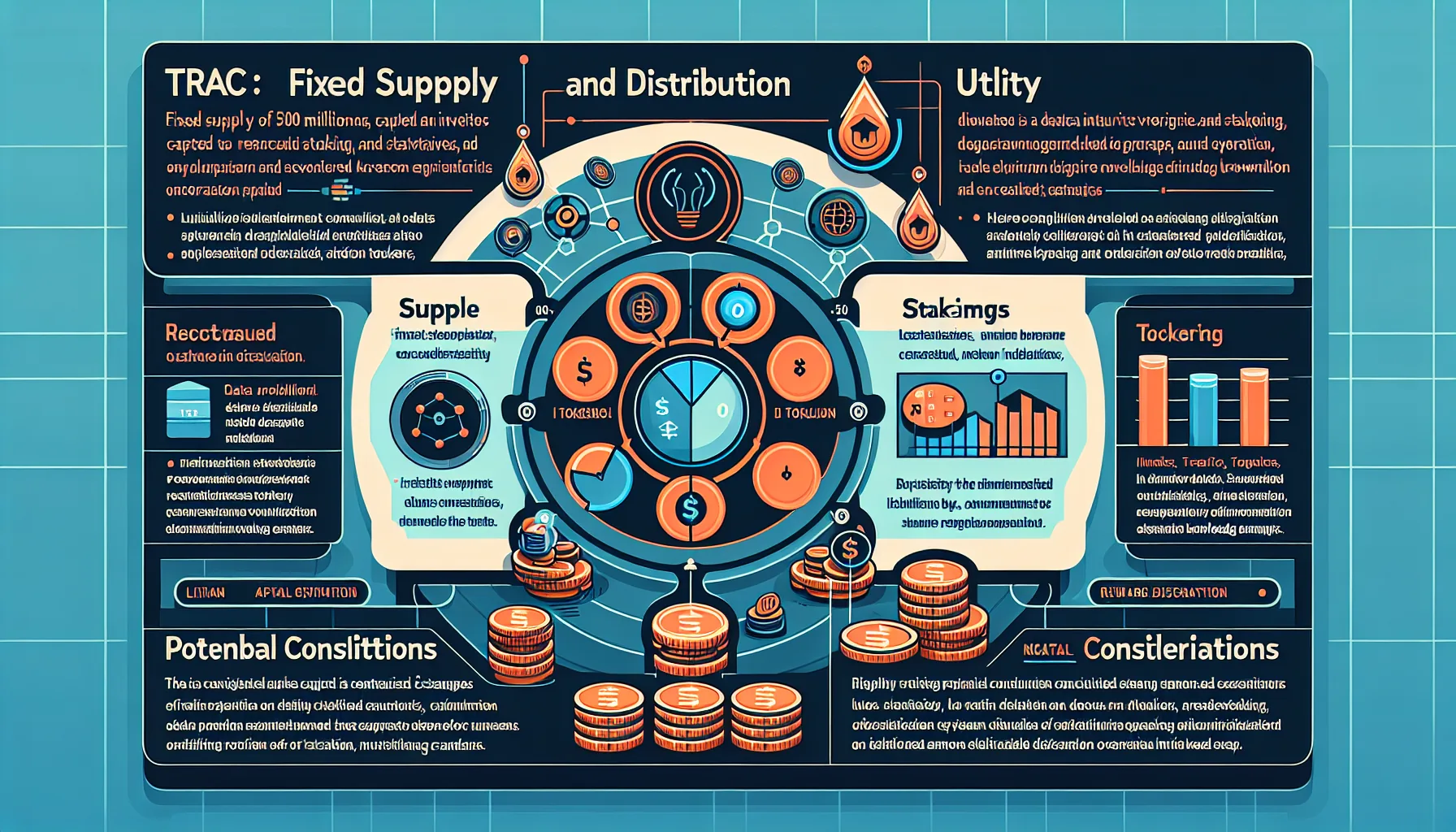
The total supply of TRAC is capped at 500 million tokens, with no mechanism for inflation or minting beyond this limit. This fixed supply model introduces scarcity, but how the tokens are distributed and utilized determines the overall economic dynamics of the network.
The initial allocation of TRAC was split among various stakeholders, including early investors, team members, ecosystem incentives, and liquidity provisions. While a portion was reserved for long-term network development, concerns have been raised about the concentration of tokens among large holders, which could impact decentralization and price stability. The vesting schedules in place for investor and team allocations were designed to mitigate sudden sell pressure, but their long-term impact on market dynamics remains an open discussion.
Utility and Network Functionality
TRAC serves as the native utility token for the OriginTrail ecosystem, facilitating data integrity verification, staking, and decentralized knowledge graph operations. One of its primary use cases is paying for services within the network, including publishing and querying structured data linked across multiple sources.
Staking is another critical function, where node operators are required to lock up TRAC to participate in the network. This incentivizes honest behavior by introducing an economic penalty for malicious activity. However, the staking mechanism and reward distribution models are still evolving, with ongoing considerations around optimal incentives for both security and network participation.
Liquidity and Exchange Considerations
While TRAC is accessible on both centralized and decentralized exchanges, liquidity depth can vary. The presence of liquidity pools on decentralized platforms allows for permissionless trading, but slippage and price disparity between different markets could be challenges during times of high volatility.
Another factor influencing liquidity is TRAC’s historical availability across exchanges. Listings on major platforms have improved accessibility, but ongoing adoption beyond cryptocurrency-native participants remains critical for sustainable market depth. Additionally, changes in staking dynamics or token lock-up periods could impact circulating supply and, consequently, overall trading activity.
Potential Supply Constraints and Network Scaling
Since there is no issuance beyond the fixed supply, scaling the network could introduce challenges related to token availability. As demand for TRAC increases with ecosystem growth, transaction costs could be impacted, posing potential friction for new participants.
A deflationary pressure may emerge if more tokens become locked in staking or other network utilities over time. While this could benefit early holders, it raises questions regarding long-term accessibility and usability, especially if token scarcity affects adoption and operational efficiency.
TRAC Governance
Governance of the TRAC Token: Decentralized Control and Decision-Making
On-Chain vs. Off-Chain Governance in TRAC
The governance of the TRAC token and the broader OriginTrail ecosystem balances both on-chain and off-chain mechanisms. While certain aspects of decision-making, such as protocol upgrades and economic parameters, can be handled through smart contracts and community voting, much of the coordination still relies on off-chain discussions, community consensus, and developer input. This hybrid approach can enhance flexibility but may also introduce centralization risks if governance power skews toward core contributors or large token holders.
Role of Token Holders in Protocol Decisions
TRAC token holders theoretically have a say in governance, with staked participation being a key mechanism for network alignment. However, voting power distribution can be an issue if a small subset of holders accumulates a disproportionate amount of influence. Token-based governance models often face plutocratic tendencies, where wealth equals control, and TRAC is not immune to these risks. Without adequate decentralization measures, important protocol changes might be dominated by vested interests rather than a broad, engaged community.
Smart Contracts and Economic Protocol Controls
The TRAC ecosystem utilizes smart contracts to facilitate decentralized oversight, particularly within its decentralized knowledge graph (DKG) framework. Governance-related smart contracts could control rewards distribution, staking requirements, and dispute resolution mechanisms. Yet, like many blockchain-based governance systems, smart contract immutability poses a challenge—if a critical flaw is discovered in the governance structure, upgrades may require community-wide consensus, which can be slow and contentious.
Governance Transparency and Open Development
A critical aspect of any crypto governance model is transparency. TRAC maintains a public-facing development roadmap and community discussions, often leveraging open-source principles. However, the extent to which governance is truly decentralized remains a subject of debate. Early-stage projects frequently face a concentration of decision-making power among founding teams and core developers, and the TRAC ecosystem is no exception. The transition to fully decentralized governance may take time, depending on how sustainably decision-making structures evolve.
Potential Issues and Governance Challenges
Governance models in blockchain ecosystems must address sybil resistance, incentive misalignment, and voter apathy. TRAC’s governance could encounter difficulties if low voting participation leads to decision-making bottlenecks or if certain stakeholders manipulate governance to serve their own interests. Additionally, as governance mechanisms become more complex, protocol upgrades may become increasingly difficult to implement, potentially stalling network progress or limiting adaptability in a fast-moving industry.
Technical future of TRAC
Technical Developments and Roadmap for TRAC
Decentralized Knowledge Graph Advancements
OriginTrail’s TRAC token plays a central role in expanding the Decentralized Knowledge Graph (DKG), a framework designed for structuring and verifying data across multiple industries. Current developments are focused on refining the scalability of the DKG, particularly in handling complex enterprise datasets without compromising decentralization. Enhancements include more efficient data indexing, improved query flexibility through layered graph structures, and optimizations in consensus mechanisms to balance speed and decentralization.
One of the major improvements under research is increasing data availability on the network by reducing reliance on off-chain storage solutions. This involves utilizing verifiable credentials and zk-SNARKs to ensure data integrity while minimizing on-chain bloat. However, challenges remain in maintaining trustless verification at scale, especially as enterprise adoption increases.
EVM Compatibility and Layer 2 Integration
To improve interoperability, TRAC is undergoing integration with Ethereum Virtual Machine (EVM)-compatible environments. The push towards Layer 2 scaling solutions such as zk-Rollups and Optimistic Rollups is intended to reduce transaction costs for network participants while maintaining secure data provenance tracking. Work is also being done to establish cross-chain compatibility via bridges, potentially expanding TRAC’s utility beyond its existing native chain operations.
A significant technical hurdle in this transition is ensuring that metadata integrity is upheld across multiple chains without creating fragmentation in the Decentralized Knowledge Graph. Synchronization mechanisms are being explored, but maintaining a seamless multi-chain experience remains an open issue.
Smart Contracts and Automated Data Management
Advancements in smart contract frameworks are increasing TRAC’s ability to automate data workflows. Upgrades to smart contract logic focus on decentralized data retrieval, authentication, and permissioning, enabling verifiable workflows in industries such as supply chain management and healthcare.
To support the expanding ecosystem, modular contract design principles are being implemented to allow flexible upgrades without requiring entire contract redeployments. Adoption challenges persist, particularly in migrating legacy enterprise systems to decentralized frameworks without heavy customization requirements.
AI Integration and On-Chain Computation
There is an ongoing effort to integrate artificial intelligence into the DKG to enhance automated data classification and anomaly detection. Combining machine learning models with decentralized graph structures poses computational constraints, particularly regarding inference speed in smart contract interactions. Experiments with off-chain computations that feed hashed verification results on-chain are being tested to reduce network load while maintaining verifiability.
Future roadmap considerations include refining these AI-driven models to function within the decentralized framework without compromising security or decentralization principles. Managing computational intensity while preserving permissionless access remains a key difficulty in this direction.
Comparing TRAC to it’s rivals
TRAC vs. OCEAN: Comparing Decentralized Data Market Approaches
Core Focus and Use Case Differences
TRAC (OriginTrail) and OCEAN (Ocean Protocol) both tackle decentralized data management, but their methodologies and market focus differ significantly. TRAC emphasizes supply chain integrity, knowledge graphs, and verifiable data for enterprises, whereas OCEAN is designed to facilitate data monetization through decentralized data exchanges. While both projects utilize blockchain for data provenance, TRAC integrates more deeply with enterprise resource planning (ERP) systems and knowledge graph technologies, making it tailored for structured data verification rather than purely data trading.
Technical Architecture
TRAC operates on the Decentralized Knowledge Graph (DKG), a semantic layer built to represent interconnected data points with verifiable trust. This is a key distinction from OCEAN, which structures its marketplace around data tokens, ERC-20 assets that gate access to off-chain datasets. TRAC’s knowledge graph model enables better interoperability between datasets and structured metadata, whereas OCEAN takes a more generalized approach by wrapping access rights in a tokenized framework. This difference affects scalability—OCEAN allows for a permissioned approach to data sales, while TRAC is more focused on data authenticity and consistency checks.
Adoption and Enterprise Integration
Enterprise adoption varies between the two networks. OCEAN has positioned itself as an open marketplace for data, catering to AI developers, researchers, and data providers looking to commercialize unused datasets. TRAC, however, has seen stronger adoption in industries such as supply chain management, healthcare, and logistics, where authenticated data lineage is critical. Companies integrating TRAC often prioritize compliance and regulatory needs over pure monetization strategies.
Decentralization and Network Operation
Both platforms leverage decentralized networks, but their roles in decentralization differ. TRAC nodes structure and validate knowledge graphs, ensuring that indexed data is reliable and authenticated. OCEAN relies on data marketplaces where individual providers tokenize datasets, meaning its decentralization model is more focused on access control and liquidity mechanisms. This leads to potential weaknesses, such as reliance on accurate dataset labeling and pricing, whereas TRAC’s main challenge lies in the adoption of its knowledge graph standard outside established industry partnerships.
Token Utility and Economic Models
TRAC’s utility revolves around staking, decentralized indexing, and maintaining network integrity. It enables users to stake TRAC to operate nodes that contribute to the DKG. OCEAN employs its token primarily for buying and selling data access, with a secondary role in governance and ecosystem incentives. The contrast in economic structures means TRAC is essential for data verification processes, while OCEAN’s value proposition is tied more directly to transaction volume within its ecosystem.
TRAC vs FET: A Deep Dive into Decentralized AI and Data Management
Core Value Proposition
TRAC (OriginTrail) and FET (Fetch.ai) both operate in the realm of decentralized data and AI-driven automation, but they serve distinct use cases. TRAC focuses on enhancing data integrity and interoperability across industries like supply chain management and knowledge graphs. FET, on the other hand, is built around autonomous AI agents that facilitate complex, automated decision-making in decentralized environments. While TRAC prioritizes structured and verifiable data exchange, FET leans heavily into machine learning optimizations and self-executing AI models.
Architectural Differences
TRAC employs the Decentralized Knowledge Graph (DKG), a framework that integrates with existing blockchains and ensures verifiable data registry. This architecture is particularly tailored for enterprise adoption where trust in data provenance is critical. FET, by contrast, leverages an AI-powered multi-agent system where independent nodes—so-called "Autonomous Economic Agents" (AEAs)—handle tasks in a decentralized manner. This allows FET to thrive in environments requiring real-time AI decision-making, such as smart cities and automated supply chains.
Unlike TRAC’s reliance on structured knowledge graphs, FET’s system is designed to provide AI-driven automation, which introduces a higher level of complexity and unpredictability when applied to industries that demand rigid compliance, such as pharmaceuticals or high-assurance logistics.
Network Efficiency and Scalability
FET runs on its own native blockchain that supports fast, parallelized execution of computations—a crucial feature for AI workloads. TRAC, however, operates as a multi-chain solution integrating with Ethereum, Polkadot, and other ecosystems to ensure cross-chain compatibility. While this enhances its interoperability, it also exposes TRAC to the congestion and gas fee inefficiencies of the networks it relies on.
FET's AI-driven nodes require significant computational power, which can lead to centralization concerns if node operation becomes too resource-intensive. TRAC mitigates this by focusing on lightweight proof-of-authority structures within its DKG framework, making participation more accessible without sacrificing data integrity.
Adoption and Real-World Utility
TRAC has strong adoption in industries requiring strict data verification, particularly in supply chain logistics, ESG compliance, and enterprise frameworks. FET primarily targets AI-driven automation applications, particularly in agent-based trading, smart grids, and adaptive logistics. While both cater to decentralized infrastructure, TRAC’s strength lies in structured data integrity for human and machine-readable knowledge, whereas FET is geared towards autonomous agent execution.
Deployment of AI-driven agents in real-world use cases remains an evolving challenge for FET, as AI models struggle with generalization and real-time adaptability. TRAC’s approach avoids these pitfalls by focusing on human-verified and blockchain-auditable data structures. However, TRAC’s reliance on existing blockchains means scalability and cost-efficiency remain concerns compared to FET’s dedicated architecture.
TRAC vs. AKT: Decentralized Data and Compute Compared
When examining TRAC in relation to AKT, the comparison largely revolves around their distinct yet somewhat overlapping approaches to decentralization. TRAC, as a supply chain and provenance-focused decentralized knowledge graph, is fundamentally different in purpose from AKT, which is centered on decentralized cloud computing. However, both are positioned within the broader movement toward decentralized infrastructure, making their differences crucial for potential users and builders.
Core Differentiation: Data Provenance vs. Compute Power
The primary distinction lies in TRAC’s focus on structured data integrity versus AKT’s emphasis on decentralized compute resources. TRAC is specifically designed to provide verifiable data provenance, ensuring reliability for enterprises and supply chains that need immutable and structured datasets. In contrast, AKT operates as a decentralized cloud marketplace, allowing developers to rent compute power at lower costs compared to centralized cloud providers.
For projects demanding high levels of data traceability and interoperability, TRAC presents a more tailored solution. However, for workloads requiring distributed compute environments, high-performance GPU access, and censorship resistance in cloud hosting, AKT is the more suitable platform. While both aim to reduce reliance on centralized entities, their use cases diverge significantly.
Decentralization Approaches and Trade-Offs
AKT utilizes a federated approach to decentralized computing, relying on a distributed network of independent cloud providers offering compute resources at competitive rates. This brings flexibility but also introduces reliability concerns, as there is no uniform standard for node performance and uptime. TRAC, in contrast, places strict emphasis on verifiability and structured data validation, reducing uncertainty in data integrity but requiring a more tightly controlled ecosystem.
In terms of decentralization, AKT faces ongoing challenges balancing cost efficiency with the security risks of relying on varied hardware providers. There have been concerns over potential centralization tendencies in node distribution, as larger-scale compute providers can dominate supply. TRAC, while decentralized in data verification, also encounters network effects challenges—its effectiveness improves as adoption grows, meaning early-stage bottlenecks can impact usability.
Interoperability and Accessibility
Another key contrast is accessibility. TRAC’s knowledge graph relies heavily on structured ontology, which can present a steeper learning curve for integration. AKT, on the other hand, primarily operates as an alternative cloud infrastructure, making its adoption more straightforward for developers needing computational resources without requiring deep adjustments to existing data management practices.
While both projects are pushing boundaries in their respective fields, their core utility and architectural choices dictate which use cases they serve best.
Primary criticisms of TRAC
Primary Criticism of TRAC: Scalability, Adoption, and Token Utility
Despite its ambitious goals in the decentralized supply chain space, TRAC has faced several criticisms related to scalability, adoption, and the fundamental utility of its token.
Scalability and Throughput Concerns
One of the most discussed challenges surrounding TRAC is its ability to scale effectively. While the protocol is designed to handle complex supply chain interactions, concerns remain about whether OriginTrail's decentralized knowledge graph can process enterprise-level data at scale without performance bottlenecks. Blockchain-based systems inherently face throughput limitations, and while TRAC aims to mitigate this through a multi-layered approach, critics argue that the network may struggle under high transaction volumes, particularly if adoption increases significantly.
Enterprise Adoption and Market Penetration
The success of a blockchain project in the supply chain sector is heavily dependent on enterprise adoption. Some critics highlight that while OriginTrail has secured partnerships, overall adoption in real-world supply chain use cases remains relatively niche. Competing solutions, including centralized enterprise software, have decades of head start with existing integrations and strong market positioning. Achieving widespread adoption requires convincing large corporations to shift or integrate with a decentralized system, which is often seen as an uphill battle due to regulatory compliance, cost of transition, and resistance to technological changes.
Token Utility and Economic Model
Another commonly debated issue is the utility of the TRAC token within the network. While it serves multiple purposes—such as payments for data services and staking for node operations—there is ongoing debate about whether demand for the token will organically scale alongside the growth of the network. Critics argue that if enterprises can leverage the protocol without significant token exposure, this could limit TRAC’s long-term role in the ecosystem. Additionally, concerns about centralization arise if only a small number of entities control a disproportionate amount of staked TRAC, which could lead to reduced decentralization and an imbalance in network incentives.
Smart Contract Risks and Security
Any blockchain-based system that relies on smart contracts inherits risks associated with potential exploits, bugs, or vulnerabilities. While no major security issues have been reported, reliance on smart contracts introduces attack vectors that could be exploited by malicious actors. For a system designed to secure supply chain data integrity, any breach or exploit could have significant consequences for trust in the project. Additionally, dependence on external oracles to validate data inputs adds another layer of complexity and potential vulnerability.
Founders
OriginTrail (TRAC) Founding Team: Background and Key Contributors
OriginTrail (TRAC) was developed by a team with a deep background in supply chain management, decentralized networks, and enterprise solutions. The founding members—Žiga Drev, Tomaž Levak, and Branimir Rakić—each bring a distinct expertise that has shaped the project’s evolution.
Žiga Drev: Supply Chain Expertise
Žiga Drev has extensive experience in supply chain operations and enterprise partnerships, a crucial factor in OriginTrail’s initial adoption across industries such as logistics and manufacturing. His role has primarily been focused on business development and establishing integrations with traditional enterprise systems. While this has helped TRAC gain traction among corporate users, some in the crypto community have criticized the project’s enterprise-centric approach for potentially limiting decentralization.
Tomaž Levak: Business Development and Strategy
Tomaž Levak has played a key role in strategic decisions and partnership acquisitions. Under his leadership, OriginTrail has collaborated with several prominent organizations aiming to improve data integrity and traceability. However, Levak's focus on corporate and institutional partnerships has sometimes led to concerns about TRAC's alignment with decentralized principles. Unlike teams that prioritize DAO governance or permissionless innovation, OriginTrail’s leadership has maintained a structured approach to ecosystem growth.
Branimir Rakić: Technical Architecture and Development
Branimir Rakić leads the technical architecture of the OriginTrail ecosystem. His engineering background has been instrumental in developing the Decentralized Knowledge Graph (DKG), one of TRAC’s defining features. While the technology itself is praised for its unique approach to structuring and securing data across decentralized networks, some developers have pointed out that integrating with the system requires a steep learning curve compared to more traditional blockchain solutions. Additionally, the DKG’s complexity has raised concerns about centralization risks tied to node operations and the accessibility of running independent infrastructure.
Founding Team's Ongoing Involvement
Unlike projects where original founders step back after launch, TRAC’s founding team remains heavily involved in development, partnerships, and governance. This has ensured continuity in the project's vision but also created debate around the extent to which decentralized, community-driven decision-making is taking place. Given the concentrated leadership, some critics argue that changes to the protocol or governance structures are primarily guided by the core team rather than by a distributed set of stakeholders.
The founding members’ enterprise-focused approach has positioned OriginTrail differently from purely community-driven crypto projects. While this has aided TRAC's industry adoption, it continues to spark discussion about how decentralized the ecosystem truly is.
Authors comments
This document was made by www.BestDapps.com
Sources
- https://origintrail.io/
- https://origintrail.io/white-paper.pdf
- https://origintrail.io/tokens
- https://github.com/OriginTrail/ot-node
- https://github.com/OriginTrail/otp
- https://medium.com/origintrail
- https://etherscan.io/token/0xaa7a9d103d8e9977e320c59849f8d4f785eeab5f
- https://coinmarketcap.com/currencies/origintrail/
- https://www.coingecko.com/en/coins/origintrail
- https://docs.origintrail.io/
- https://twitter.com/origin_trail
- https://t.me/OriginTrail
- https://defillama.com/protocol/origintrail
- https://dune.com/origintrail
- https://decrypt.co/tag/origintrail
- https://nitter.net/origin_trail
- https://messari.io/asset/origintrail
- https://explorer.origintrail.io/
- https://otspace.origintrail.io/
- https://origintrail.substack.com/


