History of TIA
The History of TIA: Origins, Development, and Key Milestones
TIA, the native crypto asset of Celestia, emerged from a vision to create a scalable, modular blockchain network. The project’s foundation was laid by developers focused on improving blockchain data availability and execution layers, addressing key limitations in monolithic blockchain architecture. Initially conceived as an alternative to the existing models, TIA plays a central role in Celestia’s approach to modular blockchain designs.
Early Development and Genesis Event
The origins of TIA trace back to research in blockchain scalability, particularly around Data Availability Sampling (DAS), a key innovation that later became central to the network. The conceptual groundwork for Celestia was developed by core contributors involved in earlier blockchain scaling solutions, leading to the creation of a testnet where foundational mechanisms were evaluated. TIA’s genesis event was a pivotal moment, marking the transition from theoretical models to a functioning modular blockchain deployment.
Token Distribution and Network Launch
TIA’s token distribution model was designed to provide early adoption incentives while ensuring decentralization. Allocations included a mix of ecosystem development funds, early contributors, and airdrop recipients, a strategy aimed at fostering engagement within the broader crypto community. While the token rollout was largely structured, some concerns emerged around allocation dynamics and potential centralization risks tied to early stakeholders.
The mainnet launch of Celestia and TIA’s introduction as its native asset were key industry developments, reinforcing the network’s vision of a modular blockchain paradigm. The protocol officially activated functions allowing developers to deploy their own execution environments while relying on Celestia for data availability. This phase solidified TIA’s utility, aligning it within the broader modular blockchain stack.
Adoption Challenges and Ecosystem Growth
Despite strong technical underpinnings, the adoption trajectory of TIA has been shaped by multiple factors, including developer demand for modular blockchain architectures and competition from alternative scaling solutions. While Celestia’s design offers key advantages in scalability, its modular framework requires parallel ecosystem development, meaning adoption is dependent on projects integrating with its infrastructure.
Concerns around security, validator dynamics, and long-term staking incentives have also been discussed within the crypto community. Ensuring a balanced token economy that supports decentralization while maintaining incentives for network participants remains a critical challenge for TIA’s ongoing development.
The historical evolution of TIA reflects the broader industry’s push toward scalable blockchain architectures, with its progress linked to the adoption of modular blockchain technology as a viable alternative to traditional models.
How TIA Works
How TIA Works: Mechanisms, Security, and Utility
TIA operates as the native token of a modular blockchain framework designed for scalability and interoperability. It secures the network, facilitates transactions, and plays a critical role in governance and data availability.
Security Through Proof-of-Stake
TIA relies on a proof-of-stake (PoS) consensus mechanism, where validators stake TIA tokens to participate in block production. The network incentivizes honest behavior through a slashing mechanism that penalizes validators for downtime or malicious activities. Delegators can stake TIA by delegating their tokens to validators, earning rewards proportional to their stake.
Slashing risks and validator centralization are key concerns. The concentration of large stakers can lead to centralization pressures, while smaller validators may struggle to attract delegation, reducing overall network decentralization. Additionally, improper validator performance can lead to unjust punishments, necessitating careful validator selection for delegators.
Data Availability and Rollup Support
TIA is central to ensuring data availability within the network. The protocol utilizes a data availability sampling (DAS) approach, allowing nodes to verify transactions without downloading full block data. This makes it an ideal backend for rollups that rely on off-chain computation while ensuring data remains accessible on-chain.
However, DAS introduces potential attack vectors. If adversaries manipulate data availability sampling, they could disrupt the verification process, leading to concerns about genuine data retrievability. Additionally, as the ecosystem grows, maintaining efficient data availability across expanding rollup solutions remains an ongoing technical challenge.
Token Utility and Gas Fees
TIA serves multiple utility functions beyond staking and security. It is used to pay for gas fees, ensuring transaction execution across the ecosystem. Additionally, it plays a role in governance, allowing TIA holders to participate in protocol upgrades, parameter adjustments, and potential changes to economic incentives.
Governance participation remains a challenge, as low voter engagement can concentrate decision-making power among a small subset of token holders. Additionally, unpredictable gas costs may lead to fluctuations in transaction expenses, especially during periods of network congestion.
Staking, Inflation, and Economic Design
The network maintains an inflationary token model to incentivize staking and secure the consensus mechanism. Inflation rates may adjust dynamically based on staking participation to ensure optimal security-economic balance.
Over time, inflation could lead to token dilution, affecting unstaked token holders disproportionately. This creates an implicit pressure to stake, potentially limiting token liquidity as more users lock tokens in staking contracts to offset dilution effects.
TIA’s design focuses on modularity, scalability, and security, but challenges related to decentralization, governance participation, and long-term economic sustainability remain areas of active development.
Use Cases
Core Use Cases of TIA
Securing the Celestia Modular Blockchain
TIA serves as the primary staking asset for validators in the Celestia ecosystem. Validators stake TIA to participate in consensus and secure the network, with penalties for malicious behavior enforced via slashing. This staking model incentivizes honest participation but also introduces centralization risks if stake becomes too concentrated among a few large validators.
Gas Fees for Data Availability
TIA is used to pay for data availability sampling, which is fundamental to Celestia’s modular architecture. Layer 2 rollups and sovereign chains post their transaction data to Celestia, and TIA covers the associated costs. However, pricing mechanisms for data availability are still evolving, and network congestion could lead to unpredictable fee structures.
Rollup and Sovereign Chain Integration
TIA is essential for projects building on Celestia, enabling rollups and sovereign chains to access its scalable data availability layer. This reduces reliance on monolithic chains but also forces projects to trust Celestia’s long-term security and fee predictability. If Celestia fails to maintain a robust validator set, dependent chains could face disruptions.
Governance and Network Upgrades
TIA holders participate in governance decisions affecting protocol upgrades, slashing parameters, and economic policies. While governance ensures decentralization, voter apathy and governance capture by large stakeholders could influence key decisions in ways that don’t always align with broader network health.
Liquidity and DeFi Use Cases
TIA is becoming integrated with DeFi applications for staking derivatives, collateralized lending, and liquidity pools. While this expands utility, it also exposes TIA holders to risks associated with smart contract vulnerabilities and potential liquidity crises if demand for DeFi involvement wanes.
Interchain Operability with IBC
Thanks to its Cosmos SDK foundation, TIA moves freely across chains within the Inter-Blockchain Communication (IBC) protocol. This facilitates cross-chain activity, but its reliance on Cosmos infrastructure could pose risks if interchain security mechanisms are compromised.
Potential Censorship Resistance Limitations
Since TIA is tied to Celestia’s validator governance, any censoring tendencies in the validator set could impact rollups depending on its data availability. While Celestia is designed for neutral data posting, censorship-resistance is only as strong as its staking distribution.
TIA Tokenomics
TIA Tokenomics: Supply, Emissions, and Utility
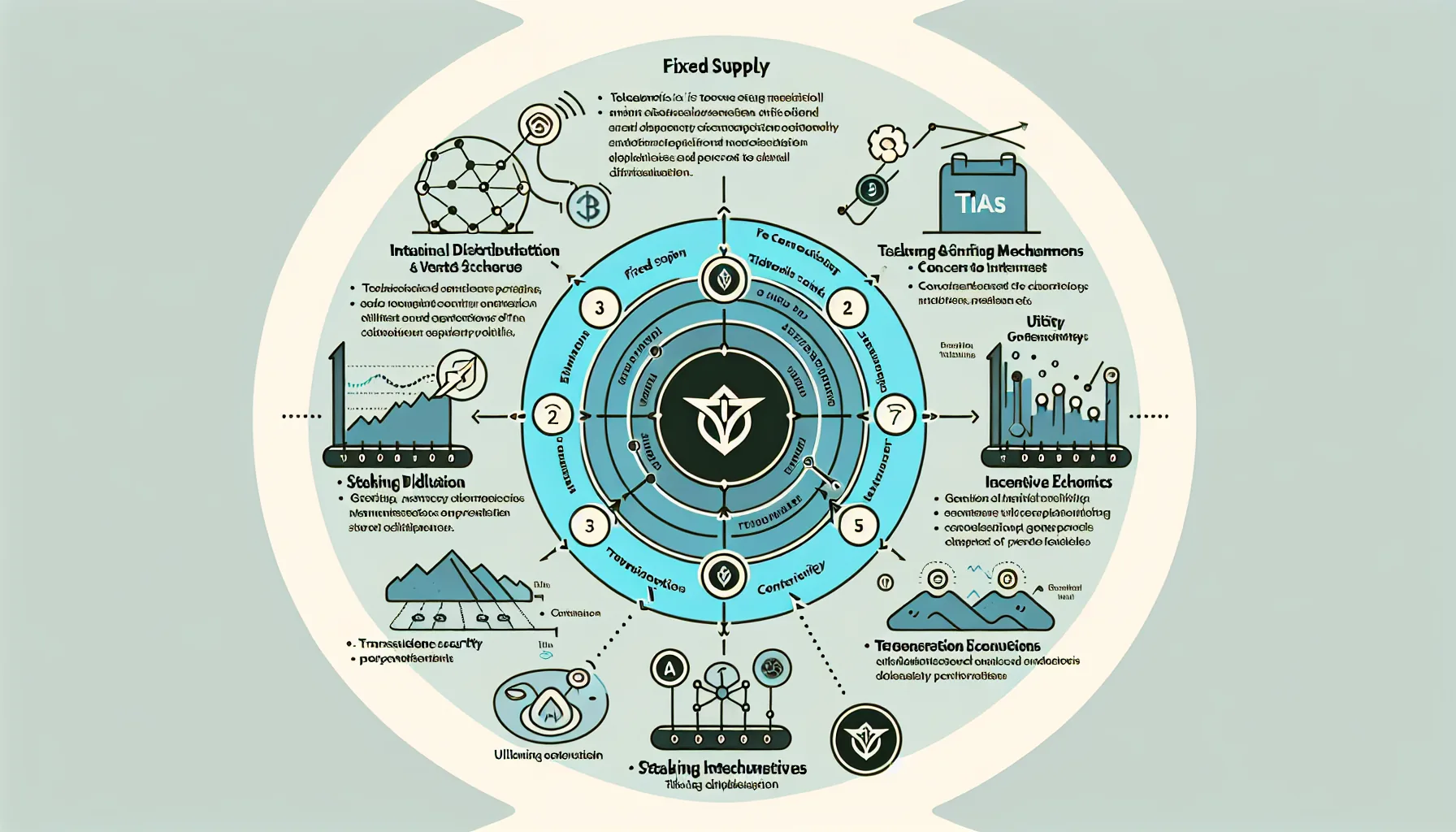
Fixed Supply and Initial Distribution
TIA operates with a predefined maximum supply, ensuring long-term scarcity and predictability. The initial token distribution allocated significant portions to early contributors, ecosystem development, and incentivization programs. While this aligns incentives for long-term growth, it also raises concerns regarding centralization risks, especially if large allocations remain concentrated among insiders or early adopters.
Emissions and Vesting Schedules
TIA follows a structured emissions model with clearly defined vesting schedules for various stakeholders, including core contributors, investors, and treasury reserves. Token unlocks occur periodically, leading to potential fluctuations in supply-side dynamics. These scheduled emissions can introduce sell pressure, particularly when large allocations unlock simultaneously. Token holders closely monitor these schedules for potential market impact, as aggressive unlocks could lead to increased short-term volatility.
Staking and Incentive Mechanisms
TIA supports staking, allowing holders to secure the network while earning rewards. This mechanism encourages long-term participation but also increases the circulating supply through reward distributions. However, staking yields must remain balanced; excessively high rewards risk inflationary dilution, while conservative incentives could discourage participation. The balance between sustainability and attractiveness is key to maintaining long-term network stability.
Utility and On-Chain Economics
Beyond staking, TIA serves multiple roles within its ecosystem, including governance participation, transaction fees, and protocol-level incentives. The design of these mechanisms directly impacts token velocity and overall demand. If the economic design fails to create meaningful and sustained utility, reliance on speculative demand could undermine long-term adoption. Addressing ecosystem-wide token sinks and value capture remains a critical factor in sustaining long-term token health.
Potential Risks and Challenges
Despite structured tokenomics, several risks persist. Supply dilution from unlocking events, centralization of holdings, and reliance on staking incentives could introduce long-term sustainability concerns. Additionally, if utility-driven demand fails to outpace emissions, downward pressure on price and value retention could emerge. Governance participation and network-wide incentives must evolve to maintain token utility and align stakeholder interests effectively.
Closing Thoughts
TIA’s tokenomics balance fixed supply constraints with structured emissions and utility-driven mechanisms. However, supply dilution risks, staking dynamics, and ongoing ecosystem development present key considerations for participants analyzing its long-term sustainability.
TIA Governance
TIA Governance: Staking, Voting Power, and On-Chain Proposals
TIA governance is structured around staking mechanisms that determine voting power, enabling token holders to influence key protocol decisions. Governance participation is typically tied to the staking of TIA tokens, where longer staking durations may provide enhanced voting weight depending on protocol rules. The influence of validators and delegators plays a critical role in shaping governance outcomes, with large token holders often exerting significant sway over the decision-making process.
Validator Influence and Centralization Risks
A core aspect of TIA governance is the role of validators. These entities not only secure the network but also participate in governance votes directly or by representing delegators. While this model theoretically ensures decentralized decision-making, in practice, governance power can become concentrated among a small number of large validators. If a few entities control a disproportionate amount of staked TIA, governance results may become skewed toward their interests, reducing the effectiveness of decentralized decision-making.
Delegators must carefully assess which validators they support, as aligning with entities that act primarily in their self-interest can result in governance decisions that do not reflect the broader community's preferences. Some validators may opt not to vote on governance proposals at all, limiting delegators’ impact unless they switch to actively voting validators.
On-Chain Proposals and Execution
TIA governance proposals cover protocol upgrades, parameter changes, and treasury allocations. These proposals go through predefined phases, including submission, discussion, and voting periods. The staking-weighted voting mechanism means that proposals with greater backing from large holders have a higher probability of passing. This structure can benefit the ecosystem by ensuring that well-supported proposals move forward but may also allow influential entities to push through initiatives that favor their interests over those of smaller participants.
There is a risk of voter apathy, where many token holders do not actively participate in governance, leading to outcomes shaped by a minority. Additionally, governance attack vectors exist, such as coordinated voting by external actors who accumulate TIA to push specific agendas. Mechanisms like quorum requirements and veto thresholds mitigate some risks but do not eliminate them entirely.
Governance Incentives and Participation Challenges
While governance participation is open to all TIA holders, there are limited direct incentives beyond ecosystem alignment. Unlike some governance models that offer rewards for voting participation, TIA governance relies on voluntary engagement. This can lead to low turnout, enabling well-coordinated groups to influence proposals with minimal resistance. Developing frameworks to enhance participation without introducing governance token inflation remains a challenge for long-term network security and decentralization.
Technical future of TIA
TIA Technical Developments and Roadmap
RollApp Advancements and Ecosystem Expansion
TIA’s technical roadmap includes continuous enhancements to its RollApp framework, optimizing scalability and execution efficiency for decentralized applications. Future updates aim to refine RollApp interoperability, reducing dependencies on centralized infrastructure and improving trust-minimized coordination between execution layers. However, challenges persist in ensuring seamless composability across RollApps, particularly when dealing with fragmented liquidity and asynchronous state transitions.
DA Layer Optimization and Gas Efficiency
Enhancements to the Data Availability (DA) layer remain a core focus. Developers are actively working on improving proof verification processes and reducing DA overhead, which currently poses barriers to high-throughput applications. Proposals for more efficient fraud-proof systems and alternative erasure coding techniques could mitigate performance bottlenecks but require rigorous testing to avoid security regressions.
EigenLayer and Restaking Implications
Ongoing integrations with EigenLayer introduce opportunities for shared security but also present risks tied to slashing conditions and liquidity constraints. The reliance on restaking mechanics necessitates careful economic modeling, as overleveraged staking positions could introduce systemic vulnerabilities within the broader TIA ecosystem.
Modular Smart Contract Upgrades
Planned upgrades to TIA’s smart contract architecture focus on modularity, allowing developers to implement permissionless contract deployments with enhanced security guarantees. The introduction of customizable execution environments offers flexibility but raises concerns about fragmentation across different virtual machine implementations.
Sequencer Decentralization Challenges
Decentralizing the sequencer layer is a key milestone, but technical complexities around leader election, censorship resistance, and fair ordering mechanisms remain unresolved. Research into Verifiable Delay Functions (VDFs) and cryptographic sortition could provide viable solutions, though implementation timelines remain uncertain.
Cross-Chain Interoperability and Bridging Security
Future developments include improvements to trust-minimized bridging solutions, addressing ongoing concerns related to liquidity fragmentation and bridge exploit vectors. Optimizations in ZK-SNARK constructions for bridging purposes are under exploration, but challenges in maintaining low proof-generation costs persist.
Long-Term Scalability Trade-Offs
Balancing state growth with chain decentralization continues to be an open issue. While sharding approaches and off-chain data availability schemes provide potential pathways, ensuring validator inclusivity without excessive hardware requirements remains an area of active research.
Governance and Network Upgrades
Protocol governance mechanisms are evolving to accommodate more granular upgrade proposals. However, voter apathy and governance capture risks could affect future roadmap execution, necessitating additional safeguards to maintain network neutrality and long-term sustainability.
Comparing TIA to it’s rivals
TIA vs. ETH: How Celestia Compares to Ethereum
Ethereum (ETH) dominates smart contracts and decentralized applications, but TIA's modular blockchain design introduces a different value proposition. Comparing Celestia to Ethereum highlights key differences in architecture, scalability, and decentralization.
Consensus and Data Availability
Ethereum operates as a monolithic blockchain, handling execution, settlement, and data availability within the same system. While Ethereum's rollup-centric roadmap aims to offload execution to Layer 2s, it still maintains a unified structure. Celestia, by contrast, takes a fully modular approach, focusing solely on data availability and consensus while offloading execution to independent rollups or sovereign chains. This separation allows Celestia to scale by offering a secure and trust-minimized data layer for multiple ecosystems, whereas Ethereum's mainnet remains constrained by base-layer execution costs.
Scalability and Throughput
Ethereum's rollup-centric model significantly boosts transaction throughput compared to its Layer 1, but data availability remains a bottleneck. Ethereum's proposed solutions, like Danksharding and Proto-Danksharding (EIP-4844), aim to improve data availability but are still in development. Celestia, on the other hand, was designed from the ground up to provide scalable data availability using Data Availability Sampling (DAS). This allows nodes to verify data without downloading the entire blockchain, potentially reducing hardware requirements while increasing throughput. However, adoption and integration with rollups remain critical challenges for Celestia's scalability claims.
Decentralization and Node Requirements
Ethereum’s full nodes require storing the entire chain state, which can be resource-intensive. While light clients exist, they rely on trust assumptions. Celestia’s DAS mechanism allows lightweight nodes to verify data availability without high storage costs, potentially enabling a more decentralized validator set. However, Celestia’s reliance on rollups introduces challenges—each execution layer must maintain its own security and consensus mechanisms, creating complexity for developers and users compared to Ethereum’s unified environment.
Ecosystem and Adoption
Ethereum has an established ecosystem with deep liquidity, a large developer community, and extensive tooling. Rollups on Ethereum benefit from its security guarantees and user base. Celestia, while offering flexibility for rollups and sovereign chains, lacks an equivalent network effect. Adoption by Layer 2s, developer tooling, and liquidity fragmentation remain hurdles. The success of Celestia’s approach depends on whether developers and applications find the benefits of modularity outweigh Ethereum’s security and established infrastructure.
TIA vs. SOL: A Technical and Ecosystem Comparison
Consensus and Performance Differences
TIA and Solana (SOL) take fundamentally different approaches to blockchain consensus and performance optimization. Solana’s Proof of History (PoH) mechanism, combined with a delegated Proof of Stake (dPoS) model, allows it to achieve extremely high transaction throughput. By integrating timestamped ordering before block production, Solana reduces validation overhead, enabling rapid finality. In contrast, TIA utilizes a modular blockchain design, leveraging Cosmos SDK and the Inter-Blockchain Communication (IBC) protocol to optimize interoperability and decentralization.
While Solana can handle thousands of transactions per second (TPS) with low fees, it has historically faced network uptime challenges. Periodic outages and validator centralization concerns have raised questions about its resilience under extreme network load. TIA’s architecture trades Solana’s raw speed for a more decentralized, modular structure designed to scale securely. However, this comes at the cost of higher latency compared to Solana’s near-instant confirmation times.
Developer Ecosystem and Smart Contract Approach
Solana’s developer environment is centered around Rust and Sealevel, its parallelized execution engine, which allows smart contracts to run concurrently. This significantly improves efficiency but introduces a steep learning curve for developers accustomed to Ethereum-based tooling. TIA, being built within the Cosmos ecosystem, supports a different paradigm using CosmWasm smart contracts, which bring secure and composable smart contract functionality with multi-chain interoperability.
Solana’s focus on monolithic performance can make it challenging for projects seeking easy cross-chain integration. Although bridges and wrapped assets exist, they add additional security risks, as seen in past exploits. TIA’s interoperability-first approach, via IBC, simplifies direct integrations with other Cosmos-based chains, reducing reliance on third-party bridge solutions.
Network Downtime vs. Modularity Trade-offs
One of the most criticized aspects of Solana has been its history of partial or full outages. High validator hardware requirements and network congestion under extreme demand events have led to multiple periods of downtime. By comparison, TIA’s modular design reduces the risk of a single point of failure but introduces its own complexities, such as reliance on shared security models between zones and potential fragmentation across Cosmos chains.
Solana’s single-layer approach emphasizes raw speed and throughput but at the cost of decentralization and robustness under stress. TIA’s multi-chain focus ensures long-term flexibility and composability but requires a more complex setup for seamless interaction between zones. These trade-offs make each network optimal for different use cases, depending on whether the priority is transaction speed or interoperability.
How TIA Compares to AVAX in Scalability and Architecture
TIA and AVAX both position themselves as high-performance blockchain networks, but their approaches to scalability and architecture diverge in critical ways. AVAX utilizes a unique multi-chain structure with the Primary Network—including the Exchange Chain (X-Chain), Platform Chain (P-Chain), and Contract Chain (C-Chain)—to optimize different transactions. In contrast, TIA takes a more modular approach influenced by the Cosmos ecosystem, focusing on interoperability and integration with the wider interchain economy.
Consensus Mechanism Differences
AVAX employs the Avalanche consensus protocol, which is designed for rapid finality and sub-second transaction speeds. This mechanism relies on a probabilistic model where validators repeatedly sample small subsets of the network to come to consensus. While this system enables efficiency and high throughput, it also introduces occasional challenges with network congestion, especially when the demand for validation spikes.
TIA, meanwhile, utilizes Tendermint consensus, a Byzantine Fault Tolerant (BFT) system that ensures fast finality with deterministic guarantees. This makes it less vulnerable to reorgs and allows networks within the ecosystem to maintain strong security assumptions. However, compared to AVAX's probabilistic approach, Tendermint consensus can be more restrictive in terms of validator scalability, as it depends more heavily on the validator set size and spacing of block proposals.
Smart Contract and Execution Environments
AVAX's C-Chain is fully compatible with the Ethereum Virtual Machine (EVM), allowing for seamless porting of Ethereum-based applications. The tradeoff here is that it inherits certain inefficiencies from Ethereum's design, such as state bloat and gas price fluctuations based on network activity.
TIA leverages the CosmWasm smart contract platform, which supports WebAssembly (WASM)-based contracts, giving developers the flexibility to use multiple programming languages and optimize execution. This approach leads to improved efficiency but comes with a higher learning curve for those accustomed to Solidity-based development. Additionally, CosmWasm has seen slower adoption compared to EVM-compatible solutions due to tooling and ecosystem maturity.
Network Expansion and Adoption Challenges
AVAX has seen broad adoption due to its EVM compatibility and subnets feature, which allow developers to launch their own customizable blockchains. However, subnet security depends on custom validator sets, which can vary in robustness and introduce risks depending on the economic incentives of participants.
TIA, being deeply integrated with the Cosmos ecosystem, benefits from a seamless interchain communication framework (IBC), making cross-chain interactions more native. However, its growth is tied to the expansion of Cosmos adoption, meaning its network effects are reliant on the broader interchain movement rather than on single-protocol dominance.
Primary criticisms of TIA
Primary Criticism of TIA
Centralization Concerns in a Supposedly Decentralized Network
One of the primary criticisms of TIA revolves around its level of centralization. While it is often marketed as a decentralized asset, a significant portion of its token supply is controlled by insiders, early investors, or the founding team. This raises concerns about potential manipulation, governance influence, and the risk of concentrated selling pressure. Additionally, any governance mechanisms in place may be skewed toward the interests of those holding a disproportionate share of the supply rather than the wider community.
Token Emission and Inflationary Pressure
Another frequently cited issue is the token emission schedule, which can lead to inflationary pressure. If new tokens are continuously being distributed at high rates—whether through staking rewards, developer allocations, or other mechanisms—the increase in circulating supply may have an impact on token valuation. Additionally, unclear or rapidly changing tokenomics can lead to uncertainty for investors and users alike. Critics argue that without strong demand-side utility, ongoing emissions could negatively affect long-term token sustainability.
Dependence on Key Infrastructure Components
TIA’s reliance on specific infrastructure components within its ecosystem has also been scrutinized. If a protocol’s critical functionality is heavily reliant on a few core validators, bridges, or liquidity providers, it can introduce significant central points of failure. The failure or compromise of any of these components could result in disruptions, security risks, or even loss of user funds.
Governance and Decision-Making Transparency
While many decentralized assets aim for transparent decision-making, critics argue that TIA’s governance process lacks sufficient transparency. Changes to key parameters such as staking mechanisms, protocol upgrades, or ecosystem incentives may be decided by a small core group, limiting meaningful community participation. The degree to which voting processes are accessible, verifiable, and resistant to manipulation remains an open question within the community.
Smart Contract and Security Risks
Like any blockchain asset, TIA is susceptible to potential smart contract vulnerabilities. Given the growing complexity of decentralized finance (DeFi) integrations and cross-chain functionalities, security risks increase. Exploits targeting weak points in liquidity pools, bridges, or governance contracts could have catastrophic consequences. Previous incidents in the broader crypto space demonstrate that even well-audited protocols can fall victim to unforeseen attack vectors.
Network Congestion and Scalability Limitations
As usage of TIA increases, concerns about network congestion and scalability come into focus. If transaction fees spike or transaction finality slows due to increased demand on the network, it can hinder user experience and affect adoption. Critics point out that without robust scalability solutions in place, sustained growth could lead to performance bottlenecks, limiting the protocol’s ability to handle high transaction volumes efficiently.
Founders
TIA Crypto Asset: Founding Team and Key Contributors
The founding team behind TIA consists of experienced builders with deep backgrounds in blockchain consensus mechanisms, distributed systems, and cryptographic research. Their work has been instrumental in shaping the project's technical underpinnings, particularly in areas such as modular blockchain architectures and interoperability solutions.
Core Team and Background
TIA was initiated by individuals with prior experience in pioneering blockchain scalability solutions. Some team members have contributed to high-profile blockchain research and have backgrounds in cryptographic security and decentralized infrastructure. Their expertise spans both theoretical advancements and practical implementations of blockchain technology.
Several of the project's architects have been involved in past projects focusing on interoperability frameworks, building on prior research in cross-chain communication. This experience has influenced TIA’s design choices, particularly in its approach to network scaling and security guarantees.
Team Transparency and Governance Structure
One point of contention surrounding TIA’s founding team is the level of transparency regarding decision-making structures and internal governance. While the project has publicly associated certain key individuals with its development, details on how leadership and long-term strategic decisions are handled remain somewhat opaque. This lack of explicit documentation has led to speculation about centralization risks, particularly concerning protocol upgrades and treasury allocations.
Additionally, the involvement of early investors and external entities in guiding the project’s direction has raised questions about how decentralized decision-making processes truly are. While governance models have been outlined, there is an ongoing discussion in the community about how much influence the founding team retains over critical aspects of the blockchain.
Past Controversies and Challenges
Like many emerging crypto projects, there have been challenges in the early phases of TIA’s development. Some community members have voiced concerns about delays in delivering specific roadmap milestones, while others have pointed to occasional misalignment between the core team and the broader developer ecosystem.
Another area that has drawn criticism is the initial distribution strategy, which some argue heavily favored insiders and early backers. The extent to which this concentration of tokens impacts long-term participation and decentralization is still a topic of debate.
Despite these challenges, the technical pedigree of the founding team remains a driving force behind TIA’s development. The team’s ongoing ability to execute will likely shape how the broader community perceives both the credibility and sustainability of the project.
Authors comments
This document was made by www.BestDapps.com
Sources
- https://celestia.org/
- https://docs.celestia.org/
- https://github.com/celestiaorg/celestia-whitepaper
- https://github.com/celestiaorg/celestia-specs
- https://github.com/celestiaorg/celestia-node
- https://forum.celestia.org/
- https://blog.celestia.org/
- https://twitter.com/CelestiaOrg
- https://medium.com/celestia
- https://discord.gg/celestiacommunity
- https://messari.io/asset/celestia
- https://coinmarketcap.com/currencies/celestia/
- https://www.coingecko.com/en/coins/celestia
- https://defillama.com/protocol/celestia
- https://celestia.org/technology/
- https://celestia.org/faq/
- https://github.com/celestiaorg/celestia-app


