History of SYSP
The History of SYSP: Tracing Its Development and Evolution
The historical trajectory of SYSP (Syscoin) begins in late 2014, distinguishing itself as one of the earlier blockchain projects to explore real-world utility beyond basic financial transactions. Conceptualized as a decentralized marketplace protocol and forked from Bitcoin's source code, SYSP aimed to fuse Bitcoin's security and decentralization with innovative features tailored for e-commerce and enterprise use cases. Its whitepaper proposed ideas such as decentralized marketplaces, asset creation, and escrow services—features that were ahead of their time within the crypto landscape.
The early stages of SYSP were marked by technical growing pains. Its initial design depended heavily on Bitcoin’s blockchain infrastructure, exposing it to Bitcoin’s inherent scalability limitations. This led to criticisms from some in the developer community, who argued that SYSP's initial vision for high-throughput applications was constrained by the lack of an efficient consensus mechanism or Layer 2 scalability solutions. The project soon acknowledged these challenges and embarked on a multi-year journey of refinement.
A pivotal decision came during the implementation of Z-DAG (Zero Confirmation Directed Acyclic Graph) technology. Introduced in later iterations, Z-DAG was engineered to enable faster transactions, addressing the latency issues that hampered its early utility. However, this innovation was not without controversy. Critics questioned its effectiveness in maintaining decentralization, and some nodes experienced synchronization issues as developers worked through optimization challenges.
Another transformative phase in SYSP’s history involved its pivot toward interoperability. Recognizing the limitations of remaining isolated within its own blockchain ecosystem, SYSP integrated with Ethereum and later expanded to support cross-chain functionality through its Syscoin Bridge. This move allowed it to leverage Ethereum's smart contract capabilities while retaining Bitcoin's security model for its base ledger. However, this shift was not universally praised. Some community members expressed concerns about over-reliance on external ecosystems, arguing that its value proposition could become diluted by aligning too closely with more dominant platforms.
Over time, governance and community involvement became another recurring topic of contention. The project experienced moments of tension, particularly as decisions related to chain upgrades and fund allocation led to ideological clashes among stakeholders. Despite the platform's commitment to decentralization, critics have occasionally raised questions about uneven participation rates in governance processes.
Throughout its history, SYSP has managed to balance moments of innovation with periods of recalibration, driven both by its successes and challenges in an evolving crypto landscape.
How SYSP Works
How SYSP Works: Underlying Mechanisms and Technical Framework
The SYSP crypto asset operates on a meticulously designed blockchain ecosystem that targets scalability, privacy, and modular interoperability. At its core, the SYSP network is built on a hybrid consensus mechanism combining Delegated Proof of Stake (DPoS) and zero-knowledge proof protocols. This integration enables faster transaction finality while maintaining a high standard of privacy and decentralization.
Consensus and Governance
SYSP's hybrid DPoS mechanism leverages a network of elected validators who are incentivized to process transactions and secure the chain. Unlike traditional DPoS models, SYSP enhances decentralization through randomly randomized leader election combined with Byzantine Fault Tolerance safeguards, ensuring a reduced risk of validator collusion. However, critics of this approach argue the dependency on validator elections inevitably centralizes power in stakeholders with significant voting weight. This could misalign governance with smaller participants' interests.
Privacy-Centric Smart Contracts
What distinguishes SYSP's architecture is its focus on private transaction mechanisms. It implements zk-SNARKs (zero-knowledge succinct non-interactive arguments of knowledge) to execute smart contracts without revealing sensitive data. This framework appeals to industries requiring financial and informational confidentiality, such as healthcare or finance. However, this combination potentially comes at the expense of computational intensity and increased block generation times. Users have also raised concerns about the added complexity when debugging private contracts, which may deter developers unfamiliar with the nuances of zero-knowledge systems.
Modular and Scalable Development
SYSP employs a modular architecture designed for sidechain compatibility. Developers can launch customized chains tied to the ecosystem while utilizing SYSP’s native token for cross-chain operations. This makes the network highly adaptable for dApps requiring independent consensus mechanisms. Nevertheless, the increased reliance on sidechains introduces potential vulnerabilities, especially if a compromised sidechain interacts with the main SYSP chain. Ensuring the seamless relay of data and securing cross-chain communication remains an ongoing technical hurdle.
Built-In Asset Utility
SYSP's native token, SYSP, powers network operations, covering transaction fees, staking rewards, and governance proposals. This holistic utility model drives demand for the token but could impose a barrier to entry for users if network adoption scales and transaction costs rise.
While technically robust, the trade-offs between privacy, scalability, and decentralization continue to shape the performance and accessibility of the SYSP ecosystem. Challenges remain in alleviating governance centralization and optimizing computationally demanding privacy mechanisms.
Use Cases
Use Cases of SYSP: Beyond Tokenomics
SYSP, a versatile blockchain asset, has carved out its niche by enabling a variety of decentralized applications (dApps) and utility-driven functionalities. Its use cases reflect its technical focus, yet hurdles in adoption and execution warrant attention for anyone aiming to leverage its potential effectively.
Smart Contract Deployment Efficiency
SYSP’s architecture supports the seamless creation and deployment of smart contracts. Developers are drawn to its lightweight nature and optimized infrastructure, which reduce transaction costs compared to some of the more congested smart contract platforms. This efficiency has made SYSP attractive for applications requiring rapid transaction validation and minimal gas fees. However, concerns have emerged around scalability under high network demand. While the chain operates effectively under moderate conditions, load stress or sudden spikes in activity may cause an increase in confirmation times, posing a bottleneck for real-time applications.
Decentralized Identity Management
One innovative use case for SYSP is in decentralized identity (DID) solutions. Utilizing its blockchain to verify and manage identities ensures privacy and security in authentication systems. This functionality has found particular relevance in sectors like healthcare, finance, and supply chain where trust and privacy are paramount. However, DID remains a relatively underdeveloped field due to fragmented standards and competing platforms. While SYSP offers the technical tools to drive adoption, interoperability challenges could limit wide-scale usability.
Custom Blockchain Ecosystems
SYSP offers a unique ability to act as a foundation for creating tailored blockchain ecosystems. Organizations looking for bespoke ledger systems with specific rulesets can fork or adapt SYSP's technology without the overhead of starting from scratch. This adaptability is especially useful for enterprise-specific or niche market applications. Nevertheless, fragmented ecosystems built on SYSP may hinder network cohesion, limiting the token’s broader utility as a medium of exchange across such silos.
Micropayments & Decentralized Commerce
Given its low-cost transaction framework, SYSP has been adopted for micropayment systems and decentralized online marketplaces. The token's ability to facilitate fast, inexpensive payments aligns well with these use cases, especially in economies or platforms requiring fractional payments. However, the lack of liquidity in some regions and limited adoption by merchants can restrict practical applications. Additionally, scalability issues remain a constraint in high-volume trading scenarios.
Gamified dApps and Incentives
SYSP has also found traction in gamified dApps, where its token economy is used to incentivize user engagement. These applications range from gaming platforms to social engagement programs. The strength here lies in SYSP's adaptability to programmatic token rewards. Yet, sustaining user interest and maintaining the integrity of reward systems requires robust anti-fraud mechanisms, something SYSP implementers must prioritize.
SYSP Tokenomics
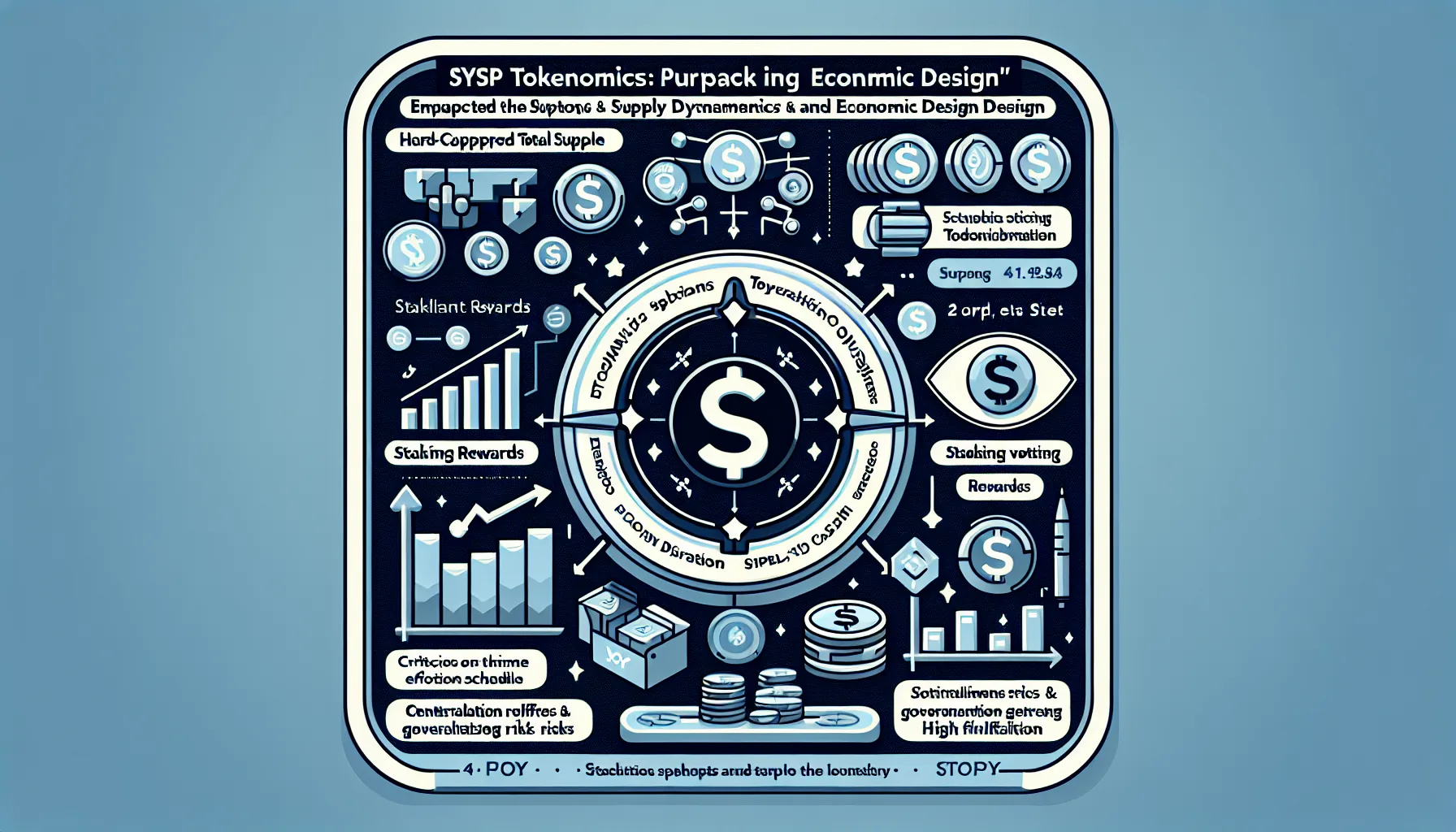
SYSP Tokenomics: Unpacking the Supply Dynamics and Economic Design
The tokenomics of SYSP is built on a foundational structure designed to balance utility, governance, and incentivization within its ecosystem. Understanding the supply metrics and economic model of SYSP is critical to assessing its utility and long-term functionality within the blockchain space.
Total Supply and Emission Schedule
SYSP operates with a hard-capped total supply, aiming to maintain scarcity and align long-term incentives among participants. The distribution of tokens is segmented across initial allocations, staking rewards, ecosystem development, and other operational needs. However, questions persist regarding the proportional split between these allocations. Specifically, critics point to the relatively high percentage allotted to the developer and foundation wallets, which raises concerns about potential centralization risks.
The emission schedule follows a predefined curve, but one challenge noted by some community members is the accelerated release of certain locked tokens. While this front-loaded unlocking mechanism may incentivize early adoption and network activity, it has also introduced criticism for its potential to create sell pressure during the early stages of adoption. As with many capped-supply tokens, post-emission challenges are expected to shift focus on sustainable fees or burns to maintain utility.
Utility and Fee Mechanisms
SYSP tokens are required for transaction fees, staking for network security, and governance participation. A distinguishing characteristic of its fee design is the inclusion of a burn mechanism tied to transaction activity. While the burn mechanism aids in deflationary pressure under high usage scenarios, the sustainability of the network will depend heavily on the on-chain activity levels remaining robust. An overly aggressive burn ratio could reduce circulating supply to unsustainable levels, potentially affecting ecosystem incentives over time.
One significant critique is the reliance on staking rewards as a primary incentive for token holders. While staking ensures network participation and security, the existing reward structure has been flagged for its relatively high annual percentage yield (APY). If not coupled with significant utility demand, such staking dynamics could dilute long-term value.
Governance and Decentralization Concerns
Governance in the SYSP ecosystem is carried out via token-weighted voting, putting decision-making power in the hands of token holders. While this aligns with decentralization principles, the high concentration of tokens in foundation and early-investor wallets introduces the risk of governance capture. This has led to calls within the community for more rigorous decentralization metrics or even the introduction of quadratic voting to mitigate the influence of large holders.
SYSP’s tokenomics offers a balance between utility, incentivization, and governance, but the sustainability of its model requires careful monitoring of supply distribution, demand generation, and community-driven decentralization initiatives.
SYSP Governance
SYSP Governance: Decentralized Decision-Making and Challenges to Watch
Governance is a cornerstone of SYSP's architecture, designed to empower its community through decentralized decision-making mechanisms. At its core, governance involves token holders actively participating in on-chain proposals and voting, making their stake an integral component of shaping the protocol’s future. While SYSP governance aims for inclusivity and transparency, it is not without critical challenges that demand attention.
Governance Mechanism Overview
SYSP relies on a governance token that enables users to propose changes, vote on protocol updates, and influence the allocation of treasury funds or other key resources. Proposals can range from minor parameter adjustments to structural upgrades of the network. Token holders stake their governance tokens to vote, with voting power proportionate to their holdings. This design gives substantial influence to active participants, but it also inherently prioritizes large token holders, raising concerns over potential centralization.
The Risk of Voter Apathy and Power Concentration
One common governance issue in the blockchain space, including SYSP, is voter apathy. Despite decentralization being a core principle, many token holders opt not to participate in governance, either due to lack of understanding, disinterest, or the complexity of proposals. This dynamic often concentrates voting power in the hands of whales—large token holders—who possess both the resources and incentives to sway decisions, potentially undermining the egalitarian ideals of the protocol.
Proposal Accessibility and Representation
For SYSP, the process to submit and approve proposals is meant to be straightforward enough for community-driven innovation. However, creating effective proposals still requires a steep learning curve and significant effort, which can act as a barrier for contributions from non-technical community members. Additionally, the resources needed to promote or explain a proposal to the wider community often skew in favor of well-funded participants, creating a potential imbalance in representation.
Sybil Resistance and Security Concerns
A critical consideration for SYSP governance is ensuring sybil resistance without sacrificing accessibility. Since voting power is tied to token ownership, the system is susceptible to entities accumulating a disproportionate share of tokens for the purpose of manipulating governance outcomes. While staking requirements and other anti-sybil features mitigate this risk to an extent, they do not eliminate it entirely.
Evolving as Governance Matures
Although SYSP governance is functional, it is far from immune to the challenges shared across decentralized governance frameworks. The outcomes hinge on active community participation, effective distribution of voting power, and the system’s ability to adapt as the protocol matures. Addressing these foundational hurdles is paramount to ensure the long-term sustainability and fairness of SYSP's decentralized infrastructure.
Technical future of SYSP
SYSP's Technical Roadmap: Innovations and Challenges
SYSP is poised to expand its technical capabilities through a series of planned developments focusing on scalability, interoperability, and decentralized infrastructure enhancement. These roadmaps aim to address ecosystem challenges and align SYSP’s architecture with the shifting priorities of the broader blockchain space.
Layer-2 Scalability Enhancements
One key initiative in SYSP’s roadmap is the integration of advanced Layer-2 solutions. The project is examining rollup technologies, such as optimistic and zero-knowledge rollups, to offset network congestion and reduce transaction fees without compromising security. However, the technical complexity of incorporating rollups raises challenges around compatibility with the SYSP mainchain consensus mechanism, which remains an area of active exploration. Unlike other blockchains that have opted for modular execution layers, SYSP’s approach will require significant overhead to ensure seamless synchronization between Layer-1 and Layer-2 data persistence.
Interoperability Initiatives
Interoperability remains a major focus for SYSP’s technical evolution. Plans are in place to deploy native bridges to facilitate cross-chain communication with ecosystems like Ethereum, Cosmos, and Polkadot. This aims to broaden the utility of SYSP-based assets while integrating external liquidity sources. That said, interoperability solutions have often been plagued by concerns over bridge vulnerabilities, and SYSP’s team will need to prioritize the development of trust-minimized frameworks to mitigate risks of exploits—something other blockchain platforms have struggled to solve conclusively.
Enhanced Decentralization of Governance and Infrastructure
Beyond scalability and interoperability, SYSP is committed to improving decentralization across all aspects of its network. In its roadmap, additional validator nodes are expected to onboard, with an emphasis on geographically distributed participation to reduce centralization risks. Additionally, plans are underway to implement decentralized governance layers to amplify community participation in protocol upgrades. However, governance decentralization introduces latency in decision-making during critical system upgrades, which could prove to be a hurdle for maintaining competitive agility in fast-evolving market conditions.
Challenges in Protocol Upgrades
SYSP’s ambition to remain at the forefront of technical innovation has led to complex upgrade paths, particularly with backward compatibility. While modular implementations are being planned to allow incremental updates, this adds significant technical debt to smart contract standards already in use. As the network evolves, maintaining developer alignment within this fragmented ecosystem is a potential concern, possibly leading to reduced participation in building on top of SYSP.
SYSP’s ongoing and proposed technical innovations show promise but also shine a light on the inherent challenges associated with scaling, decentralization, and cross-chain integration—challenges that will shape the network’s evolution moving forward.
Comparing SYSP to it’s rivals
SYSP vs ETH: A Deep Dive into Key Differentiators
When comparing SYSP to Ethereum (ETH), several crucial distinctions emerge that cater to differing user needs and technical approaches within the blockchain ecosystem. While Ethereum dominates as the foundational layer for decentralized applications (dApps), SYSP has positioned itself as a unique player with a focus on a narrower, application-specific use case.
Consensus Mechanisms: A Divergence in Architecture
Ethereum's move to Proof of Stake (PoS) protocol under Ethereum 2.0 emphasizes scalability and energy efficiency for its expansive ecosystem. SYSP, on the other hand, employs a hybrid consensus model that blends Proof of Stake with unique governance layers tailored to the asset’s goals. While this hybrid approach prohibits SYSP from matching Ethereum’s transaction throughput, it offers a niche application for users and developers relying on a governance-first blockchain structure.
Smart Contract Application and Versatility
Ethereum's dominance stems largely from the flexibility of its Ethereum Virtual Machine (EVM). Designed for a broad array of use cases, the EVM supports everything from DeFi protocols to NFT marketplaces. SYSP, however, does not prioritize general-purpose smart contract compatibility. While this may limit developer choice, it comes with the advantage of reduced attack vectors and increased security for its specific operational scope. That said, developers seeking cross-chain compatibility or EVM integration may find SYSP less accommodating.
Developer Ecosystem
Ethereum’s thriving developer ecosystem is unrivaled, supported by an enormous repository of tools (like Solidity and web3.js) and community-driven innovations. SYSP, in contrast, operates with a much smaller developer community and fewer documented resources for third-party integration. This can make onboarding new developers more challenging, though it may appeal to those seeking a streamlined and less saturated environment.
Network Costs and Latency
Ethereum’s notable challenge has always been its gas fees, which can spike dramatically during network congestion. SYSP offers more predictable and lower transaction costs due to its niche-focused user base and smaller network. However, this cost stability comes at the expense of network effects. Ethereum’s congestion is, in part, a symptom of its massive adoption, something that SYSP cannot currently parallel.
Decentralization vs. Governance-Driven Decision Making
Ethereum thrives on decentralization as a cornerstone of its operations. Node validators on Ethereum span the globe, fostering an arguably more censorship-resistant environment. SYSP, while decentralized, prioritizes governance-driven decision-making to enact protocol upgrades and adapt to user demands. Critics argue that this governance model introduces potential centralization risks, especially if decision power becomes concentrated over time.
Comparing SYSP to Binance Coin (BNB): Key Differences in Utility and Ecosystem Design
When analyzing SYSP’s competitive landscape, a closer examination of Binance Coin (BNB) reveals key contrasts in design philosophy, utility, and ecosystem integration. Both assets cater to blockchain users and developers but approach their objectives through divergent paths, leading to distinct strengths and weaknesses.
Utility in Ecosystem Participation
BNB’s primary utility is deeply intertwined with the Binance ecosystem, which includes one of the largest centralized exchanges (CEXs), the Binance Smart Chain (BSC), and a range of decentralized finance (DeFi) tools. BNB is extensively required for reduced trading fees, token launches (via Binance Launchpad), and as the foundational token of the BSC, used for transaction fees and staking. This centralized dependency on Binance as a corporation has solidified BNB’s adoption but also invites criticism regarding over-centralization and vulnerability to regulatory scrutiny.
SYSP, on the other hand, does not anchor its value around a single corporate entity or centralized ecosystem. Its utility is largely decentralized, targeting self-sovereignty and application-specific use cases. While its niche focus appeals to privacy-conscious developers and users, it also narrows adoption potential when compared to BNB’s ecosystem, which benefits from Binance’s massive global user base.
Consensus Model and Network Architecture
Binance Smart Chain eschews full decentralization in favor of speed and scalability, leveraging a Proof of Staked Authority (PoSA) mechanism run by a select set of validators. This design ensures high throughput and low transaction costs, making it ideal for projects requiring fast execution. However, frequent criticism arises over centralization—the small number of validators are closely linked to Binance itself, raising concerns about censorship resistance and trust in the network.
SYSP takes a more decentralized approach, favoring community-driven governance and self-sovereign network participation. While this aligns with ideals of decentralization, SYSP may struggle with scalability challenges as transaction volumes grow. Such a contrast shows a clear trade-off: SYSP retains a trustless model but may sacrifice speed and efficiency, while BNB’s efficiency may come at the cost of user trust.
Developer and Project Ecosystems
BNB benefits from Binance’s influence to attract developers to BSC, offering grants, incubation programs, and seamless integration with the exchange. Despite its rapid growth, BSC’s ecosystem has been criticized for hosting too many projects with questionable utility or outright scams, due to low entry barriers.
SYSP, in contrast, offers fewer incentives for rapid project onboarding but fosters a more curated ecosystem. This may result in slower growth but potentially higher-quality use cases. Developers building on SYSP tend to emphasize unique applications over imitating Ethereum or BSC trends, which could help avoid the glut of copycat projects that BSC often struggles with.
In summary, while SYSP distinguishes itself through decentralization and a community-driven ethos, BNB’s appeal lies in its scalability and powerful ecosystem—but not without trade-offs.
SYSP vs. SOL: A Technical and Strategic Comparison
When evaluating SYSP against Solana (SOL), key differentiators emerge at the intersections of scalability, network architecture, and decentralization philosophy. SYSP, while lesser-known in market capitalization compared to SOL, operates under a design philosophy that contrasts sharply with the high-speed and throughput-driven approach of Solana.
Scalability: Throughput vs. Sustainable Integrity
Solana’s reputation for high transaction throughput, often reported in the tens of thousands of TPS (transactions per second), stems from its innovative Proof of History (PoH) mechanism paired with Proof of Stake (PoS). SYSP, on the other hand, adopts a more measured, modular blockchain design that prioritizes sustainable scalability over raw speed. While SYSP may not rival Solana’s blistering throughput numbers, it sidesteps several challenges Solana faces, such as network downtime and the compromises made to maintain performance under heavy load. For developers and projects seeking network reliability, these trade-offs are a critical consideration.
Network Resilience and Downtime Concerns
One of the criticisms of Solana is its history of sporadic network outages during periods of high congestion or validator desynchronization. The Solana architecture’s focus on maximizing performance has, at times, sacrificed network resiliency. SYSP takes a different approach by placing systemic emphasis on modular upgrades and backward-compatible improvements that reduce the risk of catastrophic interruptions. However, SYSP’s commitment to methodical updates does result in comparatively slower innovation cycles, which may deter some developers accustomed to the fast-paced adaptability of ecosystems like Solana's.
Decentralization and Validator Participation
Although Solana touts advanced technology, the network’s decentralization has been a topic of concern within the crypto community. High hardware requirements for validators often limit participation, centralizing control in fewer hands. SYSP, while not achieving perfect decentralization itself, adopts a model that intentionally lowers barriers for node operators, aligning more with the original ethos of blockchain technology. This approach encourages broader validator participation, though it may come at the expense of the extreme efficiency seen in Solana’s vertically-optimized architecture.
Development Focus and Ecosystem Size
Solana boasts a robust ecosystem with a wide range of applications in DeFi, NFTs, and gaming. SYSP’s ecosystem, while smaller in scale, is steadily growing due to its community-focused development model. However, SYSP’s deliberate pace in vetting projects may hinder on-boarding for fast-moving developers and deter projects seeking instant deployment, a department where Solana excels due to its active developer grants and incubation efforts.
Both protocols highlight specific trade-offs, making the comparison between SYSP and Solana an intricate study of blockchain priorities.
Primary criticisms of SYSP
The Primary Criticism of SYSP: Challenges and Concerns Surrounding the Ecosystem
SYSP, like many blockchain-based assets, faces its share of scrutiny, with critics pointing to specific challenges that impact its ecosystem and adoption. Below are the primary concerns that surround SYSP and its framework:
1. Centralization Risks Despite Decentralization Claims
While SYSP positions itself as a decentralized asset, critics argue that certain elements of its governance and infrastructure display strong centralization tendencies. For example, key decisions around protocol updates or allocations may still be influenced heavily by core developers or a small subset of influential stakeholders. This perceived lack of true decentralization raises questions about the fairness and resilience of the network, especially in scenarios of power consolidation or community disputes.
2. Potential Scalability Limitations
Scalability remains a persistent issue for the SYSP ecosystem as usage grows. Although the project may employ specific mechanisms to handle increased transaction throughput, critics highlight that these solutions often come with trade-offs, such as reduced decentralization or higher barriers for node operators. The tension between scaling efficiently while maintaining security and decentralization is a critical challenge for SYSP, particularly if the network aims to support large-scale adoption.
3. Concerns Around Development Transparency
Another area of concern centers on the transparency of SYSP’s funding and development strategies. Critics often point to opaque decision-making processes, where the community may not have full visibility into how funds are allocated or how priorities are set for technical updates. For a project rooted in the ideals of openness and trustlessness, such opacity may erode confidence among developers and investors alike.
4. Tokenomics and Inflationary Dynamics
SYSP’s tokenomics have faced criticism regarding incentives and long-term value preservation. Some stakeholders worry that inflationary dynamics or the structure of rewards within the system could lead to reduced scarcity over time, impacting the asset's perceived value. Additionally, questions arise about whether incentives are properly aligned for long-term contributors versus short-term participants, creating risks of discouraging sustained engagement.
5. Security Implications of Consensus Mechanisms
Depending on its consensus protocol, SYSP may face potential vulnerabilities, such as susceptibility to 51% attacks or validator cartels. Critics also spotlight energy efficiency concerns if certain mechanisms require significant computational resources or incentivize hardware centralization. These security and operational risks could undermine confidence in the asset’s overall robustness.
6. Adoption Barriers and Niche Positioning
SYSP’s ecosystem, while innovative, has been criticized for its limited appeal beyond a niche audience. High technical complexity and lack of user-friendly interfaces may deter mainstream users or developers from engaging with SYSP. Moreover, the ecosystem’s reliance on a specific use case or community can be a double-edged sword, potentially constraining its ability to adapt to broader market trends.
These criticisms underscore critical questions about SYSP’s long-term viability, scalability, and operational dynamics.
Founders
SYSP Founding Team: Visionaries with a Controversial Edge
The founding team behind SYSP is a group of seasoned blockchain technologists, developers, and privacy advocates. Originally conceptualized as a project focussed on decentralized infrastructure, SYSP's core ethos revolves around privacy, security, and scalability. The founding team leveraged their collective expertise to position SYSP as a unique player in the blockchain ecosystem, emphasizing its potential to bridge traditional systems with blockchain technology for broader adoption.
Key Members and Expertise
The founding team of SYSP consists of individuals with deep roots in cryptography, distributed systems, and open-source software development. Central to the team’s credibility is their proven track record of contributions to existing blockchain projects and their extensive involvement in privacy-focused technologies. Several members have backgrounds in academic research, particularly in areas such as zero-knowledge proofs and homomorphic encryption—fields integral to SYSP’s architecture. This technical pedigree has earned the team recognition in crypto-native communities.
However, some in the broader crypto ecosystem see their strong focus on privacy as a potential double-edged sword. Privacy-centric crypto projects often face regulatory scrutiny, and SYSP's founding team has not been immune to criticism. A few detractors argue that their staunch stance on decentralization and privacy could make it difficult for SYSP to comply with global regulatory frameworks in the future.
Leadership Transparency and Decentralization Challenges
One of the most polarizing aspects of the SYSP team is its semi-anonymous leadership. While certain team members are publicly known, others actively maintain their anonymity, a decision often justified by the project's privacy-first philosophy. Critics have pointed out that this semi-anonymity could raise concerns among institutional investors or partners who prefer working with fully transparent teams. On the other hand, proponents argue that this hybrid approach aligns with the project’s decentralized principles, striking a balance between transparency and personal privacy.
Moreover, there have been valid concerns raised about the team's decentralized governance roadmap. While promising in its rhetoric, some stakeholders feel the timeline to deliver on true community-led governance has been overly optimistic relative to the actual progress made, leading to calls for greater clarity regarding milestones.
Founding Philosophy Under Review
While the SYSP founders continue to articulate a clear vision for a decentralized and privacy-forward infrastructure, skeptics within the crypto space argue that their idealistic approach may limit the project's scalability in regulated markets. This philosophical divide between the team’s foundational goals and practical execution continues to fuel healthy debate, underscoring the strengths and challenges of SYSP's founding ethos.
Authors comments
This document was made by www.BestDapps.com
Sources
- https://www.syscoin.org/whitepaper
- https://github.com/syscoin/syscoin
- https://syscoin.org/mission
- https://medium.com/syscoin
- https://docs.syscoin.org/
- https://explorer.syscoin.org/
- https://syscoin.org/roadmap
- https://syscoin.org/news
- https://coinmarketcap.com/currencies/syscoin/
- https://cryptoslate.com/coins/syscoin/
- https://syscoin.foundation/
- https://syscoin.readthedocs.io/en/latest/
- https://syscoin.network/
- https://github.com/syscoin/sysethereum-docs
- https://www.coingecko.com/en/coins/syscoin
- https://syscoin.org/tokenomics
- https://syscoin.org/blog/
- https://syscoin.medium.com/syscoin-tutorials-how-to-bridge-syscoin-to-ethereum-77d27a3ef095
- https://syscoin.org/academy
- https://chainhub.syscoin.org/


