History of SYS
The History of Syscoin (SYS): Evolution and Key Milestones
Syscoin (SYS) has undergone significant transformations since its inception, evolving from a simple blockchain project into a sophisticated dual-layer network integrating Bitcoin's security with Ethereum-compatible smart contracts. Founded with the goal of enhancing blockchain scalability and functionality, Syscoin has consistently adapted to industry shifts and technical demands.
Genesis and Early Development
Syscoin originated in 2014, following a Bitcoin-derived codebase with a focus on decentralized marketplace functionality. It was initially designed to facilitate cheap and secure transactions while offering features such as alias systems and certificate issuance. However, early iterations faced challenges related to adoption, security, and usability, prompting ongoing refinements.
Transition to Hybrid Architecture
A major turning point came with Syscoin’s integration of merge mining with Bitcoin, reinforcing security by leveraging Bitcoin’s hash power. This approach bolstered network resilience without requiring independent miners to contribute substantial computational resources. Subsequent updates gradually modernized Syscoin’s protocol, moving beyond its initial marketplace-centric vision toward a broader infrastructure-centric blockchain.
With blockchain scalability becoming a pressing concern across the industry, Syscoin introduced Z-DAG (Zero Confirmation Directed Acyclic Graph), a transaction settlement layer designed to enable high-throughput payments. While Z-DAG improved transaction speed, questions emerged regarding decentralization and network constraints under heavy load, leading to additional refinements.
EVM Integration and Smart Contract Expansion
Adapting to Ethereum’s growing dominance in smart contracts, Syscoin later introduced a layer-1 Ethereum Virtual Machine (EVM) integration. This bridged the gap between Bitcoin’s security and Ethereum’s programmability, enabling seamless deployment of decentralized applications while maintaining robust merge-mining security.
Despite these technical advancements, Syscoin’s adoption in the competitive DeFi and NFT sectors remained limited in the face of dominant ecosystems like Ethereum, Binance Smart Chain, and Solana. Yet, the project continued iterating with on-chain and cross-chain interoperability improvements.
Rollups and Modular Blockchain Paradigm
Most recently, Syscoin has pivoted towards a rollup-centric approach, incorporating zk-Rollups and optimistic rollups to enhance scalability while reducing transaction costs. The move aligns with the blockchain industry's broader modular paradigm, striving to balance performance, cost-efficiency, and security.
Syscoin’s roadmap reflects a commitment to continual improvement, but scalability implementations and interoperability efforts remain ongoing challenges. While the network’s dual-layer structure presents a unique architectural advantage, adoption hurdles and competition from other scaling solutions persist as key obstacles.
How SYS Works
How SYS Works: Layered Architecture and EVM Compatibility
SYS operates on a dual-layer architecture that integrates both a Bitcoin-based UTXO model and an Ethereum-compatible smart contract layer. This hybrid structure allows SYS to support traditional payments while enabling complex decentralized applications (dApps).
Syscoin’s Layer 1: Bitcoin-Based UTXO Model
The base layer of SYS utilizes a Bitcoin-based UTXO framework, ensuring high security and decentralization. This design allows SYS to leverage Bitcoin’s battle-tested security model while supporting near-instantaneous transactions through technologies like Z-DAG. However, while Z-DAG claims high throughput, it is not fully decentralized in the way traditional blockchain consensus mechanisms are, as it relies on probabilistic finality.
Layer 2: Merged Ethereum-Compatible Smart Contracts
A key feature of SYS is its integration with the Ethereum Virtual Machine (EVM), enabling Solidity-based smart contracts. This is facilitated by the NEVM (Network-Enhanced Virtual Machine), which executes smart contracts while settling transactions on the base layer. Unlike rollup-based solutions, NEVM functions as a separate execution layer, raising potential concerns about interoperability and security trade-offs. Developers can deploy Ethereum-based dApps with minor modifications, but SYS’s ecosystem is not as mature as Ethereum’s, limiting available tooling and liquidity.
Rollups and Scalability Solutions
SYS incorporates rollup technologies to improve transaction throughput. By leveraging optimistic and zero-knowledge rollups, it offloads execution from the base layer, reducing congestion and fees. Since these technologies are still evolving, SYS’s rollup implementations may face security and adoption challenges, requiring users and developers to evaluate their effectiveness.
Finality via Bitcoin’s Security
SYS employs a novel security model by anchoring its blockchain to Bitcoin through merge mining and a finality protocol. This provides an additional layer of security while preventing reorg attacks. However, anchoring to Bitcoin can introduce latency due to Bitcoin’s 10-minute block times, potentially impacting real-time use cases.
Token Utility and Network Participation
SYS’s native token is used for transaction fees, staking, and governance. Its multi-purpose utility creates demand but also adds complexity in managing fees across the dual-layer system. Some users have noted fluctuating gas fees on the EVM layer, influenced by network congestion and the evolving fee market dynamics.
Use Cases
SYS Use Cases: Exploring the Utility of Syscoin
Layer 1 and Layer 2 Hybrid Functionality
Syscoin integrates both a Layer 1 UTXO-based blockchain and a Layer 2 rollup solution, facilitating scalable and efficient transactions. By combining Bitcoin’s security model with Ethereum-compatible smart contracts, SYS supports tokenized assets, dApps, and DeFi protocols. However, adoption of this dual-layer model remains a challenge, as builders must navigate the complexities of merging two blockchain paradigms.
Tokenization and Asset Issuance
SYS allows for on-chain asset creation, which can be used for stablecoins, security tokens, NFTs, and fractional ownership. The low-cost transactions make it an attractive option for enterprises requiring high throughput. However, competition from established tokenization platforms, such as Ethereum and Solana, may limit its market penetration. Additionally, network effects are crucial, and failure to onboard key projects could impact adoption.
Decentralized Finance (DeFi) Applications
Syscoin's Ethereum Virtual Machine (EVM)-compatible NEVM chain provides the infrastructure for designing and launching decentralized financial products, including DEXs, lending platforms, and synthetic assets. Since gas fees are significantly lower than Ethereum’s, it offers an attractive environment for cost-sensitive protocols. However, liquidity fragmentation is a challenge, and without major DeFi integrations, sustaining an active ecosystem could be difficult.
Cross-Chain Compatibility and Interoperability
Syscoin’s implementation includes bridging mechanisms, such as ZK-Rollups and Optimistic Rollups, to enhance interoperability. This enables assets to be ported across chains, reducing siloed liquidity. However, bridge security remains a core risk, as cross-chain exploits have been a recurring attack vector in the industry.
NFTs and Metaverse Infrastructure
SYS supports NFT minting and trading, aimed at gaming and metaverse ecosystems. With low transaction costs and a scalable infrastructure, projects can deploy NFT-based economies. However, established NFT standards on Ethereum and Solana dominate market demand, making it difficult for Syscoin-based NFTs to achieve mass adoption.
Enterprise and Government Use Cases
Syscoin touts potential applications in identity verification, supply chain tracking, and enterprise blockchain solutions, leveraging its high throughput and security model. However, enterprise adoption of blockchain solutions has historically been slow, and competition from hyperledger-based private blockchains presents a challenge.
Finality and Security Implications
By utilizing Bitcoin merge-mining, Syscoin enhances its network security and immutability. While this provides robust protection against 51% attacks, reliance on Bitcoin’s mining ecosystem introduces some degree of centralization risk, as a concentration in Bitcoin mining pools could impact Syscoin’s integrity.
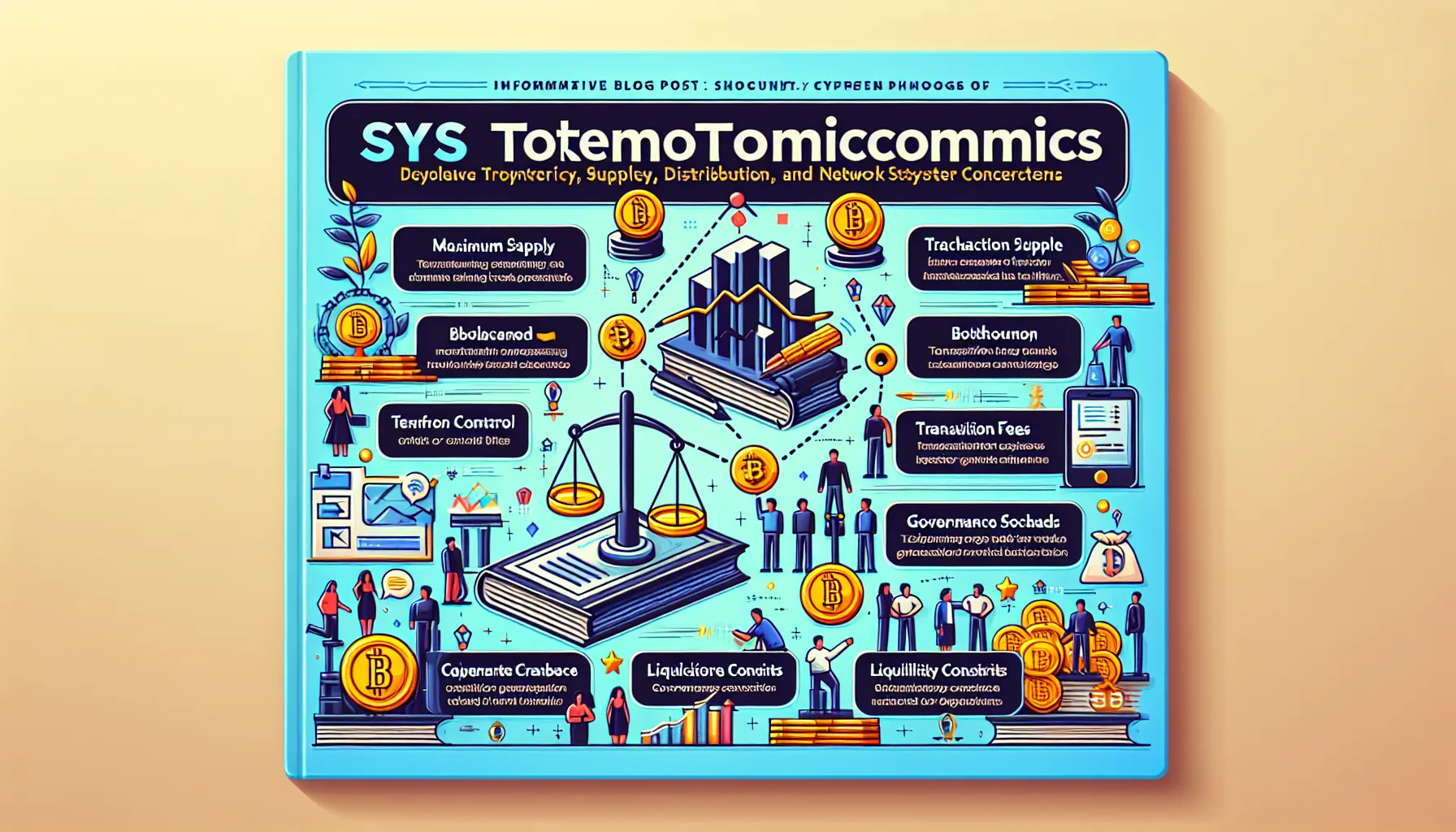
SYS Tokenomics
SYS Tokenomics: Supply, Distribution, and Utility
Fixed Maximum Supply and Inflation Dynamics
SYS has a capped maximum supply, ensuring scarcity and preventing runaway inflation. Unlike assets with unchecked issuance, SYS follows a predetermined emission schedule that reduces block rewards over time. However, concerns about long-term security incentives exist, as diminishing rewards may eventually rely heavily on transaction fees to sustain network validators.
Block Rewards and Distribution Mechanism
SYS utilizes a hybrid consensus model, leveraging both proof-of-work (PoW) and a masternode system. Block rewards are split between miners, masternodes, and a governance treasury. This structured distribution incentivizes network participation but introduces centralization risks—masternodes require a significant SYS collateral, limiting accessibility to smaller holders.
Masternode Economics and Capital Barriers
Masternodes play a crucial role in SYS's ecosystem, enabling features like instant transactions and network governance. However, the requirement to lock up a substantial SYS amount creates a barrier to entry. While this mechanism strengthens network security and reduces circulating supply, it also concentrates rewards among wealthier participants, potentially leading to a more centralized validator set.
Transaction Fees and Network Utility
SYS operates with a competitive fee model, balancing affordability with network sustainability. Transaction fees are used to compensate miners and masternodes, ensuring continued network security. However, in periods of low transaction activity, fee-based rewards alone may not be sufficient to incentivize long-term participation, raising concerns about economic sustainability post-emission.
Token Use Cases and Economic Pressure
SYS is utilized across multiple functions, including transaction fees, smart contract execution, and staking for masternodes. Additionally, it's integrated into the broader Syscoin ecosystem, supporting various dApps and tokenized assets. While these utilities drive demand, the token's actual velocity and adoption rates remain critical in determining its long-term economic viability. A lack of sustained real-world use could lead to speculative-driven price swings without fundamental network value backing the asset.
Liquidity Considerations and Supply Constraints
SYS is actively traded on multiple exchanges, providing liquidity. However, the token’s availability on major platforms and depth of liquidity vary, affecting ease of access for different market participants. The masternode collateral requirement also locks up a significant portion of supply, reducing liquid circulation but potentially amplifying price volatility when masternodes are dissolved.
Governance and Treasury Distribution
A portion of block rewards funds a decentralized treasury, enabling community-driven development efforts. While this model promotes ecosystem growth, governance control remains concentrated among masternode holders, potentially sidelining smaller stakeholders in proposal decision-making. The efficiency and transparency of treasury fund allocation play a crucial role in determining the project's long-term trajectory.
SYS Governance
SYS Governance Mechanisms and Challenges
On-Chain Governance Through Syscoin’s Dual-Layer Architecture
SYS operates on a dual-layer architecture that merges Bitcoin’s security model with Ethereum-compatible smart contracts. Governance within this system is primarily on-chain and revolves around Syscoin’s masternode network. SYS masternodes are required to stake a collateral amount of SYS, granting them voting rights on network proposals. This mechanism determines treasury allocations, network upgrades, and other developmental decisions.
The governance model relies heavily on the masternodes, meaning that decision-making power is concentrated among those who can afford the required SYS collateral. This can lead to a governance structure where wealthier participants have a disproportionately larger influence on the network’s direction.
Proposal System and Voting Structure
Governance proposals in the Syscoin ecosystem are submitted through the network’s treasury system, where masternodes vote to approve or reject funding requests. The proposal system is a typical decentralized governance model, but the effectiveness of this mechanism depends on active participation. Low voter turnout, a common issue across many proof-of-stake and masternode-based networks, can result in governance bottlenecks or decisions being made by a small subset of stakeholders.
Another critical issue within this system is the delegation of voting power. Unlike some governance models that allow delegation through liquid staking mechanisms or proxies, SYS masternode governance is direct, meaning token-holding stakeholders without a masternode have no formal vote. This limits participation to a smaller number of actors and potentially reduces decentralization in decision-making.
Limits of Off-Chain Governance
Beyond the on-chain mechanisms, SYS governance also involves off-chain processes, such as community discussions, developer input, and foundation-led initiatives. While these informal governance methods help in coordinating improvements and fostering discussion, they lack enforceability within the blockchain protocol itself.
A challenge with SYS governance is aligning incentives between different stakeholder groups, including token holders, developers, and masternode operators. Since masternodes directly benefit from transaction fees and rewards, their governance decisions may prioritize incentives that do not always align with broader network participants, such as everyday users or developers building on Syscoin.
The Risk of Governance Centralization
Although Syscoin’s governance model is designed to be decentralized, the reliance on masternodes creates potential centralization risks. Entities or individuals controlling multiple masternodes can exert significant influence over protocol changes, treasury distributions, or consensus rules. This raises concerns about plutocratic decision-making, where governance favors those with more economic stake rather than necessarily aligning with the best technological or community-driven outcomes.
Technical future of SYS
Syscoin: Current and Future Technical Developments
Merge-Mined Layer-1 with Bitcoin Security
Syscoin operates as a merge-mined Layer-1 blockchain, leveraging Bitcoin’s Proof-of-Work (PoW) security while enabling programmability through Ethereum-compatible smart contracts. The Dual Chain Architecture consists of the Syscoin base layer and an EVM-compatible Layer-2, designed to support high-throughput applications. However, merge-mining dependence on Bitcoin could introduce long-term risks related to miner incentives, given Bitcoin’s evolving fee market dynamics.
Rollux: Syscoin’s Scalable Rollup Solution
Rollux, Syscoin’s custom Layer-2 rollup framework, aims to provide high-throughput and affordable transaction execution. It integrates Optimistic Rollups in its initial phase, with plans for Zero-Knowledge Rollups (ZK-Rollups) for enhanced efficiency and finality. While this framework aligns with Ethereum’s modular roadmap, Syscoin's rollup ecosystem remains early-stage, with real-world adoption and liquidity still developing. The transition to ZK-Rollups introduces added complexity, including the challenge of decentralizing the prover network in a trust-minimized way.
Onchain Data Availability and DA Layer Innovations
Syscoin is advancing onchain data availability (DA) through innovations such as PoDA (Proof-of-Data Availability). This aims to provide an alternative to offchain DA solutions like EigenDA or Celestia while ensuring trustless verifiability. However, scaling DA directly on Layer-1 presents concerns regarding storage bloat and long-term chain sustainability, particularly as Layer-2 scaling solutions demand increasing amounts of DA resources.
Block Finality and Nakamoto Consensus Enhancements
To address probabilistic finality limitations in traditional PoW-based setups, Syscoin implements Bitcoin’s Nakamoto consensus with planned enhancements for faster settlement assurances. Proposals include finality checkpoints designed to secure Layer-2 rollup commitments more efficiently. However, balancing finality speed with decentralization remains a crucial challenge, particularly as Syscoin aims to maintain its merge-mining compatibility without compromising core security assumptions.
ZK-EVM and Future Smart Contract Performance
Syscoin's roadmap includes integrating ZK-EVM technology to enhance smart contract scalability and privacy. By leveraging Zero-Knowledge Proofs (ZKPs), smart contract execution could become more efficient while maintaining Ethereum compatibility. This move aligns with broader blockchain trends toward trustless execution, but implementing a performant ZK-EVM requires substantial cryptographic and engineering advancements. The timeline for a fully optimized ZK-EVM remains uncertain, and adoption will depend on developer familiarity and tooling maturity.
Bridging and Cross-Chain Interoperability Risks
Syscoin incorporates trust-minimized cross-chain solutions that aim to enhance interoperability without centralizing bridge dependencies. However, cross-chain communication remains a significant attack vector across the industry, with multiple historical exploits highlighting the risks associated with bridging infrastructure. Ensuring robust security for cross-chain assets will require continuous improvements in cryptographic verification and decentralized relay mechanisms.
Comparing SYS to it’s rivals
Syscoin vs Ethereum: A Technical and Functional Comparison
Syscoin (SYS) and Ethereum (ETH) both serve as foundational blockchain infrastructures, but they differ significantly in architecture, scalability, and transaction efficiency. While Ethereum remains the dominant smart contract platform, Syscoin's hybrid design introduces novel solutions that address some of Ethereum’s limitations.
Consensus Mechanism and Security
Ethereum transitioned to Proof-of-Stake (PoS) with Ethereum 2.0, reducing energy consumption and offering staking-based security. Syscoin, on the other hand, employs a dual-layer architecture combining Bitcoin’s Proof-of-Work (PoW) for base-layer security and a finality layer utilizing Rollux, a Layer 2 (L2) rollup solution. This mix aims to offer Ethereum-level smart contract functionality while maintaining Bitcoin-grade security, a notable divergence from Ethereum’s full migration away from PoW.
However, Syscoin’s reliance on merged mining with Bitcoin means security is dependent on Bitcoin’s mining ecosystem. If Bitcoin undergoes significant changes, such as moving to a different consensus model or experiencing centralization risks, Syscoin’s PoW foundation could face similar vulnerabilities.
Scalability and Throughput
Ethereum’s scalability has historically been a bottleneck. Network congestion and high gas fees remain challenges, despite various Ethereum Layer 2 solutions improving transaction efficiency. Syscoin, by integrating ZK-Rollups with optimistic rollups through Rollux, aims to achieve high throughput with low fees. This hybrid approach theoretically allows Syscoin to scale beyond Ethereum’s base-layer capabilities.
However, Ethereum’s network effect means that alternative scaling solutions, such as sharding or future rollup optimizations, may neutralize Syscoin’s advantage over time. Additionally, Syscoin’s transition to full-fledged Layer 2 adoption is still evolving, meaning its scalability improvements are not yet as battle-tested as Ethereum’s.
Smart Contracts and Ecosystem
Ethereum’s dominance in decentralized applications (dApps), DeFi, and NFT ecosystems is a significant advantage. Solidity, Ethereum’s programming language, is the industry standard with extensive developer adoption. Syscoin maintains EVM compatibility, ensuring that developers can port Ethereum-based applications with minor modifications.
Despite this compatibility, Syscoin’s ecosystem remains smaller than Ethereum’s, leading to potential liquidity fragmentation. While the lower fees and faster transactions on Syscoin offer compelling benefits, Ethereum’s established DeFi protocols, liquidity depth, and vast developer community impose a significant network effect disadvantage for Syscoin.
Decentralization Considerations
Ethereum’s PoS model has led to concerns over validator centralization, with large staking pools exerting considerable influence. Syscoin’s Bitcoin-anchored PoW + Rollux structure aims to avoid such centralization risks. However, Syscoin’s alternative reliance on stakers and masternodes introduces a different form of centralization risk if governance concentration increases.
While Syscoin presents an innovative hybrid model, Ethereum’s entrenched position in the market, ecosystem maturity, and extensive developer adoption remain critical competitive barriers.
SYS vs MATIC: A Layer-2 and Layer-1 Hybrid Compared
Architecture and Approach
SYS integrates a unique Layer-1 and Layer-2 hybrid architecture, combining Bitcoin's merged mining security with Ethereum Virtual Machine (EVM) compatibility. In contrast, MATIC (Polygon) operates primarily as a Layer-2 scaling solution for Ethereum, using sidechains and rollups to enhance transaction throughput and reduce gas costs. While both seek scalability, SYS directly incorporates Layer-1 security without fully relying on Ethereum for finality, whereas MATIC is fundamentally tied to Ethereum’s security model.
Performance and Efficiency
MATIC leverages a Proof-of-Stake (PoS) consensus mechanism alongside zk-rollups and optimistic rollups to optimize speed and cost efficiency. SYS, on the other hand, employs delegated proof-of-stake (DPoS) with its proprietary Rollux Layer-2, which aims for high-speed transactions without compromising decentralization. In terms of network congestion, MATIC has faced instances of high usage leading to increased fees, while SYS's hybrid model attempts to mitigate such issues by balancing Layer-1 and Layer-2 workloads strategically.
Ecosystem and Smart Contract Compatibility
MATIC benefits from a massive developer ecosystem due to its longstanding compatibility with Ethereum’s tooling. SYS also supports EVM-based smart contracts but differentiates itself with features like ZK-Rollups as a native solution and Bitcoin-compliant security principles. The adoption of SYS's tech stacks remains comparatively lower, meaning fewer dApps and integrations relative to MATIC’s more deeply entrenched ecosystem.
Decentralization and Network Governance
MATIC’s PoS-based validator set raises centralization concerns, as delegating stake to a limited set of validators could concentrate power. SYS enhances decentralization by incorporating merge-mining with Bitcoin, aligning with the security assurances of the largest PoW network. However, SYS’s DPoS model still introduces centralization trade-offs, as delegate selection can disproportionately influence network decisions.
Liquidity and Interoperability
MATIC enjoys broader liquidity due to its extensive exchange support and deep DeFi integrations. SYS, while EVM-compatible and DeFi-capable, faces liquidity fragmentation due to its relative market position. Both projects promote cross-chain interoperability, though MATIC’s integrations with Ethereum’s Layer-1 remain its primary advantage. SYS, by pushing for a multi-chain and hybrid consensus model, offers an alternative approach but currently lags in adoption among major DeFi protocols.
SYS vs. ARB: How They Compare in Scalability and Ecosystem Development
Layer 2 Innovation and Approach
SYS and ARB both target blockchain scalability, but their approaches differ significantly. ARB operates purely as an Ethereum Layer 2 scaling solution using Optimistic Rollups, focusing on reducing gas fees and improving transaction speeds for Ethereum dApps. SYS, on the other hand, takes a hybrid-layer model, incorporating both Layer 1 and Layer 2 functionalities, offering rollups alongside its proprietary Layer 1 blockchain. This dual-layer mechanism provides additional flexibility for developers needing both scalability and native chain security.
Transaction Costs and Speed
ARB relies on compression techniques and delayed fraud proofs, which typically result in lower transaction fees compared to Ethereum. However, congestion on ARB’s network can still lead to fluctuating costs, particularly during high demand periods. SYS offers lower and more predictable fees due to its UTXO model and rollup integration, minimizing cost volatility. Additionally, SYS employs ZK and optimistic technologies, which may give it an edge in execution efficiency compared to ARB’s fraud-proof reliance.
Ecosystem Maturity and Adoption
ARB has established itself as a major Layer 2 player, with a widespread DeFi presence and strong developer adoption. Many Ethereum-native projects have migrated or expanded to ARB, creating a deep liquidity pool and extensive tooling support. In contrast, SYS is growing its dApp presence but lacks the same level of ecosystem maturity. Although it offers interoperability with Ethereum assets, the overall network effect and developer adoption are still progressing.
Security and Decentralization
ARB’s security model is tied to Ethereum, leveraging optimistic fraud proofs that assume validity until challenged. While this enhances efficiency, it introduces a delay in finalizing withdrawals, which can take up to a week. SYS, with its hybrid approach, offers additional mechanisms like its PoDA (Proof-of-Data Availability) and ZK-Rollups, which provide alternative security assurances. However, since SYS’s ecosystem is still expanding, the robustness of its decentralization model in large-scale environments remains an evolving factor.
Developer Experience and Tooling
ARB benefits from Ethereum Virtual Machine (EVM) compatibility, allowing seamless migration for Ethereum-based smart contracts. Solidity developers can deploy on ARB with minimal changes, accelerating project migration. SYS also supports EVM compatibility but introduces extra features such as cost-efficient rollups and NFT capabilities. However, the developer experience on SYS may require additional adaptation compared to the straightforward EVM integration of ARB.
Bridging and Liquidity Access
ARB benefits from extensive bridging options, connecting seamlessly with Ethereum and other chains. Its deep liquidity ensures efficient asset flow and cross-chain compatibility for DeFi protocols. SYS, while integrating Ethereum interoperability, does not yet command the same network liquidity or diverse bridging tools as ARB, potentially affecting its adoption within highly liquid DeFi environments.
Primary criticisms of SYS
Primary Criticism of SYS
Concerns Over Centralization Risks
SYS has faced persistent criticism regarding the centralization of its key infrastructure. While the project leverages a hybrid consensus mechanism combining Bitcoin's security with fast transactions, skeptics argue that the reliance on a small number of masternodes introduces centralization risks. Since masternodes require significant SYS collateral, wealthier participants inherently hold more influence over the network. This can lead to governance concerns, where a small subset of stakeholders have disproportionate control over protocol upgrades and decision-making processes.
Smart Contract Limitations and Developer Adoption
Despite supporting EVM compatibility through its Layer 2 implementation, SYS has struggled to attract widespread developer adoption. Critics note that compared to larger ecosystems like Ethereum and BNB Chain, SYS lacks a robust decentralized application (dApp) ecosystem. Limited liquidity and lower adoption rates make it challenging for developers to prioritize deployment on SYS, raising concerns over long-term sustainability and network effects. Additionally, while its hybrid architecture aims to optimize performance, some argue that it introduces unnecessary complexity for developers used to more standard blockchain environments.
Interoperability and Ecosystem Fragmentation
SYS positions itself as a scalable, interoperable blockchain, but critics highlight challenges with fragmented adoption. Despite offering multiple layers for scalability, including ZK-Rollups and EVM compatibility, SYS has not achieved the same level of cross-chain integrations as some competitors. The ecosystem's reliance on proprietary technology, such as Syscoin’s NEVM, has been cited as a barrier to broader interoperability with other major blockchain networks.
Inflation and Tokenomics Concerns
SYS employs an emission schedule that critics argue could create long-term inflationary pressure. Some concerns stem from the continued issuance of block rewards, as well as the distribution mechanism that heavily favors masternodes. Since masternodes earn rewards while regular holders do not receive passive income unless they actively participate in staking mechanisms, it creates an incentive imbalance that benefits large SYS holders over retail investors. These tokenomics have led to debates over whether the system is truly equitable or if it disproportionately rewards early adopters and large stakeholders.
Exchange Liquidity and Market Accessibility
Compared to top-tier blockchain networks, SYS has faced challenges in maintaining high liquidity across major crypto exchanges. While it is available on multiple platforms, trading volume is sometimes inconsistent, leading to concerns about market depth and slippage for larger trades. This reduced liquidity can impact usability, particularly for institutional players or traders seeking to enter or exit positions efficiently. Additionally, availability on fewer mainstream exchanges limits accessibility to a broader investor base.
Founders
Syscoin Founding Team: Origins, Leadership, and Challenges
Syscoin was founded in 2014 by Sebastian Schepis, a developer with experience in distributed systems. Originally launched as a Bitcoin fork, Syscoin aimed to provide enhanced scalability and utility beyond simple payments, incorporating decentralized marketplace functionality early on. Schepis played a key role in the initial technical direction, but leadership over the years has shifted.
While Syscoin’s technology has evolved significantly, early leadership transitions presented challenges. Schepis eventually stepped back from an active role, leading to restructuring within the core team. Transitioning from a single founder-driven vision to a more decentralized development effort took time, and there were periods where project direction appeared uncertain to the community.
Following Schepis' reduced involvement, the Syscoin Foundation took a more prominent role in managing development and partnerships. Jagdeep Sidhu, another core developer, became increasingly central over the years, shaping Syscoin’s technological evolution, including the integration of Ethereum-compatible smart contracts and rollup scaling solutions. Under Sidhu’s technical leadership, Syscoin expanded its focus to modular blockchain architecture, positioning itself as a hybrid layer-1 solution.
However, governance and transparency have been key points of discussion among community members. While the Syscoin Foundation oversees project development, some critics argue that decision-making remains relatively opaque compared to more decentralized projects with on-chain governance mechanisms. Unlike some DAOs that have fully decentralized funding and voting rights, Syscoin’s development relies heavily on a core group of contributors, which raises concerns regarding centralization of control.
The team has also faced scrutiny regarding communications and marketing strategy. At times, updates on major roadmap milestones and partnerships have lacked clarity, leading to speculation and uncertainty within the ecosystem. This disconnect has occasionally resulted in community frustration, particularly during long periods of development without visible progress or significant adoption breakthroughs.
Despite these challenges, Syscoin has retained a dedicated base of contributors and developers. The network continues to push forward with innovations in blockchain scaling and interoperability under the guidance of its leadership. The project’s ability to maintain momentum largely hinges on how effectively the team addresses transparency concerns and balances decentralization with efficient decision-making.
Authors comments
This document was made by www.BestDapps.com
Sources
- https://syscoin.org/
- https://syscoin.org/roadmap
- https://syscoin.readthedocs.io/
- https://github.com/syscoin/syscoin
- https://github.com/syscoin/sips
- https://syscoin.org/whitepaper.pdf
- https://syscoin.org/yellowpaper.pdf
- https://explorer.syscoin.org/
- https://bridge.syscoin.org/
- https://medium.com/syscoin
- https://twitter.com/syscoin
- https://github.com/syscoin/rollux
- https://rollux.com/
- https://syscoin.org/news
- https://syscoin.org/staking
- https://syscoin.io/docs/syscoin-token-platform
- https://syscoin.io/docs/masternodes
- https://www.coingecko.com/en/coins/syscoin
- https://coinmarketcap.com/currencies/syscoin/
- https://messari.io/asset/syscoin


