History of SUSHI
The History of SUSHI: A Decentralized Saga in DeFi’s Evolution
SUSHI, the native token of SushiSwap, emerged during the height of the decentralized finance (DeFi) boom in late summer 2020. Created by the pseudonymous developer "Chef Nomi," the project was designed as a fork of Uniswap, one of the leading automated market makers (AMMs) at the time. However, SushiSwap set itself apart from its predecessor by introducing a governance token, SUSHI, allowing holders to participate in decision-making while earning rewards through staking and liquidity provision.
The launch of SushiSwap was far from conventional. In what is now famously dubbed a "vampire attack," SushiSwap incentivized liquidity providers to migrate their capital from Uniswap by offering significant SUSHI token rewards. This strategy caused a dramatic siphoning of liquidity from Uniswap and positioned SushiSwap as a heavyweight in the DeFi ecosystem almost overnight. By early September 2020, SushiSwap had amassed over $1 billion in total value locked (TVL), making its launch one of the most controversial—yet consequential—events in DeFi history.
However, the project’s meteoric rise was soon clouded by controversy. Mere weeks after launch, Chef Nomi unilaterally withdrew approximately $14 million worth of Ethereum from SushiSwap's developer fund, sparking accusations of a potential exit scam. The backlash from the community was swift, with prominent crypto figures openly condemning Nomi's actions. In response to the uproar, Chef Nomi returned the funds to the project's treasury and handed over control to the community, specifically to FTX CEO Sam Bankman-Fried, who acted as a temporary steward to stabilize governance during the project's fragile early phase.
With community governance firmly in place, SushiSwap began evolving from a Uniswap clone into a more comprehensive DeFi platform. Despite its initial rocky phase, the protocol gained traction by implementing features such as limit orders, lending, and yield farming strategies. Yet, criticisms surrounding its early handling of governance and accusations of opportunistic behavior remain focal points for skeptics of the project.
Today, SushiSwap holds an important, albeit polarizing, place in the broader DeFi narrative. Its history underscores both the possibilities and pitfalls of decentralized governance and the rapid ideological shifts within the crypto ecosystem. This foundation continues to play a significant role in defining its ongoing evolution as a decentralized protocol.
How SUSHI Works
How SUSHI Works: Unpacking the Mechanics of the SushiSwap Ecosystem
SUSHI is the native utility and governance token of SushiSwap, a decentralized finance (DeFi) protocol recognized for its automated market-making (AMM) capabilities and yield farming innovations. At the core, the functioning of SUSHI is intertwined with SushiSwap's ecosystem, where it primarily facilitates liquidity incentives, staking, governance, and fee distribution. Here's a breakdown of how it works:
Liquidity Provider Rewards and SUSHI Emissions
SUSHI is distributed as a reward to liquidity providers (LPs) who deposit token pairs into SushiSwap's liquidity pools. Participants earn LP tokens representing their share of the pool and are further incentivized with SUSHI tokens on eligible pairs. The emission model is structured to bootstrap liquidity, although this continuous token issuance has invited criticism regarding inflationary pressure, which could dilute the token's value over time.
SushiBar: SUSHI Staking for xSUSHI
Holders of SUSHI can stake their tokens into the SushiBar to mint xSUSHI, a yield-bearing token. xSUSHI accrues a share of the 0.05% trading fees collected from all swaps executed on the platform. While this mechanism encourages SUSHI holders to participate in the protocol's success, critics highlight the dependency on trading volume for rewards. During periods of low activity, rewards may diminish, potentially reducing interest in staking.
Governance via Sushi DAO
SUSHI holders have the ability to participate in decentralized governance through the Sushi DAO. This allows holders to propose and vote on protocol upgrades, partnerships, and resource allocations. However, governance participation faces challenges common in DeFi: voter apathy and the outsized influence of whale holders, which may dilute individual contributions and question the true decentralization of decision-making.
Fee Distribution and Tokenomics
Every trade on SushiSwap incurs a 0.30% fee, of which 0.25% is distributed to liquidity providers, and 0.05% is diverted to xSUSHI stakers. While this creates a transparent revenue model, the reliance on trading volume introduces variability in fee distribution. Additionally, some argue that the dual-layer incentives may overcomplicate long-term token value understanding for participants.
Limitations and Risks
One critique of SushiSwap's DeFi framework is the possibility of impermanent loss faced by liquidity providers, a problem inherent to AMM protocols. Additionally, the multiple revenue streams tied to SUSHI’s utility can create confusion about its core value proposition. Security risks, such as smart contract vulnerabilities, also pose persistent concerns, particularly given past incidents involving DeFi protocols across the industry.
The interplay between the SUSHI token's incentives, governance rights, and fee-sharing model creates a multifaceted system. However, this complexity has also sparked ongoing debates around sustainability, inflation, and the actual decentralization of the ecosystem.
Use Cases
Exploring SUSHI Use Cases in DeFi Ecosystems
SUSHI, the governance and utility token of the SushiSwap protocol, operates at the intersection of decentralized finance (DeFi) and automated market-making (AMM). As a multi-dimensional asset, SUSHI is integral to the protocol’s functionality and incentivization mechanisms, with specific use cases extending beyond simple liquidity provision.
Governance and Community Participation
One of the foundational use cases for SUSHI is its role in protocol governance. Token holders can partake in the decentralized decision-making process by proposing or voting on protocol upgrades, parameter changes, or even treasury management. This governance model offers a high level of autonomy for community participants, but its effectiveness is occasionally questioned due to voter apathy and the heavy influence of whales. The concentration of voting power among large stakeholders has raised concerns about the token's ability to truly democratize decision-making within the ecosystem.
Liquidity Mining Incentives
SUSHI is employed as a reward for liquidity providers on SushiSwap pools. By staking their assets in liquidity pools, users earn a portion of trading fees along with SUSHI rewards. While these incentives have successfully bootstrapped liquidity for the protocol, the sustainability of such rewards has come under scrutiny. Critics argue that high token emissions for incentives may lead to long-term inflationary pressures, potentially diluting value for existing holders.
SUSHI Staking via xSUSHI
Holders of SUSHI can stake their tokens to receive xSUSHI, effectively earning a share of the platform’s trading fees. This staking mechanism aligns incentives between the ecosystem and token holders by offering a passive income stream. However, fluctuating trading volumes directly influence the rewards, introducing variability in returns. Additionally, some DeFi users see room for improvement in the transparency of fee distribution mechanics.
Asset Collateralization in DeFi
SUSHI has been integrated into several DeFi lending and borrowing platforms, where it serves as collateral for obtaining loans or other synthetic assets. While this broadens the token's utility, its use as collateral often comes with risks of liquidation during sharp market downturns. The volatility of SUSHI as an asset could dissuade risk-averse participants from utilizing it in this capacity.
Yield Optimization Strategies
The token’s presence in various DeFi protocols has made it a component in yield farming strategies. Many aggregators and vault platforms incorporate SUSHI to optimize returns for users. However, the complexity of these strategies often requires a high level of understanding, limiting accessibility to more advanced participants in the crypto space. Additionally, impermanent loss and smart contract risks are significant considerations for users engaging in these activities.
SUSHI’s versatility within the DeFi landscape highlights its multi-functional utility yet also uncovers challenges tied to tokenomics, governance, and market dynamics. These use cases establish SUSHI as more than just a speculative asset, embedding it deeply into the operational mechanics of the SushiSwap ecosystem.
SUSHI Tokenomics
Tokenomics of SUSHI: An In-Depth Analysis
SUSHI, the native token of the SushiSwap ecosystem, operates on a carefully designed tokenomics model that balances user incentives, governance, and network security. This section explores the intricate dynamics of SUSHI’s issuance, utility, and distribution, highlighting both strengths and challenges.
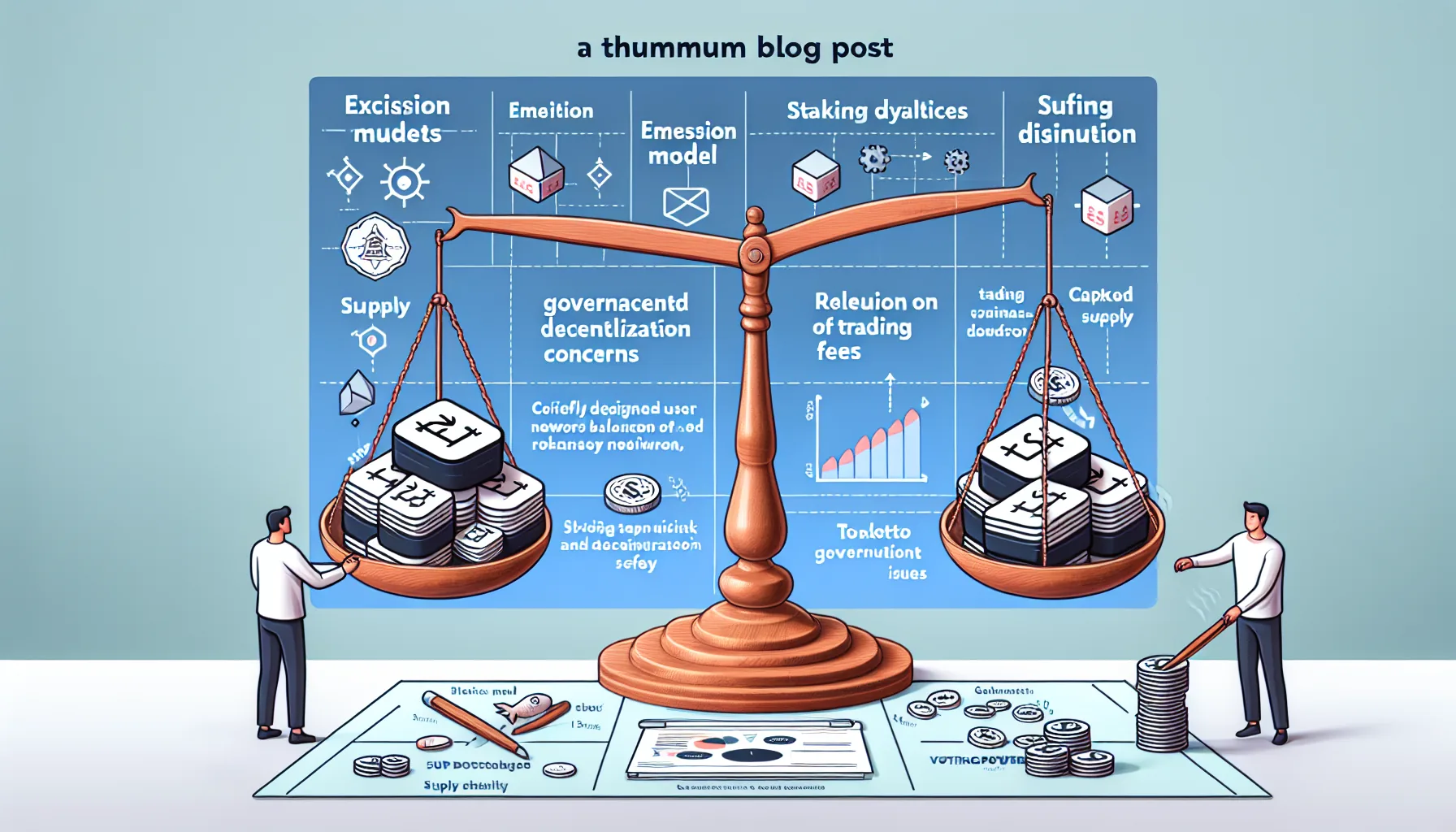
Fixed Supply vs. Emissions Model
SUSHI was initially introduced with an unlimited supply and a block reward model to incentivize liquidity providers. However, this was adjusted into a capped maximum supply of 250 million tokens through community governance—a notable shift towards long-term stability. As of now, no new inflation-oriented mechanisms have been proposed. This capped supply differentiates SUSHI from other decentralized exchange (DEX) tokens still competing within inflationary frameworks. The capped mechanism could, however, pose scalability concerns for governance incentives and developer funding in the absence of alternative revenue models.
SUSHI Staking: xSUSHI Dynamics
SUSHI holders can stake their tokens to receive xSUSHI, a derivative token earned through platform fees collected as 0.05% of every swap transaction on the SushiSwap platform. This structure ties token utility directly to platform activity. However, critics argue this is a double-edged sword. xSUSHI earnings are dependent on trade volume, and in times of reduced activity, staking rewards can diminish, potentially leading to less long-term holder retention.
The compounding mechanism of xSUSHI, where value accrues over time, adds a layer of complexity, which seasoned DeFi investors might appreciate but could act as a barrier for newer users.
Governance and Decentralization
SUSHI plays a pivotal role in SushiSwap governance, granting token holders voting power on protocol upgrades and treasury deployment. While this adheres to the ethos of decentralized finance, active voter participation remains relatively low, which can lead to governance inefficiencies and concentrated decision-making among large stakeholders or whales. This level of centralization reduces the democratic nature of the protocol, leaving the system vulnerable to governance capture.
Supply Distribution Concerns
SUSHI's distribution model has faced scrutiny, particularly with the allocation of tokens to early adopters, contributors, and community incentives. Although initially lauded for incentivizing early liquidity providers, there have been accusations of misaligned incentives and possible sell pressure from large allocations to team members or insiders. This issue has been exacerbated by a perceived lack of transparency in allocation adjustments.
Revenue Model Reliance
Finally, SushiSwap’s reliance on trading fees as a primary revenue generator linked directly to SUSHI could present sustainability risks in a competitive DeFi market. Alternative revenue streams, such as lending or tokenized bonds, remain unexplored at scale within the ecosystem, leaving SUSHI more susceptible to fluctuating demand in the broader DEX landscape.
SUSHI Governance
Governance in SUSHI: Decentralized Decision-Making and Challenges
SUSHI, the native token of SushiSwap, operates as a governance token designed to empower its holders to participate in the decentralized management of the protocol. Governance within the SushiSwap ecosystem revolves around token holders proposing and voting on changes to the protocol, including fee structures, treasury allocations, and protocol upgrades. While the intention is to create a community-driven, decentralized framework, there are complexities and issues worth examining.
Voting Power and Distribution
A key aspect of SUSHI governance is that voting power is proportionate to the amount of SUSHI a holder owns. While this may align with the token’s decentralized ethos, it can lead to a concentration of power in the hands of whales or entities that hold a significant amount of tokens. This creates a potential misalignment: smaller, individual contributors to the ecosystem may have less influence than institutional investors or major stakeholders, potentially reducing inclusiveness.
Additionally, SushiSwap has leveraged token delegation to mitigate these risks, allowing users to delegate their voting power to others. However, the delegation system can still centralize influence if the majority of votes are delegated to a few popular or high-profile individuals/entities.
Proposal Mechanism
Any member of the community with sufficient SUSHI holdings can propose governance changes through the SushiSwap forum, followed by a voting phase. However, the barriers to entry for this process—such as the technical expertise required to craft detailed proposals—may limit participation from less experienced but otherwise engaged community members. This raises questions about whether the process effectively taps into the full diversity of the SushiSwap network.
Treasury Management Concerns
SUSHI governance also extends to the SushiSwap treasury, where community-controlled funds are used to finance development, marketing, and other operational initiatives. While this decentralized budgeting mechanism is intended to safeguard SushiSwap’s sustainability, it has faced scrutiny over transparency and efficiency in fund allocation. Mismanagement or controversial treasury decisions, debated frequently on governance forums, can erode trust within the ecosystem.
Snapshot Voting: Benefits and Drawbacks
SushiSwap uses the off-chain Snapshot governance platform for voting, reducing gas fees for participants by eliminating the need for on-chain transactions. However, this raises concerns about the ultimate enforceability of proposals, as actual implementation depends on separate multisig wallet holders. This disconnect could, in some scenarios, lead to conflicts between what the community votes for and the operational decisions made by multisig signers.
Final Thoughts on SUSHI Governance Challenges
While the decentralized governance model aims to foster community collaboration, issues like token centralization, barriers to proposal creation, and multisig reliance present ongoing challenges. The SushiSwap protocol is actively exploring ways to refine its governance framework, but achieving true decentralization remains an iterative process for the ecosystem as a whole.
Technical future of SUSHI
SUSHI Token: Current and Future Technical Developments
The SUSHI token, the native asset of the SushiSwap ecosystem, has undergone significant technical evolutions since its inception. At the protocol level, SushiSwap's ongoing and planned developments aim to address scalability, composability, and user-driven innovation within the decentralized finance (DeFi) space.
Layer-2 Scaling Integrations
One major focus of the SushiSwap roadmap has been integration with Layer-2 scaling solutions, such as Arbitrum, Optimism, and zk-rollups. These integrations aim to reduce transaction fees while increasing throughput for end-users. However, fragmentation across multiple Layer-2 networks poses technical and usability challenges, such as maintaining unified liquidity pools and minimizing cross-layer arbitrage inefficiencies. The team has been exploring cross-chain bridges and liquidity aggregation tools to mitigate these issues. These solutions are still evolving, and their effectiveness remains an open question in terms of security and user adoption.
SushiXSwap and Cross-Chain Functionality
The introduction of SushiXSwap leverages Stargate to enable seamless cross-chain swaps, broadening access to liquidity across different blockchain ecosystems. This cross-chain focus is a part of SushiSwap’s broader effort to become a multichain DeFi powerhouse. However, cross-chain protocols still face concerns regarding security, as demonstrated by vulnerabilities in bridge technologies used by multiple DeFi protocols in the past. SushiSwap developers are continuing to enhance the protocol’s underlying smart contracts to reduce potential attack vectors. That said, the reliance on external solutions like Stargate adds a layer of dependency that some in the crypto community view as a trade-off against decentralization.
Trident AMM Framework
Trident, SushiSwap’s advanced automated market maker (AMM) framework, represents another pivotal development. Unlike traditional AMMs, Trident is modular, allowing developers to create custom pool types, including concentrated liquidity pools and hybrid pools. This flexibility is designed to enhance capital efficiency and support more complex trading strategies. However, adoption of Trident has been slower than anticipated, with liquidity providers (LPs) raising concerns about migration complexities and the learning curve associated with utilizing the new pool types effectively.
On-Chain Governance and Decentralization Challenges
The transition to on-chain governance has allowed SUSHI token holders to gain greater influence over protocol upgrades and treasury allocation. However, the governance framework has faced criticism for being prone to centralization risks, with large stakeholders wielding disproportionate power over decision-making. Addressing this issue has proven complex, as decentralizing governance structures without compromising efficiency often results in slower decision-making processes.
Future Enhancements to Tokenomics
A significant point on the technical roadmap involves overhauling SUSHI’s tokenomics to drive sustainability. Proposals under consideration include reducing inflationary rewards for liquidity mining and implementing mechanisms like buy-backs or deflationary mechanics to support long-term value capture. Critics argue that these changes still lack a clear execution timeline, and the frequent alterations in reward structures have led to uncertainty among LPs.
SushiSwap’s technical roadmap illustrates a clear ambition to remain competitive in the DeFi landscape, but execution and adoption hurdles remain persistent challenges. As the ecosystem becomes more intricate, striking a balance between innovation, security, and decentralization remains at the forefront of its technical strategy.
Comparing SUSHI to it’s rivals
SUSHI vs UNI: A Deep Dive into the Decentralized Exchange Rivalry
When comparing SUSHI, the governance and utility token of the SushiSwap ecosystem, to UNI, the native token of Uniswap, the competition often revolves around their approach to decentralized exchange (DEX) mechanics, fee structures, and community governance. While both tokens serve as the backbone of their respective protocols, their unique design choices and the ecosystems they enable have created clear distinctions.
Protocol Philosophy and Innovation
Uniswap pioneered the automated market maker (AMM) model, creating a foundational framework for DEXs. SUSHI, on the other hand, was born as a hard fork of Uniswap, leveraging and improving upon its predecessor. SushiSwap quickly diverged by introducing features like yield farming and staking via xSUSHI, which offers users a share of the platform’s trading fees. These additional utilities have given SUSHI a broader scope within the DeFi ecosystem, while UNI remains more narrowly focused on governance and liquidity incentivization.
However, this divergence comes with tradeoffs. Critics argue that SushiSwap’s rapid push for innovation occasionally results in rushed rollouts, raising concerns about smart contract vulnerabilities. Conversely, Uniswap’s development pace has been more deliberate, emphasizing security and robustness over speed.
Fee Structures and Tokenomics
A significant difference lies in how transaction fees are distributed. On SushiSwap, 0.05% of all trading fees are allocated to xSUSHI holders, incentivizing token staking and adding an income-generating component for long-term holders. Uniswap, in contrast, does not currently distribute fees to UNI holders, which some see as a missed opportunity for token utility. This divergence underscores the varying philosophies in aligning token holder incentives.
Unfortunately for SUSHI, its fee-sharing model also introduces sell pressure, as staking rewards must often be sold to realize gains. UNI avoids this issue by design but sacrifices direct returns for its holders. Both models have strengths and weaknesses, appealing to different types of investors and users.
Community and Governance Dynamics
Both SUSHI and UNI are centered on governance, but SushiSwap's approach has leaned heavily on community-driven initiatives to distinguish itself. While this can empower smaller token holders, it has sometimes resulted in fragmentation or slower consensus during critical decisions. Uniswap, backed by prominent venture capital firms, benefits from structured governance but has faced criticism for perceived centralization due to token distribution and voting power disparities.
Each token reflects the tradeoffs inherent in decentralized governance: speed versus deliberation, egalitarianism versus efficiency, and experimentation versus stability. These dynamics often polarize the crypto community, with active debates on which model better serves the DeFi space.
SUSHI vs. CAKE: A Comparative Dive into DeFi Dynamics
When comparing SUSHI (the token powering SushiSwap) to CAKE (the native token of PancakeSwap), the most striking differences stem from their underlying ecosystems and target audiences. Both projects serve decentralized finance (DeFi) users through their respective decentralized exchanges (DEXs), but their distinct approaches to scalability, liquidity provision, and tokenomics reveal unique strengths and weaknesses.
Network Focus and User Base
SushiSwap is an Ethereum-based DEX that has since expanded its reach by deploying on multiple chains such as Arbitrum, Polygon, and BNB Chain. In contrast, PancakeSwap, powered by CAKE, operates predominantly within the BNB Chain ecosystem. This native focus allows PancakeSwap to offer lower transaction fees and faster processing times compared to Ethereum’s congestion-prone mainnet. However, this narrower scope can be limiting for users seeking cross-chain liquidity or exposure to assets prominent in non-BNB ecosystems.
CAKE’s association with BNB Chain has made it extraordinarily popular with retail investors, specifically in regions where cost-effective transactions are essential. The tradeoff, however, is that while BNB Chain offers speed, its relative centralization raises concerns for users prioritizing decentralization—an area where SushiSwap’s Ethereum-first approach appeals to purists.
Tokenomics and Yield Opportunities
SUSHI and CAKE both serve as incentivization tools for their ecosystems but employ distinct models. SUSHI holders benefit primarily from fee-sharing mechanisms, receiving a portion of trading fees when tokens are staked. CAKE takes a different path, focusing heavily on farming, lotteries, and other gamified elements that generate high yields for liquidity providers.
CAKE’s aggressive inflationary model fuels these high yields, but it gives rise to concerns over long-term sustainability. Regular token burns have been introduced to counter inflation, yet these mechanisms don’t fully mitigate the dilution effects, especially if rewards and incentives are scaled up indefinitely. By contrast, SUSHI has faced its own challenges with its token emission schedule, particularly criticism over its token distribution to insiders during its early development phase, which dented community trust.
Governance and Decentralization
Another key distinction is governance. Holders of SUSHI can participate in SushiSwap’s decentralized autonomous organization (DAO) framework, while CAKE holders have access to governance features within PancakeSwap’s ecosystem. PancakeSwap's decisions, however, often leave questions about the BNB Chain’s partial dependence on Binance’s overarching influence. SushiSwap’s governance is also not without flaws—infighting among developers and leadership turnover have sometimes impeded progress.
Both projects play pivotal roles in DeFi, but their choices create nuanced differences in risk, reward, and alignment with user priorities.
SUSHI vs. AAVE: Key Differences in Utility and Ecosystem Design
When comparing SUSHI to AAVE, the most striking disparity lies in their distinct roles within the DeFi ecosystem. While both are decentralized protocols leveraging the Ethereum blockchain (among others), their core functionalities cater to entirely different user needs and use cases. This divergence creates opportunities, but also challenges in competition — especially as feature creep becomes increasingly common across DeFi platforms.
SUSHI, as the governance token of SushiSwap, powers a decentralized exchange (DEX) and automated market maker (AMM) platform. Its utility lies in facilitating token swaps, yield farming, and liquidity provision. AAVE, on the other hand, operates as a decentralized lending and borrowing protocol. The AAVE token is primarily used for governance, staking to secure the protocol, and reducing fees. This contrast highlights their divergence: SUSHI thrives on trading liquidity, while AAVE’s value proposition is built around debt liquidity.
One key distinction is SUSHI's focus on multi-chain AMM functionalities. SushiSwap frequently integrates with alternative chains, offering cross-chain token swaps and expanding access to liquidity pools. In contrast, AAVE's core strength lies in its sophisticated borrowing and lending markets. Its unique feature, the introduction of flash loans, created a niche for immediate, unsecured loans — a tool that SushiSwap does not replicate. This specialization gives AAVE an edge in catering to capital-efficient users but also exposes it to risks stemming from market manipulation during flash loan executions.
Where SUSHI attempts to shine with its expanding array of DeFi services, such as BentoBox and Trident, these add-ons have struggled to achieve the same prominence as AAVE's consistent lending functionality. Moreover, SushiSwap's governance has faced criticism for a lack of transparency and developer infighting, creating challenges in protocol upgrades. By contrast, AAVE Governance has largely maintained a reputation for smoother coordination and more structured proposal execution.
Security risks also diverge between the two. As an AMM, SushiSwap inherently faces the risk of impermanent loss and smart contract vulnerabilities within its liquidity pools. AAVE, while not immune to protocol risks, must deal with systemic risks related to collateral volatility and loan liquidation mechanisms, particularly in high-leverage environments.
Ultimately, the comparison underlines a fundamental divide: SUSHI is battling for liquidity in the ever-competitive DEX space, while AAVE remains focused on dominating DeFi lending. However, SUSHI's all-in-one DeFi approach can occasionally feel overstretched compared to AAVE's more targeted design philosophy.
Primary criticisms of SUSHI
Primary Criticism of SUSHI: Uneven Governance and Tokenomics Concerns
Centralization Risks in Governance
While SUSHI is marketed as a decentralized finance (DeFi) project, its governance mechanism has faced notable criticism for being susceptible to centralization. Despite the existence of token holder voting through SUSHI tokens, the governance structure has been questioned due to the heavy influence of a few major stakeholders, such as whales and core team members. The disparity in voting power raises concerns about whether the protocol truly reflects the decentralized ethos it promotes. This imbalance can lead to decisions being skewed in favor of larger token holders, sidelining the broader community and undermining the idea of fair governance.
Developer Compensation Controversies
Another significant point of criticism involves SUSHI’s developer incentives and compensation framework. The project has experienced turmoil around how contributors and core developers are compensated, with disputes about the allocation of funds from the project’s treasury. In some cases, these disagreements have even led to the departure of high-profile contributors. This instability around key human resources raises questions about the protocol’s ability to maintain a sustainable structure for long-term development.
Inflationary Tokenomics and Dilution Risks
SUSHI’s tokenomics model has also drawn scrutiny due to its inflationary design. While the use of emissions to incentivize liquidity provision is common in DeFi, SUSHI’s model risks long-term token dilution. As liquidity providers receive significant rewards in the form of SUSHI tokens, the resulting issuance can create downward pressure on the token's value over time. Critics argue that this model may prioritize short-term growth in total value locked (TVL) at the expense of long-term sustainability, potentially deterring long-term holders and investors.
Declining Incentivization Model Relevance
The heavy reliance on liquidity mining incentives—where users are rewarded with SUSHI tokens for providing liquidity—has also been criticized as a diminishing growth engine. With newer and more efficient incentive mechanisms emerging across the DeFi space, some argue that SUSHI’s strategy is becoming less competitive. This could potentially lead to reduced user adoption and liquidity retention as competitors innovate beyond token rewards.
Security and Smart Contract Risks
As with many DeFi projects, SUSHI’s complexity and reliance on smart contracts make it vulnerable to potential exploits. Though the protocol has undergone audits, no system is entirely immune to vulnerabilities. Past incidents in the wider crypto space have led critics to stress the importance of ongoing security upgrades and rigorous testing for SUSHI to mitigate risk exposure for its users.
Founders
Founding Team: Unmasking the Origins of SUSHI
SUSHI, the native token of SushiSwap, originates from a story that is both emblematic of crypto culture and mired in controversy. The founding team of SushiSwap operated pseudonymously, with the lead developer using the alias "Chef Nomi." This anonymity, while common in decentralized finance (DeFi), created an air of intrigue and suspicion around the project from its inception.
Chef Nomi launched SushiSwap in August 2020 as a fork of Uniswap, introducing additional mechanisms to incentivize liquidity providers with governance rights and rewards in the form of SUSHI tokens. While the technical foundations were compelling, the project's launch unfolded in a way that polarized the DeFi community. Chef Nomi, alongside other pseudonymous contributors like "0xMaki," presented themselves as proponents of democratized finance, but the lack of transparency in their identities and intentions raised questions about trustworthiness.
A defining moment came soon after SushiSwap’s launch, when Chef Nomi controversially withdrew $14 million worth of ETH from the project's developer funds. Despite claiming it was a rightful compensation for their work, the act was perceived as a "rug pull" by many in the community. This led to widespread backlash, with accusations ranging from greed to abandonment of core DeFi principles. Facing intense scrutiny, Chef Nomi later returned the funds and publicly exited the project, handing control to Sam Bankman-Fried, then CEO of FTX and Alameda Research, for a smoother transition of leadership.
Following Chef Nomi's departure, 0xMaki, another pseudonymous co-founder, emerged as the de facto leader. 0xMaki focused on stabilizing the project, engaging with the community, and spearheading features to differentiate SushiSwap from its Uniswap origins. Under their guidance, SushiSwap grew into a multi-chain platform with expanding use cases. However, 0xMaki’s eventual departure sparked further speculation about the challenges of retaining long-term leadership and development continuity in a decentralized, pseudonymous environment.
The anonymous nature of SushiSwap’s founders reflects a broader challenge in the DeFi space: balancing decentralization with accountability. While pseudonymity enabled rapid innovation, it also heightened risks of misaligned incentives, as evidenced in the early missteps of SushiSwap. Today, the legacy of its founding team serves as both a foundation and a cautionary tale for future DeFi projects.
Authors comments
This document was made by www.BestDapps.com
Sources
SushiSwap Official Website
GitHub Repository for SushiSwap
SushiSwap Litepaper
SushiSwap Blog
SushiSwap Tokenomics Overview
SushiSwap Analytics Dashboard
Ethereum Etherscan SUSHI Token Tracker
SushiSwap Governance Forum
DeFi Pulse - SushiSwap Metrics
CoinMarketCap SushiSwap Profile
CoinGecko SushiSwap Profile
SushiSwap Medium Articles
SushiSwap Contracts Audit by PeckShield
SushiSwap Docs
DefiLlama SushiSwap Overview
SushiSwap on Arbitrum Overview
Dune Analytics SushiSwap Data
SushiSwap Proposal Archive
Uniswap Comparison of SushiSwap Features
SushiSwap FAQ Section


