History of SOL
The History of SOL: From Vision to Network Challenges
Solana (SOL) has a history rooted in addressing a critical pain point in blockchain technology: scalability. The project was conceptualized in 2017 by Anatoly Yakovenko, a former Qualcomm engineer, who authored the first whitepaper outlining Solana's core innovation—Proof of History (PoH). This novel consensus mechanism was designed to optimize timestamping within the blockchain, enabling high throughput while maintaining decentralization.
Development of the Solana blockchain began shortly afterward, with Yakovenko joining forces with co-founder Greg Fitzgerald, a former colleague at Qualcomm. Together, they released the first implementation of Solana’s codebase, and by 2018, Solana Labs—originally known as Loom Protocol (not to be confused with Loom Network)—was formally established. Early traction came from a seed funding round led by notable crypto-focused investors, which provided the resources to develop the mainnet prototype.
The Solana mainnet beta was officially launched in March 2020, showcasing the platform's ability to handle up to 65,000 transactions per second (TPS). This was achieved through an innovative combination of PoH and a delegated Proof of Stake (dPoS) model, enabling validators to timestamp blocks efficiently. The network’s architecture attracted a rapid influx of developers seeking enhanced scalability for decentralized applications (dApps) and Web3 projects, particularly as congestion issues plagued Ethereum during periods of heightened demand.
Despite its technological promise, Solana’s history has been marked by several critical issues. Notably, the network has experienced multiple outages since its inception, some lasting hours. These disruptions were attributed to validator nodes being overwhelmed by excessive transaction requests or resource-exhausting attacks. Such incidents raised concerns about the network’s ability to handle sustained high-load scenarios while maintaining reliability. Security vulnerabilities have also been flagged, including cases of unauthorized access to users' wallets due to third-party integrations, further emphasizing the need for more robust ecosystem oversight.
Governance has historically been a contentious area for Solana. Critics have pointed to the concentration of SOL tokens among early investors and insiders, questioning the network’s claims of decentralization. This centralization has sparked debates about whether Solana is overly reliant on its core development team and venture backing.
Ultimately, while Solana’s history reflects a pioneering approach to blockchain scalability, it has not been without controversies and growing pains, impacting its perception in the broader crypto ecosystem.
How SOL Works
How Solana (SOL) Works: A Deep Dive into its Mechanisms
Solana operates on a unique high-performance blockchain that differentiates itself by implementing a Proof of History (PoH) mechanism combined with Proof of Stake (PoS) consensus. PoH acts as a cryptographic timestamping system, enabling Solana to verify the order and occurrence of transactions without relying on traditional block times, which can often create bottlenecks in scalability. By incorporating PoH, Solana can achieve low-latency block generation, typically processing thousands of transactions per second (TPS), a key factor that makes it attractive for decentralized applications (dApps) demanding significant throughput.
Core Components of Solana’s Architecture
-
Proof of History (PoH): At the heart of Solana is PoH, a system that records the sequence of events on the network in a verifiable and immutable fashion. This cryptographic clock reduces the time nodes spend reaching consensus, as they already have an agreed-upon sequence of events. However, while PoH is central to Solana’s speed, it introduces a heavy reliance on precise timestamping, which could potentially make the network less resilient to clock drift or related technical discrepancies.
-
Tower BFT: Solana leverages a modified version of Byzantine Fault Tolerance (BFT) called Tower BFT, which builds on PoH to finalize transactions efficiently. Validators within the network use this mechanism to agree on which blocks get appended to the ledger, maintaining speed without compromising security.
-
Sealevel Runtime: Another distinctive feature is Solana’s Sealevel parallel transaction processing engine. Unlike blockchains that process transactions in a sequential manner, Sealevel enables horizontal scaling by executing transaction instructions in parallel across GPUs and SSDs. While this enhances throughput, developers must adhere to strict program design paradigms to avoid cross-program interference, which could otherwise lead to inefficiencies.
-
Eight Core Protocols: Solana incorporates eight fundamental protocols, such as Gulf Stream for transaction forwarding, Turbine for propagating blocks across the network, and others like Pipelining and Archivers. These distributed processes contribute to its high-speed consensus mechanism but demand significant infrastructure requirements from validators, potentially creating barriers to accessibility for operators with limited resources.
Challenges Within Solana’s Framework
Although Solana’s architecture provides unparalleled speed and scalability compared to many other blockchains, it is not without its trade-offs. The dependency on high-performance hardware could centralize validator participation, leading to concerns over network decentralization. Furthermore, the network has faced outages in the past, often attributed to high throughput creating inefficiencies or vulnerabilities within the system. These issues underscore the potential fragility of Solana’s ambitious technical underpinnings in maintaining long-term reliability under real-world stress. Additionally, the fast-paced transaction finality, while useful, may limit flexibility for developers working with applications requiring rollback mechanisms in rare edge cases.
Use Cases
Key Use Cases of Solana (SOL) in the Crypto Ecosystem
1. High-Performance Decentralized Applications (dApps)
Solana’s primary use case lies in its ability to support high-performance decentralized applications, drawing developers seeking low latency and fast transaction speeds. Solana’s blockchain can theoretically handle tens of thousands of transactions per second (TPS), far exceeding many competing blockchains. This capability has positioned it as a strong candidate for applications requiring real-time interactions, such as decentralized finance (DeFi) platforms, NFT marketplaces, and Web3 gaming experiences. However, Solana’s scalability has been criticized for relying on a relatively centralized validator system compared to more established networks, making it less attractive to developers prioritizing decentralization.
2. DeFi Infrastructure
A significant portion of Solana’s ecosystem consists of DeFi protocols, including decentralized exchanges (DEXs), lending platforms, yield farming solutions, and stablecoin ecosystems. By leveraging its scalability and low transaction fees, Solana enables DeFi projects to operate efficiently without prohibitive costs. This opens the door to microtransactions, arbitrage strategies, and real-time trading executions. Nevertheless, some within the crypto community argue that Solana’s history of outages undermines the reliability required for mission-critical DeFi applications, introducing operational risks for users and institutions.
3. NFT Ecosystem and Digital Assets
Solana has also emerged as a prominent player in the NFT ecosystem. Its blockchain provides a cost-effective alternative to Ethereum, which has historically struggled with network congestion and high gas fees. Solana’s infrastructure supports NFT minting, trading, and marketplaces, enabling the creation of large-scale digital asset ecosystems. That said, the Solana NFT space has faced challenges, such as concerns over market saturation and centralized marketplaces dominating the ecosystem, which raises questions about the long-term decentralization of these platforms.
4. Blockchain Gaming and Web3 Integration
Another use case of Solana is in blockchain gaming and Web3 integrations. With the ability to process thousands of in-game microtransactions quickly, Solana offers a competitive advantage for game developers looking to integrate blockchain technology. Its ecosystem includes numerous play-to-earn platforms and metaverse projects. However, the long-term viability of blockchain gaming on Solana depends on the network’s stability and its ability to address criticisms of centralization and dependency on high-performance hardware.
5. Payment Systems and Stablecoins
Solana has garnered attention for its potential in payment systems and stablecoins. The network's low fees and fast confirmation times make it viable for global remittances, cross-border payments, and real-time settlement use cases. Stablecoins issued on Solana benefit from the network’s efficiency, though questions remain about the ecosystem’s resilience against real-world stress tests, such as surges in network activity. Critics often argue whether these advantages outweigh the risks associated with centralization and historical downtimes.
Limitations Impacting Adoption
Despite these versatile use cases, Solana’s blockchain faces recurring challenges that raise concerns for users and developers. These include periodic network outages, centralization concerns stemming from its validator requirements, and the high level of technical expertise and resources required to participate in the network. As a result, while Solana offers significant potential, its adoption remains partly hindered by these underlying limitations.
SOL Tokenomics
SOL Tokenomics: An In-Depth Analysis of Supply and Distribution Dynamics
Fixed Supply and Inflation Mechanics
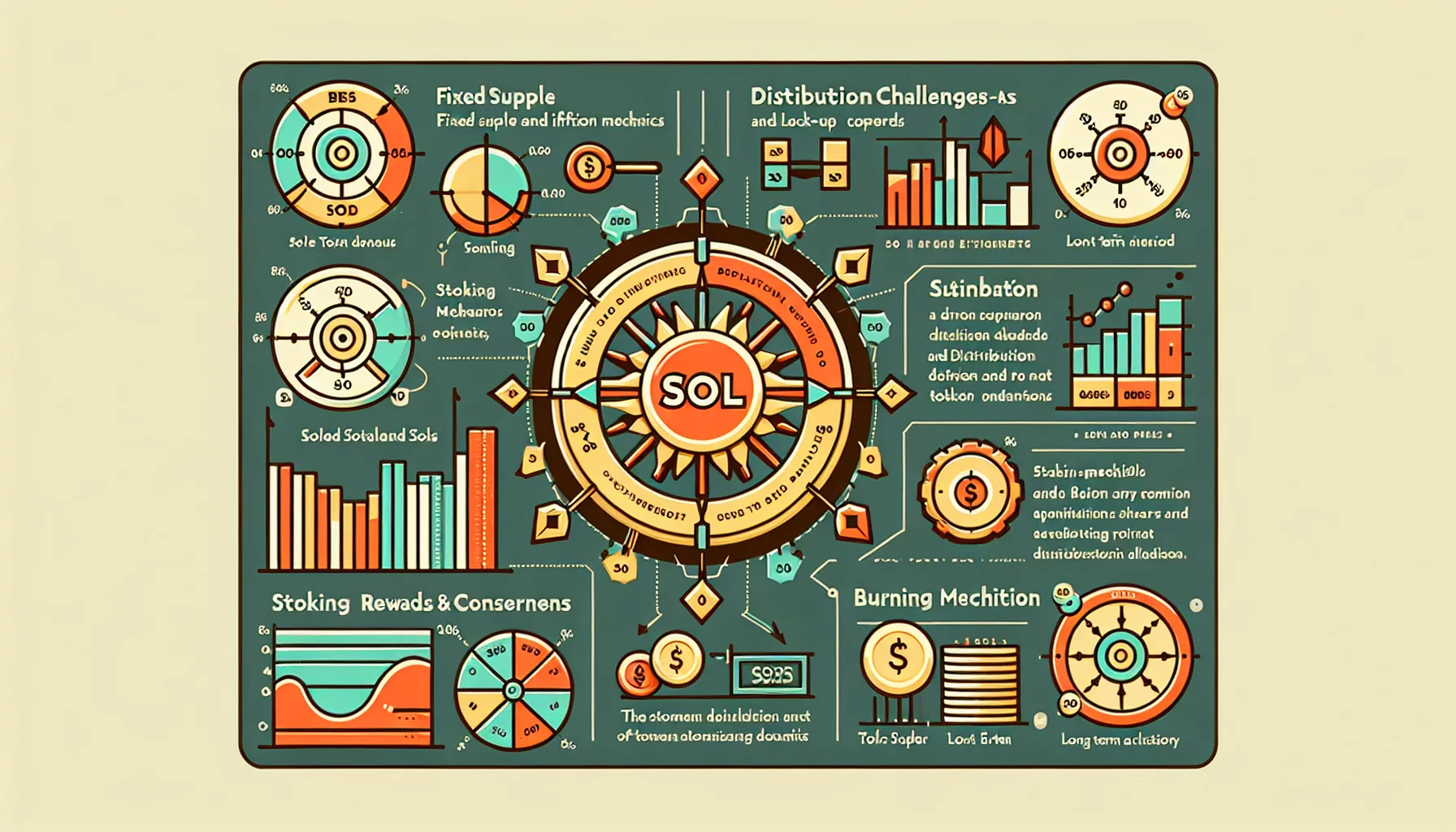
The Solana (SOL) token operates with a unique tokenomics structure driven by a blend of fixed supply constraints and tailored inflationary mechanisms. The total supply of SOL is capped at approximately 489 million tokens, though not all are currently in circulation. This approach combines a deflationary aspect with mechanisms for incentivizing network participation. However, an important note is that Solana employs an initial annual inflation rate of around 8%, which is designed to decrease over time to a long-term stable rate near 1.5%. This built-in inflation supports validator rewards, encouraging network security and decentralization. For critics, though, this adjustable inflation rate creates concern about dilution for long-term holders.
Distribution Challenges and Concentration Concerns
Solana's initial token distribution has been a topic of scrutiny due to the high proportion allocated to insiders. Approximately 48% of the total supply was distributed to private token sales, founders, and project teams, leaving only 12.5% for public sales. This distribution model has raised centralization concerns among certain segments of crypto users, as a significant portion of SOL is in the hands of a small group of stakeholders. Critics argue that this concentrated ownership could lead to governance risks or price manipulation. On the other hand, defenders of this model emphasize the importance of early funding in fueling Solana’s rapid ecosystem growth.
Staking Rewards and Lock-Up Periods
Staking plays a central role in SOL tokenomics, with token holders incentivized to stake their assets in support of the network's proof-of-stake (PoS) consensus mechanism. Validators and delegators alike are rewarded with SOL tokens, providing a dual benefit of network security and potential yield for participants. However, staking comes with lock-up periods during which staked tokens are untradeable, introducing an added layer of illiquidity risk for participants. Additionally, rewards are inflationary in nature, which incentivizes staking but could offset its benefits in times of price stagnation or limited demand growth.
Burning Mechanism and Fee Dynamics
Solana incorporates a token-burning mechanism designed to offset inflation. A portion of the transaction fees generated on the network is permanently removed from the total supply, creating a deflationary counterbalance. Despite this mechanism, transaction fees on Solana are notably low—fractions of a cent—and thus the burn rate remains modest relative to its inflation rate. While this keeps the network highly user-friendly, it dilutes the impact of deflationary forces, which some critics see as a missed opportunity to curb supply growth.
Sustainability and Long-Term Allocation
Questions persist regarding the sustainability of Solana’s tokenomics over the long term, especially in scenarios of declining transaction volume or reduced network activity. The reliance on inflationary rewards to maintain validator engagement assumes continual growth, which some skeptics argue leaves the model exposed during bearish market cycles. Furthermore, as inflation reaches its terminal rate, it remains uncertain whether the network’s fee-burning mechanism and ecosystem growth alone will be sufficient to maintain alignment between supply and demand.
SOL Governance
Solana (SOL) Governance: Strengths, Weaknesses, and Key Mechanics
Solana’s governance model is a critical aspect of its protocol design, balancing decentralization with the network’s focus on high-speed and low-cost transactions. Unlike some blockchains that have on-chain governance mechanisms, Solana’s governance approach is currently more off-chain-oriented. This distinction influences how decisions are made and how network participants influence the blockchain’s evolution.
Core Governance Mechanisms
Solana’s governance operates primarily through stake-weighted consensus, where validators and delegators play pivotal roles. Validators run nodes to secure the network and confirm transactions, while SOL token holders delegate their stake to these validators, signaling trust and contributing to a distributed security model. While delegators do influence the network indirectly, decision-making around major protocol upgrades, parameter tweaks, or new features remains the domain of Solana’s core developers, validators, and stakeholders who engage in off-chain discussions. These are often conducted through forums, GitHub proposals, and community calls.
The network leans on governance systems such as Solana Improvement Documents (SIPs), which serve as formalized blueprints for protocol changes. However, the process is less formalized compared to projects with fully on-chain governance like Tezos or Polkadot, potentially limiting transparency in decision-making at times. This off-chain focus may leave smaller stakeholders feeling excluded from direct influence, as higher stakes or proximity to core development teams tend to carry more weight.
Validator Dynamics and Stake Centralization
One area of concern within Solana’s governance is the centralization of stake among a relatively small number of influential validators. While the Nakamoto Coefficient—which measures decentralization by indicating how many validators are required to compromise the network—has improved over time, it is still below ideal levels for maximal decentralization. This scenario can lead to governance power being concentrated within a minority, raising questions about true inclusivity and whether large token holders could disproportionately sway decisions.
Challenges of Informal Governance
Solana’s informal governance structure allows for agility in implementing changes, essential for a network aiming to uphold high transaction throughput. However, this flexibility comes at the cost of transparency and distributed input. Without clearly defined voting frameworks or mechanisms for network-wide participation, smaller SOL holders may lack visibility into pivotal decisions that could impact the broader ecosystem or their holdings.
While Solana’s governance structure has successfully supported its rapid growth and technological advances, its less formalized approach remains a point of critique within the crypto community.
Technical future of SOL
Solana's Current and Future Technical Developments: Innovations and Challenges
High-Performance Blockchain Advancements
Solana continues to prioritize scalability through its unique Proof of History (PoH) mechanism combined with Proof of Stake (PoS). This ensures rapid transaction throughput while maintaining decentralization. The parallel processing capabilities of its Sealevel runtime have facilitated innovation in smart contract execution, enabling concurrent processing of transactions. However, the growing complexity of these mechanisms has surfaced challenges in maintaining stability under stress conditions, particularly during periods of elevated network activity or congestion.
On-Chain Storage Optimization
Solana has been exploring initiatives to improve on-chain storage efficiency. Focus areas include reducing the resource costs associated with state storage and increasing developer flexibility when handling accounts. Proposals such as state compression aim to address these limitations, but questions remain about how the network will manage the trade-offs between storage costs and user/developer experience, especially as more projects build decentralized applications (dApps) on Solana.
Validator Ecosystem Enhancements
Enhancing the decentralization of the validator ecosystem is a priority for Solana. While the blockchain boasts high validator participation, critiques regarding the concentration of stake within certain nodes persist. Ongoing efforts to reduce stake centralization include the incentivization of smaller validators and improvements to slashing mechanisms to encourage more equitable participation. Yet, skeptics argue that economic incentives alone may not sufficiently address centralization risks tied to initial staker dynamics.
Fee Markets and Congestion Handling
Solana's latest development efforts include the implementation of a fee market to better allocate resources during periods of high transaction demand. This dynamic pricing mechanism introduces a gas-like structure to mitigate network congestion. While promising, it remains to be seen how seamlessly this system integrates without adversely impacting user accessibility—one of Solana's defining features.
Future Roadmap Technologies
Solana's roadmap introduces technical upgrades like QUIC network protocols for faster communication between validators and improvements to account indexation for better data retrieval efficiency. Another area of focus is fostering interoperability through seamless bridges and integration with other ecosystems. However, security concerns regarding cross-chain operations remain a significant hurdle given the history of exploits in this space.
Challenges in Sustaining Development
A notable challenge is balancing rapid innovation with the delivery of robust, fault-tolerant solutions. Recent network outages have highlighted both the potential and limitations of Solana's highly optimized infrastructure, prompting the team to engage with the ecosystem for extended testing regimes and resilience planning. Such issues underscore the ongoing tension between prioritizing scalability versus maintaining consistent uptime.
Comparing SOL to it’s rivals
Solana (SOL) vs. Ethereum (ETH): A Comprehensive Comparison
When comparing Solana (SOL) and Ethereum (ETH), the most striking area of differentiation lies in their technical architecture and approach to scalability. Ethereum, as the pioneer of smart contract platforms, brought programmability to blockchain but trends toward slower throughput due to its Proof-of-Stake (PoS)-underpinned network (following the Ethereum 2.0 merge) and adherence to a more decentralized ecosystem. By contrast, Solana prioritizes high-speed transactions underpinned by its unique Proof-of-History (PoH) innovation combined with delegated Proof-of-Stake (dPoS), enabling a theoretical throughput of tens of thousands of transactions per second (TPS).
Transaction Costs and Speed
Ethereum's primary bottleneck remains its transaction speed and cost, especially during high network usage. Gas fees, though now reduced compared to its earlier Proof-of-Work period, still fluctuate significantly and can become a barrier to entry for smaller developers and retail users. Solana, by design, offers a sharp counterpoint with its low-cost, high-speed transactions. Fees on Solana usually measure fractions of a cent due to its optimized block propagation and parallel transaction processing. However, one key critique of this approach is the higher hardware requirements for Solana validators, which may pose barriers to true decentralization since the cost to run a node is substantially higher than Ethereum.
Decentralization vs. Performance
A recurring discussion point between Solana and Ethereum is the trade-off between decentralization and performance. Ethereum champions decentralization by allowing most validators to operate without significant hardware investment. This fosters a highly distributed network, though it can lead to latency in processing transactions. Solana, on the other hand, achieves its performance gains at a cost: it is often criticized for reliance on a smaller set of validators, which some interpret as leaning toward centralization. This has raised concerns about the protocol’s resilience against censorship or network failures.
Developer Ecosystem and Smart Contract Flexibility
Ethereum arguably has the most robust developer ecosystem in blockchain, being the first-mover for decentralized applications (dApps) and boasting a broad range of developer tools, resources, and adoption of the Ethereum Virtual Machine (EVM). While Solana is rapidly expanding its ecosystem, its proprietary programming environment, Rust, creates a steeper learning curve for developers compared to Ethereum’s Solidity. This has both benefits and drawbacks, as Rust offers efficiencies in transaction handling but may limit adoption among developers accustomed to EVM-compatible chains.
Network Downtime and Reliability
Another critical comparison point is network reliability. Solana has faced notable periods of network downtime, which can be catastrophic for applications reliant on the chain, such as decentralized finance (DeFi) protocols or NFT platforms. Ethereum, while experiencing congestion under heavy load, has proven historically resilient and has yet to experience full network halts in the same manner.
SOL vs ADA: A Detailed Comparison of Ecosystem and Performance
When evaluating Solana (SOL) against Cardano (ADA), both blockchain projects present unique approaches to solving scalability and decentralization challenges. While SOL has gained notoriety for its high-speed transactions and low-cost infrastructure, ADA adopts a methodical, peer-reviewed approach to blockchain development. The contrast emerges starkly when dissecting their architectures, ecosystems, and performance metrics.
Transaction Speed and Scalability
One of Solana's standout features is its unrivaled speed, achieved through innovations like Proof of History (PoH) and a parallelized processing structure. This design supports a theoretical throughput of over 65,000 transactions per second (TPS). In contrast, ADA operates on the Ouroboros Proof-of-Stake (PoS) consensus, which is more conservative in throughput, processing around 250-1,000 TPS with optimizations. While these numbers appear to favor Solana, critics argue that its reliance on high-performance hardware centralizes network participation, making it less accessible to the average user — a challenge the ADA ecosystem has avoided by emphasizing equitable staking accessibility.
Decentralization Trade-offs
Cardano's development philosophy prioritizes decentralization and deliberate, research-backed improvements. Its staking model is widely distributed across thousands of pools, aiming to mitigate centralization risk. Conversely, Solana has faced criticism for its validator requirements. Running a validator node on Solana often requires substantial computational resources, resulting in fewer active participants compared to ADA's network. Critics argue that this inherent cost structure risks making Solana overly dependent on a limited number of wealthy validators, challenging its claims to decentralization.
Smart Contract Functionality
While both SOL and ADA support smart contracts, their approaches differ significantly. Solana’s high throughput and quick finalization times cater to complex decentralized applications (dApps), making it a preferred choice for high-frequency trading platforms and gaming. ADA, however, introduced smart contracts via its Alonzo upgrade, leveraging the Plutus programming model. Although Plutus is praised for security, its adoption has been slower due to higher developer learning curves and less versatility in comparison to Solana’s more accessible Rust and C-based frameworks.
Downtime and Reliability
Solana has faced scrutiny for sporadic network outages that disrupt transactions, raising concerns over its reliability under high traffic. ADA, by contrast, has achieved a reputation for stability, partly due to its slower, incremental upgrade cycles. However, this stability can appear sluggish when compared to Solana's breakneck pace of iteration, leaving some developers frustrated with ADA’s development timelines.
Ecosystem Growth
Solana’s ecosystem boasts rapid expansion in NFT marketplaces and DeFi applications, fueled by its speed. ADA's ecosystem growth, while steadier, is more aligned with use cases requiring rigorous security. This disparity underscores the fundamentally different approaches: Solana chases immediate scalability, while Cardano invests in cautious, long-term groundwork.
Comparing SOL to APT: A Technical and Ecosystem Analysis
When analyzing Solana (SOL) in comparison to Aptos (APT), the most striking difference lies in the architecture and design philosophy underpinning their networks. Both chains position themselves as high-performance, scalable Layer 1 blockchains, but they take distinctly different approaches to achieve their throughput and ecosystem growth.
Consensus Mechanism and Scalability
Aptos operates on a unique consensus mechanism known as Block-STM, which is a leader-based, Byzantine Fault-Tolerant (BFT) protocol optimized for parallelization. This contrasts with Solana's Proof-of-History (PoH) combined with Proof-of-Stake (PoS), where validators synchronize using cryptographically-verified timestamps. While Solana’s PoH excels at extremely fast finality (~400ms) and high transaction throughput, it also introduces a steep computational overhead. Validator performance on Solana is heavily dependent on powerful hardware configurations, which has sparked criticism for centralization due to barriers to entry for smaller node operators.
Aptos, on the other hand, emphasizes deterministic parallel execution and modularity. Its multi-threading model allows nodes to process several transactions simultaneously, promising scalability without requiring validators to rely on high-performance hardware. However, this approach has yet to be stress-tested at the scale Solana operates. Questions remain about Aptos’ ability to maintain its theoretical performance benchmarks in real-world conditions, particularly as its ecosystem grows.
Programming Frameworks and Developer Adoption
Developer experience is another area of divergence. Solana leverages the Rust programming language for smart contract development, which is known for high performance and security but comes with a fairly steep learning curve for developers unfamiliar with Rust’s intricacies. In contrast, Aptos stands out for using Move, a language derived from Facebook's abandoned Libra project. Move is designed with resource optimization and safety in mind, especially when dealing with digital assets. While Move introduces innovative features like resource-oriented programming, its adoption remains nascent, and developer tools, libraries, and documentation are not as mature as those in Solana’s ecosystem.
Ecosystem and Infrastructure
The Solana ecosystem boasts extensive DeFi, NFT, and gaming adoption driven by its ultra-fast transaction speeds and negligible fees. Aptos, despite being in its earlier stages of development, has focused on addressing user-first experiences by prioritizing wallet security and transaction transparency—benefits for wider adoption but not yet sufficient to rival Solana's mature ecosystem.
Issues such as network downtimes have plagued Solana’s image, despite its robust adoption. Aptos may sidestep these challenges early on due to its more deliberate approach to scaling, but only time will tell how well it navigates its own potential bottlenecks as demand increases.
Primary criticisms of SOL
Primary Criticism of Solana (SOL): Scalability vs. Decentralization Concerns
Solana (SOL) has garnered attention for its high throughput and low transaction fees, but these advancements have not come without criticism. A primary concern within the crypto community revolves around Solana’s approach to scalability and the impact it has on decentralization and security.
Solana achieves its impressive transaction speeds using a unique consensus mechanism called Proof of History (PoH), combined with Proof of Stake (PoS). While this innovation enables the network to process thousands of transactions per second, critics argue that this design prioritizes scalability at the expense of decentralization. A significant portion of Solana's validator nodes are controlled by a relatively small number of entities, creating potential centralization risks. This concentrated control raises concerns about the blockchain's vulnerability to censorship, manipulation, or even a potential network halt due to infrastructure dependency.
Another recurring issue is Solana's network outages and downtime. In its quest for speed and scalability, the network has faced multiple periods of instability, primarily caused by resource exhaustion or high transaction loads. Critics argue that this undermines the reliability and trust required for applications being built on the network. Such outages expose structural vulnerabilities and bring into question whether Solana can fulfill its ambition of becoming a robust infrastructure for Web3 applications.
Tokenomics also comes under scrutiny. Solana’s initial token distribution was heavily skewed toward venture capitalists, early investors, and insiders. This has raised eyebrows about the equitable distribution of SOL tokens, as it concentrates wealth and governance power in the hands of a small group. Such a structure is at odds with the ethos of decentralization that cryptocurrencies are built upon and risks alienating grassroots communities.
Moreover, hardware requirements for validators on Solana are particularly high, resulting in additional barriers to entry compared to other blockchain networks. The need for robust and expensive infrastructure limits participation in securing the network to well-funded entities, further exacerbating concerns over centralization. Critics feel that these technical requirements reduce accessibility and make Solana’s network less inclusive for smaller, decentralized participants.
Lastly, while Solana’s enormous throughput is touted as a selling point, many argue that the blockchain's state size and growth rate will lead to long-term challenges. The increasing burden on storage and hardware could make running nodes unsustainably costly, amplifying centralization concerns as fewer entities can afford the resources to participate.
In summary, while Solana offers cutting-edge performance, its compromises in decentralization, reliability, and accessibility remain critical points of contention within the crypto ecosystem.
Founders
The Founding Team Behind Solana (SOL)
Solana was conceptualized and brought to life by a team with deep expertise in distributed systems, cryptography, and software engineering. At the helm of this endeavor is Anatoly Yakovenko, a former Qualcomm engineer and Dropbox software developer. Yakovenko is known for his work on highly scalable systems, a background that played a critical role in the development of Solana’s unique Proof of History (PoH) mechanism. While Yakovenko’s technical acumen is widely acknowledged, critics have raised concerns about whether his leadership style can sustain team cohesion as the ecosystem grows.
Accompanying Yakovenko is Greg Fitzgerald, a colleague from Qualcomm and the original architect behind the Solana protocol. Fitzgerald’s contributions extend heavily into the development of Rust-based tools powering Solana, tools that many developers now rely on. While his technical expertise is undeniable, some have questioned whether the heavy reliance on Rust, a less mainstream programming language for blockchain development, could limit the long-term accessibility of Solana’s developer ecosystem.
Another key figure is Raj Gokal, Solana’s COO, who has been instrumental in driving business strategy and securing funding for the project. Gokal’s experience in venture capital helped Solana secure significant financial backing early on, enabling rapid development and network adoption. However, some critics argue that Solana’s aggressive expansion strategy, shaped by Gokal and others on the leadership team, has occasionally prioritized speed over decentralization, raising questions about potential trade-offs in network resilience.
The founding team also includes several senior engineers and advisors with backgrounds across major tech corporations such as Google, Microsoft, and Intel. While this expertise has given Solana a robust foundation, detractors argue that a significant portion of leadership comes from traditional tech rather than open-source or decentralization-focused communities. This has led to speculation about whether the team's mindset aligns fully with core blockchain principles like censorship resistance and permissionless access.
Moreover, the team’s approach to managing the network has faced criticism, particularly during high-profile outages. Some attribute this to Solana’s design, but there are also questions about whether the team has adequately anticipated the risks associated with adopting a high-performance, low-latency blockchain architecture. These issues have raised skepticism about whether they are fully equipped to manage the complexities of scaling a high-throughput network.
In summary, Solana's founding team is a blend of top-tier engineering talent and strategic business minds, but challenges in decentralization, transparency, and technical trade-offs remain points of contention within the crypto community.
Authors comments
This document was made by www.BestDapps.com
Sources
- https://solana.com/
- https://solana.com/solana-whitepaper.pdf
- https://docs.solana.com/
- https://explorer.solana.com/
- https://github.com/solana-labs/solana
- https://medium.com/solana-labs
- https://spl.solana.com/
- https://github.com/solana-labs/solana-program-library
- https://stake.solana.com/
- https://solana-status.com/
- https://docs.solana.com/developing/programming-model/transactions
- https://solanabeach.io/
- https://www.coingecko.com/en/coins/solana
- https://coinmarketcap.com/currencies/solana/
- https://blog.solana.com/
- https://research.binance.com/en/projects/solana
- https://www.gemini.com/crypto/solana
- https://decrypt.co/resources/what-is-solana