History of SNT
The History of Status Network Token (SNT): Evolution of a Decentralized Vision
The Status Network Token (SNT) emerged in June 2017 as part of the Status project, a decentralized open-source platform designed to enable private, secure communication and transactions over the Ethereum blockchain. At its core, SNT aimed to be the utility token empowering the Status ecosystem, emphasizing user empowerment, censorship resistance, and decentralized governance. Its launch coincided with the height of Initial Coin Offering (ICO) enthusiasm, with its ICO raising substantial funds, reflecting significant interest in the project’s vision.
Status, developed by Jarrad Hope and Carl Bennetts, was envisioned as both a messenger and a Web3 browser. SNT was integral to this vision, representing a utility layer within the ecosystem. Unlike many ICO-era tokens that lacked tangible use cases at launch, SNT introduced specific functionalities tied to its utility. These included enabling decentralized push notifications, access to features such as username registration via the Ethereum Name Service (ENS), and facilitating community-driven decision-making through token-weighted voting.
However, the project's history has not been without its challenges. In 2018, during a particularly turbulent bear market for cryptocurrencies, the Status team faced financial difficulties. These struggles led to significant layoffs, highlighting the volatility often seen in crypto startups reliant on long-term token economy performance. Questions were raised within the community about the project’s sustainability, funding model, and execution timeline. Despite this, Status maintained its commitment to the decentralized ethos, continuing development and expanding SNT’s use cases.
Another criticism of the token’s utilization over the years has been its relatively niche appeal and low adoption outside the Status platform. While SNT was intended to serve various roles in decentralized communication, governance, and platform engagement, its dependency on the broader adoption of the Status platform created limitations in wider crypto ecosystem usage. Some community members have voiced concerns about the token’s functionality feeling secondary to promoting protocol development, causing occasional disconnects between utility and speculative value.
The token has also been involved in debates surrounding decentralized governance. While SNT holders can vote on proposals within the Status ecosystem, questions remain about whether token-weighted governance models adequately represent smaller stakeholders or encourage equitable decision-making. These governance issues reflect a broader challenge faced by decentralized projects attempting to align token utility with community objectives.
SNT’s early history reflects both the opportunities and challenges of pioneering decentralized applications and governance systems. Its trajectory showcases the complexities of building a token-driven ecosystem while adhering to decentralized principles in a highly competitive and fast-moving industry.
How SNT Works
How SNT Works: Understanding Its Role in Ethereum's Decentralized Ecosystem
Status Network Token (SNT) is a utility token that powers the Status Network, an open-source, decentralized framework built on the Ethereum blockchain. The project's core mission is to facilitate censorship-resistant communication, decentralized governance, and digital asset management. At its heart, SNT enables participation in the Status client and governs access to specific features and services. Here's how it all works:
Token Functionality
SNT operates as an ERC-20 token, allowing it to leverage Ethereum's robust smart contract functionality and ecosystem interoperability. Its primary utility lies in its role as a mechanism to align users, developers, and other stakeholders within the Status Network. The token is essential for incentivizing behavior, prioritizing network governance votes, and unlocking premium dApp features.
Decentralized Governance
A central feature of SNT is its influence on decision-making within the Status Network. Token holders determine the direction of the platform via a decentralized governance model, which utilizes smart contracts to conduct voting. Each SNT represents voting power, creating a system where users directly influence platform upgrades or integrations. However, this governance mechanism is highly dependent on participation. If a significant percentage of tokens remain idle, decision-making can become centralized around particularly active or wealthy individuals, undermining decentralization.
Peer-to-Peer Marketplace
One of SNT's more unique features is its role in facilitating a decentralized marketplace called the "Sticker Market." Users must hold tokens to buy or create stickers, with custom sticker sets being a core monetization opportunity for creators within the Status ecosystem. While innovative, this mechanism has faced criticism for its niche appeal, making the token’s utility highly dependent on user and creator adoption.
Privacy-Preserving Communication
SNT also governs features like incentivized node participation for Status's messaging infrastructure. Status's whisper-based messaging protocols rely on a decentralized network of nodes to offer private, encrypted communications. Node operators are incentivized with SNT, laying a foundation for a sustainable messaging ecosystem. However, scaling these incentives across a global user base presents challenges, as message relaying comes with operational costs that could grow disproportionately without sufficient participation.
Challenges with Adoption
While SNT introduces multiple innovative mechanisms, the token’s reliance on the broader Ethereum ecosystem presents a bottleneck. High Ethereum network fees can discourage microtransactions related to features such as voting and marketplace purchases. Similarly, the Ethereum network's congestion impacts messaging reliability and scalability—a notable drawback given the platform's focus on decentralized communication.
Use Cases
Strategic Use Cases of SNT in Decentralized Ecosystems
The Status Network Token (SNT) is integral to the Status ecosystem, a decentralized platform merging private communication, mobile Ethereum access, and decentralized applications (dApps). Its use cases are designed to align with Web3 principles of user empowerment and self-sovereignty, yet they also come with challenges that merit consideration.
1. Peer-to-Peer Governance Mechanisms
One of SNT's core functionalities lies in enabling decentralized governance. Token holders can vote on proposals that impact the Status ecosystem's development and policies, such as feature additions or protocol updates. Voting power is proportional to the amount of SNT held, representing a clear use case for direct community involvement in decision-making. However, this approach raises questions about equitable representation. Wealthier participants with massive SNT holdings may dominate governance, potentially marginalizing smaller stakeholders.
2. Spam Prevention in Messenger Services
SNT powers an anti-spam messaging feature by requiring users to stake tokens as a means to receive messages from unknown contacts. This creates an economic disincentive for spammers to flood the system with unsolicited messages. While effective in curbing spam, this feature could deter legitimate users unwilling to lock up tokens simply for communication purposes, introducing an accessibility barrier.
3. Economic Models for dApp Discoverability
Within the Status platform, users can leverage SNT to curate and feature dApps in its decentralized browser. dApp developers or promoters can "pin" their applications in exchange for tokens, relying on an economic incentive layer instead of centralized ranking algorithms. Despite its decentralized nature, this model risks favoring well-funded dApp projects, potentially tilting discoverability against smaller innovations or teams with limited resources.
4. Tokenized Contributions in Decentralized Communities
SNT is at the core of Status' contribution-based economics, allowing users to receive and send micropayments or tips directly within the application. This supports a decentralized funding model for content creators and developers, reducing reliance on intermediaries. However, the volatility of crypto assets can limit its practicality for everyday use, as contributors risk fluctuating income streams.
5. Privacy-Enhanced Name Registration
SNT facilitates pseudonymous ENS (Ethereum Name Service) domain registration, enabling users to tie human-readable names to their wallet addresses. Unlike traditional domain providers requiring personal information, this ensures a privacy-first approach. Still, users may find the process technically demanding, creating a high learning curve that can limit mass adoption.
By intertwining these features with blockchain principles, SNT pushes boundaries within the Web3 paradigm. However, scalability, fairness, and user accessibility remain important considerations in actualizing its potential.
SNT Tokenomics
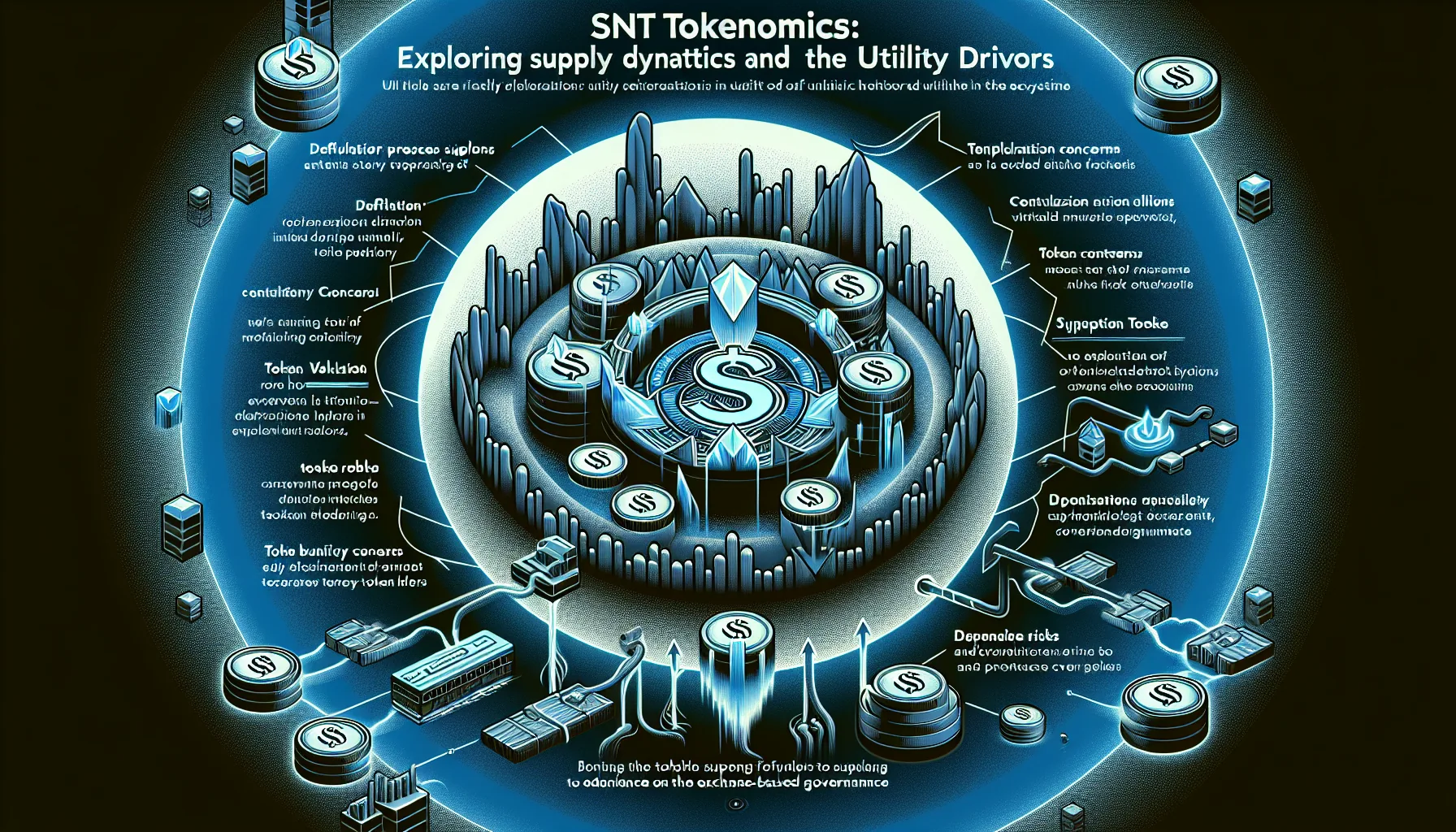
SNT Tokenomics: Exploring Supply Dynamics and Utility Drivers
The tokenomics of SNT (Status Network Token) is intricately tied to its utility within the Status ecosystem, aiming to power decentralized communication, governance, and access across its dApp services. Its design, however, carries both strategic strengths and some embedded challenges.
Total Supply and Distribution
SNT has a fixed maximum supply of 6.8 billion tokens, pre-minted during its initial distribution. No inflationary mechanism exists, which creates a deflationary pressure over time as tokens are locked in staking or spent on network services. However, a concentrated allocation to early investors and the core team during the token generation event has sparked centralization concerns. While most allocations were deemed conventional at launch, the long-term impact of potential sell-offs from early holders remains a systemic risk.
Utility-Focused Design
SNT is uniquely structured to provide functionality within the Status platform rather than act primarily as a speculative asset. Key utilities include enabling access to premium usernames, staking for governance participation, and acting as a medium of exchange within the ecosystem, such as for dApp discovery or sticker market participation. Despite this focus, adoption bottlenecks arise from the need for users to convert fiat into SNT, particularly for less tech-savvy participants. This reliance on off-chain exchanges for onboarding could hinder scaling efforts.
Governance and Incentives
SNT token holders play a direct role in influencing the protocol’s evolution via decentralized governance mechanisms. Weighted voting ensures that decision-making aligns with token holdings, but critics point to potential plutocratic tendencies. Whales, with disproportionately large holdings, could exert outsized influence on contentious proposals, raising questions about the fairness of the system for smaller participants. Additionally, engagement levels in governance remain a concern, as participation rates appear low relative to the total circulating supply.
Burning and Spend Dynamics
A notable aspect of SNT tokenomics is its partial reliance on token burning to create scarcity. This model applies to specific network services, such as vanity username auctions, where proceeds are burned. While this introduces a deflationary mechanism, the overall impact on total supply reduction remains modest unless network activity scales significantly. If demand stagnates, the anticipated deflationary benefits may be weaker than intended.
Liquidity and Exchange Risks
SNT is highly liquid across major exchanges, which supports accessibility but also amplifies vulnerability to speculative trading. High volatility in trading volumes and price discovery may deter long-term network participants from holding the token primarily for utility purposes. Furthermore, the dependency on exchange-based liquidity centralizes risks into external parties, which could impact overall resilience should exchanges delist the asset for any reason.
SNT Governance
SNT and Decentralized Governance: Navigating a Token-Holder Led Ecosystem
Status Network Token (SNT) plays a core role in the governance framework of the Status ecosystem, granting holders a direct say in the platform's developmental and operational trajectory. Unlike traditional top-down structures, Status governance is designed to be community-driven, offering SNT holders voting power and participatory rights in key decisions. While this aligns with the ethos of decentralization, there are complexities and risks that come with this model.
Token-Weighted Decision Making
Governance within the Status ecosystem relies on a token-weighted model, meaning that the influence a participant wields is directly proportional to their SNT holdings. This structure ensures that active and significant stakeholders have a say in the project's direction, but it also raises concerns about oligopolistic influence. Individuals or entities with substantial holdings can theoretically exert outsized control, potentially overriding smaller stakeholders. This centralization of voting power among "whale" accounts is a recurring issue across many token-driven governance systems, SNT being no exception.
Proposal Mechanism and Voting Process
The proposal process allows SNT holders to submit initiatives covering various aspects, from technical upgrades to community-led programs. While this mechanism broadens engagement, one notable issue is voter apathy. Often, governance participation is limited to a small subset of the community, either due to insufficient awareness, burdensome technical requirements, or disengagement. Inadequate voter turnout could lead to decisions that don’t accurately reflect the wider community's consensus.
Smart contracts govern the voting process, ensuring transparency and immutability of results. This reliance on code, however, means the governance system inherits potential bugs or vulnerabilities present in the underlying smart contracts—a recognized industry risk. If exploited, these vulnerabilities could undermine the integrity of the decision-making process.
Challenges in Balancing Decentralization and Efficiency
SNT governance aims to strike a balance between decentralization and operational efficiency, but this remains an ongoing challenge. Distributed decision-making can slow down critical processes, particularly when the community fails to reach a consensus quickly. This delay can be detrimental in a competitive crypto ecosystem where agility often determines success.
Moreover, the lack of a robust dispute resolution mechanism means that contentious or controversial decisions may lead to factionalism within the community. Without an agreed-upon system to address disagreements, governance disputes could erode trust in the platform.
Conclusion
While SNT offers an innovative governance architecture, its challenges—ranging from voter apathy to systemic vulnerabilities—are a tangible reminder of the complexities inherent in decentralized decision-making. Recognizing and addressing these issues will be critical to ensuring the long-term sustainability of Status’ governance model.
Technical future of SNT
Status Network Token (SNT): Current and Future Technical Developments
Status Network Token (SNT), the utility token powering the Status platform, continues to be at the core of a decentralized ecosystem for communication, governance, and payments. This section explores the key technical developments currently shaping the project and future advancements outlined in its roadmap, focusing on the constant evolution of its underlying technology.
Enhancing Core Infrastructure
SNT is intrinsically linked to the Status mobile and desktop apps, which prioritize privacy, censorship resistance, and peer-to-peer communication. One significant ongoing development is the integration of Waku (formerly Whisper V2) for decentralized messaging. Waku, leveraging a mix of store-and-forward messaging alongside topic-based message filtering, addresses some of the fundamental technical issues Whisper faced, such as scalability and bandwidth inefficiency. However, challenges persist, including maintaining relay incentives for nodes and guaranteeing low-latency communication.
There are concerted efforts towards improving Whisper V2 load balancing to ensure optimal message delivery even under network strain. However, issues around resource-intensive operation linger, raising questions about long-term sustainability without advanced optimization or the involvement of more robust incentives for node participation.
Building on Ethereum 2.0 and Layer-2 Solutions
As Ethereum transitions to Ethereum 2.0, Status is investigating ways to leverage its shift toward proof-of-stake and shard chains. Reducing energy consumption and increasing transactional throughput on Ethereum offers a pathway for more scalable and cost-efficient SNT-based interactions. Additionally, the integration of Layer-2 solutions, such as zk-rollups and optimistic rollups, is being evaluated to overcome bottlenecks in existing microtransactions within the ecosystem.
That said, the implementation of such solutions faces hurdles, particularly in regards to compatibility with decentralized applications (dApps) currently using SNT. The Status technical team is working on seamless interoperability, though concerns about fragmented liquidity and user confusion remain active risks.
Advancing ENS Integration
Status heavily utilizes Ethereum Name Service (ENS) for decentralized usernames, which requires SNT for registration and maintenance. The technical roadmap includes improving ENS's UX within the app to simplify onboarding for less tech-savvy users. However, gas fee spikes on Ethereum have made interactions with ENS costly, presenting a significant barrier to adoption. Exploring multi-transaction batching or alternative layer-2 integrations may mitigate these issues, but such features are still in the experimental phase.
Future-Proofing with Protocol Upgrades
The development team continues evaluating modular upgrades, including account abstraction (EIP-4337) to unlock advanced features like meta-transactions and enhanced wallet security. Despite promising benefits for user experience and composability, integrating these upgrades into Status without breaking existing functionality remains a technically intensive task.
Ongoing audits and revamped emphasis on decentralization resonate with a tech-savvy audience seeking assurance of protocol robustness.
Comparing SNT to it’s rivals
Comparing SNT to BAT: Decentralization vs. Ad-Based Incentives
The Status Network Token (SNT) and Basic Attention Token (BAT) target fundamentally different aspects of blockchain technology, yet their purposes intersect in the realm of user empowerment and decentralized ecosystems. By examining their respective features and approaches, we can better understand how SNT competes with its rival, BAT, in the crypto space.
Use Case Comparison
SNT focuses on enabling privacy-centric communication via the Status application. It leverages a decentralized infrastructure to provide secure messaging, a Web3 browser, and wallet functionalities. The token itself governs features such as secure group chats, ENS usernames, and DApp curation. On the other hand, BAT revolves around revolutionizing online advertising by creating a tokenized incentive structure for users, advertisers, and publishers. Integrated with the Brave browser, BAT rewards users for their attention while allowing advertisers to reach a targeted audience more effectively.
This divergence in use cases presents a challenge for SNT when competing against BAT's tightly integrated ecosystem. BAT's browser-centric model has an easily measurable value proposition—advertising efficiency—whereas SNT's appeal hinges on privacy and decentralized communication in a market dominated by convenience-first messaging apps.
User Adoption and Ecosystem
BAT benefits from widespread adoption through the Brave browser, which already has a large and growing user base. By integrating BAT directly within its platform, Brave simplifies user interaction with the token—a hurdle that Status has struggled to overcome. For SNT, adoption requires users to not only download the Status app but also invest time in understanding its tokenized ecosystem, a complexity that may deter mainstream users.
Moreover, BAT's focus on token rewards for simple actions, such as browsing the web, provides a low-friction entry point for individuals new to cryptocurrency. SNT, while targeting the privacy-conscious segment, has a steeper learning curve, limiting its potential audience compared to BAT’s more intuitive onboarding mechanism.
Decentralization: Strength and Weakness
SNT's philosophical commitment to decentralization is one of its defining characteristics. However, this same commitment introduces friction in usability. Decentralized apps often face scalability issues and less-polished user experiences compared to more centralized approaches. Conversely, BAT employs decentralization in aspects like data privacy but offers a hybrid approach that sacrifices complete decentralization in favor of performance and user convenience.
Status’s heavy reliance on the Ethereum network also impacts scalability, particularly during periods of high congestion. BAT sidesteps this issue with its less resource-intensive design, offering a smoother user experience.
Token Utility
Both tokens serve utilitarian purposes within their ecosystems, but BAT arguably provides clearer value for non-technical users. With SNT, the token utility is tied deeply to governance and advanced features within Status, which appeals to a niche segment of the crypto space. BAT, with its direct link to ad payouts, is more straightforward, providing immediate tangible benefits to its users while requiring less technical understanding.
While SNT’s strong focus on decentralization sets it apart philosophically, BAT's strategy of accessibility and integration has given it a competitive edge in practical adoption and ease of use.
SNT vs. GRT: Navigating Key Differences in Purpose and Utility
When analyzing Status Network Token (SNT) alongside its rival The Graph's token (GRT), the critical distinction lies in their foundational purpose within the Web3 ecosystem. While SNT emphasizes decentralized communication, user sovereignty, and privacy through its integration into the Status platform (a secure messaging app, crypto wallet, and Web3 browser), GRT is oriented towards blockchain data indexing and querying. This division in focus results in drastically different utility structures, market narratives, and developer adoption.
The Graph’s GRT is integral to fueling a decentralized data infrastructure. Through its indexing protocol, The Graph enables developers to efficiently query data from multiple blockchains such as Ethereum, making it a critical layer for dApps that require real-time and organized data access. By comparison, SNT's utility arises from its role in enabling peer-to-peer interactions that prioritize privacy, as well as optional governance participation for its platform's community.
One key differentiator is the adoption landscape. The Graph has been widely adopted across DeFi and NFT projects, as efficient data retrieval is a prerequisite for many high-traffic decentralized applications. SNT’s adoption, while significant for privacy-centric users and crypto communities focused on censorship resistance, is more niche and tied tightly to the Status ecosystem. This divergence also showcases a contrast in scalability priorities—GRT is designed to accommodate high demand for data processing across a growing dApp marketplace, while SNT’s efforts are tightly aligned with enhancing individual user autonomy within its own ecosystem.
A potential challenge for SNT in this comparison is prominence and ubiquity. GRT’s specialized use case positions it as an infrastructure token, and the widespread need for such services secures its visibility among developers. On the other hand, SNT’s appeal as a privacy and communication tool might struggle to reach the same level of ecosystem interdependence, given the broader market’s focus on use cases like DeFi and NFT functionality.
From a technical standpoint, both tokens operate on Ethereum but diverge in how they use the platform. GRT leverages Ethereum for staking mechanisms tied to its delegators and indexers. SNT, by contrast, is used to power features in its application, such as acquiring usernames or voting on user-submitted proposals. This further emphasizes that SNT’s utility is user-facing, whereas GRT’s utility is developer-focused.
While both SNT and GRT contribute meaningfully to the expansion of Web3, their distinct approaches highlight how varied blockchain ecosystems can be in delivering value. This disparity is both an opportunity and a challenge for SNT as it competes within a rapidly evolving market.
Comparing SNT Against CVC: Identity Verification and Decentralized Communication
When analyzing Status (SNT) in relation to Civic (CVC), one of the key points of comparison lies in how both projects address identity verification and user data within decentralized environments. While each asset targets privacy and decentralization, their approaches differ significantly, with areas of overlap and distinct trade-offs that must be considered by users and developers alike.
Focus and Utility Divergence
The core function of CVC is centered on identity verification and secure storage of personal credentials on the blockchain. Civic operates as an identity-focused solution, enabling users to authenticate themselves without the need to share sensitive information repeatedly. In contrast, SNT is part of the broader Status ecosystem, aiming to facilitate private, decentralized communication and financial transactions while providing tools like the Status Mobile Ethereum client and encrypted messaging. Identity-related features in SNT exist, particularly in its implementation of ENS usernames, but they don’t represent the sole focus of the ecosystem.
While this divergence allows both projects to serve separate but complementary roles in the decentralized landscape, it also means SNT provides a wider array of functionalities at the cost of not being highly specialized in one specific area like CVC is. Users seeking robust verification mechanisms may find CVC's singular focus advantageous, but those valuing a multi-purpose app ecosystem may lean toward SNT.
Decentralized Governance
Another distinguishing factor is the governance model. SNT is heavily tied to its decentralized governance structure, which allows token holders to vote on key protocol decisions, such as app feature prioritization or ecosystem development initiatives. In contrast, CVC’s governance structure is more centralized, limiting the input of token holders when it comes to defining the platform’s direction. This emphasis on decentralization may appeal to users who prioritize community involvement but can also slow decision-making processes for Status-related projects when compared to the quicker, top-down model of Civic.
Adoption Challenges
One area where both SNT and CVC appear to face obstacles is adoption. Civic’s user base for identity verification services is still relatively niche, often limited to very specific use cases. Similarly, SNT's broader ecosystem, while innovative, struggles to attract mainstream momentum and faces stiff competition in both the communication and financial spheres. This raises questions about network effects for both assets and illustrates how serving a smaller subset of users can impact their overall ecosystem growth.
Privacy Considerations
From a privacy perspective, SNT focuses on encrypted messaging via the Status app, positioning it as a tool for anonymous communication and self-sovereignty over user data. CVC, while providing increased control over identity data, often involves interactions with third-party services for verification purposes, potentially introducing trust intermediaries into what is otherwise a decentralized process. For privacy-centric users, this difference is notable and could influence the asset they adopt based on their specific use case.
Both projects address critical aspects of decentralized technology—SNT as a multi-functional ecosystem with identity features and CVC as a secure credentialing system—but their priorities and execution differ fundamentally, which affects how their respective communities and use cases evolve.
Primary criticisms of SNT
Primary Criticism of SNT: Challenges Facing Status Network Token
One of the primary criticisms of Status Network Token (SNT) lies in its unclear value proposition when compared to alternative blockchain-based communication platforms. While SNT powers the Status ecosystem with features like decentralized chat, browsing, and payments, skeptics argue that the token's utility suffers due to overlapping functionalities that can often be replicated by other blockchain solutions, or even traditional Web2 applications, without the need for a governance or utility token.
Another notable issue arises from the network's governance structure, which is heavily reliant on token-weighted voting. Critics contend that this model inherently favors large token holders, creating a plutocratic system that undermines the core tenet of true decentralization. Regardless of the platform's intentions, smaller stakeholders may feel disenfranchised, which could hamper user engagement and lead to centralization of influence over critical decisions.
Adoption is another area where SNT has received considerable scrutiny. Despite the ambitious suite of decentralized tools and applications that Status offers, the actual user base utilizes only a fraction of these features. Questions have been raised about whether the Status platform has been able to truly differentiate itself in the hyper-competitive crypto landscape, motivating some to label it as more experimental than practical for mass adoption. Additionally, the fragmented onboarding process and limited resources for non-technical users further alienate potential contributors and participants.
Scalability concerns have also been raised. Although the Status network benefits from Ethereum’s robust security, it is also subject to its limitations. Network congestion and high transaction fees on Ethereum can hinder the usability of SNT within the Status ecosystem, especially for micropayments and day-to-day interactions. While layer 2 solutions and future Ethereum upgrades address these issues broadly, critics argue that SNT's reliance on these developments adds uncertainty to its long-term functionality.
A final criticism revolves around regulatory challenges and legal ambiguity. As with many utility tokens, there are ongoing questions regarding whether SNT could someday face legal restrictions in specific jurisdictions. This uncertainty creates a level of risk not just for developers but also for potential users and investors. For a project aimed at championing privacy and decentralization, such challenges could discourage participation and engagement.
Founders
Founding Team Behind Status (SNT)
The founding team of Status (SNT) consists of engineers and visionaries who aimed to create a decentralized communication platform leveraging Ethereum's blockchain ecosystem. Leading the initiative are Carl Bennetts and Jarrad Hope, the co-founders of Status, both of whom have prior experience collaborating on software and entrepreneurial projects emphasizing decentralization and privacy.
Carl Bennetts
Carl Bennetts has a background in marketing and growth strategies for decentralized technologies. Before Status, he was involved in projects prioritizing user sovereignty over data. Bennetts' emphasis on privacy-centric communication and intuitive blockchain access platforms has been instrumental in shaping the goals of Status. However, some critics argue that a marketing-heavy perspective can result in overpromising, which early iterations of Status faced due to unmet functionality expectations during the project's nascent stages.
Jarrad Hope
Jarrad Hope brings coding expertise and a philosophical grounding in decentralization. His focus is directed at dismantling centralized systems of control, but critics often note that such purist philosophies can sometimes conflict with practical implementation—especially in a volatile space like blockchain, where user adoption often depends on compromises between decentralization and UX accessibility.
The Team's Synergy and Challenges
Both co-founders have expressed their alignment with Ethereum’s ethos of decentralization, which has directly informed the design philosophy of Status. However, challenges have surfaced with their execution strategies. For example, while the team achieved a significant milestone during its Initial Coin Offering (ICO) phase, raising over $100 million USD, some have questioned their ability to effectively allocate those funds for long-term scalability and development stability. Delays in feature rollouts and criticisms over user engagement highlight potential gaps between their aspirations and real-world deliverables.
Broader Team Contributions
The broader Status team includes engineers, designers, and community managers focused on open-source development. However, retaining top blockchain talent remains a persistent challenge noted within the project. The relatively niche utility of some features (like peer-to-peer payments or the DApp browser) has made it difficult for Status to fully activate its community on a global scale.
While the leadership has maintained transparency in development decisions, the founding team is often scrutinized for navigating the tension between their decentralized ideals and the practical hurdles of delivering a polished, widely adopted product. How their governance model evolves under their guidance will remain a key area of interest within the crypto community.
Authors comments
This document was made by www.BestDapps.com
Sources
- https://status.im/whitepaper.pdf
- https://status.im/
- https://github.com/status-im/status-react
- https://github.com/status-im/status-protocol-go
- https://etherscan.io/token/0x744d70fdbe2ba4cf95131626614a1763df805b9e
- https://coinmarketcap.com/currencies/status/
- https://status.im/security-audit-reports/
- https://medium.com/status
- https://discord.gg/status
- https://docs.status.im/specs/
- https://statusnetwork.com/
- https://www.coingecko.com/en/coins/status
- https://status.im/keycard/
- https://stats.status.im/
- https://github.com/status-im/specs
- https://forum.status.im/
- https://status-im.github.io/infra-metrics/
- https://dappradar.com/dapp/status
- https://status.im/build_status/
- https://status.im/roadmap/


