History of RUNE
The Origin and Early History of RUNE: Tracing THORChain’s Roots
RUNE, the native utility token of the THORChain ecosystem, emerged alongside the development of what has become one of the most innovative cross-chain liquidity protocols in the cryptocurrency landscape. THORChain was conceived in 2018 during a Binance hackathon event by an anonymous group of developers intent on solving a significant pain point in decentralized finance: seamless, non-custodial asset swaps between blockchains. While initial ambitions revolved around creating a decentralized exchange aggregator, the project pivoted to a chain-agnostic protocol that would become foundational to its design.
At the heart of this vision was RUNE, a token designed to act as both the base asset and economic engine for liquidity pools in the network. Early in its history, RUNE's utility properties reflected a deep alignment with THORChain’s goals. It serves as the settlement asset for liquidity pairs, a security mechanism for validator nodes via bonding, and a key tool for governance. These core functions have remained central to maintaining economic balance within the protocol while mitigating risks such as Sybil attacks.
In its formative stages, THORChain deployed on Binance Chain, issuing RUNE as a BEP-2 token. This initial choice reflects practical considerations rather than ideological alignment with Binance’s centralized ecosystem. BEP-2 RUNE provided cost-effective and fast transactions during this nascent phase, enabling the focused development of the protocol's technology stack. However, it wasn’t until the team launched its native blockchain on Cosmos SDK that RUNE truly realized its potential. The project's transition to a native token on its own network marked a pivotal shift, enabling integration with THORChain’s automated market maker (AMM) protocols and better scalability for cross-chain routing.
RUNE’s early days were not without challenges. Questions about decentralization have followed the project since its inception, particularly given its anonymous founding team and decision-making opacity. Additionally, the migration from BEP-2 to native RUNE introduced friction for early adopters, requiring token swaps and demanding user education for seamless transitions. Security concerns also loomed large in its initial development stages—highlighted by early exploits and criticisms of the protocol’s complexity, which left vulnerabilities exposed despite the project's strong economic incentives for validators. These events underscored the difficulty of uniting cross-chain interoperability with robust security in a trust-minimized setting.
Nevertheless, RUNE's journey demonstrates the iterative evolution of cryptoasset-backed ecosystems, forging the foundations for THORChain’s current operations as a cross-chain decentralized liquidity protocol.
How RUNE Works
How RUNE Works: The Mechanics Behind THORChain's Native Utility Token
RUNE is the native cryptocurrency of THORChain, a decentralized liquidity protocol designed to facilitate cross-chain asset swaps without relying on centralized intermediaries or wrapped assets. At its core, RUNE serves a multi-pronged role within the ecosystem, enabling liquidity provision, network security, and governance. Understanding how RUNE operates is essential for evaluating its functionality and impact on the protocol's broader architecture.
Liquidity Pools and the RUNE Pairing Model
One of the critical functions of RUNE is its use in liquidity pools. THORChain employs a Continuous Liquidity Pool (CLP) model, where all supported assets are paired exclusively with RUNE rather than being directly paired with one another. This means if a user swaps Bitcoin for Ethereum, the transaction is processed through RUNE as an intermediary (BTC → RUNE → ETH). This model simplifies mathematical calculations, improves transparency, and reduces complexity in cross-chain swaps.
However, pairing every asset with RUNE introduces significant systemic dependency. The RUNE token’s valuation, availability, and liquidity directly impact the efficiency and cost of transactions, potentially creating circular dependencies during periods of high volatility or liquidity shortages.
Network Security: The Bonding Mechanism
THORChain uses a Proof-of-Stake (PoS) derived system, where RUNE is essential for securing the network through bonding and staking. Node operators are required to bond RUNE to participate in validating transactions and maintaining the network. These bonded tokens act as collateral, ensuring that nodes act honestly as their staked RUNE can be slashed for malicious behavior.
The protocol enforces a "1:2:1" economic ratio between bonded RUNE, staked RUNE in liquidity pools, and external pooled assets. This mechanism is designed to create economic incentives that prioritize network security over liquidity. However, it can present risks: if the ratio veers too far off balance (e.g., insufficient nodes bonding enough RUNE), the network’s security could be jeopardized.
Impermanent Loss Protection and RUNE Emission
THORChain also integrates RUNE into its unique Impermanent Loss Protection mechanism for liquidity providers. Over time, the protocol compensates liquidity providers for any impermanent loss incurred due to price divergence between RUNE and the paired asset. While this incentivizes participation, it also relies heavily on external demand and the sustainable emission of RUNE to fund these compensations, raising concerns about long-term inflationary pressures.
Governance Limitations of RUNE
Unlike many other utility tokens, RUNE's role in governance is minimal. THORChain governance is designed to be largely automated and deterministic, reducing reliance on token-based voting. While this minimizes the risks of governance attacks or token-weighted manipulation, it also limits RUNE holders' direct influence on the protocol's development and decision-making processes.
In summary, RUNE’s functionality within THORChain revolves around liquidity provision, security bonding, and economic incentivization. While these mechanics make it integral to the ecosystem, they also introduce risks tied to token dependency, inflationary pressures, and systemic balances. The intricate design of RUNE reflects both the strengths and challenges of THORChain's decentralized architecture.
Use Cases
Exploring the Use Cases of RUNE: Utility and Functionality in the THORChain Ecosystem
RUNE, the native cryptocurrency of the THORChain ecosystem, serves as a cornerstone for the network's functionality, providing essential utility in liquidity, governance, and security. As the fuel for this cross-chain decentralized exchange protocol, RUNE's design addresses the needs of a trust-minimized and permissionless environment but also comes with inherent considerations for users and developers alike.
Cross-Chain Liquidity and Asset Swapping
RUNE's primary use case lies in its role as a settlement asset within THORChain's liquidity pools. By acting as a bridge asset in every liquidity pair, it facilitates seamless swaps across various Layer 1 blockchains without requiring wrapped or synthetic assets. This positions RUNE as the connective tissue between otherwise siloed blockchain networks like Bitcoin, Ethereum, and others. However, relying on RUNE as the intermediary asset introduces systemic risk; any disruption or devaluation of RUNE could have cascading effects on THORChain's overall liquidity.
Impermanent Loss Mitigation and Pooled Liquidity
For liquidity providers (LPs), RUNE is paired with a user's deposited assets to form THORChain's bi-directional liquidity pools. Its automated market maker (AMM) structures imbue RUNE with the ability to mitigate impermanent loss through dynamic fees, although this mitigation is not foolproof. While dynamic fees are designed to protect LPs during periods of high volatility, they may not completely offset losses in extreme market conditions or during sustained price divergence between RUNE and the paired asset.
Network Governance and Incentivization Dynamics
RUNE holders participate in the network's governance mechanics, granting them indirect influence over protocol parameters such as fees and system upgrades. Unlike protocols with formal on-chain voting systems, THORChain employs a more implicit governance model, primarily through node operators who must stake RUNE for network security and consensus. This dual-use structure aligns economic incentives but also creates a potential centralization risk. Large RUNE holders, whether LPs or node operators, could theoretically exert disproportionate influence, emphasizing the importance of distribution dynamics to the ecosystem's long-term health.
Security Through Sybil Resistance
As part of THORChain's design, RUNE serves a critical security purpose by enforcing Sybil resistance. Node operators must bond a significant amount of RUNE, ensuring economic penalties in the event of malicious activity. The 2:1 bond-to-liquidity ratio requirement creates a structural safeguard, but also imposes a high capital barrier to entry for new node operators. This could unintentionally limit network decentralization, as smaller participants may find it infeasible to meet bonding requirements.
Challenges and Risks
While RUNE’s multifaceted utility within the THORChain ecosystem underscores its importance, it is not without challenges. Dependency on RUNE for the network's stability introduces single points of failure. Additionally, the asset's dual role as an economic driver for node security and liquidity provision could lead to market-driven conflicts of interest, particularly in scenarios of price volatility or liquidity shortage.
RUNE’s use cases are pivotal to understanding how THORChain operates, but users should remain cautious of its vulnerabilities in network design and economic dependencies. This layered functionality makes RUNE both powerful and intrinsically complex.
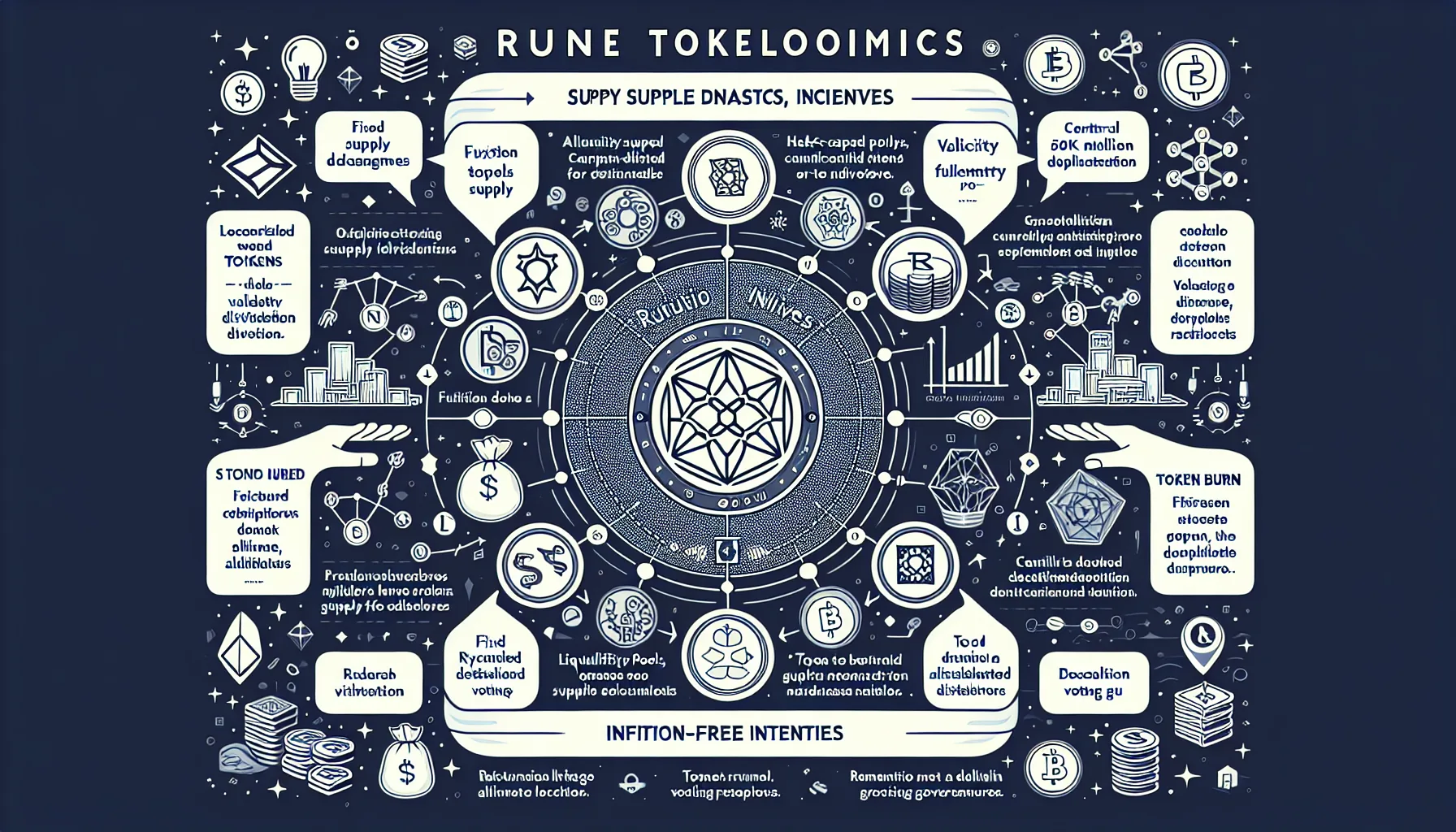
RUNE Tokenomics
Understanding RUNE Tokenomics: Supply Dynamics, Utility, and Incentives
THORChain's native asset, RUNE, underpins the protocol's ecosystem, serving as the primary medium for liquidity, security, and governance. The design of RUNE’s tokenomics plays a critical role in maintaining network functionality while incentivizing users and validators. Below is an in-depth breakdown of its tokenomics.
Fixed Supply and Allocation Distribution
RUNE operates with a hard-capped supply of 500 million tokens. This fixed supply model aims to ensure scarcity over time, but its initial allocation has been met with some criticism. A significant portion was distributed to the team, early investors, and ecosystem development—a standard approach for crypto projects, but one that has raised concerns around substantial centralization risks if early holders retain large stakes.
For example, high concentrations of RUNE in a few wallets could potentially threaten decentralization and create vulnerabilities, particularly if any of these holders choose to liquidate their positions en masse. That said, mechanisms like vesting schedules were introduced to mitigate immediate sell-offs, but debates persist in crypto-savvy circles about whether this sufficiently ensures equitable distribution.
Liquidity Pool Integration and Bonding
A unique aspect of RUNE tokenomics is its mandatory pairing with liquidity pools (LPs). As per the protocol’s 1:1 collateralization design, every external asset in a THORChain liquidity pool must be matched with an equivalent value of RUNE. This model directly ties RUNE’s utility and demand to LP activity, ensuring that the token’s value scales up with the network’s transaction volume.
However, this approach introduces an inherent dependency on external market forces. Low participation in pools or diminishing demand for cross-chain swaps could stagnate RUNE’s utility, adversely impacting the ecosystem’s growth. Furthermore, impermanent loss concerns may discourage new liquidity providers from joining, affecting overall token circulation.
Incentives for Nodes and Economic Security
RUNE is designed to secure the network through bonding by validators, who are referred to as nodes. Validators must bond twice the value of the capital they wish to earn from liquidity pools, creating an economic deterrent against malicious behavior. This dual-token collateralization model reinforces security but also heavily ties systemic health to RUNE’s market valuation.
A challenge arises if RUNE’s price becomes unstable, as this would directly impact validators’ bonding incentives and the network's overall economic security. Additionally, the high bond requirements have drawn criticism for creating high barriers to entry, limiting the number of validator nodes and concentrating network control.
Inflation-Free Framework and Implications
Unlike systems that utilize inflationary models, RUNE operates on a deflationary framework governed by token burns. A portion of transaction fees is burned, effectively reducing the circulating supply over time. While this aligns with value-accrual strategies, the reliance on sustained transaction volume to fuel burns creates dependency on long-term activity within the network. Critics argue that during periods of low usage, this approach could fail to sustain the asset’s attractiveness.
Decentralized Governance Concerns
Although RUNE functions as a governance token within the protocol, concerns have arisen regarding the true decentralization of decision-making. Large RUNE holders potentially have outsized influence over votes, which may undermine the robustness of decentralized governance frameworks. This aspect of RUNE’s tokenomics continues to be a point of contention within the community.
RUNE Governance
RUNE Governance: Decentralized Decision-Making and Potential Challenges
As the native token fueling the THORChain ecosystem, RUNE plays an integral role in governance, enabling token holders to influence critical protocol decisions. Unlike traditional centralized models, governance in THORChain is structured to align with its decentralized ethos, where RUNE stakers participate in securing the network, allocating resources, and shaping its evolution. However, while the framework provides a mechanism for community-driven decision-making, it is not without challenges.
Node Operators and Protocol Governance
THORChain's governance relies heavily on its node operators, who are responsible for maintaining the network's integrity and ensuring consensus. Node operators must bond a significant amount of RUNE to participate, effectively aligning their financial incentives with the network's health. This high bonding requirement acts as a safeguard against malicious actors but creates a barrier to entry, concentrating decision-making power among well-capitalized participants. As a result, some critics argue that this dynamic might limit the diversity of voices in governance and tilt influence toward wealthier stakeholders.
On-Chain Voting and Proposals
THORChain governance is designed to be flexible yet secure. Protocol changes and upgrades are enacted through an on-chain governance process. RUNE holders and node operators propose and vote on upgrades, new features, and parameter adjustments. While this ensures a transparent mechanism for decision-making, participation rates in on-chain governance remain a concern. Low voter turnout, common across decentralized projects, can result in decisions being disproportionately influenced by a small subset of participants.
Governance Overload and Coordination Complexity
As THORChain expands in scope and functionality, the volume of governance proposals could overwhelm participants, leading to governance fatigue. Moreover, ensuring coordinated decision-making across distributed RUNE holders and node operators is non-trivial. There is a delicate balance between maintaining decentralization and implementing governance processes that are efficient and scalable. Delays in voting and executing proposals could hinder THORChain’s ability to respond promptly to emerging challenges, potentially posing risks to its competitiveness.
Security Implications of Governance
Lastly, governance itself is a potential attack vector. Exploiters could seek to manipulate proposals or the voting process by acquiring large amounts of RUNE. The bonding and slashing mechanisms aim to mitigate such risks, but they cannot entirely eliminate the possibility of governance-based vulnerabilities. This underscores the need for continual refinement of THORChain’s governance model to minimize systemic risks.
In summary, while RUNE's governance structure embodies decentralization and aligns incentives, it presents challenges relating to accessibility, participation, and security. These ongoing dynamics are fundamental to the asset's role within the ecosystem.
Technical future of RUNE
Current and Future Technical Developments of RUNE: Mapping the ThorChain Ecosystem’s Evolution
ThorChain, powered by the RUNE token, stands at the nexus of cross-chain liquidity provision and decentralized finance (DeFi). Its technical architecture has undergone continuous evolution, with clear enhancements and upcoming changes outlined in its roadmap. This section delves into the platform's current and upcoming technical developments while addressing both strengths and potential pitfalls in its design.
Protocol Upgrades and Current Development Focus
ThorChain’s current focus continues to revolve around refining the functionality of its native Automated Market Maker (AMM) and cross-chain bridging capabilities. The roll-out of the “Continuity Upgrade” brought improved features, such as chain halt recovery enhancements and added robustness in observing external chain activity. A key feature, “Bifrost Protocol,” remains a critical element of ThorChain’s architecture, enabling seamless cross-chain transfers. However, complexities in maintaining compatibility with an increasing number of external blockchains have raised concerns about scalability, node operator workload, and potential network fragility.
Another technical advancement is the optimization of the network’s on-chain liquidity pools. The introduction of Synths (synthetic assets) has helped alleviate liquidity fragmentation, allowing users to gain exposure to native assets with minimized impermanent loss. However, this mechanism has also raised questions over how ThorChain mitigates systemic over-leveraging in scenarios of extreme market turbulence, a technical risk requiring careful monitoring.
Transition to Chaosnet and Permissionless Nodes
ThorChain is slowly pivoting toward greater decentralization by enabling permissionless node operation and expanding Chaosnet (its decentralized set of nodes). While this transition is foundational for strengthening the ecosystem's trustlessness, there are significant challenges. Networking here is complex, as increased decentralization adds system overhead, necessitating higher thresholds for hardware requirements and uptime monitoring. Critics argue balancing decentralization and usability for node operators remains a difficult problem for ThorChain.
Future Roadmap: Layered Scaling and Integration
Future upgrades aim to tackle network congestion and operational inefficiencies through the implementation of sharding techniques and layer-2 scalability. These developments are expected to allow deeper integration of additional native chains, particularly those requiring novel bridging mechanisms. Additionally, a proposed enhancement—the dynamic fee structure for liquidity pools—intends to address concerns around liquidity provision incentives and gas fee fragmentation, but details on its execution remain sparse.
Lastly, the integration of threshold signature schemes (TSS) to replace some current multi-sig implementations is a major planned overhaul. Although this promises enhanced security, its complexity raises questions around implementation timelines and tester community participation, especially as it will likely require sophisticated auditing to mitigate potential exploits.
Comparing RUNE to it’s rivals
RUNE vs ATOM: A Technical and Functional Comparison
RUNE, the native asset of the THORChain protocol, and ATOM, the centerpiece of the Cosmos Network, occupy distinct niches within the cryptocurrency ecosystem. While both seek to drive cross-chain interoperability, their underlying architecture, consensus mechanisms, and use cases diverge significantly, offering advantages and limitations depending on the specific goals of users and developers.
Interoperability Architecture
RUNE powers THORChain, a decentralized liquidity network that facilitates native cross-chain swaps without wrapping or synthetic tokens. THORChain's emphasis lies in non-custodial swaps using a Layer-1 approach supported by its Continuous Liquidity Pool (CLP) mechanism. This enables liquidity providers to stake native assets directly within the network, earning rewards proportional to pool activity.
ATOM, on the other hand, operates within the Cosmos ecosystem, which prioritizes interoperability through the Inter-Blockchain Communication (IBC) protocol. Unlike RUNE’s direct liquidity model, Cosmos focuses on building an extensive network of application-specific blockchains ("zones"), all connected via its hub-spoke model. This structure offers scalability and flexibility but requires projects to adopt Cosmos SDK and implement IBC features, creating a potential barrier for integration compared to THORChain's universal design.
Consensus Mechanism
The ecosystem difference extends into their consensus mechanisms. RUNE utilizes Tendermint-bFT, a Byzantine Fault Tolerance system also used in ATOM/Cosmos but applies it in the context of its Asgard vaults for transaction security. Validators within THORChain are tasked with managing these vaults, ensuring liquidity and native asset swaps occur seamlessly.
ATOM brings the added complexity of a staking-based consensus model powering its hub. While its security is amplified by the strength of the entire Cosmos ecosystem, it requires active participation from validators and delegators staking ATOM to secure the network. RUNE’s simplicity in staking liquidity versus ATOM’s staking and governance-led model offers a clear divergence depending on user objectives.
Scalability and Governance
RUNE excels in its purpose-specific liquidity model but lacks the extensive customization options that Cosmos SDK provides to developers. ATOM's modularity enables launching independent application-specific blockchains, which is compelling for projects requiring their own architecture. However, ATOM faces criticism for its tokenomics, where questions around clear utility and value accrual via staking rewards have been raised. RUNE sidesteps this critique by tying its utility directly to liquidity incentives and fee generation.
That said, THORChain’s reliance on validators to secure Asgard vaults has raised concerns about potential centralization risks. If the validator set shrinks, the network could face scalability issues—a challenge ATOM partially mitigates via its multi-zone consensus and validator distribution.
Ultimately, RUNE’s direct liquidity focus contrasts sharply with ATOM’s expansive, developer-centric network, underscoring the unique trade-offs between decentralized liquidity and blockchain interoperability frameworks.
RUNE vs. Fantom (FTM): A Layer-1 Protocol Comparison for DeFi Innovators
When comparing RUNE to Fantom (FTM), it’s essential to recognize the distinct architectural and operational goals that set them apart, particularly within the decentralized finance (DeFi) sector. Both projects are key players in the blockchain space, but they adopt very different approaches to scalability, cross-chain functionality, and network utility.
Technical Framework and Scalability
Fantom operates as a Layer-1 blockchain with its Lachesis consensus mechanism, a Directed Acyclic Graph (DAG)-based protocol designed to offer high throughput and near-instant transaction finality. This technical setup enables Fantom to handle a significantly larger number of transactions per second (tps) compared to many blockchain networks. RUNE, in contrast, operates as the native token of the THORChain ecosystem, which is primarily focused on enabling secure, cross-chain liquidity provision. RUNE’s scalability is rooted in its ability to act as a settlement layer for liquidity pools rather than optimizing for high tps directly.
The key difference here lies in their priorities: while Fantom is geared toward supporting scalable Layer-1 dApps for smart contract execution, RUNE is purpose-built for decentralized liquidity across multiple chains. This differentiation makes the comparison between the projects less about competition and more about complementary use cases, though for users seeking high-speed standalone blockchain performance, Fantom has an edge.
Decentralization and Governance
Fantom’s DAG structure is often celebrated for its efficiency, but the network still grapples with criticisms over its degree of decentralization. A lower number of active validators relative to some other chains has raised questions about the potential risks of centralization. RUNE and the THORChain ecosystem face similar scrutiny, particularly regarding its reliance on bond-based validators to secure the network. However, THORChain has worked to mitigate centralization risks by ensuring validators have robust economic incentives.
Ecosystem Interoperability
Where Fantom largely focuses on building out its internal DeFi landscape with projects that leverage its high-performance infrastructure—such as SpookySwap or Geist Finance—THORChain’s RUNE prioritizes interoperability. It facilitates seamless, native token swaps across multiple blockchains without wrapping assets. This cross-chain capability gives RUNE a distinct advantage for users seeking access to multi-chain liquidity. However, Fantom’s strategy of fostering an isolated but thriving Layer-1 DeFi ecosystem may appeal more to developers looking for a self-contained, high-performance blockchain.
Security Considerations
Both Fantom and RUNE face the constant threat of smart contract vulnerabilities as they expand their DeFi functionalities. Fantom’s rapid pace of ecosystem growth has occasionally led to concerns around contract audits and exploits. Meanwhile, RUNE has experienced its share of challenges, including critical exploits in THORChain’s bridges, which resulted in temporary pauses of its network. These incidents underline that security remains a shared struggle as both networks aim for broader adoption.
RUNE vs. INJ: A Direct Comparison in Cross-Chain Liquidity and Ecosystem Design
When comparing RUNE (ThorChain) to INJ (Injective), the most notable distinction lies in their approach to facilitating interoperability and liquidity in the decentralized finance (DeFi) ecosystem. Both projects address the need for seamless asset movement, but the underlying mechanisms and focus areas set them on divergent paths, leading to unique strengths and limitations.
Core Use Case Divergence
RUNE operates as the backbone of ThorChain, a cross-chain decentralized liquidity protocol designed to enable native asset swaps across multiple blockchains. INJ, on the other hand, powers the Injective ecosystem, a layer-1 blockchain dedicated to decentralized derivatives trading, orderbook-based exchanges, and Web3 financial primitives. While both projects emphasize decentralization, INJ’s focus leans more towards advanced trading infrastructures, including perpetual swaps and structured financial products, whereas RUNE prioritizes liquidity pools for simple, trustless swaps.
The immediacy and simplicity of ThorChain’s design allow for a highly inclusive and permissionless swapping experience. However, this has led to concerns over scalability and network congestion during periods of high demand. INJ’s derivative-focused ecosystem, while more niche, offers deeper functionality for institutional-grade traders, but it sacrifices some of the accessibility found in RUNE’s liquidity-first approach.
Network Design and Scalability
ThorChain’s architecture, built on the Cosmos SDK, provides true cross-chain functionality using its unique Continuous Liquidity Pools (CLPs) and automated market-making mechanisms. INJ also relies on Cosmos SDK infrastructure but extends scalability through a unique rollup architecture optimized for high-frequency trading and low-latency order execution.
While INJ excels at supporting sophisticated trading scenarios with minimal latency, critics have often pointed out that its focus on such specific use cases narrows its ecosystem potential. RUNE’s broad design philosophy allows it to facilitate any native asset, but this inclusivity has come under scrutiny for its increased exposure to exploits and unanimous reliance on validator consensus, which can create bottlenecks for network throughput.
Security Trade-Offs
One of the notable challenges for ThorChain has been its history of security incidents, particularly involving exploits in liquidity pools. While ThorChain has undergone rigorous iterations to improve its resilience, the risks associated with its highly composable and interconnected architecture remain a lingering concern. INJ, by contrast, has had a more conservative security record, likely attributed to its definition of clear boundaries around orderbook-driven ecosystems. However, this same characteristic limits INJ's adaptability for broader use cases outside of trading and DeFi niches.
Community and Ecosystem Development
RUNE boasts a vibrant, liquidity-driven community that actively participates in ThorChain's network governance, adding to its decentralized ethos. INJ’s community, however, is more specialized, skewing toward traders and institutional participants. While this specialization fosters advanced innovation in trading solutions, it constrains its broader appeal to general DeFi users, where ThorChain has maintained stronger mindshare.
By assessing direct trade-offs such as usability, ecosystem flexibility, and targeted functionality, the distinction between RUNE and INJ remains clear: one emphasizes universal liquidity, while the other specializes in trading infrastructure.
Primary criticisms of RUNE
Primary Criticism of RUNE: Challenges Facing the Thorchain Ecosystem
Centralization Risks within the Thorchain Network
One of the primary criticisms of RUNE stems from concerns about centralization. While Thorchain presents itself as a decentralized protocol, skeptics argue that its node distribution can appear disproportionately controlled by a smaller subset of validators. This raises questions about the actual level of decentralization achieved. Critics highlight that node operators must bond a significant amount of RUNE to participate, which may create a barrier for smaller operators and concentrate control among entities with greater resources. As decentralization is a core tenet for any blockchain protocol, this concern presents a significant philosophical and technical critique of the network.
Exploits and Security Concerns
Thorchain has faced scrutiny due to past exploits and vulnerabilities in its smart contract infrastructure. Critics argue that these incidents reveal potential weaknesses in the protocol's design and an apparent lack of rigorous auditing processes. Although the team has implemented iterative updates to improve security, a history of breaches undermines confidence in the stability of the ecosystem. For a project aiming to secure cross-chain liquidity through its native asset, RUNE, even isolated events of compromised security can have enterprisewide ramifications. This has led some within the crypto community to question the robustness of Thorchain's architecture.
Liquidity Constraints and Market Manipulation Potential
Liquidity constraints represent another significant point of contention. By design, bonded RUNE must be twice the value of non-RUNE assets in the network to maintain adequate collateralization within liquidity pools. While this model provides theoretically sound incentives for securing the network, critics argue that it artificially inflates demand for RUNE and could make liquidity imbalances more pronounced during high market volatility. Furthermore, the model's dependency on RUNE creates potential entry points for market manipulation, particularly from whales capable of manipulating asset pairings and pool depths.
Governance Challenges and Lack of Transparency
Critics have also raised concerns about Thorchain's governance model. With no formalized on-chain governance mechanism, decisions often rely on informal proposals and communication between developers, node operators, and the broader community. This lack of structured governance introduces ambiguity around how disputes are resolved and decisions are made. Critics argue that greater transparency and formal mechanisms are necessary to ensure the long-term scalability and trustworthiness of the protocol.
Limited Cross-Chain Adoption
Finally, while Thorchain positions itself as a leader in cross-chain operability, its adoption beyond major blockchains has been slower in comparison to competitors. Critics point out that its cross-chain integrations come with significant limitations, such as difficulties in addressing the diversity and complexity of other blockchain protocols. This slower pace of integration limits RUNE's value proposition, especially in ecosystems that rely on extensive multi-chain connectivity.
Founders
The Founding Team Behind RUNE: A Deep Dive
RUNE, the native token of the Thorchain ecosystem, owes its origins to a decentralized and relatively anonymous founding team. The project was initiated in 2018 by a group of developers who remain pseudonymous to this day, operating under collective aliases instead of individual recognition. This decision aligns with Thorchain’s ethos of decentralization and minimizing centralized leadership, but it has sparked various debates in the crypto community regarding transparency and accountability.
While anonymity isn't uncommon in the world of crypto—Bitcoin, after all, was spearheaded by the enigmatic Satoshi Nakamoto—the lack of visibility into Thorchain’s leadership introduces real concerns. Trust within the crypto community is often hard-earned, particularly when substantial financial assets are at play. For those backing RUNE, this anonymity requires faith in the protocol’s technical robustness and its capacity for decentralized governance. Critics, however, argue that it poses a risk, especially in the event of serious network issues or exploitation, where direct accountability might be diminished.
Despite this, aspects of the team’s actions and development milestones are well-documented. The team conducted no ICO, no pre-mine, and no token presale, which immediately set Thorchain apart from many other crypto projects launched in the same timeframe. This approach demonstrated a deliberate effort to foster trust, focusing instead on community-driven funding and decentralized incentives through liquidity pools.
As Thorchain evolved, what originally began as a hackathon project quickly gained traction due to the team's clear technical vision for cross-chain liquidity. This vision, however, has not been without hurdles. Security incidents, including exploits in the protocol, have occurred, leading to concerns about whether the anonymity of the core team hinders timely and transparent communication when incidents arise. While the team typically communicates through official channels like GitHub updates, Medium articles, and Twitter, critics suggest that pseudonymity has at times made crisis management feel less direct or personal.
That said, Thorchain has continued to grow by fostering community-driven governance and contributions outside of the core team. RUNE’s ecosystem is now maintained by an increasingly decentralized network of developers and validators, yet the foundational influence of the original team remains an enduring point of discussion within crypto circles. Whether this level of anonymity will remain a strength or a vulnerability depends heavily on the continued maturation and security of the protocol.
Authors comments
This document was made by www.BestDapps.com
Sources
- https://thorchain.org
- https://rune.thorchain.info
- https://docs.thorchain.org
- https://github.com/thorchain
- https://medium.com/thorchain
- https://blog.thorchain.com
- https://thorchain.org/whitepaper.pdf
- https://explorer.thorchain.net
- https://www.coingecko.com/en/coins/thorchain
- https://coinmarketcap.com/currencies/thorchain
- https://defillama.com/protocol/thorchain
- https://docs.thorchain.org/simulation
- https://www.reddit.com/r/thorchain
- https://legacy.thorswap.finance
- https://twitter.com/thorchain_org
- https://etherscan.io/token/0x3155ba85d5f96b2d030a4966af206230e46849cb
- https://dexscreener.com/thorchain
- https://community.thorchain.org
- https://messari.io/asset/thorchain


