History of RNDR
The History of the RNDR Crypto Asset: A Deep Dive into its Origins and Development
RNDR, the native token of the Render Network, emerged with the vision of tackling a pressing industry challenge: the high computational demand for rendering realistic 3D graphics. Born from the intersection of blockchain technology and GPU-based rendering, the project aimed to decentralize processing power and create a distributed network capable of handling intensive workloads efficiently. Its origins are deeply tied to the creators' expertise and the growth in demand for distributed rendering solutions, particularly for applications in gaming, virtual reality, and design-heavy industries.
Conceptualized by OTOY Inc., a company recognized for its work in graphics software, RNDR was initially envisioned as a marketplace for GPU rendering power. During its early development, the project sought to expand upon the inherent benefits of blockchain’s decentralization while addressing real-world inefficiencies in the graphics rendering industry. Organically, it caught the interest of content creators and developers seeking cost-effective and scalable solutions.
The journey toward its adoption was by no means without hurdles. One of the critical challenges in RNDR’s history was balancing decentralization goals with ensuring computational reliability and efficiency across the network. Being an asset tied to the performance of a distributed computational network, RNDR has faced technical complexities—particularly concerning consistency in task results across different nodes in a distributed environment. Ensuring quality control for rendered outputs while leveraging decentralized contributors required extensive iterating on both infrastructure and governance protocols.
In its nascent stages, RNDR’s tokenomics were carefully designed to incentivize participants on both sides of the marketplace: those providing GPU power (node operators) and those consuming it (content creators). However, skepticism occasionally arose regarding the economic model, as critics pointed out potential risks related to token inflation or demand fluctuation that could impact network adoption. Additionally, the ecosystem faced scrutiny over whether it could truly compete with large centralized cloud providers in terms of scalability and ease of use.
Throughout its history, RNDR also navigated the legal and regulatory ambiguity often associated with blockchain projects, which added complexity to its business model's evolution. Nonetheless, its association with a well-established name in the graphics industry lent credibility to the project's foundational goals.
The history of RNDR is one of ambition but also one that highlights the inherent challenges of launching blockchain-based networks in competitive, high-demand industries. Its ongoing refinement reflects the project’s response to both user feedback and technical obstacles.
How RNDR Works
How RNDR Works: Decentralized GPU Rendering at Scale
RNDR (Render Token) operates as a decentralized network designed specifically for GPU-based rendering tasks. It connects those who need high-performance rendering (such as designers, artists, and studios) with GPU operators who provide computational power. By leveraging blockchain technology and smart contracts, RNDR creates a marketplace where rendering jobs are distributed, executed, and validated.
At its core, RNDR runs on the Ethereum blockchain, utilizing its ERC-20 standard for the RNDR token and smart contract functionality for task coordination. Users (rendering requesters) convert their projects—typically in formats like OctaneRender scenes or other supported 3D file types—into tasks uploaded onto the network. Here, these tasks are split into smaller work units and assigned to network participants (node operators) equipped with idle GPU capacity.
A key technical component of the RNDR system is the proof-of-render algorithm. This serves as a verification layer, ensuring that the rendering output generated matches the requester’s specifications. Proof-of-render functions by embedding watermarks within rendered frames, which are cross-checked by the requester before the final output is unlocked. This hybrid off-chain/on-chain approach helps maintain the integrity of results without overwhelming the Ethereum network with excessive data.
One of RNDR's notable features is scalability. Distributed workloads allow the Render Network to accommodate projects ranging from simple scenes to complex, high-resolution animations. However, challenges remain. For instance, the network's reliance on Ethereum means it faces inherent limitations like gas fees and congestion, which can introduce inefficiencies, especially during peak blockchain activity.
There's a dual-incentive structure in play: Requesters pay with RNDR tokens to have their work rendered, while operators earn RNDR tokens for performing computations. These tokens also act as an access key for engaging with the Render Network, which can create barriers to adoption for users unfamiliar with managing crypto wallets or those unwilling to navigate token volatility.
Security is another consideration. While the system employs encryption and watermarks for task protection, data confidentiality still hinges on the decentralized nature of the network and the trustworthiness of participating nodes. Additionally, onboarding new users—both creators and GPU operators—can involve a steep learning curve due to the technical complexity of the ecosystem.
RNDR balances technical sophistication and accessibility in enabling GPU compute sharing, but efficient scaling, cost optimization, and user experience remain critical for broader long-term utility.
Use Cases
Use Cases of RNDR: Powering Distributed Rendering for 3D and Visual Effects
RNDR, the utility token of the Render Network, is specifically tailored to address the challenges of rendering complex 3D graphics and animations by providing a distributed, decentralized solution for GPU-based rendering. By marrying blockchain technology with high-performance computing, RNDR facilitates several specific use cases within the creative and technical industries.
High-Quality 3D Rendering for Artists and Studios
One of the core use cases of RNDR is to bridge the resource gap for 3D artists and visual effects (VFX) studios. Traditional rendering pipelines often require expensive hardware or third-party render farms, which may be cost-prohibitive for smaller creators or studios. Utilizing the Render Network, users can tokenize their rendering jobs, allowing them to distribute rendering tasks across idle GPUs in the network. However, projects involving highly sensitive intellectual property may face risks related to distributing assets over a decentralized network, particularly due to concerns around data privacy and asset security, even with encryption measures in place.
Virtual Reality and Augmented Reality Content Creation
Given the demand for immersive experiences, VR and AR developers require reliable, high-throughput rendering solutions. RNDR supports the rendering-intensive nature of creating scenes for these environments, enabling faster and more affordable generation of hyper-realistic assets. Despite this, network latency, potential outages, or disputes around reward distribution can sometimes slow the rendering process or create inconsistencies compared to traditional centralized solutions.
Architectural Visualization and Product Design
RNDR’s functionality extends to industries like architectural visualization and product design, where photorealistic renders are critical for pre-production workflows. Designers can offload computational work to the network and streamline production pipelines. Nevertheless, this scalability comes with trade-offs, as the decentralized architecture may result in challenges related to job prioritization or unpredictable node performance, leading to varying render times.
Supporting NFTs, Gaming, and the Metaverse
RNDR is also being adopted to power the creation of NFTs, game assets, and elements for metaverse experiences, where high-quality and complex 3D elements are integral. The token economy incentivizes users to provide GPU resources, enabling creators to render unique digital assets efficiently. However, scalability could become an issue as demand rises, and the network’s capacity to sustain high throughput while maintaining decentralized principles will face increasing pressure.
Scientific Simulations and Machine Learning Models
RNDR has extended its use into areas such as scientific simulations and training machine learning models. These compute-intensive tasks can leverage the decentralized GPU power offered by the Render Network. Unlike existing cloud-based solutions, RNDR minimizes centralized dependencies. However, task complexity and unpredictable network congestion can still limit its effectiveness for workloads requiring precise timing or synchronization.
RNDR’s use cases showcase its versatility across industries, but limitations such as scalability, privacy concerns, and network stability remain relevant challenges to address.
RNDR Tokenomics
RNDR Tokenomics: A Breakdown of Supply and Distribution
RNDR (Render Token) stands out in the crypto sphere for its unique utility within the decentralized GPU rendering ecosystem, but its tokenomics reveal deeper dynamics that demand close scrutiny. Understanding RNDR's supply mechanics, distribution, and incentive structures is critical for evaluating its role within this niche infrastructure network.
Total Supply and Emission Schedule
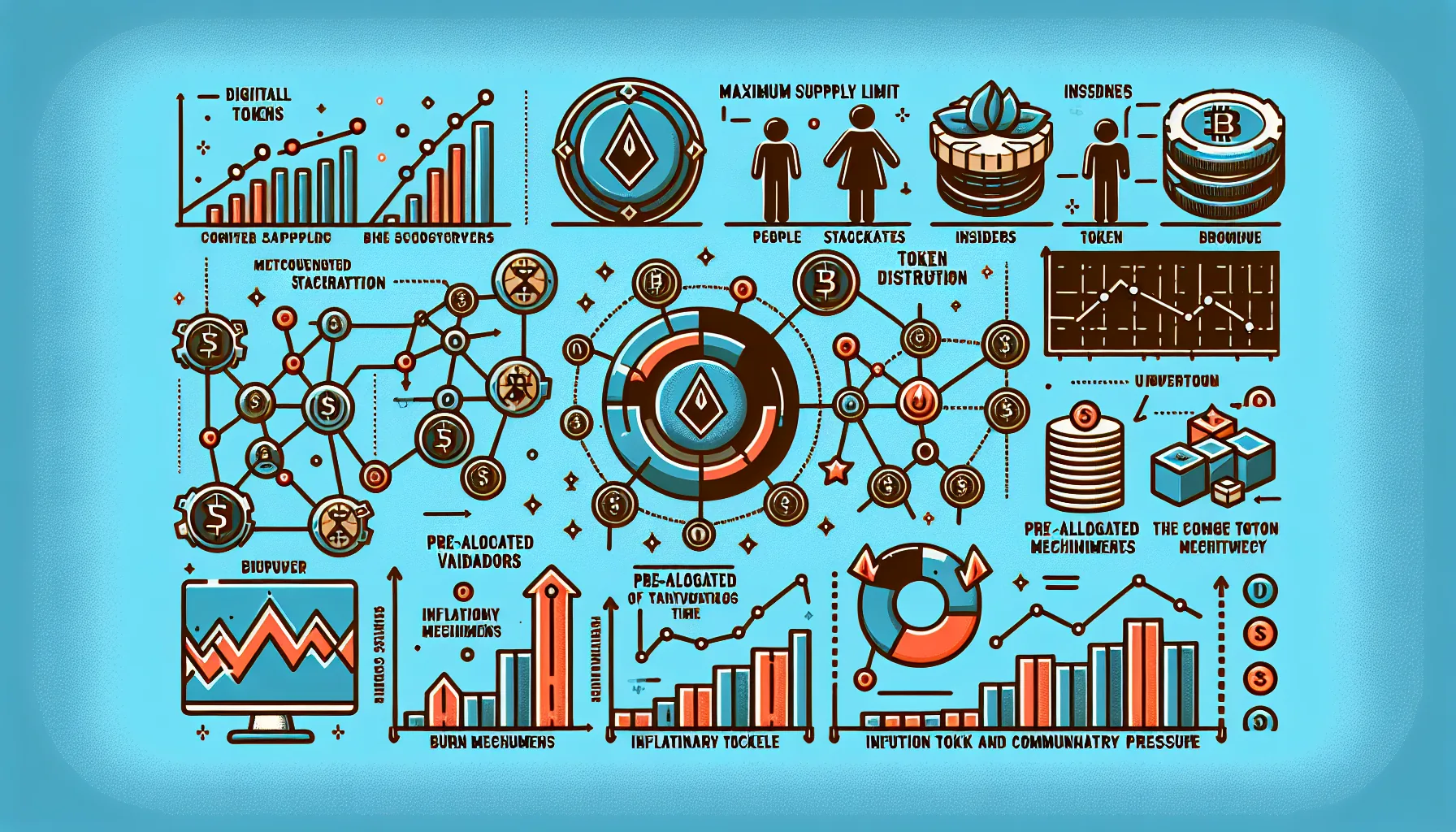
RNDR is capped at a maximum supply of 536,870,912 tokens, a finite limit that enforces scarcity over the long term. However, the circulating supply grows progressively as tokens are distributed to incentivize network validators and other stakeholders. Notably, the release mechanisms are accelerated by demand within the Render Network's ecosystem itself, as usage of rendering services directly translates into token burns or validator compensation. This introduces a complex feedback loop between demand for computational resources and the token supply in circulation.
Initial Allocation and Distribution Concerns
At launch, a significant portion of RNDR’s supply was pre-allocated to insiders, including the founding team, advisors, and early investors. Approximately 25% of the total supply was set aside for these groups, raising questions about centralization risks and prolonged sell pressure. While vesting schedules were implemented, the eventual unlocking of these tokens could potentially dilute holders’ stakes or destabilize the token price if selling persists disproportionately.
Conversely, 65% of the total supply was allocated for community incentives, including rewards to node operators who power the GPU rendering tasks. By prioritizing community rewards in its tokenomics design, RNDR aims to tether its supply issuance to actual network utility. Nonetheless, critics argue that the sizable insider allocations could create asymmetric benefits, which, in a worst-case scenario, may compromise the network’s decentralized ethos.
Burn Mechanisms and Utility Integration
A unique aspect of RNDR’s tokenomics involves its burn-and-mint equilibrium model. Users pay node operators in RNDR tokens for rendering services, a portion of which is burned, reducing the total supply over time. This model links token value directly to network usage, potentially stabilizing token inflation. Yet, scalability challenges and adoption barriers impacting transaction volumes could undermine the efficacy of this mechanism. A stagnant network usage rate would render the burn function negligible, blunting one of the core principles underpinning RNDR’s tokenomics.
Inflationary Pressure from Staking Rewards
While RNDR incentivizes node operators and validators through staking rewards, this approach introduces inflationary pressure. Unless the rise in transaction demand outpaces token issuance for rewards, inflation could outstrip network growth. Careful balancing of reward rates with actual utility metrics remains a crucial challenge, as excessive rewards may dilute token value over time.
RNDR’s tokenomics architecture clearly emphasizes incentivized participation and utility-driven deflation. However, potential friction points like insider allocations, inflation management, and network adoption barriers require continual monitoring for the long-term health of the ecosystem.
RNDR Governance
Decentralized Governance within the RNDR Ecosystem
The RNDR token introduces a distinctive governance framework designed to align decision-making processes with the decentralized principles of the Render Network. However, while the governance mechanism seeks to empower token holders and ensure collaborative oversight, it also presents challenges and nuances that merit closer examination.
Token Holder Voting Power
A core element of RNDR’s governance is its reliance on token-weighted voting. Token holders have the ability to participate in decisions regarding protocol upgrades, resource allocation, and potential improvements to the Render Network. This democratic model theoretically incentivizes active participation by those heavily invested in the ecosystem. However, the centralization of voting power among large holders, commonly known as "whales," remains a potential vulnerability. Critics argue that this dynamic can skew decision-making in favor of a concentrated minority, diluting the decentralized ethos RNDR aims to uphold.
Proposal Mechanism
The network employs an on-chain proposal submission mechanism where community members can suggest changes or enhancements to the protocol. Successful proposals generally require a quorum, ensuring substantial network participation before implementation. While this fosters an open collaborative environment, the process can sometimes be slow-moving, particularly for urgent matters. Additionally, high entry barriers—such as technical expertise or significant token ownership—may discourage smaller participants from submitting proposals, creating an implicit hierarchy within the ecosystem.
Balancing User Groups
RNDR governance must navigate the complex interplay between diverse stakeholders, including creators, node operators, token holders, and developers. The differing priorities of these groups occasionally lead to friction over resource allocation or feature prioritization. For example, creators may advocate for lower rendering fees, while node operators may prioritize incentivized staking or infrastructure investments. This balancing act underscores the importance of consensus-building but also highlights the difficulty of satisfying all parties involved in a highly decentralized system.
Long-Term Risks of Governance Centralization
Though RNDR emphasizes decentralization, reliance on governance structures connected to token ownership poses risks of gradual centralization. Consolidation could occur as larger entities—such as institutional investors or well-funded organizations—acquire more tokens, heightening their governance influence. Such centralization could stifle innovation and might result in decisions that benefit select groups over the broader community. Safeguards against these outcomes remain a critical area requiring ongoing attention from participants.
RNDR’s governance model represents a bold effort to distribute decision-making across a diverse, global network of stakeholders. While it offers tangible pathways for collaborative input, inherent challenges—including concentration of power and competitive priorities—shape the framework’s current dynamics. Understanding these nuances is crucial for anyone actively engaging with the RNDR ecosystem.
Technical future of RNDR
Current and Future Technical Developments for RNDR
Evolving Infrastructure with Layer-2 Integrations
RNDR has actively prioritized scalability by exploring Layer-2 solutions like Ethereum’s Optimism and Polygon. These integrations are aimed at mitigating Ethereum's high transaction fees and improving processing speeds for asset distribution across the decentralized rendering network. While this marks a progressive effort to enhance usability, some users have raised concerns about interoperability challenges, particularly when bridging assets back to Ethereum's mainnet. Maintaining decentralization amid these Layer-2 offloading strategies remains a technical hurdle requiring more transparent solutions.
OctaneRender Integration and GPU Efficiency
Central to RNDR's ecosystem is its reliance on OctaneRender, the OTOY ecosystem's flagship rendering software. Efforts are underway to enhance GPU efficiency for render node operators by optimizing job distribution. However, these developments are constrained by the technical demands of OctaneRender, particularly its compatibility with specific GPU hardware. This narrow compatibility risks alienating operators without high-performance GPUs, creating a potential barrier to entry for wider network participation.
Intellectual Property (IP) Protection Through Encryption
A targeted focus in the RNDR roadmap includes advancing encryption protocols to enhance IP protection for artists leveraging the network. Current progress centers around secure asset handling via decentralized storage, such as IPFS integrations. While this approach addresses concerns about unauthorized access to rendering assets, its reliance on third-party storage layers introduces latency and exposes the network to potential vulnerabilities arising from storage fragmentation.
Rendering on Decentralized Nodes: Expanding Compute Capacity
The RNDR network's strategy to expand through decentralized GPU nodes has encountered scaling friction. Although the beta phase has shown promise, node onboarding remains limited by validator approval mechanisms. Future technical plans aim to transition onboarding to a more autonomous model with reduced manual oversight. However, this shift raises questions about how the system will maintain trust and security integrity while scaling rapidly.
Smart Contract Automation and Job Escrows
RNDR plans to increase automated allocation of rendering jobs via more sophisticated smart contract-based escrows. These contracts are designed to strengthen the efficiency of node payment and job validation processes. Although this development offers significant upside in terms of operational throughput, the complexity of these workflows demands rigorous auditing. Challenges related to potential bugs in contract logic could disrupt job fulfillment, highlighting the critical need for continuous monitoring and testing.
Exploring Multi-Chain Expansion
To reduce reliance on Ethereum's ecosystem, RNDR has teased multi-chain expansion as part of its long-term roadmap. Proposed chains include those optimized for decentralized computing. While this signals a step toward resilience and cross-chain utility, each additional chain introduces its own set of complexities surrounding bridge security, liquidity fragmentation, and network effects.
Comparing RNDR to it’s rivals
RNDR vs HNT: A Technical Comparison of Decentralized Infrastructure
Render Network (RNDR) and Helium Network (HNT) are both innovators in decentralized infrastructure, but their underlying technologies and use cases appeal to distinct niches within the crypto ecosystem. While RNDR focuses on providing GPU-based rendering power to creators and developers, Helium's core function lies in building a decentralized wireless network infrastructure for IoT devices. This section dives into the specific differences and challenges between these ecosystems, particularly as they compete for dominance in their respective fields.
Core Functionality and Market
RNDR is fundamentally a protocol aimed at creators and businesses needing scalable, decentralized GPU rendering services. By leveraging idle GPU capacity from users globally, RNDR enables a peer-to-peer marketplace that taps into high-end hardware without relying on centralized providers. In contrast, HNT operates in the wireless communication space, incentivizing its users to deploy physical radio hotspots to support a global decentralized IoT network.
While both networks depend on their communities to provide critical services, their infrastructures serve entirely different user bases. RNDR's user base skews toward industries like animation, virtual reality, gaming, and high-end design, whereas HNT largely appeals to IoT developers and enterprises monitoring low-power devices such as sensors and trackers. This fundamental difference limits direct competition but highlights their shared reliance on the scalability of user-driven ecosystems.
Technical Architecture
RNDR’s success is heavily tied to the demand for GPU-intensive computational tasks. Its protocol effectively bridges the gap between users with high computational needs and providers with idle GPU power, all housed on the Ethereum blockchain. However, this reliance on Ethereum brings challenges, particularly regarding transaction speed and gas fees, which could hamper RNDR’s usability as its network scales.
HNT, on the other hand, employs a Proof-of-Coverage (PoC) consensus algorithm, which is purpose-built for validating the physical presence of hotspots within its network. This incentive structure ensures global wireless coverage but comes with challenges of its own, like equipment costs for participants and concerns about centralization from high-concentration hotspot deployment in specific regions.
Scalability Challenges
While HNT’s issues revolve around achieving balanced geographical distribution and reliability for IoT devices, RNDR’s challenge is deeply rooted in ensuring enough GPU liquidity to handle surges in rendering requests. RNDR's decentralized model necessitates a steady supply of node operators with high-performing GPUs, which could face bottlenecks if demand outpaces supply.
RNDR also faces potential competition from centralized rendering services, which may offer more consistent performance for enterprise-level projects. Conversely, HNT’s reliance on physical infrastructure establishes high entry costs, making broad adoption slower despite its IoT use case’s appeal.
RNDR vs. GRT: Decentralized Graphics Rendering Meets Web3 Data Indexing
When comparing RNDR (Render Network) to GRT (The Graph), it’s clear that while both crypto assets serve specialized niches in Web3 infrastructure, their underlying use cases and technical frameworks differ significantly. RNDR focuses on decentralized GPU processing power for rendering graphics and 3D content, whereas GRT facilitates the querying and indexing of blockchain data through its decentralized protocol. However, there are overlapping narratives given both aim to optimize vital components of a decentralized internet.
Differentiators in Use Case Utility
GRT is purpose-built for blockchain data accessibility, allowing developers to query on-chain information efficiently via subgraphs. This is a core utility for decentralized apps (dApps) looking to present clean, searchable data to end users. RNDR, however, solves a different bottleneck entirely—the immense computational resource demands of rendering. This divergence means that while GRT interacts heavily with applications directly reliant on data retrieval, RNDR’s offerings are skewed toward visual creativity, including industries like virtual reality, VFX, and metaverse development. The question becomes less about direct competition and more about which protocol will see greater adoption as Web3 scales in complexity.
The Centralization Critique
Both GRT and RNDR claim decentralization as a core ethos. However, GRT faces criticism regarding the concentration of indexers—entities that stake GRT tokens to perform data querying tasks. The higher the financial stakes, the more difficult it becomes for smaller operators to enter. This runs parallel to RNDR's network concerns, as its GPU providers are similarly at risk of consolidation, with larger node operators gaining disproportionate power. Both protocols must navigate a careful balance to avoid centralization risks that erode their visions of democratized systems.
Tokenomics Considerations
A key distinction lies in how their token economics engage their ecosystems. GRT is used as a medium for staking, rewards, and fees within its indexing and querying economy. Nodes are incentivized to deliver quality, fast, and accurate data to dApp developers. RNDR, by contrast, leverages its token to price GPU rendering workloads, positioning it as a direct exchange medium. While this specificity gives RNDR a strong economic anchor, GRT’s model potentially allows for greater versatility when supporting multi-chain environments.
Challenges in Scalability
Both ecosystems highlight scalability as a critical hurdle. GRT must contend with the rapid expansion of blockchain data across multiple Layer-1 and Layer-2 protocols, requiring efficient subgraph deployment and continued protocol updates. RNDR faces similar challenges due to growing workloads from increasingly complex 3D rendering demands and the onboarding of more node providers. Without ongoing advancements, either protocol risks stagnating in its respective niche.
This juxtaposition underscores the niche-specific strengths of RNDR and GRT, while also highlighting shared growing pains that stem from their ambitious roles in Web3 infrastructure.
RNDR vs. FIL: Decentralized Power Meets Decentralized Storage
When comparing RNDR and Filecoin (FIL), it becomes clear that while both projects are vital to the decentralized future, they operate in fundamentally different domains but with overlapping implications for Web3 infrastructure. RNDR stands as a decentralized GPU rendering protocol, focused on powering intensive 3D, AR/VR, and motion graphics workloads. FIL, on the other hand, is the backbone of decentralized storage, aiming to disrupt traditional cloud storage by incentivizing users through a peer-to-peer marketplace. Despite their differing core functions, the two cater to creative industries, decentralized applications (dApps), and blockchain projects, creating competitive and complementary dynamics.
Target User Base Differences
FIL's decentralized architecture primarily appeals to developers and enterprises seeking a trustless storage solution. Its value proposition is in solving the high costs and centralization risks associated with providers like AWS or Google Cloud. On the other hand, RNDR provides tools for visual creators, game studios, and AR/VR developers who require immense GPU power that centralized options often make cost-prohibitive.
Where tension arises is in overlapping markets like Web3 dApps. Many projects using RNDR for rendering tasks may also require storage for assets or datasets, which makes FIL a strong adjacent solution. However, FIL's current data retrieval speeds and scattered storage nodes can present a challenge for creators managing large workflows, particularly as rendering pipelines often demand low-latency asset access.
Tokenomics and Utility Comparison
FIL's utility stems from its native token's role as the fuel for storage and retrieval deals on its network—a pure case of supply and demand. RNDR, while also having a token-based economy, follows a work-unit logic paired with GPU contributions, requiring task-specific allocations. Both tokens are inherently reliant on network effect growth, but FIL's adoption heavily depends on enterprise partnerships and network improvements addressing scaling and reliability, while RNDR involves an ecosystem driven by high-end technical users seeking GPU availability.
Critics of FIL argue that onboarding processes and usability for non-technical users remain hurdles—issues RNDR has arguably mitigated with an interface designed to appeal to creatives. However, RNDR often faces skepticism concerning its GPU provider network’s decentralization compared to FIL’s decentralized storage provider base.
Sustainability Challenges
A common criticism of FIL is its storage providers’ tendency to "game" the network by storing low-value or even junk data to maximize rewards rather than serving legitimate clients. By comparison, RNDR’s staking mechanics and verifier protocols are targeted at filtering out bad actors. Nevertheless, RNDR's system isn't without its challenges, such as balancing job distribution efficiently across its node network, especially as demand scales.
Primary criticisms of RNDR
Primary Criticism of RNDR: Challenges Facing the Render Token Ecosystem
Centralization Concerns in the RNDR Network
One of the most frequently raised criticisms of the RNDR ecosystem revolves around centralization concerns. While RNDR markets itself as a decentralized rendering platform leveraging blockchain technology, critics argue that the governance structure skews toward centralized control. The Render Network Foundation and its affiliates maintain significant influence over protocol decisions, roadmap development, and the allocation of network resources. This level of oversight has raised questions about the degree of decentralization, which is a cornerstone for many blockchain projects. Critics often point out that the reliance on centralized entities for decision-making could expose RNDR to bottlenecks or biases, limiting its ability to operate as a truly decentralized system.
Questionable Scalability for High-Intensity Workloads
Another area of critique is the scalability of the RNDR network, particularly as demand for high-intensity rendering workloads continues to grow. While distributed rendering offers a theoretically efficient solution, skeptics argue that practical limitations may hinder its effectiveness, especially for more complex projects. Distributed GPU rendering requires seamless coordination between nodes, but network latency, uneven computational power among providers, and potential disruptions can create delays. Such inefficiencies may make RNDR less practical for industries or creators with critical deadlines and massive rendering needs, like feature-length animations or AAA video games.
Limited Incentives for Node Operators
Node operators play a fundamental role in RNDR’s ecosystem by providing GPU compute resources to users. However, critics have highlighted a lack of enticing incentives for these operators to participate or scale their contributions. The token reward model, while functional, faces questions of sustainability. Transaction fees paid in RNDR may be insufficient to compensate for the costs of electricity, hardware, and maintenance, particularly in regions with higher energy prices. This imbalance risks discouraging GPU resource providers, which could further exacerbate concerns around network scalability and reliability.
Barriers to Entry for GPU Providers
Although RNDR seemingly allows anyone with a GPU to contribute to the network, the reality may impose barriers to participation for smaller operators or individuals. Setting up node infrastructure typically requires a baseline technical expertise, while institutional-grade providers may naturally outcompete smaller players due to resource advantages. This creates an uneven playing field and shifts network participation toward a more centralized group of operators, thereby undermining its decentralized ethos.
Lack of Broader Adoption Beyond Niche Use Cases
Despite its focus on the rendering market, another critical issue is RNDR’s limited penetration beyond niche industries like 3D graphics, VFX, and virtual production. Critics argue that its utility is narrowly targeted, which restricts scalability in terms of user base. While rendering is an essential service, others have questioned whether RNDR offers compelling advantages over traditional rendering solutions for most users, especially as onboarding into the blockchain ecosystem introduces friction for non-tech-savvy participants.
Founders
Founding Team Behind RNDR: Visionaries Shaping Decentralized GPU Rendering
RNDR (Render Token) was conceived by OTOY, a company known for its trailblazing work in cloud rendering and GPU-based ecosystems, with Jules Urbach as its centerpiece founder. Urbach is a serial entrepreneur with extensive experience in 3D rendering, graphics technology, and distributed computing. His vision with RNDR extends beyond traditional centralized rendering solutions, aiming to create a decentralized network that leverages idle GPU compute power globally. Urbach’s leadership has driven RNDR’s technical innovation, but skeptics sometimes point to concerns about founder-led decision-making, particularly in terms of governance and scalability as the project matures.
OTOY itself has been a key player in fueling RNDR’s growth, but this deep entanglement also raises questions about dependency. Critics argue that RNDR’s association with OTOY might limit its perception as a fully decentralized project. Furthermore, while the team brings significant technical expertise and industry connections, some in the community question whether this corporate association aligns with the decentralized ethos fundamental to blockchain.
RNDR's team is supported by a roster of seasoned professionals with diverse backgrounds in blockchain development, distributed computing, and creative industries. While this multifaceted expertise is a strength, there is ongoing debate over the transparency of team operations and updates. While ample documentation exists for RNDR’s technical architecture and tokenomics, details about long-term team expansion and operational decentralization are less frequently disclosed, fueling skepticism among some community members.
In addition to Urbach, the project benefits from advisors and contributors with strong domain expertise, including former senior executives from Hollywood studios and cloud computing firms. While impressive, there has been occasional criticism that such advisors may cater more to enterprise-focused use cases, potentially sidelining small-scale creators or community-driven priorities. Balancing enterprise adoption with grassroots engagement remains an area for future scrutiny.
One unique aspect of RNDR’s founding team is their focus on blending blockchain technology with creative tools, a relatively uncharted territory. However, this ambition has also introduced engineering challenges, particularly around delivering a frictionless user experience for non-crypto-savvy artists without diluting RNDR's functionality. While the founding team has made strides in addressing these hurdles, ongoing development bottlenecks highlight the need for iterative refinement and community feedback.
In sum, RNDR’s founding team marries visionary leadership with undeniable technical prowess, though lingering questions around transparency, governance, and enterprise bias persist.
Authors comments
This document was made by www.BestDapps.com
Sources
https://rendertoken.com
https://docs.rendertoken.com
https://github.com/rendertoken
https://portal.rendertoken.com
https://medium.com/render-token
https://etherscan.io/token/0x6de037ef9ad2725eb40118bb1702ebb27e4aeb24
https://coinmarketcap.com/currencies/render-token/
https://cointelegraph.com/tags/render-token
https://cryptoslate.com/coins/render-token/
https://messari.io/asset/rndr
https://www.coingecko.com/en/coins/render-token
https://decrypt.co/resources/what-is-the-render-network-and-rndr-token
https://twitter.com/rendertoken
https://www.linkedin.com/company/render-token
https://www.youtube.com/channel/UCwJYSzayC_9L1EC0Fao7Dyg
https://www.crunchbase.com/organization/render-network
https://forum.rendertoken.com
https://blog.rendertoken.com
https://support.rendertoken.com
https://dappradar.com/ethereum/marketplaces/render-token


