History of RBN
The History of RBN: Tracing the Origins and Evolution of Ribbon Finance’s Native Token
RBN, the native token of the Ribbon Finance ecosystem, emerged as a core component of the platform’s mission to redefine risk management strategies within decentralized finance (DeFi). Ribbon Finance, built on the Ethereum blockchain, initially launched as a DeFi protocol aimed at offering automated yield strategies using structured products. The token, RBN, was introduced to further decentralize the governance of the protocol and incentivize user participation.
Ribbon Finance was officially launched in early 2021, responding to the increasing demand for innovative yield optimization techniques. The RBN token, however, was not part of the initial rollout. For several months, the protocol operated without a native governance or utility token. It wasn’t until the latter half of 2021 that Ribbon Finance issued RBN through a token distribution event. This marked a pivotal moment in the protocol’s history, enabling the community to have greater influence over Ribbon’s roadmap and treasury management.
The token distribution was designed to balance community engagement with ecosystem sustainability, but its mechanics drew mixed reactions. A portion of RBN was allocated to early users through an airdrop, intended to reward those who contributed to the platform’s growth at its inception. Simultaneously, a substantial percentage of tokens was reserved for the Ribbon Finance team, venture capital investors, and the protocol’s treasury. While this structure provided the protocol with financial stability and resources, concerns over token concentration and potential centralization of influence were raised by segments of the crypto community. These debates became especially pronounced among advocates of DeFi’s decentralized ethos.
Another notable development in RBN’s history was its integration into Ribbon Finance’s evolving governance framework. The token powered a decentralized autonomous organization (DAO), allowing holders to vote on upgrades to the protocol, new product launches, and treasury usage. However, questions about voter apathy—a common issue across many token-based DAOs—also surfaced as RBN voting activity showed sporadic participation rates.
Throughout its history, RBN has faced typical growing pains associated with scaling a DeFi token, such as smart contract risks and adapting to a competitive ecosystem. Despite criticism over certain early token distribution decisions and challenges in maintaining active governance participation, RBN remains an intrinsic part of Ribbon Finance’s ecosystem, capturing the broader narrative of DeFi innovation amid growing complexities. Its historical trajectory underscores the ongoing evolution of token-driven governance within decentralized platforms.
How RBN Works
How RBN Works: A Deep Dive into Ribbon Finance's Token Mechanics
The RBN token is the native utility and governance token at the core of Ribbon Finance, a protocol designed to automate structured products in the decentralized finance (DeFi) ecosystem. Unlike simple yield farming protocols, Ribbon leverages exotic financial strategies like options writing and fixed income products to optimize yield for users. Here's how the mechanics of RBN fit into the ecosystem:
Utility and Protocol Incentivization
RBN primarily functions as an incentive layer for Ribbon Finance, encouraging liquidity providers, options writers, and other participants to contribute to the ecosystem. When users deposit assets into Ribbon’s vaults, these assets are deployed into structured strategies—most notably, covered call and cash-secured put options. The vault leverages RBN to reward active participants, which aligns incentives and maximizes capital efficiency. However, this heavy reliance on RBN emissions raises concerns about sustainability, as the value of these rewards depends on the token's long-term adoption and market performance.
Governance and Decentralized Decision-Making
RBN plays a significant role in governance, granting its holders voting power within the Ribbon DAO. Governance participants can propose and vote on protocol upgrades, treasury management, and new structured product offerings. These on-chain governance mechanisms aim to decentralize control over Ribbon Finance and enable token holders to steer the project's roadmap. However, low voter participation—a challenge common across DeFi protocols—could lead to governance centralization in the hands of a few large RBN holders.
Tokenomics and Distribution
The distribution of RBN is structured to support Ribbon’s growth while retaining value for early adopters. A portion of the token supply has been allocated to the core team, early investors, and the community treasury, while incentives for vault participants form another significant tranche. Over time, emissions are expected to taper, which could impact the attractiveness of participation incentives. Critics argue that the token allocation favors insiders and risks creating sell pressure as unlock schedules progress.
Risks and Limitations
A key limitation of RBN lies in its dependency on the success of Ribbon Finance’s structured products. Should these strategies underperform, user adoption could decline, diminishing demand for RBN. Furthermore, Ribbon Finance’s reliance on the options market exposes users to inefficiencies in pricing, high slippage, and potential counterparty risks. These risks, tied to the token's value accrual mechanisms, underline the importance of evaluating RBN beyond mere speculative appeal.
In summary, RBN functions not only as a governance token but as a critical component of Ribbon Finance's operational and incentive structure. However, its effectiveness is closely intertwined with the protocol's overall success and the broader DeFi market dynamics.
Use Cases
Use Cases of RBN: Unlocking the Potential of Ribbon Finance
Ribbon Finance’s native token, RBN, has carved out a niche within decentralized finance (DeFi) by serving as a utility and governance token central to its innovative structured product ecosystem. Its primary use cases can be divided into three core areas: governance, incentivization, and participation in Ribbon’s financial products. However, while its functionality supports a growing DeFi ecosystem, there are notable considerations and potential limitations tied to these use cases.
Governance: Influencing the Future of Ribbon Finance
RBN is designed to empower its holders with governance rights over the Ribbon Finance protocol. Token holders can propose, debate, and vote on key protocol decisions, including fee structures, the development of new option strategies, and treasury management. This decentralized governance structure aligns with the ethos of DeFi, giving active participants a say in the platform’s development. That said, governance participation in practice can be limited by voter apathy and token distribution dynamics. A high concentration of RBN among a few large holders introduces risks of centralization, potentially skewing decisions in favor of whales rather than the broader community.
Incentivizing Liquidity and Platform Usage
RBN is employed as an incentive for liquidity providers (LPs) and users of the protocol. Specific pools and vault strategies are bolstered by offering RBN rewards to drive adoption and maintain liquidity within the platform. While this mechanism has proven effective for growth, its sustainability depends on balancing rewards with the long-term health of the ecosystem. Over-reliance on token incentives can dilute value and create speculative demand rather than fostering organic growth from genuine interest in Ribbon’s structured products. Ensuring that RBN’s incentive model remains aligned with the protocol’s goals is a key challenge.
Access to Ribbon’s Structured Products
RBN also plays an indirect role in enhancing participation in Ribbon’s vault strategies, such as options-based yield generation. Holding or earning RBN can provide stakeholders with closer ties to the platform’s financial products, either through governance decisions on new offerings or direct incentives to enter specific vaults. However, RBN’s utility is currently limited in terms of direct product interaction compared to some other DeFi tokens focused on similar ecosystems. Further diversification of RBN’s use cases could enhance its attractiveness to a broader audience.
Challenges in Realizing Full Potential
While RBN enables meaningful participation in Ribbon’s ecosystem, scalability issues and potential regulatory scrutiny of token-based structured financial products remain concerns. Additionally, its reliance on composability with other DeFi protocols exposes the ecosystem to external risks, such as vulnerabilities or disruptions in integrated platforms.
RBN Tokenomics
RBN Tokenomics: Understanding the Mechanics of Ribbon Finance's Native Asset
Ribbon Finance's utility token, RBN, plays a pivotal role within its ecosystem by aligning incentives, enabling governance participation, and driving value accrual through protocol activity. At its core, RBN's tokenomics is built to cater to two stakeholders: users of the protocol's structured products and governance participants.
Supply Distribution and Allocation
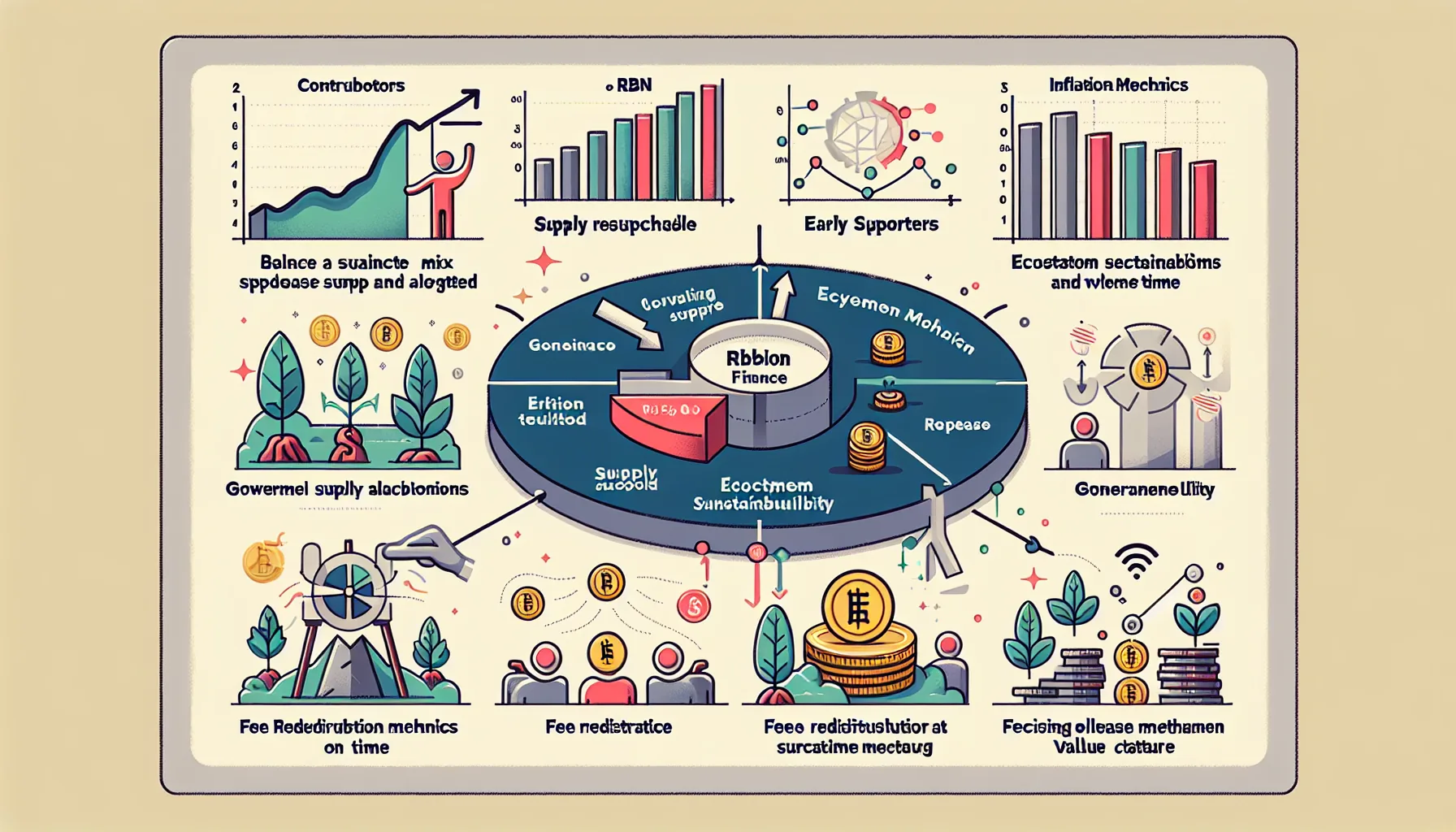
RBN's total token supply was pre-determined at its genesis, with allocations targeting a balanced mix of contributors, early supporters, and ecosystem sustainability. Typically, a significant portion is reserved for the team and early investors, which raises concerns about long-term centralization risks as these allocations unlock over time. Additionally, a percentage of RBN is allocated for ongoing incentives such as liquidity mining and rewards for vault users. This allocation strategy aims to grow adoption, yet it often results in substantial token emissions, adding potential sell pressure if not carefully managed.
Emission Schedule and Inflation Mechanics
RBN’s emission schedule follows a progressively decreasing release mechanism designed to balance incentivization with supply control. Critics, however, have noted that high emissions in the early phases flooded the market with liquidity, which could depress price stability and reduce perceived scarcity. As the protocol matures, token emissions play a lesser role, meaning the ecosystem must rely increasingly on organic demand and utility to sustain RBN's relevance.
Governance Utility
RBN token holders play a crucial role in Ribbon Finance's governance. Proposals submitted to the decentralized governance framework allow token holders to vote on critical protocol changes, new feature implementations, and treasury management strategies. However, the governance model has been scrutinized for potential plutocratic tendencies, where token-rich entities exert disproportionate influence on the protocol’s evolution.
Fee Redistribution and Value Capture
Ribbon vaults utilize performance and management fees, which provide a foundation for the protocol’s value accrual mechanisms. A portion of these fees is directed toward the treasury, creating potential opportunities for token buybacks, staking rewards, or other utility models. Critics have expressed concerns about whether this fee structure adequately captures value for RBN holders, noting that a lack of direct staking rewards or dividends could limit the token's appeal beyond governance utility.
Growth Versus Sustainability
Balancing short-term growth incentives with long-term ecosystem sustainability remains an ongoing challenge for RBN's tokenomics. While liquidity mining and other yield-driven incentives have boosted user acquisition, they can lead to inflated supply dynamics and mercenary capital inflows. To counterbalance these effects, the protocol must navigate creating utility-driven demand for RBN without over-reliance on emissions or speculative adoption cycles.
RBN Governance
RBN Crypto Asset Governance: Decentralized Decision-Making and Challenges
The governance structure of the Ribbon Finance (RBN) token is designed to support the decentralized ecosystem powering automated, structured products within the DeFi space. RBN plays a critical role in enabling token holders to shape the protocol’s evolution and maintain alignment between Ribbon Finance’s users and developers. However, like other decentralized governance models, its implementation presents both opportunities and challenges.
Token-Based Voting Mechanism
RBN governance is fundamentally driven by a token-weighted voting mechanism. Holders of the governance token are empowered to propose, discuss, and vote on protocol changes, treasury funding, and other strategic decisions. By linking voting power to token ownership, RBN governance aligns economic incentives with participation. However, this approach naturally raises questions about centralization risks. Since users with significant holdings wield disproportionate influence, the system may favor whales or centralized entities over smaller stakeholders, potentially distorting community-driven decision-making.
On-Chain Governance Framework
The on-chain governance of Ribbon Finance ensures that all proposals and voting activities are transparent and immutable. This further decentralizes control over key elements of the ecosystem, such as treasury management and strategy approval. While this brings a degree of trustlessness to the process, on-chain governance often comes with scalability challenges. High participation rates are required to reach quorum, and low voter turnout can lead to governance stagnation or domination by a subset of token holders.
Treasury Management and Incentives
A major focus of RBN governance lies in treasury management. Decisions about how to allocate funds—whether toward protocol development, liquidity incentives, or ecosystem grants—are a fundamental aspect of the token’s utility. Poorly structured treasury distributions or governance inefficiencies could misalign incentives and weaken long-term protocol sustainability. Critics have voiced concerns that governance funds, while well-intended, could drift toward short-term gains rather than fostering meaningful innovation. Active community engagement is vital to ensuring accountability in these areas.
Governance Challenges and Accessibility
One notable hurdle in RBN governance is the technical barrier to entry for some holders. Participating in governance requires not only owning RBN tokens but also understanding the intricacies of Ribbon Finance’s ecosystem. Furthermore, complex proposal discussions often occur off-chain via forums or social media, potentially alienating less tech-savvy holders and impeding truly decentralized participation.
By design, RBN attempts to balance decentralization, security, and scalability in its governance mechanism. However, issues related to centralization risk, voter engagement, and technical accessibility remain areas of discussion within the community. These challenges highlight the importance of both community education and thoughtful governance evolution.
Technical future of RBN
RBN: Current and Future Technical Developments
Leveraging Automated Options Strategies on Ribbon Finance
RBN is the native utility token of Ribbon Finance, a decentralized protocol focused on structured financial products, specifically automated options strategies. At the heart of its technical innovation lies a robust smart contract infrastructure utilizing Ethereum's base layer and Layer 2 scaling solutions to optimize for gas efficiency and security. Ribbon’s signature vaults, which use covered call and put-selling strategies, automate complex options strategies, reducing user workload and manual risk calculation. However, the reliance on Ethereum's network has made gas fees a persistent obstacle for smaller participants, driving discussions about potential multi-chain expansion to improve accessibility.
Furthermore, the protocol is actively evolving its Ribbon Earn products, which utilize principal-protected options vaults. These efforts focus on making yield strategies more modular and flexible, appealing to a broader range of crypto-native institutions. Updates to the technical architecture enable vault customization, allowing users to adjust risk parameters directly without deploying new contracts. However, community feedback suggests that these adjustments can add complexity to the user interface, creating a steeper learning curve for non-institutional participants.
Enhancements in Smart Contract Security
Ribbon's smart contracts have undergone rigorous audits from established firms like OpenZeppelin and Quantstamp; however, vulnerabilities remain an ever-present risk in DeFi ecosystems. The team recently introduced a layered risk mitigation strategy, incorporating on-chain circuit breakers to prevent cascading failures during unexpected market events. Despite these developments, critics argue that the protocol's reliance on a centralized multisig for emergency actions introduces a single point of failure, which is counterintuitive to DeFi’s ethos. The community has called for DAO-driven mechanisms to decentralize this aspect further.
Technical Roadmap
The future technical roadmap for RBN focuses heavily on enabling Ribbon Finance to interoperate with emerging DeFi primitives. Plans to introduce cross-chain compatibility aim to bridge Ribbon Vaults with protocols on Solana and BNB Smart Chain. However, cross-chain technologies bring their own challenges, particularly around ensuring the security of token bridges—a weak link exploited in several high-profile exploits.
An additional cornerstone of the roadmap involves introducing new products like leveraged & index vaults, expanding the utility of RBN as a potential governance token in setting parameters for these innovative vaults. Long-term development will also focus on zk-rollup and optimistic rollup integrations to further reduce costs and enhance scalability. Yet, adding support for emerging Layer 2 technologies raises concerns about fragmenting liquidity pools, a hurdle the protocol will need to address without compromising long-term usability.
Comparing RBN to it’s rivals
RBN vs GMX: A Detailed Comparison of Features and Differentiators
When evaluating RBN (Ribbon Finance) against GMX, it’s essential to focus on the core functionalities, user base, and relative advantages of each platform. While both projects operate within the decentralized finance (DeFi) ecosystem, they cater to distinct segments with differing approaches to risk, yield generation, and user experience.
Derivatives vs. Custom Yield Strategies
GMX has carved a niche in the decentralized perpetuals and spot trading arena, enabling users to trade with leverage and maintain on-chain control of their positions. By contrast, RBN occupies the structured product market, primarily offering users custom yield strategies via options and vaults. While GMX prioritizes synthetic asset liquidity and frictionless execution for traders, RBN emphasizes sustainable, automated yield generation.
The divergence between the two is especially apparent in their risk profiles. GMX users actively engage in market speculation and expose themselves to liquidation risks, whereas RBN’s products are designed for passive participants seeking consistent, albeit typically lower, returns. This fundamental difference makes RBN more appealing to those looking for lower-touch, long-term strategies rather than frequent trading. However, this also means RBN’s audience lacks access to the high reward potential (and equally high risk) associated with GMX’s leveraged trading.
Fee Models and Capital Efficiency
GMX is praised for its relatively low fee structure, especially when juxtaposed with traditional financial platforms or centralized exchanges. RBN, on the other hand, leverages performance-based fees on its yield-generating vaults. This alignment incentivizes optimal strategy execution from vault operators but could lead to user concerns if performance lags.
Another key difference is capital efficiency. GMX’s model requires liquidity providers (e.g., GLP holders) to sustain margin and spot trading, while RBN relies on sophisticated derivatives strategies—such as options writing or spreads—to generate yield. Though innovative, RBN’s reliance on advanced financial instruments can create higher barriers to entry for users unfamiliar with options markets.
Composability in DeFi Ecosystem
GMX integrates neatly within trading-centric DeFi ecosystems and boasts growing interest from aggregators building liquidity strategies around its perpetuals market. RBN, with its focus on structured products, serves a different composability purpose, often acting as a yield-generating component in portfolio strategies. However, the simplicity and transparency offered by GMX’s perpetual trading might make it more accessible to builders compared to the nuanced financial models underpinning RBN’s products.
Liquidity and Sustainability Risks
Both projects face liquidity concerns but in unique ways. GMX requires substantial liquidity to maintain its spot and leveraged markets, leading to potential strain during periods of high market activity. RBN, meanwhile, depends on the sustained demand for its options-selling strategies. A prolonged decline in volatility or options volume could undermine its performance, raising questions about its long-term viability.
In sum, while both RBN and GMX play critical roles in the DeFi ecosystem, the contrast between their primary functionalities highlights the different types of users they attract and the unique challenges they must address.
RBN vs. LYRA: A Detailed Comparative Breakdown
When comparing Ribbon Finance (RBN) to Lyra (LYRA), both projects occupy critical niches in the decentralized finance (DeFi) derivatives ecosystem, yet their approaches diverge significantly. Understanding these differences can illuminate how each protocol meets user demands and addresses market inefficiencies.
Focused Mechanisms: Covered Options vs. Market-Making Efficiency
RBN’s core innovation revolves around automated covered option vaults, enabling users to passively earn yields by selling options. This structure targets a yield-seeking audience while simplifying participation in options trading. On the other hand, LYRA positions itself as a decentralized options trading protocol tailored for professional and retail traders who value customizable strategies. LYRA’s automated market maker (AMM) design combines liquidity pooling with dynamic risk management to ensure responsive pricing. RBN's simplicity appeals to passive users, while LYRA’s customizable model empowers more sophisticated traders.
Liquidity Dynamics and Capital Efficiency
A crucial difference lies in how the two protocols approach capital efficiency. LYRA employs liquidity pooling with adaptive risk curves, allowing it to dynamically hedge against volatility. This model decreases slippage and ensures tighter bid-ask spreads for traders. However, it also results in higher complexity for liquidity providers (LPs), where the risks are tied to price exposure and insurance fund stability. RBN, in contrast, prioritizes a set-it-and-forget-it experience for liquidity providers. While this aids user adoption, it can lead to less flexible pricing and limited appeal for high-frequency traders seeking precision.
Tokenomics and Governance Structure
Both LYRA and RBN utilize governance tokens, but LYRA’s design leans heavily toward incentivizing active participation through staking and liquidity rewards. This reinforces its need for deep liquidity and active engagement. RBN’s tokenomics, by contrast, reflect its focus on vault participation, which could limit certain governance discussions to a narrower audience. The divergence in token utility highlights the different communities each platform serves—RBN targeting yield-seekers and LYRA favoring active, professional participants.
Drawbacks and Challenges
While LYRA may be attractive to a wider spectrum of traders, its reliance on AMMs introduces risks associated with impermanent loss and insufficient hedging during market volatilities. Additionally, its focus on active strategy execution demands a higher learning curve, which may deter less experienced users. Conversely, RBN sacrifices market-specific flexibility for simplicity, leaving advanced traders to seek alternatives like LYRA’s nuanced ecosystem.
Understanding these nuances is key for stakeholders evaluating RBN against LYRA, as each serves distinct yet overlapping user demographics within the DeFi options landscape.
RBN vs. DOPEX: A Deep Dive into Protocol Differentiation
When comparing RBN (Ribbon Finance) to DOPEX (Decentralized Options Exchange), the distinctions between their approaches to structured derivatives markets become particularly noteworthy. While both projects cater to DeFi traders seeking enhanced yield opportunities through options strategies, their underlying mechanisms, user bases, and value propositions significantly diverge, resulting in distinct trade-offs for users.
Focus on Accessibility Versus Specialization
Ribbon Finance primarily aims to simplify access to sophisticated financial instruments, packaging complex strategies like covered calls and cash-secured puts in user-friendly vaults. DOPEX, on the other hand, operates as a more comprehensive decentralized options platform focused on maximizing capital efficiency through specialized features like Single Staking Options Vaults (SSOVs) and customizable option pools. RBN's accessibility ethos has made it a go-to for users less familiar with options mechanics, while DOPEX caters more to advanced and institutional-grade option traders who value flexibility and deep configurability.
This difference in target audience creates a contrast in user behavior. DOPEX’s expert-oriented design may intimidate less experienced users, whereas Ribbon's abstraction of complexity lowers the barrier to entry. That said, Ribbon's simplified offerings come with fewer customization opportunities, which some traders may see as a limiting factor compared to DOPEX’s granular control over strike prices, expirations, and asset pairings.
Liquidity and Pricing Mechanisms
Another critical distinction emerges in how the two protocols address liquidity and pricing. DOPEX uses its unique liquidity pooling model to provide competitive options pricing and minimize implied volatility risks, incentivizing liquidity provision through rebates and fee-sharing mechanisms. Ribbon, conversely, sources its liquidity from external markets like centralized exchanges and depends on these markets’ pricing for executing its strategies.
While DOPEX's model enables more controlled pricing and potentially higher returns for liquidity providers, it inherently ties options activity to the robustness of its own ecosystem. Ribbon’s reliance on external liquidity may limit the protocol’s growth in isolated DeFi ecosystems, but it avoids over-concentrating risk in a closed-loop liquidity model, a frequently cited concern within DOPEX's ecosystem.
Risk Profiles and Rewards
DOPEX’s SSOVs offer a unique mechanism for staking tokens while simultaneously writing options, attracting users seeking dual utility from their assets. However, this increased yield potential is not without drawbacks—namely, higher exposure to impermanent loss and variations in implied volatility, which could deter more conservative traders. Ribbon, by design, mitigates direct user exposure to such risks by restricting interaction to predefined strategies, but this comes at the cost of reduced yield ceilings compared to DOPEX's more aggressive financial engineering.
Governance Differentiation
While both protocols make use of governance tokens (RBN for Ribbon and DPX for DOPEX), their decentralized governance emphasis varies. DOPEX heavily integrates governance into its ecosystem by allowing DPX holders to influence strike price thresholds and fee distribution. In contrast, RBN governance has historically been more focused on strategy deployment and expansion rather than asset-specific fine-tuning, which may render Ribbon less appealing to highly active governance participants.
These contrasts highlight divergences in protocol priorities and cater to varying risk tolerances and trader profiles within DeFi's rapidly evolving landscape.
Primary criticisms of RBN
Key Criticisms of RBN: Examining the Challenges and Limitations
1. Concentration of Governance Power
One of the primary criticisms of RBN (Ribbon Finance’s native utility token) revolves around governance centralization. While RBN theoretically allows token holders to propose and vote on protocol changes, governance in practice has been criticized for being highly concentrated among whales and insiders. A significant percentage of the tokens are held by team members, early investors, and large-scale participants, which can effectively alienate smaller holders. This dynamic can create a governance system in which decision-making is controlled by a small group, potentially leading to decisions that prioritize their interests over the broader community. Critics argue that such imbalances undermine the core decentralized ethos of crypto governance.
2. Concerns Around Regulatory Risk
RBN’s mechanics — particularly its role in facilitating structured yield-generation strategies like covered calls and put selling — have drawn regulatory scrutiny from some detractors. Critics voice concern that Ribbon’s financial products might resemble traditional derivatives or securities in the eyes of regulators, placing it under the risk of compliance crackdowns. These risks could affect the continuity of the ecosystem and, in turn, the utility and demand for RBN tokens. Some stakeholders argue that RBN holders are left bearing the brunt of uncertainty regarding legal classifications and potential enforcement actions against the protocol.
3. Limited Token Utility
Another common critique of RBN relates to its perceived lack of substantive utility beyond governance. While other DeFi protocols often pair governance roles with real staking rewards or introduce mechanisms that directly tie token value to protocol growth, RBN has been questioned for failing to create similar incentive structures. Without strong economic incentives for holding or using the token, critics argue that RBN risks remaining a speculative asset rather than building truly long-term value for holders.
4. Sustainability of Yield Strategies
RBN’s performance relies heavily on Ribbon Finance’s ability to generate competitive yield through its options-based strategies. Critics highlight the potential risk of diminished demand for structured products during prolonged market downturns or periods of low volatility. If Ribbon’s yield optimization strategies underperform compared to other DeFi protocols, it could reduce user adoption and, indirectly, affect the value and relevance of RBN. This dependency on niche yield strategies underscores concerns about the sustainability of the broader ecosystem supporting RBN.
5. Barriers to Accessibility
Lastly, Ribbon’s options strategies, while innovative, target a relatively advanced DeFi audience. Critics argue that the complexity of these products naturally limits Ribbon Finance’s appeal to the broader crypto user base, which could place a ceiling on the long-term demand for RBN. For less experienced users, understanding and utilizing RBN’s role in the ecosystem entails a steep learning curve, leaving them hesitant to participate.
Founders
The Founding Team Behind RBN: Who’s Behind Ribbon Finance?
RBN, the native token of Ribbon Finance, is intricately tied to the people and visionaries driving the protocol. Ribbon Finance, recognized as a pioneering decentralized application offering structured products in the DeFi space, owes much of its development, vision, and technical progress to a team of seasoned professionals with a strong background in both traditional finance and blockchain technology. However, like with many crypto projects, the dynamics, transparency, and focus of the founding team raise several important points to consider.
Julian Koh: A Technically Grounded Co-Founder
At the forefront of Ribbon Finance’s development is Julian Koh, whose technical expertise plays a central role in the protocol's creation and evolution. Koh, an alumnus of Coinbase, brings valuable experience in product engineering. This background offers critical insights into building scalable infrastructure—an essential component for a protocol like Ribbon Finance, which caters to users deploying significant capital into automated yield-generation opportunities. Koh also contributed to the early development of Set Protocol, underlining his familiarity with DeFi-centric smart contracts. The emphasis of his leadership appears to be balancing complex financial primitives with user accessibility. However, some critics have noted that Ribbon's early smart contracts suffered from limited auditing in its infancy, raising questions about risk oversight under Koh's technical leadership.
Ken Chan: Behind the Smart Contracts
Another significant contributor to Ribbon's success is Ken Chan, whose primary focus lies on the secure and optimized design of Ribbon’s automated strategies and options vaults. His work directly impacts the operational reliability of Ribbon’s products, including its covered call and put selling strategies. Chan’s emphasis on leveraging composability within the Ethereum ecosystem has been a key differentiator. However, with the rapid scaling of Ribbon’s user base, there have been occasional community concerns about the oversight and testing of complex smart contract interactions, especially considering the high-stakes nature of options trading in volatile market environments.
A Lean and Strategic Core Team
Beyond Koh and Chan, Ribbon Finance has maintained a relatively lean core team. This approach allows for agile development, which has enabled Ribbon to ship new features and improvements more frequently than many larger, bureaucratic projects. On the downside, this slim team structure sometimes means longer turnaround times for addressing certain community concerns or implementing non-product related upgrades, such as in governance processes or front-end improvements.
Community vs. Team
A recurring point of contention in Ribbon’s evolution is the perceived separation of the founding team's vision and the feedback from the broader community. Critics argue that governance processes on the platform, although nominally decentralized, remain highly influenced by the preferences of the core team and early insiders. This dynamic has led to debates about the degree to which Ribbon Finance can be considered truly community-driven.
Authors comments
This document was made by www.BestDapps.com
Sources
- https://ribbon.finance/
- https://ribbon.finance/assets/docs/RibbonWhitepaper.pdf
- https://github.com/ribbon-finance
- https://docs.ribbon.finance/
- https://messari.io/asset/ribbon-finance
- https://etherscan.io/token/0x6123b0049f904d730db3c36a31167d9d4121fa6b
- https://medium.com/@ribbonfinance
- https://ribbonfinance.mirror.xyz/
- https://coinmarketcap.com/currencies/ribbon-finance/
- https://www.coingecko.com/en/coins/ribbon-finance
- https://defillama.com/protocol/ribbon
- https://cryptoslate.com/coins/ribbon-finance/
- https://dune.com/ribbonfinance
- https://arxiv.org/abs/crypto-asset-paper
- https://twitter.com/ribbonfinance
- https://www.youtube.com/c/RibbonFinance
- https://gov.ribbon.finance/
- https://forum.ribbon.finance/
- https://defipulse.com/projects/ribbon-finance
- https://tokenomicsdao.com/ribbon-finance-tokenomics/