History of RAY
History of RAY: Tracing the Origins of Raydium
Raydium (RAY) was launched as a core infrastructure project on the Solana blockchain, designed to address both the limitations of Ethereum-based decentralized exchanges (DEXs) and leverage the high-speed, low-cost advantages of Solana. Its debut marked a critical development in cross-chain decentralized finance (DeFi) by introducing an Automated Market Maker (AMM) and liquidity protocol built directly into Solana’s Serum ecosystem, which utilizes a central limit order book (CLOB). This hybrid approach enabled Raydium to provide deeper liquidity and improved capital efficiency compared to traditional AMMs.
The inception of Raydium can be traced to the growing bottlenecks on Ethereum in terms of scalability and transaction costs. The project's initial focus was to offer a better experience for liquidity providers and traders by building upon the high throughput and low-latency characteristics of the Solana network. The team behind Raydium, although pseudonymous at first, positioned the protocol as a solution catering to both retail and institutional traders by scaling up the DeFi ecosystem for more sophisticated operations.
Raydium gained rapid traction within the Solana ecosystem thanks to its integration with Serum’s CLOB. This integration allowed it to route trades through both its own AMM pools and Serum’s order books, which gave users access to unparalleled liquidity compared to isolated DEX models. However, its reliance on Serum also introduced vulnerabilities. Any disruption in Serum’s infrastructure or wider Solana network outages has the potential to impact the seamless operations of Raydium's protocol. This dependency remains one of the platform’s critical risks.
In the early stages, Raydium differentiated itself through features like "AcceleRaytor," a launchpad for new projects on Solana, and “Fusion Pools,” which enabled more complex yield farming opportunities. These innovations, while effective in attracting liquidity and user participation, also drew criticism for concentrating power within a small group of developers controlling key aspects of governance and smart contract upgrades. Additionally, Raydium has faced scrutiny from the crypto community over its pseudonymous team, raising concerns about transparency and long-term accountability.
Another historic milestone in RAY’s journey was its role in catalyzing interoperability. The protocol pioneered strategic collaborations with Solana-native projects, as well as fostering partnerships outside Solana's ecosystem. But as competitors emerged with similar liquidity solutions, maintaining first-mover advantage became increasingly challenging. Critics have also pointed out that RAY suffered from slow response times to evolving DeFi narratives, occasionally ceding market share to more agile platforms.
How RAY Works
How Raydium (RAY) Works: A Deep Dive into Its Mechanism
Raydium (RAY) functions as an automated market maker (AMM) and liquidity provider built on the Solana blockchain, leveraging its high throughput and low latency framework. At its core, Raydium serves as a decentralized exchange that uses the Serum decentralized order book to enable both liquidity pool-based swaps and order book-based trades. Here's a detailed breakdown of how this mechanism operates.
Liquidity Pools and Yield Farming
Raydium employs liquidity pools where users deposit tokens to facilitate swaps while earning fees and rewards. These pools are integral to the protocol, providing the base for users to execute trades utilizing RAY as both an incentive model and utility token. Liquidity providers (LPs) are rewarded proportional to their stake in the pool, but this system introduces impermanent loss risks—especially during periods of high price volatility between paired assets. This trade-off is common across AMMs, yet Raydium's tight integration with Serum's central limit order book distinguishes it.
Unlike other AMMs, Raydium doesn't operate in a siloed ecosystem. Instead, its liquidity pools are directly connected to Serum's order book, allowing users to tap into aggregated liquidity. This bridging mechanism resolves some fragmentation issues typical of AMMs by exposing liquidity providers to Serum's broader trading activity, enabling higher capital efficiency.
The Power of Solana and On-Chain Order Books
Powered by Solana, Raydium benefits from sub-second transaction finality and minimal fees, which are critical for executing high-frequency trades and reducing slippage. By integrating with Serum’s infrastructure, Raydium offers unique hybrid functionality—users can either trade within Raydium’s pools via instant swaps or interact with Serum’s order books for more dynamic pricing. However, this complexity can deter less-experienced users who've been conditioned to simpler AMM interfaces.
RAY Token Utility and Governance
The RAY token fuels the Raydium ecosystem in several ways: it’s used as a reward for yield farmers, a utility token for staking, and a governance token, enabling token holders to propose and vote on protocol upgrades. Governance participation remains low at this stage—an issue observed across many blockchain ecosystems, potentially stifling decentralization narratives.
Scalability and Challenges
While Solana's scalability underpins Raydium's operation, the blockchain is not without criticism. Solana's periodic network outages have previously impaired the performance of applications like Raydium, undermining user trust. Additionally, the model's reliance on Serum creates systemic dependency risks—changes or disruptions to Serum could propagate adverse effects across Raydium’s ecosystem.
Understanding these operational intricacies is key before interacting with the protocol to assess both its advantages and trade-offs effectively.
Use Cases
Use Cases of RAY: Powering Solana's DeFi Ecosystem
RAY, the native token of Raydium, plays a pivotal role in the broader Solana decentralized finance (DeFi) ecosystem by driving functionalities and fostering user participation within the protocol. Built as an Automated Market Maker (AMM) and liquidity provider, Raydium utilizes RAY for various critical use cases that extend beyond basic governance. However, as with any crypto asset, several considerations and potential drawbacks accompany these applications.
1. Liquidity Provision Incentives
RAY is instrumental in incentivizing liquidity providers within the Raydium platform. Users deposit supported tokens into liquidity pools to earn rewards in the form of RAY. This mechanism strengthens the liquidity environment, enabling more efficient and stable swaps. However, one challenge lies in the well-known issue of impermanent loss, where users who stake tokens may experience reduced profits if the token prices in their pool fluctuate significantly. Additionally, with heavy competition from other AMMs on Solana, there’s no guarantee that future liquidity incentives tied to RAY will maintain user retention long-term.
2. Yield Farming and Staking
RAY can be staked within Raydium’s protocol to earn rewards directly or used in complex yield farming strategies. These opportunities allow participants to capitalize on their holdings while supporting the ecosystem’s liquidity depth. Despite the appeal of potential high yields, the sustainability of these rewards depends heavily on tokenomics and demand, which raises questions about how the protocol handles excessive token emissions. Over-reliance on inflationary rewards could dilute long-term value for RAY holders.
3. Protocol Governance
RAY is used for governance, granting holders voting power to influence protocol decisions, such as changes to fees, supported pairs, or reward structures. However, one drawback is the relatively high concentration of RAY among early adopters and insiders, which could centralize decision-making power. This limits the effectiveness of true decentralized governance and potentially prioritizes the interests of larger players over smaller token holders or the community.
4. Bridging Solana DeFi with Project Serum
One of Raydium’s unique use cases involves its synergy with the Solana-based Serum decentralized exchange. Raydium’s AMM pools integrate with Serum’s central order book, utilizing RAY indirectly to enhance liquidity for a wider range of trading pairs. While this cross-integration is innovative, it creates dependencies on Serum’s own stability and adoption, intertwining RAY’s utility with the success—or failures—of the broader ecosystem it supports.
In summary, RAY demonstrates a focused set of use cases within the Solana DeFi space, but it is not without risks, including token inflation, governance centralization, and external dependencies. Understanding these dynamics is critical for navigating its role effectively.
RAY Tokenomics
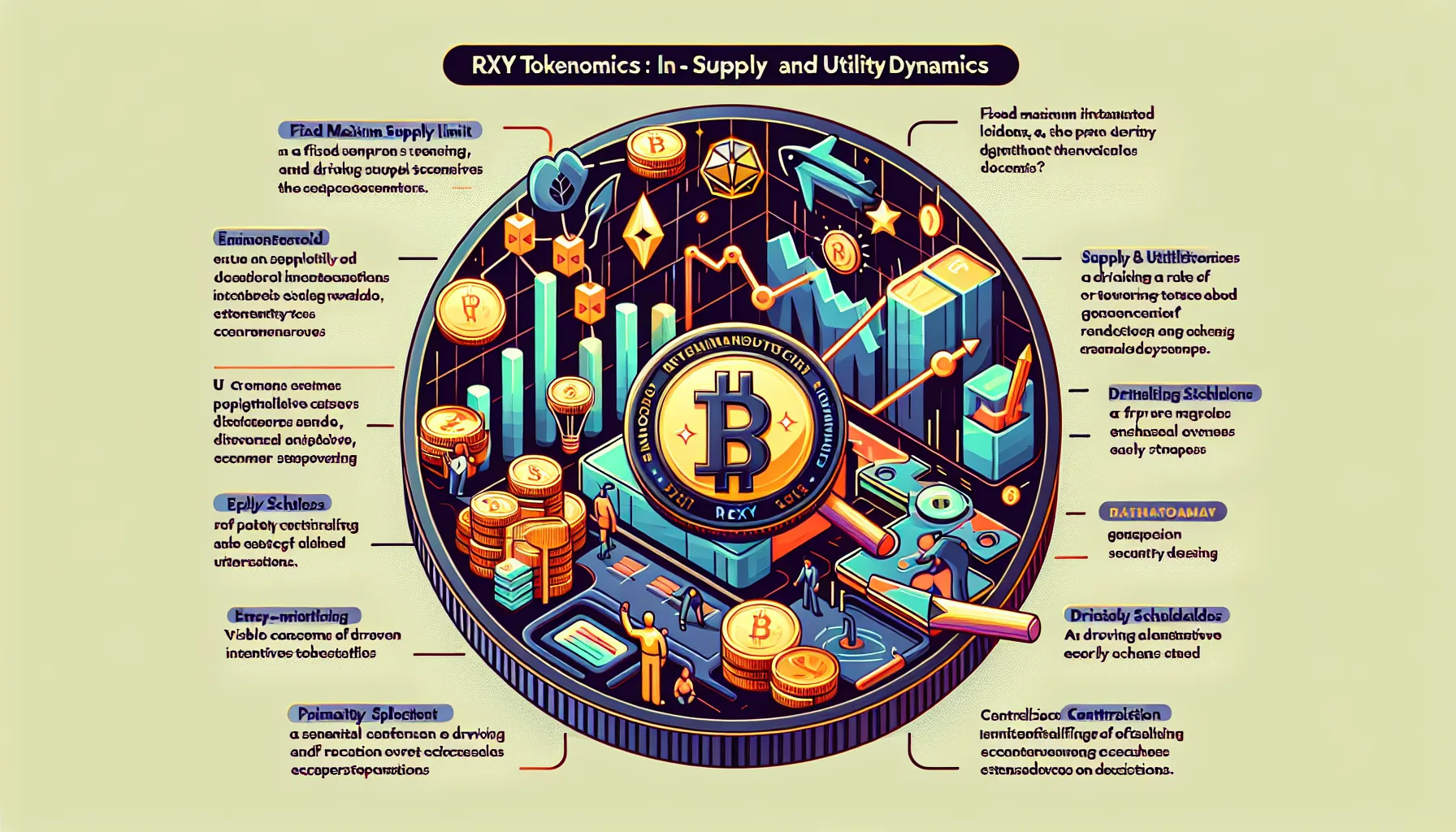
RAY Tokenomics: A Deep Dive into Supply and Utility Dynamics
The tokenomics of Raydium’s native token, RAY, is a critical element underpinning its role within the Solana ecosystem. Designed to fuel the decentralized exchange’s (DEX) operations and incentivize participation, RAY’s supply allocation, emission schedule, and use cases warrant close attention from any crypto-savvy analyst.
Fixed Supply and Allocation Breakdown
RAY has a fixed maximum supply of 555 million tokens, a structure that inherently caps inflation and adds scarcity over time. However, the initial allocation of these tokens has raised questions due to its uneven distribution. A significant portion was reserved for early-stage stakeholders: 34% of the total supply was allocated to team development and partnerships, while 20% was set aside for ecosystem mining and liquidity incentives. Critics argue this centralization introduces challenges to long-term decentralization, as early insiders maintain substantial leverage over governance mechanisms.
Emission Schedule and Vesting
RAY’s emission schedule includes vesting periods that stagger the release of team and partnership tokens into circulation over three years. While this approach aims to minimize abrupt sell-offs by large holders, it has not entirely eliminated concerns about potential supply shocks. With miners and liquidity providers receiving regular emissions, the gradual dilution of token value is another factor to monitor for those participating in the protocol’s staking or liquidity operations. It’s worth noting that these emissions directly compete with the organic buy-side demand for staking and trading activity, potentially putting downward pressure on the token’s price.
Core Utility: Incentives and Governance
RAY primarily functions as both a utility and governance token. Its most prominent utility lies in incentivizing liquidity provision and farming on Raydium’s Automated Market Maker (AMM). Stakers are rewarded in RAY, adding a layer of compounding possibilities for participants. However, this creates a self-reinforcing feedback loop where users stake not out of demand for governance but to maximize yield, with governance often playing a secondary role in user behavior.
Centralization Concerns
Another area of scrutiny lies in governance participation. Since early investors hold outsized allocations, they maintain a significant impact on protocol decisions despite the token ostensibly promoting community control. This imbalance could stifle broader participation and lead to governance risks, especially if vested interests conflict with long-term sustainability.
RAY’s tokenomics reflects a blend of strategic utility and inherent trade-offs. While it successfully drives liquidity and activity within the ecosystem, its centralized ownership and emission-rate dynamics represent risks that require vigilant assessment. By understanding these underlying mechanics, participants can better navigate the complexities of the asset.
RAY Governance
Governance of Raydium (RAY): Decentralization and Challenges in Decision-Making
Raydium (RAY) operates as a key automated market maker (AMM) and liquidity provider within the Solana ecosystem, but its governance structure highlights both opportunities and challenges for stakeholders. Unlike some other decentralized finance (DeFi) protocols that commonly adopt fully community-driven governance by early design, Raydium's governance mechanics are still evolving, posing both benefits and limitations for its network participants.
Token Holder Voting Power
RAY token holders play a critical role in the protocol's governance. Governance rights are tied directly to token ownership, enabling holders to propose and vote on protocol upgrades, fee structure changes, or treasury fund utilization. However, like many systems relying on governance token weighting, this introduces the potential for centralization. Token concentration among large stakeholders—or "whales"—raises concerns about disproportionate influence, skewing decision-making in favor of the wealthy minority.
Proposal Process: Accessibility vs. Complexity
While the overarching goal of decentralized governance is inclusivity, Raydium’s proposal framework can be intricate for the average user. Creating impactful governance proposals may require deep technical expertise and resources, which can dissuade smaller token holders from actively participating. Additionally, the lack of infrastructure to support governance off-chain, such as accessible forums or structured proposal building tools, may marginalize less-experienced contributors, undermining true decentralization.
Lack of Transparency in Decision Outcomes
One notable critique within the Raydium ecosystem is the limited transparency around how governance decisions are operationalized. After a tokenholder vote passes, updates on timelines or implementation processes can lack clarity. This can erode trust and lead to frustration among the community, especially when governance proposals take extended periods to materialize.
Governance Token Utility Beyond Voting
Despite its importance in facilitating protocol decision-making, RAY's governance features are often secondary to its more prominent utilities, such as staking and liquidity rewards. This dual-purpose approach may dilute its governance use case, discouraging participants from acquiring or holding RAY tokens explicitly for governance purposes. Adoption of mechanisms such as time-weighted voting or boosted staking for active participants could provide a stronger alignment between governance and token utility.
On-Chain vs. Off-Chain Coordination
Another challenge lies in the balance between on-chain and off-chain governance. On-chain voting ensures transparency and immutability but can be slow and inflexible compared to off-chain discussions. Raydium may need to invest in more robust hybrid models to allow nuanced collaboration without jeopardizing the security and trustless nature of its network.
Governance remains a critical aspect of Raydium’s evolution as it seeks to strike a balance between decentralization, community involvement, and efficient decision-making. However, addressing these friction points will be essential for fostering sustainable growth in the protocol.
Technical future of RAY
Technical Developments and Roadmap for RAY (Raydium)
Raydium (RAY), a leading Automated Market Maker (AMM) and liquidity provider built on the Solana blockchain, continues to prioritize innovation and scalability within the decentralized finance (DeFi) ecosystem. Below, we examine the current technical progress and outline future development goals on its roadmap.
Current Technical Developments
Raydium’s integration of the Solana blockchain offers a distinct technological advantage through high throughput and low transaction costs. A key feature of Raydium’s infrastructure is its ability to place limit orders and interact with Serum’s central limit order book (CLOB). This functionality ensures deep liquidity and positions Raydium as a hybrid protocol bridging the AMM and order book models.
Recent updates to Raydium’s architecture have focused on optimizing performance under network congestion. By leveraging Solana’s growing ecosystem of data validators, Raydium has improved its transaction finality and throughput, ensuring that users experience a seamless trading interface. Additionally, there has been an upgrade to its user-facing API, with advanced query capabilities and multi-token support, allowing third-party dApps to implement Raydium’s liquidity pools without introducing significant latency.
Innovations in yield farming mechanisms have also been implemented, enabling dual yield opportunities across newer Raydium Fusion Pools. However, this advancement has faced criticism for its compounded complexity, which could deter less-experienced participants. The lack of detailed documentation surrounding these pools has created a technical barrier for developers and users seeking to deploy or navigate the updated protocol.
Technical Roadmap
A critical focal point for Raydium’s development team is the scaling of cross-chain functionalities. The migration toward interoperability seeks to integrate Wormhole’s bridging infrastructure, allowing for seamless token transfers between Solana, Ethereum, and other supported networks. This expansion, while technically ambitious, carries inherent risks related to bridge vulnerabilities and exploits, which have historically plagued the DeFi space.
Another prospective upgrade includes a decentralized governance mechanism, introducing on-chain voting to enhance protocol democracy. However, concerns remain regarding voter participation rates, which are often low due to governance token hoarding or apathy.
Beyond governance, Raydium aims to implement zero-knowledge (ZK) proofs to enhance user privacy without compromising transaction transparency. Nevertheless, zk-tech application within the Solana network remains experimental and has yet to achieve widespread adoption due to its significant computational overhead.
Lastly, Raydium's emphasis on UX/UI redesigns for portfolio management tools highlights a need to address criticism of its current interface. While effective, stakeholders have pointed out its dated and cluttered design impedes efficient navigation, particularly for users managing diversified liquidity positions.
Comparing RAY to it’s rivals
Comparing RAY to SRM: A Detailed Analysis of Key Differences in the Solana Ecosystem
When evaluating RAY (Raydium) alongside SRM (Serum), a clear distinction emerges in their approaches to solving decentralized finance (DeFi) challenges within the Solana ecosystem. While both projects share the common thread of supporting Solana’s high-performance blockchain and fostering liquidity in the ecosystem, their roles, infrastructure integration, and technical nuances set them apart.
Core Functionality: AMM vs. Order Book
The fundamental difference between RAY and SRM lies in their focus. RAY operates as an Automated Market Maker (AMM) and liquidity provider, built to deliver seamless trading and yield farming opportunities. Mechanics like direct liquidity pools and incentivized farming allow it to facilitate rapid, permissionless token swaps, making it key for retail users and liquidity seekers.
In contrast, SRM anchors its utility on Serum’s order book-based decentralized exchange (DEX). Its infrastructure aligns more with traditional trading paradigms, offering features like limit orders and deeper market analysis. While this caters to a broader range of traders, including institutions, the reliance on an order-book system can create higher frictions compared to AMMs when trading smaller, illiquid tokens.
Integration within Solana
RAY uniquely leverages its connection to Serum’s order book for liquidity, creating a synergistic infrastructure. This integration means trades executed on Raydium tap into Serum’s liquidity depth, effectively blending AMM convenience with order-book efficiency. However, this dependency also exposes RAY to secondhand risks tied to SRM’s ecosystem health and adoption. For instance, reduced activity or issues within Serum could directly impact RAY’s liquidity dynamics.
SRM, by contrast, is primarily self-contained as the utility token of Serum DEX. Its functionality hinges on staking, transaction fee discounts, and governance-related perks. While this independence reduces reliance on third-party protocols, excessive centralization concerns have been raised regarding its governance structures and token distribution. RAY’s architecture arguably provides a more accessible and organic entry point into Solana-based DeFi applications for individual users, although this simplicity may come at the cost of advanced trader-specific functionality.
Tokenomics and Adoption
RAY’s emissions-based tokenomics aim to incentivize liquidity pool participation, which has occasionally led to criticisms of inflationary pressure on its circulating supply. Over time, such dynamics have the potential to dilute RAY’s value if not offset by sustained demand and utility growth within its ecosystem.
In comparison, SRM adopts a deflationary model, with staking and fee discounts promoting holding behavior. While deflationary structures can bolster long-term confidence, they may also limit liquidity mobility within the short term, restricting active market participation—a potential strategic downside when competing with AMM-centric assets like RAY.
User Adoption and Accessibility
RAY’s AMM architecture lowers the technical barriers for new users to engage with DeFi on Solana, making it a preferred starting point for yield farmers and retail traders. However, its reliance on Serum’s liquidity infrastructure could lead to complications for users during broader ecosystem disruptions or underperforming markets.
In contrast, SRM may align better with experienced traders due to its familiarity with traditional order-book models. However, its steeper learning curve and gateway requirements could deter less experienced users from participation, highlighting RAY’s broader accessibility advantage in the entry-level DeFi space.
RAY vs. SOL: A Technical and Ecosystem Comparison
When analyzing RAY (Raydium) in comparison to SOL (Solana), the competitive landscape becomes a nuanced study of utility, technical integration, and ecosystem positioning. While both share a foundational alignment within the Solana blockchain, their roles and priorities diverge significantly, illuminating both strengths and limitations.
Core Utilities: AMM vs. Layer-1 Protocol
RAY's primary function as an automated market maker (AMM) and liquidity provider situates it firmly within the DeFi vertical. Its concentrated focus on decentralized exchanges (DEXs) and yield farming contrasts heavily with SOL's role as Solana's native cryptocurrency, underpinning the Layer-1 blockchain's entire architecture. SOL operates as a utility token for transaction fees, network security through PoS (Proof of Stake), and scalability efforts via delegated staking. This broader application makes SOL indispensable to the Solana ecosystem but also dilutes its direct appeal to specific niches like DeFi.
RAY, on the other hand, relies on SOL's infrastructure to provide lightning-fast transactions and scalability but exists as a specialized tool rather than a foundational pillar. This specialization allows RAY to excel in delivering liquidity for projects built on Solana, yet it also makes its utility contingent on the overall health of Solana's broader ecosystem.
Speed and Scalability: Indirect Dependencies
Both RAY and SOL benefit from Solana's high transaction throughput, but the dependency is unilateral. RAY cannot function without Solana, creating a potential bottleneck if Solana itself experiences network congestion, outages, or security vulnerabilities. SOL, being the fuel for the network, holds a more secure position in terms of dependence, whereas RAY users and developers must constantly hedge against external risks tied to Solana's performance and long-term adoption.
Tokenomics Disparities
SOL's tokenomics are more straightforward, with its value driven by network utility and staking rewards for validators and delegators. RAY, by contrast, offers a more DeFi-centric tokenomic structure, emphasizing rewards for liquidity providers and farmers. While this incentivizes participation, it can also lead to inflationary pressures if demand for DEX services or total value locked (TVL) fails to keep pace with the token supply.
Governance and Ecosystem Fragmentation
SOL holds a natural advantage in governance due to its central role in Solana’s protocol-level decisions. RAY, while offering governance mechanisms for its DEX, lacks the overarching control or influence that SOL holders have over the blockchain's future direction. This fragmented governance approach may limit RAY's ability to adapt quickly to systemic changes in the Solana ecosystem.
Developer and Community Focus
SOL has a broader developer audience and serves as an entry point for projects looking to build on Solana. In contrast, RAY primarily caters to users and developers within the DeFi and trading space. This focus narrows RAY's direct competition within subsets of Solana's ecosystem while leaving it vulnerable to newer AMMs or composable DeFi protocols that could challenge its dominance without needing to compete directly with SOL.
How RAY Stacks Up Against FTT: An In-Depth Comparison
When analyzing RAY in comparison to FTT, a number of distinctions emerge in terms of utility, architectural design, and community focus. FTT, as the native token of the now-defunct FTX exchange ecosystem, carved a niche as a utility token heavily entwined with exchange functionality—a context that significantly contrasts with RAY’s role within decentralized liquidity provision and yield farming.
Focus on Utility: Protocol-Centric vs. Exchange-Centric
RAY is deeply embedded within Raydium, a Solana-based decentralized exchange (DEX) and automated market maker (AMM) protocol. Its utility is tightly linked to liquidity provision, governance, and protocol rewards. On the other hand, FTT primarily operated as a centralized exchange token. Its utility was contingent on user incentives like fee discounts, staking benefits, and token burns tied directly to exchange activity. In this sense, FTT's design catered more to traders and market participants in a centralized environment, whereas RAY serves the builders and participants in decentralized ecosystems.
The critical difference lies in resiliency. While RAY benefits from a decentralized infrastructure, reducing risks tied to single points of failure, FTT was inherently dependent on the performance, stability, and reputation of the centralized exchange. For users assessing governance decentralization and survivability, RAY may be seen as better aligned with crypto’s ethos, though it also depends on Solana’s broader ecosystem reliability.
Liquidity Concentration and Network Impact
RAY’s liquidity pools enable more direct integration with decentralized finance (DeFi) projects, whereas FTT primarily focused on leveraging centralized liquidity channels. The automated yield farming and staking mechanisms that underpin RAY are designed to attract long-tail participation from liquidity providers. FTT, however, was more top-heavy, catering to institutional clients and high-frequency traders using the FTX exchange.
An additional consideration for users is lock-in. With FTT, benefits such as staking for fee-tier discounts created strong incentives to remain within FTX’s trading ecosystem at the cost of flexibility. RAY, leveraging Solana’s high-speed infrastructure, allows for decentralized interaction without such constraints. Nonetheless, this flexibility might come at a cost in terms of the fragmented liquidity landscape in DeFi, where slippage and depth can vary across platforms.
Issues of Trust and Impact of Ecosystem Collapse
FTT’s collapse illustrates the dangers of over-reliance on centralized entities in crypto. While RAY avoids these exact vulnerabilities, it should not be assumed to be free of risk, particularly as it operates on Solana, a network criticized for periods of downtime and centralization concerns. These underlying dependencies can directly impact user confidence and adoption for both tokens, albeit in different ways.
Primary criticisms of RAY
Primary Criticism of RAY: Assessing the Challenges Facing Raydium (RAY)
One of the most prevalent criticisms directed at Raydium (RAY) is its over-reliance on the Solana blockchain. While leveraging Solana's high-speed and low-cost infrastructure has been a foundational strength for Raydium, it inherently ties the project's fate to the stability, reliability, and long-term viability of the Solana ecosystem. Any technical challenges or network outages on Solana directly impact Raydium’s performance and user experience, raising concerns about dependency risk within decentralized finance (DeFi). In a rapidly evolving industry, this lack of diversification in blockchain interoperability can be seen as a critical vulnerability.
Another issue raised by critics is the centralization concerns surrounding Raydium's governance model. Although marketed as a decentralized protocol, Raydium has been scrutinized for retaining significant control with its core development team and an uneven token distribution. The concentration of RAY tokens among insiders and institutional players can undermine the principles of decentralization and potentially foster skepticism regarding the fairness and inclusivity of governance decisions. In particular, an imbalanced tokenomic structure could lead to low participation from the broader community, diminishing its ability to influence critical protocol proposals.
The impermanent loss associated with Raydium's automated market maker (AMM) functions, a widespread challenge for liquidity providers in AMMs, also attracts criticism. While impermanent loss is not unique to Raydium, the barriers to mitigating this risk remain high, especially for new users engaging on the platform. Some argue that the platform has not made significant strides in educating or providing tools to help its users navigate this inherent risk, leaving less experienced users vulnerable to unexpected losses when providing liquidity.
A further point of contention is the project’s competitive positioning in the decentralized exchange (DEX) space. Despite its integration with Solana, Raydium faces stiff competition from both Solana-native and multi-chain DEXs that may offer more advanced features or cross-chain functionalities. Critics question whether Raydium has done enough to differentiate itself in a highly crowded and innovative market. Retaining and expanding its user base, particularly among advanced traders and institutional participants, poses an ongoing challenge in such an environment.
Lastly, some crypto-savvy users express dissatisfaction over the platform's user interface and experience. While the interface is functional, it is often argued that it lacks the intuitive and polished design seen in competing DEX platforms, which could hinder adoption among less technical users.
Founders
The Founding Team Behind RAY: Insights into the Minds Shaping Raydium
Raydium (RAY), a cornerstone of the Solana DeFi ecosystem, owes its development and growth to a technically proficient founding team with a laser focus on the utility and scalability of decentralized finance. While much of the team's work has been impactful in crafting a robust automated market maker (AMM) protocol with on-chain order book capabilities, certain aspects of the team dynamics and transparency have sparked debate within the crypto community.
The core founding member of Raydium operates under the pseudonym “AlphaRay.” AlphaRay is the brain behind the protocol's vision and strategy, focusing on integrating AMM liquidity directly with Serum’s central limit order book. While anonymity is commonplace in the crypto world, it raises concerns about accountability and long-term commitment. This pseudonymous structure, combined with the technical complexity of the protocol, makes it challenging for the average crypto user to assess the team’s depth in terms of transparency and responsiveness.
Backing AlphaRay’s efforts is another core contributor, “XRay,” who spearheads the protocol’s backend architecture. XRay’s contributions have been vital for optimizing the alignment of Raydium's AMM functionality with Solana’s high-throughput, low-latency blockchain infrastructure. However, similar to AlphaRay, XRay’s identity is shrouded in mystery, which, while standard in the blockchain space, detracts from the visibility and openness some investors and users expect when entrusting their assets to decentralized protocols.
In addition to the technical leads, Raydium’s founding team includes contributors with expertise in blockchain development, product design, and DeFi integrations. The alignment of this team’s skillset is evident in the protocol’s advanced features, such as lightning-fast trades and liquidity provision incentives. At the same time, critics occasionally question the lack of external audit commentary from named members. Whether this is due to confidentiality or operational priorities remains unclear.
The team’s decision to remain pseudonymous is a double-edged sword. On the one hand, it reflects the ethos of decentralized finance, where trust is placed in code rather than individuals. On the other, skepticism lingers over how effectively the team could address community concerns or handle critical situations requiring accountability. Competence is strongly implied through the sophisticated mechanics of Raydium, but the absence of public-facing figures leaves a gap in fostering trust among institutional participants and more conservative users.
Ultimately, the founding team’s role in shaping RAY has been transformative but not without nuances and room for evaluation, whether in transparency, governance inclusivity, or long-term accountability in the rapidly evolving crypto space.
Authors comments
This document was made by www.BestDapps.com
Sources
- https://raydium.io/
- https://github.com/Raydium-Protocol/raydium-core
- https://raydium.io/whitepaper.pdf
- https://docs.raydium.io/
- https://medium.com/raydium
- https://solana.com/ecosystem/raydium
- https://explorer.solana.com/address/4k3Dyjzvzp8eM2A7GJxfmhKuShMoJ6H667AdrxE1c1o2
- https://coinmarketcap.com/currencies/raydium/
- https://messari.io/asset/raydium
- https://docs.serum.io/builders/raydium
- https://coingecko.com/en/coins/raydium
- https://cryptorank.io/price/raydium
- https://defillama.com/protocol/raydium
- https://blog.raydium.io/
- https://twitter.com/RaydiumProtocol
- https://raydium.gitbook.io/protocol/
- https://substack.com/profile/60759621-raydium
- https://rekt.news/raydium-hack/
- https://dappradar.com/solana/defi/raydium
- https://solanalysis.com/projects/raydium


