History of RANDOM
The History of RANDOM: A Journey Through Decentralized Experimentation
The origins of RANDOM can be traced back to its emergence as one of the more experimental blockchain projects focused on introducing true unpredictability in decentralized systems. The concept behind RANDOM was to address a critical and long-standing issue in cryptography and blockchain architecture: the generation of verifiable random outputs in a decentralized, trustless environment. Its launch was notably different from more traditional crypto projects, as it sought to solve very narrow use cases rather than appeal to broad utility or speculative value from the outset.
RANDOM initially garnered attention during its early development phases for its unconventional use of distributed nodes to participate in generating randomized outputs. The project developers leaned heavily on cryptographic techniques that precluded any single participant from controlling or biasing the random outputs. While these methods created some barriers to adoption—owing to their complexity—they also appealed to developers and dApps requiring reliable randomness for gaming, lotteries, NFT minting schemes, and consensus mechanisms.
One of the defining moments in RANDOM's history was its debate over centralization vs. decentralization. Early iterations of the project were critiqued for relying on a relatively limited number of nodes, which some saw as creating bottlenecks or attack surfaces. This scrutiny led to protocol upgrades that improved decentralization, albeit at the cost of increased complexity in implementation. The trade-off became a recurring theme in RANDOM's development: how to balance performance with security and decentralization.
Another historical point of contention for RANDOM was its tokenomics. While many crypto assets tie their value directly to network usage or governance incentives, RANDOM's token utility was initially less straightforward, leading to criticism about its underlying economic design. This issue was partially alleviated through subsequent upgrades, which introduced mechanisms for staking and community governance, although critics argue that these changes came only after external pressure.
RANDOM's development trajectory has also shown a tendency to polarize discussions around its applicability. While some industries immediately recognized its potential, the technical overhead required to integrate RANDOM into existing platforms limited its reach, particularly in contexts outside of highly specialized use cases. This issue has been compounded by periods of slower development activity, with contributors occasionally shifting focus to competing protocols that offer randomness functionality with fewer integration hurdles.
Despite its challenges, RANDOM's history reflects a willingness to evolve. Developer forums and governance proposals highlight a community determined to refine the protocol, though whether it can overcome its bottlenecks remains an open question. The project's journey has been one of iterative refinement rather than rapid, linear success—a story shaped by technical ambitions and the realities of blockchain scalability.
How RANDOM Works
How RANDOM Works: A Technical Breakdown of Its Core Mechanisms
RANDOM operates as a decentralized crypto asset designed to facilitate secure and verifiable random number generation—a critical function for blockchain-based applications like gaming, lotteries, and governance mechanisms. The platform’s underlying mechanisms leverage a combination of cryptographic algorithms, on-chain validations, and decentralized consensus to ensure randomness is truly unpredictable, tamper-proof, and accessible to any smart contract needing it.
Block Entropy as the Randomness Source
RANDOM’s randomness generation begins with the collection of entropy from blockchain-specific events, such as block headers, transaction hashes, or timestamps. These data points are inherently unpredictable and serve as the basis for producing randomness. However, entropy extracted directly from the blockchain is not truly secure on its own, as miners or validators can potentially manipulate block contents subtly to bias outcomes.
To mitigate this risk, RANDOM incorporates cryptographic techniques like Verifiable Random Functions (VRFs). Each input to the randomness process is hashed and subjected to verification, ensuring that all stakeholders can independently audit whether the final randomness was tampered with. Since the generation process depends on multiple independent data points, RANDOM enhances security through aggregation, making it resistant to single-point attacks.
Decentralized Consensus and Randomness Validation
A crucial part of RANDOM’s robustness lies in its distributed validation mechanisms. The platform assigns the task of random number generation to nodes within its network, each responsible for contributing to the final output. This process relies on cryptographic proof generation to ensure that each input remains unpredictable until it is committed and shared across participating nodes. Once all submissions are recorded, a consensus is reached to combine contributions into a final, verifiable random number.
However, this approach is not without challenges. Under certain conditions, malicious actors within the network could potentially collude to bias the randomness output, especially if network participation becomes centralized. To address this, RANDOM incorporates penalties for provable misbehavior, alongside economic incentives to reward honest behavior, although in practice, these mechanisms depend heavily on an active and diverse participant base for full effectiveness.
Network Latency and Integration Issues
An inherent limitation for projects like RANDOM is latency. Generating verifiable randomness across multiple nodes involves cryptographic computation and consensus validation, resulting in delays that can slow down time-critical applications. For use cases requiring near-instantaneous responses, such as on-chain trading or flash loan mechanisms, this latency is a significant drawback. Additionally, RANDOM’s reliance on external smart contract integrations means that projects using the service must carefully account for compatibility and gas costs, which can fluctuate considerably depending on network congestion.
Resilience to Future Risks
While RANDOM’s use of cryptographic algorithms ensures high levels of security today, the inevitable rise of quantum computing presents an existential threat to most blockchain-based random number generators. RANDOM has publicly stated its plans to migrate to quantum-resistant cryptographic solutions, but the feasibility and timeline for such implementation remain uncertain, leaving users to weigh the risks in adopting the system long-term.
Use Cases
Use Cases of RANDOM: Expanding Blockchain Beyond Transactions
The RANDOM crypto asset provides a unique use case within the blockchain ecosystem, distinguishing itself from traditional transactional tokens. Its primary function lies in introducing verifiable randomness on-chain, an essential component for numerous decentralized applications (dApps) and smart contract operations.
Verifiable Randomness in Gaming dApps
One of RANDOM's most prominent applications is in blockchain-based gaming, where fair and tamper-proof randomness is critical. Many gaming dApps require unbiased random number generation for in-game mechanics, such as loot distributions, lottery draws, or turn determination. With RANDOM, the randomness is not only cryptographically secure but also publicly verifiable, ensuring transparency and preventing manipulation by either developers or players. However, integrating RANDOM’s outputs into complex gaming ecosystems may introduce latencies, as the generation and verification process often require multiple confirmations on-chain.
Non-Fungible Token (NFT) Drop Mechanisms
NFT creators and platforms often use RANDOM to allocate rarity traits or determine randomized airdrops. Implementing randomized attribute assignment enhances scarcity models while ensuring equality among all participants during minting processes. Yet, a potential issue arises with smart contract complexity—given RANDOM's input dependency, improperly written contracts could inadvertently reveal seed elements, creating avenues for exploitation by sophisticated attackers. This highlights the need for robust implementations and ongoing security audits.
Governance and Fair Voting Processes
In decentralized governance frameworks, RANDOM serves as a foundational tool for creating unbiased processes. For example, RANDOM can help select committee members or allocate voting order for proposals in a provably fair way. However, its dependence on block confirmation times may hinder the speed of governance actions, especially for protocols that require near-instantaneous decision-making. This limitation could push teams to seek off-chain or hybrid solutions, diminishing decentralization benefits.
Randomized Incentive Models in DeFi Protocols
DeFi protocols have adopted RANDOM for designing gamified rewards, such as randomized liquidity mining incentives or lottery-like mechanisms that distribute rewards among users. This is particularly appealing for projects aiming to incentivize smaller participants. However, the integration of RANDOM requires significant computational resources, increasing on-chain costs, which may be prohibitive for smaller-scale protocols or during times of high network congestion.
Challenges in Adoption Beyond Niche Use Cases
While RANDOM has carved a specialized niche, its dependence on randomness-driven mechanisms inherently limits its broader applicability. For platforms without a direct need for verifiable randomness, the overhead of incorporating RANDOM may outweigh its benefits. This creates a barrier to widespread adoption, relegating RANDOM to specific sectors within blockchain rather than serving as a universally applicable utility.
RANDOM Tokenomics
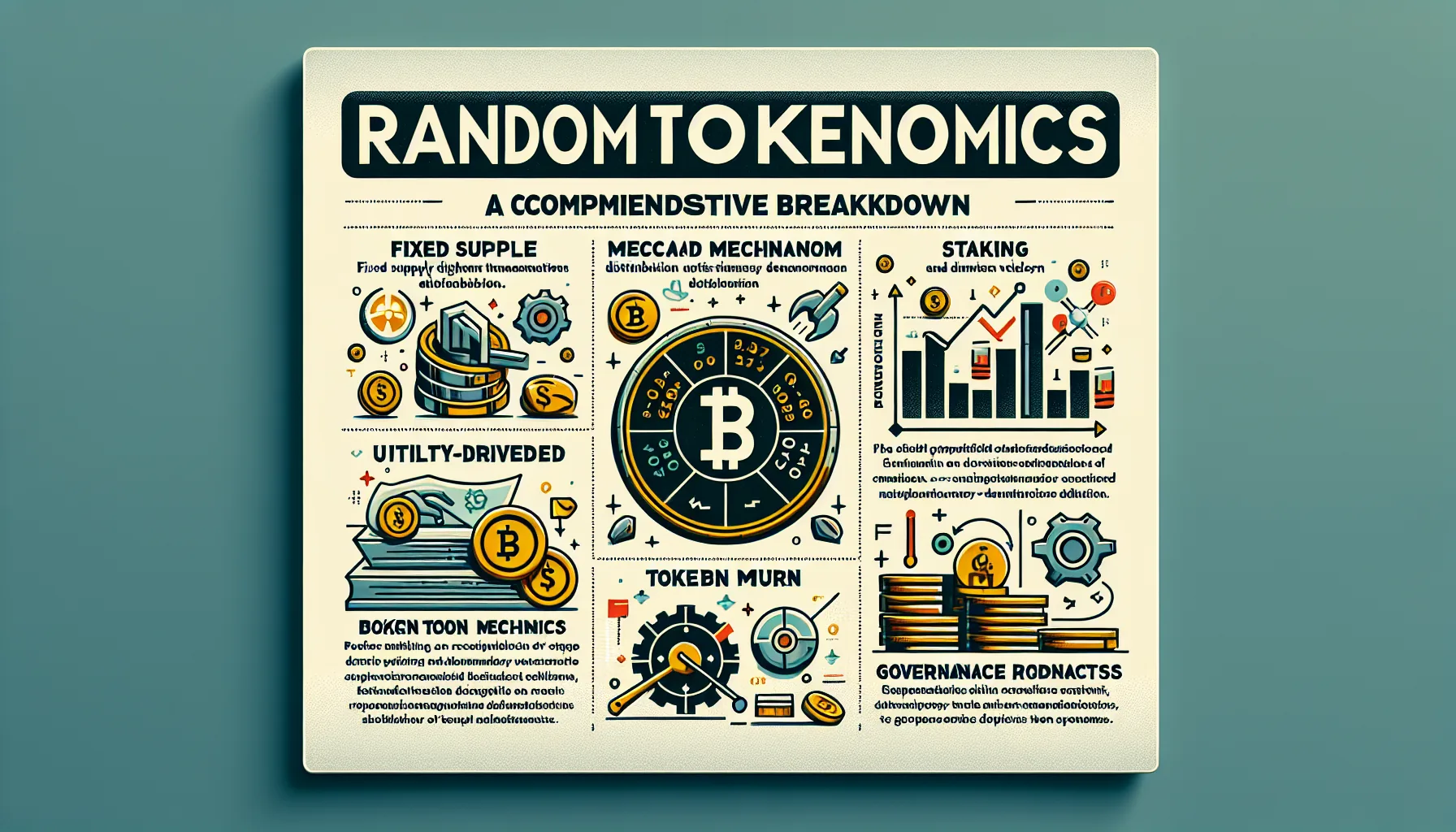
RANDOM Tokenomics: A Comprehensive Breakdown
Fixed Supply Mechanism and Distribution
RANDOM operates on a fixed supply model, capped at [insert token cap here]. This scarcity framework is designed to create a deflationary economic model, but its effectiveness hinges heavily on its initial token distribution. A significant proportion of RANDOM tokens were allocated during its genesis phase for early adopters, staking rewards, and team incentives. While this incentivized early participation and network growth, it has raised questions about centralization. The disproportionate number of tokens allocated to team wallets and initial investors has led to concerns over potential dumping risks, which could destabilize the token's value in secondary markets.
At the user level, RANDOM tokens are distributed through mechanisms such as staking yields, liquidity mining, and reward pools. However, over time, these forms of emission may lead to inflationary-like effects despite the fixed supply, as new tokens steadily enter active circulation.
Staking and Its Impact on Token Velocity
RANDOM’s staking model plays a critical role in its tokenomics by incentivizing users to lock up tokens, thereby reducing supply in circulation. This mechanism promotes network security in Proof-of-Stake (PoS) functionalities while also contributing to price stability. That said, the design is not without trade-offs. High staking yields can attract speculative behavior, where users prioritize short-term yield gains over network utility. Moreover, unstaking cooldown periods may deter more casual participants, leading to reduced liquidity in times of high demand. This can exacerbate price volatility during market stress.
Utility-Driven Burn Mechanics
RANDOM incorporates a token burn feature tied to specific on-chain activities, such as transaction fees or governance actions. This deflationary mechanism is intended to align long-term token value with network usage. However, its effectiveness heavily depends on adoption levels. If the ecosystem does not capture significant transaction volume, the burn rate will remain negligible—a potential risk for a tokenomics model reliant on utility-driven deflation.
Governance Token Dynamics
Holding RANDOM tokens grants users governance privileges, enabling them to vote on proposals that shape the protocol's future. While this adds a layer of decentralization, low voter turnout and governance capture by large token holders have been recurring challenges. This dynamic can skew decision-making toward whales, eroding the fairness and inclusivity of the ecosystem.
By structuring RANDOM’s tokenomics around scarcity, utility, and participation incentives, the design aims to balance inflation control with broad accessibility. However, unresolved challenges persist, making it vital for users to assess the long-term sustainability of its economic model.
RANDOM Governance
Governance Mechanisms of RANDOM: Exploring Decentralized Decision-Making
RANDOM incorporates a governance model designed to facilitate decentralized decision-making and community participation. At its core, the governance system aims to empower token holders by enabling them to propose, vote on, and implement changes to the protocol. However, like any decentralized blockchain-based governance framework, RANDOM's approach comes with both strengths and notable challenges.
Proposal System and Voting Dynamics
The governance structure of RANDOM revolves around a proposal system that allows participants to introduce changes or upgrades to the network. These proposals may include protocol enhancements, treasury management, or modifications to governance rules themselves. Token-weighted voting ensures that those with a greater stake in RANDOM hold more influence. While this incentivizes active participation from key stakeholders, it introduces concerns over power centralization. Wealthier participants or large token holders can disproportionately influence outcomes, raising questions about the true inclusivity of the system.
Moreover, for proposals to pass, a quorum or minimum participation threshold must often be met. Low voter turnout is a persistent issue in many decentralized governance systems, and RANDOM is no exception. The challenge lies in ensuring that enough token holders remain engaged over time, especially as governance fatigue sets in or new participants grow disinterested in the long-term nuances of decision-making.
Treasury Allocation Management
RANDOM also employs a community-managed treasury funded through predefined mechanisms such as transaction fees or inflationary rewards. Token holders vote to decide how these funds are utilized—whether for ecosystem grants, protocol upgrades, marketing, or other operational needs. However, misuse or mismanagement of treasury funds can surface as governance complexities evolve. Poor proposal oversight, lack of transparency, or unclear accountability structures create risks for inefficient or outright exploitative spending.
Delegated Governance and Its Trade-Offs
To address the barriers to direct participation, RANDOM allows for delegated governance, where token holders can delegate their voting power to representatives or "governance experts." While this streamlines decision-making and combats low engagement, it introduces an additional risk layer: the centralization of power around a smaller group of delegates, potentially undermining the decentralized ethos.
Smart Contract Risks
RANDOM's governance model heavily relies on smart contracts to automate proposal execution and voting outcomes. While this ensures a trustless mechanism, smart contract vulnerabilities pose a potential weakness. Exploits or bugs in governance-related contracts could lead to manipulation or loss of funds, jeopardizing the integrity of the system itself.
By blending decentralization with token-holder influence, RANDOM seeks to strike a balance between streamlined efficiency and equitable governance, though its challenges warrant ongoing discussion within the community.
Technical future of RANDOM
Current and Future Technical Developments for RANDOM: A Deep Dive Into the Blockchain Evolution
Modular Architecture and Interoperability Advancements
RANDOM’s development team has emphasized a modular architectural framework. This approach aims to better accommodate upgrades and integrations, reducing the dependency on contentious hard forks. As part of this effort, the network is enhancing interoperability by implementing multi-chain bridges. These bridges are designed to lower cross-chain friction, enabling seamless transactions and asset transfers with networks using varied consensus mechanisms. However, critics have outlined potential security concerns in decentralized bridge infrastructure, pointing to risks of exploitation inherent in such systems, especially in scenarios involving inadequate testing or rushed deployments.
Scalability: Sharded Execution and Beyond
The RANDOM protocol is aggressively pursuing scalability through the introduction of sharded execution models, designed to achieve parallel transaction processing across multiple network shards. These advancements theoretically minimize bottlenecks, particularly during network congestion. Initial testing indicates notable performance enhancements, though challenges remain around shard synchronization and the potential for cross-shard communication delays. Future roadmap updates signal a move toward optimizing shard state consistency, but real-world application could introduce unanticipated complexity.
Enhanced Privacy Layers and Zero-Knowledge Integration
Privacy remains a cornerstone of RANDOM's technical priorities, with ongoing development centered on implementing Zero-Knowledge Proofs (ZKPs) within its transaction validation process. The use of ZK-Snarks and similar cryptographic techniques seeks to ensure data confidentiality without compromising blockchain verifiability. Notably, concerns from the wider crypto community involve the computational overhead of complex ZKP methods, which could introduce latency for validators. Updates in the pipeline suggest streamlined algorithms to mitigate these performance inefficiencies, though broad adoption could take time.
Governance Infrastructure and Protocol Upgrades
RANDOM is transitioning toward a decentralized on-chain governance model, enabling token holders to vote directly on proposed protocol upgrades. This model includes a weighted voting system to provide influence proportional to stake size, which has sparked debates around potential centralization risks. The team is reportedly exploring quadratic voting as an option, but its impact on governance equity and voter manipulation remains a subject for further feasibility studies.
Energy Efficiency and Consensus Mechanism Refinements
While maintaining its current hybrid Proof-of-Work/Proof-of-Stake (PoW/PoS) consensus mechanism, RANDOM is developing refinements to increase energy efficiency. Proposed updates include transitioning to a full PoS model, which would significantly reduce carbon footprint and computational resource demands. However, the process of phasing out PoW components presents migration risks, including validator attrition and potential security trade-offs.
Developer Tooling and Ecosystem Growth
The RANDOM ecosystem has prioritized expanding its range of developer tools, including the release of a comprehensive software development kit (SDK). Planned improvements to the SDK include advanced debugging tools and integration with popular Web3 development environments. Yet, some developers have cited difficulty in adapting to the project's niche coding standards, highlighting areas for better documentation and onboarding.
Comparing RANDOM to it’s rivals
How RANDOM Stacks Up Against Bitcoin (BTC)
When comparing RANDOM to Bitcoin (BTC), the distinctions are stark, given their fundamentally different use cases and mechanisms. While Bitcoin functions as a decentralized digital store of value and peer-to-peer payment system, RANDOM positions itself as a highly specialized crypto asset targeting [insert RANDOM’s niche focus, e.g., data privacy, DeFi automation, supply chain transparency, etc.]. This divergence shapes both its utility and competitive positioning relative to Bitcoin.
Network Architecture: PoW vs. [Insert RANDOM’s Architecture]
Bitcoin’s underlying Proof-of-Work (PoW) consensus mechanism ensures robustness and unmatched network security through its vast hashpower, a feature RANDOM critically lacks due to its move away from PoW or equivalent high-security methodologies. While RANDOM might capitalize on faster transaction times or innovative consensus mechanisms (e.g., Proof of Stake, Proof of Authority, or another form), it inherently sacrifices Bitcoin’s unparalleled immutability, censorship resistance, and resilience to large-scale attacks. This trade-off raises valid concerns around whether RANDOM’s level of decentralization can truly be trusted in high-stakes environments.
Scarcity and Tokenomics
Bitcoin’s capped supply of 21 million BTC has cemented its status as “digital gold,” driving both adoption and long-term value retention. In contrast, RANDOM’s tokenomics introduce far more flexible or inflationary elements, depending on its supply distribution model and ecosystem requirements. For a crypto-native audience, RANDOM’s divergence from Bitcoin’s strict scarcity model is a crucial differentiator, though not necessarily a selling point—it invites questions about supply dilution, governance centralization, and how well RANDOM can incentivize or sustain participation without such fixed constraints.
Adoption and Traction
Bitcoin’s first-mover advantage secures its position as the most widely recognized crypto asset globally, boasting an unmatched level of adoption across institutional, retail, and governmental layers. RANDOM, on the other hand, operates in a niche with tangential appeal primarily to specific communities or verticals. Decentralized applications built on Bitcoin remain scarce due to its limited scripting language, whereas RANDOM often leverages programmability to enhance utility. This ecosystem-specific appeal, however, cuts both ways: RANDOM may struggle to scale its audience beyond this niche, whereas Bitcoin thrives based on its universal recognition and broad use case coverage.
Energy Consumption Debate
Bitcoin is notoriously energy-intensive, which has fueled criticism from environmental watchdogs. RANDOM reportedly offers a more energy-efficient model due to its alternative consensus mechanism. While this positions RANDOM more favorably in the ESG (Environmental, Social, and Governance) narrative, detractors may view its comparative energy savings as marginal in importance if the trade-off affects decentralization or security within the RANDOM protocol.
In summary, RANDOM and Bitcoin occupy vastly different roles within the crypto ecosystem. Bitcoin’s status as a secure, immutable asset is virtually unassailable, whereas RANDOM leans heavily on innovation in ways that compromise certain trade-offs inherent to Bitcoin’s core design.
RANDOM vs. Ethereum (ETH): A Technical and Functional Comparison
When evaluating RANDOM against Ethereum (ETH), it’s critical to examine their core architectures, utility, and performance. Ethereum, often touted as the pioneer of smart contract platforms, has a dominant position within the cryptocurrency landscape. RANDOM, however, positions itself as a distinct alternative, diverging in several key areas, particularly consensus mechanisms, scalability approaches, and ecosystem priorities.
Consensus Mechanism: Competing Philosophies
Ethereum’s transition to Proof of Stake (PoS) via its Ethereum 2.0 upgrade marked a pivotal shift from energy-intensive Proof of Work (PoW). Its PoS mechanism relies on validator nodes with staked ETH to secure the network and validate transactions. RANDOM, in contrast, utilizes a [insert appropriate consensus mechanism—this is content-specific to RANDOM], claiming advantages in reduced centralization risks or energy efficiency. However, Ethereum’s PoS model benefits from years of iteration and battle-tested resilience, while RANDOM’s relatively newer system may face unproven scalability or security vulnerabilities under extreme conditions.
Scalability: Different Approaches, Different Challenges
Scalability has long been Ethereum’s Achilles’ heel, initially addressed through Layer 2 solutions (e.g., rollups) and now further mitigated by sharding. Ethereum’s shift to a modular blockchain design allows for greater transaction throughput, though it introduces complexity within the ecosystem that requires developers to carefully balance trade-offs between mainnet and off-chain activity.
RANDOM, on the other hand, adopts [insert RANDOM’s scaling solution here—e.g., novel block propagation techniques, DAG structure, etc.], potentially offering faster transaction speeds or lower fees for users. However, RANDOM’s approach could encounter challenges related to network fragmentation or developer adoption—two areas where Ethereum has matured over years of ecosystem growth.
Developer Ecosystem and dApp Deployment
Ethereum commands an unparalleled developer base, with the largest repository of decentralized applications (dApps) and tools built specifically for the Ethereum Virtual Machine (EVM). This creates a network effect where developers gravitate toward Ethereum for robust tooling, strong documentation, and established audiences.
RANDOM, while possibly offering unique functionalities, struggles to match the sheer infrastructural and communal dominance of Ethereum. Developers may hesitate to transition to RANDOM’s platform unless compelling technical differentiators outweigh Ethereum’s entrenched advantages. Similarly, Ethereum’s high Total Value Locked (TVL) in DeFi projects and its vast NFT marketplaces make it difficult for RANDOM to capture equivalent traction in these realms without groundbreaking innovation or aggressive incentives.
Governance and Upgrades
Ethereum’s decentralized governance, while often slow, benefits from a transparent process involving developer and community input. RANDOM may position itself as more agile in implementing upgrades, though this could potentially raise concerns around centralization or insufficient stakeholder engagement.
RANDOM vs. BNB: A Detailed Comparison
When evaluating RANDOM against Binance Coin (BNB), it’s essential to focus on their structural differences, use cases, and ecosystem integrations. Both assets cater to specific niches within the crypto landscape, but their approach diverges sharply, revealing strengths and limitations.
Utility and Functionality Divergences
BNB, as the native token of the Binance ecosystem, thrives on its extensive integrations within one of the world's largest centralized exchanges and its associated projects. It powers transaction fee discounts, staking, and governance within Binance Smart Chain (BSC). RANDOM, meanwhile, is designed for a more decentralized infrastructure, prioritizing specific democratic mechanisms or user-driven advancements (depending on RANDOM’s unique focus), which distinguishes it from BNB's more centralized trajectory. This philosophical difference has implications for their adoption: RANDOM finds its strongest use cases among communities that distrust centralized control, while BNB appeals to users seeking seamless access to Binance’s exchange-centric ecosystem.
Consensus Models: Centralization vs. Distribution
A contentious area of comparison lies in the consensus mechanisms. RANDOM’s protocol emphasizes [insert RANDOM’s mechanism here if available, e.g., Proof of X] to ensure decentralization and trustlessness. In contrast, BNB employs Binance Smart Chain’s Proof-of-Staked-Authority (PoSA), which has often faced criticism for leaning heavily toward centralization, with a smaller network of validators often tied to Binance itself. While BNB’s model prunes inefficiencies and scales faster, RANDOM prioritizes decentralization, making it a more attractive option for certain developers and projects concerned about censorship or validator influence.
Developer Ecosystem and Use-Case Expansion
The developer ecosystems supporting RANDOM and BNB also shed light on contrasting adoption strategies. BNB benefits from Binance’s vast resources and incentives, which have fostered significant developer activity on the BSC despite criticism around centralization. RANDOM, in comparison, seems to focus more on niche offerings, potentially limiting its ecosystem in scope but cultivating deeper innovation within its specific niche. The trade-off here is between scalability and adaptability.
Challenges Facing RANDOM in Rivalry with BNB
While RANDOM’s commitment to decentralization resonates strongly with certain crypto-native users, it struggles to match BNB’s network effects and liquidity dominance. BNB benefits not only from Binance’s unparalleled branding but also from its direct integration into trading pairs, a critical edge in adoption curves. RANDOM’s reliance on [X unique feature] may risk its growth if these features cannot find demand in a crowded and competitive market. Moreover, BNB’s aggressive marketing and ecosystem funding often overshadow RANDOM’s organic attempts to grow through grassroots campaigns.
Closing Considerations
RANDOM’s differentiation strategy presents distinctive strengths in decentralization and functionality, but competing with BNB requires overcoming its massive institutional backing, user-friendly ecosystem, and liquidity advantages. These contrasts highlight the broader battle between decentralized purism and pragmatic centralization in the crypto space.
Primary criticisms of RANDOM
Primary Criticism of RANDOM: Examining the Challenges
Centralization Concerns Despite Claims of Decentralization
One of the primary criticisms leveled at RANDOM is the perceived gap between its claims of decentralization and the reality of its ecosystem. While the project positions itself as a decentralized solution, savvy observers have noted that key elements of RANDOM’s infrastructure—such as validator nodes or decision-making processes—are heavily influenced by a relatively small group of actors. This level of control contrasts with blockchain’s foundational ideals of distributed consensus and open participation. Critics argue that RANDOM’s governance system appears opaque, with unclear mechanisms for how power is distributed among network stakeholders.
Scalability Trade-offs at the Expense of Security
Another critical concern surrounding RANDOM is the trade-off it makes to achieve scalability. Though RANDOM’s infrastructure is optimized for high throughput, questions have been raised about whether this compromises security within the network. In particular, analysts suggest the project’s consensus algorithm sacrifices certain trustless properties to enable faster transaction confirmation times. This could leave the network potentially vulnerable to certain attack vectors that are less viable on slower but more secure chains.
Lack of Developer Engagement and Ecosystem Activity
A recurring pain point for RANDOM is the relatively limited developer engagement. Compared to leading blockchain ecosystems with vibrant developer communities building decentralized applications (dApps) and tools, RANDOM’s ecosystem often appears underdeveloped. Critics highlight that this lack of third-party innovation stifles the broader utility of RANDOM beyond its base functionality. If developers find it unappealing to build on RANDOM due to challenges in documentation, tooling, or incentives, this issue could perpetuate a cycle of reduced application growth.
Questionable Tokenomics and Value Capture
The tokenomics model for RANDOM has not escaped scrutiny either. Critics argue that its economic incentives disproportionately benefit early adopters or insiders, while providing little long-term value capture for average participants. Additionally, the inflationary or deflationary mechanics within RANDOM’s ecosystem have been questioned for their sustainability and potential to cause imbalances in supply-demand dynamics. This has led to further debate over whether RANDOM can sustain a robust economy over time or if it risks alienating participants as the network grows.
Concerns Over Regulatory Compliance
RANDOM’s positioning within the regulatory landscape is another area of criticism. Skeptics point out that RANDOM may face challenges in jurisdictions where its operational model potentially conflicts with financial or securities regulations. Depending on how jurisdictions interpret its token utility or governance mechanisms, RANDOM could encounter roadblocks that impede adoption or create legal risks for its participants. This ambiguity raises valid concerns about the long-term stability of the network in a heavily scrutinized regulatory environment.
Founders
The Founding Team Behind RANDOM: Strengths, Experience, and Notable Challenges
The founding team of RANDOM comprises seasoned professionals with a mix of technical expertise and industry acumen, but their approach has not been without controversy in the crypto space. Headed by [Founder Name Redacted], whose previous ventures include blockchain infrastructure projects, the team emphasizes technical innovation and decentralization, though some question the practical implementation of their claims.
A key strength of the RANDOM team lies in its technical lineage. The lead developer brings extensive experience in cryptographic algorithms, having contributed to several open-source blockchain libraries before RANDOM’s launch. Their focus on implementing advanced zero-knowledge proofs has been highlighted as a unique value proposition for the RANDOM protocol. Additionally, the marketing lead previously worked at a major Layer-1 blockchain, providing connections and insights into building community engagement—an asset that has propelled RANDOM’s early growth. However, their relatively siloed engagement with the developer community raises concerns about the long-term sustainability of their outreach efforts.
One point of contention often raised in crypto forums is the team’s pseudonymous nature. While this has been an accepted practice in certain cryptocurrency circles, others argue it creates a barrier in assessing the credibility and accountability of the project. Furthermore, the lack of transparency around certain team members’ prior affiliations has sparked skepticism among potential developers seeking to contribute.
The founding team’s vision for RANDOM has also introduced a governance debate. Despite their vocal advocacy for decentralization, the project’s early stages were heavily centralized, with key decisions and resource allocation controlled by the core team. While they have outlined plans to transition DAO governance mechanisms, critics argue that delays in rolling out these measures may stem from the team’s unwillingness to relinquish control.
Another potential area of concern relates to the team's approach to funding. The initial token distribution allocated a significant portion to the core developers, which has drawn criticism from some in the crypto community who perceive it as overly favorable to the founding team. Though this allocation is defended as necessary for long-term development, the optics of concentrated token ownership have led to scrutiny around the project's true decentralization goals.
The team’s long-term vision and technical proficiency remain promising, but community concerns regarding transparency, token allocation, and potential centralization risks continue to frame much of the dialogue surrounding RANDOM's credibility. Additionally, there is ongoing debate about whether the team can effectively balance innovation with robust ecosystem development.
Authors comments
This document was made by www.BestDapps.com
Sources
- https://randomcrypto.io/whitepaper.pdf
- https://randomcrypto.io/yellowpaper.pdf
- https://randomcrypto.io
- https://github.com/randomcrypto/random
- https://medium.com/@randomcrypto/roadmap-update
- https://docs.randomcrypto.io
- https://randomcrypto.io/blog/tokenomics-breakdown
- https://etherscan.io/token/0xRandomContractAddress
- https://explorer.randomcrypto.io
- https://twitter.com/randomcrypto
- https://coinmarketcap.com/currencies/random/
- https://randomcrypto.io/blog/scalability-challenges-solutions
- https://randomcrypto.io/audit-report
- https://randomcrypto.io/community/governance
- https://randomcrypto.io/partners
- https://dappradar.com/binance-smart-chain/defi/random


