History of RAD
The History of RAD: A Decentralized Governance Evolution
RAD, the native token for the Radicle protocol, was meticulously designed to empower decentralized collaboration. Radicle itself originated as an ambitious initiative to decentralize software development, providing an alternative to centralized platforms like GitHub. The journey of RAD as a crypto asset is deeply intertwined with the broader narrative of open-source software and blockchain innovation.
Radicle began as an open-source project in 2018, spearheaded by a group of developers focused on creating a peer-to-peer network for code collaboration. Its foundation was rooted in the idea of aligning the principles of open-source software with the decentralized ethos of blockchain technology. By 2020, the Radicle protocol had evolved to include a robust peer-to-peer repository system that rejected dependency on servers and centralized structures.
RAD was introduced as part of the protocol's pivot toward on-chain governance and funding mechanisms. The launch of the token in 2021 marked a significant shift in the protocol's trajectory. RAD was not purely a utility token but a governance token designed to allow holders to participate in decisions affecting the protocol's development and treasury. This incorporation of decentralized governance aimed to ensure that Radicle remained true to its original principles of autonomy and decentralization.
Despite RAD's promise, the asset’s distribution model introduced areas of contention. Initial allocations raised community concerns, primarily over the high proportion set aside for core contributors, early backers, and foundation funding. While this structure was necessary to incentivize long-term development, critics noted it created a level of centralization within an ostensibly decentralized protocol. Such distribution models have sparked debates within the crypto community over the balance between incentivizing innovation and genuinely distributing power.
Moreover, governance activity with RAD has faced its own challenges. Early token holder participation was criticized for being relatively low, raising questions about how effectively the token could fulfill its governance purpose. This phenomenon is common in governance token ecosystems, where voter apathy often leads to governance being steered by a minority of active participants rather than the broader token-holding base.
Nonetheless, the emergence of RAD was a pivotal moment for Radicle, acting as a bridge between the decentralized ethos of the project and its necessity for sustainable development. The token’s history reflects the wider struggles and triumphs of integrating decentralized governance within open-source ecosystems. However, questions around participation, centralization of power, and community alignment continue to shape RAD's journey.
How RAD Works
How RAD Works: The Mechanics Behind Radicle's Decentralized Protocol
Radicle (RAD) operates as the native governance token within the Radicle ecosystem, a peer-to-peer network designed to enable collaborative software development without reliance on centralized intermediaries. At its core, Radicle leverages a combination of public key cryptography and a peer-to-peer replication protocol built on Git. This ensures repository hosting and collaboration occurs directly between users without requiring traditional centralized platforms like GitHub or GitLab.
Decentralized Code Collaboration
Unlike centralized platforms, all data in Radicle is retained locally by peers and is broadcast to others via a process known as "gossiping." This model eliminates single points of failure and empowers developers to maintain sovereignty over their codebases. RAD token holders gain governance rights over the Radicle Treasury, which is used to fund development and incentivize network participation.
Governance and Staking
A key function of the RAD token is its role in decentralized governance. Through this mechanism, token holders can propose and vote on protocol upgrades, treasury allocations, and feature releases. While this gives empowered stakeholders influence over the protocol’s roadmap, the decentralized nature can also result in slower decision-making, given the challenges of achieving consensus across a diverse global community.
Additionally, RAD tokens are used to incentivize participation in the network's operations, including the maintenance of application mirrors on the Ethereum blockchain. These mirrors enable developers to pin repositories to Ethereum to ensure immutability and serve as an optional fallback layer. However, the dual-layer structure introduces potential friction, as managing both Radicle-native and Ethereum-based components can be cumbersome for users unfamiliar with blockchain integrations.
Issues of Usability
While Radicle prioritizes decentralization, this commitment often comes at the expense of accessibility. Users must fully grasp Git’s functionality alongside peer-to-peer networking principles in order to navigate the system effectively. Bug fixes and updates are also not immediately universal, as changes require adoption by individual peers rather than instant propagation from a central server. These traits can make the system intimidating for beginners and inconvenient for teams who prioritize ease of use or fast implementation.
Security Considerations
The protocol’s decentralized architecture inherently reduces attack surfaces associated with centralized servers. However, the reliance on public key cryptography means the onus is placed squarely on users to safeguard their private keys. Any compromise of these keys could result in the irreversible loss of access to codebases or funds tied to RAD governance. This "self-sovereign security" model, while empowering to experienced users, includes significant risks for those who are less technically adept.
Use Cases
Use Cases for RAD: Decentralizing Governance and Beyond
The RAD token plays a central role in the decentralized governance of the Radicle protocol, a peer-to-peer network designed for code collaboration. One of its primary use cases focuses on enabling permissionless funding and decision-making through a community-led governance structure. RAD holders can propose and vote on network upgrades, treasury allocation, and protocol changes, ensuring that the ecosystem evolves according to collective community input. The token's governance use case is particularly appealing for developers prioritizing decentralization and autonomy in their tools.
Another critical use case of RAD arises in incentivizing participation in the network. By staking RAD, users can gain access to governance powers or shape the direction of the Radicle protocol. However, this model has faced scaling and fairness challenges, as larger token holders naturally possess outsized voting power. This raises concerns about the inclusivity of smaller developers and participants, potentially diluting the ethos of decentralized collaboration. The network aims to mitigate centralization risks, but achieving a truly equitable governance structure remains an ongoing obstacle.
RAD is also employed for network fee management within the Radicle ecosystem. Specifically, RAD is used to unlock premium features or functionalities for specific peer-to-peer interactions. This economic layer focuses on positioning Radicle as an alternative to centralized platforms, particularly in repositories hosted entirely on the network, avoiding reliance on traditional cloud solutions. Still, critics have questioned whether this value proposition sufficiently justifies the network’s onboarding friction compared to the user-friendliness of entrenched, centralized platforms.
Importantly, RAD also facilitates treasury decentralization, giving the community control over development funding. By governing the allocation of treasury funds, RAD helps maintain alignment between protocol priorities and the needs of its contributors. However, treasury-managed financing models often run into issues of inefficiency or competing interests—especially in systems where conflicts can arise between a community-oriented focus and individual profit motives. Striking this balance is critical but remains a complex challenge.
Finally, RAD empowers network sovereignty for projects that directly interact with and contribute to broader open-source ecosystems. Organizations can host repositories, fund initiatives, and conduct governance without exposing their operations to the limitations of third-party dependencies. However, the adoption challenges for mainstream developers—stemming from both technical learning curves and resistance to change—indicate that RAD’s niche might remain concentrated among highly decentralized ecosystems in the foreseeable future.
RAD Tokenomics
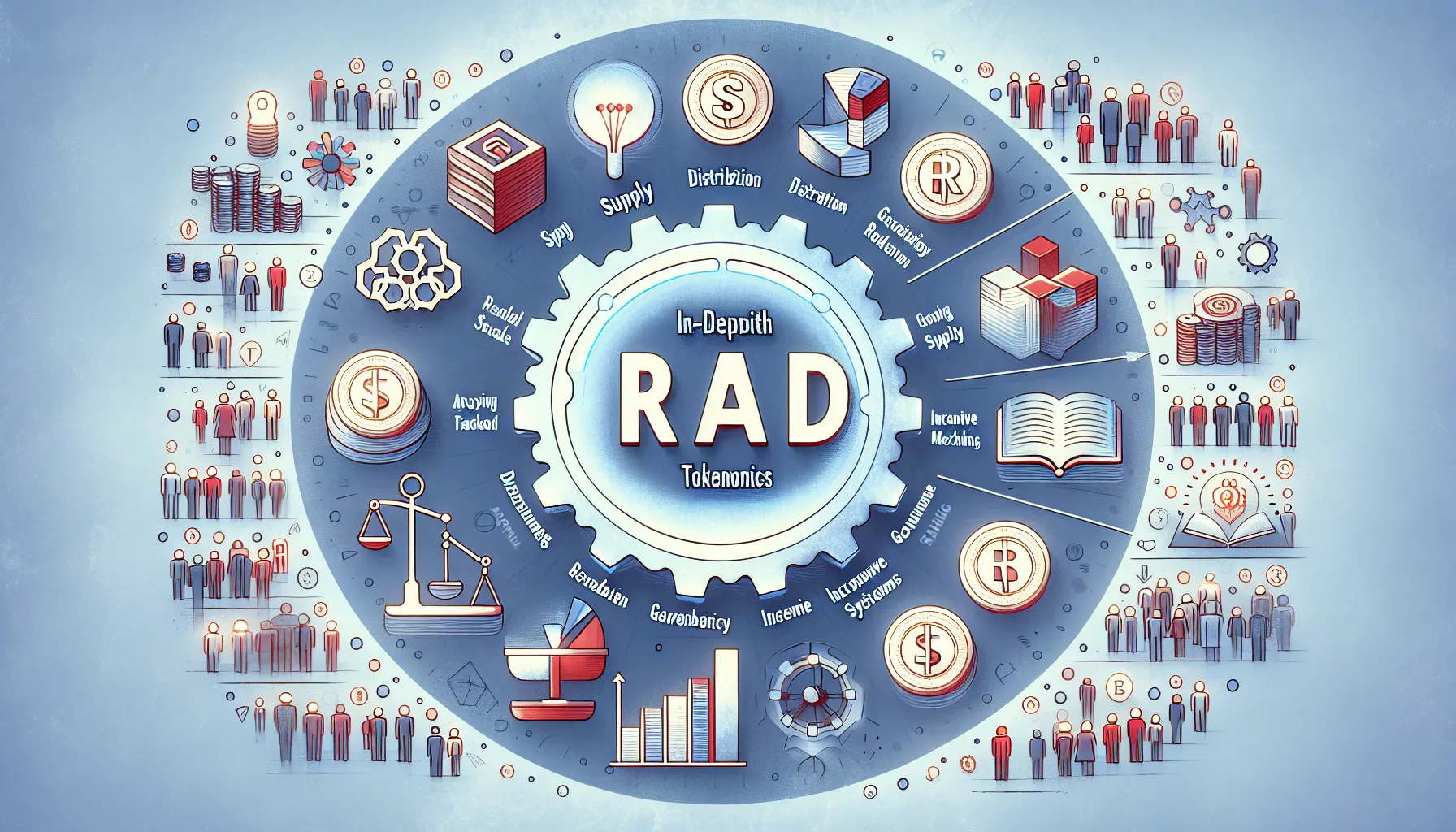
In-Depth Tokenomics of RAD: Analyzing Supply, Distribution, and Incentive Mechanics
The RAD token, native to the Radicle protocol, is central to its decentralized architecture, governance, and incentivization model. Understanding its tokenomics reveals not only its utility but also the potential weaknesses in its economic structure.
Fixed Total Supply and Distribution Dynamics
RAD operates on a fixed total supply model, capped at 99,999,620 tokens. While a capped supply provides scarcity, fostering value retention, distribution raises essential questions. A significant portion of RAD tokens was allocated to Radicle’s founding team, early backers, and contributors. This allocation strategy, while typical for funding development, creates potential concerns regarding centralization of influence. A skewed distribution introduces systemic risk if a small group holds significant governance power or liquidates holdings, leading to adverse market effects.
Additionally, the community portion—intended for ecosystem growth—plays a crucial role in enabling Radicle’s vision of decentralized project hosting. However, the actual efficiency of token deployment within the community ecosystem remains a critical point of consideration. Mismanagement or underutilization of these funds could hinder long-term community adoption.
Governance Participation and Barriers
RAD’s governance framework allows token holders to propose and vote on protocol changes. This ensures community participation in shaping the protocol's future. However, in practice, token-based governance mechanisms often grapple with voter apathy and unequal representation. Low participation rates coupled with whale dominance—spurred by the initial distribution—can lead to governance centralization, undermining the decentralized ethos RAD is designed to champion.
Further, the utility of RAD as a governance token depends heavily on the incentives provided to stakeholders for active participation. Critics may argue that governance incentives in projects like Radicle remain insufficiently robust to sustain long-term engagement from smaller holders, tilting the scales toward large stakeholders.
Inflationary Rewards and Usage Constraints
While RAD’s fixed supply model sets a cap, the protocol employs an inflationary rewards mechanism to incentivize active governance participation. This controlled inflation introduces a balancing act: rewarding active users while avoiding excessive dilution of existing holdings. The challenge lies in maintaining token-holder trust and preventing inflation from devaluing long-term stakes—a common critique across token economies employing similar systems.
On the utility front, RAD also supports mechanisms such as fee subsidies for Radicle's collaborative code hosting features. While this incentivizes protocol adoption, the alignment between token utility and long-term value capture remains debatable. If fees or usage incentives do not drive sustained demand for RAD, utility-based valuation mechanisms may falter.
Closing Thoughts on Tokenomics Risk Factors
A closer examination of RAD’s tokenomics highlights areas for scrutiny, particularly around its initial distribution centralization and governance participation challenges. Token sustainability will depend heavily on executing transparent mechanisms for community engagement while minimizing barriers to governance and value dilution risks.
RAD Governance
Understanding Governance in RAD: Decentralizing Decision-Making
Governance is a critical aspect of any crypto asset that claims to embody decentralization, and RAD (Radicle) attempts to reflect these principles in its framework. However, the effectiveness and nuances of its governance model warrant careful examination by stakeholders seeking long-term trust and participation.
On-Chain vs. Off-Chain Governance
Radicle employs a hybrid governance structure that combines both on-chain and off-chain components. The on-chain governance is made possible through the RAD token, which is primarily utilized for voting on protocol upgrades, funding allocation, and decisions surrounding network evolution. However, much of the discussion and proposal drafting still occurs off-chain through various forums and community platforms. While this approach enables broad community participation, it introduces potential bottlenecks where voter turnout or engagement may fall short, as off-chain governance often relies on a centralized point of discussion.
The hybrid nature of governance may invite scrutiny from decentralization advocates, especially if the off-chain discussions are dominated by a small subset of influential participants. As a result, achieving a genuinely inclusive governance system remains a challenge for Radicle.
Incentives for Participation
A key aspect of RAD governance is ensuring token holders are incentivized to participate in decision-making. Yet, this incentive structure can face hurdles. For instance, voter apathy is a common issue in similar governance protocols, where even token holders with substantial stakes may not participate due to lack of knowledge, interest, or perceived value. Additionally, Radicle's distribution of RAD tokens, and whether it's sufficiently decentralized to prevent governance capture by whales or early investors, is an area that requires monitoring.
Governance Over Treasury Management
An important dimension of RAD governance is the control over its treasury. The RAD token grants holders decision-making power regarding the allocation of funds for community initiatives, protocol upgrades, and ecosystem growth. While this level of participation provides transparency and direct influence, it can also expose the ecosystem to inefficiencies and the potential for misallocation of resources. Poorly thought-out treasury management can lead to stagnation or a weakening of the community’s trust in the ecosystem’s leadership.
Smart Contract Risks
RAD's governance actions occur within the bounds of its on-chain mechanisms and smart contracts. While these foundational technologies aim to be immutable and trustless, they are not immune to vulnerabilities. Bugs in governance-related smart contracts or suboptimal design decisions could have severe repercussions, impacting both governance mechanisms and stakeholders alike. For developers and users familiar with past governance failures in similar projects, this remains a concern worth addressing.
Technical future of RAD
Current and Future Technical Developments for RAD: A Technical Roadmap
Modular Design for Decentralized Governance
At the core of RAD lies the Radicle protocol, which focuses on peer-to-peer software collaboration. One of its standout technical developments is the modular architecture supporting decentralized governance. Radicle's design prioritizes reduced reliance on centralized intermediaries, leveraging Ethereum smart contracts to handle critical functions like funding, project ownership, and access control. However, the implementation faces ongoing challenges, particularly in gas efficiency and scalability. High gas fees on Ethereum can limit the accessibility of governance interactions and disincentivize participation, especially among smaller stakeholders.
To address these issues, there are considerations around layer-2 integration and alternate rollups to mitigate cost concerns. This exploration remains in development, making scalability a key bottleneck for broader adoption of RAD's decentralized ecosystem.
Git Integration Enhancements
RAD supports decentralized code hosting and collaboration through its integration with Git. Recent updates aim to bolster usability for developers by introducing streamlined workflows that combine on-chain and off-chain features. Despite these efforts, challenges remain in balancing decentralization with performance. Certain Git operations, such as large repository management or conflict resolution in collaborative projects, can still be slower in comparison to centralized competitors like GitHub. Enhancements planned in the roadmap focus on increasing performance and minimizing latency without compromising security or decentralization.
Additionally, discussions around interoperability with other decentralized Git solutions could expand Radicle’s ecosystem, but these are still theoretical rather than concrete implementation phases.
Governance Mechanisms and Smart Contract Maintenance
Radicle's governance is managed through its native RAD token, giving token holders voting power on protocol upgrades and treasury allocation. A significant technical improvement in the pipeline includes dynamic proposal frameworks aimed at making governance processes more flexible while reducing proposal submission barriers. Although this encourages greater participation, there are critiques about how token-weighted governance can lead to plutocracy, where larger holders dominate decisions.
Another technical focus is the continual upgrade of smart contracts controlling treasury funds. Emphasis is being placed on auditing and formal verification to ensure security, especially given the historical vulnerabilities in DeFi governance systems. The reliance on Ethereum, while beneficial for infrastructure, also leaves Radicle susceptible to Ethereum's broader vulnerabilities.
Privacy and Anonymity Features
A key future technical addition on Radicle's roadmap involves improving user privacy within the decentralized code hosting framework. Current architectures expose certain interactions on-chain, which may inadvertently leak metadata or sensitive project details. The introduction of zero-knowledge proofs (ZKPs) is being explored as a potential solution to anonymize contributions while still maintaining verifiability. However, integrating ZKP into Radicle is computationally complex, and its implementation timeline remains undefined.
Challenges in Expanding Participation
While the broader technical vision is expansive, Radicle faces challenges in terms of ecosystem adoption and user retention. Its unique value proposition as a decentralized alternative competes against highly polished centralized platforms. Addressing these adoption barriers will require not only technical advancements but also developer-focused tooling improvements and reducing friction in onboarding workflows.
Comparing RAD to it’s rivals
Comparing RAD to ATOM: Key Differentiators and Overlaps
When analyzing Radicle (RAD) alongside Cosmos (ATOM), the conversation often focuses on decentralization models, network goals, and developer ecosystems, as the two projects play within overlapping niches but approach solutions with divergent philosophies.
Governance and Decentralization
One of RAD’s standout characteristics is its fully decentralized governance system, which allows RAD token holders to participate directly in decision-making processes. This contrasts with ATOM, where governance revolves around the Cosmos Hub validators, creating a balance of decentralization but leaning heavily on validator influence. While Cosmos incentivizes token staking through influencers in the network, some argue that this may centralize power within a smaller group of participants who control validator operations. RAD, on the other hand, embraces flat, token-holder driven governance. However, this flat structure could pose challenges for scalability and decision efficiency in the long term, whereas Cosmos’s validator system may provide a more streamlined approach to updates and consensus.
Focus on Use Cases: Code Collaboration vs. Interoperability
Radicle is hyper-focused on decentralized code collaboration, positioning itself as a Web3 alternative to platforms like GitHub. Its peer-to-peer repository hosting model removes reliance on centralized servers, creating an uncensorable infrastructure for developers. Cosmos, in contrast, is designed as the "Internet of Blockchains," emphasizing interoperability and enabling many blockchains to communicate with each other via its Inter-Blockchain Communication (IBC) protocol. While this makes ATOM highly versatile in connecting diverse ecosystems, it lacks a specialized focus such as RAD's niche in software development tooling. The differentiation in their primary use cases is clear, though some critics have pointed out that Radicle’s target market remains niche, whereas ATOM’s broader applicability may yield wider adoption.
Developer Ecosystem Support
Cosmos has cultivated one of the most robust developer ecosystems in the blockchain space, supported by an extensive toolkit like the Cosmos SDK. This has spurred the creation of numerous app-chains and projects built on its infrastructure. RAD, by contrast, aims to attract developers through its decentralized code collaboration environment, but its ecosystem remains smaller and tightly focused. While Radicle’s design benefits niche developers who value autonomy, broader developer participation could be limited by the learning curve involved in fully adopting decentralized workflows. Cosmos, with its vast ecosystem tools and resources, arguably lowers barriers to entry for blockchain developers at large.
Network Design and Trade-Offs
RAD operates on Ethereum, leveraging its existing infrastructure for security and interoperability but potentially hampered by Ethereum’s network limitations, such as scalability and transaction fees. ATOM, with its purpose-built Tendermint-based consensus engine, avoids Ethereum’s congestion issues and offers high-performance app-chains. However, Cosmos’s reliance on independent blockchains could mean a more fragmented security model compared to Ethereum’s shared consensus layer. For RAD users, Ethereum’s trustless environment might be more appealing, even at the cost of higher fees and slower transactions.
This comparative lens shows that while RAD and ATOM share some conceptual overlaps in decentralization, their layers of focus and technical trade-offs make each project distinct, catering to different audience needs and priorities.
RAD vs. DOT: How Do They Stack Up?
When comparing RAD (Radicle) to DOT (Polkadot), the contrast lies in their core design philosophies and utility within the crypto ecosystem. Both projects aim to decentralize infrastructure but approach it for entirely different use cases and participants.
Differing Use Cases
Radicle’s focus is heavily tied to decentralized code collaboration and version control. It is tailored for developers who want to escape reliance on centralized platforms like GitHub. DOT, on the other hand, is designed as a multi-chain protocol aiming to enable interoperability between various blockchains. Polkadot’s main utility comes from connecting disparate blockchains and facilitating seamless data and asset transfers.
This distinction creates a natural divergence in their user bases. RAD appeals directly to developers and open-source contributors who prioritize censorship resistance in their workflows. DOT, by contrast, caters to blockchain projects and enterprises looking to interlink ecosystems and improve scalability.
Governance Models: Simplicity vs. Complexity
Radicle employs a lightweight, on-chain governance structure where decisions are made primarily by RAD token holders. This straightforward approach aligns with its niche use case and relatively small user base compared to DOT.
Polkadot’s governance system, in contrast, is far more intricate. Its on-chain model incorporates multiple stakeholder groups, including nominators, validators, and the Polkadot Council, which collectively influence upgrades and changes to the network. While this system provides a higher level of decentralization and representation, it can also lead to governance gridlock, especially as competing interests arise within a diverse ecosystem.
Technical Architecture
Polkadot’s architecture centers around its Relay Chain and Parachains. This allows it to support parallelized blockchains and scale effectively, making it a go-to for projects needing high throughput or customizability. Meanwhile, Radicle has a more limited scope. Its focus on decentralized code storage and contribution means it does not aim to solve scalability issues inherent to blockchain interoperability. This technical simplicity makes RAD more specialized, while DOT offers broad, scalable infrastructure with tech overhead that could deter less resourceful projects.
Community Scope
Radicle’s developer-focused ecosystem lacks the expansive marketing campaigns and partnerships often found in Polkadot’s orbit. DOT’s position in the crypto space has been bolstered by a vibrant community of builders launching Parachains with significant financial backing. This disparity can make RAD feel niche or unpolished in comparison, which may hinder its adoption despite its utility for specific users.
Closing Thoughts on the Comparison
While Radicle and Polkadot share overarching goals of decentralization, DOT’s expansive scope and governance complexity contrast sharply with RAD’s narrowly defined, developer-focused mission. This divide is at the core of how these two assets compete—and often complement—each other in the broader ecosystem.
Comparing Radicle (RAD) to Avalanche (AVAX): Decentralization and Use Case Divergence
When evaluating Radicle (RAD) against Avalanche (AVAX), it's crucial to analyze their underlying approaches to scalability, decentralization, and protocol utility, as the two assets address fundamentally different components of the blockchain ecosystem.
Protocol Design and Consensus Mechanisms
Radicle operates as a decentralized code collaboration network, enabling peer-to-peer software development without relying on centralized platforms. Its focus on Git-based version control places its design firmly within the realm of development tooling, aiming to provide trustless infrastructure for open-source communities. Avalanche, on the other hand, is a highly-scalable smart contract platform that supports decentralized applications (dApps) and enterprise applications. AVAX relies on its Avalanche consensus protocol, known for achieving sub-second finality and high throughput.
While AVAX’s architecture emphasizes low latency and scalability for global transaction settlement, Radicle remains constrained by its niche focus on decentralized developer collaboration. This fundamental divergence means Radicle does not directly aim to compete with Avalanche’s DeFi or NFT ecosystems. However, Radicle’s stringent adherence to decentralization highlights a potential tradeoff: Avalanche employs subnets for flexibility and scalability but introduces concerns around the decentralization of validator networks in certain use cases.
Development Ecosystem
Avalanche has cultivated a robust ecosystem, with extensive tooling for developers building dApps, along with widespread support from liquidity providers and institutional stakeholders. Radicle, being tailored to code collaboration and repository hosting, is inherently more focused on developers as its core participants. While Avalanche’s focus on interoperability has allowed it to integrate with EVM-compatible chains and foster cross-chain liquidity, Radicle's focus on decentralization through peer-to-peer networking can feel limiting in terms of attracting mainstream or enterprise developers.
Token Utility
The AVAX token underpins the Avalanche ecosystem, functioning as currency for transaction fees, staking, and participating in network governance. This multi-faceted utility creates demand across various layers of Avalanche's infrastructure. RAD, by contrast, is utilized for governance within the Radicle ecosystem and for incentivizing long-term project sustainability. One area of contention arises from RAD’s perceived limited utility, as it does not directly fuel network operations or incentivize scalability, which could limit organic usage growth compared to AVAX.
Critiques and Challenges
Avalanche’s aggressive pursuit of scalability via validator subnets has occasionally drawn scrutiny, with skeptics arguing that its decentralization may suffer when subnets are controlled by smaller, permissioned groups. Radicle’s issues lie in adoption hurdles: while its user base is highly specialized, this narrow scope reduces network effects and growth potential outside of its direct niche. As Avalanche continues expanding its influence across DeFi and enterprise sectors, Radicle’s ecosystem may feel comparatively isolated.
Primary criticisms of RAD
Primary Criticism of RAD: Challenges and Concerns
Centralization Despite Governance Claims
RAD markets itself as a governance token, empowering stakeholders to influence the evolution of the Radicle ecosystem. However, one of the primary criticisms centers on the uneven distribution of decision-making power. A significant portion of RAD’s supply remains concentrated in the hands of early investors, developers, and core contributors, raising concerns about potential centralization. While decentralization is a guiding principle for most crypto projects, this allocation structure may unintentionally limit the influence of smaller token holders, undermining the equitable governance ideal.
Limited Adoption and Ecosystem Lock-in
Radicle aims to provide decentralized code collaboration tools as an alternative to centralized platforms like GitHub, but adoption has been relatively niche. Critics argue the ecosystem has yet to prove its viability beyond committed open-source communities. Additionally, the dependency on the Ethereum network for financial mechanics, such as staking and rewards, introduces potential issues with scalability and gas fees. As Radicle faces competition from both centralized and decentralized alternatives, these adoption barriers remain a substantial hurdle for its long-term viability.
Token Utility Concerns
The real-world use case for RAD has also been a point of contention. Beyond governance, critics question whether holding RAD provides enough intrinsic value to token holders. Staking mechanisms tied to network maintenance or incentivization are relatively underdeveloped compared to other projects in the decentralized finance (DeFi) space. For some, RAD feels more like a speculative asset rather than a token that drives active participation or offers everyday utility within the ecosystem.
Security and Sustainability Uncertainties
The decentralized hosting of repositories on Radicle, while appealing in principle, has raised concerns around security and sustainability in comparison to mature competitors. Centralized platforms offer robust backup options, auditability, and accountability for code management, while decentralized systems like Radicle may face challenges in ensuring data integrity and redundancy at scale. Additionally, the protocol is reliant on Ethereum, making it susceptible to the broader network’s vulnerabilities, such as potential congestion or exploits in its infrastructure.
Governance Fatigue
With the proliferation of DAO-based governance models across the crypto space, RAD’s proposal and voting mechanisms are sometimes criticized as overly complex or prone to low engagement. Critics highlight that many token holders prioritize speculative gains rather than active governance participation, potentially leaving decisions in the hands of a small subset of stakeholders. This phenomenon, often referred to as "governance fatigue," poses risks to the ecosystem’s ability to evolve based on community consensus.
This combination of governance limitations, adoption challenges, and broader industry skepticism creates notable pressure points for RAD and its ongoing role in the crypto landscape.
Founders
The Founding Team Behind the RAD Crypto Asset
The RAD crypto asset, the native token of the decentralized Radicle network, originates from a team that set out to disrupt centralized code collaboration platforms. The project's roots trace back to a deep-seated ethos of decentralization, open-source values, and creating autonomous systems for software collaboration. However, the founding team’s ambitions and approach come with both strengths and challenges.
Radicle was co-founded by a small group of open-source developers with extensive backgrounds in distributed systems, peer-to-peer networking, and cryptography. The team operates under the umbrella of Monadic, a development organization with a strong focus on privacy and trustlessness. Founders like Alexis Sellier, best known for creating the widely adopted CSS preprocessor “Stylus,” became instrumental in shaping the technical foundations of Radicle. Their experience lends credibility to the project, particularly within the software engineering and Web3 communities.
Despite the technical expertise of the team, one challenge that has emerged is the relatively low visibility of its members compared to founders of other crypto ecosystems. Unlike high-profile figures in blockchain-based projects, the RAD founding team opts for a more reserved, community-driven approach. While this aligns with Radicle’s decentralized philosophy, it has also led to questions around leadership dynamics, decision-making transparency, and long-term accountability. The lack of visible, charismatic leadership could be seen as a hurdle in attracting widespread adoption and investment attention, which often hinges on strong personal brands in the Web3 landscape.
Another area of interest is the governance structure tied to RAD, which further reflects the founding team’s ideological foundations. The token itself is integral to Radicle’s decentralized governance system, enabling community-driven decision-making. However, some critics argue that the team’s early control mechanisms and token allocation raise concerns about centralization at the protocol’s inception. While the gradual transitioning of power to token holders is the stated goal, the process has been closely scrutinized by those advocating for immediate decentralization in crypto projects.
The team’s past work demonstrates a clear inclination toward innovation, with Radicle utilizing unique peer-to-peer mechanisms to enable code hosting and version control without reliance on centralized servers. However, this technical complexity has also been a double-edged sword, as it can create barriers to entry for developers less familiar with blockchain ecosystems or peer-to-peer protocols.
In summary, the RAD founding team embodies a blend of technical prowess and ideological commitment, but their understated presence in the broader crypto space and potential governance pitfalls pose questions worth scrutinizing.
Authors comments
This document was made by www.BestDapps.com
Sources
- https://radicle.xyz
- https://radicle.xyz/whitepaper
- https://github.com/radicle-dev/radicle-upstream
- https://radicle.mirror.xyz
- https://docs.radicle.xyz
- https://gov.radicle.network
- https://radicle.xyz/faq
- https://discord.gg/Ek3nCPMxH8
- https://radicle.community/c/announcements
- https://medium.com/radicle
- https://github.com/radicle-dev/radicle-link
- https://radicle.xyz/blog
- https://radicle.network
- https://twitter.com/radicle
- https://developer.radicle.xyz
- https://tokenomics.radicle.xyz
- https://radicle.community/c/governance
- https://arxiv.org/abs/1812.01449
- https://etherscan.io/token/0xd50c1746d835d2770ddd636dbd9ead759d21f8d6
- https://radicle.substack.com