History of QKC
The History of QuarkChain (QKC)
QuarkChain (QKC) launched with the goal of addressing blockchain scalability through sharding technology. The project was first introduced via a whitepaper detailing a two-layered architecture designed to enhance transaction throughput while maintaining decentralization and security.
Initial Development and ICO
QuarkChain garnered early attention during its initial coin offering (ICO), which was held to fund the project’s development. The ICO was highly anticipated due to its proposed capabilities in scalability, with claims of being able to achieve high transaction per second (TPS) performance. After the fundraiser, QKC tokens were distributed, and the project moved into its developmental phase.
Testnet and Mainnet Launch
Following the ICO, the team focused on rolling out its testnet, allowing developers and users to interact with the network and test its proposed sharding mechanisms. The testnet phase helped the team refine its approach to horizontal scalability. After a period of testing and adjustments, QuarkChain launched its mainnet, marking a critical milestone in its roadmap.
During this period, the network integrated cross-shard transactions and an adaptive state sharding mechanism, which differentiates it from traditional single-chain structures. These features were meant to reduce congestion and improve transaction speeds without compromising blockchain security.
Challenges and Adjustments
Despite strong technical ambitions, QuarkChain faced several hurdles. One of the primary criticisms was its complex architecture, which introduced additional challenges in development and adoption. Sharding, while promising, required careful implementation to avoid security issues, and concerns were raised about its potential vulnerabilities.
The project also encountered issues regarding ecosystem adoption. While its scalability approach was technically sound, developer traction and dApp adoption struggled to match the initial expectations set during the ICO phase.
Governance and Evolution
Over time, QuarkChain introduced governance mechanisms to involve the community in decision-making processes. The project explored staking models and incentivization strategies to encourage participation and secure network operations.
Additionally, the team continued iterating on interoperability features, aiming for integration with cross-chain solutions that extended beyond its native ecosystem. However, competition remained fierce, with newer blockchain solutions emerging, many of which tackled scalability with alternative approaches.
Security and Network Stability
QuarkChain has navigated security concerns, ensuring that its sharded architecture does not compromise decentralization or expose the network to external risks. The team has periodically released updates addressing potential exploits and optimizing consensus mechanisms to maintain efficiency.
How QKC Works
How QKC Works: Sharding, Consensus, and Virtual Machines
QuarkChain (QKC) is a blockchain platform designed for high throughput using a sharding-based architecture. Unlike monolithic chains that rely on a single ledger, QKC employs multiple shard chains that process transactions in parallel, significantly increasing scalability. Each shard acts as an independent blockchain, handling its own smart contracts and transactions while still being secured by a unified root chain.
Two-Layer Blockchain Architecture
QKC operates with a dual-layer system:
- Shard Chains – These chains execute transactions independently, reducing congestion and increasing transaction throughput. The number of shards can be adjusted dynamically based on the network load.
- Root Chain – This chain oversees shard chain security and finalizes transactions via cross-shard communication, ensuring data consistency across the network.
This structure allows for massively parallel processing while avoiding single-chain bottlenecks. However, increased complexity in cross-shard transactions introduces latency concerns, as inter-shard communication requires additional validation steps.
Consensus Mechanism: Multi-Chain Proof of Work
QKC employs a modified Proof-of-Work (PoW) consensus model tailored to support multiple shards. Unlike traditional PoW systems where miners secure a single blockchain, QuarkChain distributes mining power between the root chain and multiple shard chains.
- Root chain nodes – Secure overall network integrity and validate finalized shard transactions.
- Shard nodes – Handle transaction verification and block generation for individual shards.
A critical challenge here is hash power allocation. Without careful distribution, certain shards could become under-secured, making them more susceptible to attacks. To counterbalance this, QKC uses an incentive model that pushes miners to allocate computing resources dynamically.
EVM Compatibility & Smart Contracts
QKC maintains Ethereum Virtual Machine (EVM) compatibility, allowing developers to migrate and deploy smart contracts with minimal changes. This interoperability makes it attractive for projects looking to leverage sharding without developing entirely new contract frameworks. However, cross-shard contract execution introduces complexity, requiring additional communication layers to ensure atomicity and consistency.
While EVM compatibility makes QKC accessible, it also inherits Ethereum’s limitations, such as gas inefficiencies and smart contract security risks. Additionally, managing cross-shard execution remains a persistent challenge, as transactions spanning multiple shards can experience delays and increased costs.
Overall, while QKC’s architecture presents a scalable solution to blockchain’s throughput problem, its reliance on intricate cross-shard mechanics adds operational complexity that developers and validators must carefully navigate.
Use Cases
QKC Use Cases: Smart Contracts, Sharding, and dApp Development
Smart Contract Execution with Ethereum Compatibility
QKC enables smart contract execution through its Ethereum Virtual Machine (EVM) compatibility. Developers can deploy Solidity-based contracts on the QuarkChain network, leveraging its high throughput and low transaction costs. This makes QKC an alternative for projects looking to avoid Ethereum’s congestion and high gas fees. However, while EVM compatibility provides a familiar environment, it also means that vulnerabilities present in Solidity-based contracts on Ethereum can also exist on QuarkChain.
High-Performance dApp Development
The QuarkChain network, powered by QKC, is designed for scalable decentralized applications (dApps). By utilizing multiple shards, QKC enables parallel transaction execution, reducing bottlenecks. Gaming, DeFi, and enterprise blockchain solutions benefit from this structure, as it allows for higher transaction throughput compared to single-chain architectures. However, the adoption rate of dApps on QuarkChain remains limited compared to larger smart contract platforms, potentially reducing network effects for developers seeking a broad user base.
Cross-Shard Transactions and Scalability
One of the core use cases for QKC is its ability to facilitate seamless cross-shard transactions through its collaborative sharding structure. Unlike traditional sharded blockchains that struggle with interoperability between shards, QuarkChain’s design enables inter-shard transactions to be completed within a single block. Despite this, maintaining fast cross-shard coordination while keeping security intact introduces complexity that could lead to unforeseen security vulnerabilities if not properly managed.
Enterprise Blockchain Solutions
QKC supports permissioned blockchain deployments, allowing enterprises to utilize QuarkChain’s sharding technology for private blockchains. This offers organizations the flexibility to optimize their networks for security, efficiency, and regulatory compliance while benefiting from QuarkChain’s scalability improvements. That said, the enterprise blockchain space remains competitive, with major players like Hyperledger and R3 Corda dominating adoption among corporations, making it unclear how much traction QKC’s enterprise solutions can gain.
Multi-Native Token Support
The network supports multi-native tokens, meaning that projects building on QuarkChain can issue their own tokens with the same level of security as QKC itself. This is particularly useful for DeFi and gaming applications. While this design enhances flexibility, it also presents challenges in token standard management and can create fragmentation across ecosystems, limiting liquidity compared to more standardized ERC-20 or BEP-20 token environments.
Infrastructure Incentives and Network Security
QKC is central to incentivizing nodes and miners who secure the QuarkChain network. The blockchain’s dual-layer structure, comprising root chain and shard chains, ensures network efficiency. Nonetheless, reliance on a hybrid consensus mechanism (Proof of Work for mining and PoS-based governance) introduces potential attack vectors that must be continuously monitored to maintain network integrity.
QKC Tokenomics
QKC Tokenomics: Supply, Distribution, and Incentive Structure
Total Supply and Emission Schedule
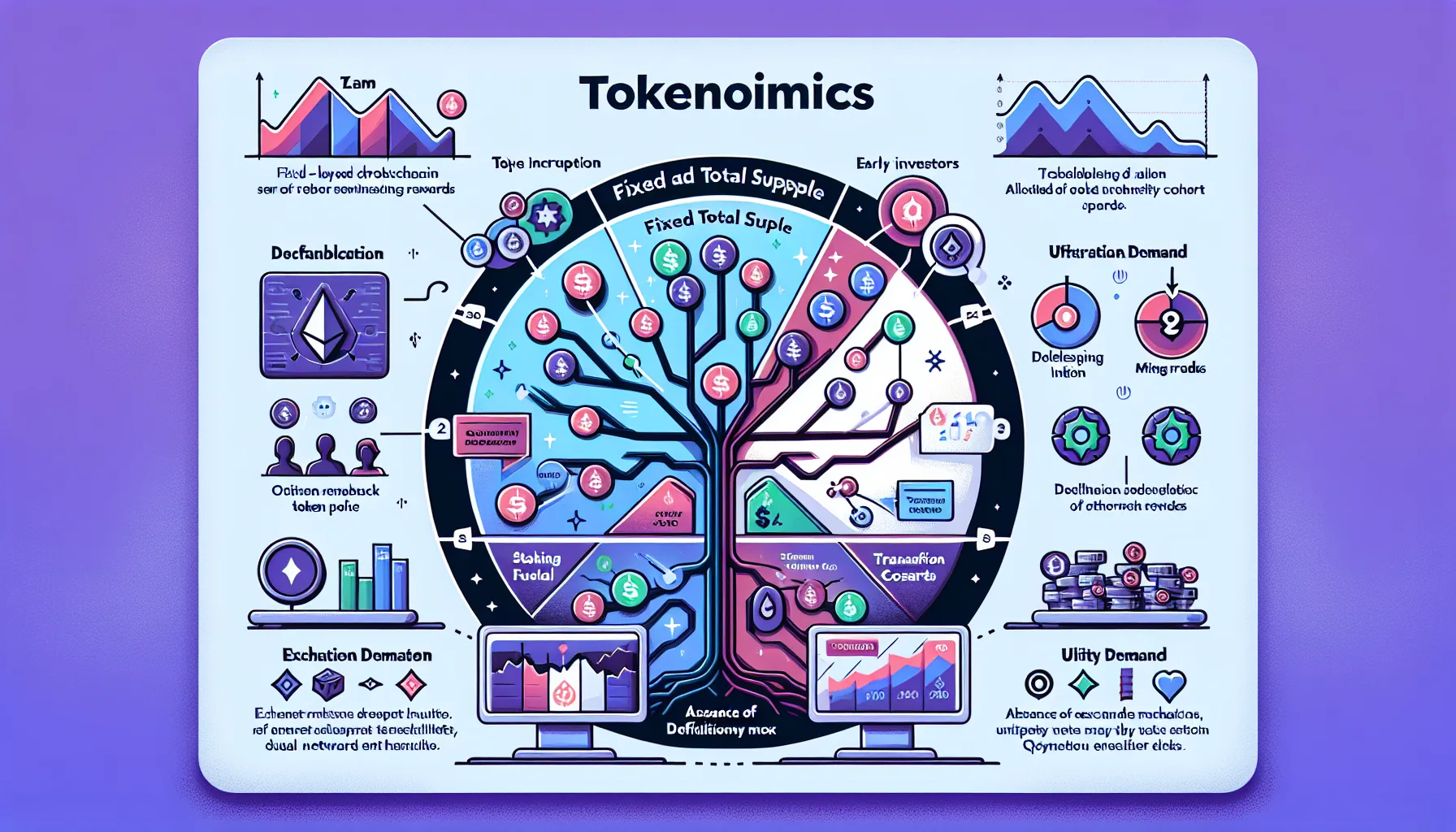
QuarkChain's native asset, QKC, has a fixed total supply, a crucial factor in its tokenomics design. The initial supply was minted at genesis, with a portion allocated to various stakeholders, including the team, advisors, and early investors. The remaining supply is released through mining rewards and staking incentives, aligning with QuarkChain’s two-layer blockchain architecture. The emission schedule follows a gradually decreasing model, ensuring a controlled supply distribution over time.
Staking and Gas Fee Mechanism
QKC serves a dual purpose within the QuarkChain ecosystem: it is required for transaction fees and network security through staking. Validators in QuarkChain’s consensus mechanism must stake QKC to participate in securing shard chains, creating a demand pressure for the token. Stakers earn rewards from gas fees and block rewards, though reward rates fluctuate based on network participation. The gas fee model follows a dynamic pricing system, which can lead to variability in transaction costs, especially during periods of high network congestion.
Token Distribution and Centralization Risks
A significant portion of QKC’s supply was allocated to early investors and the development team, raising concerns about potential centralization. While some of these tokens are vested over time, large holder concentrations have historically led to market liquidity concerns. Additionally, governance decisions remain primarily under the team’s control, limiting community-driven protocol upgrades compared to fully decentralized alternatives.
Inflation vs. Utility Demand
Since mining and staking rewards continuously introduce new tokens into circulation, inflation poses a risk to QKC’s value retention. The long-term sustainability of QKC depends on increasing network utility—transaction activity, DeFi applications, and enterprise adoption. If real demand cannot absorb the released supply, downward price pressure remains a concern.
Liquidity and Market Participants
QKC has broad exchange listings, offering accessibility to traders and liquidity providers. However, on-chain liquidity is more concentrated in centralized exchange markets, reducing usage within decentralized finance (DeFi) protocols. This limits financial composability and may impact decentralized trading pair developments within the QuarkChain ecosystem.
Token Burn and Deflationary Mechanics
There is no built-in burning mechanism in QKC’s tokenomics, meaning token supply persists unless manually burned through protocol-driven measures. Without a deflationary counterbalance, maintaining token scarcity relies solely on organic demand from network activity and staking participation.
QKC Governance
Governance Structure of QKC: On-Chain and Off-Chain Dynamics
QuarkChain (QKC) utilizes a hybrid governance model that combines on-chain mechanisms with off-chain decision-making processes. This setup aims to balance decentralization with operational efficiency but introduces trade-offs that impact transparency and community influence.
On-Chain Governance: Limited but Functional
QKC’s on-chain governance is relatively limited compared to fully decentralized ecosystems. Token holders primarily participate through staking and delegation, but direct governance influence is constrained. Smart contract upgrades and network parameter adjustments are largely managed by the core development team, with some input from validators and major stakeholders. Unlike systems with formalized DAO structures, QKC’s protocol-level decisions are not entirely community-driven.
Transaction fees and economic parameters are subject to periodic review but are not autonomously adjusted through token-holder voting. Proposals for governance changes must pass internal review before being implemented, which reduces governance friction but also diminishes direct community participation.
Validator Role and Network Influence
QKC’s sharding architecture means that validators play a crucial role in maintaining network security and performance. However, their governance power is indirect, focused primarily on consensus participation rather than protocol upgrades. While validators can theoretically coordinate to resist unfavorable changes, the governance framework does not formalize their role in decision-making beyond staking incentives and operational compliance.
Decentralization in validator selection remains a point of discussion. A concentration of power among a few large validators introduces potential risks, particularly if economic incentives drive centralization over time. Unlike some governance models that include quadratic voting or weighted voting systems to prevent dominance, QKC lacks explicit mechanisms to mitigate validator influence imbalances.
Off-Chain Decision-Making and Core Development Control
Much of QKC’s governance happens off-chain through developer roadmaps, foundation-led initiatives, and forum discussions. This centralized control allows for faster protocol upgrades but at the cost of reduced transparency and decentralization. Core team decisions dictate major network developments, with community input usually limited to feedback mechanisms rather than direct voting power.
While this governance approach enables efficient execution of technical improvements, it raises concerns about long-term sustainability and accountability. A lack of structured community-driven proposals means that governance decisions remain largely in the hands of a centralized entity, which could become a friction point for users seeking a more decentralized decision-making process.
Without structural enhancements to expand token-holder influence, QKC’s governance remains semi-centralized, favoring efficiency over fully decentralized control.
Technical future of QKC
QKC Technical Developments and Roadmap
Sharding Implementation and Optimizations
QuarkChain’s core scaling solution relies on sharding, but continuous optimizations are being explored to improve network efficiency. Recent developments focus on refining cross-shard transactions, which are crucial for maintaining usability in a multi-shard environment. Reducing latency and increasing throughput remain key priorities, as existing cross-shard execution still introduces complexity in transaction ordering and finality. Future improvements include enhanced shard synchronization through more efficient relay nodes and validator structures to reduce bottlenecks.
Virtual Machine Upgrades and EVM Compatibility
QuarkChain maintains EVM compatibility, allowing Solidity-based smart contracts to deploy on its network. However, ongoing development efforts include refining how smart contracts interact across shards, addressing the challenges of state fragmentation. Enhancements to the underlying virtual machine aim to improve execution efficiency and security, ensuring minimal stalling during inter-shard execution. Developers are also exploring additional layer-2 solutions to reduce gas costs while maintaining decentralization.
Consensus Mechanism Enhancements
The network’s hybrid consensus approach—leveraging a combination of proof-of-work (PoW) for mining and proof-of-stake (PoS) for governance—continues to evolve. Development efforts are focused on improving PoS integration to enhance chain security while optimizing validator incentives. Changes to mining difficulty adjustments and checkpointing mechanisms are under review to ensure long-term network stability. However, challenges remain in effectively tuning PoW and PoS parameters to prevent potential centralization risks while keeping the system efficient.
Interoperability and Cross-Chain Communication
Interoperability is a key focus, with ongoing work to facilitate cross-chain transactions beyond QuarkChain’s ecosystem. Development resources are allocated toward bridging protocols that enable seamless asset transfers between different blockchain networks. However, security remains a persistent concern, as cross-chain bridges have been a frequent target for exploits in the broader crypto space. Measures such as improved multi-signature verification and rollback mechanisms are being explored to mitigate risks.
Developer Tooling and Ecosystem Growth
Efforts are being made to enhance developer tooling for deploying and interacting with decentralized applications (dApps) on QuarkChain. The goal is to improve smart contract debugging tools, provide more robust SDKs for various programming languages, and enhance blockchain indexing services. Documentation and developer resources also require improvement, as fragmentation in available materials continues to pose onboarding challenges.
Network Governance and Decentralization Adjustments
As governance mechanisms evolve, developers are looking into refining voting frameworks that influence protocol upgrades and shard management decisions. Ensuring decentralized decision-making while maintaining efficient network upgrades is a tradeoff that remains under review. Further adjustments to governance parameters will likely be introduced based on network participation metrics and ongoing community feedback.
Comparing QKC to it’s rivals
QuarkChain (QKC) vs. Zilliqa (ZIL): A Comparison of Sharding Implementation and Network Efficiency
QuarkChain (QKC) and Zilliqa (ZIL) both leverage sharding as a scaling solution, but their approaches differ significantly in architecture, consensus mechanisms, and network dynamics. These differences influence factors such as transaction throughput, decentralization, and developer adoption.
Sharding Architecture: Flexibility vs. Fixed Design
QKC employs a two-layered blockchain structure, where multiple shards process transactions independently while a root chain maintains finality and security. This design allows QuarkChain to support heterogeneous shards, meaning different shards can run various consensus mechanisms or even distinct virtual machines. This flexibility theoretically enables cross-chain compatibility and specialized shard optimizations.
In contrast, ZIL utilizes a fixed shard structure with leader-based validation. Each shard processes a portion of transactions before aggregating them into final blocks. While this structured approach simplifies network management, it lacks the adaptability seen in QKC’s dynamic sharding model. However, this flexibility in QKC also introduces additional complexity, which can impact security considerations and developer accessibility.
Consensus Mechanism and Network Decentralization
ZIL implements a hybrid Proof-of-Work (PoW) and Practical Byzantine Fault Tolerance (pBFT) mechanism, where PoW is used for sybil resistance and pBFT ensures finality. This dual-layered approach establishes fast final settlement but requires synchronization across all shards, leading to centralization concerns at the leader node level.
QKC, on the other hand, employs a Proof-of-Stake (PoS)-enhanced framework where miners contribute hash power across multiple shards. The root chain manages cross-shard security and transaction verification. One major critique of this model is that shard mining distribution must be carefully balanced to prevent centralization risks where hash power is dominated by certain entities. Given the relative novelty of its implementation, long-term security and decentralization remain points of concern.
Smart Contract Execution and Developer Ecosystem
Both QKC and ZIL support smart contracts, but their execution environments differ. QuarkChain is EVM-compatible, allowing direct deployment of Ethereum-based dApps with minimal modifications. This lowers the barrier for developers migrating from Ethereum.
Zilliqa, by contrast, uses Scilla, a proprietary smart contract language designed for security and formal verification. While this offers improvements in contract safety, it also demands developers learn a specialized language, which can limit adoption. The trade-off between security and ease of use plays a critical role in developer traction for both platforms.
While QuarkChain’s heterogeneous sharding provides more flexibility than Zilliqa’s fixed design, the added complexity introduces trade-offs in decentralization and long-term stability.
Comparing QKC to ZIL: Performance and Architectural Differences
QuarkChain (QKC) and Zilliqa (ZIL) both aim to enhance blockchain scalability through sharding, but they differ significantly in architecture, consensus mechanisms, and developer ecosystems.
Sharding Implementation: Fundamental Approach Differences
ZIL employs a network sharding model where transactions are processed in parallel across multiple shards before final consensus is achieved by a DS (Directory Service) committee. This model guarantees high throughput but results in a rigid architecture where shard states require synchronization. In contrast, QKC uses a two-layered structure where microchains handle transactions before settling onto a root chain, providing more flexibility but also introducing complexity in cross-shard communication.
One of ZIL’s main advantages is the deterministic nature of its shard assignments, reducing intra-shard latency. However, this also creates potential bottlenecks when network congestion occurs in a specific shard. QKC’s model, while more adaptable, has required ongoing optimizations to handle inter-shard communication efficiently.
Consensus Mechanism: PBFT vs. PoSW
ZIL utilizes a hybrid consensus combining proof-of-work (PoW) for miner eligibility followed by practical Byzantine Fault Tolerance (PBFT) to finalize transactions. This structure significantly enhances security and finality speeds but also increases overhead due to frequent network coordination among consensus nodes.
QKC, on the other hand, employs a Proof-of-Stake Weighted (PoSW) model, which combines staking incentives with PoW to balance security and decentralization. While this approach decreases energy consumption compared to traditional PoW, it introduces complexities in validator selection and overall network governance that require continuous refinement.
Smart Contracts and Developer Accessibility
ZIL introduced Scilla, a proprietary smart contract language designed to reduce logic-based vulnerabilities while improving contract safety. The move to a custom language, however, has created adoption barriers as developers must learn an entirely new paradigm compared to more widely used Ethereum-like environments.
QKC has maintained EVM compatibility, providing developers with a more accessible development framework. While this broadens usability, it also limits some of the possible optimizations that a purpose-built language like Scilla offers for transaction processing and security.
Network Adoption and Ecosystem Strength
ZIL has seen stronger enterprise collaborations and a defined roadmap for integrating its technology with financial applications. However, the trade-off has been slower iterations in protocol updates due to its rigid governance model. In contrast, QKC’s more modular approach allows faster upgrades but also demands a higher level of network cohesion to maintain stability.
QKC vs. CKB: A Technical and Architectural Comparison
Consensus Mechanism and Security
QKC utilizes a sharded blockchain architecture with a hybrid consensus mechanism that combines Proof-of-Work (PoW) for mining and Practical Byzantine Fault Tolerance (PBFT) for finalizing blocks. This approach enhances scalability while maintaining a level of decentralization.
CKB, on the other hand, operates on the Nervos CKB consensus mechanism, which is a variant of PoW optimized for security and decentralization. Unlike traditional PoW chains, CKB separates state storage from computation using its layered architecture. This design allows it to serve as a base layer with strong security guarantees, especially for dApp development and state verification. However, the PoW-based approach of CKB means that it does not benefit from the same immediate finality advantages that QKC’s PBFT component provides.
State and Storage Model
QKC follows a more traditional account-based model with optimizations for sharding. Its infrastructure is designed to enable high transaction throughput by separating nodes into different shards, preventing bottlenecks.
CKB, in contrast, operates under the "Cell Model," which could be compared to Bitcoin’s UTXO model but is more flexible. This approach allows users to store arbitrary data on the blockchain, making CKB particularly valuable for data availability and smart contract execution. While this increases its ability to function as a base layer for decentralized applications, it also presents challenges in state bloat and efficient storage handling, something the ecosystem is attempting to mitigate through economic incentives like state rent.
Smart Contract Capabilities
QKC supports Ethereum-compatible smart contracts, enabling seamless migration of dApps from Ethereum and other EVM-based chains. This compatibility allows developers to leverage existing Solidity tooling and codebases.
CKB takes a different approach with its RISC-V-based virtual machine (CKB-VM). While this provides developers with greater flexibility in terms of supported programming languages (compared to Solidity-only environments), it also increases the learning curve and development complexity. The need for low-level optimizations and different security models may deter teams accustomed to standard EVM ecosystems, limiting its adoption for certain use cases.
Network Efficiency and Scalability
QKC's strength lies in its high throughput, achieved through sharding. By processing transactions in parallel across multiple shards, it aims to reduce congestion and improve efficiency. However, maintaining cross-shard communication without introducing latency remains a technical challenge.
CKB prioritizes long-term scalability through its layered approach, where Layer 2 solutions and off-chain computing handle high-frequency transactions. While this design potentially enhances scalability without compromising security, it depends heavily on secondary layers being actively developed and widely adopted, which is not an immediate guarantee.
Developer Ecosystem and Adoption Challenges
QKC benefits from Ethereum compatibility, making it easier for existing developers to onboard. However, fragmented liquidity across L1s and growing competition from other EVM-compatible chains pose risks to its adoption.
CKB, with its unique architecture, caters to a more specialized subset of developers. Its model enables novel use cases that aren't as straightforward on traditional account-based chains, but the tradeoff is that adoption can be slower due to the need for ecosystem-specific tools and education.
Primary criticisms of QKC
Primary Criticism of QKC
Concerns Over Network Centralization
One of the major criticisms of QKC is its potential centralization issues. While the project employs sharding to enhance scalability, concerns persist regarding how validator nodes are distributed and whether a small group of entities control a disproportionate portion of the network. The reliance on certain key participants for consensus has led to debates about whether the network is sufficiently decentralized to resist manipulation and censorship.
Unclear Governance and Development Trajectory
Another key issue with QKC is the lack of transparent governance mechanisms. Decision-making processes, particularly regarding network upgrades and protocol adjustments, have been criticized for being opaque or poorly communicated. This creates uncertainty among developers and investors, as unclear governance structures can lead to unpredictable roadmaps and potential conflicts among stakeholders regarding the project’s long-term direction.
Liquidity and Exchange Presence
Although QKC is listed on multiple exchanges, liquidity concerns have been raised. Traders have noted that order books can sometimes be thin, leading to slippage during large transactions. This impacts market efficiency, making it difficult for users to enter or exit positions without affecting the price. While liquidity issues are not unique to QKC, they contribute to concerns about its overall market adoption and usability.
Competition from More Established Scaling Solutions
QKC operates in a highly competitive sector where multiple projects are exploring scalability solutions through various approaches. Larger and more well-funded blockchain ecosystems offer Layer 2 alternatives, high-performance Layer 1 blockchains, and novel consensus mechanisms that compete directly with QKC’s sharding implementation. This intense competition raises concerns about QKC’s ability to maintain relevance, especially if its technology does not differentiate itself sufficiently from these alternatives.
Smart Contract Adoption and Developer Activity
Despite being a smart contract-capable blockchain, QKC has struggled to gain significant adoption among developers. While it supports Ethereum compatibility, the actual rate of decentralized application (dApp) deployment remains relatively low compared to leading smart contract platforms. The ecosystem’s growth depends on attracting developers, and without strong incentives, network effects may not take hold, limiting the blockchain’s utility.
Tokenomics and Inflationary Pressures
The tokenomics of QKC have also been a point of contention, with concerns that inflationary mechanisms could create sell pressure over time. If rewards for stakers or miners significantly outweigh demand for the token, sustained downward pressure on price valuation could become an issue. Critics argue that a well-balanced tokenomic model is necessary to ensure long-term sustainability and value retention.
Founders
QuarkChain (QKC) Founding Team: Background and Challenges
Qi Zhou – The Architect Behind QuarkChain
Qi Zhou, the founder of QuarkChain, is a blockchain researcher and engineer with a background in distributed systems and scalability solutions. He holds a PhD from the Georgia Institute of Technology and has previously worked at established tech companies, including Google and Facebook. His experience includes deep technical work in distributed databases and large-scale cloud infrastructures, which provided the foundation for QuarkChain’s sharding-based blockchain architecture.
Under Zhou’s leadership, QuarkChain was designed as a high-throughput blockchain network with multi-layered sharding to address inefficiencies in transaction scalability. His technical expertise played a key role in building the project's initial credibility among blockchain developers. However, despite his strong background, QuarkChain's adoption and development pace have faced challenges, leading to mixed long-term community sentiment.
The Core Development Team and Early Challenges
QuarkChain was developed by a team comprising engineers with extensive expertise in cryptography, blockchain security, and large-scale system design. Many of the project’s early developers had experience at major technology firms, particularly in distributed computing and networking. Their technical contributions helped implement QuarkChain’s dual-layered blockchain structure with dynamic sharding.
However, one of the key challenges faced by the team has been maintaining a balance between scalability and decentralization. Critics have pointed out that while QuarkChain’s technical architecture is innovative, full decentralization has been difficult to achieve, especially in aspects such as node distribution and network security. The reliance on a sophisticated sharding mechanism also increases the risk of cross-shard communication vulnerabilities, which have been an ongoing consideration for the team.
Leadership Decisions and Community Relations
Since its launch, QuarkChain’s leadership has made strategic decisions that have drawn diverse reactions from the crypto community. Certain aspects of token distribution and governance have raised concerns among early backers. Additionally, periods of slowed development and perceived lack of transparency around updates have led to skepticism from some investors and developers.
The team has continually worked on technological improvements, but competing scalability solutions such as Layer 2 networks and other sharding-based blockchains have presented external challenges. Despite technical achievements, the team has faced hurdles in sustaining long-term engagement from both developers and enterprises.
These factors highlight the complexities in managing an advanced blockchain project beyond just technical innovation, reinforcing the importance of strategic execution and community trust in the evolution of QuarkChain.
Authors comments
This document was made by www.BestDapps.com
Sources
- https://quarkchain.io/
- https://quarkchain.io/whitepaper/
- https://github.com/QuarkChain/pyquarkchain
- https://etherscan.io/token/0xea26b78255df2bbc31c1ebf60010d78670185bd0
- https://coinmarketcap.com/currencies/quarkchain/
- https://www.coingecko.com/en/coins/quarkchain
- https://docs.quarkchain.io/
- https://medium.com/quarkchain-official
- https://github.com/QuarkChain/quarkchain-devkit
- https://explorer.quarkchain.io/
- https://quarkchain.medium.com/quarkchain-mainnet-guide-611184bfdff5
- https://forum.quarkchain.io/
- https://quarkchain.io/faqs/
- https://defillama.com/protocol/quarkchain
- https://t.me/quarkchainio
- https://twitter.com/Quark_Chain
- https://github.com/QuarkChain/EIPs
- https://quarkchain.io/roadmap/
- https://quarkchain.io/developer-portal/


