History of PYR
The Origins and Evolution of PYR
PYR, the native token of the Vulcan Forged ecosystem, was conceived as a utility and governance token for a rapidly expanding blockchain gaming platform. Initially developed to support Vulcan Forged's suite of play-to-earn games and its NFT marketplace, PYR quickly became integral to the ecosystem’s staking, rewards, and transaction mechanisms.
Early Development and Token Genesis
PYR was launched as part of Vulcan Forged’s broader initiative to establish a decentralized gaming platform. The token’s initial distribution was met with enthusiasm from gaming and crypto communities, particularly due to its utility within the platform’s key offerings, such as VulcanVerse and other metaverse-related projects. From the outset, PYR was designed for in-game transactions, staking, and NFT trading, creating a closed-loop economy that incentivized participation.
Expansion and Ecosystem Growth
As user adoption increased, the Vulcan Forged team expanded the platform’s gaming ecosystem, integrating PYR into new products and services. The introduction of additional games and decentralized applications (dApps) further solidified PYR’s presence within the ecosystem. Additionally, the token’s cross-chain capabilities expanded with integrations beyond its initial blockchain, allowing for broader interoperability.
Security Breaches and Challenges
Despite its rapid growth, PYR’s history has been punctuated by security concerns. A major hack targeted the Vulcan Forged ecosystem, compromising user wallets and leading to the unauthorized withdrawal of PYR tokens. This event highlighted vulnerabilities in the platform’s infrastructure and briefly impacted trust in the ecosystem. In response, the team implemented enhanced security measures, including migrating to a new wallet system and providing compensation to affected users.
Adjustments to Tokenomics and Utility
As the Vulcan Forged ecosystem evolved, the utility and distribution model of PYR underwent several refinements. A key aspect of its tokenomics included deflationary mechanisms such as token burns, aimed at maintaining scarcity and long-term value. Adjustments were also made to staking rewards and play-to-earn incentives, balancing sustainability with user engagement. These shifts reflected the platform’s need to maintain long-term viability while keeping the token attractive to both gamers and investors.
Regulatory and Ecosystem Considerations
Like many blockchain-based assets, PYR has faced regulatory scrutiny. Compliance with evolving policies has remained an ongoing concern, particularly as token-based economies in gaming are increasingly examined by authorities. The project's decentralized approach helps mitigate some risks, but regulatory clarity remains a factor that could influence future developments within PYR’s ecosystem.
How PYR Works
How PYR Works: Mechanisms and Utility
PYR is the native utility token of the Vulcan Forged ecosystem, designed to facilitate transactions, incentivize participation, and govern various platform mechanics. It operates as an ERC-20 token on Ethereum while also being available on other networks such as Polygon for lower fees and faster transactions.
Staking and Fees
PYR is central to staking mechanisms within the Vulcan Forged ecosystem. Users stake PYR to access exclusive NFTs, earn rewards, and participate in ecosystem governance. The staking process typically requires locking tokens for specific periods, reducing circulating supply. However, this mechanism also exposes users to impermanent loss if the token’s value fluctuates significantly.
Transaction fees within the ecosystem are also denominated in PYR. Games and marketplace interactions require PYR payments, creating organic demand but also increasing costs for users who may need to acquire the token regardless of market conditions or network congestion.
Play-to-Earn and Marketplace Transactions
PYR fuels the ecosystem’s play-to-earn model. Players earn the token by engaging with Vulcan Forged’s gaming platform, completing tasks, and participating in events. However, token issuance through play-to-earn mechanisms can introduce sell pressure if demand does not match supply, potentially impacting long-term value retention.
The marketplace for NFTs and in-game assets operates on PYR, serving as the primary medium of exchange. All purchases, sales, and upgrades within Vulcan Forged’s ecosystem rely on the token, reinforcing its utility. However, fees and liquidity requirements may deter some users from fully engaging.
Layer-2 Integration and Multi-Chain Presence
Initially launched as an ERC-20 token, PYR has expanded to Polygon and other networks to address Ethereum’s high gas fees and slow transaction times. This multi-chain approach helps reduce friction for users while maintaining security through Ethereum’s established framework.
Despite these advantages, fragmentation across chains can present challenges in liquidity management and token bridging. Users moving PYR between networks need to account for fees, bridge reliability, and potential smart contract risks.
Utility Beyond Gaming
Beyond gaming transactions, PYR is used for governance, allowing holders to vote on ecosystem decisions. Governance participation can influence game mechanics, fee structures, and future development priorities. However, governance power is often concentrated among larger holders, potentially leading to centralized decision-making.
PYR’s burning mechanism also creates deflationary pressure by reducing token supply. A portion of transaction fees is burned, theoretically increasing scarcity over time. However, the effectiveness of this mechanism depends on overall transaction volume and sustained ecosystem engagement.
Use Cases
PYR Crypto Use Cases: Gaming, Staking, and Fees
In-Game Currency and NFT Transactions
PYR is integral to the Vulcan Forged ecosystem, primarily serving as the in-game currency across its blockchain-based titles. Players use PYR for purchasing, upgrading, and trading NFTs, including virtual land, characters, weapons, and other digital assets. This allows for true digital ownership, where assets can be freely exchanged on secondary markets. However, relying on PYR for all transactions within the ecosystem can introduce volatility concerns, as fluctuating token prices may impact affordability and asset valuations.
Staking for Rewards and Benefits
PYR holders can stake their tokens to earn rewards, often in the form of passive income or exclusive in-game perks. Staking mechanisms vary, with players sometimes required to lock up tokens to access premium content or reduced marketplace fees. This system incentivizes long-term holding but can also create barriers for casual users who may not want to commit assets upfront. Additionally, lock-up periods mean users may miss out on liquidity when they need it most.
Marketplace and Ecosystem Fees
The token is used for covering fees within the Vulcan Forged ecosystem, including marketplace transactions, NFT trades, and network-related costs. Fee structures typically include a percentage burn mechanism, potentially reducing circulating supply over time. While this deflationary aspect may appeal to some holders, increasing transaction costs during times of high activity could deter adoption, particularly if network congestion impacts efficiency.
Governance and DAO Integration
While PYR plays a role in governance, allowing holders to participate in decisions regarding game development and ecosystem upgrades, its impact can be limited. A concentration of holdings among a few whales could skew decision-making power, reducing the effectiveness of decentralized governance. This dynamic has been seen in other crypto projects, where governance often becomes dominated by early adopters or large stakeholders rather than the broader community.
Cross-Chain Utility and Bridging Risks
PYR supports multi-chain interoperability, allowing users to move assets between networks. This enhances accessibility but introduces security risks often associated with cross-chain bridging, including smart contract vulnerabilities and potential exploits. Users must weigh the benefits of expanded functionality against the risks posed by third-party bridge services or underlying bridge mechanics.
While PYR enables multiple use cases within Vulcan Forged and beyond, practical challenges remain in terms of access, volatility, and network dynamics. Each application has benefits and trade-offs that impact user experience and adoption.
PYR Tokenomics
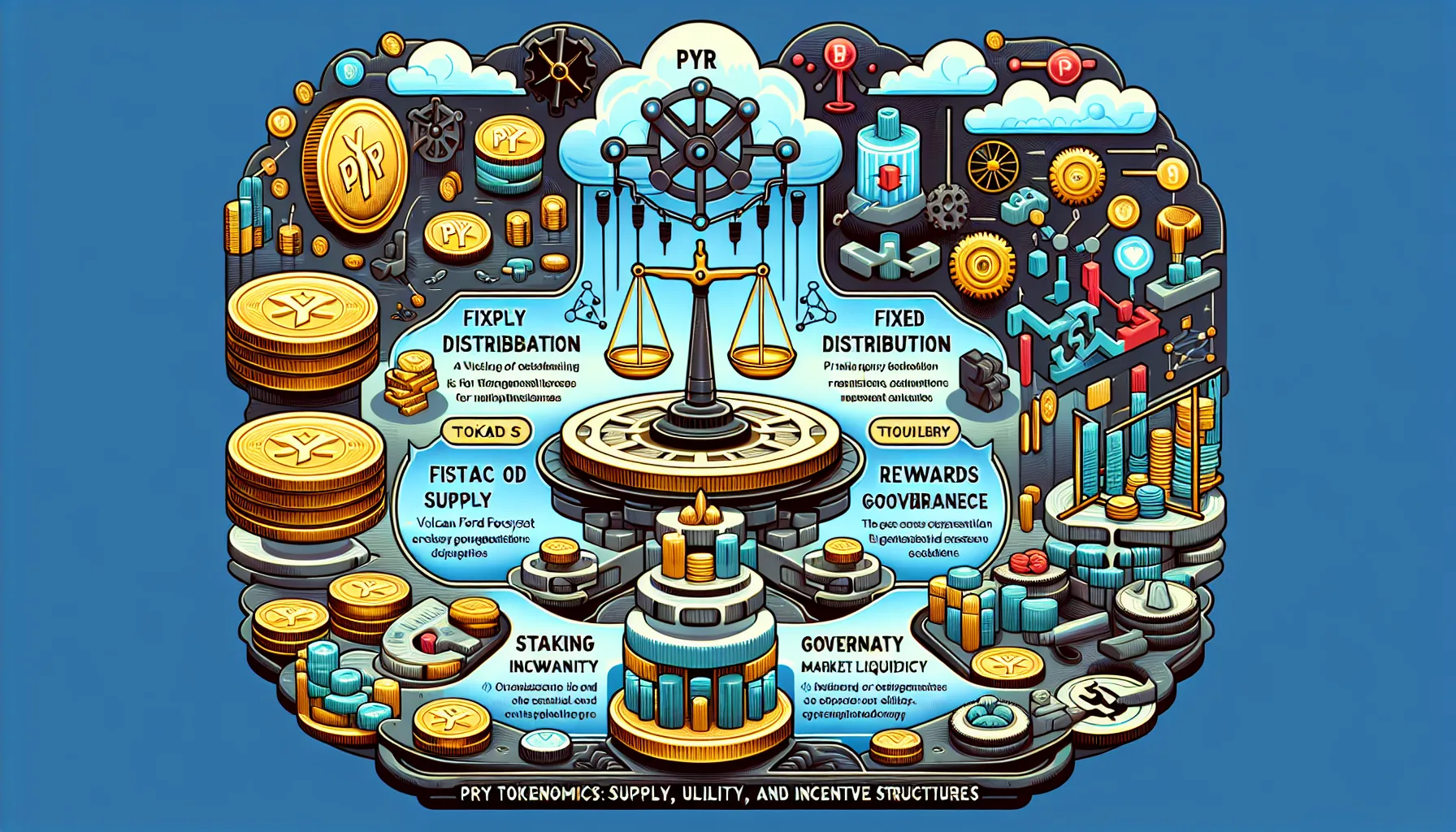
PYR Tokenomics: Supply, Utility, and Incentive Structures
Fixed Supply and Distribution
PYR operates with a fixed total supply, ensuring scarcity as a fundamental driver of value. The token allocation spreads across various stakeholders, including ecosystem incentives, team allocations, and community rewards. A portion of the supply is reserved for staking rewards, further influencing circulating availability. However, concerns arise regarding the initial token distribution, particularly regarding allocations to early investors and team members, which could result in long-term centralization risks if not managed transparently.
Utility in the Vulcan Forged Ecosystem
PYR serves as the primary transactional layer within the Vulcan Forged ecosystem. It facilitates marketplace transactions, staking mechanics, and play-to-earn (P2E) incentives. A key mechanism involves token burning, where fees from marketplace transactions contribute to reducing total supply over time. While this deflationary mechanism supports price stability, the overall impact depends on transaction volume and adoption rates within the ecosystem. The reliance on a single utility token also exposes risk if user activity decreases, potentially limiting transactional demand.
Staking and Reward Incentives
PYR staking provides users with yield opportunities and tier-based benefits within the ecosystem. These include access to exclusive NFTs, reduced transaction fees, and governance participation. The staking design locks supply out of circulation for variable periods, which can create temporary supply constraints. However, concerns exist around sustainability, particularly if staking rewards lead to inflationary pressures or if user retention drops, reducing staking participation over time.
Governance and Decision-Making Power
Although PYR integrates governance functions, its effectiveness depends on the extent of decentralization. Token holders can participate in decision-making, yet governance weight is often skewed toward entities with substantial holdings. If a limited group controls governance, it could weaken decentralization goals and raise concerns surrounding fair protocol evolution. Mechanisms to prevent governance centralization remain key to ensuring a balanced decision-making structure.
Market Liquidity and Emission Considerations
Circulating supply dynamics play a role in PYR’s market performance. Unlocking schedules, vesting periods, and liquidity provisions significantly affect short-term and long-term price stability. Periodic token releases from team allocations or ecosystem funds can impact market liquidity if not properly structured. While emission schedules are typically predictable, any unexpected changes could introduce volatility or investor uncertainty.
PYR’s tokenomics rely heavily on continued ecosystem engagement, structured staking models, and optimized supply mechanics. While numerous deflationary and incentive-based mechanisms exist, maintaining a balance between supply constraints, utility-driven demand, and decentralization remains an ongoing challenge.
PYR Governance
Governance Mechanisms of PYR: Token Utility & Decentralization Challenges
PYR plays a critical role in the governance of the Vulcan Forged ecosystem, granting holders influence over certain aspects of platform development and decision-making. However, governance implementation remains an ongoing process, with varying degrees of decentralization.
Community Voting and Decision-Making
PYR holders are expected to participate in governance through voting mechanisms, typically influencing ecosystem decisions, upgrades, and potential adjustments to in-game economies tied to Vulcan Forged titles. While governance structures have been proposed, the extent to which token holders have meaningful control remains dependent on governance implementations that are still evolving.
Governance via Staking Mechanisms
One method of governance involvement is staking PYR for specific privileges. Token staking provides holders access to certain decision-making abilities, including potential voting rights on upgrades, ecosystem grants, and treasury allocations. However, governance implementation through staking is not fully autonomous, meaning that core development teams and centralized entities may still exert dominant influence over major strategic directions.
Decentralization vs. Centralization Concerns
Despite PYR’s role in governance, concerns exist regarding the balance between token-holder control and centralized decision-making by Vulcan Forged developers. If governance structures remain predominantly off-chain or if proposals lack execution transparency, token-holder influence may be limited in practice. The risk of centralized control over essential ecosystem decisions, particularly regarding treasury management or game economy adjustments, could raise concerns for those seeking a fully decentralized framework.
Smart Contracts and Governance Execution
For governance to function effectively, smart contracts need to autonomously execute decisions made by the community. However, governance-related contracts in the PYR ecosystem are not fully trustless, meaning that certain changes might still require approval from core developers or entity-controlled mechanisms. This can become a point of contention if stakeholders demand more decentralized execution processes.
Future Implications for Governance Expansion
While governance mechanisms tied to PYR provide some involvement for token holders, the extent to which governance will scale into a decentralized autonomous organization (DAO) model remains uncertain. For governance to be robust, transparency in voting, execution, and treasury management will be critical. The ongoing evolution of governance contracts, staking incentives, and community participation will determine how much authority truly rests with PYR holders versus centralized teams driving ecosystem development.
Technical future of PYR
PYR Technical Roadmap and Future Developments
Layer-2 Scaling and EVM Compatibility
The development team behind PYR is prioritizing Layer-2 scaling solutions to mitigate Ethereum's congestion issues and high gas fees. One ongoing effort is the integration of an Optimistic Rollup framework aimed at reducing transaction costs and improving transaction finality. Additionally, EVM compatibility remains a key focus, with plans to ensure that smart contracts built within the ecosystem can seamlessly interact with existing Ethereum-based protocols. However, the complexity of maintaining full interoperability across multiple chains remains a challenge, particularly in ensuring security and avoiding centralization risks.
Cross-Chain Integrations and Bridging Challenges
PYR’s roadmap includes expanding cross-chain compatibility, particularly through multi-chain bridge integrations. Efforts are being made to enhance decentralized bridging mechanisms to reduce the reliance on custodial systems that introduce counterparty risks. One of the major hurdles in these integrations is ensuring that the bridging infrastructure remains resistant to exploits, as many previous cross-chain protocols have been targeted due to weak security assumptions.
NFT Marketplace Upgrades and Smart Contract Optimizations
PYR is heavily integrated into the blockchain gaming sector, and its NFT-related functionalities are continuously evolving. Planned developments focus on advanced smart contract optimizations aimed at reducing minting fees and enabling dynamic metadata updates for in-game assets. However, challenges exist in ensuring that these smart contract upgrades remain backward-compatible with existing assets, preventing fragmentation within the ecosystem.
On-Chain Governance and Decentralization Efforts
Governance mechanisms tied to PYR are undergoing modifications to provide token holders with more direct influence over protocol upgrades and treasury allocations. A shift toward fully on-chain governance models is being explored, though the technical implementation remains complex due to potential voter apathy and governance attack vectors such as Sybil attacks and vote manipulation by concentrated token holders.
Security Enhancements and Smart Contract Audits
The team is placing emphasis on regular security audits, particularly with the increasing number of contracts deployed within the ecosystem. The roadmap highlights continuous penetration testing and immunity hardening for core protocols, although the effectiveness of these security measures remains dependent on the adoption of best practices by third-party developers building within the PYR ecosystem.
Technical Bottlenecks and Scalability Constraints
While there are ambitious scaling solutions in development, achieving low-latency and high-throughput execution remains a challenge, especially in the context of decentralized game asset management. The ability to process complex game logic on-chain without sacrificing performance continues to be a significant technical constraint that requires ongoing optimizations.
Comparing PYR to it’s rivals
PYR vs. IMX: A Deep Dive into Gaming-Focused Crypto Assets
Layer 1 vs. Layer 2 Approach
One of the core distinctions between PYR and IMX lies in their blockchain architecture. PYR operates on its own EVM-compatible L1 chain, Vulcan Forged Elysium, which allows for greater control over network dynamics, fees, and governance. In contrast, IMX is a Layer 2 scaling solution on Ethereum utilizing StarkEx’s ZK-rollup technology. IMX benefits from Ethereum’s security while reducing gas fees and transaction finality times, but it remains dependent on Ethereum’s ecosystem decisions.
Elysium’s L1 approach grants PYR independence in setting network rules, but it also means it must bootstrap security and adoption from scratch. IMX, being a Layer 2, bypasses this hurdle by leveraging Ethereum’s vast liquidity and user base. However, reliance on Ethereum’s infrastructure means IMX inherits Ethereum’s limitations, such as network congestion during high-activity periods.
Token Utility and Economic Model
Both PYR and IMX serve as the primary gas and governance tokens for their ecosystems, but their tokenomics differ significantly. PYR is deeply integrated into the Vulcan Forged gaming ecosystem, serving as a staking asset, marketplace currency, and node-incentive mechanism. Additionally, Elysium introduces a novel gas-to-tree mechanism where network transaction fees are directed towards carbon offset initiatives—a unique feature absent in IMX’s model.
IMX, by contrast, is primarily used for gas fee payments and governance voting within Immutable X, but it also employs a fee-sharing model where 20% of protocol fees must be paid in IMX, creating a buy-pressure mechanic. A major difference is that IMX lacks a native block production process, as its transactions are settled on Ethereum, whereas PYR functions as a primary gas asset within its own chain.
Ecosystem and Adoption
IMX has positioned itself as an onboarding-focused infrastructure layer, integrating with multiple Web3 games, NFT marketplaces, and mainstream game studios. Its zk-rollup technology allows developers to implement gas-free transactions, solving a key UX barrier for blockchain gaming adoption. PYR, meanwhile, focuses heavily on a vertically integrated gaming ecosystem, with first-party developed games and partnerships forming the core of its ecosystem.
IMX’s interoperability across various projects gives it an advantage in network effects, whereas PYR’s approach relies on adoption of Elysium-native infrastructure. While PYR offers a more self-sufficient ecosystem, IMX’s broader integration potential makes it a more immediate plug-and-play solution for developers looking for Ethereum scaling without launching on a separate chain.
PYR vs GALA: A Detailed Comparison
Core Utility and Ecosystem Differences
PYR is deeply embedded in the Vulcan Forged ecosystem, focusing on an all-in-one blockchain gaming platform with an emphasis on NFT marketplaces, metaverse integrations, and developer-friendly tools. In contrast, GALA operates within the Gala Games ecosystem, which prioritizes decentralization through its node-based infrastructure, allowing users to participate in network governance while supporting game hosting.
A key distinction lies in their strategies—PYR operates within its own ecosystem, offering native tools like Elysium, a dedicated blockchain tailored for gaming applications. GALA, on the other hand, leans heavily on partnerships with developers, aiming to decentralize game publishing rather than creating a unified gaming marketplace.
Tokenomics and Rewards Mechanisms
Both PYR and GALA serve as utility tokens, but their economic models differ substantially. PYR is used for in-game transactions, NFT purchases, staking, and fee settlements across the Vulcan Forged ecosystem. GALA, while also used for transactions and governance, integrates a unique node reward system, incentivizing users through GALA emissions based on node participation. However, this model has faced criticism for potential over-inflation, with concerns over long-term sustainability. PYR's tokenomics are structured to mitigate inflation, incorporating mechanisms such as burning fees on transactions performed on Vulcan Forged products.
Game Portfolio and Market Presence
PYR is primarily focused on developing and nurturing its first-party games, with flagship titles like VulcanVerse leading the ecosystem. GALA, meanwhile, takes an aggregator approach, onboarding third-party developers and licensing games to foster a wider variety of offerings. This allows GALA to feature a broader range of gaming styles but introduces challenges in maintaining consistent quality and engaging user adoption across its portfolio.
Additionally, GALA’s heavy emphasis on a decentralized node system introduces complexities in game distribution, raising concerns over reliability and dependency on community-run infrastructure. PYR, with its singular ecosystem approach, benefits from more centralized control over its game servers and marketplace operations, reducing possible disruptions.
NFT Integration and In-Game Economy
Both platforms enable NFT ownership, but GALA integrates NFTs into gameplay mechanics on a game-by-game basis, whereas PYR emphasizes interoperability across its ecosystem. The Vulcan Forged ecosystem encourages users to carry digital assets across multiple titles, enhancing asset utility. However, GALA’s approach allows for distinct economic models per game, making some titles more accessible while others remain highly monetized, depending on developer preferences.
Scalability remains a critical aspect where PYR’s blockchain strategy with Elysium could provide long-term efficiency, whereas GALA’s multi-game roadmap depends on sustaining developer interest and continuous user engagement.
PYR vs. SAND: A Deep Dive into Their Ecosystem Differences
When comparing Vulcan Forged (PYR) and The Sandbox (SAND), the key differentiator lies in their approach to blockchain gaming and the metaverse. While both aim to create expansive play-to-earn ecosystems, the execution and focus of each project diverge significantly.
Ecosystem and Use Case Variations
PYR operates within the Vulcan Forged ecosystem, which is structured around its own marketplace, game studio, and blockchain solutions. By comparison, SAND is centered around user-generated content (UGC) and virtual land ownership, positioning itself as a decentralized gaming platform where users and brands can create experiences using voxel-based assets.
SAND leverages a no-code experience for creators, allowing easier entry for developers, artists, and players looking to monetize content. PYR, on the other hand, integrates a more traditional gaming approach, catering to studios and gamers with an interest in blockchain-backed economies but with a focus on in-house development rather than an entirely open-world creator economy.
Blockchain Infrastructure and Scalability Challenges
One significant distinction comes in blockchain scalability. The Sandbox operates on an Ethereum-based layer, relying on Polygon for lower fees, but transaction congestion remains an issue during peak activity periods. PYR utilizes an ecosystem that is increasingly moving toward a multi-chain approach, reducing reliance on a single network for scalability.
Gas costs have been a persistent challenge for SAND-related transactions, especially as LAND sales and in-game assets see high demand. PYR mitigates some of these concerns by incorporating its customized Lava Pool system, which provides gas-free transactions under specific conditions.
Token Utility and Economic Model
Both PYR and SAND serve as the respective backbone currencies of their ecosystems, but their tokenomics diverge. SAND is heavily tied to its LAND sales, staking mechanisms, and in-game marketplace. However, criticism surrounds the centralized decision-making and token release schedules, which have led to concerns about vested allocations and developer-controlled supply distributions.
PYR takes an alternative route with a tiered staking system and in-game utility that rewards both players and developers in a controlled ecosystem. While both projects emphasize decentralization, SAND has faced issues related to governance token concentration, where a significant portion of the ecosystem remains under the influence of core team wallets.
Adoption and Market Positioning
The Sandbox has gained significant traction due to strong brand partnerships and mainstream adoption strategies, with collaborations spanning entertainment, sports, and fashion. This has positioned SAND as a recognizable metaverse brand, though user retention has been inconsistent due to the long development timeline and the reliance on landowners to create engaging content.
PYR, by contrast, appeals more to a dedicated blockchain gaming audience, focusing on an ecosystem driven by actively developed games. While it lacks the same mainstream branding appeal as SAND, its model ensures that its gaming-specific user base remains engaged with tangible use cases beyond speculative land ownership.
Primary criticisms of PYR
Primary Criticism of PYR
Centralization Concerns in Ecosystem Development
Despite its positioning as a blockchain gaming asset, one of the most common criticisms of PYR is the degree of centralization within its ecosystem. The development and management of the Vulcan Forged platform remain heavily controlled by its core team, raising concerns among crypto purists who prioritize decentralization. While some aspects of the ecosystem employ blockchain mechanics, decision-making, game integrations, and marketplace functionalities often rely on centralized oversight. This raises questions about governance, transparency, and the long-term resilience of the project.
Smart Contract and Security Risks
Security remains a persistent issue in blockchain-based gaming and NFT ecosystems, and PYR has not been immune to vulnerabilities. Smart contract reliability is a major area of concern, particularly given the history of exploits within similar crypto gaming platforms. Concerns about how well PYR’s architecture safeguards against breaches, exploits, or improper access continue to be debated within the community, especially given the complexities of multi-chain asset support.
Liquidity and Utility Efficiency
A key point of criticism regarding PYR is the actual efficiency of its token utility. While it serves multiple functions, including staking, marketplace transactions, and rewards, users have raised issues about friction in the overall token economy. Problems such as liquidity constraints, high transaction fees under certain conditions, and occasional inefficiencies in reward distribution have been discussed within the community. These factors make it less seamless for users trying to actively engage with the ecosystem without friction.
Market Manipulation and Token Distribution
The concentration of token holdings among early adopters and large stakeholders has led to concerns about potential price manipulation and market control. Questions have been raised about how PYR’s tokenomics influence market movements, particularly concerning token unlock events or significant redistributions. Speculation around whether the ecosystem’s incentives align with smaller holders or primarily benefit early investors has fueled skepticism around long-term fairness.
Gaming Adoption and Sustainability Challenges
Despite PYR’s focus on blockchain gaming, one major area of criticism is the actual adoption rate of its gaming ecosystem. While blockchain-based gaming has gained traction, retaining user engagement is an ongoing challenge. Many blockchain games struggle with sustainability, and concerns exist regarding whether the Vulcan Forged platform can continuously attract and maintain an active player base beyond speculative interest. If game content fails to keep users engaged, PYR’s long-term viability as a gaming ecosystem token could face substantial hurdles.
Founders
The Founding Team Behind PYR: Leadership, Vision, and Challenges
Founder and Visionary Leadership
PYR, the native token of the Vulcan Forged ecosystem, was founded by Jamie Thomson. Thomson has played a central role in shaping the project’s direction, leveraging his background in blockchain gaming and platform development. His leadership has been instrumental in positioning Vulcan Forged as both a game studio and an NFT-driven ecosystem. However, the project’s rapid growth has not been without challenges, particularly in areas of security and platform expansion.
Core Team and Technical Foundations
While Jamie Thomson serves as the primary public figure, the broader Vulcan Forged team includes blockchain developers, game designers, and financial strategists focused on the token's utility and integration within play-to-earn mechanics. The team has built a self-contained ecosystem where PYR is used for staking, governance, and in-game transactions. However, critics have pointed out that much of the development has centered around the Vulcan Forged platform, raising questions about broader interoperability and decentralization.
Security Incidents and Team Accountability
One of the most notable challenges the PYR team has faced was a significant security breach that resulted in the loss of user assets. While the team acted quickly to reimburse affected users and improve security, the incident raised concerns about the project’s overall security measures. Some in the crypto community argue that the breach highlighted weaknesses in the platform's infrastructure, emphasizing the need for a more decentralized security model.
Community Engagement and Transparency
The Vulcan Forged team actively engages with the community through social media channels and governance mechanisms. While they promote an open dialogue, there have been instances where users questioned the transparency of certain decisions, particularly regarding tokenomics and ecosystem expansions. The team continues to navigate the balance between company-driven decision-making and decentralized governance, an ongoing issue for many blockchain-based projects.
Balancing Growth and Sustainability
PYR’s growth has been fueled by the Vulcan Forged ecosystem, but the project’s long-term sustainability relies on whether the founding team can effectively scale beyond a single gaming platform. Some concerns remain regarding the dependency on internal game adoption rather than broader blockchain integrations, making leadership decisions crucial for maintaining long-term value.
Authors comments
This document was made by www.BestDapps.com
Sources
- https://vulcanforged.com/
- https://docs.vulcanforged.com/
- https://whitepaper.vulcanforged.com/
- https://medium.com/vulcanforged
- https://twitter.com/VulcanForged
- https://etherscan.io/token/0x430ef9263e76dae63c84292c3409d61c598e9682
- https://polygonscan.com/token/0x430ef9263e76dae63c84292c3409d61c598e9682
- https://coinmarketcap.com/currencies/vulcan-forged-pyr/
- https://www.coingecko.com/en/coins/vulcan-forged
- https://playtoearn.net/blockchaingame/vulcan-forged
- https://dappradar.com/polygon/games/vulcan-forged
- https://github.com/VulcanForged
- https://vulcanforged.medium.com/
- https://vulcanforged.com/terms-and-conditions
- https://vulcanforged.com/news
- https://www.binance.com/en/price/vulcan-forged
- https://cointelegraph.com/tags/vulcan-forged
- https://cryptoslate.com/coins/vulcan-forged/
- https://defillama.com/protocol/vulcan-forged
- https://nftnow.com/tag/vulcan-forged/


