History of PYR
The History of PYR: Tracing the Origins of Vulcan Forged’s Token
PYR, the native utility token of the Vulcan Forged ecosystem, has its roots linked directly to the rapid growth of blockchain-based gaming and NFT marketplaces. The journey of PYR began as a critical response to the limitations of traditional ecosystems for gamers and creators, seeking to merge decentralized finance (DeFi) with a user-focused metaverse economy. Vulcan Forged, the platform hosting PYR, initially launched as a small NFT game studio but quickly evolved into a multi-faceted blockchain powerhouse.
The token's inception ties closely with the rise of Ethereum-based dApps, but Vulcan Forged decided to pivot from Ethereum’s scalability restrictions by integrating an Ethereum Layer-2 solution. PYR was designed to facilitate transactions such as NFT sales within Vulcan Forged’s marketplace, sustain staking mechanisms, and fuel the play-to-earn model within its portfolio of games like VulcanVerse. While the architecture aimed to relieve congestion and high gas fees, early adopters faced hurdles with wallet integrations and bridging processes, exposing frictions in on–ramping for new users.
The creators of Vulcan Forged focused on community building, initially offering PYR to early adopters through play-to-earn incentives and reward mechanisms. This approach rapidly expanded user engagement and participation across its gaming ecosystem but wasn’t without challenges. Critics flagged the tokenomics model as being overly dependent on in-game usage and rewards, raising concerns over potential vulnerabilities to hyperinflation.
A pivotal moment in PYR’s history came when Vulcan Forged suffered a significant wallet breach affecting numerous users in its network. Approximately $140 million worth of PYR was compromised, escalating concerns over platform centralization and custodial weaknesses. Despite these setbacks, the project took extensive measures to improve security protocols, implementing mandatory two-factor authentication (2FA) and non-custodial wallet solutions. Nevertheless, some participants voiced reservations about the ease of use and complexity in adapting to these upgrades.
Another notable development in PYR’s timeline was its eventual cross-chain expansion through partnerships with Polygon and Binance Smart Chain (BSC). This allowed PYR holders greater flexibility and access to liquidity pools while mitigating Layer-1 congestion. However, critics argued that such expansions fragmented the ecosystem, leading to discrepancies in token usage across platforms.
From a macro-viewpoint, PYR’s historical trajectory demonstrates the intersection of blockchain gaming innovation and the recurring challenges of scalability, security, and user adoption logistics. The token’s development underscores the complex relationship between visionary ambitions and real-world technical limitations, laying the groundwork for ongoing evolution within the Vulcan Forged universe.
How PYR Works
How PYR Works: The Mechanics Behind the Vulcan Forged Ecosystem
PYR is the native utility and settlement token at the core of the Vulcan Forged ecosystem, a blockchain-powered gaming and NFT platform. Built on Ethereum and Polygon Layer 2 for scalability, the token underpins the functioning of its decentralized applications, including play-to-earn games, NFT marketplaces, and staking mechanisms. Here’s a detailed breakdown of how PYR operates.
Core Utility and Use Cases
PYR primarily functions as a medium for transactions within the Vulcan Forged ecosystem. This includes game-related payments, trading fees on the Vulcan Market NFT marketplace, and staking for passive income. One of its key applications is in facilitating "fee delegation," which allows users to transact within the ecosystem without worrying about gas fees—Vulcan Forged subsidizes these costs if the user holds a minimum amount of PYR. This setup aims to make blockchain-based gaming more approachable, though it does introduce centralization risks since protocol-level fees are managed by Vulcan Forged, not the user.
Additionally, PYR tokens are tied to in-game rewards. Users earning resources or completing achievements in Vulcan Forged games like "VulcanVerse" are rewarded in PYR, aligning with the play-to-earn model. However, the dependency on constant game activity raises questions about sustainability, especially if user adoption plateaus. A drop in player activity could reduce token utility and diminish its perceived value.
Staking and Reward Distribution
PYR introduces a staking mechanism, enabling users to lock their tokens in exchange for rewards. Those who actively participate in staking can earn another token, LAVA, which acts as a secondary asset within the ecosystem, used for in-game utilities and crafting NFTs. While this dual-token system is designed to expand use cases and reduce selling pressure, it has received criticism for potential overcomplication.
Cross-Platform Functionality
Through its multi-chain deployment, PYR leverages Ethereum for transparency and Polygon for reduced transaction costs. Interoperability is a key selling point, but it brings challenges, particularly around bridging tokens between chains. Users must execute the correct bridging steps, and any failure—whether due to user error or technical flaws—can result in lost funds. These risks highlight the importance of cautious navigation within the ecosystem.
Concerns About Centralization
One pertinent issue is the ecosystem’s reliance on Vulcan Forged as a controlling entity. While they advertise decentralization, the development team maintains significant control over transaction fees, token supply mechanics, and platform updates. This centralized backend raises concerns about its alignment with blockchain ideals of self-custody and transparency.
Use Cases
Use Cases of PYR: Driving Dynamics in NFT Gaming and Beyond
PYR, the native utility token of the Vulcan Forged ecosystem, plays a pivotal role in facilitating functionalities across its gaming-focused blockchain projects. As a key component in the Vulcan Forged ecosystem, PYR is primarily utilized within their NFT-based gaming platforms, creating cross-platform synergy for gamers, developers, and creators. This multi-functional application provides diverse utility but also introduces certain complexities worth considering.
In-Game Currency and Marketplace Integration
One of the primary use cases of PYR lies in its role as an in-game currency across Vulcan Forged’s suite of games. It allows players to purchase in-game assets, participate in NFT trading, or pay for upgrades that customize and enhance their experience. The integration of PYR into these ecosystems ensures transactional efficiency while simultaneously reinforcing the value proposition of the token to the Vulcan Forged ecosystem. However, the reliance on PYR could also limit user adoption in regions or demographics with limited crypto accessibility, particularly users unaccustomed to moving between wallets or exchanges.
Staking and Rewards Mechanisms
PYR introduces a staking mechanism where users can lock their tokens within the ecosystem to gain benefits, such as reduced marketplace fees or access to exclusive items. Additionally, staking PYR can also reward users with LAVA, another token integral to Vulcan Forged’s applications. While the staking model incentivizes long-term holding, it can create issues for liquidity, especially if the majority of the circulating supply becomes tied up in staking pools. The double-token economy (PYR and LAVA) also demands users to navigate dual layers of interaction, which can complicate the user experience.
Play-to-Earn Utility
Vulcan Forged games integrate PYR into their play-to-earn mechanisms, rewarding players for in-game achievements or contributing to ecosystem development. By combining entertainment with financial gain, the token fits seamlessly into the growing GameFi narrative. Despite this, the sustainability of the play-to-earn model is often questioned, as it heavily relies on continuous demand for NFTs or tokens. If user acquisition slows, token distribution could outpace its utility, leading to potential devaluation.
Development Aid and Governance
PYR also contributes to funding game developers within the ecosystem, particularly through grant programs designed to attract talent and expand the platform's offerings. Furthermore, PYR holders may have governance rights, enabling them to participate in ecosystem decision-making. While this fosters decentralization and community involvement, low voter turnout or governance apathy can hinder effective decision implementation, particularly in niche ecosystems where user concentration is lower than broader crypto projects.
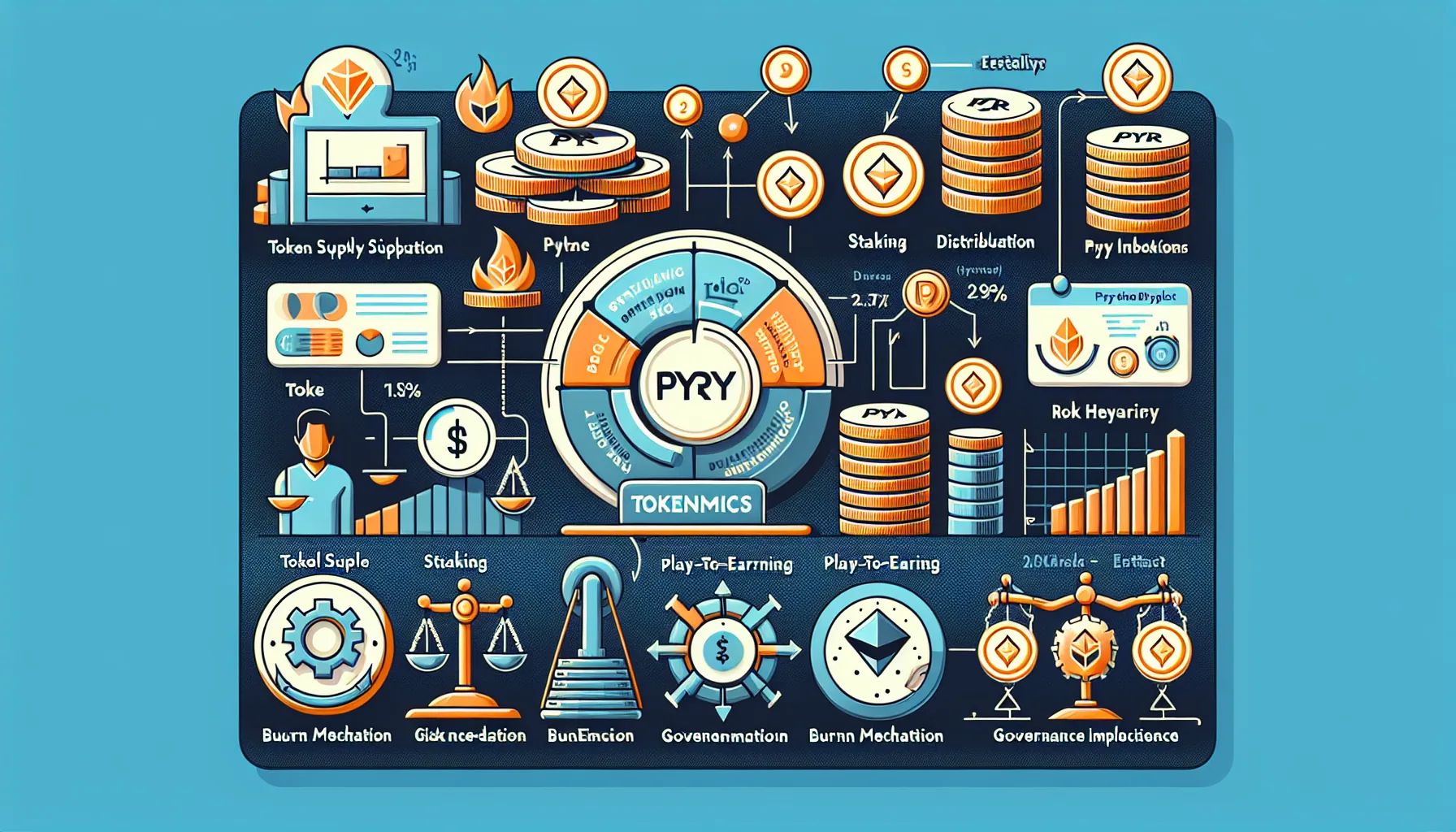
PYR Tokenomics
PYR Tokenomics: A Deep Dive into Supply and Utility Structure
Token Supply and Distribution
The PYR token operates with a capped maximum supply of 50 million tokens, which is designed to create scarcity and align with the deflationary nature of blockchain asset design. However, questions surrounding the distribution mechanics have been raised. Initially, a notable portion of the tokens was allocated to private investors, team members, and advisors, which some believe creates concentration risks. Early-stage token holders often capture substantial control over circulating supply, something seasoned crypto investors may view as a potential for centralization and market manipulation.
Beyond the initial distribution, PYR’s vesting schedule for team and investor allocations is worth noting. While a vesting structure is put in place to reduce the impact of token dumping, critics argue that transparency on vesting milestones lacks clarity, leaving stakeholders to speculate on when notable unlock events might occur. This is a factor to consider for liquidity and market activity over time.
Use Cases: Staking and Play-to-Earn
The PYR token serves as the lifeblood of its underlying ecosystem, offering various utility mechanisms such as staking rewards and play-to-earn functionalities. Staking is a cornerstone in its tokenomics, where users lock up PYR to earn rewards, participate in governance votes, or gain additional perks within the ecosystem. However, questions regarding the sustainability of staking rewards persist. If the rewards are funded primarily from inflation or ecosystem fees, it raises concerns about long-term economic viability, especially when user adoption stalls or fees decrease over time.
Play-to-earn mechanics further integrate PYR into its ecosystem, incentivizing active user engagement. While this feature creates demand within the ecosystem, critics often highlight potential vulnerabilities, such as dependence on user acquisition rates. If new users fail to enter the ecosystem at a pace that sustains demand, token value utility could erode. This risk is compounded by gaming ecosystems historically struggling with economic imbalances between earners and spenders.
Burn Mechanism and Fees
The introduction of a burn mechanism for PYR is intended to contribute to its deflationary nature, with a percentage of fees generated from ecosystem transactions permanently removed from circulation. This could theoretically counterbalance inflationary pressures. However, concerns arise over whether this burn rate sufficiently offsets new token issuance during staking or other reward distributions. A misalignment here may dilute long-term holder value, prompting scrutiny on net token sink efficacy.
Governance Implications
PYR token holders are granted governance rights within the project’s ecosystem, but one notable issue is the asymmetry of influence. Large stakeholders naturally wield disproportionate power, which underscores centralization concerns in governance decision-making. Tight oligarchic control could deter smaller participants from engaging long-term, shrinking the decentralized ethos.
PYR Governance
Governance of PYR: A Deep Dive into Decentralization and Decision-Making
PYR, the native token of the Vulcan Forged ecosystem, plays a pivotal role in the governance structure of its platform. As a crypto-savvy audience, it's critical to dissect how PYR integrates with the ecosystem’s decentralized processes and analyze potential strengths and deficiencies of its governance framework.
Decentralized Decision-Making
At its core, PYR functions as a utility and governance token, enabling holders to influence key decisions within the Vulcan Forged ecosystem. Token holders are empowered to propose and vote on changes, spanning game integrations, ecosystem expansion, and updates to the play-to-earn (P2E) framework. The objective is to ensure that the community exercises substantial control over the platform’s direction. However, a central question remains: does the governance framework adequately reflect the diverse interests of its stakeholders, or does it suffer from concentration of influence?
Stake-Based Voting Mechanism
The governance mechanism leverages a stake-weighted voting system, where each PYR token grants proportional voting power. While this model is standard among many blockchain projects, it inherently carries risks of centralization. Wealthier stakeholders or early adopters with deep PYR holdings have the potential to dominate voting outcomes, potentially sidelining smaller token holders. Within crypto ecosystems, this imbalance often sparks concerns about equitable representation and undermines the ethos of decentralization.
Proposal Process and Transparency
To initiate changes within the Vulcan Forged ecosystem, proposals must undergo specific processes before reaching a vote. This ensures that poorly-thought-out ideas or malicious intentions are filtered early in the governance pipeline. However, there are questions regarding the clarity and transparency of this process. For example, are all community members adequately informed of upcoming proposals? Are there safeguards to prevent coordinated action by a select group that might impact the voting process?
Potential Problems with Off-Chain Influence
Although on-chain governance is a hallmark of decentralized systems, off-chain influence could still plague PYR’s governance. External partnerships, whale coordination, and private negotiations may have the potential to sway decisions beyond what the token-weighted results might suggest. This dual-layered risk—on-chain centralization coupled with off-chain influence—poses a challenge to the integrity of the governance system.
Governance Utility Beyond Voting
PYR’s governance utility extends beyond merely deciding on development initiatives. Governance parameters might also determine tokenomic adjustments, such as staking yield rewards or token burn ratios. While this aligns stakeholders with long-term ecosystem health, the complexity of these decisions could alienate holders without sufficient technical expertise, effectively gatekeeping participation.
Technical future of PYR
PYR Technical Developments and Roadmap: Advancing Blockchain Gaming Infrastructure
The PYR token, the core utility asset within the Vulcan Forged ecosystem, continues to evolve with a focus on robust technical development and infrastructure enhancements. At its core, Vulcan Forged leverages blockchain technology to power a decentralized gaming platform that integrates NFTs and play-to-earn mechanics. Below, we explore the ecosystem's current technical implementations and future roadmap.
Expanding Layer-1 Blockchain Support
One key technical focus for PYR is the expansion of its dedicated blockchain, Elysium. Elysium is designed as an eco-friendly blockchain solution tailored for NFTs and gaming applications. It supports high transaction throughput and reduced energy consumption, a technical edge in meeting the scalability demands of its growing ecosystem. Enhancements to Elysium’s consensus mechanism are reportedly being worked on to further optimize transaction finality and reduce latency, though critics have pointed out potential centralization concerns due to node operator requirements.
Elysium's interoperability remains an ongoing technical challenge. While the project has integrated with Ethereum and Polygon for cross-chain NFT activity, further work is necessary to seamlessly scale its multi-chain functionality. The introduction of bridges for other popular networks has been hinted at but not yet realized, limiting the utility of PYR in a fully interoperable DeFi ecosystem.
NFT Marketplace and Smart Contract Refinement
The Vulcan Forged marketplace, a critical component of the PYR ecosystem, is undergoing continuous upgrades for better scalability and user functionality. A shift towards more advanced smart contract functionalities—including automated royalties, dynamic NFTs, and modular contract architecture—aims to enhance the developer and user experience. However, the technical debt incurred from early marketplace iterations occasionally results in bugs and exploits, challenging the platform’s technical resilience.
Gaming SDKs and Middleware Development
A significant portion of the roadmap revolves around strengthening Vulcan Forged’s game development tools. Its proprietary gaming SDKs aim to attract developers by simplifying the integration of blockchain mechanics, such as token economies and asset tokenization, into traditional game design. However, development pace and documentation support remain areas where the community has expressed concern, as competing platforms have already rolled out more developer-friendly middleware options.
Future Advances in DeFi Integration
The roadmap for PYR suggests deeper DeFi integration through staking models, liquidity pools, and lending protocols tied explicitly to in-game assets and NFTs. While this could unlock new utilities for PYR and broaden its use case, it introduces regulatory risk and technical complexity. Security audits of these new protocols must remain rigorous, especially given the recent rise in DeFi exploits across the industry.
Technical progress in the PYR ecosystem is evident, but challenges surrounding decentralization, interoperability, and competitive differentiation persist. The roadmap's execution will be critical to addressing these pain points.
Comparing PYR to it’s rivals
PYR vs. IMX: A Detailed Comparison of Gaming-Focused Crypto Assets
Navigating the competitive world of blockchain gaming tokens, PYR (Vulcan Forged) and IMX (Immutable X) stand out due to their nuanced approaches to supporting NFT ecosystems and decentralized gaming infrastructures. While both share common ground in catering to blockchain-based gaming economies, their underlying platforms, and technical structures diverge, shaping user adoption and utility in markedly different ways.
Layer-1 vs. Layer-2 Foundations
PYR operates on a multi-chain ecosystem, notably leveraging Ethereum and Polygon, which positions it as a versatile and interoperable solution. In contrast, IMX functions as a dedicated Layer-2 scaling protocol built specifically on Ethereum, utilizing ZK-Rollups to enhance transaction speed and reduce gas fees. This focused optimization grants IMX a significant edge in scalability and user experience for gamers and NFT traders who rely heavily on seamless transactions. However, IMX’s reliance on Ethereum's infrastructure means it’s susceptible to any systemic challenges faced by the Ethereum network, such as congestion or future protocol upgrades.
Developer and User Focus
The Vulcan Forged ecosystem emphasizes integrating gaming development tools, providing support through features like no-code tools and APIs for developers. PYR also encourages community input with initiatives like “Create Your Own Game,” aligning its growth strategy with user participation. On the other hand, IMX prioritizes scalability for Web3 games by offering APIs dedicated to NFT minting and management. The tradeoff for IMX here lies in its more developer-centric approach, which may alienate non-technical users looking for intuitive entry points into blockchain gaming.
NFT Marketplace Dynamics
IMX places a core focus on enabling high-speed NFT minting and trading, boasting a carbon-neutral footprint as a value proposition to environmentally conscious users. This aligns well with the surge in NFT activity but may pigeonhole IMX’s appeal primarily to developers and NFT platforms rather than to broader gaming enthusiasts. PYR, meanwhile, powers the Vulcan Marketplace, which directly integrates with its native game titles, offering a more holistic gaming-first ecosystem. Nevertheless, PYR's reliance on a centralized approach within its marketplace ecosystem contrasts with the decentralized ethos championed by IMX, a point of contention for purist blockchain advocates.
Token Utility and Adoption
Both PYR and IMX tokens serve as integral pieces of their platforms, supporting staking, marketplace transactions, and rewards distribution. However, PYR’s staking model is often criticized for its relatively higher barrier to entry compared to IMX’s straightforward, low-cost staking environment. IMX’s token mechanics focus more on fueling its ecosystem’s transactional throughput, while PYR is deeply tied to community governance and monetizing in-game interaction. Users seeking simplicity may favor IMX, while PYR’s model could appeal to those who value deeper ecosystem participation.
Trade-offs in Ecosystem Growth
One of the challenges for IMX lies in fostering diverse, quality gaming projects on its platform, as its focus remains tightly bound to infrastructure optimization. PYR, however, wrestles with scaling its current user base beyond its existing titles, creating a slower onboarding process for new developers and users.
PYR vs. IMX: A Detailed Comparison of Functional Ecosystems and Use Cases
When analyzing PYR and IMX, two blockchain projects operating in the gaming and NFT sectors, the comparison largely boils down to their ecosystem strategies, technical frameworks, and approaches to scalability and user adoption within decentralized gaming economies.
Ecosystem Depth: Vertical Integration vs. Marketplace Dominance
PYR focuses on creating a vertically integrated gaming ecosystem through its Vulcan Forged platform, which revolves around in-house games and tools. In contrast, IMX (Immutable X) prioritizes a marketplace-first approach. IMX serves as a Layer-2 scaling protocol for Ethereum, designed specifically for NFTs in gaming and other collectible-centric ecosystems, enabling developers across platforms to mint and trade NFTs with no gas fees.
While PYR emphasizes an all-in-one ecosystem for its users—integrating its own titles, NFT creation tools, and marketplaces—IMX takes a more modular role. It functions as infrastructure to support independent gaming developers by providing interoperability and liquidity through its Immutable X marketplace. As a result, IMX has captured a larger share of crypto projects beyond its native games, giving it broader appeal though potentially less cohesion than PYR's tightly-knit ecosystem.
Scalability and Gas Fee Solutions
IMX utilizes ZK-Rollups, an Ethereum Layer-2 scaling solution that aggregates and processes transactions off-chain before batching them back onto the Ethereum blockchain. This allows IMX transactions to maintain Ethereum-level security while being extremely cost-efficient, boasting near-zero gas fees for NFT transactions. PYR, on the other hand, operates on a hybrid blockchain structure using an EVM-compatible sidechain model, VulcanVerse, and nevertheless incurs some gas costs depending on activity type.
For developers and users, IMX's reliance on ZK-Rollups may seem more appealing due to its alignment with Ethereum's broader network, but such reliance could also carry risks tied to Ethereum's own network bottlenecks or ecosystem decisions. PYR’s sidechain model, while somewhat independent, offers less technical compatibility with large Ethereum-based projects aiming to onboard NFTs seamlessly.
Adoption Among Developers
IMX’s acceleration through partnerships is noteworthy. It has appealed to major names by providing a generalized infrastructure, allowing full flexibility for developers to control their branding and in-game economies. However, this "plug-and-play" approach may dilute direct ties between IMX and its partnering dApps, as loyalty to the base infrastructure is rarely strong when developers have other Layer-2 options emerging in the market.
In comparison, PYR's bespoke ecosystem fosters tighter connections between developers and the Vulcan Forged platform. While this can be a strength, it may also limit outside adoption, as developers seeking a more neutral foundation might hesitate to commit to an ecosystem carrying another layer of its own branding.
Liquidity Challenges
IMX's focus on marketplace dominance and interoperability can make its ecosystem reliant on broad-based NFT adoption trends. Low liquidity in specific gaming assets might hamper its utility for casual users if critical mass isn't achieved within particular projects. In this regard, some argue it spreads its value proposition thin by not having a killer app or flagship game cementing its influence in gaming.
PYR vs. MANA: A Strategic Comparison in Metaverse Gaming Ecosystems
When dissecting PYR’s positioning within the crypto gaming and metaverse landscape, MANA (the native token of Decentraland) emerges as a significant rival. Both projects operate at the intersection of blockchain gaming and virtual economies, but their foundational approaches diverge, defining their respective strengths and weaknesses.
One of the fundamental distinctions lies in the core infrastructure supporting each platform. MANA is deeply integrated within Decentraland, a fully decentralized virtual world owned and governed by its users via a DAO (Decentralized Autonomous Organization). This structure gives MANA holders direct voting rights over the platform’s development trajectory, enabling community-driven decisions. In contrast, PYR, as the lifeblood of Vulcan Forged, focuses on a broader ecosystem of NFT-based games and dApps, relying on its tailored Elysium blockchain to enhance transaction scalability and environmental sustainability. While Decentraland’s DAO governance bolsters its reputation as a truly decentralized metaverse, critics argue that community consensus processes can slow decision-making and hinder swift technical advancements.
Another key comparison point is user engagement within the ecosystem. Decentraland’s approach emphasizes virtual real estate (LAND) as a central pillar of its economy, sparking interest among investors seeking scarce digital assets. However, the utility of LAND has been questioned, with some users finding limited interoperability and a lack of gamified incentives for broader participation. PYR addresses this gap by structuring its ecosystem around gaming mechanics, fostering deeper engagement through play-to-earn (P2E) models and diverse game experiences. That said, Vulcan Forged’s centralized development raises concerns about long-term decentralization, potentially posing risks to its community ethos.
From a technological perspective, MANA operates on the Ethereum network, relying on Layer 2 solutions to mitigate gas fees and transaction bottlenecks. This dependence introduces challenges, as network congestion can impact user experience for transaction-heavy interactions. PYR sidesteps this issue by leveraging Elysium, but this proprietary solution increases its exposure to isolated risks—critical for a blockchain that’s yet to achieve the adoption scale of Ethereum.
Finally, both tokens must grapple with sustainability challenges in onboarding non-crypto-native users. MANA’s reputation benefits from its branding as one of the earliest metaverse pioneers, but some argue that its dated visuals and limited gameplay loop hinder mass market appeal. PYR, with its gaming-first strategy, appears more engaging for casual adopters, though its relatively narrower community size limits its current global reach.
By contrasting PYR with MANA, it becomes clear that their differences highlight trade-offs between decentralization, technological agility, and user-centered design.
Primary criticisms of PYR
Primary Criticism of PYR: Concerns Surrounding Sustainability and Ecosystem Growth
While PYR has garnered attention within the play-to-earn and NFT gaming sector, the platform and its ecosystem are not without their critics. The following are notable issues and challenges faced by PYR, structured to help readers deeply understand where skepticism arises from crypto enthusiasts and developers alike.
Centralization Concerns in Game Development
One point of contention lies in the centralized nature of game development within the Vulcan Forged ecosystem. Critics highlight that while PYR presents itself as a gateway to decentralized gaming, the underlying gaming mechanics and decision-making processes often remain under the control of the core development team. This lack of decentralization in game operations raises red flags, especially for purists who view decentralization as a fundamental principle of blockchain-based ecosystems. Skeptics argue that this setup could lead to imbalanced power dynamics within the community, undermining the trust ethos central to crypto projects.
Tokenomics and Supply Allocation Issues
The distribution model and utility of PYR tokens have also been called into question. Critics argue that the ecosystem’s heavy reliance on PYR for staking, in-game purchases, and rewards could lead to a fragile token economy. If user adoption or game engagement plateaus, the demand for PYR tokens could weaken, potentially destabilizing the ecosystem. Additionally, some have raised concerns about the initial distribution of tokens, questioning whether early insiders or large holders have outsized influence on the market.
Scalability for Mass Adoption
While Vulcan Forged promotes cross-chain functionality, critics suggest PYR may face difficulties scaling as the user base grows. Blockchain-based gaming platforms are notably resource-intensive, and although layer-2 solutions and sidechains mitigate some of these limitations, the infrastructure is still evolving. If the underlying blockchain networks encounter performance bottlenecks, PYR users could experience increased fees, slower transaction times, and reduced accessibility—issues that could drive users to competing platforms.
Security and Data Breaches
PYR has not been immune to security criticisms due to past incidents involving breaches within the platform. Even though the team has implemented solutions to bolster security post-incident, these events have left some users questioning the platform’s reliability. For a crypto-savvy audience, any exploits or vulnerabilities erode confidence, particularly in a space where trustlessness is a key selling point.
Limited Interoperability in Practice
While PYR markets itself as being blockchain-agnostic, critics suggest that its interoperability features have been more limited in practice than advertised. True cross-chain integration demands significant development resources and partner coordination, and some users feel that PYR’s interoperability claims may be overstated when compared to its actual current capabilities. This raises questions about how much practical utility the token delivers outside the Vulcan Forged ecosystem.
Community Governance Gaps
Though the platform states its intention to build a decentralized and community-driven ecosystem, many in the crypto community have observed gaps in community governance mechanisms. Critics argue that token holders have limited say in major decisions, with the core team retaining most of the influence. Such a structure contradicts the principles of decentralized autonomy many crypto enthusiasts expect from blockchain ecosystems.
In summary, while PYR and Vulcan Forged bring innovative concepts to blockchain gaming, these criticisms showcase the potential risks and challenges that may impact both growth and user trust over time.
Founders
Founding Team Behind PYR: A Deep Dive into Visionaries and Challenges
The crypto asset PYR, a key player in the GameFi and NFT ecosystem, was developed by Vulcan Forged, an innovative blockchain-based game studio. The founding team, led by Jamie Thomson, has been instrumental in conceptualizing and driving the project forward. Thomson, serving as the CEO of Vulcan Forged, has a background in blockchain gaming and digital asset development, with previous experience in creating gamified decentralized applications. His leadership has provided a strong technical and creative direction for PYR’s ecosystem.
However, while Thomson’s vision has been integral to establishing PYR’s foothold in GameFi, the team faced criticism in the past regarding security vulnerabilities. Specifically, in a high-profile incident, the platform suffered a security breach that resulted in the theft of user funds. This incident called the team’s security infrastructure into question and highlighted the challenges of scaling a blockchain gaming platform while ensuring user confidence. In response, Vulcan Forged overhauled its security systems and introduced a semi-decentralized custodial wallet to address these vulnerabilities. Yet, this approach has sparked debates among crypto purists who advocate for full decentralization, raising philosophical questions about the project's direction.
The core team combines expertise in blockchain, gaming, and business development, with members hailing from diverse professional backgrounds that align with the unique challenges of building a GameFi project. The team is supported by a broader network of developers, artists, and marketing experts, whose work ensures the seamless integration of PYR into the existing Vulcan Forged ecosystem. This includes infrastructure for VulcanVerse, the platform’s flagship metaverse, and other proprietary games. While this multidisciplinary approach has been praised for fostering innovation, some in the community argue that the lack of transparency regarding individual team members’ identities creates hurdles for establishing deeper trust.
Another challenge tied to leadership is the apparent limited focus on forming strategic partnerships outside of the Vulcan ecosystem. Critics suggest this insularity could hinder PYR’s expansion and adoption in a competitive GameFi landscape where cross-platform collaborations often play a vital role in driving utility and awareness.
Despite these hurdles, the Vulcan Forged team remains a committed group of developers and creators actively iterating on the PYR ecosystem. For those examining the long-term success of PYR, the team’s ability to adapt to these challenges will likely remain a crucial factor.
Authors comments
This document was made by www.BestDapps.com
Sources
- https://www.vulcanforged.com/
- https://docs.vulcanforged.com/
- https://medium.com/vulcanforged
- https://whitepaper.io/document/1048/vulcan-forged-whitepaper
- https://coinmarketcap.com/currencies/vulcan-forged-pyr/
- https://www.coingecko.com/en/coins/vulcan-forged
- https://twitter.com/vulcanforged
- https://www.reddit.com/r/VulcanForged/
- https://github.com/VulcanForged
- https://vulcanverse.substack.com/
- https://dappradar.com/rankings/protocol/vulcan-forged
- https://vulcanforged.medium.com/deconstructing-pyr-tokenomics-part-1-c02c9d5dfc07
- https://vulcanverse.com/
- https://www.youtube.com/c/VulcanForged
- https://coinsutra.com/pyr-vulcan-forged-review/
- https://playtoearn.net/blockchaingame/vulcan-forged
- https://metaverseinsider.tech/2023/02/09/vulcan-forged-the-key-ecosystem-in-play-to-earn-gaming/
- https://cryptoslate.com/coins/pyr/
- https://pyr.dapp.com/
- https://academy.binance.com/en/articles/what-is-vulcan-forged-pyr


