History of OST
The History of OST (Simple Token)
OST, originally known as Simple Token, emerged as a solution to facilitate the creation of branded crypto economies for businesses without requiring deep blockchain expertise. The project was founded by the team behind Pepo, a blockchain-powered social app, and backed by a broader vision of simplifying tokenization for mainstream adoption.
Token Sale and Early Adoption
OST raised capital through an ICO during the height of the token sale frenzy, successfully attracting significant funding. The sale positioned OST as a utility token designed to function within a broader Layer-2 ecosystem that enabled companies to launch their own branded tokens on the Ethereum network. The project aimed to tackle issues related to scalability and user experience by abstracting complex blockchain interactions.
Development of OpenST Protocol
A key component of the OST ecosystem was the OpenST protocol, which allowed businesses to stake OST tokens and generate their own branded tokens with minimal friction. This mechanism was promoted as a way to bring tokenized economies to real-world applications. However, despite the conceptual appeal, adoption remained limited beyond OST’s own ecosystem-driven initiatives.
Shift in Strategy and Challenges
As the crypto landscape evolved, OST faced challenges in gaining mainstream traction. The rise of competing Layer-2 scaling solutions and enterprise blockchain infrastructures posed difficulties in positioning OST's technology as an industry standard. Additionally, regulatory uncertainties around tokenized economies further complicated adoption efforts.
OST’s association with Pepo was an attempt to showcase a real-world use case, integrating OST's token technology into a user-generated content platform. While Pepo demonstrated practical token utility through microtransactions and incentives, it struggled to achieve significant market penetration, limiting OST’s value proposition beyond its native ecosystem.
Token Migration and Project Evolution
Throughout its development, OST underwent strategic shifts including a token migration proposal that aimed to align with a new focus. The evolving priorities of the team led to exploration of integrations with other blockchain architectures, signaling a departure from the original branded token economy concept. However, these transitions resulted in fragmentation within the OST community, as some early supporters found it challenging to keep up with the shifting roadmap.
Like many early ICO projects, OST's journey reflects both the opportunities and obstacles associated with blockchain adoption. Its attempts at driving mainstream token usage highlighted fundamental crypto UX challenges that remain relevant in broader industry discussions.
How OST Works
How OST Works: Layer-2 Scaling and Branded Tokens
OST is designed to facilitate the creation of branded tokens on Ethereum using a layer-2 protocol. At its core, OST enables businesses and developers to launch their own token economies without dealing with Ethereum’s congestion and gas fees. The system operates through a set of smart contracts and a sidechain architecture that enhances scalability.
Protocol Mechanics and Token Architecture
OST operates on OpenST, a protocol that allows value representation from Ethereum on a more efficient transactional layer. Businesses stake OST tokens on Ethereum to mint equivalent branded tokens on a sidechain. These branded tokens remain pegged to the value locked in the Ethereum mainnet contract, enabling a secure yet scalable system.
The protocol relies on utility smart contracts that define staking, minting, and redemption functions. When a branded token transaction occurs, it is handled on the layer-2 chain, with periodic state commitments submitted to Ethereum. This minimizes costs while ensuring cryptographic verifiability.
Layer-2 Scaling Through Staked Representation
OST’s system relies on staking OST tokens to generate branded tokens. This staking mechanism ensures that the value on the sidechain remains collateralized. However, reliance on staking introduces liquidity risks—if large amounts of OST are locked for minting, unstaking can become a bottleneck, affecting businesses needing high turnover.
By leveraging Merkle proofs and hashed transaction data, sidechain activities can be reconciled against Ethereum’s mainnet. This approach reduces direct dependency on Ethereum for every transaction while maintaining an auditable trail. The downside is the dependency on periodic settlements, meaning any failure in state synchronization can lead to disputes or lag in finalizing transactions.
Developer Interaction and Smart Contract Limitations
OST provides SDKs and APIs to integrate branded token functionalities with minimal blockchain expertise. This lowers adoption barriers but also means developers are restricted to OST’s predefined frameworks. Customization is limited because smart contract logic must adhere to OpenST’s rules, which might not be flexible enough for complex DeFi applications or unique tokenomics.
Additionally, since OST’s architecture is not a general-purpose layer-2 but specifically tailored for branded tokens, its use cases are constrained. Businesses requiring cross-chain interoperability or non-token functionalities may find it restrictive compared to broader layer-2 solutions like rollups or Plasma.
Security and Trust Assumptions
Because OST relies on a staking model to collateralize branded tokens, economic security depends on the integrity of the underlying OST token. If the token value significantly fluctuates, the collateral backing the system can weaken, raising concerns about long-term stability.
Additionally, while the protocol leverages Ethereum for finality, its operational security partly relies on off-chain validators and bridge mechanisms. Any exploit in these components could compromise token integrity before reconciliation on Ethereum.
Use Cases
OST Token Use Cases: Enabling Branded Token Economies
Tokenizing In-App Transactions
OST was designed to help businesses create and manage branded token economies with minimal blockchain expertise. By integrating OST, platforms can tokenize rewards, in-app purchases, and payments. This allows companies to provide token-based incentives for user engagement, referrals, and content creation while leveraging blockchain transparency. However, adoption barriers remain, as integrating OST requires development resources and a fundamental shift in how value is transferred in-app.
Loyalty and Rewards Programs
Brands can use OST to issue loyalty tokens that can be earned and redeemed within ecosystem-specific economies. This offers advantages over traditional loyalty points, including provable scarcity, tradeability, and interoperability with external wallets. However, liquidity concerns arise since OST-based tokens have limited exchangeability unless explicitly designed for outside use. Additionally, reliance on smart contracts means security risks must be carefully managed.
Micropayments and Digital Goods
OST enables low-friction micropayments through branded tokens, reducing dependency on centralized payment processors. This use case is particularly relevant for gaming, content platforms, and media businesses looking for cost-efficient transactions. However, user experience challenges persist, as wallet management and gas fees (where applicable) can introduce friction, especially for non-crypto-native users.
Interoperability and Multi-Platform Integration
One of OST's key utilities is the ability to create custom token ecosystems while still benefiting from Ethereum’s security model. This allows seamless integration across multiple platforms, enabling token transfers between apps while maintaining a degree of decentralization. Despite this, significant UX tradeoffs exist. Users must often bridge tokens, manage multiple wallets, or deal with contract interactions that complicate onboarding.
Automated Smart Contracts for Business Logic
OST’s architecture enables businesses to automate various financial and engagement models via smart contracts. This includes subscription services, tiered access models, and conditional rewards. While this automation reduces reliance on intermediaries, smart contract vulnerabilities remain a risk, and businesses must ensure they are secure against potential exploits.
Challenges in Ecosystem Adoption
While OST presents a compelling utility for tokenized economies, adoption hurdles exist. Businesses need clear incentives to move away from traditional point systems, and users may be hesitant due to unfamiliarity with blockchain mechanics. Furthermore, dependency on Ethereum means scalability challenges can arise, particularly during periods of network congestion.
OST Tokenomics
OST Tokenomics: Supply, Utility, and Distribution
Fixed Supply and Token Allocation
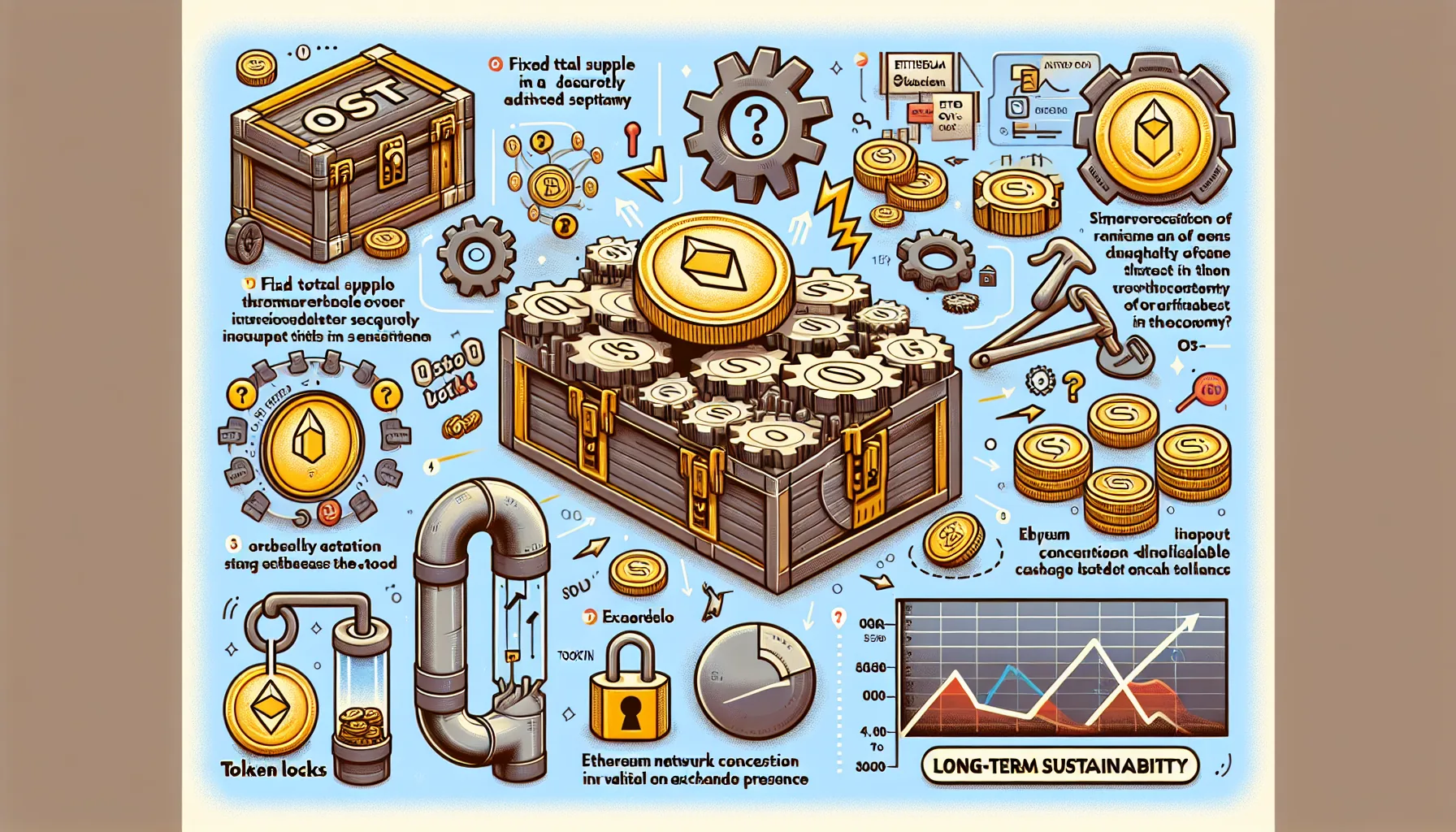
OST has a fixed total supply, ensuring that no additional tokens can be minted. The initial distribution followed a structured allocation, with portions designated for ecosystem incentives, team, advisors, and token sale participants. A portion was also reserved for strategic partnerships and development. While this distribution aimed to balance long-term sustainability and growth, concerns have been raised about centralization due to the allocation to team members and investors.
Utility in the Simple Token Economy
OST functioned as a utility token designed for the OpenST protocol, enabling businesses to create and operate branded token economies. It was used as a staking mechanism, allowing projects to collateralize their own tokens while remaining interoperable within the OST ecosystem. However, as adoption of branded token solutions struggled to reach critical mass, the demand for OST remained limited.
Smart Contract Design and Gas Considerations
OST transactions relied on Ethereum-based smart contracts. While this ensured security and decentralization, it also meant exposure to Ethereum network congestion and fluctuating gas fees. This introduced inefficiencies, particularly during periods of high network usage, leading to concerns about OST’s viability as a scalable transaction medium.
Liquidity and Exchange Presence
OST was listed on several centralized and decentralized exchanges, but liquidity remained an ongoing challenge. Thin order books at times resulted in significant slippage for larger transactions. Additionally, reliance on third-party exchanges meant that OST was vulnerable to delistings, impacting accessibility for traders and projects looking to integrate the token.
Vesting Schedules and Token Unlocks
The team and advisor allocations followed a vesting schedule, preventing immediate sell-offs. However, when vested tokens were released, market participants speculated on potential sell pressure. This led to volatility concerns, as larger token unlock events sometimes coincided with price fluctuations.
Challenges in Long-Term Sustainability
Without sustained adoption of branded token solutions, OST’s demand dynamics remained uncertain. Questions about long-term utility, coupled with liquidity constraints and dependency on Ethereum gas fees, created challenges for maintaining a robust token economy. These factors raised concerns about whether OST could sustain its original vision or if changes to its tokenomics would be necessary for continued relevance.
OST Governance
OST Governance: On-Chain Decisions and Control Mechanisms
OST, the token powering the Simple Token ecosystem, has governance mechanisms that influence its protocol parameters, ecosystem upgrades, and potential future utility. While many crypto projects have evolved toward decentralized autonomous organizations (DAOs), OST’s governance has historically been more opaque, with limited community-driven decision-making.
Centralized Governance Structures
OST governance has been largely driven by the core development team and affiliated entities. Unlike protocols that use formalized on-chain voting systems such as Ethereum’s EIP process or governance tokens with direct voting rights, OST has not implemented a fully decentralized governance framework. This centralized approach enables efficient decision-making but can alienate token holders who expect a participatory governance model.
Lack of On-Chain Governance Features
Unlike projects with smart contract-based governance systems where token holders vote on proposals, OST has not integrated a formal staking or voting mechanism that gives direct influence to its holders. This absence of an on-chain governance model means major changes in protocol upgrades or tokenomics adjustments rely on off-chain discussions and decisions from core contributors.
Upgrade and Proposal Mechanisms
OST’s governance has primarily functioned through internal roadmap decisions rather than community-directed improvement proposals. Without a structured governance token model, modifications to token utility, changes in the bridge mechanism, or layer-2 optimizations have been centrally coordinated. This may lead to faster execution, but it also reduces transparency in decision-making.
Token Holder Influence and Decision-Making Gaps
Without staking-based governance or proposal mechanisms like snapshot voting, OST token holders have limited direct input over network upgrades or strategic pivots. While some governance discussions have taken place in community forums, there has been no formalized framework ensuring that stakeholder voices translate into actionable protocol changes.
Governance Risks and Challenges
A governance framework that relies entirely on a centralized development team introduces risks tied to unilateral decision-making. If key contributors step away or shift priorities, there is little recourse for token holders to direct or sustain ecosystem growth. Additionally, this structure can create uncertainty for projects building on OST, as decisions affecting integrations or scalability are conducted without a predictable governance model.
Without an established decentralized governance architecture, OST governance remains reliant on core developers, raising concerns about long-term control, protocol sustainability, and transparency in decision-making.
Technical future of OST
OST Crypto Asset: Current and Future Technical Developments
Layer-2 Scaling and Ethereum Integration
OST has focused on Layer-2 scaling solutions to optimize transaction costs and throughput. Built on Ethereum, the project has worked on improving its smart contract framework to ensure seamless token migrations and interactions with Ethereum's mainnet. However, challenges remain regarding compatibility with Ethereum's upgrades, particularly in handling gas fees and maintaining security without relying excessively on centralized components.
Smart Contract Enhancements and Security Audits
OST's smart contract architecture has undergone multiple revisions to enhance efficiency and reduce potential attack vectors. Key areas of improvement include reducing unnecessary on-chain interactions and optimizing gas consumption through contract rearchitecting. While previous audits have fortified security, concerns persist regarding how OST's contracts will adapt to future Ethereum protocol changes, particularly with shifting consensus mechanisms and evolving Solidity best practices.
Developer Tooling and SDK Evolution
A core component of OST’s ecosystem is its developer suite, including SDKs that facilitate token integration for businesses. While the tooling simplifies onboarding for non-crypto-savvy developers, adoption barriers exist due to fluctuating tooling support and incomplete documentation. Ensuring long-term maintenance and compatibility with major blockchain frameworks remains a challenge, especially as competing Layer-2 and middleware solutions continue to improve their developer experience.
Future Roadmap and Scalability Goals
OST's roadmap includes further integration of cross-chain interoperability solutions, allowing transactions to occur seamlessly between multiple blockchain ecosystems. However, the implementation of such interoperability raises concerns about security, as bridges remain a primary target for exploits. Additionally, OST plans to enhance its staking and governance mechanisms, though details on decentralization strategies and community involvement remain ambiguous.
Challenges in Network Adoption and Sustainability
Despite promising technical upgrades, adoption remains a concern. Many blockchain projects that initially utilized OST’s infrastructure have pivoted to alternative scaling solutions, questioning the long-term viability of OST’s unique stack. The project also faces competition from more established Layer-2 protocols that offer similar advantages but with larger developer ecosystems and community backing.
Uncertainty in Continued Development Support
One of the primary technical uncertainties surrounding OST is its long-term developer support and funding. As blockchain ecosystems evolve, sustaining continuous improvements, security updates, and compatibility enhancements requires significant resources. The lack of transparency regarding ongoing funding mechanisms and developer engagement raises questions about the longevity of the project's technical roadmap.
Comparing OST to it’s rivals
OST vs. LOOM: A Comparative Analysis
When evaluating OST against LOOM, both projects occupy the blockchain scalability and dApp enablement space but take distinct approaches in execution, use cases, and technical architectures.
Network Design and Scalability Approaches
OST leverages the OpenST protocol, which allows businesses to launch branded tokens on Ethereum via side chains. This design intends to offload transactions from the Ethereum mainnet, reducing costs while still benefiting from Ethereum’s security model. By contrast, LOOM operates its own Layer 2 network, Loom Basechain, a Delegated Proof-of-Stake (DPoS) blockchain that provides scalability through independent sidechains optimized for performance-heavy dApps.
While both incorporate sidechain-based architecture, OST remains closely tethered to Ethereum’s security model, whereas LOOM prioritizes speed and usability, often at the risk of increased centralization.
Developer and Ecosystem Adoption
LOOM initially targeted gaming and social applications, offering developers plug-and-play scalability with integrations such as Plasma and zk-rollups. It gained traction with mainstream integrations but later shifted focus towards enterprise and healthcare applications. OST, in comparison, positioned itself as an enterprise-tokenization platform, attracting businesses looking for seamless token issuance without managing complex smart contract infrastructures.
OST’s ecosystem was structured for a more guided onboarding process, which appealed to enterprises unfamiliar with blockchain deployment. However, LOOM’s developer tools and SDKs provided a more flexible environment for independent dApp builders, allowing greater customization for specific use cases.
Security and Decentralization Trade-offs
A key point of comparison is decentralization. OST’s reliance on Ethereum’s security mechanisms ensures a trust-minimized approach for transactions. However, this came with trade-offs, such as the need to align all sidechain interactions with Ethereum’s finality rules, potentially impacting speed.
LOOM, on the other hand, made trade-offs in decentralization by using a permissioned set of validators, which enhanced transaction throughput but introduced concerns regarding validator control. This centralization risk, especially in enterprise use cases, meant developers had to weigh scalability gains against potential long-term security vulnerabilities.
Token Utility and Adoption Challenges
LOOM token adoption was historically driven by staking requirements within its DPoS model and usage for transaction fees on Loom Basechain. OST, structured differently, enabled branded token issuance but faced challenges in driving sustained utility beyond initial business integrations. While both projects aimed for mainstream adoption, OST’s model required ongoing enterprise demand, whereas LOOM relied more on its validator network to sustain token economics.
Overall, both projects addressed Ethereum’s scalability limitations in unique ways, but differences in decentralization, developer accessibility, and token ecosystems highlight divergent strengths and vulnerabilities.
OST vs. POA: A Deep Dive into Their Unique Approaches
When comparing OST to POA, it's critical to examine their fundamental design choices, consensus mechanisms, and target use cases. While both projects focus on scalability and Ethereum compatibility, they take distinct approaches that impact their adoption and technological potential.
Consensus Mechanisms: Proof-of-Stake vs. Proof-of-Authority
OST utilizes Ethereum's broader infrastructure and does not operate its own independent blockchain. Instead, it provides tools for businesses to launch their own branded tokens on Ethereum via scalable layer-2 solutions. In contrast, POA employs a Proof-of-Authority (PoA) consensus model, where a set of trusted validators secures the network. This approach significantly reduces transaction costs and improves speed but introduces centralization concerns. Since PoA consensus relies on pre-approved validators rather than open participation, it limits decentralization—a key principle in the crypto space.
Adoption and Use Cases
OST was designed for enterprises seeking to tokenize transactions while leveraging Ethereum’s security and decentralization. It offers modular solutions allowing companies to integrate crypto into their ecosystem without requiring deep blockchain expertise. POA, however, has positioned itself as both an Ethereum scaling solution and a network suited for private and semi-private blockchain applications. Its low-cost infrastructure has led to adoption in niche applications, such as interchain bridges and blockchain governance experiments. However, POA’s ecosystem has not seen the same level of broad enterprise adoption as OST’s tools, which directly integrate with Ethereum’s mainstream developer stack.
Scalability and Network Security
One of POA’s main selling points is its high-speed, low-cost transactions. However, the tradeoff is security—since validators are handpicked and relatively few in number, the network is more vulnerable to collusion risks compared to fully decentralized alternatives. OST, by contrast, retains Ethereum’s security model by using sidechains and smart contract-based interactions, but at the cost of higher transaction fees and dependence on Ethereum’s overall network performance. This introduces scalability challenges during periods of Ethereum congestion, whereas POA’s dedicated chain is more resistant to spikes in gas costs.
Developer Ecosystem and Integration Challenges
POA has developed several technical products to enhance Ethereum interoperability, including the POA Bridge, which enables asset transfers between Ethereum and POA’s network. However, developer adoption remains a challenge, as building on a PoA network requires trust in the validator set. OST, on the other hand, benefits from direct Ethereum integration, which simplifies onboarding for projects already embedded in Ethereum’s developer landscape. The tradeoff is that it requires developers to navigate Ethereum’s limitations, such as gas fees and potential layer-2 complexities.
OST vs. MTL: A Comparison of Utility and Ecosystem Focus
Token Utility and Use Case Differences
OST and MTL are both designed to facilitate blockchain-powered transactions, but their focus diverges significantly. OST was developed to enable businesses to integrate tokenized economies through the OpenST protocol, focusing on scalability and utility for enterprise-level applications. In contrast, MTL (Metal) was created with a strong emphasis on peer-to-peer payments, gamification of transactions, and regulatory compliance within the financial sector.
One of the key differentiators is MTL’s user-facing approach. MTL rewards users with rebates in its native token when they transact using Metal Pay, a proprietary payment app. This model encourages adoption but limits its utility primarily to the Metal Pay ecosystem. OST, on the other hand, provides tools for businesses to build their own branded token economies, making it more adaptable for companies looking to tokenize without being tied to a single platform.
Blockchain Infrastructure and Technical Approach
OST relies on its OpenST protocol, which operates as a layer-2 scaling solution for Ethereum, enabling businesses to deploy their own token economies with minimal friction. By allowing the creation of side chains, OST minimizes congestion on Ethereum’s mainnet while ensuring security through cryptographic proofs.
MTL, however, is built on Ethereum but has expanded to integrate with other blockchain networks over time. One of its distinguishing factors is its regulatory compliance efforts, positioning itself within the financial sector with an approach aimed at adhering to legal and banking regulations. While this compliance focus can enhance trust, it also results in additional hurdles for broader adoption outside of regulated markets.
Adoption and Ecosystem Growth Challenges
OST’s enterprise-focused model offers flexibility but demands active engagement from businesses to create and sustain their own token economies. This approach requires partnerships and strong adoption from developers and companies, which presents significant challenges when competing against more traditional SaaS solutions.
MTL, despite its emphasis on ease of use, faces its own adoption hurdles. The requirement for transactions to take place within the Metal Pay ecosystem limits its usability outside of its immediate network. Additionally, the rewards-based model is sustainable only if sufficient demand exists for MTL tokens, making long-term growth contingent on continued user participation.
While both projects aim to power real-world transactions, their differing priorities—OST’s decentralized business integration versus MTL’s consumer-focused approach—highlight unique strengths and limitations within the blockchain space.
Primary criticisms of OST
Primary Criticism of OST Token
Lack of Adoption and Ecosystem Growth
One of the most persistent criticisms of OST is its struggle to achieve widespread adoption. Despite its vision of enabling businesses to launch their own branded tokens, OST has not seen significant traction among developers or enterprises. The lack of major partnerships or real-world implementations raises concerns about the project’s viability. Without a robust ecosystem utilizing OST, the token faces diminishing utility, which can limit its long-term relevance.
Unclear Token Utility
OST was designed as a bridge for converting ERC-20 tokens within a business ecosystem, but its actual utility remains unclear. Many projects have attempted similar tokenized business models but failed to establish lasting value. The key issue is whether OST offers a distinct advantage over existing blockchain solutions. Critics argue that most businesses do not need a proprietary token system, making OST’s core value proposition questionable.
centralization concerns with Simple Token framework
OST’s model introduces a level of centralization that contradicts the decentralized nature of blockchain technology. Businesses that create branded tokens using OST still rely on OST’s infrastructure, leading some to question whether this setup truly leverages decentralization. If a project depends too heavily on OST’s protocol, there remains a risk of bottlenecks, governance concerns, or potential failure points arising from centralized control.
Development and Innovation Stagnation
Another major criticism is the perceived slowdown in development and innovation. A project within the cryptocurrency space needs consistent improvements, community engagement, and active development to stay relevant. If updates, partnerships, or technical milestones are not delivered consistently, confidence in the project diminishes. While some blockchain initiatives actively evolve to meet market needs, OST has faced skepticism regarding its pace of progress.
Competition from More Established Solutions
The concept of tokenized businesses is not unique to OST. Larger-scale blockchain solutions offer similar functionalities with greater recognition, developer support, and enterprise engagement. Competing projects often provide better blockchain infrastructure, improved scalability, and superior security. This competitive pressure makes it difficult for OST to carve out a dominant position, leading critics to question its long-term viability within the crowded blockchain landscape.
Liquidity and Exchange Listing Challenges
OST has faced challenges regarding liquidity and exchange support. Limited availability on major trading platforms restricts accessibility for new users and businesses interested in utilizing the token. This lack of liquidity makes it difficult for token holders to enter or exit positions efficiently, increasing overall friction for traders and potential adopters.
Founders
OST Founding Team: Key Players Behind the Project
The OST crypto project was founded by Jason Goldberg, a serial entrepreneur known for launching multiple startups before venturing into blockchain. Goldberg previously co-founded Pepo, a social media and microtransactions platform that integrated OST's token infrastructure. His background includes founding Fab.com, a design-focused e-commerce company that saw rapid growth but later struggled due to overexpansion and financial mismanagement. This track record has led to scrutiny from some in the crypto community, who question his ability to manage long-term sustainability in a decentralized ecosystem.
Accompanying Goldberg, Ben Bollen served as OST’s Chief Technology Officer. Bollen was instrumental in shaping OST’s technical architecture, leveraging his experience in decentralized systems and blockchain infrastructures. His past work included contributions to open-source projects, which aligned with OST's approach to building a scalable tokenized economy. However, critics have pointed out that OST faced challenges delivering all of its core promises, particularly in terms of widespread adoption beyond a niche developer base.
Another key figure was Sunil Khedar, the Chief Product Officer, who brought expertise in product development and user experience. His role centered on making OST’s blockchain solutions accessible to mainstream developers, an area where many crypto projects struggled. However, while OST positioned itself as a bridge for businesses to integrate blockchain technology, building that adoption proved difficult in the competitive landscape of enterprise-focused token solutions.
The OST team's composition blended entrepreneurial experience with blockchain engineering, but this mix also raised concerns. Some in the industry questioned whether the leadership’s background in high-velocity startups translated well to the deeply technical and trust-dependent world of blockchain. Additionally, while the team effectively marketed OST’s vision, the execution faced hurdles, including shifting strategies and pivots that left some early supporters uncertain about long-term commitment.
Despite its ambitious goals, OST’s founding team had to navigate a crowded market of tokenization platforms, many of which had stronger backing or more developer adoption. The reliance on Goldberg’s leadership, given his past ventures, remained a point of both confidence and doubt among investors and users alike.
Authors comments
This document was made by www.BestDapps.com
Sources
https://ost.com
https://blog.ost.com
https://github.com/ostdotcom
https://medium.com/ostdotcom
https://twitter.com/OSTdotcom
https://etherscan.io/token/0x2c4e8f2d746113d0696cce89b35f0d8b67e3fcb5
https://coinmarketcap.com/currencies/ost/
https://bitcoinwiki.org/wiki/OST
https://cryptoslate.com/coins/ost/
https://www.coingecko.com/en/coins/ost
https://www.reddit.com/r/OSTcrypto/
https://whitepaper.io/document/583/ost-whitepaper
https://bitcointalk.org/index.php?topic=2349486
https://icodrops.com/ost/
https://messari.io/asset/ost
https://tokeninsight.com/en/coin/ost
https://nomics.com/assets/ost-simple-token
https://defipulse.com/ost
https://dappradar.com/token/ost
https://www.livecoinwatch.com/price/OST-OST


