History of ORDI
ORDI: Tracing the Origins and Evolution of a Pioneering Bitcoin Ordinal Token
The history of ORDI is deeply tied to the emergence of the Ordinals Protocol, a groundbreaking development that redefined possibilities for Bitcoin-based assets. Positioned as one of the first tokens built on this protocol, ORDI has a unique role in pushing the boundaries of what Bitcoin’s base layer can support beyond conventional transfers of value.
The story of ORDI begins with the introduction of Ordinals, a protocol that allows for the inscription of data directly onto individual satoshis, the smallest unit of Bitcoin. These inscriptions serve as a foundational layer for what the crypto community has come to recognize as Bitcoin-native NFTs and tokens. Unlike Ethereum or other smart contract-based blockchains that rely on external token standards like ERC-20 or ERC-721, ORDI's existence is directly tied to Bitcoin's immutable ledger, providing a stark contrast to traditional token ecosystems.
Understanding ORDI also requires attention to technical limitations in the Ordinals Protocol itself. Since Bitcoin was not designed with token creation in mind, the functionalities supporting tokens like ORDI remain constrained by Bitcoin’s underlying architecture. Each ORDI transaction requires metadata to be inscribed onto satoshis, adding computational overhead and potentially increasing fees during periods of network congestion. This raises questions about scalability and long-term sustainability, as critics argue that the Ordinals Protocol creates competition for block space with Bitcoin’s primary use case as a peer-to-peer currency.
The launch of ORDI sparked a wave of both excitement and skepticism. While it demonstrated what's technically possible through the Ordinals Protocol, its innovation came with trade-offs. Bitcoin maximalists expressed concern over the perceived deviation from Bitcoin's intended purpose, framing ORDI and similar tokens as potential threats to network efficiency and decentralization. Yet, for those who embrace Bitcoin's expanding functionality, ORDI represents a historic milestone in the evolution of blockchain utility.
Another historical consideration is the governance—or, more accurately, the lack thereof. Since ORDI operates fully on Bitcoin’s decentralized network, there are no native upgrade paths, governance mechanisms, or on-chain treasuries to guide its future. Support, adoption, and development around ORDI are entirely driven by grassroots efforts within the Bitcoin and broader crypto communities, posing risks of fragmentation in the absence of a centralized steward for the asset’s evolution.
In retrospect, ORDI’s history mirrors a larger narrative within the crypto ecosystem: a bold experiment that disrupts traditional paradigms while generating debates over its broader implications.
How ORDI Works
How ORDI Works: The Mechanics Behind the Protocol
ORDI operates as the native crypto asset on the Bitcoin Ordinals layer, leveraging the innovative yet controversial concept of "inscriptions" to encode data such as text, images, and smart contract-like functionalities directly onto satoshis (the smallest Bitcoin unit). This functionality is made possible by the Ordinals protocol, which assigns serial numbers to each satoshi based on the order of their mining, essentially transforming Bitcoin from a fungible currency into a ledger capable of hosting intricate data constructs.
At the core of ORDI's utility is its role in facilitating transactions and interactions within the emerging Bitcoin Ordinals ecosystem. The token is not tethered to traditional Bitcoin mechanics like UTXOs (Unspent Transaction Outputs) in the same way altcoins are to their blockchains; instead, ORDI accrues value and functionality from its integration with Ordinals inscriptions. These enable developers to validate and execute on-chain programmable actions while preserving Bitcoin’s decentralized characteristics.
However, a key challenge lies in scalability. Since the Bitcoin network was never designed for high-throughput applications, embedding additional data into block space can strain the limited capacity of 1 MB per block, leading to increased congestion, higher transaction fees, and debates about the ethical use of block space for non-monetary purposes. This limitation may hinder ORDI and other Ordinals-powered assets from achieving seamless, large-scale adoption.
Another notable aspect of ORDI is its lack of a dedicated native consensus mechanism. This dependency on Bitcoin’s existing proof-of-work consensus provides security and immutability, but it also means the success and growth of ORDI are fundamentally tied to Bitcoin itself. Furthermore, miners have begun prioritizing transactions with higher fees due to surging block demand caused by Ordinals users. This has sparked concerns regarding how inclusive the network remains when lower-value transactions are priced out.
Moreover, ORDI and the Ordinals protocol as a whole have faced scrutiny over their potential to dilute Bitcoin’s original vision as "peer-to-peer electronic cash." Critics argue that carving out block space for non-financial purposes could be seen as a misuse of resources intended for monetary transactions. This creates philosophical divides within the Bitcoin maximalist community, potentially posing reputational risks for projects building atop the Ordinals layer.
From a development perspective, ORDI's full potential hinges on supportive tooling and infrastructure. At present, many tools to interact with ORDI require hands-on knowledge and cumbersome workarounds, creating friction for all but the most advanced users. Simplifying these interactions will be vital for encouraging broader participation and driving growth in the ORDI ecosystem.
Use Cases
Use Cases of ORDI: Exploring Functionality and Limitations
The ORDI token represents a significant milestone in the evolution of Bitcoin’s Ordinals protocol, functioning as a fungible asset. However, its applications extend beyond the technical novelty, catering to various on-chain and off-chain use cases while facing notable challenges.
1. Empowering Bitcoin’s NFT Ecosystem
ORDI is a core component of the Ordinals NFT ecosystem, supporting the inscription of digital assets like art, metadata, and utility layers directly onto Bitcoin’s blockchain. Unlike traditional NFT minting, which relies on platforms like Ethereum or Solana, ORDI enables NFT deployment using the security and permanence of Bitcoin. This positions it as an essential tool for collectors and creators seeking greater decentralization and durability for tokenized creations.
2. Enhancing Bitcoin-Based Smart Contract Applications
With the emergence of experimental smart contract functionality on the Bitcoin network, ORDI plays an instrumental role in enabling programmability. Developers can leverage ORDI to write, test, and execute rudimentary contract logic tied to Bitcoin's UTXO framework. However, Bitcoin’s inherent limitations on programmability and throughput present challenges for scaling complex applications compared to leading smart contract blockchains like Ethereum or Solana.
3. Decentralized Data Anchoring
ORDI is also used to anchor immutable data to Bitcoin’s blockchain. This creates use cases in data verification, ownership proofs, and timestamping with applications in industries like IP protection, supply chain tracking, and digital certifications. The reliance on Bitcoin’s chain for anchoring provides these systems with enhanced security, but questions around scalability and transaction costs may inhibit broader adoption.
4. Tokenized Micropayments
ORDI has potential utility in powering micropayment systems within the emerging Bitcoin scalability layer. It fosters efficient, trustless payments for subscription models, gaming incentives, and content tipping. However, Bitcoin’s base-layer congestion and high transaction fees remain a barrier to achieving seamless, cost-effective daily payments.
5. Experimental DApps and Ecosystem Expansion
As the Ordinals protocol matures, ORDI could drive the development of decentralized applications (DApps) that prioritize privacy, ownership, and Bitcoin-native innovation. Nonetheless, challenges such as fragmented tooling, developer onboarding, and limited interoperability with other chains create barriers for ORDI adoption in mainstream DApp development.
The current use cases for ORDI showcase innovative intersections of Bitcoin functionality and digital asset utility. Yet, the token’s scalability, usability, and integration hurdles highlight areas for evolution within the ecosystem. Developers and users will need to address these limitations moving forward to ensure ORDI's continued relevance in emerging blockchain applications.
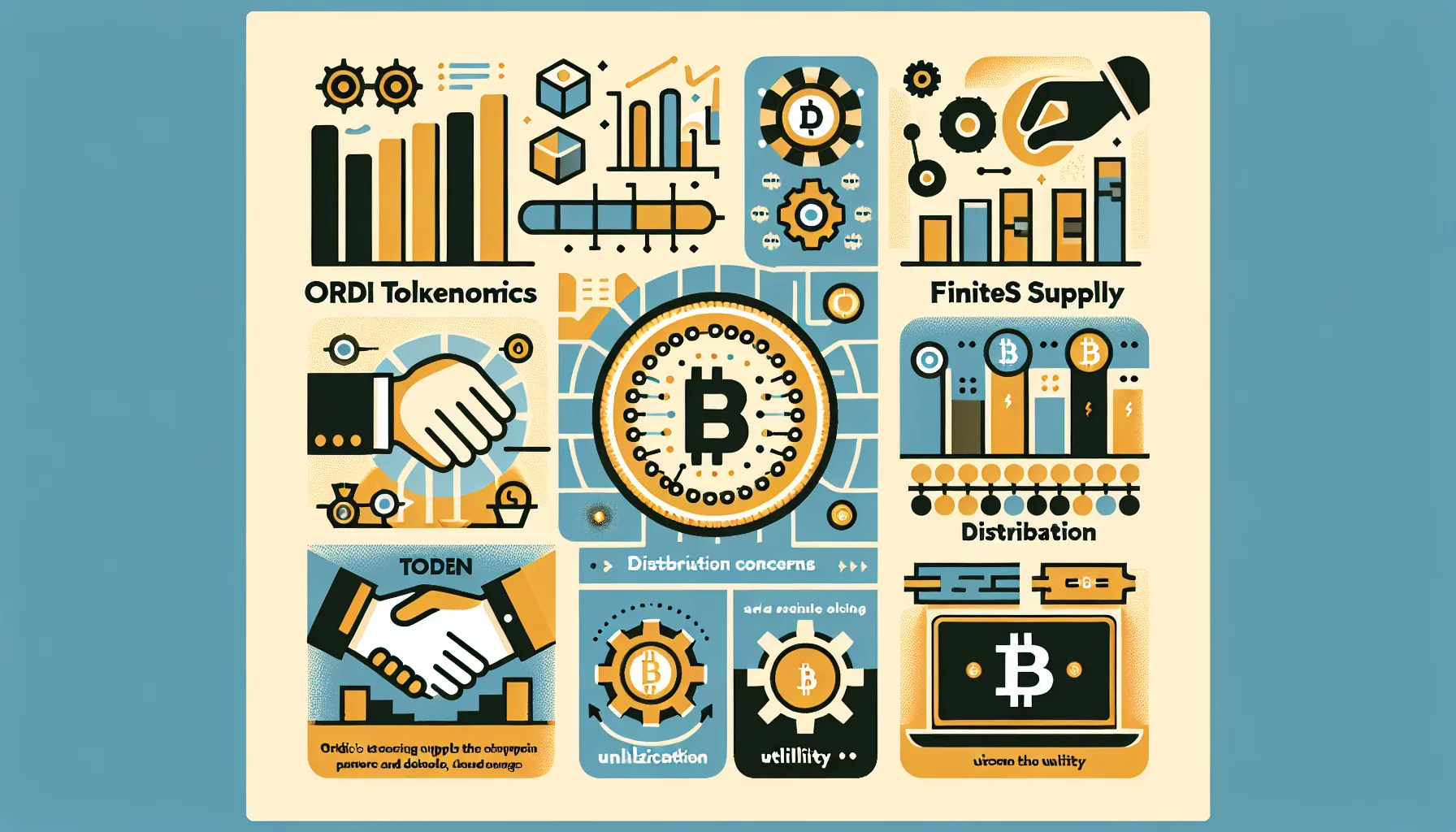
ORDI Tokenomics
ORDI Tokenomics: Exploring Supply, Distribution, and Utility
ORDI, as the native crypto asset of the Bitcoin Ordinals ecosystem, exhibits unique tokenomics that blend scarcity, distribution dynamics, and utility on the Bitcoin blockchain. Its financial architecture plays a pivotal role in its positioning within the broader crypto landscape, but it also presents challenges and intricacies worth noting.
Fixed Supply Mechanism
One of the most defining features of ORDI is its finite supply. With a hard cap of 21 million tokens, the token mirrors Bitcoin's scarcity ethos, which appeals to proponents of deflationary assets. However, against this backdrop of fixed supply, sustainability concerns arise. Limited supply may create artificial barriers to entry or skew distribution in favor of early adopters, which could inhibit decentralization over time.
Initial Distribution and Allocation Concerns
ORDI's launch was marked by fair distribution principles; the tokens were inscribed directly onto the Bitcoin blockchain as part of a novel experiment in Ordinals technology. However, this unique approach raises questions about equity in token allocation. Early adopters, enthusiasts familiar with Ordinals, and technically savvy participants were in a position to claim a disproportionate share of the tokens. This naturally creates concerns about wealth concentration, and in practice, it remains unclear how well ORDI has achieved fair distribution compared to other crypto assets.
Another layer of complexity stems from the lack of a pre-mine or token sale. While this ostensibly strengthens ORDI’s decentralization narrative, the absence of a more structured token launch process also means there is limited documentation on allocation transparency, which may deter some institutional participants from considering ORDI as a viable investment.
Utility Built on Bitcoin
ORDI's tokenomics hinge on its utility within the emerging Ordinals ecosystem. As an asset existing directly on the Bitcoin chain, its primary use cases include driving activity tied to Bitcoin’s digital artifact inscription movement, along with experimentation in decentralized finance (DeFi) and NFT-like applications. However, building utility on Bitcoin comes with challenges. High transaction fees and congestion on the Bitcoin blockchain during peak periods can directly impact ORDI users by making transfers or utility engagement cost-prohibitive.
Inherent Limitations of Bitcoin’s Base Layer
Because ORDI operates solely within the constraints of Bitcoin’s base layer, it lacks the flexibility of smart contract-enabled networks like Ethereum. This raises questions about its long-term scalability and ability to evolve alongside user demands. Further, Bitcoin-native experiments such as ORDI risk being seen as overly niche, as their development is inherently restricted by Bitcoin’s broader public perception as a "store of value" rather than a platform for application-layer experimentation.
ORDI Governance
Governance in ORDI: A Deep Dive into Decentralized Oversight
ORDI operates without a centralized governance framework, reflecting its alignment with the ethos of decentralization. As a crypto asset built on Bitcoin’s Ordinals protocol, its governance is inherently constrained by the limitations and design principles of Bitcoin itself. Unlike Ethereum-based assets that frequently employ DAO structures or smart contract-enabled voting systems, ORDI lacks explicit mechanisms for collective decision-making, often raising concerns in the developer and investor communities.
Lack of Formalized Governance Structures
One of the most debated aspects of ORDI governance is the absence of a formalized protocol-layer governance model. Without a defined DAO or similar structure, changes to its ecosystem, such as adjustments to technical implementations or token standards, are heavily reliant on the informal consensus of developers, miners, and the wider Ordinals user base. This lack of structure inhibits the rapid coordination seen in more protocol-flexible ecosystems like Ethereum or Cosmos, meaning any proposed changes can face long delays or even stagnation due to fragmented decision-making.
Miner Influence in Governance Dynamics
Since ORDI is built on Bitcoin, the mining community indirectly holds governance power that could influence its growth and adoption. Miners possess the ability to prioritize certain transactions or choose not to support protocol upgrades. While this serves as a form of governance by participation, it highlights a critical issue: ORDI is largely governed by mechanisms outside its own ecosystem. This can create conflicts of interest, as miners may not always align with the priorities of ORDI users or developers.
Challenges in Community Coordination
Another governance challenge is the relatively nascent development of an active, unified community around ORDI. While some dedicated developers and enthusiasts work to build the Ordinals ecosystem, coordination among this decentralized group is inherently difficult. Communication is largely confined to informal channels like forums or social media, and there is no clear pathway for proposals or collective decision-making. This can hinder responses to critical issues such as scalability or security risks, leaving the ecosystem vulnerable to stagnation or exploitation.
Resistance to Governance Evolution
ORDI's governance challenges are partially tied to the broader Bitcoin community’s skepticism of on-chain governance. Bitcoin’s emphasis on security and simplicity often rejects experimentation with formalized governance models, which can limit ORDI’s ability to introduce mechanisms like token-holder voting or automated upgrade pathways. This philosophical resistance creates a barrier to governance evolution, leaving ORDI reliant on informal consensus models that may not scale effectively as its adoption increases within the Ordinals ecosystem.
Technical future of ORDI
ORDI: Current and Future Technical Developments and Technical Road Map
ORDI, built on the Bitcoin blockchain as an early BRC-20 token, is deeply entwined with the emerging ecosystem of Bitcoin-based tokenization. With technical developments consistently pushing boundaries, ORDI faces both opportunities and challenges in refining its infrastructure, usability, and scalability.
Enhancements to the BRC-20 Standard
The foundational aspect of ORDI lies in the constraints and capabilities of the BRC-20 token standard. Unlike Ethereum’s ERC-20 tokens, BRC-20 relies on Bitcoin Ordinals and inscriptions, which were originally designed for embedding arbitrary data on the Bitcoin blockchain. As a result, inefficiencies like high transaction costs, slower processing times, and network congestion remain central bottlenecks. Current work in the ORDI community appears focused on optimizing inscription labeling, potentially reducing storage overhead and minimizing bloated mempool sizes during peak demand.
One ongoing development is exploring ways to enhance the clarity of token transfer semantics within Bitcoin script constraints. However, BRC-20 by design lacks certain features like smart contract functionality, hindering ORDI in establishing more complex use cases. The roadmap includes creating interoperability frameworks to interface with sidechains or Layer 2 solutions, enabling a broader functional range without altering Bitcoin's fundamental architecture.
Scalability and Network Adaptations
ORDI’s reliance on Bitcoin blocks inherently limits scalability, as block space competition intensifies when network activity spikes. Layer 2 solutions, such as payment channels or Drivechains, are currently being debated as potential remedies to these scalability issues. However, adoption within the ORDI ecosystem is still fragmented, and there are technical hurdles to effectively integrating these solutions without compromising network security or Bitcoin’s decentralization ethos.
Additionally, the reliance on Bitcoin mining fees poses an ongoing challenge. High fees associated with inscribing ORDI transactions can make microtransactions impractical, stifling broader adoption for utility-driven use cases. Developers are also evaluating ways to incentivize miners to prioritize ORDI activities in the absence of direct smart contract execution.
Long-Term Toolset Development
Developers are actively working on refining support tools for ORDI, particularly wallet infrastructure and indexing services. Current wallet compatibility remains inconsistent, with many Bitcoin wallets absent of full BRC-20 support. Custom indexing servers are needed to trace BRC-20 states on the Bitcoin blockchain, and these third-party solutions can present risks of centralization.
Plans to standardize the indexing layer or introduce lightweight nodes optimized for BRC-20 are on the table, but execution depends heavily on community participation and funding. Moreover, the lack of a formalized governance structure for ORDI makes steering technical priorities a challenge, with no established mechanism for coordinating collective upgrades.
NFT and Token Interplay
As ORDI builds upon Bitcoin Ordinals, a growing area of interest is the integration of NFT-like inscriptions with tradable tokens under BRC-20. While this opens up opportunities for composability between fungible and non-fungible assets, the lack of sophisticated metadata embedding standards restricts seamless interactions. Resolving these gaps may require updates to tooling or entirely new use-case paradigms within the ORDI ecosystem.
Token interoperability with broader blockchain networks is another unexplored frontier. Cross-chain bridges remain largely hypothetical due to inherent security risks, leaving ORDI comparatively isolated within the Bitcoin ecosystem. Future development will need to address these connectivity issues to expand its utility in multi-chain environments.
Comparing ORDI to it’s rivals
ORDI vs. BIT: A Detailed Comparison of Approach and Ecosystem Dynamics
When analyzing ORDI against BIT in the competitive landscape of the crypto space, one sees clear distinctions in priorities, mechanisms, and community alignment, which may appeal to different user bases depending on their needs and preferences.
Unique Governance vs. Decentralization Focus
BIT operates as a governance-focused protocol within the cryptocurrency industry, leveraging its DAO (Decentralized Autonomous Organization) framework to empower token holders with decision-making power. This positions BIT as a tool for actively shaping the future of its ecosystem. ORDI, while also decentralized, does not place the same emphasis on governance structures. Instead, ORDI focuses heavily on maintaining lightweight infrastructure built specifically for Bitcoin Ordinals, which may limit its flexibility in adapting to rapidly evolving demands compared to the governance adaptability BIT offers.
For savvy users, this raises an essential question: is the ability to actively participate in protocol development through voting mechanisms more valuable than ORDI’s minimalist, Bitcoin-native orientation?
Ecosystem Breadth
BIT has managed to build and expand an ecosystem that supports various DeFi functionalities, including derivatives trading, lending, and staking. Its interoperability across blockchain networks amplifies its functionality within the broader crypto world. On the other hand, ORDI is narrowly focused within the Ordinals ecosystem, tied strictly to inscriptions on the Bitcoin blockchain. While this focus creates unparalleled specialization for Ordinals enthusiasts, it also narrows its possible use cases when placed alongside a multi-functional rival like BIT.
For developers, traders, or power users seeking wide-ranging utility, this specialization could signify either laser-sharp efficiency or a frustrating limitation, depending on perspective.
Community and Accessibility
BIT's DAO-centric model relies heavily on cultivating a community that actively engages in governance and ecosystem development. However, such democratically driven ecosystems sometimes suffer from slower decision-making processes, especially when community consensus proves difficult. ORDI sidesteps this issue by operating with a streamlined model, but its community remains highly niche and niche-focused, primarily attracting users deeply embedded in Bitcoin-based NFT culture.
Accessibility is another differentiator. BIT’s ecosystem integrates easily with non-Bitcoin users via cross-chain support. ORDI, conversely, inherently restricts itself to the Bitcoin chain and related Ordinal protocols, which could alienate those outside of the Bitcoin maximalist or NFT space.
Scalability Challenges
BIT benefits from a less constrained environment, operating on multiple platforms and managing scalability with relative ease via Layer 2 solutions or other technologies. ORDI’s scalability is inherently tied to Bitcoin’s base layer, which presents well-documented bottlenecks: slow transaction speeds, high fees, and limitations when network activity peaks. While ORDI thrives on Bitcoin’s security and decentralization, its scalability struggles could hinder mass adoption compared to the more scalable options BIT provides.
By focusing exactly where each asset shines—and stumbles—users can better understand how deeply their own priorities align with ORDI versus a rival like BIT.
ORDI vs PEPE: A Deep Dive into Their Differences
When comparing ORDI to PEPE, it’s crucial to highlight the unique mechanics and token ecosystems that differentiate these two crypto assets. Both share a common lineage in the realm of meme-inspired cryptocurrencies, but they diverge significantly in their design, purpose, and community dynamics.
Tokenomics and Supply Structure
ORDI operates as the first BRC-20 token, emerging from the experimental fusion of Bitcoin’s Ordinals and ERC-20-like functionality. This acclaim as a technical pioneer places it in a category with distinct limitations and advantages tied to the Bitcoin blockchain. ORDI’s capped supply and Bitcoin-native provenance create a scarcity-driven appeal, though they also impose slower transaction speeds and higher fees compared to assets running on more scalable blockchains.
PEPE, in contrast, leverages the Ethereum ecosystem, granting it access to broader DeFi integration and faster network capabilities. However, PEPE also carries a much larger token supply, closely aligning itself with the traditional hyper-inflationary meme coin model. This results in stronger appeal to high-risk, speculative traders but potentially alienates those looking for more solid fundamentals. For ORDI, the BRC-20 framework offers simplicity and security but lacks the programmable flexibility that PEPE enjoys as an Ethereum token.
Community Dynamics and Adoption
PEPE has aggressively embraced the meme coin ethos, benefitting from virality and one of the most active meme-based online communities. While this explosive growth facilitates swift adoption, it also invites volatility, pump-and-dump risks, and rapid shifts in sentiment. ORDI’s community, although smaller, skews toward a more technically-minded demographic, drawn by the novelty of BRC-20 tokens on Bitcoin. This difference creates a subdued growth trajectory for ORDI but potentially grounds its adoption in longer-term adherence by loyal advocates.
Network Congestion and Utility
PEPE's reliance on Ethereum presents hurdles regarding network congestion and gas fees during peak activity, a common criticism in the Ethereum space. ORDI, on the other hand, faces similar — if not greater — challenges tied to Bitcoin’s limited block space, compounded by the increased on-chain demand spurred by Ordinals. While Ethereum has Layer 2 solutions like Arbitrum and Optimism to mitigate bottlenecks, the Bitcoin network has fewer comparable scaling answers, leaving ORDI at a persistent disadvantage regarding usability and cost efficiency.
Cultural Identity and Long-Term Perception
Finally, while PEPE thrives on its loud, irreverent cultural identity, ORDI’s positioning is less meme-centric and more experimental within Bitcoin’s ecosystem. This divergence raises questions about ORDI’s mass appeal versus its niche utility, especially when held against PEPE’s raw market momentum.
ORDI vs Meme: Contrasting Visions in Token Utility and Culture
When comparing ORDI to Meme, it's clear that these two crypto assets serve different niches despite sharing a broad category within the digital asset ecosystem. While ORDI emerged as part of the Bitcoin-originated BRC-20 framework, offering a distinct appeal tied directly to Bitcoin’s decentralized infrastructure, Meme is historically intertwined with the movement of tokenizing cultural currency and satirical digital art. This divergence in purpose sets the stage for their rivalry, particularly in terms of use case, community ethos, and broader ecosystem alignment.
Token Utility: Practicality vs Gamification
ORDI distinguishes itself by leveraging the BRC-20 protocol, a system that inherits Bitcoin's unmatched security and decentralization while enabling token creation. This positions ORDI as a serious player for developers exploring token applications beyond Ethereum or other EVM chains. On the other hand, Meme leans heavily into gamification. Its primary function has centered around staking NFTs and earning derivative token rewards, creating a loop for NFT enthusiasts looking to engage with playful yet speculative tokenomic models.
However, the practicality of Meme’s staking mechanics can sideline individuals who prefer fungible tokens without dependency on non-fungible assets. Meme’s ecosystem, although creative, can feel overly complex or exclusionary for users uninterested in navigating a tightly coupled NFT-token model. ORDI, meanwhile, avoids this entanglement entirely but arguably lacks the playful innovation that Meme represents.
Cultural Identity: Grassroots vs Self-Referential Satire
A key differentiator lies in their approach to community-building and cultural identity. Meme thrives on internet satire. It's a token that wears its humor as a badge of honor, directly tying its identity to the broader "meme economy" trend. While this resonates with audiences seeking comedic commentary on the absurdities of crypto hype, its reliance on cultural trends risks making it feel ephemeral or gimmicky.
ORDI, contrastingly, derives its identity from the experimentation inherent in Bitcoin’s lack of native smart contract support. It appeals to a crowd more interested in pushing the boundaries of what Bitcoin can facilitate rather than riding waves of internet humor. This more "serious" focus may alienate those who appreciate the lighthearted ethos championed by Meme.
Ecosystem and Technological Constraints
Meme's Ethereum-based foundation enables integration into a wide network of dApps, DeFi protocols, and marketplaces. However, this interoperability can lead to congestion issues or higher transaction costs during periods of network stress. ORDI, residing on Bitcoin’s blockchain via ordinals, bypasses these issues to some extent but trades them for the limitations of the BRC-20 framework, such as limited scalability and slower transaction speeds.
This contrast points to a fundamental trade-off between Meme’s reliance on Ethereum’s ecosystem maturity versus ORDI’s commitment to building within the constraints of Bitcoin’s environment. Ultimately, their differences highlight distinct priorities: Meme optimizes for interactiveness and play, while ORDI answers the call for Bitcoin-oriented innovation.
Primary criticisms of ORDI
Primary Criticism of ORDI: Examining Its Limitations
As one of the earliest tokens built on Bitcoin via the Ordinals protocol, ORDI has garnered significant attention within the crypto community. However, despite its novelty and technological underpinnings, ORDI is not without its detractors. Here are the core criticisms that have surfaced regarding the asset and its surrounding ecosystem:
1. Scalability Issues on the Bitcoin Network
ORDI’s reliance on the Bitcoin blockchain for its operation raises major concerns about scalability. The blockchain is not inherently designed to handle high throughput for fungible tokens, and this limitation is exacerbated by the additional load created by Ordinals inscriptions. Critics argue that ORDI usage could lead to heightened congestion and increased transaction fees on Bitcoin, potentially impacting other users of the network who do not interact with ORDI or Ordinals.
2. Lack of Robust Developer Tools
The infrastructure supporting ORDI is still in its infancy compared to more mature crypto ecosystems like Ethereum or Solana. Smart contract development, brought about through alternative Bitcoin layers such as the use of Ordinals, often lacks the polished developer tools, robust libraries, and streamlined systems found elsewhere. This leaves developers working on ORDI at a disadvantage, limiting the growth of associated projects and potentially stalling broader adoption.
3. Criticism of Ordinals’ Usage of Bitcoin’s Block Space
A recurring point of contention is whether Bitcoin's block space should be utilized for storing Ordinals data. Purists within the Bitcoin community often criticize the Ordinals protocol — and by extension ORDI — for deviating from Bitcoin's primary purpose of acting as a store of value and medium of exchange. They argue that ORDI contributes to unnecessary bloat, making the blockchain less efficient and diverging from the ethos of simplicity and utility.
4. Limited Use Cases
Despite the ecosystem hype, skeptics point out that ORDI currently lacks well-defined, compelling use cases beyond speculative trading. Unlike tokens within ecosystems designed around decentralized applications (dApps), ORDI does not inherently support smart contracts or programmable functions beyond what the Ordinals protocol allows. This limits its versatility and raises questions about its long-term sustainability.
5. Centralization Concerns
There are concerns over the centralization of influence within the ORDI community and the Ordinals development process. As a relatively new platform, much of the direction for Ordinals and by extension ORDI is driven by a small group of developers and influencers. This poses risks of favoritism or arbitrary decision-making, which could alienate other contributors and harm the project’s decentralization ethos.
While ORDI represents a new frontier for Bitcoin-based tokens, these issues showcase the challenges it faces in scaling, adoption, and utility within an increasingly competitive crypto landscape.
Founders
The Founding Team Behind ORDI: Key Insights and Controversies
ORDI, the first token to emerge on the Bitcoin Ordinals protocol, was conceptualized and launched by an anonymous collective, a common yet controversial hallmark in the crypto industry. While this pseudo-anonymity aligns with the decentralized ethos of blockchain technology, it raises questions about transparency and accountability, especially for a project sitting at the intersection of Bitcoin's immutable ledger and experimental tokenization.
The key figure often associated with the development and early promotion of the Ordinals protocol is Casey Rodarmor, a seasoned software engineer and an outspoken advocate for exploring new possibilities within the Bitcoin ecosystem. Though Rodarmor clarified he is not directly involved with ORDI’s issuance or tokenomics, his creation of the protocol laid the foundation for the project’s rapid adoption. He openly discusses Ordinals in public forums, lending credibility to the surrounding ecosystem, but the same transparency does not extend to ORDI's core team, whose identities remain shrouded.
A critical challenge for the ORDI project is the lack of verifiable information on its founding members. In a sector rife with scams, especially within the realm of experimental Layer 2 applications on Bitcoin, this opacity can deter institutional and retail engagement. The crypto community holds mixed opinions: On one hand, anonymity can shield creators from regulatory scrutiny and foster innovation unhindered by external pressures. On the other hand, it introduces a layer of risk that savvy investors and developers cannot overlook.
Debate also surrounds the team’s initial token distribution strategy. The ORDI supply was inscribed as NFTs on the Bitcoin blockchain using Ordinals, a groundbreaking yet polarizing technique. Critics argue this unconventional approach was rushed, with insufficient audits or input from Bitcoin’s broader development community. Meanwhile, proponents applaud the team’s ingenuity in leveraging Bitcoin’s nearly 14-year-old infrastructure for tokenization. Regardless, the absence of identifiable accountability amplifies concerns over their decision-making process.
Additionally, the founding team’s communication with the community has been sporadic. Documentation regarding ORDI’s roadmap, future protocol upgrades, or governance remains limited, leaving questions unanswered amid rapidly evolving user interest. The lack of transparency isn’t uncommon in crypto, yet it’s worth noting that ORDI’s success leans heavily on the credibility of its mysterious creators, who have yet to deliver active reassurances through trust-building actions.
Authors comments
This document was made by www.BestDapps.com
Sources
https://docs.ordi.io/whitepaper.pdf
https://docs.ordi.io/yellowpaper.pdf
https://ordi.io
https://explorer.ordi.io
https://github.com/ordi-project/core
https://blog.ordi.io/decentralized-tokenomics/
https://research.binance.com/en/projects/ordi
https://coinmarketcap.com/currencies/ordi/
https://messari.io/asset/ordi
https://medium.com/ordi-insights/
https://twitter.com/ordi_io
https://docs.ordi.io/token-distribution.pdf
https://defillama.com/protocol/ordi
https://roadmap.ordi.io
https://community.ordi.io
https://discord.gg/ordi


