History of NYM
The History of NYM: From Mixnets to Blockchain Integration
Origins and the Mixnet Foundation
NYM’s origins trace back to the necessity of a more sophisticated privacy layer for network communications. The project emerged as a response to the limitations of traditional VPNs and Tor, focusing on mixnet-based obfuscation. Mixnets have existed for decades, but NYM aimed to create an incentivized, decentralized version where nodes would be rewarded for relaying traffic. This approach sought to prevent metadata leakage, a critical weakness in anonymous communication systems.
The NYM network’s early development began with academic research and grants, particularly influenced by cryptographers interested in privacy-enhancing technologies. However, the challenge was not just technical but also economic—how to ensure long-term node participation without central control. This led to NYM exploring blockchain as a means to reward network participants transparently.
Tokenization and Blockchain Deployment
The integration of blockchain technology into NYM wasn’t immediate but became necessary to support an incentivization model. The NYM token was introduced as a way to reward mix node operators for processing encrypted traffic. Unlike simple staking models, NYM incorporated mixnet-specific reputation systems, aiming to balance decentralization with efficiency.
Early rollouts of the staking framework saw adjustments as node operators initially faced fluctuating rewards and concerns over centralization tendencies within staking pools. Over time, NYM refined its economic model, introducing mechanisms such as performance-based rewards to prevent freeloading and ensure routing efficiency.
Development Challenges and Adoption Hurdles
Like many privacy-focused crypto projects, NYM encountered adoption barriers, particularly in onboarding users unfamiliar with mixnets. The complexity of integrating NYM with existing applications slowed broader adoption, leading the team to focus on making the system developer-friendly.
Regulatory concerns also presented obstacles. While mixnets provide anonymity, they also attracted scrutiny from entities concerned with illicit activities. Some centralized exchanges hesitated to list the NYM token due to compliance concerns, limiting initial liquidity.
Security was another critical area of focus. The mixnet’s early phases required rigorous testing to ensure resistance against traffic analysis attacks, a fundamental weakness of early anonymity networks. Despite advancements, there were periods where network efficiency suffered due to congestion or suboptimal routing, requiring further protocol optimizations.
Evolving Governance and Decentralization Efforts
Governance mechanisms shifted over time, reflecting ongoing attempts to prevent centralization within the network. Initially, token-weighted governance risked favoring large stakeholders, prompting discussions about alternative models, such as quadratic voting or delegation-based systems. These governance debates underscored an ongoing tension between efficiency and decentralization within the NYM community.
How NYM Works
How NYM Works: Privacy Infrastructure and Mixnet Technology
The Core of NYM: A Mixnet for Network-Level Privacy
NYM operates as a decentralized privacy infrastructure designed to prevent metadata leakage. At its core, it utilizes a mixnet (mix network) to obfuscate network-level data, making it resistant to surveillance and traffic analysis. Unlike traditional VPNs or Tor, which have limitations in latency, scalability, or resistance to sophisticated adversaries, NYM's mixnet shuffles and delays packets in a way that significantly increases anonymity.
Layered Encryption and Traffic Mixing
NYM's mixnet functions by routing packets through multiple layers of encryption across a distributed set of mix nodes. Each node mixes, delays, and re-encrypts network traffic before forwarding it. This process prevents third parties from linking sender and receiver metadata, offering network-level privacy that other solutions struggle to maintain. The result is an obfuscation of not just message content but also communication patterns, making it difficult for adversaries to perform correlation attacks.
The Role of NYM Tokens in Network Incentives
NYM tokens play a fundamental role in the economic model of the mixnet. They are used for staking and rewarding mix nodes, ensuring that operators are incentivized to provide bandwidth and reliable service. However, this introduces centralization risks, as high-stake nodes may dominate network operations. The risk of sybil attacks is mitigated through bonding and delegation mechanisms, but concerns remain regarding the distribution of power among node operators.
Service Credentials and Anonymous Access
Beyond mixnet privacy, NYM introduces anonymous credentials that allow users to authenticate services without revealing their identity. Unlike traditional authentication mechanisms that expose user metadata, NYM credentials ensure that users prove access rights without exposing their identity or behavioral patterns. This has potential applications in censorship resistance and private web browsing, but adoption challenges exist, as many internet services are not yet built to integrate such privacy-preserving credentials.
Latency and Performance Trade-offs
A major drawback of NYM’s design is increased latency due to its mix-and-delay approach. Compared to direct peer-to-peer or traditional routing, NYM’s mixnet introduces noticeable delays, making it less suitable for applications requiring low latency, such as real-time gaming or instant financial transactions. Scalability is another concern, as increased users also require a proportional increase in mix nodes, which may face limitations in participation incentives.
Potential Threats and Limitations
While NYM enhances privacy, its reliance on staking mechanisms means economic centralization and token volatility could affect the stability of node incentives. Additionally, adversaries with sufficient resources may attempt continuous network analysis or deny-of-service attacks to degrade network efficiency. Addressing these scalability and resilience issues remains a key challenge to the long-term viability of NYM’s privacy network.
Use Cases
Use Cases of NYM: Privacy, Anonymity, and Network Incentives
Privacy-Preserving Communications
NYM is primarily used to enhance privacy in digital communications by routing data through a mixnet. Unlike traditional VPNs or Tor, NYM’s mixnet introduces time-based mixing, making traffic analysis significantly more difficult. This is particularly valuable for users who require strong metadata protection, such as journalists, activists, or anyone concerned with surveillance. However, due to the additional processing required for mixing packets, this can introduce latency, making it less practical for real-time applications like video calls or gaming.
Anonymous Credentialing System
NYM integrates with Coconut, a privacy-preserving credential system that allows users to prove attributes without revealing their full identity. This use case is particularly useful for secure authentication in decentralized applications (dApps), KYC-free financial services, and private voting systems. While this enhances privacy, it also poses a challenge for regulatory compliance, as governments and financial institutions push for stronger identity verification in crypto-related transactions.
Incentivized Mixnode Participation
NYM tokens are used to reward mixnode operators for processing network traffic. Staking is required to participate, ensuring network reliability and discouraging low-performance nodes. However, the reputation-based rewards model means that early or lesser-known nodes may struggle to earn enough rewards, leading to centralization risks if only a few highly staked nodes dominate the mixnet.
DeFi and Private Transactions
Although not a privacy coin in itself, NYM can be integrated with DeFi platforms to provide private transaction routing. By obscuring metadata, users can protect their financial activity from surveillance. However, this is still an emerging use case, with adoption dependent on DeFi protocols incorporating NYM into their infrastructure. Additionally, the complexity of running mixnets could prove to be a bottleneck for widespread DeFi integration.
Resistance to Censorship
NYM can help users in regions with restricted internet access by preventing network surveillance and blocking. This is especially useful in countries with strong internet censorship practices. However, determining effective entry points into the mixnet can be a challenge in heavily restricted environments, as network censorship mechanisms may eventually attempt to block known NYM infrastructure.
Challenges in Adoption
While NYM provides strong network-level anonymity, its usability can be complex for non-technical users. Running a mixnode requires both technical knowledge and economic incentives, potentially limiting broader adoption. Furthermore, projects integrating NYM must balance privacy with performance, as mixnets inherently introduce delays that some applications may find impractical.
NYM Tokenomics
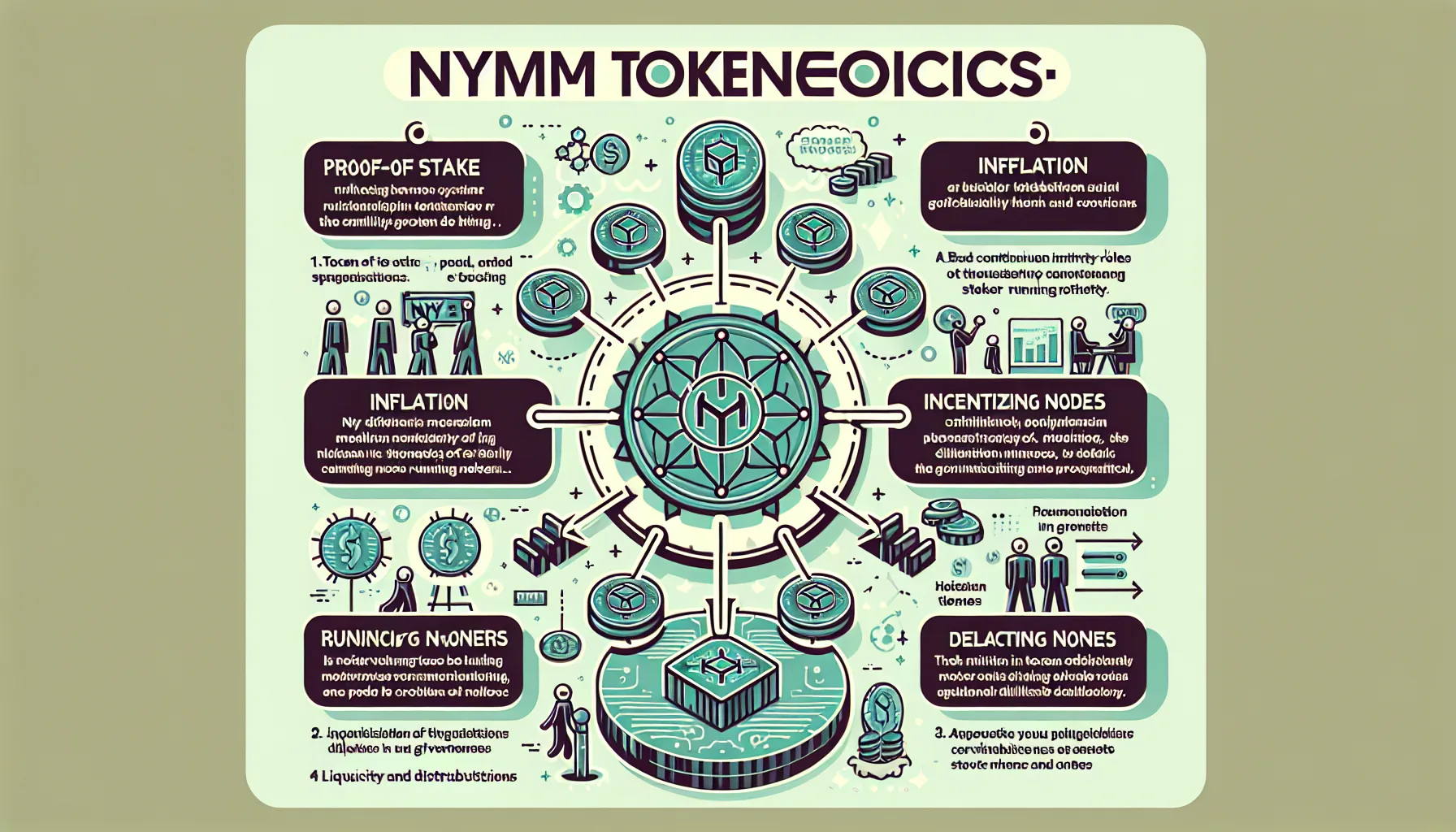
NYM Tokenomics: Staking, Inflation, and Utility
Staking and Delegation Mechanism
NYM operates a proof-of-stake (PoS) system where token holders can either run mix nodes or delegate NYM tokens to existing nodes. These nodes are responsible for providing privacy-enhancing network services, and their compensation comes from a mix of block rewards and transaction fees. Delegation incentivizes participation while promoting a competitive environment where node operators must balance uptime, efficiency, and profitability. However, this structure introduces centralization risks, as a concentration of delegated tokens in a few high-performing nodes could lead to power imbalances within the network.
Inflation and Block Rewards
NYM employs an inflationary model to ensure long-term network incentives. New tokens are continuously minted to reward node operators and delegators, with the supply growing over time. While inflation is crucial for sustaining network security and participation, it also introduces potential dilution risks for passive holders. Unless counterbalanced by network demand and token utility, inflationary mechanics could exert downward pressure on prices, especially if staking returns are not competitive with other PoS-based crypto assets.
Token Utility and Usage
NYM tokens serve multiple utility roles beyond staking:
- Paying for Bandwidth: Users accessing the privacy-preserving mixnet must spend NYM tokens to compensate node operators, directly linking network activity to token demand.
- Incentivizing Mix Nodes: Reward mechanisms ensure active participation, fostering greater network reliability and resistance to surveillance.
- Governance: Token holders can participate in governance decisions, influencing protocol upgrades, economic policies, and incentive structures.
Despite these utilities, the adoption of NYM for bandwidth payments remains a key challenge. The sustainability of the reward system hinges on whether real user demand can offset inflationary emissions. If token circulation remains primarily within staking and node incentives without organic demand from actual network users, long-term sustainability could be questioned.
Liquidity and Distribution Challenges
The distribution of NYM tokens through initial allocations, staking rewards, and ecosystem incentives plays a crucial role in market liquidity. Large token unlocks or concentrated holdings among early investors and team members could introduce volatility risks. Additionally, secondary market liquidity is essential to ensure seamless token utility, as users require reliable exchanges or decentralized trading avenues to acquire and spend NYM for network services. If liquidity is insufficient, friction in acquiring and using the token could hinder adoption.
NYM Governance
NYM Governance: Staking, Delegation, and Decision-Making
Governance within the NYM ecosystem is structured around a decentralized model that leverages staking and delegation while integrating community-driven proposals and votes. Holders of NYM tokens play a critical role in influencing network operations and protocol upgrades by participating in governance processes that dictate everything from parameter adjustments to broader network changes.
Token-Based Voting Mechanism
NYM governance operates through a token-weighted voting system, meaning the amount of staked NYM directly impacts voting power. This can lead to centralization among large token holders, which raises concerns about governance capture and the extent to which smaller participants can meaningfully contribute to decision-making. While delegation allows token holders to assign voting power to trusted representatives, it does not entirely mitigate the influence of dominant stakeholders.
Role of Validators and Delegators in Governance
Network validators are integral to governance since they secure the mixnet and typically have the technical expertise to assess proposals. However, validators with significant delegation may have outsized control, potentially leading to governance distortions. Delegators, by staking their NYM tokens with validators, influence governance indirectly but rely on validators’ actions aligning with their interests. This setup incentivizes validators to act transparently and in the network’s best interest, but also creates scenarios where misaligned incentives could arise.
Proposal Mechanism and Network Upgrades
Any governance participant can submit proposals for network changes, including updates to staking mechanisms, reward structures, or privacy-enhancing features. Proposals are assessed through a structured voting process where those staking NYM dictate outcomes. While this model ensures decision-making remains decentralized, governance participation rates can be inconsistent, leading to concerns about low voter engagement impacting critical network upgrades.
Challenges and Limitations
A key challenge in NYM governance is balancing decentralization with efficiency. While an open governance model ensures community participation, complex or highly technical proposals may result in voter apathy, with decision-making power concentrated among a few active participants. Additionally, governance mechanisms that depend on high voter turnout can be vulnerable to manipulation if large stakeholders coordinate votes.
As governance continues to evolve, mechanisms for improving voter participation and decentralizing influence remain focal points within the NYM ecosystem. The interplay between validators, delegators, and token holders will shape the long-term sustainability and security of NYM’s governance framework.
Technical future of NYM
NYM Technical Roadmap: Privacy Enhancements and Scaling Challenges
Ongoing Developments in NYM’s Mixnet Architecture
The NYM network continues to refine its mixnet infrastructure to enhance resistance against traffic correlation attacks while improving network efficiency. Recent updates focus on optimizing mix node selection algorithms to ensure better distribution of traffic load. While these changes improve decentralization and security, network congestion remains a challenge, particularly in periods of high user activity. Further refinements in congestion control mechanisms and reward structures for mix nodes aim to mitigate inefficiencies, but achieving optimal throughput without compromising privacy remains an ongoing issue.
Service Providers and Layered Privacy Expansions
A key technical direction is the integration of NYM’s privacy-enhanced routing with third-party applications beyond cryptocurrency transactions. The expansion of NYM’s service provider ecosystem is designed to enable anonymous access to a broader range of online services. However, adoption by external applications remains slow, hindered by the complexity of integrating mixnet functionality into existing infrastructures. Reduced latency and improved SDK usability are critical focus areas to drive broader adoption in decentralized and traditional applications.
Implementation of Coconut-Based Anonymous Credentials
NYM’s implementation of the Coconut cryptographic scheme provides a privacy-preserving way to authenticate users without exposing their identities. This feature enhances selective disclosure mechanisms, allowing users to prove certain characteristics (such as reputation or access rights) without revealing additional personal data. However, practical deployment at scale presents computational challenges. Efficient issuance and verification of anonymous credentials without straining network resources is an ongoing research area, with optimizations required to prevent performance bottlenecks.
Incentivization Model Adjustments for Network Sustainability
The current delegation and staking model for mix nodes has undergone refinements to maintain long-term sustainability. Adjustments to reward distribution mechanisms seek to discourage the centralization of high-earning nodes while ensuring smaller operators remain profitable. However, incentive imbalances still exist, with some node operators struggling to earn sustainable rewards due to fluctuating network participation dynamics. Further tuning of reward parameters and stake weight adjustments is anticipated to create a more stable mixnet ecosystem.
The Road to Post-Quantum Security
With advancements in quantum computing posing a potential long-term threat to cryptographic security, NYM has indicated research into integrating post-quantum resistant encryption within its mixnet protocols. While this transition remains in early exploratory phases, future updates may include hybrid cryptographic approaches that balance efficiency with quantum resistance. The challenge here remains balancing security with computational overhead, as post-quantum cryptographic schemes often require significantly greater processing power.
Comparing NYM to it’s rivals
NYM vs. XMR: A Detailed Comparison
When evaluating NYM against Monero (XMR), the most immediate distinction lies in their core privacy approaches. While both projects prioritize privacy, their methodologies differ significantly in execution and underlying technology.
Privacy Architecture: Mixnet vs. Ring Signatures
NYM utilizes a mixnet system, which routes network traffic through multiple decentralized nodes that obscure metadata and prevent third-party surveillance. This design is aimed at protecting against traffic analysis attacks, an area where other privacy solutions can sometimes fall short.
Monero, on the other hand, achieves privacy on the blockchain level using ring signatures, stealth addresses, and confidential transactions. Ring signatures obscure transaction origins by mixing inputs with decoys, while stealth addresses ensure that only the intended recipient can identify funds.
While Monero's approach is highly effective for transaction privacy, it does not directly address metadata-level tracking, such as timing correlations and network-layer surveillance. This creates a gap that NYM’s mixnet aims to cover by anonymizing all types of internet traffic, not just financial transactions.
Decentralization and Network Incentives
Both NYM and XMR emphasize decentralization, but their incentive structures differ. Monero relies on proof-of-work (PoW), which offers a high level of censorship resistance but also comes with mining centralization risks due to specialized hardware dominance.
NYM, in contrast, operates through a node-based reward system where participants contribute to traffic mixing and earn fees in NYM tokens. A potential issue with this model is the reliance on economic incentives to maintain node participation—if rewards decrease, network performance and privacy resistance could be affected.
Adoption and Usability Challenges
Monero has a well-established reputation in privacy-focused financial transactions, with a substantial user base on darknet markets and among privacy-conscious individuals. However, its obfuscated transaction structure leads to frequent delistings from exchanges due to regulatory pressure.
NYM, while not primarily a financial transaction layer, also faces adoption hurdles. The complexity of integrating mixnet infrastructure into mainstream applications creates friction for user onboarding. Additionally, while offering robust network privacy, it depends on widespread adoption for maximal effectiveness—without enough users blending traffic, anonymization benefits may diminish.
Attack Vectors and Resistance
Monero’s main vulnerability lies in statistical analysis techniques aimed at reducing the anonymity set over time, including potential chain analysis of older transactions. While its privacy measures remain strong, persistent adversaries could attempt to weaken its unlinkability over extended observation periods.
NYM’s mixnet theoretically resists network-level traffic correlation, but its reliance on the number of active relays means that lower participation could reduce the effectiveness of anonymization. Furthermore, mixnets inherently introduce latency, which may deter real-time applications from utilizing the system.
NYM vs ZEC: Comparing Privacy and Anonymity Approaches
When comparing NYM and ZEC, the most significant difference lies in their approach to on-chain privacy. Zcash (ZEC) primarily utilizes zero-knowledge proofs (zk-SNARKs) to offer transaction privacy, while NYM focuses on mixnet technology to obscure network-level metadata.
Privacy Model: Shielding vs. Mixnets
ZEC offers optional privacy through shielded transactions using its zk-SNARK implementation. While these transactions obscure sender, recipient, and amount, many users and exchanges still rely on transparent transactions due to higher fees and limited wallet support for shielded transfers. This results in much of ZEC’s transaction activity being publicly viewable, reducing its real-world anonymity.
NYM, in contrast, addresses a different vector of privacy—network-level metadata. Even with shielded transactions, blockchain activity can be correlated through network analysis. NYM’s mixnet anonymizes packet-level data by routing traffic through multiple decentralized nodes, making it resistant to mass surveillance. This targets a broader spectrum of potential privacy leaks beyond just on-chain financial data.
Adoption Challenges and Usability
ZEC’s optional privacy model has led to inconsistent adoption, and exchanges often default to transparent transactions due to regulatory uncertainty. Additionally, usability has historically been a bottleneck for ZEC’s shielded transactions, as not all wallets support them, and transactions can be computationally expensive.
In comparison, NYM’s mixnet operates independently of blockchain transactions, allowing it to provide privacy enhancements not just for cryptocurrency transfers but also for general internet usage. However, mixnets introduce latency due to multiple relays, which can be a limiting factor for high-frequency use cases.
Regulatory and Compliance Considerations
ZEC, due to its transparent transaction capabilities, has found itself in a gray area regarding regulatory acceptance. Some jurisdictions have scrutinized its privacy features, limiting exchange integrations or requiring additional monitoring solutions.
NYM’s approach differs in that it obfuscates network metadata rather than transaction details, making it applicable to a wide range of Web3 applications beyond financial transactions. However, this could also make it a target for increased scrutiny, as governments and corporations continue to crack down on privacy-preserving technologies.
Both NYM and ZEC offer distinct solutions to digital privacy. While ZEC prioritizes transactional anonymity, NYM focuses on metadata protection, leading to different trade-offs in usability, adoption, and regulatory risk.
NYM vs. SCRT: A Deep Dive into Privacy Approaches
When comparing NYM to SCRT, the most striking difference lies in how each project approaches privacy. NYM operates as a mixnet that provides network-level anonymity by obfuscating metadata, while SCRT focuses on confidential smart contracts using Trusted Execution Environments (TEEs).
Privacy Mechanisms: Mixnets vs. TEEs
NYM's mixnet shuffles internet traffic through multiple nodes, introducing delays and cover traffic to prevent metadata leaks. This design inhibits even powerful adversaries from conducting traffic analysis. In contrast, SCRT leverages TEEs, specifically Intel SGX, to execute smart contracts privately. While this ensures data is only processed in an encrypted state, it also introduces trust concerns with hardware manufacturers and the potential for backdoors or vulnerabilities in SGX itself.
Decentralization Trade-offs
SCRT inherits its consensus model from the Cosmos ecosystem, utilizing Tendermint for block production and governance. While this provides fast finality, it also means validator access is permissioned by staking requirements, consolidating influence among participants with significant SCRT holdings. NYM, on the other hand, decentralizes packet mixing across an open network of node operators, with rewards based on performance metrics rather than staked assets. However, concerns remain about whether mixnet node incentives will remain sustainable long-term.
Use Case Flexibility
SCRT’s privacy model is smart contract-specific, making it useful for transactions requiring confidential state execution, such as private DeFi applications or encrypted NFTs. However, it does not make general network activity anonymous. NYM, by contrast, provides privacy protection for any internet service, including blockchain transactions but also broader applications like messaging, email, and VPN alternatives. This gives it a wider scope, albeit without direct smart contract capabilities.
Attack Surfaces and Risks
NYM must ensure its mixnet design stays resilient against advancements in traffic analysis methods. If incentives for mix nodes weaken, network reliability could suffer. SCRT, relying on TEEs, faces different challenges—such as past vulnerabilities in SGX (e.g., Foreshadow). If an exploit compromises TEEs, the confidentiality of smart contracts could be at risk, potentially breaking the system’s core privacy guarantees.
Adoption Barriers
Adoption friction differs significantly. NYM requires applications and users to integrate mixnet routing, which could introduce latency concerns for real-time use cases. SCRT, being part of the Cosmos ecosystem, has an easier onboarding process for developers already building on Tendermint-based chains. However, skepticism around SGX's long-term security could deter certain privacy-focused users.
Primary criticisms of NYM
Primary Criticism of NYM: Scalability, Incentive Structures, and Regulatory Risks
Network Scalability Concerns
One of the primary criticisms of NYM is its scalability limitations, particularly regarding the mixnet’s ability to handle high transaction volumes efficiently. While mixnets are inherently more private than traditional Tor-style onion routing, they introduce significant latency as packets are mixed and delayed to obfuscate metadata. This added complexity raises concerns about NYM’s ability to support real-time applications or high-throughput use cases without compromising performance. Critics argue that as network demand grows, the system’s efficiency could degrade, impacting usability and adoption.
Economic and Token Incentive Risks
NYM’s incentive model is another area of scrutiny. The network relies on a staking-based system where mix nodes must stake NYM tokens to participate and receive rewards. However, this approach has raised concerns about centralization risks, as entities with more capital can operate more performant nodes, potentially leading to an oligopolistic structure. If large holders dominate the node landscape, it could reduce the network’s overall decentralization and resilience.
Additionally, the long-term sustainability of the reward model has been questioned. Some critics argue that if network usage does not scale proportionally with token emissions, there may be insufficient transaction fees to replace inflationary rewards. This could lead to reduced financial incentives for node operators, risking network degradation over time.
Regulatory Uncertainty and Privacy Trade-offs
NYM operates in a regulatory gray area due to its strong privacy guarantees. Governments and law enforcement agencies have consistently scrutinized privacy-focused technologies under the pretext of crime prevention. There is an ongoing risk that NYM could face legal challenges similar to other privacy-centric projects, potentially leading to restrictions on its usage, exchange delistings, or targeted legal actions against operators.
Moreover, privacy solutions like mixnets often walk a fine line between anonymity and usability. While NYM enhances metadata privacy, there are trade-offs regarding ease of use and integration into existing blockchain ecosystems. Some critics argue that unless privacy mechanisms are seamlessly incorporated into mainstream applications, adoption will remain niche.
Challenges in Adoption and Competition
Despite its technical advancements, NYM faces competition from alternative privacy solutions such as zero-knowledge proofs, ring signatures, and other decentralized anonymity networks. The broader crypto ecosystem is rapidly evolving, and NYM must consistently prove its superiority over competing privacy layers to gain adoption. Critics highlight the challenge of persuading developers and users to integrate NYM when alternative privacy-preserving solutions may offer lower friction or broader compatibility with existing infrastructure.
Founders
The Founding Team Behind NYM: Key Figures and Backgrounds
NYM was founded with the goal of creating a robust, decentralized privacy infrastructure, and its core team reflects a blend of cryptography expertise, distributed systems engineering, and early contributions to privacy-enhancing technologies. Led by individuals with strong academic and industry backgrounds, the project has drawn from both academia and the wider crypto ecosystem.
Harry Halpin – CEO and Co-Founder
Harry Halpin stands at the forefront of NYM’s development. With a background in computer science and privacy research, he has been an advocate for internet freedom and security for years. Before co-founding NYM, he was deeply involved in privacy-oriented projects and worked with standards bodies like the W3C (World Wide Web Consortium). His involvement in cryptographic research has helped shape NYM’s vision, though his outspoken approach to privacy and decentralization has also sparked debates within the broader crypto community.
Claudia Diaz – Chief Scientist
Claudia Diaz, a professor in privacy and security technologies, plays a crucial role in NYM's scientific development. Previously associated with the Tor Project and having contributed to mixnet research, Diaz’s expertise ensures that NYM's privacy infrastructure is grounded in rigorous cryptographic principles. While her academic background is a major strength, some critics argue that transitioning cutting-edge research into scalable, user-friendly networks remains a challenge for the team.
Dave Hrycyszyn – Former CTO
Dave Hrycyszyn was an early technical leader in the NYM project, responsible for overseeing architecture decisions and implementation strategies. His departure from NYM raised questions regarding internal transitions and product development direction. While such shifts are common in open-source and startup environments, they led to speculation about the project's technical roadmap and execution.
Other Contributors and Advisory Influence
Beyond the core founders, NYM has attracted contributors from privacy-centric projects, cryptography research, and blockchain engineering. This includes former developers and advisors with experience in zero-knowledge cryptography, distributed networking, and tokenomics. However, the interplay between academic research and execution remains a key challenge, as many privacy-focused projects struggle with adoption beyond the crypto-native user base.
Internal Challenges and Team Evolution
Like many crypto projects, NYM has faced growing pains. The balance between privacy maximalism, regulatory considerations, and practical usability remains a recurring topic of debate. While the team’s credentials are strong, some question whether academic-driven leadership fully addresses the needs of a broad user base. Additionally, team transitions and the evolving regulatory landscape present ongoing hurdles for NYM’s long-term execution.
Authors comments
This document was made by www.BestDapps.com
Sources
- https://nymtech.net/
- https://nymtech.net/whitepaper.pdf
- https://nymtech.net/publications/Nym-Decentralized-Credentials.pdf
- https://medium.com/@nymproject
- https://github.com/nymtech
- https://explorer.nymtech.net/
- https://docs.nymtech.net/
- https://nymtech.net/blog/
- https://nymtech.net/tokenomics/
- https://forum.nymtech.net/
- https://twitter.com/nymproject
- https://discord.gg/nym
- https://t.me/nymtech
- https://nomics.com/assets/nym-nym
- https://coinmarketcap.com/currencies/nym/
- https://www.coingecko.com/en/coins/nym
- https://defillama.com/protocol/nym
- https://messari.io/asset/nym
- https://cryptoslate.com/coins/nym/
- https://cointelegraph.com/tags/nym


