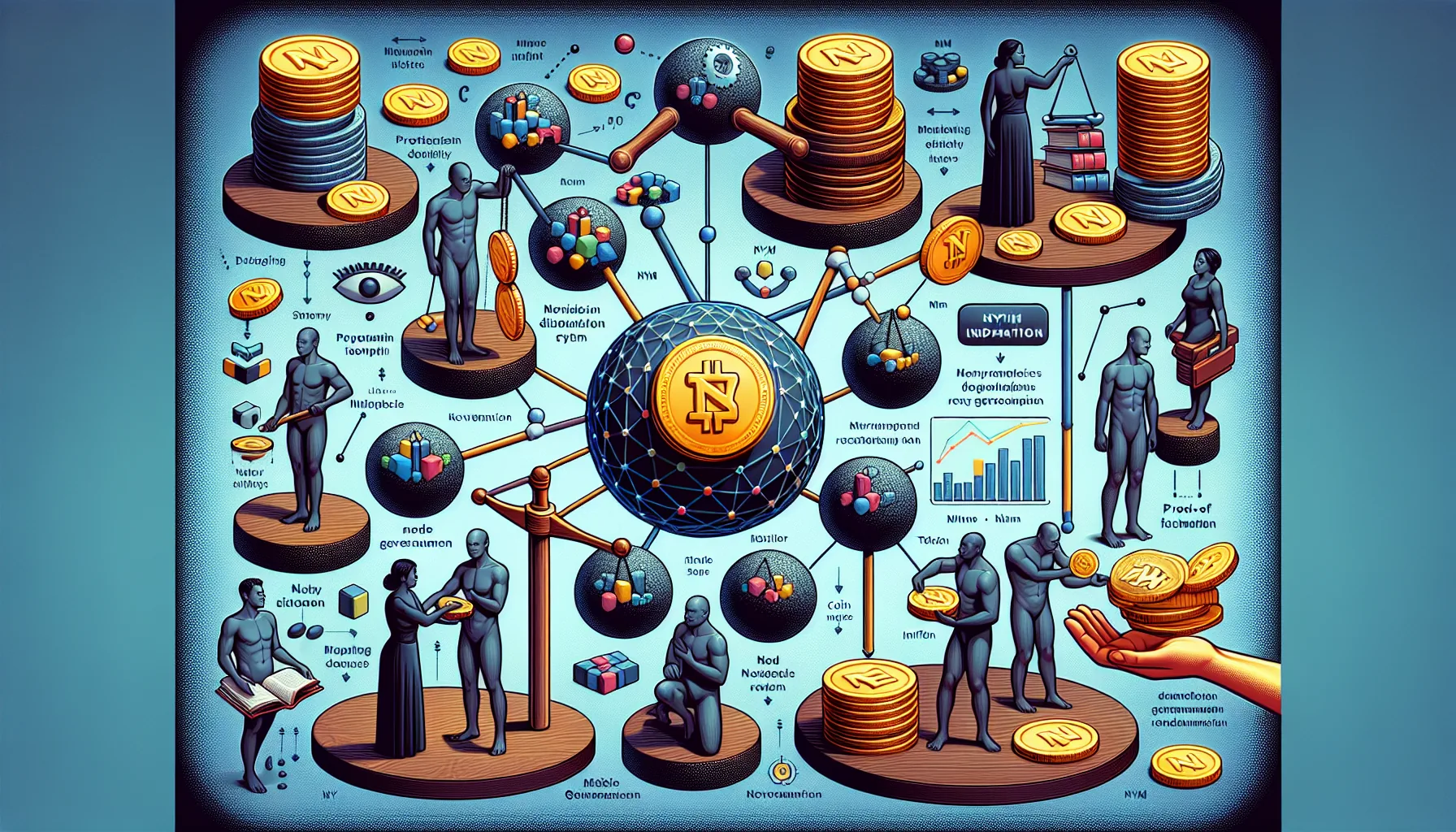
History of NYM
Unpacking NYM: A Deep Dive into Its Origins and Historical Development
NYM, the native token of the Nym Network, has an intricate history rooted in the growing demand for privacy-preserving technologies in the blockchain sphere. Conceived to address critical gaps in the anonymity infrastructure of decentralized networks, NYM’s development journey touches on both technical milestones and the challenges of pioneering a unique cryptographic solution.
The project began with a commitment to tackle a long-standing issue in the internet ecosystem: the exposure of metadata. Privacy enthusiasts and cryptographic researchers saw a gap in existing solutions like Tor or VPNs, which, while effective to some degree, left vulnerabilities unaddressed in terms of scalability and full-spectrum privacy. NYM was designed to bridge this gap by introducing a mixnet, a network layer solution originally envisioned decades ago, now reimagined using decentralized tools.
NYM's roadmap from concept to execution wasn’t without obstacles. The reliance on mixnet technology posed significant implementation challenges, as it historically suffered from performance bottlenecks and lackluster adoption. Getting decentralized nodes to efficiently mix metadata without degrading performance required extensive research and applied cryptography. Early development was marked by a series of testnet phases, during which key efficiency issues related to node incentivization, traffic reliability, and privacy robustness were iteratively refined.
Key to NYM’s development history was its mission to integrate incentivization directly into the protocol, addressing a recurring theme in privacy technology: how to encourage participation at scale. The introduction of the NYM token was pivotal here, as it enabled a decentralized rewards mechanism designed to compensate operators of mix nodes. This created a twofold challenge—balancing the security of the network against potential centralization risks that could arise from token-rich operators dominating the ecosystem.
Legal and regulatory uncertainties have also played a significant role in shaping the project’s trajectory. Operating at the cutting edge of anonymity tools has placed NYM under scrutiny, with questions about how privacy networks intersect with regional compliance laws emerging as ongoing concerns. Such legal ambiguity has raised complications around adoption, particularly as governments increasingly scrutinize technologies they perceive could contribute to illicit activities.
The history of NYM is complex and evolving, reflecting both the technical achievements of its community and the practical hurdles inherent in rolling out a next-generation anonymity layer in an adversarial and regulatory-heavy environment. NYM's progression from concept to a functional privacy-enhancing solution underscores the layered dynamics of creating and maintaining a decentralized network centered around anonymity.
How NYM Works
How NYM Works: A Deep Dive into Its Privacy Infrastructure
At its core, NYM is designed to provide network-level privacy by utilizing a decentralized mixnet and a robust credential-based access control system. The project's architecture enables users to send and receive data packets anonymously, shielding metadata from analysis and surveillance. Here’s a breakdown of how it achieves this:
The Mixnet: Obfuscating Metadata
The mixnet is a key component of the NYM ecosystem, comprising a decentralized network of nodes that process data packets. When data enters the mixnet, it is split into uniform-sized packets, encrypted, and then routed through multiple layers of nodes. At each layer, packets are "mixed," meaning they are shuffled and re-encrypted. This process ensures that the relationship between incoming and outgoing packets is untraceable even for sophisticated adversaries performing traffic analysis.
The mixnet relies on a proof-of-stake mechanism to incentivize node operators, who stake the NYM token in exchange for rewards. However, this reliance introduces potential risks: the centralization of stake could compromise the network's security if a small group gains disproportionate control over node operations. Furthermore, while the probabilistic packet routing adds strong protection, the system’s latency is higher compared to non-privacy-preserving networks, which could deter specific high-throughput use cases.
Coconut Credentials: Enhancing Privacy Controls
Another cornerstone of the NYM network is its use of Coconut, a cryptographic anonymous credential system. This system allows users to authenticate themselves without revealing their identity. For example, service providers can verify a user's right to access a resource without exposing any personal details via zero-knowledge proofs.
Although this is a novel and powerful privacy enhancement, the integration of Coconut can be computationally intensive for both users and verifiers, potentially creating friction in applications requiring real-time responsiveness. Additionally, because Coconut is relatively new, its long-term security remains contingent on rigorous peer review and practical testing in diverse environments.
Token Utility and Network Sustainability
The NYM token plays a dual role as both a medium to incentivize participants and a means to access the mixnet's services. Users pay in NYM for bandwidth, creating a self-sustaining economy between consumers and node operators. However, the dependency on token-based payments could create barriers to entry for non-crypto-savvy users or those without access to NYM tokens, limiting its broader adoption.
Ultimately, while the NYM network addresses critical privacy challenges, its complexity and reliance on emerging cryptographic techniques present hurdles that demand further examination and evolution.
Use Cases
Exploring the Use Cases of NYM: Privacy Infrastructure in Web3
The NYM token powers a decentralized mixnet specifically designed to enhance privacy across digital communications. This mixnet, operated by nodes known as “mix nodes,” breaks metadata linkability and provides a robust shield against traffic analysis. The use cases of the NYM protocol broadly revolve around its capability to safeguard sensitive communication, but its applications span diverse sectors, each benefiting from its privacy-oriented infrastructure.
1. Privacy-Enforced Communication Networks
One of the most straightforward use cases for NYM is enabling private communication over the internet. The mixnet can be integrated into decentralized applications (dApps) or traditional applications to provide users with metadata protection in messaging, email, and VoIP services. Unlike standard encrypted solutions, which often leave communication metadata exposed, NYM’s layered encryption and data obfuscation ensure that even third-party observers cannot infer the sender, recipient, or the timing of messages. However, integrating such privacy layers frequently increases latency, which presents a challenge for real-time, high-performance communication platforms.
2. Decentralized VPNs and Proxies
NYM holds potential for decentralized VPNs and proxy services, offering censorship resistance and privacy guarantees against surveillance. By routing internet traffic through multiple mix nodes, users can bypass geo-blocking or oppressive monitoring. While this offers clear advantages to activists, journalists, and users in restrictive regimes, the commercial adoption of these privacy-focused VPNs remains relatively niche compared to mainstream, centralized VPN services. Scalability bottlenecks, particularly during high-demand periods, could further limit accessibility for everyday users.
3. Privacy for Blockchain Transactions
NYM is particularly relevant for enhancing privacy in the crypto ecosystem. Blockchain transactions, while pseudonymous, remain traceable. By interfacing with blockchain wallets or smart contracts, users can anonymize transaction metadata, reducing vulnerabilities to deanonymization attacks. However, developers of other privacy-centric protocols like Tornado Cash or zk-SNARK solutions may regard NYM as redundant unless it complements existing privacy methodologies. Additionally, integrating with public blockchains requires trust in cross-platform collaboration, a hurdle for wider ecosystem alignment.
4. IoT and Industrial Use Cases
The expanding Internet of Things (IoT) ecosystem faces major privacy concerns, particularly regarding data leaks. NYM’s mixnet could prevent traffic analysis attacks on IoT devices, securing sensitive telemetry data from centralized entities or hackers. However, given the resource-intensive nature of the mixnet, leveraging NYM in industrial IoT environments with low-power hardware would demand significant optimization or trade-offs in processing efficiency.
5. Data Marketplace Obfuscation
With rising concerns over how user data is traded, NYM offers a pathway for privacy-respecting data marketplaces. It can anonymize who is contributing or receiving data sets, thus leveling the playing field for participants worried about exploitation. Yet, the broader data market has yet to fully embrace such privacy solutions, and adoption might be hindered by a lack of robust regulatory frameworks.
While NYM provides meaningful applications across these domains, barriers such as operational complexity, latency, and adoption hesitance persist, making its scalability a critical area to watch.
NYM Tokenomics
NYM Tokenomics: Dissecting Utility and Distribution
The NYM token lies at the heart of the Nym Network, underpinning its decentralized incentivization model and core functionalities. As a utility token, it facilitates access to privacy-enhanced services while also functioning as a mechanism for sustaining the protocol's infrastructure. However, like most crypto projects, NYM's tokenomics present nuanced considerations that both bolster and challenge the ecosystem.
Utility and Core Functions
The NYM token plays a dual role within the ecosystem. First, it is required for interacting with the mixnet, the Nym Network's privacy-preserving infrastructure. Users who need anonymity for their data transmissions must acquire NYM tokens to pay for mixnet services. By creating an explicit economic incentive structure, the token aligns user demand with network operation. Second, token holders can delegate their NYM to node operators, participating in the network’s Proof-of-Stake model to secure the infrastructure. This delegation offers a reward-sharing mechanism to encourage wider network participation, while also introducing avenues for passive income streams.
Token Distribution
NYM's allocation strategy is a critical point of discussion. The token's initial distribution combines proportions allocated toward community incentives, development funding, and early backers. While this ensures development and growth, concerns arise regarding centralization risks due to disproportionate holdings by core contributors or early investors. Large allocations held in fewer hands could challenge the network's ideals of decentralization if governance power becomes unevenly weighted. Balancing these allocations over time will require careful monitoring.
Emission and Staking Dynamics
NYM employs a token emission model that supports staking rewards, directly incentivizing mixnode operators and delegators. Over time, staking rewards are designed to decrease, aiming to create long-term sustainability while maintaining incentivization for early network participants. This model, however, introduces pressure to ensure that network activity and utility scale alongside token emission. Without meaningful growth in adoption, there's a risk of over-reliance on staking rewards, which could dilute incentives for participation.
Risks of Inflation and Governance
Token inflation, a byproduct of staking rewards, poses a challenge for value retention long-term. While emission rates are carefully calibrated, the presence of inflation necessitates corresponding growth in demand and usage to avoid negative impacts on token economics. Governance represents another potential friction point. As token-weighted voting directs protocol decisions, unequal token distributions could consolidate influence, potentially alienating smaller stakeholders from meaningful participation. This dynamic needs ongoing scrutiny to ensure governance processes remain equitable.
NYM's tokenomics, while robust in utility design, are subject to these trade-offs, balancing decentralization, incentive structures, and sustainable growth. The interplay of these factors will continue to shape the network's trajectory.
NYM Governance
Governance in the NYM Ecosystem: A Deep Dive
The governance framework of the NYM cryptocurrency is a critical aspect of its decentralized infrastructure, designed to align incentives and ensure sustainable development. At its core, NYM governance revolves around community participation, token-holder rights, and decision-making mechanisms. However, like any decentralized system, it faces distinct challenges and trade-offs that demand examination.
Staking and Voting Power: A Governance Mechanism
NYM governance is token-based, with decision-making power primarily determined by the amount of NYM tokens held and staked. Staking allows participants to secure the network while simultaneously earning the right to vote on protocol proposals. However, one key issue here is the potential centralization of voting power. High-net-worth token holders or entities may effectively shape the protocol’s future, leading to power imbalance concerns. While staking rewards incentivize participation, smaller holders may feel disempowered, reducing wider community engagement over time.
Proposal Submission and Transparent Decision-Making
Governance proposals within the NYM ecosystem typically involve technical upgrades, resource allocation, or policy changes related to the network. While submission guidelines aim to encourage transparent and informed decision-making, the process can sometimes be perceived as inaccessible to non-technical users. The learning curve for crafting impactful proposals creates a gap between developers and less technical community members, raising questions about inclusivity in governance.
Challenges in Decentralized Participation
While decentralization is a core ethos of NYM governance, ensuring truly broad participation has proven challenging. Active engagement often skews toward highly incentivized participants, such as validators or developers, while the average holder may be less involved. Furthermore, geographical and linguistic diversity within the community can complicate discourse and decision-making, despite the protocol’s global ambitions.
Off-Chain Influence and Governance Risks
An additional concern in NYM governance is the influence of off-chain networks such as social media platforms, private forums, or informal group dynamics. These off-chain factors can amplify certain voices and agendas, potentially undermining the fairness and autonomy intended within the on-chain governance system. The lack of checks on these external pressures could translate to unintended centralization of influence, even within a decentralized framework.
The Balance Between Core Developers and Token Holders
A recurring theme in the NYM governance structure is the role of core developers versus token holders. While decentralized governance aims to democratize decision-making, the technical expertise of developers inevitably positions them as key stakeholders. This dynamic can be a double-edged sword, as the development team’s involvement may expedite crucial updates but also lead to perceived conflicts of interest if they wield disproportionate influence.
Governance within the NYM ecosystem is a work in progress, reflecting the broader challenges of decentralized decision-making in the crypto space. With a reliance on token-weighted voting and active community involvement, its structure highlights both the opportunities and limitations of decentralized governance models.
Technical future of NYM
NYM: Current and Future Technical Developments and Roadmap
The NYM project, centered around providing privacy-enhancing decentralized services, has focused on advancing its technical infrastructure to address the growing need for digital anonymity. Central to its system is the mixnet, a decentralized network designed to obscure metadata through layered encryption and packet shuffling. This section reviews NYM's current progress and dives into its ongoing and future development efforts.
Current Technical Developments in the NYM Ecosystem
NYM has made significant strides with its mixnet technology, enabling users to route their network traffic in a way that prevents data interception and metadata analysis. The introduction of incentives for mix node operators is a key feature, structured around a proof-of-mixing mechanism. Operators are rewarded for correctly handling and anonymizing network traffic, ensuring the network’s integrity and scalability.
One notable advancement is the integration of Coconut, NYM’s custom credential system, which leverages attribute-based credentials to ensure both privacy and selective disclosure. This system can be used for authentication without revealing unnecessary details, making it a cornerstone for interoperability with privacy-focused dApps.
Despite its innovations, there are still challenges to address. Latency in the mixnet remains a technical bottleneck, particularly for real-time applications where response times are critical. Stake decentralization also poses risks, as over-concentration of stake in particular nodes could lead to reduced performance or expose vulnerabilities.
Future Technical Roadmap and Enhancements
The NYM roadmap outlines several ambitious technical upgrades. A high-priority area involves improving the network’s scalability while maintaining strong privacy guarantees. Planned upgrades to the mixnet architecture focus on optimizing throughput without compromising on metadata resistance, reducing latency further to accommodate real-time applications like voice-over-IP (VoIP).
Integration with additional blockchain ecosystems is another core objective. The current dependence on the Cosmos SDK is practical but limits NYM’s accessibility to non-Cosmos interoperability. Future support for Ethereum Virtual Machine (EVM)-compatible chains and Layer-2 solutions could position NYM’s mixnet as a foundational layer for enhanced privacy in DeFi, NFTs, and broader Web3 applications.
Another important development involves enhanced governance mechanisms. While NYM is currently partially decentralized, the shift towards full decentralization is scheduled to occur in phases. This includes the migration to decentralized autonomous organization (DAO)-driven decision-making for protocol upgrades and network management.
Finally, enhanced developer tools are planned to encourage broader adoption and further ecosystem growth. Clearer SDK documentation, API support, and modular integration kits for mixnet usage could make NYM more accessible to developers.
Challenges in Execution
While the roadmap highlights significant potential, there are notable risks to consider. Continued scalability could exacerbate latency issues, necessitating careful balance between increasing the load capacity and maintaining the foundational privacy guarantees. Additionally, attracting a diverse set of mix node operators to ensure decentralization may remain a long-term challenge, especially if the reward mechanism is not sufficiently enticing.
These technical milestones and challenges shape the future evolution of NYM, framing it as an ambitious yet complex endeavor in advancing online privacy infrastructure.
Comparing NYM to it’s rivals
NYM vs SCRT: A Deep Dive into Privacy-Centric Frameworks
When comparing NYM and SCRT, the focus naturally centers on their shared commitment to privacy but with distinctive methodologies that cater to different use cases within the decentralized ecosystem. Both projects aim to safeguard user data and encourage trustless systems, but the underlying mechanics and their implications reveal significant contrasts.
Privacy Approach: Network-Layer vs Smart Contract Privacy
NYM's core strength lies in its mixnet architecture, a network-layer privacy solution that obfuscates metadata. This approach operates independently of any blockchain, meaning it shields all types of internet traffic, including but not limited to crypto transactions. Metadata protection ensures that observers—whether malicious actors or government entities—cannot trace patterns or infer user identities.
In contrast, SCRT (Secret Network) prioritizes on-chain privacy through encrypted smart contracts (known as "Secret Contracts"). While SCRT addresses the growing demand for private computation directly on its blockchain, the reliance on Trusted Execution Environments (TEEs) introduces centralization concerns. TEEs have drawn criticism primarily due to their dependence on hardware manufacturers, such as Intel SGX, raising questions about potential vulnerabilities and trust assumptions.
For NYM, however, reliance on a mixnet ensures independence from hardware-based solutions but requires significant scaling efforts to achieve low latency. As the mixnet grows in user base and complexity, maintaining high performance without degrading the quality of metadata protection is an ongoing challenge.
Tokenomics and Incentive Structures
The $NYM token incentivizes mixnode operators to maintain network robustness and high performance, with node quality weighted heavily in earnings. This meritocratic system ensures the network prioritizes resilience and reliability. However, the practicality of this model remains tied to adoption, as the incentive must outweigh the operating costs of running a node.
SCRT’s token model, on the other hand, serves dual purposes: it empowers governance and facilitates access to secret contracts. While incentivizing participation in privacy applications, SCRT struggles with interoperability when projects outside its ecosystem wish to adopt its unique features. Unlike NYM’s universal applicability to internet-based systems, SCRT’s use cases largely reside within the realm of blockchain-based dApps.
Challenges in Adoption
While both networks aim to lock in user loyalty through privacy, NYM’s broader infrastructure approach gives it an edge in versatility. However, network effect remains vital; without widespread adoption from developers and businesses, NYM runs the risk of being outpaced by networks that offer ready-to-use, vertically integrated solutions. SCRT faces its own hurdles with TEEs often perceived as a bottleneck for trustless decentralization purists.
By focusing on complementary, rather than overlapping, aspects of privacy, NYM and SCRT highlight the evolving diversity of approaches within the Web3 privacy space.
NYM vs. MINA: A Detailed Comparison
When analyzing NYM against MINA in the realm of crypto assets, one encounters an intriguing contrast in their approach to privacy and scalability. Both projects address critical challenges in blockchain technology but diverge sharply in strategy and application.
Scalability vs. Privacy Infrastructure
MINA is lauded for its groundbreaking focus on scalability through its succinct blockchain design, which maintains a fixed size of about 22 kilobytes regardless of network growth. This is achieved via zk-SNARKs, allowing the chain to stay lightweight and enabling users to operate nodes with minimal computational resources. However, while MINA excels in compression and decentralized verifiability, its privacy capabilities are secondary to its scalability goals. NYM, on the other hand, places privacy at its core, specifically tackling metadata leaks through its mixnet infrastructure. This makes NYM distinct in its commitment to end-to-end privacy protection on a metadata level, an area where MINA does not prioritize as heavily.
Technological Trade-offs
One critical differentiation is the level of complexity in implementation. MINA’s use of zk-SNARKs requires specific cryptographic expertise, broadening the barrier of entry for developers seeking to integrate its technology. Additionally, the focus on maintaining a lightweight blockchain necessitates a compromise on certain functionalities, as MINA's minimalistic design is not suited for all types of decentralized applications (dApps). NYM, in contrast, centers its innovation around mixnets and privacy-preserving infrastructure, which is purpose-built for privacy-centric use cases like messaging and VPN-like services. That said, the challenge for NYM lies in adoption, as its layered privacy network can be resource-intensive and complex to deploy at scale.
Community and Use Case Limitations
MINA’s proposition appeals largely to developers and projects needing a low-resource blockchain solution. Its adoption tends to skew toward audiences where scalability is critical but privacy is not the primary concern. This creates a narrower overlap in use cases between MINA and NYM. NYM’s user base, however, heavily targets privacy advocates and those concerned with pervasive surveillance. While this fuels a strong philosophical appeal, it also limits its traction in broader applications where privacy protection isn’t the main consideration.
Ecosystem Development
The ecosystems also differ in maturity and growth trajectories. MINA benefits from being more generalized in its applicability, attracting partnerships focused on reducing blockchain bloat. In contrast, NYM’s niche focus on privacy infrastructure may face slower ecosystem development due to its specialized nature. Moreover, MINA’s emphasis on lightweight chain design enables easier access for a broader range of participants, whereas NYM’s mixnet may present upfront technical challenges for users and developers alike.
NYM vs Monero (XMR): A Deep Dive into Privacy Protocols
When comparing NYM with Monero (XMR), a staple in the crypto privacy space, it’s clear that the two projects are philosophically aligned in their intent to safeguard user anonymity but deploy radically different approaches to achieve it. Examining these differences reveals both NYM’s innovative potential and Monero’s enduring strengths.
At its core, Monero leverages advanced cryptographic primitives like ring signatures, stealth addresses, and confidential transactions to ensure complete transaction privacy at the protocol level. This on-chain obfuscation makes Monero a pioneer in true fungibility, as all tokens are indistinguishable from one another. However, its exclusive focus on financial privacy creates a narrow use case compared to NYM’s broader ambitions. NYM steps beyond the transactional realm by implementing a mixnet architecture, designed to anonymize metadata across various types of network communications, not just financial transactions.
One area where Monero holds an edge is decentralization. With a proven track record since its 2014 launch and a robust, global mining ecosystem bolstered by RandomX (a mining algorithm resistant to ASIC centralization), Monero has achieved strong trust and adoption in the crypto community. NYM, while backed by novel technology and ongoing development, is still gaining traction as it builds its mixnet validators and broader user base—a necessary step for achieving comparable decentralization.
Another key differentiator is scalability. Monero’s reliance on ring signatures and zero-knowledge proofs incurs significant overhead, resulting in larger transaction sizes and slower network speeds compared to non-privacy-focused blockchains. While this is an accepted tradeoff for its users, NYM’s mixnet architecture sidesteps this bottleneck altogether by operating off-chain on a dedicated overlay network. This design helps mitigate blockchain-level constraints but introduces its own complexities, like requiring users to rely on application-specific integration before they can fully utilize NYM’s features.
Regulation and public perception are also worth analyzing. Monero’s focus on irreversible privacy has made it a frequent target for regulators and centralized exchanges, often resulting in delistings. NYM’s metadata anonymization ambitions may face similar scrutiny, particularly as governments increase surveillance on encrypted communications. However, Monero’s longevity has shown that strong privacy projects can persist despite regulatory headwinds.
In conclusion, while Monero offers a mature, battle-tested solution to on-chain financial privacy, NYM’s off-chain mixnet approach expands the use case for privacy beyond transactions. Both technologies face scalability and regulatory challenges but represent distinct paradigms for preserving anonymity in the crypto space.
Primary criticisms of NYM
Primary Criticism of NYM: Barriers to Adoption and Technical Complexity
The NYM ecosystem has been positioned as a privacy-enhancing solution for decentralized networks, but it has not been immune to criticism. One of the most significant criticisms revolves around its technical complexity, particularly for both developers and end users. While the protocol aims to provide advanced privacy protections via mixnets and anonymous credentials, the steep learning curve for integrating NYM's infrastructure has deterred wider adoption within the broader blockchain ecosystem. This issue particularly affects smaller projects or less technically adept developers who may struggle to implement NYM's functionalities without substantial resources or expertise.
Another key critique lies in its incentivization structure. The reliance on token rewards for mixnode operators, who play a vital role in maintaining and running the network, opens up the potential for centralization over time. Critics argue that without effective mechanisms to decentralize node participation geographically and socioeconomically, wealthier or more technically advanced participants could dominate the network. This centralization poses a threat to the fundamental goal of maintaining decentralized privacy.
Scalability also emerges as a contested point for NYM. Privacy-focused networks often introduce latency, and NYM's mixnets are no exception. Balancing performance with robust privacy guarantees is a difficult trade-off, but the associated delays and increased resource consumption (such as bandwidth and computation requirements) risk alienating even privacy-conscious users seeking fast and economical network solutions. Critics highlight that if these issues are not addressed, NYM risks limiting its appeal to niche use cases rather than achieving the broad, multi-industry adoption it envisions.
Interoperability across blockchain networks is another sticking point. While NYM’s privacy features are highly specialized, integrating these features into a multitude of existing blockchain ecosystems remains limited and non-trivial. Many believe that without seamless compatibility with leading smart contract platforms, NYM risks being overshadowed by other solutions that offer easier integration—even if those solutions come with reduced privacy guarantees.
Lastly, there are apprehensions about regulatory risks. NYM’s architecture, with its focus on providing complete anonymity, could potentially draw scrutiny from regulators, particularly in jurisdictions advocating for stricter oversight of privacy technologies. This liability creates uncertainty for developers and projects considering adopting NYM, as regulatory challenges could jeopardize their broader operational strategies. While the NYM protocol is undoubtedly innovative, embracing full adoption demands addressing these pointed concerns from both technical and regulatory standpoints.
Founders
The Founding Team Behind NYM: A Deep Dive
The NYM project originates from a highly technical and privacy-focused team, drawing expertise from a range of blockchain and cryptographic disciplines. At its core, NYM is driven by individuals who bring together experience in decentralized technologies and data protection, positioning the project to address privacy in the digital age. However, as with any crypto project, the composition and dynamics of the founding team raise both points of strength and potential scrutiny.
Leadership and Expertise
NYM’s co-founders include Harry Halpin, a recognized figure in the privacy and security ecosystem. Halpin’s academic background in computer science and his affiliation with organizations like MIT reflect a deep-rooted understanding of cryptographic research. He has been vocal about the need for stronger privacy protections, and these principles seem central to NYM’s mission. While such leadership lends credibility, some question whether his academic and theoretical focus translates effectively into the practicalities of building and scaling global infrastructure within the crypto space.
On the technical side, NYM benefits from contributions by researchers with extensive experience in blockchain, cryptography, and anonymity networks. Other team members have worked on projects such as chain-level privacy mechanisms and mixnets, which are essential for NYM’s functionality. The team's technical pedigree has helped instill some confidence in its ability to deliver its ambitious privacy goals. That said, critics have pointed to the inherent risks associated with highly technical teams — particularly the potential for creating technologies that are too complex to achieve widespread adoption.
Decentralization of Decision-Making
One area that draws attention is the project’s governance structure and whether decision-making is adequately decentralized. While NYM’s founding team laid the groundwork for its technical roadmap, skepticism exists regarding whether their strong influence may inadvertently concentrate power, especially in the early phases of the project. Centralized leadership can contradict the ethos of privacy- and autonomy-driven projects, a point actively debated within the crypto community.
Challenges of Scaling Ambitions
NYM’s team has sought to tackle both privacy infrastructure and tokenomics, a dual focus that some feel spreads resources too thin. Ensuring the full integration of NYM’s mixnet with crypto ecosystems requires consistent innovation, significant funding, and partnerships — challenges even for a highly skilled team with a strong vision.
In summary, the founding team of NYM comprises seasoned cryptographers and privacy advocates, but its success depends on the balance between advancing complex privacy technologies and fostering adoption across the broader blockchain ecosystem.
Authors comments
This document was made by www.BestDapps.com
Sources
https://nymtech.net/
https://nymtech.net/whitepaper/nym-whitepaper.pdf
https://nymtech.net/nym-token/
https://github.com/nymtech/nym
https://nymtech.net/docs/
https://nymtech.net/blog/
https://medium.com/nymtech
https://twitter.com/nymproject
https://github.com/nymtech/nym/tree/develop/design-specifications
https://nymtech.net/tokenomics/
https://coinmarketcap.com/currencies/nym/
https://cypherpunkswritecode.com/nym/
https://arxiv.org/abs/2106.00857
https://decrypt.co/resources/what-is-nym
https://messari.io/asset/nym
https://docs.nymtech.net/nym-network-introduction/
https://explorer.nymtech.net/
https://docs.nymtech.net/validators/build-delegate-layers/
https://hub.cosmos.network/main/hub-overview/overview.html
https://medium.com/nymtech/exploring-mixnets-surpassing-privacy-limitations-c2b66606d4d0


